Showing posts with label jamaat-e-ahmadiyya. Show all posts

Monday, October 17, 2011

Mindless EDL thugs storm Muslim exhibition in Cradley Heath market

Wimbledon Guardian, UK
News
Mindless EDL thugs storm Muslim exhibition in Cradley Heath market
The EDL at Cradley Heath market
1:05pm Monday 17th October 2011

A MUSLIM book stall in Cradley Heath market was stormed by over 25 thugs from the English Defence League this weekend.

The shocking attack occurred in front of shoppers, many of which were women and children, at the market at 2.30pm on Saturday.

The local Ahmadiyya Muslim book stall and Qur’an exhibition was attacked and volunteers were manhandled and abused by members of the Far Right organisation.

Shocked Ahmadiyya outreach worker Toby Ephram described the scene in the market.

He said: “About 25 of the EDL group stormed our stall in Cradley Heath pushing, shoving and threatening our members.”

“We have the book stall to raise awareness of our work in Britain and in the local community we are proud to be British Muslims and this incident saddened us.

“Our motto is ‘Love for All - Hatred for None’ and we do not meet violence with violence so we just stood there and did not respond to the provocation.”

He added: “I’d like to thank the police for responding to the problem so quickly and controlling the situation and we will be back as usual at the market on Saturday.”

Last week the News reported the Muslim group was setting up the stall and exhibition in a bid to ‘increase understanding and improve community cohesion’.

Halesowen and Rowley Regis MP James Morris condemned the incident and branded it an ignorant and mindless attack.

He said: “The people storming the stall may claim that they are defending their English identity, but tolerance for other people’s views and beliefs has long been a key part of what it means to be English.

“The Ahmadiyya Muslim Community in Cradley Heath actively works to help different sections of our society to live peacefully alongside each other, whatever their religion.”

He added: “This mindless attack is absolutely deplorable and can only have been caused by ignorance of the views and action of the Ahmadiyya Muslim Community locally.”

A spokesman for West Midlands Police said: “We were called at 1.40pm with reports of people causing a disturbance in the Market Square area of Cradley Heath. “Officers attended the scene and the groups dispersed.”

On Boxing Day 2009 Cradley Heath Mosque and Islamic Centre in Plant Street was burnt to the ground by arsonists.

Copyright 2001-2011 All rights reserved.
URL: www.halesowennews.co.uk/news/9309878...Heath_market/

Friday, October 14, 2011

Ahmadiyya Muslim sect thanks Wimbledon Guardian and Wandsworth Guardian for exposing hate

Wimbledon Guardian, UK
News
Ahmadiyya Muslim sect thanks Wimbledon Guardian and Wandsworth Guardian for exposing hate
How we reported the story one year ago
9:21am Friday 14th October 2011
By Omar Oakes »

A minority Muslim sect says it still faces persecution from extremists but has praised efforts to stamp out discrimination in south London.

A year ago, this newspaper exclusively revealed shocking examples of Ahmadiyya Muslims, whose main mosque is in Morden, being openly insulted and discriminated by religious bigots who targeted their livelihoods and even their political candidates.

The Ahmadiyya religion does not believe, as most Muslims do, that the prophet Mohammed was the last messenger of Allah – a theological difference so serious it led to Ahmadis declared as non-Muslim heretics in Pakistan.

Last year, 93 Ahmadi worshippers were slaughtered by terrorists while they prayed in mosques in Lahore. One of the victims was Muhammad Ashraf Bilal, a visiting businessman who lived in Sispara Gardens, Southfields.

Parliamentary group set up to investigate hate claims

Since our exposure of the plight of Ahmadiyya Muslims around the world, an All-Party Parliamentary Group was set up and chaired by Mitcham and Morden’s MP, Siobhain McDonagh. Wimbledon MP Stephen Hammond is the group’s vice-chairman.

Ms McDonagh said: “I’m sure that without the hard work of the local Guardian in bringing this issue to light, this group may not even have come together to do the important work it does.

“Not only have we had meetings in Parliament, but in the European Parliament too. We’ve met with Ofcom to talk about the censorship of religious broadcasts which promote violence, and we’ve discussed the issues with Foreign Office Minister, Alistair Burt.”

Trouble in Tooting started with conference

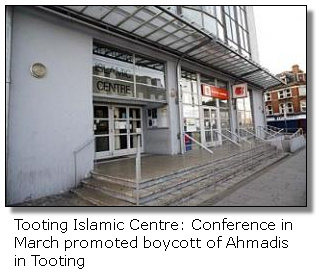
The evidence pointed specifically to the Tooting Islamic Centre, where its imam, Suliman Gani, had invited hardline clerics in March 2010 to speak about the danger of the Ahmadiyya Muslim religion spreading in the face of mainstream.

The clerics included Abdur Rehman Bawa from the Khatme Nabuwwat, a organisation will claims to “provide awareness” about the Ahmadiyya religion. At the conference, Mr Bawa urged worshippers not to do business with Ahmadis.


Following that conference, Mr Gani admitted he had pleaded with a halal meat shop owner not to sell his business to an Ahmadi because he believed Ahmadis could not be trusted to sell legitimate halal meat.

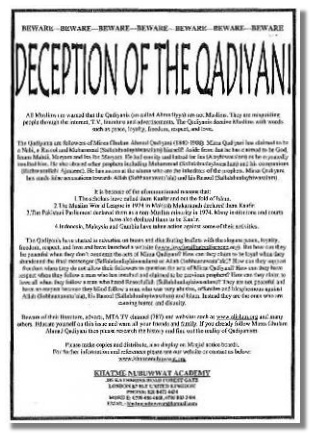
There were also leaflets entitled “Deception of the Qadiani” found in Tooting and an Ahmadi butcher won an employment tribunal case in which he was found to have been sacked because he would not renounce his religion.

The Crown Prosecution Service came under criticism from Parliament’s Human Rights Group for not prosecuting the allegations under hate crime laws and its vice-chairman, Eric Lord Avebury, likened the evidence to “the beginnings of the Holocaust”.

Reflecting on the last year, the Wandsworth police officer who investigated the case said he had not received any new allegations about anti-Ahmadiyya material being displayed or distributed in Tooting or elsewhere.

Chief Inspector Tim Harding said: “We continue to maintain good communications with all our Islamic communities and we urge them to inform us of any issues that causes them concern and our local safer neighbourhood teams provides day to day contact with them.

“Previous allegations and investigations have not identified evidence that may lead to any potential arrest of suspects.”

Sadiq Khan: “Pleased we have moved on”

Tooting’s MP, Sadiq Khan, also came under criticism from his political rivals after they were threatened with violence during last year’s general election campaign.

Mr Khan won the seat with a small majority of 2,524 after fierce opposition from Conservative candidate Mark Clarke, but it was Liberal Democrat candidate Nasser Butt – an Ahmadi – whose presence at the Tooting Islamic Centre angered hardliners.

On April 14, 2010, the hustings turned into a dangerous farce when Mr Clarke, who is mixed-race, had to be locked into a room for his own safety after he was mistaken for Mr Butt by thugs.

Mr Butt, who was due to arrive, was quickly told by telephone to stay away for his own safety.

Mr Khan, who denied any knowledge of his rivals being threatened, expressed his disappointment at discrimination happened at a mosque in which he is a regular worshipper.

This week Mr Khan, who is also Labour’s shadow justice secretary, said: “A year ago, like many local residents I was both surprised and disappointed to learn of the growing tensions within our community, as Tooting is well known for its tolerance and respect.

“I am pleased that we have moved on and hope that this period is now well and truly behind us. All local residents should feel safe in our community. We have a duty to each other to remain vigilant.”

Naseer Dean, Naseer Dean, President of the Ahmadiyya Muslim Association of London, said: “We wish to thank the local Guardian for championing and safeguarding the rights of all.

“This is the best of British reporting epitomising the British values of fairness and justice for all.

“We are grateful to the Wimbledon Guardian and Wandsworth Guardian for highlighting the plight of Ahmadi Muslims who are persecuted around the World.

“The articles highlighted the dangers facing us and others who live peacefully in the UK, but a lot more needs to be done by others to stamp out extremism in the UK.”

Copyright 2001-2011 Wimbledon Guardian, UK. All rights reserved.
URL: www.wimbledonguardian.co.uk/news/9306389..hate/

Saturday, December 25, 2010

What about Jinnah’s Pakistan?

Dawn.com Blog
What about Jinnah’s Pakistan?
by Murtaza Razvi on 12 25th, 2010 |

Qaid-e-Azam, Muhammad Ali JinnahSome random thoughts come to mind this Christmas, a day that also happens to be Mr. Jinnah’s birthday.

If it were the year 1947, would the advisor to the chief minister, Sindh, Ms. Sharmila Faruqui have rushed to the police station in Clifton as she did last Monday to meet a rape victim only to cast aspersions on the victim’s complaint that she was kidnapped and raped by her assailants? Ms. Faruqui not only disclosed the identity of the rape victim to the media but also implied that she was not quite convinced of the victim’s account of the assault; that she found her to be “hyper and rude”, within hours of the rape; and that the victim and her female friend, who was also beaten up badly, were coming from a party late at night. What does the advisor to the CM actually think? That it’s OK to rape a girl who parties? Who gave Ms. Faruqui the right to cast aspersions on the victim’s story even before the police began to investigate?

Then, just who is Ms. Faruqui to judge the veracity of the wronged woman’s claim, whose medical reports proved that indeed a gang-rape had been committed? Does Ms. Faruqui not know that rape is a heinous crime in any civilised society, regardless of the profession of the victim, whether she is a prostitute or a submissive, God-fearing woman, and that a rapist is a rapist even if he happens to be the husband of the victim?

While the whole episode is outrageous, yet another outrage brews elsewhere in the land of the pure, with a victim who is twice disadvantaged – being a woman and that too from a minority community. Aasia Bibi as the latest blasphemy accused, a poor Christian woman from a village in Punjab who’s on death row in a Lahore prison. Would the mullahs of all hues, Barelvi, Debandi, Ahl-i-Hadis, Shia and what have you, who are now demanding her death have been able to rally for their ‘cause’ at the birth of Pakistan?

Remember how they had stood discredited in the public eye on the eve of the creation of Pakistan, which they had opposed, as Jinnah unequivocally charged the Constituent Assembly at Karachi with framing a constitution for his country, declaring that “Religion will have nothing to do with the business of the state”?

Then, are Ahmadis free to assemble and worship in Pakistan today? Jinnah would be turning in his grave if he knew that we created a minority out of a community that was Muslim in his Pakistan up until 1974. The entire Ahmadi population of the city of Rabwah in Punjab, with a population of 70,000, has a gagging order against them to assemble and pray as they wish, in a country where Jinnah had assured all that they were free to go to their “mosques… temples and any other place of worship”.

If there was a Pakistan Ideology, it was given to the Constituent Assembly of Pakistan by Jinnah himself on the eve of independence, that is why he had to die before a new Objectives Resolution could be passed by his deputies in the same assembly in 1949.

This was the starting point of introducing religion into the business of the state, and upon which Z.A. Bhutto and General Ziaul Haq built the entire edifice of their controversial process of Islamisation, with the result that today Islam itself has become controversial, with Sufi shrines and mosques of rival sects being bombed by the puritans, and innocent citizens being killed because they are not Muslim enough. It was about such people that Jinnah had said: “[Pakistan] will not be a country ruled by mullahs with a divine mission;” and that, “The British parliamentary system should be the model before us.” Both the ideals have since been severely compromised.

Jinnah’s Pakistan was as much in the name of Islam as the independent state of Bosnia in our own times. Pakistan was created for the welfare of the Muslim-majority provinces of British India just as Bosnia was created for safeguarding the interests of the Muslim majority of that region of the former Yugoslavia. Following partition of India, Indian Muslims were advised by the Quaid to remain loyal to their country; it is they who have heeded Jinnah’s call while we in Pakistan have created our own distortions and deviations from his ideals.

Here in a nutshell is a very secular rationale for the creation of Pakistan: Muslims of the even Muslim-majority provinces of a united India, in the face of the denial of any affirmative action in their favour by Congress in 1947, could not have been able to safeguard their socioeconomic interests. Non-Muslims were better qualified to take up most jobs and lucrative vocations, which in their absence fell to Muslims in what we call Pakistan today.

The Quaid was more than willing to keep India in one piece provided he was able to extract an affirmative action plan in favour of the very backward Muslims at the time of independence; this means that even before Pakistan became a reality on the map, Mr. Jinnah had revisited and reviewed his Two-Nation Theory. Never was he to invoke it again even to unite East and West Pakistan, which saw the language riots in Dhaka right at the outset.

The leader and the lawyer Jinnah understood well the distinction between creating a country for disadvantaged Muslims or one in the name of Islam. That fine line was later blurred by his deputies after his death and it was removed altogether by ambitious politicians and military dictators to perpetuate their own rule.

In Jinnah’s Pakistan, we would have been saved many a Ms. Faruqui in the government; instead, an Aasia Bibi, on the back of ballot, could have become the head of state without endangering Islam or trading off nuclear secrets. These two feats today are the exclusive privileges of Pakistani Muslims alone.

Murtaza Razvi is the Editor, Magazines, at Dawn.

©2010 DAWN Media Group. All rights reserved
URL: http://blog.dawn.com/2010/12/25/what-about-jinnah%E2%80%99s-pakistan/

Thursday, December 23, 2010

“Historic” meeting between Ahmadiyya Community and Tooting Islamic Centre ends in silence

Wimbledon Guardian, UK
News
“Historic” meeting between Ahmadiyya Community and Tooting Islamic Centre ends in silence
4:00pm Thursday 23rd December 2010
By Omar Oakes »

Sadiq Khan MP: Joint statement of TIC and Ahmadis will reflect 'goodwill and postivity' at meeting
Sadiq Khan MP: Joint statement of TIC and Ahmadis will reflect “goodwill and postivity” at meeting
Ten days after what was billed as a “historic” meeting to rebuild community relations damaged by a hate campaign against a minority Islamic sect the main participants seem unable to agree what, if anything, it has achieved.

In October, the Wimbledon Guardian and the Wandsworth Guardian revealed evidence of a hate campaign against the Morden-based Ahmadis, an Islamic minority sect considered non-Muslim by many mainstream Muslims.

Our investigation focused on Tooting and the Tooting Islamic Centre (TIC) in Upper Tooting Road, where an anti-Ahmadi conference was held in March in which worshippers were told to boycott Ahmadi-run shops.

After that conference, Ahmadi-run shops complained of a sharp loss of trade and anti-Ahmadi leaflets have been found on display in a Tooting cosmetics shops and on the main noticeboard of the Tooting Islamic Centre.

Following our investigation, a meeting, organised by Tooting MP Sadiq Khan, was held at Wandsworth Town Hall on Monday, December 13 to discuss the Ahmadis’ concerns.

It was attended by Mr Khan, Wandsworth police borough commander David Musker, Wandsworth Council Leader Edward Lister, four representatives from the TIC and nine representatives from the Ahmadiyya Muslim Association (AMA).

A joint statement was due to be issued last week on behalf of the TIC and the AMA, but so far no statement has been agreed and no further meetings have been planned.

This newspaper was denied access to the meeting and the participants are remaining tight lipped on the outcome - billed by Tooting MP Sadiq Khan as a “historic” chance for the TIC and AMA to clear the air.

In an interview last month Mr Khan said he did not know about the anti-Ahmadi campaign until told by this newspaper in October.

At the time he said he was pleased to “organise this historic first meeting”.

But yesterday his only comment was to issue a two line statement saying: “It was agreed the management of TIC and the Ahmadiyya community leaders would try and agree a joint statement, and I am hopeful this will reflect the goodwill and positivity that was evident from all sides during the meeting.”

Kingston police were investigating allegations of hate crimes after a leaflet was allegedly distributed in Kingston town centre.

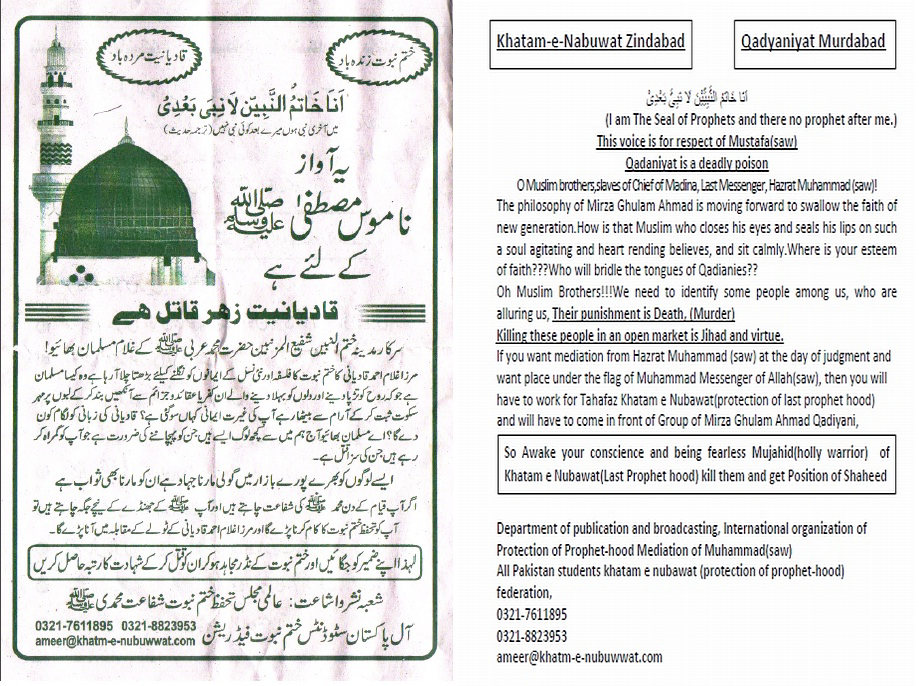
A teenage Ahmadi girl, who did not want to be named, gave police a statement claiming the leaflet, which she said was written in Urdu, said: “Kill a Qadiyani [Ahmadiyya] and doors to heaven will be open to you”.

Kingston police later said it had never been handed the leaflet and has not received any other allegations.

Copyright 2001-2010 Wimbledon Guardian, UK. All rights reserved.
URL: www.wimbledonguardian.co.uk/news...c_Centre_ends_in_silence/

Monday, December 6, 2010

CPS criticised for not prosecuting alleged Ahmadiyya Muslim hate crimes in Tooting

Wimbledon Guardian, UK
News
CPS criticised for not prosecuting alleged Ahmadiyya Muslim hate crimes in Tooting
2:30pm Monday 6th December 2010
By Omar Oakes »

'Not effective': Lord Eric Avebury on religious hatred laws
“Not effective”: Lord Eric Avebury on religious hatred laws
A leading human rights expert has called for a change in hate laws after the Crown Prosecution Service (CPS) decided not to bring charges over alleged hate crimes against a Morden-based religious group.

Lord Eric Avebury, vice-chairman of the Government’s Parliamentary Human Rights Group, also called for an investigation into why the CPS had only brought one case against incitement to religious hatred since the law came into being four years ago.

In October, the Wimbledon Guardian exclusively revealed evidence of hate speeches, leaflets, and boycotts against members of the Ahmadiyya community, an Islamic minority sect.

Evidence included video footage from a conference at the Tooting Islamic Centre (TIC), in which scholars called for a boycott of Ahmadi-run businesses and urged attendees not to associate with Ahmadis.

Last month, the Crown prosecutor for Wandsworth, Hilary Ryan, said the allegations fell short of being criminally actionable.

Lord Avebury, an 82-year-old Liberal Democrat peer, said the threshold for prosecution was too high.

He said: “I believe the law on incitement to religious hatred has not been effective, partly because the prosecution has to prove not only that the accused did incite, but that he intended to do so.

“At any rate, there has been only one case brought since the law was enacted, over a four-year period when incitement was becoming more prevalent.

“The reasons for this inactivity by the CPS need to be investigated.”

A CPS spokesman said: “A CPS London prosecutor gave initial advice that the material submitted could not constitute an offence.

“If the police ask for a full review of the material, the file will be passed to the central casework divisions.

“A full review is always carried out by prosecutors who specialise in racial and religious hatred offences and after careful consideration of a number of cases since this legislation was introduced, there has only been one case that reached the threshold for prosecution.”

A spokesman for the Ahmadiyya Muslim Association (AMA), which is based at the Bait-ul-Futuh mosque in London Road, said it was seeking independent legal advice before thinking about pursing a judicial review of the claims.

Tooting’s MP Sadiq Khan has arranged for a meeting between senior memebrs of the AMA and TIC on Monday, December 13..

Copyright 2001-2010 Wimbledon Guardian, UK. All rights reserved.

Saturday, December 4, 2010

Lord: Hate laws are not effective enough

Kingston Guardian, UK
News
Lord: Hate laws are not effective enough
11:40am Saturday 4th December 2010
Lord Avesbury has called for an investigation into why the CPS had only brought one case against incitement to religious hatred since the law came into being four years ago
A human rights lawyer has called for a change in the law after no charges were brought over alleged hate crimes stemming from a leaflet handed out in Kingston.

Kingston police launched an investigation into suspected hate crime against an Islamic minority sect after leaflets were allegedly distributed in the town centre on July 6.

A teenage Ahmadi girl, who did not want to be named, gave them a statement claiming the leaflet, which was written in Urdu, said: “Kill a Qadiyani [Ahmadiyya] and doors to heaven will be open to you”.

But Kingston police later said it had never been handed the leaflet and had not received any other allegations.

The incident led to complaints of hate speeches, leaflets, and boycotts against members of the Ahmadiyya community, an Islamic minority sect, across south west London.

Evidence included video footage from a conference at the Tooting Islamic Centre (TIC), in which scholars called for a boycott of Ahmadi-run businesses and urged attendees not to associate with Ahmadis.

Last month, the Crown prosecutor for Wandsworth, Hilary Ryan, said the allegations fell short of being criminally actionable.

Lord Eric Avebury, an 82-year-old Liberal Democrat peer, said the threshold for prosecution was too high.

Lord Avebury, vice-chairman of the Government’s Parliamentary Human Rights Group, also called for an investigation into why the CPS had only brought one case against incitement to religious hatred since the law came into being four years ago.

He said: “I believe the law on incitement to religious hatred has not been effective, partly because the prosecution has to prove not only that the accused did incite, but that he intended to do so.

“At any rate, there has been only one case brought since the law was enacted, over a four-year period when incitement was becoming more prevalent.

“The reasons for this inactivity by the CPS need to be investigated.”

A CPS spokesman said: “A CPS London prosecutor gave initial advice that the material submitted could not constitute an offence.

“If the police ask for a full review of the material, the file will be passed to the central casework divisions.”

A spokesman for the Ahmadiyya community, which is based at the Bait-ul-Fatah mosque in London Road, said it was seeking independent legal advice before thinking about pursuing a judicial review of the claims.

Copyright 2001-2010 Kingston Guardian, UK. All rights reserved.

Friday, November 26, 2010

An instrument of abuse?

Dawn.com Blog
An instrument of abuse?
by ANNIE on 11 26th, 2010 |

ProtestersThe death sentence handed down to Pakistani Christian woman Aasia Bibi by a court in Punjab province’s Nankana district has once again brought attention to Pakistan’s blasphemy laws. And while the 45-year-old mother of five awaits a review of the verdict against her, questions are being raised regarding the intent behind and utility of the said laws.

While the Constitution of Pakistan criminalises “deliberate and malicious acts intended to outrage” the religious sentiments of “any” community, the blasphemy laws, in the form of additions to Sections 295 and 298 of the Pakistan Penal Code (PPC), proceed to recommend much more exacting penalties, including death, if the accused is found to be either disrespectful toward or critical of the Quran, Prophet Mohammad, Islam’s caliphs and other important figures mentioned in the statutes. These particular laws therefore do not stand up for religions other than Islam thereby rendering defenceless other religious communities. Moreover, the laws’ provisions pertaining to the Ahmedi community in many ways constrain them from practicing their religion. Forbidden from calling themselves, or “posing” as, Muslims, the legislation makes abundantly clear, albeit circuitously, that their faith should not be what it is.

It was in the early 1980s and during the regime of former military dictator Ziaul Haq that committing blasphemy was made a penal offence under the PPC. In its current state, the law prescribes a jail term for anyone found disrespectful toward the Quran and death penalty for anyone found to be reproachful of Prophet Mohammad. Oddly enough, while the question of intent is not considered when it comes to the latter offence, it continues to remain punishable by nothing short of the death penalty. The blasphemy laws also prescribe a fine and a prison term with regard to penal offences associated with the Ahmedi community.

Having survived for nearly three decades in its current and extreme form, the blasphemy laws have so far escaped all reform due to opposition from religio-political groups. At the same time, other, essentially secular, political groups have been succumbing to these hardline forces mostly out of fear of losing clout in regions with conservative leanings and where religious organisations seem to enjoy a considerable degree of influence. Even at this point, with the international community ramping up pressure on the government to pardon Aasia and to eventually repeal the blasphemy laws, certain otherwise antagonistic clerics from the Barelvi and Deobandi schools of thought have come together to caution President Asif Ali Zardari over going ahead with the pardon saying the move may lead to “untoward repercussions”.

While the sentencing of Aasia has led to much international uproar, hers is just one of the many cases which have led to blasphemy convictions by the courts. Moreover, many of the blasphemy accused – mostly from the unprotected religious minority groups – have been targeted and sometimes killed by lynch mobs. The still recent killing of two Christian brothers in Faisalabad, the case of Zaibunnisa who remained incarcerated for 14 long years on blasphemy allegations and the violence that targeted Christians in Gojra in 2009 are just some of the recently reported instances which clearly depict how such laws have effectively abandoned the country’s religious minorities and emboldened extremists.

These and similar other incidents have inevitably led to questions pertaining to the rationale behind the laws as well as to their outcome in terms of greater social good. And while the laws are frequently used to blackmail and victimise Pakistan’s miniscule religious minorities, they also come in handy by those wanting to settle personal scores, sort business rivalries and tackle land disputes with other Muslims. Rights groups have continually demanded that the laws be repealed and have referred to the statutes as fundamentally unjust and discriminatory in nature.

Moreover, legal experts and analysts have frequently termed the text of the laws as vague and even flawed in ways that make it a ready instrument of abuse. Incompatible with the universally accepted human rights charter, the laws and their application also stand in clear violation of the Constitution of Pakistan which guarantees every citizen the “right to profess, practice and propagate” his/her religion and in fact forbids the state from making “any law which takes away” the citizens’ fundamental rights.

Given the fact that the blasphemy laws have only served to fuel disharmony and strife in society, a thorough review of the legislation, followed by significant changes to it, can be the first small step toward countering the culture of exploitation that has become all-too-synonymous with these laws.

Qurat ul ain Siddiqui is the Desk Editor at Dawn.com

©2010 DAWN Media Group. All rights reserved

Wednesday, November 3, 2010

Mosque linked to hate campaign causes rift in Muslim community

Streatham Guardian, UK
News
Mosque linked to hate campaign causes rift in Muslim community
7:20am Wednesday 3rd November 2010
By Matt Watts »
A mosque has been linked to a hate campaign causing a dangerous rift in south London’s Muslim community.

Evidence shows Ahmadiyya Muslims are being demonised and ostracised by UK Islamic fundamentalist group Khatme Nabuwat, whose hardline clerics have been preaching in south London mosques.

The alleged campaign has seen Ahmadi residents, businessmen and politicians targeted, including inflammatory leaflets being distributed in south London encouraging violence against “Qadiyanis” – a derogatory term for Ahmadis.

The rift has stemmed from some Muslims not accepting members of the Ahmadi community as fellow Muslims.

Ahmadis differ from mainstream Islam in that they state the second coming of the messiah has already happened and is embodied by their founder, Mirza Ghulam Ahmad.

South London Ahmadis – who built what is believed to be the biggest mosque in western Europe, based in Morden – say their beliefs have made them victims of a hate campaign.

Now Streatham’s mosque has been dragged into the debate after a poster seen on the noticeboard of the South London Islamic Centre in Mitcham Lane stated the meat sold by an Ahmadi-run butcher in Tooting, Lahore Halal, was not halal.

Mumtaz Malik, the mosque’s Iman, said the poster was put up by a member of the Somali community to inform Muslims of the change of ownership of the supermarket to an Ahmadi.

He said as part of Islamic teachings, Muslims are advised to buy their meat from fellow Muslims.

He said the ownership of the shop by a “non-Muslim” raised questions about whether the meat sold was still halal, despite there being no evidence it was not.

But the Ahmadi shopkeeper who owns Lahore Halal, has told the Streatham Guardian “through religious discrimination and harassment” his business had suffered both reputationally and financially, with takings being cut by up to 50 per cent.

An Ahmadi supermarket worker across the street won an employment tribunal against his former boss last month for wrongful dismissal after he had pressure put on him to convert to the Sunni Muslim faith.

Lambeth police promised to talk to Streatham mosque about the poster, while Wandsworth police are investigating wider allegations in the Tooting community of inciting religious hatred against Ahmadis.

Copyright 2001-2010 Wimbledon Guardian, UK. All rights reserved.

Thursday, October 21, 2010

Hardliners call for deaths of Surrey Muslims

The Independent, UKUK
Hardliners call for deaths of Surrey Muslims
Thursday, 21 October 2010 By Jerome Taylor, Religious Affairs Correspondent

Islamic extremists have started openly calling for the destruction of a controversial Muslim sect in a major escalation of sectarian conflict within British Islam, an investigation by The Independent has revealed.

Members of the Ahmadiyya Community have seen a significant upsurge in threats and intimidation over the past four months, sparked by an extremist attack on two of their largest mosques in Pakistan earlier this year.

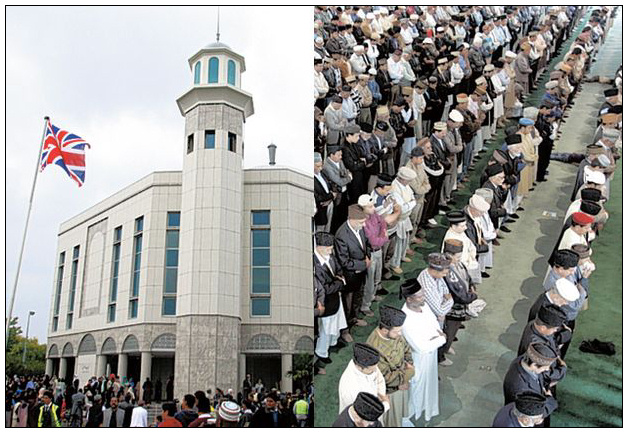
The Ahmadiyya Muslim community during Friday prayers at Baitul Futuh Mosque in Morden, London.

Hardline Islamists in Britain have been distributing leaflets calling for the murder of AhmadiMuslims in Kingston-upon-Thames whilst mosques have been vandalised in Newham and Crawley. Preachers in south London have also been orchestrating a boycott of Ahmadi businesses and Ofcom has had to reprimand an Islamic satellite channel for repeatedly calling the sect “Wajib-ul Qatal” - an Arabic phrase used to describe those who digress from mainstream Islam that translates as “liable for death”.

Community leaders say the upsurge in animosity towards Ahmadis is directly linked to violence in Pakistan where local Taliban militants have declared war on sects that they deem to be heretical such as the Ahmadis and the Shi’a.

Although the Ahmadis have been targeted by extremists in the past, the combined attacks on two mosques in Lahore in May was the most brazen assault on their community yet, with 93 worshippers killed as they gathered for Friday prayers, including a number of Britons.

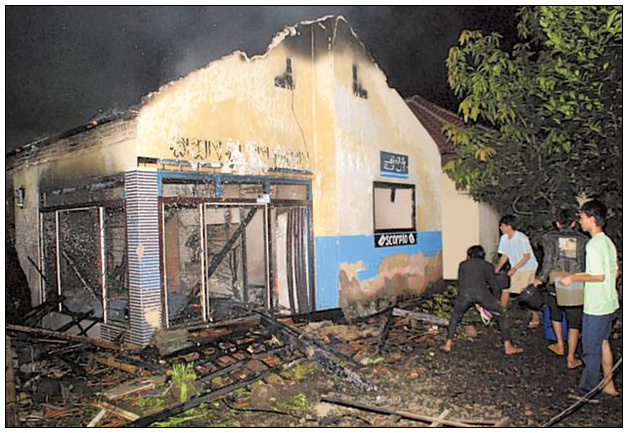
Followers of the Ahmadiyya sect in Ciampea examine their burnt-out mosque in Indonesia's West Java province earlier this month. Many Muslims in Indonesia regard Ahmadiyyah as a heretical sect and have called for it to be suppressed.

Since the mid 1980s the Ahmadi community has been headquartered in Morden, south London, after their leaders were forced to flee Pakistan, the only country in the world that legally forbids them from declaring themselves Muslims. They claim to have 70 million adherents worldwide although detractors say the number is closer to two million. An estimated 15,000 live in Britain including their spiritual leader Hadhrat Mirza Masroor Ahmad.

The Ahmadi leadership had hoped the attacks in Lahore would prompt an outpouring of sympathy among British Muslims. Instead, they say, it has emboldened a minority of extremists to openly target them in an upsurge in intimidation.

Rafiq Hayat, national president of the Ahmadiyya Muslim Community UK, told The Independent: “Through leaflet distribution, posting of hate material on websites and via programmes on satellite TV (often in Urdu and other south Asian languages) our community is being made a target of hatred and hostility by preachers of hate. The perpetrators of this act are Muslims and whilst they are certainly not representative of the vast majority of Muslims in this country, they are creating hatred in society.”

Police in Kingston-upon-Thames have opened a hate crime investigation earlier this summer when an Ahmadi woman was handed a leaflet by a man which stated: “Kill [an Ahmadi] and the doors to heaven will be open for you.” In Tooting, meanwhile, some mainstream Sunni preachers have urged follower to boycotts Ahmadi businesses.

To many orthodox Muslims, the Ahmadis are considered heretical because they believe that their 19th century founder was none other than the Mahdi - Islam’s equivalent of the messiah - and the successor to the Prophet Mohamed.

Islamic satellite channels, a rapidly expanding but largely unregulated section of the broadcast media, have played an instrumental role in recent anti-Ahmadiyya campaigning. This week Ofcom criticised the Ummah Channel for a string of three programmes broadcast shortly before and after the Lahore massacre in which clerics and callers alike said Ahmadis should be killed.

In one programme “Seal of the Prophethood” a cleric declared: Until now, whenever one has claimed to be a prophet the Muslim nation has issued fatwa that he should be killed. It is only that at present Muslims are weak and they do not have the power to slice such a man in two parts.”

On 21 May the Ummah Channel broadcast a in which Islamic scholars debated the status of Ahmadis within Islam.

When a caller named Asim asked for a scholar to explain whether Ahmadis were legitimate Muslims the imam replied: “Since the time of the Holy Prophet (peace be upon him) the Sahiba [knowledgeable scholars] have confirmed that anyone who believes in a prophet after the Holy Prophet is a kafir [unbeliever], murtad [apostate] and Wajib-ul Qatal [liable for death].“

He later added: “Until now, whoever has claimed prophethood, the Muslim Ummah has issued the fatwa for them to be killed. And all these false prophets have always been killed. It is only now that Muslims have become weak and they do not have the strength that they should cut such people into two.”

Ahmadis were also frequently referred to as “filth” who should be avoided by mainstream Muslims.

Ofcom ruled that the Ummah Channel breached broadcasting regulations with its “abusive treatment of the religious views and beliefs of members of the Ahmadiyya community”.

A representative of Ummah Channel said the station has now broadcast apologies for the programmes. “The Ummah Channel would like to express their sincere apologies for any offence caused,” the spokesperson said. “It was never the intention of the Ummah Channel to support or condone these opinions that were delivered by independent scholars during ‘live’ phone in shows.”

The Ahmadis say that doctrinal opposition towards their community is being spearheaded by Khatme Nubawwat Academy, a British offshoot of a Pakistani group that is dedicated to confronting Ahmadi beliefs.

The group, whose name translates to “The Finality of the Prophet”, has close connections to the Pakistani establishment and met Pakistan’s high commissioner in the UK earlier this summer.

They also held a conference in Newham on 18th June in which one of their speakers claimed that the attacks on the two mosques on Lahore were an Ahmadi conspiracy.

Imam Suhail Bawa, a leading Khatme Nubbawat preacher, told worshippers: “This will become apparent very soon to you all that Qadiani [a derogatory term for Ahmadis] themselves are behind this whole conspiracy. [They] are responsible for whatever has happened in Lahore. This is all Qadiani conspiracy. They now come to television programs to try to “falsely” demonstrate their victimisation.”

He then went on to warn that any attempt to try and change laws in Pakistan which forbid Ahmadis from calling themselves Muslims would be met with violence on a similar scale to a previous massacre of Ahmadis in 1953 in Lahore.

“If the anti-Qadiani laws or the blasphemy laws are touched by anyone in Pakistan,” Imam Bawa said, “then the 1953 Lahore agitation against the Qadianis will be repeated in the streets once more. The streets and roads of Lahore were filled with blood in that agitation.”

Khatme Nubbawat preachers have also given anti-Ahmadi speeches in Tooting Islamic Centre.

On the website for the group’s east London offices in Forest Gate, Ahmadis are described as “nothing but a gang of traitors, apostates and infidels”. The term Wajib-ul Qatal is not used although their preachers in Pakistan often use the term.

Akber Choudhry, a spokesperson for the Khatme Nubawwat Academy, said: “[We are] an independent UK organisation that is loosely affiliated with other such organisations around the world, and one of their major goals is to counter Qadiani (Ahmadiyya) propaganda within the laws of the jurisdiction in which each such organisation is based. We condemn all atrocities being committed in Pakistan and it is our wish and desire that Pakistan be free from all war, foreign intervention and attacks on civilians.”

Asked whether he thought it was acceptable to describe a religious group as a “gang of traitors, apostates and infidels” Mr Choudhry replied: “The words ‘apostates’ and ‘infidels’ are understood differently in English than in their Islamic theological sense, especially within the Urdu-speaking Muslims, and can be replaced by terms more sensitive to the current climate in which the connotations of these words have changed quite rapidly in the past few years.”

But Mr Hayat said he believed groups like Khatme Nubawwat create an atmosphere that encourages ordinary Muslims to be hostile towards Ahmadis.

“Freedom of speech is one thing, but incitement of hatred is another matter altogether,” he said. “We appeal to the authorities to nip this in the bud; otherwise this campaign of hatred against Ahmadi Muslims today will tomorrow grow into a threat against other moderate Muslims and indeed the wider society.”

© independent.co.uk
URL: www.independent.co.uk/news/uk/home-news/hardliners-call-for-deaths-of-surrey-muslims-2112268.html

Thursday, October 14, 2010

Worshippers told at Tooting Islamic Centre to boycott Ahmadiyya shops

Wimbledon Guardian, UK
News
Ahmadiyya Investigation
Worshippers told at Tooting Islamic Centre to boycott Ahmadiyya shops
1:20pm Thursday 14th October 2010
Exclusive By Omar Oakes »
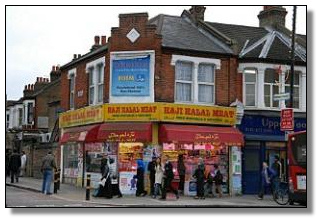
Haji Halal Meat: Sacked Ahmadi employee who 'would not convert'
Boycott plea: Leaflet written in Somali found in
Streatham mosque
Ahmadi shopkeepers face financial ruin after clerics demanded a boycott of their shops.

Imam Suliman Gani, of the TIC, admitted he personally pleaded with the owner of the Lahore Halal Meat in Tooting not to sell his business to an Ahmadi man.

He said: “Since the Qadianis are routinely deceptive about their religion, there was a potential risk of Muslims being offered meat that wasn’t necessarily halal.

“Can you imagine the uproar in the Jewish community if it was found that a shop selling purportedly kosher food was not doing so?

“If there is any deception involved in the provision of halal meat, naturally, we will prefer to err on the side of caution.”

Imam Suliman Gani: Pleaded with Tooting businessman
Mr Gani offered no evidence to support claims the meat might be non-halal and later admitted if the meat came from the same supplier as before [which it did] “there would be no issue”.

One leaflet, the origin of which is not known but was posted on the wall of the Streatham Mosque, called for a boycott on Lahore Halal.

Another Ahmadi butcher, who came to London in 2001 after fleeing Pakistan, won an employment tribunal last month after being sacked in March.

Employment Judge Baron accepted Azizur Rahman, owner of Haji Halal Meat in Upper Tooting Road, pressured his employee to convert to the Sunni Muslim faith.

The tribunal heard: “Mr Rahman said he had been told that if he continued to employ the claimant then his customers would cease to patronise him.

“Mr Rahman referred specifically to pressure being placed on him by the head of the Sunni sect who had helped Mr Rahman to gain admission for his daughters to single sex school for girls.”

Mr Rahman claimed he had been influenced by a conference held by KN at the TIC on March 28, where worshippers were ordered to boycott Ahmadi-run shops.

During that conference Mr Gani shared a stage with KN Abdul Rehman Bawa. Mr Bawa said: “I don’t know why our sisters or mothers are talking with these Qadiani and making friendships … I know in this road, Tooting high street, all of the shops who are selling to Qadiani.

“Don’t make friends with them… they are trying to deceive you, they are trying to convert you from Islam to Qadianism.”

The owner of one Tooting halal butchers said his trade had fallen by nearly 50 per cent in three months. He said: “We have lost so much business because some people refuse to come here just because I am Ahmadi. They use words against me like ‘Kafir’, which means I am not Muslim.

“I’ve lived here for 13 years and lots of people know me in Tooting, but this situation has become so much worse now.”

A Wandsworth police spokesman said an investigation into the alleged hate crimes was ongoing.

Copyright 2001-2010 Wimbledon Guardian, UK. All rights reserved.

Tooting election race infected by anti-Ahmadiyya hate campaign

Wimbledon Guardian, UK
News
Ahmadiyya Investigation
Tooting election race infected by anti-Ahmadiyya hate campaign
1:10pm Thursday 14th October 2010
Exclusive By Omar Oakes »
Threatened: Tory candidate Mark Clarke 'mistaken for Ahmadi'Ahmadi: Lib Dem candidate Nasser Butt told not to come to hustingsRe-elected: Sadiq Khan MP won with slim majority
Hatred and threats towards the Ahmadiyya community even infected the general election race in Tooting.

Since being re-elected in May with a slim majority of 2,524 after fierce opposition from Conservative candidate Mark Clarke, Sadiq Khan has gone on to become Shadow Justice Secretary.

But Nasser Butt, who stood against him for the Liberal Democrats and is an Ahmadi, spoke out about a campaign to prevent him being elected because of his religion.

An election hustings at the Tooting Islamic Centre (TIC) on April 14 turned into a dangerous farce after hardliners shut down proceedings.

After arriving at the TIC, mixed-race Tory candidate Mark Clarke had to be locked into a room for his own safety after he was mistaken for Mr Butt by fundametalists.

Mr Clarke’s election agent, Andre Walker, said: “We had to be locked in a room for our own security. The mosque committee were embarrassed by it and it was tense for a while…it was clear Nasser’s arrival would have been dangerous and a real problem. There was anger an Ahmadi was running.”

During the incident, Mr Butt said he received a phone call from a committee member who told him it would be best if he did not come to speak as had been arranged.

It has also emerged worshippers were given precise orders at the TIC to urge Muslims not to vote for Ahmadi candidates.

A secret recording of a meeting at the TIC, two days before polling day on May 3, revealed Imam Suliman addressed the meeting alongside Harris Bokhani, speaker from an unknown organisation.

Mr Bokhani is heard to tell the audience: “The majority of Muslims in this area are voting Lib Dem, because they think Nasser Butt is a Muslim.

“If you don’t go in and speak to them, they’re not going to do it. They’re fed up of hearing it from the imams. They want to hear it from you. They need to you go into the community and say ‘Why are you supporting the Qadiani community?’”

Mr Khan told this paper last week he was not aware of the incident until days later and did not know about the pair being locked in a room.

He rejected claims the Muslim vote played an important role in his re-election, claiming he had support from faith leaders across the religious spectrum.

He said: “It’s really important everyone in the community gets along. One of the hallmarks of Tooting is that people with different rules and religions have got along so well for so long.

“If there’s any section of our community that feels vulnerable or discriminated against, there’s a responsibility on the rest of us to reach out and ensure this doesn’t happen.

“There are theological differences but we shouldn’t just tolerate each other, we should respect each other.

“My job as MP is to represent everyone in the community, irrespective of the size of the community and religious beliefs.”

TIC Imam Suliman Gani told us this week: “We never recommend any political candidate on religious grounds.

“Like all organisations, we only recommend political candidates based on how their stated policies affect our community.

“The Ahmadiyya community has been actively distributing leaflets claiming they are the only Muslims who love peace and harmony and thereby maligning the vast Muslim community.

“So, as an example, unless an Ahmadi candidate renounced such maligning of Muslims by the community he belongs to, we would not recommend him as he/she would be antithetical to the perception of our peace-loving community in such delicate times.”

Copyright 2001-2010 Wimbledon Guardian, UK. All rights reserved.

Relgious hate leaflets found in Tooting, Streatham and Kingston

Wimbledon Guardian, UK
News
Ahmadiyya Investigation
Relgious hate leaflets found in Tooting, Streatham and Kingston
1:20pm Thursday 14th October 2010
Exclusive By Omar Oakes »
Hate Leafllet: Khatme Nabuwwat warns muslims to beware
Hate Leafllet: Khatme Nabuwwat warns
muslims to beware
Inflammatory leaflets have been distributed across south London as part of a targeted ideological campaign against the Ahmadiyya community.

Some of the literature is produced by anti-Ahmadi group KN, whose spokesmen delivered speeches at the TIC in Tooting, Streatham mosque and the Kingston mosque.

One KN leaflet, Deception of the Qadiyani, was recently displayed in the window of the Sabina Hair and Cosmetic shop in Mitcham Road, Tooting.

When we confronted staff to ask why they had put up these leaflets, a worker said: “These people are not Muslims. I did it myself.

Boycott plea: Leaflet written in Somali found in Streatham mosque
Boycott plea: Leaflet written in Somali
found in Streatham mosque
“They don’t believe that prophet Mohammed is the last prophet.”

In August, Kingston police launched an investigation into suspected Ahmadi hate crime after leaflets were allegedly distributed in Kingston on July 6.

Kingston police confirmed a teenage Ahmadi girl, who did not want to be named, gave them a statement claiming the leaflet, which was written in Urdu, said: “Kill a Qadiyani and doors to heaven will be open to you”.

Police said they were appealing for information, but were not in possession of the leaflet, which was allegedly handed to the girl outside the Bentall Centre in Kingston town centre.

Copyright 2001-2010 Wimbledon Guardian, UK. All rights reserved.

Hate campaign discovered against south London Ahmadiyya Islamic minority

Wimbledon Guardian, UK
News
Ahmadiyya Investigation
Hate campaign discovered against south London Ahmadiyya Islamic minority
1:20pm Thursday 14th October 2010
Exclusive By Omar Oakes »
An international hate campaign by Islamic fundamentalists against a minority sect has spread to Britain and is causing a dangerous rift in south London’s Muslim community.

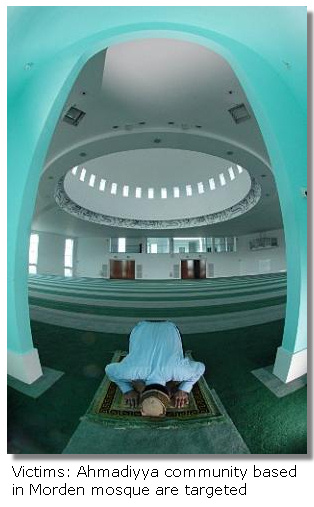
Victims: Ahmadiyya community based in Morden mosque are targeted
The situation has been likened to the “beginnings of the Holocaust” by a leading expert who is urging the police to act.

Lord Avebury, the long-serving vice-chairman of the Parliamentary Human Rights Group, said the extremist views were being imported from Pakistan and compared the vilification of Ahmadiyya Muslims with the beginnings of the Holocaust.

Our investigation has revealed shocking examples of Ahmadi residents, businessmen and politicians being demonised and ostracised by UK Islamic fundamentalist group Khatme Nabuwat (KN).

Ahmadi-owned businesses have been boycotted and face ruin, while employers have been pressurised into sacking Ahmadi workers.

The hate campaign even infected the General Election result after a campaign to discourage Muslims voting for an Ahmadi Liberal Democrat candidate in Tooting.

There are an estimated 13,000 Ahmadi Muslims living and working in south west London, who were drawn to the area after its first mosque was built in Southfields.

Ahmadiyya Muslims differ from mainstream Islam by believing the second coming of the Messiah has already happened and is embodied by their founder, Mirza Ghulam Ahmad.

Their two main mosques are the London Mosque, built in 1926 in Gressenhall Road, Southfields, and the massive Bait-ul-Fatah mosque in Morden, built in 2003 – which their website claims is the largest mosque in Western Europe.

Since then, many Ahmadis who have fled religious persecution in Pakistan have come to live in Merton, Wandsworth, Kingston and Lambeth.

Since being established in 1884, the movement is followed by 160m people in 190 countries worldwide and actively promotes humanitarian efforts under the motto: “Love for all, hatred for none”.

They have a highly active public relations team, which within the past year has promoted community initiatives on behalf of the entire Muslim community, such as an advertising campaign launched in February on London’s bus network.

Copyright 2001-2010 Wimbledon Guardian, UK. All rights reserved.

Friday, October 8, 2010

Hate on the Internet

Daily Dawn, Pakistan
Pakistan
Hate on the Internet
By Huma Imtiaz exclusively for Dawn.com
Friday, 08 Oct, 2010
Shoes of members of the attacked Ahmadi worship place lie outside the building's entrance in the Garhi Shahu area of Lahore on May 30, 2010. Over 80 people died as squads of militants burst into prayer halls May 27, firing guns, throwing grenades and taking hostages. - AFP Photo

KARACHI: Pakistan is no stranger to state-sanctioned censorship. Since the 1950s, successive governments, both military and civilian, have taken pains to ensure that the media has been scrutinised, censored and harassed.

Even as the twenty-first century has dawned upon Pakistan, the cycle continues. In 2009, the Pakistan government removed videos, of a Pakistan Army officer allegedly beating a Swat resident, from YouTube. Later on, videos of President Zardari saying “shut up” to a supporter at a public gathering were erased off of YouTube. In 2009, following a petition in the courts, the Lahore High Court slapped a ban on Facebook, which was later lifted. Even www.thepersecution.org, which documents crimes committed against the Ahmadi sect, is routinely banned by the Pakistan Telecommunications Authority (PTA).

Which makes it even all the more surprising that with such stringent control over the media and the internet, the Pakistan government has so far, turned a blind eye to the abundance of religious hate material that is floating around and readily available on the internet.

A simple search on YouTube for Masood Azhar, head of the Jaish-e-Mohammed, a militant organisation, reveals a long list of speeches by Azhar. Some exhort Muslims to rise up against the United States and India, others border on the comical, where Azhar dubs the television as the cause of all evils. Users frequently comment on the videos, praising Masood Azhar and his ideology.

Haq Char Yaar, which describes itself as a website to “expose Shias and Qadianis” is another example of websites that incite hate against different religious sects in the country. Run by supporters of the now banned Sipah-e-Sahaba-Pakistan, even viewing the website requires one to accept faith in the finality of Prophet Muhammad (PBUH) as the last prophet. Two options are given to users, ‘accept’ or ‘decline’, those who decline are labelled “munkir” or non-believers. Clicking on “Decline” leads users to a page with two poems, one that’s first line says, “Shias have no links to Islam”.

Ansar Al Jihad Network’s website is another popular jihadi website that is accessible in Pakistan. The forum has been closed for membership, but features videos, press releases and discussion about the war in Afghanistan and Pakistan. While one could not see the discussion on the forums, it is astounding to see the sheer number of videos that have been produced by the As-Sahab Foundation for Islamic Media Publication, Al-Qaeda’s media cell, featuring members of the Taliban that have been killed, or messages from current Taliban leaders fighting in Afghanistan and Pakistan.

Videos range from As-Sahab documentaries to press statements of the Taliban in Afghanistan. Here, news is classified as being from a “kuffar news source” if posted from a source other than the Taliban media cell.

Majahden2.org has archival footage of As-Sahab productions, with multiple links to download, for example Ayman-Al-Zawahiri videos. And if you cant find what you’re looking for, one can even “ask a mujahedeen brother” to send you the links that will help answer your question.

Shamikh1.net’s forum is another treasure trove for the aspiring jihadi or sympathiser, featuring the latest videos from Osama Bin Laden on Pakistan’s flood relief efforts. Users comment freely here, “God save our sheikh and leader, lion of Islam, Osama bin Laden. God bless you and care and we have made from your followers in the world and the Hereafter.”

And while lawyers were riled up about Draw Muhammad Day on Facebook, no one seems to have filed a petition against this page – where the latest videos from As-Sahab Media and other jihadi sources are regularly posted. Judging from the activity and frequency of posts, this is one of the most actively maintained Facebook pages.

YouTube features other videos that highlight the Taliban’s struggle against “apostate forces” such as this one titled “Night operations targeting apostate forces in Pakistan” and , where users can watch militants walking down a rocky terrain and preparing for battle by loading their arms. Some faces are blurred out in the video, and the night operations consist of sounds of gunfire in the dark. Right when users begin to lose interest, one can see computer animation, to depict the area being attacked and later on, footage of the arms lying on the ground as militants crowd around in a check post. In the morning, the militants show off the gear and arms that they have recovered and the names and pictures of the “shaheeds”.

...

While even the Interpol recently reported on the dramatic increase in extremist websites and the difficulties faced in blocking them, if one can find jihadi websites in a matter of minutes, surely it would take the PTA or the Ministry of IT and Telecom as much time to find and block the websites. During the Facebook ban period, PTA decided to block hundreds more websites than were actually mandated by the court, many of which did not even feature the “Draw Mohammad Day” event or cartoons that had been posted on Facebook and were, for the most part, proxy bypassing websites or websites that would allow you to browse the internet anonymously.

In a telephonic interview, PTA spokeman Khurram Mehran said that it is not the PTA that decides what websites are to be blocked, but rather the decision is made by a committee set up by the Ministry of IT and Telecom. According to the Secretary for the Ministry of IT and Telecom, Najibullah Malik, there is a mechanism in place for blocking such websites that is enforced by the committee. The members include representatives from the Interior Ministry, Ministry of Religious Affairs, and intelligence and law enforcement agencies. “Whenever we get reports about something that is anti-state or anti-Islam, we ask PTA to block the URL.”

The committee’s secretary Mudassir Hussain has this to say about the committee, which has been operational since 2006, “We have a standing order that any organisation that has been proscribed, their websites will be blocked. Regarding jihadi websites, either the agencies refer them to us or we have our own mechanism to find out about them, the Interior Ministry deliberates over the content and then we ask PTA according to block it. “Hussain says that organisations’ websites that have been proscribed by Pakistani law or international law have been blocked.

That these websites are accessible in Pakistan is of grave concern. Multiple terror attacks have wreaked havoc all over the country, and websites such as the ones mentioned above are not helping the security situation. However, Dr. Maria Sultan, the Director General of the South Asian Strategic Stability Institute says that due to Pakistan’s social structure, not many Pakistanis are affected by jihadi websites. “It’s a problem of legality and understanding how active the religious ministry is. The religious ministry has to give information to the Information Ministry about them. Religion is such an sensitive issue so it’s not clear when they’re about religion and when they’ve crossed over into extremism.” According to Dr. Sultan, there is also the question of freedom of expression and religious schools of thought. “Where do you draw the line between constitutional rights and religious freedom?” Analysts believe there is a need for the Council for Islamic Ideology, the Islamic University and the political parties to achieve a consensus on these websites in the absence of ijtihad.

Another analyst, who did not wish to be quoted, said that judging by how many porn videos Pakistanis were looking at on YouTube, it seemed as if they weren’t using the Internet for education, but rather for recreation.

While freedom of expression is a fundamental right and there may only be a small percentage of the population that is accessing these websites, there is a genuine fear among many that such websites could be used to indoctrinate the confused amongst the younger generation, who have access to the internet and are looking for a way to join a cause that may seem to be “the right way”. While a military operation continues in the tribal areas of the country and thousands have died in terror attacks and have been displaced due to the war, it is time for the government to redouble their efforts to block websites that are propagating hatred against religious sects and inciting violence against the people of Pakistan.

Huma Imtiaz works as a journalist in Pakistan and can be reached at huma.imtiaz@gmail.com

©2010 DAWN Media Group. All rights reserved

Monday, August 23, 2010

In defense of Islam, vigilante justice in Indonesia

Global Post, USA
Indonesia
Home / Asia / Indonesia
--
In defense of Islam, vigilante justice in Indonesia
Indonesian government sits idly by as Islamic Defender's Front, called thugs by most, runs amok.
By Sara Schonhardt — Special to GlobalPost
Published: August 23, 2010 06:44 ET in Asia
--
Indonesian Islamic Defenders Front (FPI) leader Rizieq Shihab gestures as he delivers a speech to his supporters inside the court room after his trial in Jakarta on Oct. 30, 2008. (Adek Berry/AFP/Getty Images)

JAKARTA, Indonesia — They call themselves the Islamic Defenders Front and they say their mission is to stamp out sinful acts and to protect the poor and marginalized.

But the majority of Indonesians in this moderate Muslim nation call them thugs. They say the FPI, as they are known here, are tarnishing the image of both Islam and Indonesia.

In only the last few months the group has been accused of attacking churches, raiding suspected communist conferences and waging assaults against minority religions.

A showdown took place in the Jakarta suburb of Bekasi earlier this month when a stick-wielding mob of FPI members attacked and beat around 20 members of the Batak Christian Protestant Church.

And through it all, Indonesia’s secular government has largely stood idly by and, in some cases, offered support. In most cases the country’s leaders have remained silent, even as FPI attacks grow increasingly frequent and increasingly violent.

The FPI argues that the Batak congregation is worshipping without the proper government permits and is threatening Muslim society by proselytizing.

Bonar Tigor Naipospos, vice chairman of the Setara Institute, which works to promote democracy and peace, said the FPI is using the threat of Christianization to strengthen their position, to gain sympathy and spread their ideology to their followers.

According to a recent study by the institute, acts of violence against Christians are on the rise, which could signal that religious tensions, which always seem to be simmering in Indonesia, are coming to a boil.

“Some politicians in the West use Indonesia as a model of moderate Islam, but behind the surface the embryo of intolerance still exists,” Naipospos said. “And if the Indonesian government doesn’t do something, this embryo will get stronger.”

During an Islamic congress in June, FPI leader Habib Rizieq said evangelicals were Christianizing Muslims by offering them social services like free health care and education. They were also performing hypnosis and constructing illegal churches, he said.

Murhali Barda, the leader of the FPI’s Bekasi branch, had been preparing for a clash.

“My Muslim brothers…!!! Come to Ciketing..!!” He wrote on his Facebook page the day before the attack. “Help our brothers that were walked all over by the Batak people … church business people, moneylenders, pig and dog eaters!”

Angry tweets began trending on Twitter after news of the attack broke, just one among many in recent weeks. Forced church closures and protests against community activity, such as the butchering of pigs, have also made recent headlines.

The occasion forced Indonesian President Susilo Bambang Yudhoyono to break his silence on FPI’s attacks. The president, however, said only that anarchic behavior would not be permitted during the Islamic holy month of Ramadan.

“But it is permitted,” said Sidney Jones, a senior analyst at the International Crisis Group, which monitors security issues. “The easiest thing would be to arrest the perpetrators, and it’s not clear to me why they have refrained from doing so.”

In 2008, following an assault on a peaceful rally in support of religious freedom, police did arrest nearly 60 FPI members, including Rizieq. The FPI kingpin was later sentenced to 18 months in prison for helping organize the attack against the supporters of Ahmadiyah, an Islamic sect many conservative Muslims consider heretical since they refuse to accept Mohammad as Islam’s final prophet.

But the arrests were mostly a response to public outrage. And while the government stopped short of completely banning the Ahmadis as the FPI had demanded, it did issue a ministerial decree prohibiting Ahmadis from practicing their faith or proselytizing in public, appearing to again side with religious hardliners instead of religious pluralists.

Jones said it was unacceptable that the Indonesian police and military have stood by and let these attacks continue. Individuals in the FPI should be prosecuted for assault, but the police should also be held responsible, she said.

Both Jakarta’s governor and one of its police chiefs attended the FPI’s 12th-anniversary celebration earlier this month in what is thought to have been an attempt to enlist the group’s material, and perhaps political, support.

And even though the Religious Affairs Ministry in March named the FPI among nearly 70 potentially illegal sects because its actions deviated from the country’s accepted Islamic teachings, the government still took no action against the group.

Started with police and military backing in 1998, the FPI was originally part of a group of street-level militias aimed at countering the student-led, democratic reform movement and providing security to then-president B.J. Habibie. The FPI has since gained notoriety for conducting vigilante crackdowns on “un-Islamic” activities, which, before recently, usually only involved aggressive raids on bars and nightclubs during Ramadan.

FPI members say their actions are not antagonistic to Islam and that they are merely upholding their duty to rid society of sin.

“FPI has one mission and one vision, and that is to eliminate tyranny and to enforce truth and justice,” said H. Chep Hernawan, head of the Islamic Reform Movement. “Our ulemas [Muslim scholars] and Muslim warriors are the ones who fought against the colonizers. So, I think it’s normal if we want to enforce Islamic law.”

The FPI are not religious crusaders, however. Ian Wilson, a researcher of radical groups-cum-gangs at Australia’s Murdock University, said its members frame issues in religious terms but are not on the same page ideologically as Islamic terrorist organizations like Jemaah Islamiyah.

“Their whole rationale is to stir up trouble … to be in the public eye,” he said.

Barda, who wears a wrap-around skirt and white skullcap often associated with conservative Islam, said FPI’s activities in Bekasi are based on the wishes of the community, which it works to coordinate and strengthen against people who might pose threats, namely the Christian Batak, an ethnic group originally from the neighboring island of Sumatra.

For more than a month the Batak congregation has been praying in a field in Ciketing, on the outskirts of Jakarta, where demonstrators meet them each Sunday demanding they cease prayers and leave the area.

Christian groups must have the consent of the surrounding community to establish a place of worship, and the hardliners say they are fighting the Batak because they refuse to abide by the law.

But when asked about rumors of declining membership numbers among the FPI, Barda, who likes speaking in idioms, only laughed. He said all he needs to do is produce a magnet and the nails will come to him.

“We are small, but we have many supporters,” he said.

Copyright 2010 GlobalPost — International News
 
^ Top of Page