Showing posts with label Sipah-e-Sahaba-Pakistan. Show all posts

Sunday, December 26, 2010

Blasphemy protests: Christian, Muslim protesters kept apart

Express Tribune, Pakistan
Pakistan
Punjab
Blasphemy protests: Christian, Muslim protesters kept apart
Rana Tanveer
December 26, 2010
People shout slogans during a rally in Lahore threatening anarchy if the Blasphemy Act is amended. PHOTO: FILE/AFP

LAHORE: The police claimed to have averted a clash between pro- and anti-blasphemy law protestors at Faisal Chowk on Christmas day.

Around two dozen Tahaffuz-i-Namoos-i-Risalat (TNR) activists staged a sit-in at Faisal Chowk in the morning to press the government not to pardon blasphemy convict Aasia Bibi.

Meanwhile, a few dozen members of the Pakistan Christian Democratic Alliance, Masiha Milan Party and Human Liberation Commission began a rally from Davis Road. They carried crosses and banners demanding that the blasphemy laws be repealed and Aasia Bibi be released from death row.

When they reached Faisal Chowk, the two sides started competing over which could shout their slogans the loudest. Witnesses said that the TNR activists tried to head towards the Christian rally, but the police managed to keep them apart.

Deputy Superintendent of Police Pervaiz Butt, who was at the scene, said that both parties dispersed peacefully. He said there may have been a scuffle if the police had not been around.

Aslam Parvaiz Sahotra, president of the Masiha Milan Party, said that Christians had a right to protest and the government must ensure that this right is not usurped by religious extremists. “Were it not for the police, the TNR protestors would have pounced on us,” he said. He said the Christians’ protest was meant to be a response to the rallies in favour of the blasphemy laws, which he believed were meant to “ruin” the celebration of Christmas.

The Tehreek-i-Hurmat-i-Rasool, an offshoot of banned group Jamaatud Dawa, also held protests in favour of the blasphemy laws in Shehdadpur, Chakwal, Narowal, Pasroor, Faisalabad, Sargodha and Toba Tek Singh. Dr Mehdi Hassan, chairman of the Human Rights Commission of Pakistan, said that clerics should not be allowed to schedule protests during the celebration of Christmas and other religious holidays.

Published in The Express Tribune, December 26th, 2010.
URL: http://tribune.com.pk/story/94925/blasphemy-...-kept-apart/

Monday, December 13, 2010

In the name of religion: 32 blasphemy cases in Sindh

Express Tribune, Pakistan
PAKISTAN
SINDH
In the name of religion: 32 blasphemy cases in Sindh
June 07, 2010
Not only the accused, but the legal community also faces the ire of vigilantes.
KARACHI: According to the Sindh police, 32 blasphemy cases have been registered in the province this year, which include five in Karachi, six in the Hyderabad region and 21 in the Sukkur region.

While the Citizens Police Liaison Committee (CPLC) has a record of 11 blasphemy cases registered in Karachi from January to December 7, 2010, the Karachi police say they have not registered any case this year.

The Human Rights Commission of Pakistan (HRCP) knows of one incident in Karachi this year – a conviction in a 2006 blasphemy case. HRCP says a total of 24 cases and convictions have been recorded in Pakistan in 2010. Blasphemy cases in Sindh are believed to be less in number than in Punjab. HRCP director and activist IA Rehman told The Express Tribune that this is because, “Anti-Ahmadi sentiment is more prevalent in Punjab, where politics is also mixed with religion. The issue of Ahmadis in Punjab is where the blasphemy laws arose from.”

However, like Punjab, blasphemy cases in Sindh have had violent outcomes. Since 1986, at least three people have been murdered after being charged under the blasphemy laws, according to data compiled by the HRCP and the National Commission for Justice and Peace (NCJP). Jagdesh Kumar was killed in 2008 by colleagues at his workplace in Korangi, while Zafar Ahmad, from the Ahmadi community, was killed in Dadu in 2000. Anees Mallah, who was serving a jail term, was attacked by a mob of 200 people in the Sanghar prison on April 3, 2009. He was reportedly tortured before being shot dead. HRCP’s 2009 annual report quoted his brother as saying that he had been wrongly implicated. In March 2008, Mallah had crashed into a gate erected for a Milad event which angered the organisers, who implicated him in a blasphemy case.

According to the NCJP, three women have been accused in Sindh under the blasphemy laws. In 2009, Tabassum Malkana in Sanghar was accused of desecrating the Quran. In Karachi, Akhtari Begum was booked under Pakistan Penal Code Section 295-B in 2001 for claiming to be a prophet and Bushra Taseer was charged under Section 295-C in 1996 after a tailor alleged that she had given him cloth to stitch, which had a religious inscription on it.

A key issue in such cases is the lack of legal support and security for defendants and their legal counsel. Extra-judicial killings of those accused of blasphemy have taken place since 1990, but the legal community has also faced the ire. In 1997, Lahore High Court judge Arif Iqbal Bhatti, who had acquitted two Christians in a blasphemy case in 1995, was shot dead as he left the court.

Human rights lawyer Zia Awan says defending such cases “is a difficult job”. “We are living in a mad country. Even Islam allows people to defend themselves and so does our law. But the government should arrange for lawyers to defend those accused of blasphemy and provide protection to lawyers in such cases,” he told The Express Tribune. “Prosecutors of anti-terrorism courts recently went on strike for the same reason – to demand that they be provided security to do their job.”

I A Rehman says, “There are also professional complainants who accuse people of having committed blasphemy. Such people are present in Sindh too but in a smaller number.”

In May 2010, two Christian couples residing in Karachi were reportedly accused of blasphemy and went into hiding. According to the Asian Human Rights Commission, seven Hindus from the Bheemo Mal Megwar Para area in Mirpurkhas were reportedly arrested on blasphemy charges in August 2010 after an attack on August 23 by the area’s Muslim residents on a Hindu settlement.

Published in The Express Tribune, December 13th, 2010.

Tuesday, December 7, 2010

Blasphemy killings: 15 of 34 murdered were Muslims

Express Tribune, Pakistan
Pakistan
Blasphemy killings: 15 of 34 murdered were Muslims
December 07, 2010
Human rights organisations urge immediate repeal of blasphemy laws.

LAHORE: A total of 34 people were killed extra judicially in Pakistan during 1990-2010 following charges of blasphemy, The Express Tribune has learnt.

The information obtained by the Tribune revealed that 15 of those killed were Muslims and 31 were killed in the Punjab.

16 of the murdered people were Christians, 15 Muslims, two Ahmadis and one a Hindu. All these people accused, of crimes under the blasphemy laws, were either killed extra judicially or found dead in prison under dubious circumstances.

Eight of these people died in the police custody. Five were killed by the police. One of them committed suicide and two were found dead in prison with the cause of their death unknown. Dr Mehdi Hasan, Human Right Commission of Pakistan (HRCP) chairperson, said that he believed that the extrajudicial killings raised questions in relations to the failure of the police security. “The HRCP has always been condemning such tragic incidents. We have long been campaigning for repeal of these laws,” he added.

Ali Dayan Hasan, the senior South Asia researcher at the Human Rights Watch, said that Pakistan would remain a laboratory for rights abuse in the name of religion if blasphemy laws were not repealed.

National Commission for Peace and Justice (NCPJ) is among the organisations calling for blasphemy laws repeal. NCPJ Executive Secretary Peter Jacob said, “In a society like Pakistan where people can be easily instigated into taking law in their hands, such laws should be immediately abolished.”

Religious scholar Javed Ahmad Ghamidi said that the Quran does not lay down a punishment for blasphemy. “In talking about these laws, one should understand the circumstances in which Ziaul Haq introduced them,” he said. He also said that the current laws were not Islamic.

Published in The Express Tribune, December 7th, 2010.

Saturday, December 4, 2010

Blasphemy case: Cleric offers Rs500,000 for Aasia’s execution

Express Tribune, Pakistan
Pakistan
Blasphemy case: Cleric offers Rs500,000 for Aasia’s execution
December 04, 2010

PESHAWAR: A prominent cleric on Friday offered a reward of half a million rupees for executing Aasia Bibi, a Christian woman who was sentenced to death by a court on charges of blasphemy.

Maulana Yousaf Qureshi, the Khateeb of the historic Masjid Mohabaat Khan in Peshawar, offered a Rs500,000 reward for anyone who kills Aasia, Online news agency reported.

Qureshi also warned the government against any move to abolish or change the blasphemy law.

“No president, no parliament and no government has the right to interfere in the tenets of Islam. Islamic punishment (according to Muslim jurisprudence) will be implemented at all costs,” said Maulana Qureshi.

“We will strongly resist any attempt to repeal laws which provide protection to the sanctity of Holy Prophet Muhammad (PBUH),” Qureshi is reported to have told a rally. “Anyone who kills Aasia will be given Rs500,000 in reward from Masjid Mohabat Khan.”

“We expect her to be hanged and if she is not hanged then we will ask the mujahideen and the Taliban to kill her.”

Jamaat-i-Islami’s provincial spokesperson Israrullah has said that the case should be dealt with in accordance with the Constitution and laws of the land. He said that whatever Maulana Qureshi had said was his own personal opinion and not the party’s stated position.

Mian Iftikhar Hussain, the spokesperson for the Khyber-Pakhtunkhwa government, said that the case is still in court and its decision will be acceptable to everyone. He said such decisions cannot be taken on the streets.

Latif Afridi, a renowned lawyer and a former president of the Peshawar High Court Bar Association, said that no one in their right mind could make such a statement, referring to the Maulana’s statement regarding Aasia Bibi. He said that these are “a mad person’s words and are contrary to basic human rights”. He added that such remarks constituted an open threat to someone’s life and stern action should be taken against such an act. Article 506 of the Pakistan Penal Code can be applied in this case, he added.

SSP (operations), Peshawar, Ijaz Ahmed said that he was in no position to say anything definitive in this context but if a legal opinion comes from departments concerned, he would follow the law and take the prescribed route.

with input from REUTERS and our correspondent

Published in The Express Tribune, December 4th, 2010.

URL: http://tribune.com.pk/story/85412/blasphemy-case-...-offers-reward-to-kill-aasia/

Saturday, November 20, 2010

Mughalpura terrified after firing incident

Express Tribune, Pakistan
Pakistan
Punjab
Mughalpura terrified after firing incident
November 20, 2010
Ahmadis have been frequently targeted in hate campaigns.

LAHORE: Eight armed men are said to have opened fire at an Ahmadi place of worship in Mughalpura on Thursday. However no casualty was reported in the incident. There was no police official present at the scene when the attack occurred.

A security guard, deputed by the administration of the place of worship, is reported to have shot once or twice in retaliation. The assailants, however, fired dozens of times creating panic and giving an impression of a terrorist attack, said a shopkeeper. Even after the incident, only one policeman was deputed to ‘secure’ the entire place.

Mughalpura police registered an FIR against unidentified assailants. Police, however, tried to degrade the incident to a “clash among two non-Ahmadi groups” and accused Ahmadis of trying to exploit the situation.

However, on the identification of local Ahmadis, police have arrested two accused who were later identified as Zaheer Ahmed ‘Fauji’ of Mughalpura and Rana Qurban Ali of Dharampura, and declared them to be behind the firing incident.

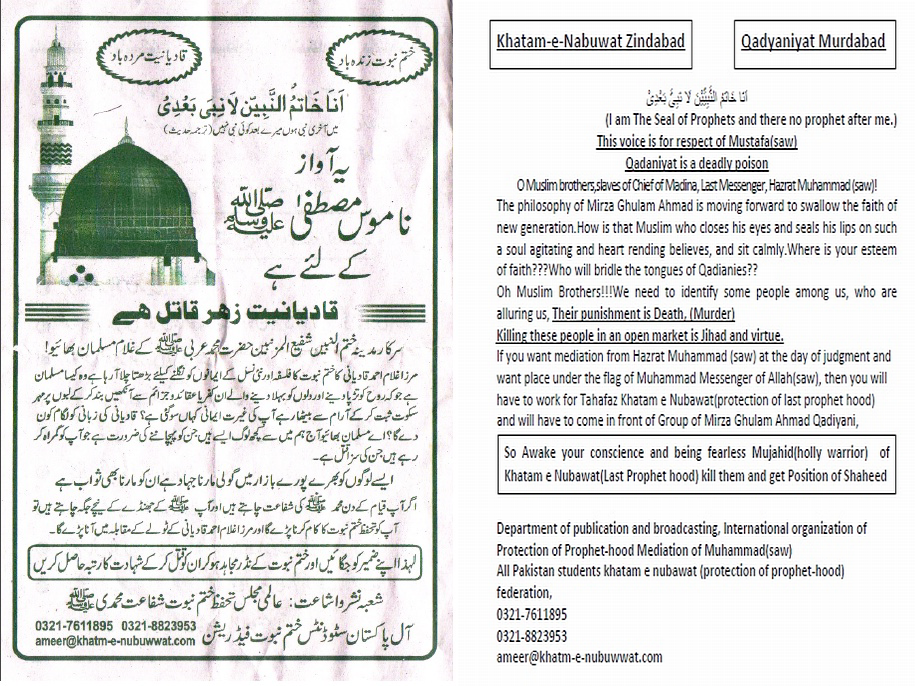
Saleemudin, spokesperson for Jamaat Ahmadiyya, told The Express Tribune that the police had arrested the accused with the help of CCTV footage provided by the administration of their place of worship. He said the firing was carried out with the intent of frightening or harming the Ahmadiyya community. Saleemudin said that some local elements in Mughalpura were resorting to “a hate campaign against our community”. He said some people have also circulated anti-Ahmadi pamphlets and there was even a signboard in a graveyard in Mughalpura barring the entry of Ahmadis.

Condemning police inaction and discriminatory attitude, Saleemudin said that they were barely able to get an FIR lodged after five hours of the incident. Before lodging their complaint, the police even tried to persuade the Ahmadis that the firing was not carried out against them, he said. Criticising the police, he said it was a routine matter that police favoured criminals against the Ahmadis.

Mughalpura Police Station investigation in-charge Inspector Munawar Dogar insisted that the incident had nothing to do with Ahmadis or their place of worship and said the shootout was the result of a clash among two local groups.

He said the accused, Zaheer and Qurban, had clashed with one Farrukh Bhatti of the same area on Wednesday. The inspector said although Bhatti was not a local resident, he used to frequent a barber shop near the place of worship. The accused opened fire on Bhatti in a bid to convey a message to him that they could kill him, he said.

14 casings of 30-bore bullets were seized from the areas while the police were also trying to apprehend their accomplices, he added.

Published in The Express Tribune, November 20th, 2010.

Friday, November 19, 2010

Firing at Ahmedi worship place in Lahore; no casualties

Dawn.com, Pakistan
Pakistan
Firing at Ahmedi worship place in Lahore; no casualties
Agencies
November 19, 2010
The attackers were using small weapons, police said, adding that empty bullet casings had been recovered from the site. - Photo by AP
The attackers were using small weapons, police said, adding that empty bullet casings had been recovered from the site. — Photo by AP

LAHORE: Unknown assailants opened fire at an Ahmedi worship place in Lahore’s Mughalpura area, DawnNews reported.

The gunmen, however, managed to escape after security guards deputed at the worship place opened retaliatory fire.

No casualties were reported in the incident.

Police said the worship place was attacked by four to five assailants and that the firing lasted for a few minutes.

The attackers were using small weapons, police said, adding that empty bullet casings had been recovered from the site.

Ahmedis, a religious minority in Pakistan, have been targeted by militants in the past. In May 2010, at least 93 people were killed when militants attacked two Ahmedi worship places in Lahore.

©2010 DAWN Media Group. All rights reserved

Friday, October 8, 2010

Hate on the Internet

Daily Dawn, Pakistan
Pakistan
Hate on the Internet
By Huma Imtiaz exclusively for Dawn.com
Friday, 08 Oct, 2010
Shoes of members of the attacked Ahmadi worship place lie outside the building's entrance in the Garhi Shahu area of Lahore on May 30, 2010. Over 80 people died as squads of militants burst into prayer halls May 27, firing guns, throwing grenades and taking hostages. - AFP Photo

KARACHI: Pakistan is no stranger to state-sanctioned censorship. Since the 1950s, successive governments, both military and civilian, have taken pains to ensure that the media has been scrutinised, censored and harassed.

Even as the twenty-first century has dawned upon Pakistan, the cycle continues. In 2009, the Pakistan government removed videos, of a Pakistan Army officer allegedly beating a Swat resident, from YouTube. Later on, videos of President Zardari saying “shut up” to a supporter at a public gathering were erased off of YouTube. In 2009, following a petition in the courts, the Lahore High Court slapped a ban on Facebook, which was later lifted. Even www.thepersecution.org, which documents crimes committed against the Ahmadi sect, is routinely banned by the Pakistan Telecommunications Authority (PTA).

Which makes it even all the more surprising that with such stringent control over the media and the internet, the Pakistan government has so far, turned a blind eye to the abundance of religious hate material that is floating around and readily available on the internet.

A simple search on YouTube for Masood Azhar, head of the Jaish-e-Mohammed, a militant organisation, reveals a long list of speeches by Azhar. Some exhort Muslims to rise up against the United States and India, others border on the comical, where Azhar dubs the television as the cause of all evils. Users frequently comment on the videos, praising Masood Azhar and his ideology.

Haq Char Yaar, which describes itself as a website to “expose Shias and Qadianis” is another example of websites that incite hate against different religious sects in the country. Run by supporters of the now banned Sipah-e-Sahaba-Pakistan, even viewing the website requires one to accept faith in the finality of Prophet Muhammad (PBUH) as the last prophet. Two options are given to users, ‘accept’ or ‘decline’, those who decline are labelled “munkir” or non-believers. Clicking on “Decline” leads users to a page with two poems, one that’s first line says, “Shias have no links to Islam”.

Ansar Al Jihad Network’s website is another popular jihadi website that is accessible in Pakistan. The forum has been closed for membership, but features videos, press releases and discussion about the war in Afghanistan and Pakistan. While one could not see the discussion on the forums, it is astounding to see the sheer number of videos that have been produced by the As-Sahab Foundation for Islamic Media Publication, Al-Qaeda’s media cell, featuring members of the Taliban that have been killed, or messages from current Taliban leaders fighting in Afghanistan and Pakistan.

Videos range from As-Sahab documentaries to press statements of the Taliban in Afghanistan. Here, news is classified as being from a “kuffar news source” if posted from a source other than the Taliban media cell.

Majahden2.org has archival footage of As-Sahab productions, with multiple links to download, for example Ayman-Al-Zawahiri videos. And if you cant find what you’re looking for, one can even “ask a mujahedeen brother” to send you the links that will help answer your question.

Shamikh1.net’s forum is another treasure trove for the aspiring jihadi or sympathiser, featuring the latest videos from Osama Bin Laden on Pakistan’s flood relief efforts. Users comment freely here, “God save our sheikh and leader, lion of Islam, Osama bin Laden. God bless you and care and we have made from your followers in the world and the Hereafter.”

And while lawyers were riled up about Draw Muhammad Day on Facebook, no one seems to have filed a petition against this page – where the latest videos from As-Sahab Media and other jihadi sources are regularly posted. Judging from the activity and frequency of posts, this is one of the most actively maintained Facebook pages.

YouTube features other videos that highlight the Taliban’s struggle against “apostate forces” such as this one titled “Night operations targeting apostate forces in Pakistan” and , where users can watch militants walking down a rocky terrain and preparing for battle by loading their arms. Some faces are blurred out in the video, and the night operations consist of sounds of gunfire in the dark. Right when users begin to lose interest, one can see computer animation, to depict the area being attacked and later on, footage of the arms lying on the ground as militants crowd around in a check post. In the morning, the militants show off the gear and arms that they have recovered and the names and pictures of the “shaheeds”.

...

While even the Interpol recently reported on the dramatic increase in extremist websites and the difficulties faced in blocking them, if one can find jihadi websites in a matter of minutes, surely it would take the PTA or the Ministry of IT and Telecom as much time to find and block the websites. During the Facebook ban period, PTA decided to block hundreds more websites than were actually mandated by the court, many of which did not even feature the “Draw Mohammad Day” event or cartoons that had been posted on Facebook and were, for the most part, proxy bypassing websites or websites that would allow you to browse the internet anonymously.

In a telephonic interview, PTA spokeman Khurram Mehran said that it is not the PTA that decides what websites are to be blocked, but rather the decision is made by a committee set up by the Ministry of IT and Telecom. According to the Secretary for the Ministry of IT and Telecom, Najibullah Malik, there is a mechanism in place for blocking such websites that is enforced by the committee. The members include representatives from the Interior Ministry, Ministry of Religious Affairs, and intelligence and law enforcement agencies. “Whenever we get reports about something that is anti-state or anti-Islam, we ask PTA to block the URL.”

The committee’s secretary Mudassir Hussain has this to say about the committee, which has been operational since 2006, “We have a standing order that any organisation that has been proscribed, their websites will be blocked. Regarding jihadi websites, either the agencies refer them to us or we have our own mechanism to find out about them, the Interior Ministry deliberates over the content and then we ask PTA according to block it. “Hussain says that organisations’ websites that have been proscribed by Pakistani law or international law have been blocked.

That these websites are accessible in Pakistan is of grave concern. Multiple terror attacks have wreaked havoc all over the country, and websites such as the ones mentioned above are not helping the security situation. However, Dr. Maria Sultan, the Director General of the South Asian Strategic Stability Institute says that due to Pakistan’s social structure, not many Pakistanis are affected by jihadi websites. “It’s a problem of legality and understanding how active the religious ministry is. The religious ministry has to give information to the Information Ministry about them. Religion is such an sensitive issue so it’s not clear when they’re about religion and when they’ve crossed over into extremism.” According to Dr. Sultan, there is also the question of freedom of expression and religious schools of thought. “Where do you draw the line between constitutional rights and religious freedom?” Analysts believe there is a need for the Council for Islamic Ideology, the Islamic University and the political parties to achieve a consensus on these websites in the absence of ijtihad.

Another analyst, who did not wish to be quoted, said that judging by how many porn videos Pakistanis were looking at on YouTube, it seemed as if they weren’t using the Internet for education, but rather for recreation.

While freedom of expression is a fundamental right and there may only be a small percentage of the population that is accessing these websites, there is a genuine fear among many that such websites could be used to indoctrinate the confused amongst the younger generation, who have access to the internet and are looking for a way to join a cause that may seem to be “the right way”. While a military operation continues in the tribal areas of the country and thousands have died in terror attacks and have been displaced due to the war, it is time for the government to redouble their efforts to block websites that are propagating hatred against religious sects and inciting violence against the people of Pakistan.

Huma Imtiaz works as a journalist in Pakistan and can be reached at huma.imtiaz@gmail.com

©2010 DAWN Media Group. All rights reserved
 
^ Top of Page