Showing posts with label firing. Show all posts

Thursday, November 25, 2010

The blasphemy law

Daily Dawn, Pakistan
The blasphemy law
I.A Rehman
November 25, 2010

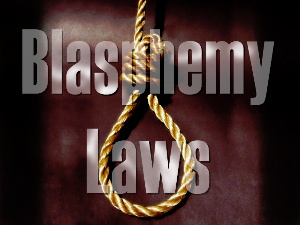
Blasphemy LawsTHE worldwide outrage caused by the awarding of the death sentence to Aasia Bibi on a blasphemy charge was bound to happen sooner or later, in view of Pakistan’s inability to scrutinise a law that satisfies neither human rights advocates nor many authentic authorities on Islam. It is time this shortcoming was seriously addressed.

The matter has been complicated by two factors. First, the conservative opinion has not taken the reaction in the West, especially the Pope’s plea for mercy, in a proper spirit. Just as the people of Pakistan have a right to protest at violations of the Palestinian people’s human rights, western observers have a right to express concern at what they think amounts to human rights abuse in Pakistan.

Secondly, the idea of presidential intervention is counter-productive. Reprieve for a convict or two will not solve the problem. Future victims of the controversial legislation may have no defender at home or abroad. A critical appraisal of Section 295-C has become imperative, particularly because the Pakistan Penal Code (PPC) provision does not even enjoy the unanimous support of Islamic scholars.

This will become abundantly clear from the history of the addition of Section 295-C to the Penal Code. As the Penal Code did not have any specific provision for blasphemy against the Holy Prophet (PBUH), advocate Ismail Qureshi moved the Federal Shariat Court (FSC) in 1984 that to prescribe the death penalty for blasphemy. The petition did not go unchallenged. One objection raised by the counsel for the federation (under Gen Zia) was that the petition was not maintainable. Another issue was that since legislation fell under the jurisdiction of parliament, could the FSC issue a direction to the federation? The court reserved judgment.

Meanwhile, a bill was moved in the National Assembly seeking the insertion of Section 295-C in the PPC. It provided for the death penalty for blasphemy against the Prophet (PBUH).

According to Mr Ismail Qureshi, the law minister did not support the bill on the ground that the Quran did not prescribe a penalty for this offence. “Besides, an unexpected situation arose,” says Mr Ismail Qureshi, “when many Islamic-minded members of the Assembly did not wholly agree with the bill because they thought imprisonment for life was sufficient punishment for blasphemy.” Anyhow the bill was passed though the law ministry added life imprisonment as an alternative punishment. Discussion on the bill was cut short because its supporters insisted that the issue was not debatable.

Mr Qureshi again moved the FSC, this time for deletion of the alternative punishment from Section 295-C. He admits that “some ulema argued that blasphemy was a forgivable offence and some even said that the ruler could award a lesser punishment than death”.

The FSC ruled in October 1990 that the alternative punishment should be deleted as it was repugnant to Islam. The court further directed the federation to add a provision to the effect that any act of blasphemy upon other prophets should also be punishable with death. The government was told to amend Section 295-C by April 30, 1991. The federation filed an appeal against the FSC verdict but it was withdrawn.

Fears that Section 295-C could be abused were expressed from the very outset, by Mr Ismail Qureshi himself. He wrote: “In my opinion, this Section 295-C needs to be further amended because it is necessary to bring it in accord with Quran and Sunnah (emphasis added). In the present form it could create ambiguity and legal complications.” He then emphasised that proof of intent was necessary to secure conviction (a point also made by the FSC) and that the sentence of death should be based on ‘tazkiat-ul-shahood’ (unimpeachable evidence).

To give effect to a part of the FSC verdict (relating to the deletion of the alternative punishment) the Nawaz Sharif government moved the Criminal Law (Third Amendment) Bill 1991. In its report on the bill the Senate Standing Committee, headed by PML-N leader Senator Zafarul Haq, expressed reservations about the definition of the offence. It said:

“The Standing Committee on Law and Justice after detailed deliberations decided to recommend the proposed deletion of ‘or imprisonment of life’ from Section 295-C of the Pakistan Penal Code. The members, however, observed that there was a need for a more specific definition of the offence under Section 295 PPC which the members were of the considered opinion was in the present form very generalised. The committee suggests that the matter may be referred to the Council of Islamic Ideology for suggesting a more specific definition of the offence falling under Section 295 PPC As well as for its opinion as to whether during the lifetime of the Holy Prophet (PBUH) or during the period of Khulafa-i-Rashideen or afterwards in any of the Muslim countries, what was the punishment awarded to the offenders for committing offence falling under Section 295 PPC” (Gazette Extraordinary, Feb 22, 1992).

It was only during the early days of Benazir Bhutto’s second government that the amendment bill was finally adopted. Again the government was in a hurry to push the bill because the house was about to be prorogued.

The fears of abuse of Section 295-C started coming true soon afterwards. A surge in blasphemy accusations, mostly against Christians and Ahmadis in the beginning, invited the comment that this law had generated offences that previously were rare.

Three unsavoury facts were established: a) in many cases the law was invoked to deal with a business rival, to grab property or to settle a personal score; b) that filing FIRs against vulnerable persons had been adopted as a lucrative business by quite a few clerics; and c) that the conservative elements subjected courts to unbearable strains by laying siege to them. Subsequently it was found that trial courts were generally afraid of acquitting even an illiterate child accused of writing blasphemous notes or a man about whom a certificate of his mental disorder was on record.

Further, it was found that a blasphemy accused was safe neither in prison nor at a police station, nor even outside the Lahore High Court. Those acquitted by high courts could not live in Pakistan and a judge who had acquitted a child was killed after retirement.

Over the last few years the use of Section 295-C has become a weapon in the hands of sectarian warlords. While cases against non-Muslim citizens are still filed, in a good number of cases the accused are Muslims, including prayer leaders. It is not that governments have not been uncomfortable with 295-C. The governments of Benazir Bhutto, Nawaz Sharif and Pervez Musharraf all toyed with the idea of making some procedural changes but to no effect. Any further dilly-dallying will only compound the government’s difficulties.

While the argument for a repeal of the admittedly flawed text of the law is unexceptionable, this may take a long time. What is urgently needed is a serious effort to ensure that only those who deliberately commit an offence are punished and courts are protected against mob threats.

©2010 DAWN Media Group. All rights reserved
URL: www.dawn.com/2010/11/25/the-blasphemy-law-by-i-a-rehman.html

Wednesday, November 24, 2010

Religious parties threaten protest in blasphemy case

Daily Dawn, Pakistan
Pakistan
Religious parties threaten protest in blasphemy case
From the Newspaper
November 24, 2010
Activists of Jamaat-e-Ahl-e-Sunnat stage demonstration in support of their demands outside press club Lahore on Wednesday. - Online Photo
Activists of Jamaat-e-Ahl-e-Sunnat stage demonstration in support of their demands outside press club Lahore on Wednesday. — Online Photo

LAHORE: Religious parties have warned the Pakistan People’s Party government, especially Punjab Governor Salmaan Taseer, of a rigorous protest drive if they try to release the woman convicted of blasphemy.

The Aalmi Tanzeem Ahle Sunnat staged a demonstration outside the Lahore Press Club on Tuesday where participants chanted slogans against Taseer for promising to use his influence to seek presidential pardon for Asia, who was sentenced to death by a sessions court judge on blasphemy charges.

Addressing the demonstrators, Pir Afzal Qadri demanded the Supreme Court take notice of the governor’s interference into the judicial system and disqualifying him to hold the public office as, what Qadri said, Taseer had proved himself to be an enemy of the religion by declaring the blasphemy law as ‘black law’ and the verdict a “cruel judgment”.

Other speakers demanded that President Zardari should refrain from hurting feelings of the Ummah by granting pardon to the convict otherwise a protest drive would be launched against the government.

They announced observing Friday (Nov 26) as a protest day against the governor’s statement and his intention to seek relief for the convict.

Jamaat-i-Islami (JI) amir Munawwar Hasan has also condemned the campaign launched by the governor and the country’s secular lobby for the release of Asia, and said the nation would foil every conspiracy to abolish the blasphemy law.

In a statement, he said any such attempt would prove to be the last nail in the coffin of the PPP government.

He said the JI would consult other political and religious parties to chalk out a joint line of action against the secular lobby’s designs.

Besides some foreign powers, the secular lobby and the foreign-funded NGOs having ‘anti-Islam’ and ‘anti-Pakistan’ agenda were pressurising the government into releasing the convict in a blatant interference in the country’s judicial system and its internal affairs, he alleged.

He said none of the human rights or women’s rights bodies had made any protest when a US court sentenced Dr Aafia Siddiqui to 86 years in jail without any proof and no ruler, including the governor, felt any sympathy for her.

However, on the conviction of Asia, Taseer promptly reached the jail to ensure “justice” to a blasphemer and even President Zardari hinted at releasing her, the JI chief lamented.

©2010 DAWN Media Group. All rights reserved

Tuesday, November 23, 2010

Pakistan will not repeal blasphemy law: minister

Daily Dawn, Pakistan
Pakistan
Pakistan will not repeal blasphemy law: minister
Reuters
November 23, 2010
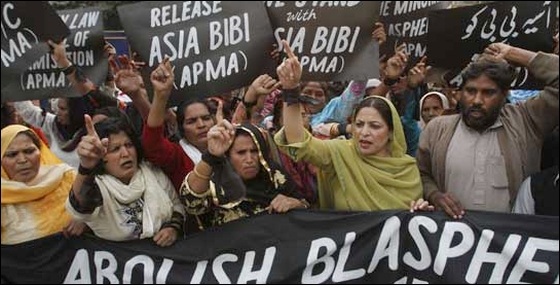
Protesters hold up placards while demanding the release of Asia Bibi, a Pakistani Christian woman who has been sentenced to death for blasphemy, at a rally in Lahore November 21, 2010. - Reuters
Protesters hold up placards while demanding the release of Asia Bibi, a Pakistani Christian woman who has been sentenced to death for blasphemy, at a rally in Lahore November 21, 2010. — Reuters

ISLAMABAD: Pakistan will not repeal its controversial blasphemy law but may amend it to prevent abuse because scrapping the legislation could fuel militancy, a government minister said on Tuesday.

The law, which carries the death penalty for insulting Islam or its Prophet Mohammad, has come under the spotlight this month after a court sentenced a Christian mother of four, Asia Bibi, to death in a case stemming from a village dispute.

Widespread media attention on the case has led to renewed appeals by human rights groups for the repeal of the law but Minister for Minorities Shahbaz Bhatti said that would not happen.

“(Repeal) is not being considered though we are considering changing it so that misuse of the law should be stopped,” Bhatti told Reuters.

The law enjoys widespread support in Pakistan, which is more than 95 per cent Muslim, and politicians are loathe to be seen as soft on the defense of the religion.

Blasphemy convictions are common although the death sentence has never been carried out. Most convictions are thrown out on appeal, but angry mobs have killed many people accused of blasphemy.

Bhatti said consultations with Islamic clerics and representatives of religious minorities on amending the law would soon be held.

He said repealing it was not being considered because that could provoke religious parties and militants who want to topple the pro-US civilian government.

“We have to analyse what the reaction of those having intolerant attitudes will be,” Bibi [Bhatti] said. “At this point our aim is to stop its misuse.”

Critics say the law can be misused by people making false accusations against rivals.

Liberal and secular groups say the law discriminates against religious minorities who make up roughly 4 per cent of Pakistan’s 170 million population. Most members of minorities are Christian.

Bhatti said an initial inquiry into the case of the Christian mother suggested she had not committed blasphemy but was falsely accused after a quarrel.

Bibi, the first woman sentenced to death for blasphemy, has appealed to President Asif Ali Zardari to pardon her.

“It will take few more days. We are looking into different things, not just pardon. She could get relief from the courts,” Bhatti said.

Authorities were providing Bibi with security in jail and her family had also moved for safety reasons, he said.

New York-based Human Right Watch has said the blasphemy law and government’s failure to address religious persecution by extremist groups effectively enable atrocities against minorities. – Reuters

©2010 DAWN Media Group. All rights reserved

Saturday, November 20, 2010

Mughalpura terrified after firing incident

Express Tribune, Pakistan
Pakistan
Punjab
Mughalpura terrified after firing incident
November 20, 2010
Ahmadis have been frequently targeted in hate campaigns.

LAHORE: Eight armed men are said to have opened fire at an Ahmadi place of worship in Mughalpura on Thursday. However no casualty was reported in the incident. There was no police official present at the scene when the attack occurred.

A security guard, deputed by the administration of the place of worship, is reported to have shot once or twice in retaliation. The assailants, however, fired dozens of times creating panic and giving an impression of a terrorist attack, said a shopkeeper. Even after the incident, only one policeman was deputed to ‘secure’ the entire place.

Mughalpura police registered an FIR against unidentified assailants. Police, however, tried to degrade the incident to a “clash among two non-Ahmadi groups” and accused Ahmadis of trying to exploit the situation.

However, on the identification of local Ahmadis, police have arrested two accused who were later identified as Zaheer Ahmed ‘Fauji’ of Mughalpura and Rana Qurban Ali of Dharampura, and declared them to be behind the firing incident.

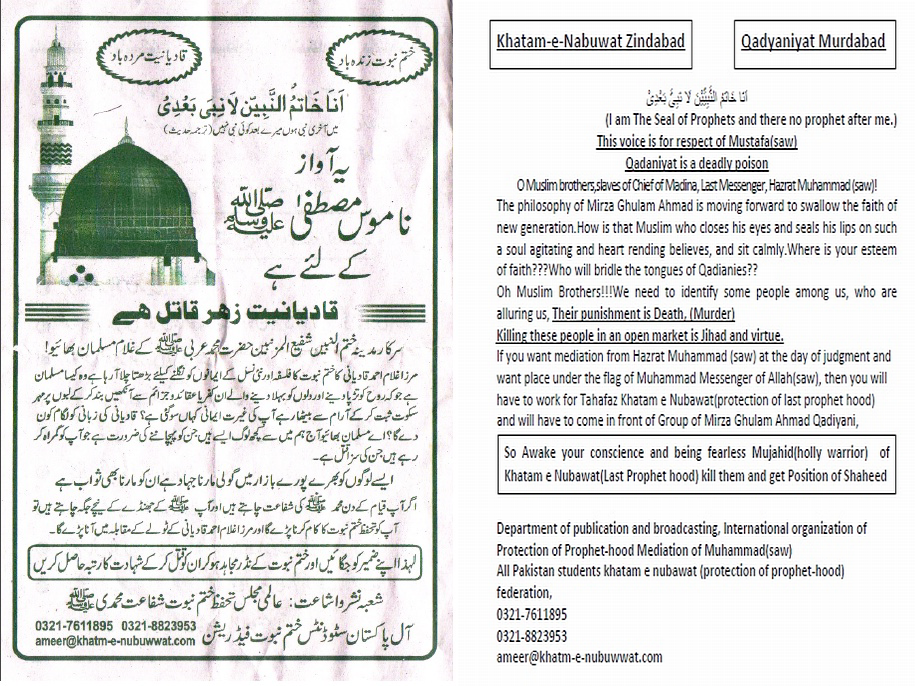
Saleemudin, spokesperson for Jamaat Ahmadiyya, told The Express Tribune that the police had arrested the accused with the help of CCTV footage provided by the administration of their place of worship. He said the firing was carried out with the intent of frightening or harming the Ahmadiyya community. Saleemudin said that some local elements in Mughalpura were resorting to “a hate campaign against our community”. He said some people have also circulated anti-Ahmadi pamphlets and there was even a signboard in a graveyard in Mughalpura barring the entry of Ahmadis.

Condemning police inaction and discriminatory attitude, Saleemudin said that they were barely able to get an FIR lodged after five hours of the incident. Before lodging their complaint, the police even tried to persuade the Ahmadis that the firing was not carried out against them, he said. Criticising the police, he said it was a routine matter that police favoured criminals against the Ahmadis.

Mughalpura Police Station investigation in-charge Inspector Munawar Dogar insisted that the incident had nothing to do with Ahmadis or their place of worship and said the shootout was the result of a clash among two local groups.

He said the accused, Zaheer and Qurban, had clashed with one Farrukh Bhatti of the same area on Wednesday. The inspector said although Bhatti was not a local resident, he used to frequent a barber shop near the place of worship. The accused opened fire on Bhatti in a bid to convey a message to him that they could kill him, he said.

14 casings of 30-bore bullets were seized from the areas while the police were also trying to apprehend their accomplices, he added.

Published in The Express Tribune, November 20th, 2010.

Friday, November 19, 2010

Firing at Ahmedi worship place in Lahore; no casualties

Dawn.com, Pakistan
Pakistan
Firing at Ahmedi worship place in Lahore; no casualties
Agencies
November 19, 2010
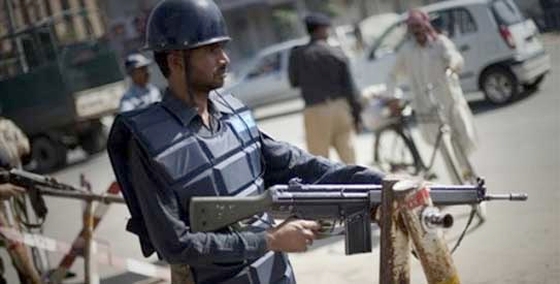
The attackers were using small weapons, police said, adding that empty bullet casings had been recovered from the site. - Photo by AP
The attackers were using small weapons, police said, adding that empty bullet casings had been recovered from the site. — Photo by AP

LAHORE: Unknown assailants opened fire at an Ahmedi worship place in Lahore’s Mughalpura area, DawnNews reported.

The gunmen, however, managed to escape after security guards deputed at the worship place opened retaliatory fire.

No casualties were reported in the incident.

Police said the worship place was attacked by four to five assailants and that the firing lasted for a few minutes.

The attackers were using small weapons, police said, adding that empty bullet casings had been recovered from the site.

Ahmedis, a religious minority in Pakistan, have been targeted by militants in the past. In May 2010, at least 93 people were killed when militants attacked two Ahmedi worship places in Lahore.

©2010 DAWN Media Group. All rights reserved
 
^ Top of Page