Showing posts with label non-Muslims. Show all posts

Friday, July 15, 2011

In Ahmadis’s desert city, Pakistan closes in

Reuters, USA
Edition US
In Ahmadis’s desert city, Pakistan closes in
Rabwah
By Myra MacDonald
RABWAH, Pakistan | Fri Jul 15, 2011 9:04am EDT
(Reuters) — At the office of what claims to be one of Pakistan’s oldest newspapers, workers scan copy for words it is not allowed to use – words like Muslim and Islam.

“The government is constantly monitoring this publication to make sure none of these words are published,” explains our guide during a visit to the offices of al Fazl, the newspaper of the Ahmadiyya sect in Pakistan.

This is Rabwah, the town the Ahmadis built when they fled the killings of Muslims in India at Partition in 1947, and believing themselves guided by God, chose a barren stretch of land where they hoped to make the Punjab desert bloom.

Affluent and well-educated, they started out camping in tents and mud huts near the river and the railway line.

Now they have a town of some 60,000 people, a jumble of one- and two-storey buildings, along with an Olympic size swimming pool, a fire service and a world class heart institute.

Yet declared by the state in the 1970s to be non-Muslims, they face increasing threats of violence across Pakistan as the country strained by a weakening economy, an Islamist insurgency and internecine political feuds, fractures down sectarian and ethnic lines.

“The situation is getting worse and worse,” says Mirza Khurshid Ahmed, amir of the Ahmadi community in Pakistan. “The level of religious intolerance has increased considerably during the last 10 years.”

The town, renamed Chenabnagar by the state government since “Rabwah” comes from a verse in the Koran, is now retreating behind high walls and razor wire, awaiting the suicide bombers and fedayeen gunmen who police tell them are plotting attacks.

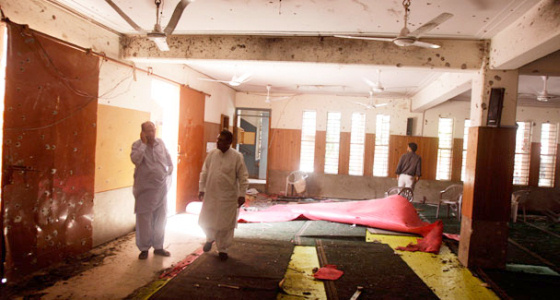
Last May, 86 people were killed in two Ahmadi mosques in Lahore, capital of Punjab; others were attacked elsewhere in the province. Many fled to Rabwah where the community gives them cheap housing and financial support.

Among them is 15-year-old Iqra from Narewal, whose shopkeeper father was stabbed to death last year as the family slept. “I was sleeping in another room when my father was attacked,” she begins in a small voice, pulling a black scarf across her face to cover her mouth in the style of Ahmadi women.

“The attacker wanted to kill all the Ahmadis in Narewal,” her brother Zeeshan continues. “My elder brother tried to help my father and he was stabbed and wounded too.”

Later police found the attacker hiding in a mosque. He had believed the mullahs when they told him that all Ahmadis were “wajib ul qatl”, or deserving of death.

BATTLEGROUND FOR POWER

The Ahmadis follow the teachings of Mirza Ghulam Ahmad, who in the town of Qadian in late 19th century British India called for a revival of a “true Islam” of peace and justice. His teachings were controversial with Muslims and Christians alike.

He argued that Jesus did not die on the cross but escaped and travelled to India and was buried in Kashmir. And he claimed to be the metaphorical second coming of Jesus, destined to put Muslims back on the true path.

Many Muslims were offended by the suggestion he had come as a prophet, breaching a basic tenet of Islam that there can be no prophet after Mohammad, whose teachings are believed to be based literally on the word of God, perfect and therefore final.

Yet his call for peace, hard work, temperance, education and strong community bonds resonated, and over the years the proselytizing movement acquired millions of followers worldwide.

At home, however, their history has been intimately bound up in Pakistan’s own descent from its relatively optimistic birth.

Lacking a coherent national identity, it has become a battleground for competing political, religious and ethnic groups seeking power by attacking others.

“The mistake of the Ahmadis was that they showed their political strength,” said an Ahmadi businessman in Lahore.

Better education he said, meant they obtained good positions in the army and civil service at first; strong community bonds made them an influential force in politics up to the 1970s.

But they also made an easy target for the religious right who could whip up anti-Ahmadi sentiment for political gain.

Ahmadis follow two different schools of thinking, but will argue, often with detailed references to the Koran in both Arabic and English, that they do not dispute the finality of the Prophet Mohammad. Their erudite theological arguments, however, had little chance against the power of the street.

After anti-Ahmadi violence, they were declared non-Muslims in 1974. In the 1980s, their humiliation was completed when legal provisions barred them from associating themselves with Islam, for example by using the call to prayer or naming their place of worship a “masjid” or mosque.

“You can say you don’t consider me to be a Muslim but you can’t force me to also say I am not a Muslim,” complains Ahmed, the amir, the pain clear in his voice.

Yet in the newspaper office in Rabwah, a white board displays the words they are not allowed to use – they could be accused of blasphemy, which carries the death penalty.

SPREADING TO OTHER SECTS

Many Pakistanis, if you ask about treatment of the Ahmadis, shrug it off – it’s an old story, they say, dredged up by westerners who do not appreciate the importance of the finality of the Prophet.

Yet there are signs the attitudes first directed toward Ahmadis are spreading to other sects. In a country which is majority Sunni, and where insurgents follow Sunni Islam, Shi’ites and even Sufi shrines have been bombed.

A 2010 study by Pakistani analyst Ayesha Siddiqa of students in elite colleges found that while 60 percent said the government was right to declare Ahmadis non-Muslims, a sizeable 18 percent believed Shi’ites were also non-Muslims.

These and other findings led her to conclude that radicalism was growing even among the educated youth – it is often, wrongly, blamed on poverty – which in its extreme form could lead people into violence.

Their tendency, she wrote, to see different groups with an unquestioned bias, she wrote, “especially coated with religious overtones or padded with religious belief prepares the mind to accept the message from militant organizations.”

In the nearest town to Rabwah, the central square as been renamed “Khatme Nubuwwat” Chowk, meaning the finality of the Prophet. Beyond, low jagged hills spike up above the dusty land, the summits of much bigger rock formations below the surface.

Many of the Ahmadis had been active supporters of the movement which created Pakistan and when they first came here they were inspired by a verse in the Koran, describing “an elevated land of green valleys and springs of running water.”

Now they are surrounded by a very different country.

Rabwah itself is open to the outside world – despite the high walls guarding individual houses, it is not a walled town.

“Under the circumstances we try to take the best measures we can to protect ourselves,” says the amir. “But what we can do is very limited. We don’t have a mindset or training for that.

And in any case, he adds, “How many people can leave Pakistan or Rabwah?“

Sunday, December 12, 2010

Anti-blasphemy resolution at UN is absurd

Calgary Herald, Canada
Anti-blasphemy resolution at UN is absurd
By Dan Shapiro, For The Calgary Herald DECEMBER 12, 2010

The recent UN Human Rights Council draft resolution on “Combating defamation of religions” would make George Orwell roll over in his grave. If adopted by the UN General Assembly, it will give governments around the world unacceptable powers.

In the name of preventing religious discrimination, the resolution insulates religious orthodoxy from all criticism. The resolution is incoherent, self-contradictory and a gross violation of the fundamental freedoms of religion and expression.

Sponsored by Morocco on behalf of the Organization of the Islamic Conference (OIC), it lends cover and legitimacy to the blasphemy laws of oppressive states which do not respect their citizens’ religious freedom. It thus precludes any possibility of an Islamic reformation, the very thing many Muslims want.

How can you “defame” a religion by saying something “false” about it? “Defamation” involves making a purportedly factual claim about someone that harms their reputation, but is false. For example, Jerry Falwell famously sued Hustler publisher Larry Flynt for printing a cartoon implying Falwell had sex with his own mother in an outhouse. The U.S. Supreme Court ruled that public figures such as Falwell cannot be protected from offensive speech recognizable as satire. Why, then, should “religious symbols and venerated personalities” be protected from ridicule, as the resolution suggests?

Besides, religious disagreement is a very different beast than protecting individuals’ reputations. It is about the truth or falsity of the religion or religious claims. So, you can’t have a law against saying something “false” about a religion precisely because there is no agreed upon means of determining truth or falsity here.

If religious disputes are to be decided by the state, they will come down on the side of orthodoxy and against dissenting views every time.

The resolution claims, disingenuously, that it aims to combat discrimination based on religion. Of course, we should combat actual religious discrimination. For example, if you don’t get a job because you are Muslim or a Jew, that is unjustifiable discrimination. But this doesn’t mean that Islam or Judaism should be protected from criticism and debate.

The resolution is incoherent because it targets the wrong kind of discrimination and protects the wrong entities. Individuals have human rights to be protected; ideas, ideologies, religions and states do not.

Yet, the resolution claims that it protects freedom of religion. Invoking a measure that restricts freedom of religion (by seeking to make it illegal to express religious views that differ from official opinion) is a funny way to protect this fundamental freedom.

Belief systems such as religions are not homogeneous. Blasphemy laws exacerbate, rather than reduce, discrimination based on religion. Such laws violate state neutrality, since the state evaluates competing religious claims and punishes the dissenting minority.

Minorities who differ from the majority religion, for example Christians or non-believers in Muslim-majority countries, are at risk. So too are minority co-religionists, such as Ahmadis who do not view Muhammad as the last Prophet and are persecuted as apostates in many Muslim-majority countries.

Case in point: “Although Christians, Ahmadis, and Hindus make up less than three per cent of Pakistan’s population, they have accounted for about half of the blasphemy defendants over the last two decades,” according to “Policing Belief,” a recent Freedom House report. Pakistan’s Penal Code imposes capital punishment for blasphemy, including for defamation of Islam.

You can’t have meaningful freedom of religion and conscience without robust freedom of speech. For if we’re not free to express our deeply held beliefs, then it makes no sense to speak of freedom of religion and conscience.

In the case of blasphemy or “defamation of religion” laws, there is a dangerously slippery slope since they are often used to punish political opponents and dissidents. For example, bloggers in Pakistan and Iran who have criticized their governments have been charged with “defaming Islam.”

Unfortunately, it bears constant repetition: No government, church, mosque, synagogue or UN Human Rights Council should coerce you into thinking or saying – or, not thinking or not saying – what you believe (short of the infamous yelling “fire” in a crowded theatre exception).

The “defamation of religions” resolution is not about protecting human rights; it is about justifying repression of opinion not sanctioned by the authorities. The resolution does not advance freedom of religion; on the contrary, it curtails it in dangerous ways.

Dan Shapiro is a research associate with the Sheldon Chumir Foundation for Ethics in Leadership.

Copyright © The Calgary Herald

Thursday, July 8, 2010

Pakistan’s Religious Minorities Face Persecution by the State

Jakarta Globe, Indonesia

July 08, 2010
Pakistan’s Religious Minorities Face Persecution by the State

Just a month ago, at least 95 members of the Ahmadiyah Islamic sect were killed and nearly 100 injured in attacks on their places of worship in Lahore, in Pakistan’s Punjab province. The attacks were part of a campaign against Ahmadis by Islamist groups openly sympathetic to terrorist groups, including the Taliban.

Politicians have been strangely silent on the attacks. Punjab’s chief minister, Shahbaz Sharif, the leader of the Pakistan Muslim League, has not shown his face at either Ahmadi mosque targeted in the attacks, despite living down the road from them.

Mohammed Hanif, a journalist, wrote: “When the funerals of the massacred Ahmadis took place there were no officials, no politicians present.”

Several days after the attack, former Pakistani Prime Minister and Pakistan Muslim League leader Nawaz Sharif said the members of the Ahmadi sect were his brothers and sisters and that militants should be flushed out wherever they were active.

His comments drew sharp criticism from religious parties like the Khatm-e-Nabuwat Movement, Jamiat Ulema-e-Islam and Jamaat-e-Islami.

Maulana Ilyas Chinioti, the head of KNM, a member of the PML-N and the Punjab provincial assembly, also condemned Sharif’s statement.

Maulana seems to be openly preaching that non-Muslims are lesser humans, despite the fact that Ahmadis profess that they are Muslims.

Those who dare to defend the rights of religious minorities in Pakistan are usually labeled as being “anti-Islam.”

Ahmadis have been under widespread attack by increasingly violent Islamic fundamentalists across the planet.

The movement was founded in India by Mirza Ghulam Ahmad, who died in 1908 and who claimed to have succeeded the Prophet Muhammad as leader of the religion and who would bring about the final triumph of Islam as per Islamic prophecy.

According to a June 4 story in The News, a surviving attacker of the Lahore carnage, Abdullah, alias Muhammad, said he was misled into believing that Ahmadis were involved in drawing blasphemous caricatures of the Prophet Muhammad, so their bloodshed was a great service to Islam.

The campaign against the sect began a decade ago in Pakistan. Before the 1947 partition of Pakistan and India, anti-Ahmadiyah agitation was instigated by the Majlis-i-Ahrar, a lower-middle-class party.

In 1934, Ahrar set up an anti-Ahmadi movement after the Ahmadi community supported a demand for a Pakistan. In 1953, six Ahmadis lost their lives when an anti-Ahmadiyah wave swept the newly founded country.

According to Waqar Gilani, in 1973 the then president of Azad Jammu and Kashmir, Sardar Abdul Qayyum, declared Ahmadis to be non-Muslims. In the same year, a Saudi Arabian conference also agreed to oust Ahmadis from the circle of Islam.

In 1974 they were declared non-Muslims by the Pakistani Parliament. In 1984, Gen. Zia-ul-Haq promulgated a martial law ordinance containing blasphemy laws that undercut the activities of religious minorities generally, but struck at Ahmadis in particular.

Since then, they have been arrested frequently for greeting someone with the traditional Islamic Assalam-o-Alaikum, reciting Muslim prayers or reading the Holy Koran.

In the period 1984-2009, 105 Ahmadis were killed in Pakistan, according to two authors writing in Viewpoint, a Pakistani online magazine.

“During the same period, 22 Ahmadiyah mosques were demolished, 28 were sealed by authorities, 11 were set on fire and 14 were occupied, while construction of 41 was banned. In at least 47 cases, burials were denied in common graveyards while 28 bodies were exhumed,” the two wrote.

Since 2000, an estimated 400 Ahmadis have been formally charged in criminal cases, including blasphemy. Many remain imprisoned.

Both printed and electronic Pakistani media have played a scandalous role in spreading hatred against the community.

Recently, the Muslim Canadian Congress blamed major media outlets in Pakistan for inflaming rhetoric against Ahmadiyah, Ismaili and Shia Muslims.

In particular, the MCC pointed out that GEO Television had become the voice of Al Qaeda and the Taliban and had spread hatred against these communities as well as against non-Muslims.

Religious minorities in general and Ahmadis in particular are not treated by the Pakistani state as equal citizens. They are routinely intimidated and persecuted because of their faith.

Unless the state changes its mind-set about minorities, they will live under constant threat, which is against international human rights laws and the constitution of Pakistan.

Aftab Alexander Mughal is the editor for a Pakistan-based nongovernmental organization, Minorities Concern of Pakistan.

Copyright 2010 The Jakarta Globe

Tuesday, July 6, 2010

Religious fundamentalism main root of violence in Pakistan

Calgary Herald, Canada
Religious fundamentalism main root of violence in Pakistan
By Mahfooz Kanwar, For The Calgary Herald July 6, 2010

In a little more than a month there have been two major terrorist attacks perpetrated by Muslims against other Muslims at mosques in Lahore, Pakistan.

This past Thursday, two suicide bombers blew themselves up killing at least 42 people and injuring a minimum of 180 people at the Data Darbar shrine, where a famous Sufisaint is buried.

On May 28, fundamentalist Muslims massacred more than 90 Ahmadiyya Muslims at their two mosques in Lahore and injured hundreds more.

When these events occur – and their have been many more in this Punjab region of Pakistan – the world wonders: why do Muslims kill other Muslims?

Not only did some Muslim fundamentalists armed with suicide vests, guns and grenades kill and injure dozens of worshippers, but they also took a large number of Ahmadis hostage.

This appalling, murderous act is not unusual in the history of Pakistan. In 1953, Jamaat-e-Islami Pakistan, a fundamentalist religious and political party in Pakistan, created a murderous upheaval against Ahmadis in the same city of Lahore. Jamaat’s hooligans killed approximately 2,000 innocent Ahmadis. Now, the Taliban and al-Qaeda are suspected in this sectarian violence.

During my schooling, I minored in Islamic studies, and have published a book on Sociology of Islam. I have studied Islam further and have published my research in two other of my books as well as columns in newspapers and I have discussed those results in three of my 21 documentaries over the years.

Many Muslim fundamentalists are semi-literate, and some of them totally illiterate mullahs. The Holy Book of Qur’an makes it very clear that those Muslims who kill or commit suicide will be condemned to hell. Yet, some of these ill-informed Muslim extremists, such as suicide bombers, commit both murder and suicide. And they believe they are acclaimed to go to heaven in their life here after.

Pakistani Islamists always have had issues with the Muslim sect of Ahmadis. Along with the Islamic fundamentalists, some prominent secular politicians have also played the card of religion in Pakistan. The former prime minister of Pakistan, Zulfikar Ali Bhutto, declared Ahmadis as non-Muslims in the early 1970s.

Bhutto’s government introduced a column for religion on the national identity cards as well as passports in singling out the Muslim sect of Ahmadis along with the rest of non-Muslims in Pakistan. This was designed basically to create a system of religious apartheid in Pakistan. That act smacked the basic Islamic principle of tolerance.

In Pakistan, Ahmadis are often barred from praying in their mosques. To preach their faith is considered to be a crime under Article 295 of the Penal Code of Pakistan. The federal sharia Court of Pakistan has ruled that preventing Ahmadis from preaching their faith is no violation of the fundamental rights guaranteed in the Constitution of Pakistan. This is akin to the system of apartheid which was once practised in South Africa.

Although Bhutto was overwhelmingly supported politically by more than two million Ahmadis in Pakistan, he declared Ahmadis as non-Muslims. Bhutto, a secular political leader, betrayed Ahmadis big time. However, the vile fundamentalist and ruthless military dictator Muhammad Zia-ul-Haq expanded the system of apartheid for Ahmadis in Pakistan.

What makes Bhutto, Zia and many mullahs qualified to decide who are or aren’t Muslims? It is supposed to be God’s business to judge His creatures.

In my research for my forthcoming book, Addiction to Religion, I note, among other things, that Islam means peace and Muslims are supposed to adhere to peace, but that does not seem to be the case for decades now.

Islam is a religion but Islamism is an addiction to religion that leads to terrorism. Fundamentalism is a gateway to addiction to religion which blinds people to become suicide bombers who commit two sins in Islam that will take them to hell.

Unfortunately, Pakistan is ruled by five pillars of corrupt establishment. They are: unpatriotic feudal landlords turned politicians (they, along with the Jamaat-e-Islami, were opposed to the creation of Pakistan), cruel military dictators (who have ruled Pakistan ruthlessly for more than half of it’s history), corrupt politicians, depraved bureaucrats, and fundamentalist mullahs.

This last pillar is perhaps the most key. Until the idea of freedom of religion becomes accepted in Pakistan, Muslims will keep on killing each other. That’s because they believe that there is only one way to practice Islam – their way. They are taught no tolerance to other faiths or even to those who share their faith but practise it differently. That’s why Shiites kill Sunnis, Sunnis kill Shiites, both kill Ahmadis and these groups – with the backing of the government and Pakistani law – all persecute and attack Christians and Hindus.

Until and unless something revolutionary happens, Pakistan will continue facing drastic, murderous problems.

Mahfooz Kanwar is Professor Emeritus at Mount Royal University

Copyright © The Calgary Herald

Taliban oppresses Ahmadi Muslim sect in Pakistan

Sepro News
World:  Asia
Taliban oppresses Ahmadi Muslim sect in Pakistan
Tuesday, July 06, 2010
By Spero News

In June 2010, at least 95 members of the Ahmadi Muslim sect were killed and nearly 100 injured in attacks on their places of worship in Garhi in Lahore, Pakistan’s Punjab province. This attack is part of a campaign against Ahmadis by Islamist groups such as the Sunni Tehrik, Tehrik-e-Tahafaz-e-Naomoos-e-Risalat, Khatm-e-Nabuwat and many others who are openly sympathetic to terrorist groups, including Taliban. Ironically, most of the politicians were very careful to condemn the attacks on Ahmadis. Even Punjab’s chief minister, Shahbaz Sharif, leader of Pakistan Muslim League (PML-Nawaz Group), has not shown his face at either mosque, despite living down the road from them. Mohammed Hanif, a journalist, writes, “When the funerals of the massacred Ahmadis took place there were no officials, no politicians present.”

Later, former Pakistan Prime Minister and PML-N chief Nawaz Sharif said that the members of the minority Ahmedi sect are his brothers and sisters and that militants should be flushed out wherever they are active. His comments drew sharp criticism from religious parties like Khatm-e-Nabuwat Movement (KNM), Jamiat Ulema-e-Islam and Jamaat-e-Islami. Maulana Ilyas Chinioti, the head of KNM, a member of the PML-N and the Punjab provincial assembly, also condemned Sharif’s statement. There was no doubt that Maulana Chinioti seems to be openly preaching that non-Muslims are lesser humans. Daily Times says that those who dare to defend the rights of religious minorities are usually labeled as being ‘anti-Islam’.

According to The News of Pakistan, a surviving attacker of the Lahore carnage, Abdullah alias Muhammad, disclosed that he was misled into believing that Ahmadis were involved in drawing blasphemous cartoons of Mohammed, and believed that killing them was a great service to Islam. The attacker belongs to a militant group affiliated with al-Qaeda. He was trained in Miramshah in North Waziristan, lawless tribal area of Pakistan.

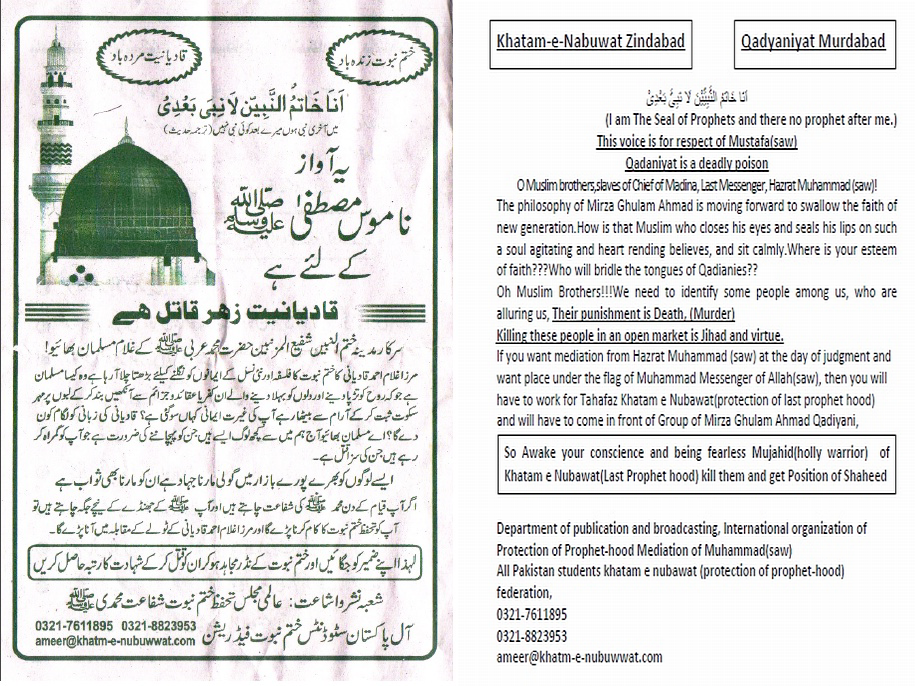
Right after the Lahore carnage, a mysterious SMS campaign has been launched against Ahmaddiya community which makes them more fearful, the Minorities Concern of Pakistan learnt. Moreover, the Islamists issued statements in which they asked Ahmadis to cease from hurting the feelings of the majority population. Jamaat-i-Islami chief Syed Munawwar Hasan, on June 18, warned of a fresh Khatm-i-Nubuwwat movement if the “Ahmadis did not accept their minority status” in Pakistan. At the same time, many blame a “foreign hand.” Some openly said that the Indian intelligence agency, Research and Analysis Wing (RAW), was involved in Lahore attacks. However, Interior Minister Rehman Malik declared on June 18 that the RAW was not involved in the killing of Ahmadis.

Ahmadiyya sect was formed in 1880s in Qadian, India. They view themselves as Muslims but hardliners consider them non-Muslims. They are a relatively small minority in Pakistan and they make up somewhere between 0.25 per cent (according to Pakistan’s census 1998). However, the Economist estimates that their population is 2.5 per cent. They have always been a soft target for persecution. The campaign against them is a decade ago. Before the partition, Anti-Ahmadiyya agitation instigated by Majlis-i-Ahrar, a lower middle class party.

In 1934, Ahrar arranged a big gathering against Ahmadis called Tahafuz-e-Khatm-e-Nabuwat Conference, held at Qadian. Ahrar was angry with Ahmadiyya community to support Quaid-e-Azam Muhammad Ali Jinnah for the demand of Pakistan. In 1953, six Ahmadis lost their lives when an anti-Ahmadiyya wave swept in newly founded Pakistan. The state constituted an inquiry commission; Justice Muhammad Munir as president and Justice Kayani as member. The commission’s report, also called Munir Report, carried an analysis of the Ulema’s concept of the Islamic State and of a Muslim. The report concluded that the concept of a Muslim differed for different sects and if the fatwas of the Ulema were relied upon to determine whether an individual is Muslim or Kafir then no sect could be called Muslim because of the lack of a single, coherent and unanimous definition of a Muslim and an Islamic State.

According to Waqar Gilani, in 1973, the then president of Azad Jammu and Kashmir, Sardar Abdul Qayyum declared Ahmadis to be non-Muslims. In the same year, Rabta-e-Alam-e-Islami Conference in Saudi Arabia also gave its stamp of approval to oust Ahmadis from the circle of Islam. The unfortunate beating of the students of Nishtar Medical College, Multan, on May 29, 1974, proved to be a major incident that infuriated this anti-Ahmadi movement. The students, going on train, started shouting against Ahmadis while reaching Rabwah, the headquarter city of Ahmadis in Pakistan, resulting in a strong reaction of Ahmadis to this gathering. The incident geared up the Khatm-e-Nabuwat movement that started a violent protest.

On Sept. 6, 1974, a minor incident sparked other anti-Ahmadiyya riots leaving 24 members of Ahmadiyya community dead. In the same year, they were declared non-Muslims by the parliament.

On April 26, 1984, General Zia-ul-Haq promulgated the Martial Law Ordinance XX. Through this ordinance he introduced some blasphemy laws which undercut the activities of religious minorities generally, but struck at Ahmadis in particular. Since then, frequently, they have been arrested for greeting someone with an Assalam-o-Alaikum, reciting the kalima or reading the Holy Quran. “In the period 1984-2009, 105 Ahmadis were target killed. During the same period, 22 Ahmadiyya mosques were demolished, 28 were sealed by authorities, 11 were set on fire, and 14 were occupied while construction of 41 was banned. In at least 47 cases, burials were denied in common grave yards while 28 bodies were exhumed,” Adnan Farooq and Riaz ul Hassan write in View Point.

Since 2000, an estimated 400 Ahmadis have been formally charged in criminal cases, including blasphemy. According to one report, in 2009, at least 37 Ahmadis were charged under the general provisions of the blasphemy laws and over 50 were charged under Ahmadi-specific provisions of the law. Many of these individuals remain imprisoned.

It is apparent that both the Pakistani state and society are both are very hostile against Ahmadis. Moreover, both printed and electronic Pakistani media have also played a role in spreading hatred against this community. Recently, the Muslim Canadian Congress (MCC) blamed the major media outlets in Pakistan for inflaming the rhetoric against Ahmadiyya, Ismaili and Shia Muslims. In particular, the MCC pointed out that GEO Television has become the voice of al-Qaeda and the Taliban, and spreads hate against these communities as well as against non-Muslims.

According to one report, “After the attacks some newspapers ran op-ed article creating an impression as if these attacks were a violent consequence of ongoing polemic between certain Muslim sects and the Ahmadiyyas.”

The Minorities Concern of Pakistan learnt that when Jamaat-i-Ahmadiyya’s arranged a press conference after Lahore incident most of the reporters refused to take tea there.

Adnan Farooq writes on June 18: It remained a routine with the Urdu papers to print anti-Ahmadiyya statements and hate-mongering stories with bold headlines. However, no paper published the occasional Ahmadiyya explanation. In year 2007, 974 such news items appeared in the press, but in 2008 the number went up to 1033 items. Almost all of these were prejudiced, hate-promoting and false propaganda. The daily Nawa-i-Waqt (with editor Majeed Nizami) led this bandwagon by printing 465 items. The daily Jang stood second, and the Daily Express was a close third. Provocative statements issued by various clerics’ are carried without any verification. A few of these headlines are translated below: Qadianis are not loyal to the country, nation and Islam: ‘Sajid Mir’ (The daily Jang, Lahore; May 27, 2008) - Qadianis are enemies of Islam and Pakistan: Shadabi Raza, Mufti M. Sadeeq (The Daily Express, Lahore; June 2, 2008).

Source: Minorities Concern of Pakistan

© Copyright Spero, All rights reserved.

Sunday, June 27, 2010

Fear and silence

Daily Dawn, Pakistan
FROM THE PAPER »
EDITORIAL
.
Fear and silence
   By Mohsin Hamid
   Sunday, 27 Jun, 2010
 .
Why are Ahmadis persecuted so ferociously in Pakistan? - (File Photo)
Why are Ahmadis persecuted so ferociously in Pakistan? — (File Photo)

Why are Ahmadis persecuted so ferociously in Pakistan?

The reason can’t be that their large numbers pose some sort of ‘threat from within’. After all, Ahmadis are a relatively small minority in Pakistan. They make up somewhere between 0.25 per cent (according to the last census) and 2.5 per cent (according to the Economist) of our population.

Nor can the reason be that Ahmadis are non-Muslims. Pakistani Christians and Pakistani Hindus are non-Muslims, and similar in numbers to Pakistani Ahmadis. Yet Christians and Hindus, while undeniably discriminated against, face nothing like the vitriol directed towards Ahmadis in our country.

To understand what the persecution of Ahmadis achieves, we have to see how it works. Its first step is to say that Ahmadis are non-Muslims. And its second is to say that Ahmadis are not just non-Muslims, but apostates: non-Muslims who claim to be Muslims. These two steps are easy to take: any individual Pakistani citizen has the right to believe whatever they want about Ahmadis and their faith.

But the process goes further. Step three is to say that because Ahmadis are apostates, they should be victimised, or even killed. We are now beyond the realm of personal opinion. We are in the realm of group punishment and incitement to murder. Nor does it stop here. There is a fourth step. And step four is this: any Muslim who says Ahmadis should not be victimised or killed, should themselves be victimised or killed.

In other words, even if they are not themselves Ahmadi, any policeman, doctor, politician, or passerby who tries to prevent, or just publicly opposes, the killing of an Ahmadi, deserves to die. Why? Because anyone who defends an apostate is themselves an apostate.

Aha.

This is what the persecution of Ahmadis achieves. It allows any Muslim to be declared an apostate. For the logic can be continued endlessly. When an Ahmadi man is wounded in an attack and goes to a hospital for treatment, if the doctor agrees to treat him, she is helping an apostate, and therefore she becomes an apostate and subject to threats. When a policeman is deputed to protect the doctor, since she is an apostate, the policeman is helping an apostate, so he too becomes an apostate. And on and on.

The collective result of this is to silence and impose fear not just on the few per cent of Pakistanis who are Ahmadis, or even on those who are Christians and Hindus, but on all of us. The message is clear. Speaking out against the problem means you are the problem, so you had better be quiet.

Our coerced silence is the weapon that has been sharpened and brought to our throats.

This is why Nawaz Sharif’s statement in defence of Ahmadis met with such an angry response. Because the heart of the issue isn’t whether Ahmadis are non-Muslims or not. The heart of the issue is whether Muslims can be silenced by fear.

Because if we can be silenced when it comes to Ahmadis, then we can be silenced when it comes to Shias, we can be silenced when it comes to women, we can be silenced when it comes to dress, we can be silenced when it comes to entertainment, and we can even be silenced when it comes to sitting by ourselves, alone in a room, afraid to think what we think.

That is the point.

The writer is the author of the novels Moth Smoke and The Reluctant Fundamentalist.

©2010 DAWN Media Group. All rights reserved

Wednesday, June 2, 2010

Religious leaders launch tirade against Ahmedis

Press Trust of India
Religious leaders launch tirade against Ahmedis
STAFF WRITER 16:36 HRS IST
M Zulqernain

Lahore, Jun 2 (PTI) Religious hardliners have launched a fresh tirade against Pakistan’s Ahmedi sect, just days after a terrorist attack on mosques of the religious minority left 95 people dead and over 100 injured.

Leaders of the Tahfuz-e-Namoos Risalat Mahaz demanded that the government should take “strict action” against Ahmedi community director Mirza Ghulam Ahmad for committing “blasphemy” by saying that with a stroke of a pen the community had been declared non-Muslims.

Addressing a press conference yesterday, TNRM leaders Allama Razai Mustafa, Allama Abdus Star Saeedi, Qazi Muzafar Iqbal, Qari Zawar Buhadar, Allama Gul Muhammad Aqiqi, Allama Khadim Hussain and Ashraf Jilali did not condemn Friday’s attacks on the Ahmedi mosques.

Instead, they demanded that the Ahmedi leaders should be penalised for statements they had issued after the carnage.

Jilali claimed the feelings of Pakistani Muslims were hurt by such statements.

“Qaidianis (Ahmedis) are non-Muslims. Not only Pakistan, but a number of other countries have also declared them so,” he said.

“Qaaidians are a threat to our religion and they want to highjack our Quran and Prophet,” Jilali said.

He demanded that the government must “come down hard” on the Ahmedis.

Jilali said that 600 Ahmedis were in the Israeli army but did not offer any proof to back up his claim.

The TNRM leaders also spoke at length about the sins allegedly committed by Ahmedis against Islam and Muslims.

To the surprise of liberal segments of society, the comments made by the TNRM leaders were published in almost all Urdu dailies.

However, the electronic media and English newspaper did not cover the press conference.

Jamaat-e-Ahmadiyya Pakistan spokesman Saleemuddin said: “Such propaganda against Ahmedis is not new. Religious extremists have been injecting venom against us even in children studying in seminaries for a long time. They want us to leave Pakistan.”

While Ahmedis consider themselves Muslim, they were declared non-Muslims in Pakistan in 1974, and in 1984 they were legally barred from proselytising or identifying themselves as Muslims.

Some 1.5 million Ahmedis live across Pakistan.

News also carried by Zee News @ www.zeenews.com/news630997.html

Sunday, May 30, 2010

Culture of intolerance

Daily Dawn, Pakistan                 |   From the Paper > Editorial
 

Culture of intolerance
   Editorial
   Sunday, 30 May, 2010
Officials visit the Garhi Shahu mosque which was stormed by militants on Friday, in Lahore, on Saturday, May 29, 2010. - Photo by AP.

Friday’s gruesome attacks on Ahmadi worshippers in Lahore were a tragic reminder of the growing intolerance that is threatening to destroy our social fabric. Bigotry in this country has been decades in the making and is expressed in a variety of ways. Violence by individuals or groups against those who hold divergent views may be the most despicable manifestation of such prejudice but it is by no means the only one. Religious minorities in Pakistan have not only been shunted to the margins of society but also face outright persecution on a regular basis.

Take the police force, which is notorious for terrorising the poor. Even within that section of society, however, it reserves its harshest treatment for non-Muslims, for the simple reason that brutal or coercive acts directed against minorities are even less likely to get policemen into trouble. There is no shortage of more insidious means of discrimination either. To this day many job applications require candidates to state their religion. Has the irrelevance of this query never struck the organisations in question, or is it part of a screening process designed to weed out ‘undesirables’? Now let’s venture down to the basic building blocks of society, from institutions to households. In many middle-class and affluent Muslim homes, separate eating utensils of distinctly poorer quality are reserved for domestic staff. But there’s more: a further distinction in entitlement is made between Muslim and non-Muslim employees.

None of this is surprising in a country whose statute books are riddled with discriminatory laws, where jingoism is drummed into the heads of schoolchildren and where radio and television talk show participants can casually state that “we are all Muslims here in Pakistan”, which is patently not the case. This is a country where a non-Muslim cannot, by law, become president or prime minister. The blasphemy laws continue to be abused to settle personal scores, evade debts owed to non-Muslims and to grab their land by forcing them to flee in the face of violence. The state, meanwhile, remains largely unmoved by the plight of minorities — and that isn’t surprising either for it is a party to this persecution.

Tackling the terrorists who kill almost at will isn’t the only job at hand. The culture of intolerance has become ingrained in Pakistan and wide-ranging measures are required to change our collective mindset. Textbooks need to be revised and the perils of both brazen and covert narrow-mindedness must be publicly debated. It would also help if major religious parties came forward to condemn atrocities such as Friday’s attacks on Ahmadis in Lahore. But that is perhaps asking for too much.
©2010 DAWN Media Group. All rights reserved
URL : www.dawn.com/wps/wcm/connect/dawn-conte...-of-intolerance-050-hh-12

Friday, November 6, 2009

PK: Pampering the mullah

---The News International, Pakistan
Friday, November 06, 2009, Zi`qad 17, 1430 A.H

Pampering the mullah

Friday, November 06, 2009
Talat Farooq

After the government crackdown on certain madrassas in Islamabad recently, the representatives of the Wafaq-ul-Madaris aired their indignation on TV channels. They criticised the action on the grounds that madrassas have always been weapon/terror-free – including, if you please, the Lal Masjid – and, as such, cannot be held responsible for any anti-state activities The went on to add thatif the government officials wish to visit any of the premises, they must do so with the permission of Wafaq-ul-Madaris. In answer to such defiant outbursts, the interior minister meekly assured the Wafaq that the government never meant to violate the sanctity of these great places of learning and knowledge, and is only looking for some foreign Imams residing in some madressahs illegally. One fails to understand why the government has to be apologetic in carrying out such actions against any institution in Pakistan if it has reports of illegal activity there, especially when we are in a state of war. Madressahs, even if registered, are not sacrosanct or above the law. Unfortunately, it is this obsequiousness of our rulers toward the mullah since the creation of Pakistan that has emboldened the extremists over the last six decades.

The Muslim struggle for Pakistan did not include the Deoband or the Jamiat-e-Ulema-e-Hind who opposed the idea of Pakistan tooth and nail. Nonetheless, once Pakistan became a reality the Wahabi-Deobandi groups made gradual inroads as our leaders acquiesced to their demands within a few years of independence. Since then their influence has remained unchecked by the state as it focused on short-term political goals, it is therefore not surprising that they have eventually assumed the mantle of our self-proclaimed saviours and architects of the national identity of Pakistan.

Be it the Objectives Resolution or the timing of the Anti-Ahmadiyya movement in the 50s that facilitated the first martial law; the ban on alcohol and declaration of Friday as a weekly holiday by Zulfikar Ali Bhutto, Naseerullah Babar’s Taliban idea during Benazir’s government, or Nawaz Sharif’s Shariah Bill of the 90s, staying on the right side of Maulana Fazl ur Rahman by successive governments or the on-going pampering of Wafaq-ul-Madaris by the incumbent administration, the political players of Pakistan have always put their own narrow interests before the interests of the nation.

The military dictatorships on the other hand have used the mullah to further their own specific interests. From Ayub Khan to Musharraf, all military regimes have sought the cooperation of one religious sect or the other. Zia in particular played the mullah card to promote American interests and Arab culture simultaneously, destroying national institutions in the process while Musharraf’s post-9/11 two-faced strategy ensured the continuity of extremism. Jointly, the politicians and the military dictators, with help from America and Saudi Arabia, have managed to create a monster that feeds on violence and bloodshed.

The religious clerics, whether Muslim or non Muslim, derive their political power from exploiting the insecurities of the masses by focusing on differences in religious and socio-cultural beliefs, thus leading to social divisions. In a multi-ethnic Pakistani society with a sizeable non-Muslim population, this has spelled disaster. Over the last three decades, the Deobandi/Wahabi mindset has transmuted ideological divisions into militant sectarianism that has been duly exploited by the Taliban and their domestic sympathisers that include mainstream religious-political parties.

Muslim states like Turkey, in keeping with the Ottoman tradition, have managed to keep their clerics under state control to ensure social order. In Pakistan, they have been given a free hand; what we are witnessing today in the shape of violence is the dark side of religiosity infused by religious extremists into the psyche of both the uneducated masses and the unsuspecting educated elite. This has transpired due to the manipulation of religious sentiments by vested interests and festering socio-economic and governance issues all rolled into one. But above all, this is due to the deliberate omission of critical thinking skills and philosophical knowledge from the national curricula, thus rendering a large majority of Pakistani population incapable of objective assessment. This omission is largely attributable to the direct or indirect influence of the mullah especially during and after the Zia era.

Today the same extremist elements continue to spread their hatred of one another as well as propagate against Pakistan’s national interests by promoting conspiracy theories and blind anti-Americanism from the pulpit. And while doing so, they fail to mention the negative influence of certain policies of the Saudi government toward Pakistan. The anti-American and anti-government slogans after the Islamic University bombing would have sounded more genuine had they been accompanied with anti-Taliban slogans. Pakistan will never become a self-respecting nation unless it disengages itself from not only American shackles but also the ones imported from Saudi Arabia. This requires a mature political leadership that believes in impartial analyses and practical strategies, not to mention courage and wisdom.

The Waziristan operation is in full swing and if the religious parties cannot support it for fear of life, they can at least remain quiet. By stoking the fire of anti-Americanism to garner support for the Taliban through ill-timed rallies and referendums, they are doing no service to Pakistan. The nation is being driven into a frenzy that can only spread more intolerance and spawn fear and anxiety. Furthermore, it serves as a diversion because it deflects people’s attention from the real issue of good governance and allows religious and secular leaders, whether in the government or opposition or outside the parliament, to play their petty games without having to shoulder the required responsibilities to steer the country out of the present quagmire.

Religion is a strong social phenomenon and has been employed by many in human history to serve political ends. Muslim history is no exception. The mullahs of Pakistan have employed the same dispensation since 1947 to gain political power. This has eventually led to the rise of a ferocious militant element never known in Muslim history. Not even the Hashashins of Hassan Sabah killed with such merry abandon. It is high time for the state to check the spread of unbridled hatred. It is time to stop pampering the mullah.

The writer is executive editor of Criterion, Islamabad. Email: talatfarooq11@gmail.com

Source: www.thenews.com.pk/daily_detail.asp?id=206964

 
^ Top of Page