Showing posts with label Jesus. Show all posts

Friday, July 15, 2011

In Ahmadis’s desert city, Pakistan closes in

Reuters, USA
Edition US
In Ahmadis’s desert city, Pakistan closes in
Rabwah
By Myra MacDonald
RABWAH, Pakistan | Fri Jul 15, 2011 9:04am EDT
(Reuters) — At the office of what claims to be one of Pakistan’s oldest newspapers, workers scan copy for words it is not allowed to use – words like Muslim and Islam.

“The government is constantly monitoring this publication to make sure none of these words are published,” explains our guide during a visit to the offices of al Fazl, the newspaper of the Ahmadiyya sect in Pakistan.

This is Rabwah, the town the Ahmadis built when they fled the killings of Muslims in India at Partition in 1947, and believing themselves guided by God, chose a barren stretch of land where they hoped to make the Punjab desert bloom.

Affluent and well-educated, they started out camping in tents and mud huts near the river and the railway line.

Now they have a town of some 60,000 people, a jumble of one- and two-storey buildings, along with an Olympic size swimming pool, a fire service and a world class heart institute.

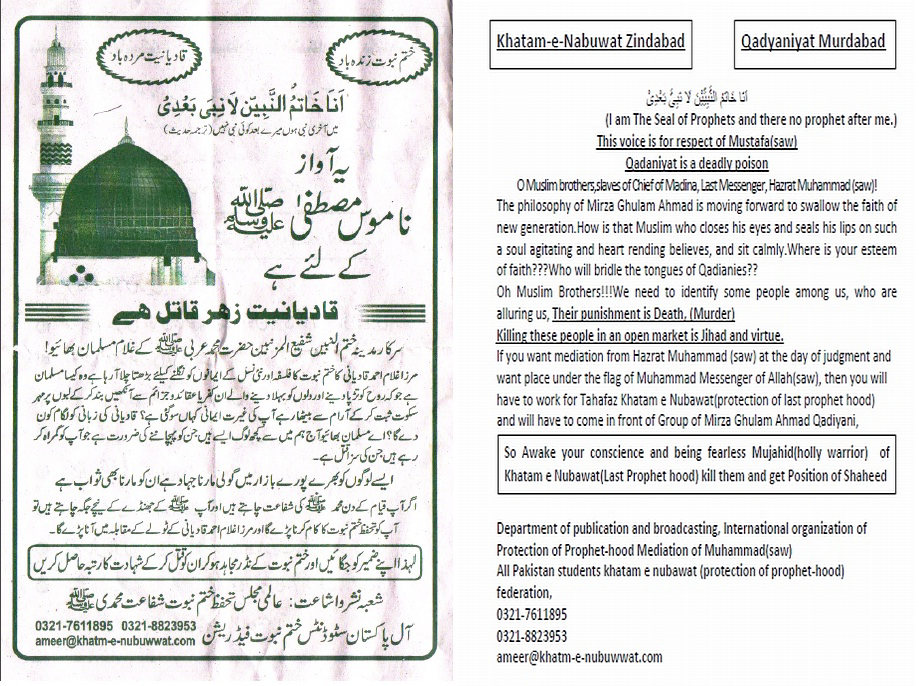
Yet declared by the state in the 1970s to be non-Muslims, they face increasing threats of violence across Pakistan as the country strained by a weakening economy, an Islamist insurgency and internecine political feuds, fractures down sectarian and ethnic lines.

“The situation is getting worse and worse,” says Mirza Khurshid Ahmed, amir of the Ahmadi community in Pakistan. “The level of religious intolerance has increased considerably during the last 10 years.”

The town, renamed Chenabnagar by the state government since “Rabwah” comes from a verse in the Koran, is now retreating behind high walls and razor wire, awaiting the suicide bombers and fedayeen gunmen who police tell them are plotting attacks.

Last May, 86 people were killed in two Ahmadi mosques in Lahore, capital of Punjab; others were attacked elsewhere in the province. Many fled to Rabwah where the community gives them cheap housing and financial support.

Among them is 15-year-old Iqra from Narewal, whose shopkeeper father was stabbed to death last year as the family slept. “I was sleeping in another room when my father was attacked,” she begins in a small voice, pulling a black scarf across her face to cover her mouth in the style of Ahmadi women.

“The attacker wanted to kill all the Ahmadis in Narewal,” her brother Zeeshan continues. “My elder brother tried to help my father and he was stabbed and wounded too.”

Later police found the attacker hiding in a mosque. He had believed the mullahs when they told him that all Ahmadis were “wajib ul qatl”, or deserving of death.

BATTLEGROUND FOR POWER

The Ahmadis follow the teachings of Mirza Ghulam Ahmad, who in the town of Qadian in late 19th century British India called for a revival of a “true Islam” of peace and justice. His teachings were controversial with Muslims and Christians alike.

He argued that Jesus did not die on the cross but escaped and travelled to India and was buried in Kashmir. And he claimed to be the metaphorical second coming of Jesus, destined to put Muslims back on the true path.

Many Muslims were offended by the suggestion he had come as a prophet, breaching a basic tenet of Islam that there can be no prophet after Mohammad, whose teachings are believed to be based literally on the word of God, perfect and therefore final.

Yet his call for peace, hard work, temperance, education and strong community bonds resonated, and over the years the proselytizing movement acquired millions of followers worldwide.

At home, however, their history has been intimately bound up in Pakistan’s own descent from its relatively optimistic birth.

Lacking a coherent national identity, it has become a battleground for competing political, religious and ethnic groups seeking power by attacking others.

“The mistake of the Ahmadis was that they showed their political strength,” said an Ahmadi businessman in Lahore.

Better education he said, meant they obtained good positions in the army and civil service at first; strong community bonds made them an influential force in politics up to the 1970s.

But they also made an easy target for the religious right who could whip up anti-Ahmadi sentiment for political gain.

Ahmadis follow two different schools of thinking, but will argue, often with detailed references to the Koran in both Arabic and English, that they do not dispute the finality of the Prophet Mohammad. Their erudite theological arguments, however, had little chance against the power of the street.

After anti-Ahmadi violence, they were declared non-Muslims in 1974. In the 1980s, their humiliation was completed when legal provisions barred them from associating themselves with Islam, for example by using the call to prayer or naming their place of worship a “masjid” or mosque.

“You can say you don’t consider me to be a Muslim but you can’t force me to also say I am not a Muslim,” complains Ahmed, the amir, the pain clear in his voice.

Yet in the newspaper office in Rabwah, a white board displays the words they are not allowed to use – they could be accused of blasphemy, which carries the death penalty.

SPREADING TO OTHER SECTS

Many Pakistanis, if you ask about treatment of the Ahmadis, shrug it off – it’s an old story, they say, dredged up by westerners who do not appreciate the importance of the finality of the Prophet.

Yet there are signs the attitudes first directed toward Ahmadis are spreading to other sects. In a country which is majority Sunni, and where insurgents follow Sunni Islam, Shi’ites and even Sufi shrines have been bombed.

A 2010 study by Pakistani analyst Ayesha Siddiqa of students in elite colleges found that while 60 percent said the government was right to declare Ahmadis non-Muslims, a sizeable 18 percent believed Shi’ites were also non-Muslims.

These and other findings led her to conclude that radicalism was growing even among the educated youth – it is often, wrongly, blamed on poverty – which in its extreme form could lead people into violence.

Their tendency, she wrote, to see different groups with an unquestioned bias, she wrote, “especially coated with religious overtones or padded with religious belief prepares the mind to accept the message from militant organizations.”

In the nearest town to Rabwah, the central square as been renamed “Khatme Nubuwwat” Chowk, meaning the finality of the Prophet. Beyond, low jagged hills spike up above the dusty land, the summits of much bigger rock formations below the surface.

Many of the Ahmadis had been active supporters of the movement which created Pakistan and when they first came here they were inspired by a verse in the Koran, describing “an elevated land of green valleys and springs of running water.”

Now they are surrounded by a very different country.

Rabwah itself is open to the outside world – despite the high walls guarding individual houses, it is not a walled town.

“Under the circumstances we try to take the best measures we can to protect ourselves,” says the amir. “But what we can do is very limited. We don’t have a mindset or training for that.

And in any case, he adds, “How many people can leave Pakistan or Rabwah?“

Monday, October 18, 2010

Indonesian Vice President: Stand Up Against Radicals

Jakarta Globe, Indonesia
INDONESIA
Indonesian Vice President: Stand Up Against Radicals
Ulma Haryanto & Anita Rachman | October 18, 2010

Indonesian Vice President Boediono, left, with United States President Barack Obama at the Nuclear Security Summit in Washington DC in April. In the strongest comments by a senior politician yet against creeping radicalism, Boediono said the country must not abandon the basic principle that guarantees religious freedom for all. (EPA Photo)
Jakarta. Vice President Boediono has received cautious praise after calling on the “silent majority” to take a stand against a growing radicalism that he describes as threatening to take the country down a path of destruction.

“Once we allow radicalism to take over our way of thinking, it will lead us toward destruction,” the vice president said in a speech on Saturday at the opening of the Global Peace Leadership Conference, organized by Nahdlatul Ulama.

“Freedom of expression has been used by certain groups to spread hatred,” he added.

Though racism and interreligious conflict are fundamental issues that exist in most societies, Boediono said, Indonesians should protect the foundation upon which the country was built — the principle of unity in diversity. “Although Islam is the religion of the majority of people, Indonesia is not an Islamic state,” he said.

Boediono said the country must not abandon the basic principle that guarantees religious freedom for all.

To do this, he called on the silent majority to take a stand. “Radicals are usually vocal, though they are few in number. They drown out the silent majority,” he said. “But there are times when the silent majority must dare to speak out. We must loudly reject radicalism and return to the original agreement of the founding fathers of the nation.”

Pluralism advocates applauded him for speaking out strongly on a threat they have long warned of but that officials have paid little attention to. Week after week, stories of discrimination against minority religious groups fill news pages, and several surveys have pointed to a worrying increase in intolerance among Indonesians.

Dhyah Madya Ruth, chairwoman of Lazuardi Birru, a group that aims to educate young people about the dangers of extremism, said it was important that the government made a clear stand.

“We have to create a synergy between the government, the people and civil society organizations in solving this problem,” she said. “Most important in this is not just the silent majority, but the silent government has to make a firm stand.”

Burhanuddin Muhtadi, an analyst from the Indonesian Survey Institute (LSI), said that President Susilo Bambang Yudhoyono had never strongly addressed radicalism.

In August Yudhoyono decried “groups that threatened the nation,” but his vague message could not be grasped by the public, Muhtadi said.

“He is too focused on his own image. He doesn’t want to be considered antagonistic toward Islamic hard-liners.”

Another important government figure who needs to stand up against those who promote hatred is the religious affairs minister, said Ulil Abshar Abdalla, the founder of the Liberal Islam Network and a Democratic Party politician.

“For example, in several Islamic gatherings people openly call for the banishment of [minority Islamic sect] Ahmadiyah. That should not be allowed,” he said, adding that he regretted that Religious Affairs Minister Suryadharma Ali had adopted a conservative approach that fostered radicalism. Suryadharma has openly advocated banning the Ahmadiyah sect.

Copyright 2010 The Jakarta Globe
URL: www.thejakartaglobe.com/politics/indonesian-vice-president-stand-up-against-radicals/401881

Tuesday, September 28, 2010

Questions for religious affairs minister

READERS FORUM
Tue, 09/28/2010
11:05 AM

Letter: Questions for religious affairs minister

Religious Affairs Minister Suryadharma Ali said the Jamaah Ahmadiyah faith — who claim to be Muslim — had to be broken up, as these followers violated regulations and were not Muslim (the Post, Aug. 31).

Suryadharma Ali and his group apparently see themselves to be “true” Muslims and Ahmadis not.

Now, my questions are:

• Can any definition of a Muslim be found in the Holy Koran, or was any such definition applied by the Holy Prophet (peace be upon him) without exception during his lifetime? If there does exist such a definition then what is it?

• Can it be considered legitimate for anyone to propose any definition, in any era, which is in disregard of such a definition found in the Holy Koran, or by the Holy Prophet, a definition that can be shown to have been applied in the lifetime of the Holy Prophet?

• Is it to be considered legitimate to declare someone to be outside the pale of Islam, notwithstanding one’s belie8f in the Five Pillars of Islam, just because one’s interpretation of a few verses of the Holy Koran is unacceptable to some Muslim divines of certain sects?

The Ahmadis believe in the Five Pillars of Islam, Six Pillars of Faith including the Holy Koran as their Holy Book. Their “problem” is that their interpretation of the verse khataman nabiyyin is unacceptable to some Muslims.

The Holy Koran says “[Allah] named you Muslims both before and in this Book,” (Chapter 22: 78)

The words “He named you Muslims before” mean that this name was prophesized a long time ago before Prophet Muhammad. Muslim and Islam as proper names were given from God to the Holy Prophet Muhammad so this name belongs to Allah and He has the patent.

The Holy Prophet Muhammad said “One who observes the same prayer as we do, faces the same direction [in prayer] as we do, and partakes from the animal slaughtered by us, then such a one is a Muslim concerning whom there is a covenant of Allah and His Messenger; so you must not seek to hoodwink Allah in the matter of this Covenant.” from Bukhari, Kitabus-Salat, Baab Fazl Istiqbal il-Qibla.

Can Mr. Suryadharma surpass the authority of defining what is “Islam” and “Muslim” that are defined by God in the Holy Koran and Prophet Muhammad? Do you think the Prophet Muhammad’s definition of Muslim has expired?

The history of religious persecution, as told by the Koran, clearly shows that followers of true religion or true faith did not begin to persecute religious minority groups but they were victims of violence as minority groups.

The Koran gives the example of Noah, Hud, Abraham, Saleh, Moses, Jesus, Muhammad and others, who called the people to God by using love, sympathy and humility.

Dildaar Ahmad
Indonesian Muslim Ahmadi
Bogor, West java


Tuesday, September 21, 2010

Editorial: Religious Freedom Needs the Rule of Law

Jakarta Globe, Indonesia
OPINION
Editorial: Religious Freedom Needs the Rule of Law
September 21, 2010

We emphatically support efforts by both the government and the legislature to formulate a law that would guarantee religious harmony. The issue desperately deserves attention, because the joint ministerial decree has been found by many to be fundamentally flawed and wholly unable to provide a strong foundation for pluralism in the country. (Antara Photo/Yudhi Mahatma)
.
The right to worship freely is clearly enshrined in our Constitution. But to our nation’s chagrin, this guarantee may only exist in theory, and not yet in practice. As the recent spate of violence against religious minorities — such as Christian congregations and the Ahmadiyah sect — has shown, the pluralism that our nation’s founding fathers wisely envisioned has yet to materialize.

In a country as wide and as diverse as ours, ignoring pluralism would mean eliminating the very ties that have been able to bind us together as a nation for so long. It is the recognition of this plurality, and the need for all Indonesians to mutually respect each other’s differences, that has been able to make this nation so strong.

But the latest incidents, including the assault on members of the Batak Christian Protestant Church in Bekasi, have not only sullied the tolerance this nation is known for, but also threaten to endanger our national unity and cohesion.

Many people have blamed these problems on the 2006 joint ministerial decree on the building of houses of worship, issued by the attorney general and the ministers of home affairs and religious affairs.

They say it encourages official discrimination against religious minorities and provides justification for the violence increasingly being directed against these minorities.

That is why recent statements from Djoko Suyanto, the coordinating minister for political, legal and security affairs, have come as such a breath of fresh air.

Djoko initially said the joint ministerial decree could always be reviewed and amended, and on Tuesday he supported calls for a law on religious harmony to replace the decree.

Even more welcome was the decision reached on Tuesday by the House of Representatives and the government to immediately start drafting a law on religious harmony.

Although the House remains divided over whether the law should use the controversial joint ministerial decree as its starting point, the willingness to address the problem and try to overcome it is laudable.

We emphatically support efforts by both the government and the legislature to formulate a law that would guarantee religious harmony.

The issue desperately deserves attention, because the joint ministerial decree has been found by many to be fundamentally flawed and wholly unable to provide a strong foundation for pluralism in the country.

It is not our intention to try and influence or interfere with the work of the government and the House.

But we think it is important for us to remind them that to uphold the Constitution, the laws that protect the rights of religious minorities and provide a secure environment for them must be honored.

The new law must go further than the current ones to protect the religious rights of all members of Indonesia’s ever-changing society.

Copyright 2010 The Jakarta Globe

Monday, September 20, 2010

Minister for Religion Says No to Calls to Revise Decree

Jakarta Globe, Indonesia
Jakarta
Minister for Religion Says No to Calls to Revise Decree
Camelia Pasandaran & Eras Poke | September 20, 2010

Jakarta. The minister of religious affairs on Monday said there were no plans to revise the joint Ministerial Decree on Houses of Worship despite a chorus of criticism from rights activists and lawmakers against the regulation.

Suryadharma Ali dismissed calls to amend the decree, which have been mounting since an attack on two leaders of a congregation from the Batak Christian Protestant Church (HKBP) Pondok Timur Indah in Bekasi on Sept. 12, in which one church elder was stabbed.

Tensions have been raised in Bekasi for the past few months with some hard-line Muslim groups opposing the building of a church in the Pondok Timur Indah area because it lacks the proper permits.

“This regulation is needed to maintain harmony,” Suryadharma said. “If this regulation didn’t exist, people would be free to do whatever they wanted.”

The decree, issued by both the ministries of religious affairs and home affairs, requires the approval of at least 60 households in the immediate vicinity of new houses of worship before they are granted permits to build or conduct services.

Suryadharma said securing the approval of 60 households was not too much to ask for.

“In the past, the requirement included securing approvals from up to 300 to 400 households. So if every household in that lot included at least three people, that would mean 1,200 approvals. This is just 60 households,” he said.

The decree, however, has been slammed by rights groups for making it nearly impossible for minority faiths to build houses of worship in Muslim-majority areas.

In recent months, the regulation has been cited to justify a spate of attacks against Christians in the Greater Jakarta area by hard-line Muslim groups who say the congregations have no permits to hold religious services.

Some state officials, however, have expressed support for revising the decree.

Constitutional Court Chief Mahfud MD has said he backs revising — but not abolishing — the regulation, arguing it should adapt to changing social conditions.

“A law should be attuned to the times and consider the changes and developments that take place in the society,” he said.

Several lawmakers have also said the decree should be revised, and have even supported calls to draft a new law to support religious harmony.

In addition to securing the approval of 60 households, the decree also states that new houses of worship need recommendations from the local offices of the Religious Affairs Ministry and Interreligious Communication Forum (FKUB).

But Hendardi, who chairs the Setara Institute for Democracy and Peace, has accused the FKUB of regularly “filtering out” permit applications instead of protecting the rights of religious groups.

Meanwhile, hundreds of people from the East Nusa Tenggara People’s Solidarity and Transparency Forum (Somasi) rallied outside the provincial council building in Kupang to protest against the attacks on the HKBP in Bekasi and the ban on its members from worshiping in a vacant lot.

The demonstrators, who included officials from the provincial branch of the Commission for Missing Persons and Victims of Violence (Kontras), also protested against recent attacks on members of Ahmadiyah, a minority Islamic sect, which Suryadharma has repeatedly called for a ban on, claiming that its followers had “violated regulations” and were “not Muslims.”

Speaking with the East Nusa Tenggara Council speaker, Agustinus Medah, Somasi said the attacks against the HKBP and Ahmadiyah were evidence the state was failing to protect the constitutional right to worship.

“The president should have acted firmly,” said Winston Rondo, a representative of Somasi. “He should do so now and protect his people from violence. He is instead more interested in raising his public image.”

Copyright 2010 The Jakarta Globe

Friday, September 17, 2010

Disbanding Ahmadiyah costs the freedom of the nation

OPINION
Fri, 09/17/2010
10:48 AM

Disbanding Ahmadiyah costs the freedom of the nation
Al Makin, Yogyakarta

By the end of Ramadan, Religious Affairs Minister Suryadharma Ali promised to bestow a “controversial gift” on Indonesians, a gift that would displease proponents of tolerance, peace and common sense.

That is, after Idul Fitri he will take serious steps to disband Ahmadiyah. The arguments supporting his statement sound obsolete and unfounded. That is, the group violated a 2008 joint ministerial decree and the outdated 1965 anti-blasphemy law. The public knows where these “weak laws” lead us.

As a politician of the United Development Party (PPP) and a former cooperatives and small and medium enterprises minister, Suryadharma Ali’s maneuver is not mindless. Genuine motivations behind his effort should be explained.

However, as he will unlikely explain what has really provoked him to lash out at the religious minority, we can only guess.

Take a political drive as the first clue to this puzzle.

As a politician, he needs popularity to enhance the number of voters for his party. To become the center of the media’s attention is of great benefit to him. He is now popular. As soon as you type his name into Google, his statement about disbanding Ahmadiyah will appear in various online publications.

As a party that targets conservative voters, the PPP, which was established in the early years of Soeharto’s government, faces the Prosperous Justice Party (PKS) as a serious competitor in the political race.

However, the PKS is seemingly building its image as an “open political party” that “makes room” for the values of pluralism and nationalism. This party has seemed to have learned the lesson that Indonesians are not fond of leaning too far to the right. PKS leaders want to swing the party to the middle, at least in the eyes of the public.

The gambit sounds tactical. The PKS also deserves credit, for educating conservative stakeholders to accept the fact that the party needs to increase the number of voters, regardless of their beliefs and ideologies. Politics is about the voters, in front of whom your principles should be disguised.

However, the strategy also yields risks. Indonesian voters with nationalist sentiments may look at the PKS’ move with a measure of skepticism, while loyal voters with conservative and radical minds may leave the party, seeing that the party has betrayed their original ideology.

The PPP, which wants to construct itself as an icon of conservatism, has seized on an opportunity. The Ahmadiyah issue has been chosen to attract potential conservative and radical voters.

If this is the case, short-term political gain has won out over long-term national interest.

Iskandar Zulkarnain, a scholar on Ahmadiyah, wrote that the Islamic sect’s contributions to this country and Indonesian Muslims since even before independence, such as translating the Koran into Javanese and other intellectual endeavors, cannot be belittled. Amien Rais also held Ahmadiyah’s achievements in the world, such as promoting intellectual Islam in Europe, in high regard.

What is obvious is that in the soil of Indonesia, Ahmadiyah has stood for much longer than those who want to eradicate it. Ahmadiyah — like NU (Nahdlatul Ulama), Muhammadiyah, the PGI, Kawali, Parisada Hindu Dharma, and other religious groups that have colored the Indonesian canvas with diversity — has contributed to this country much more than those who want to annihilate it.

Ahmadiyah is part of Indonesia. If its members are not allowed to live in this country, which they love as much as we do, where should they go? Should we just throw them into ocean? Or expel them?

There are rows and rows of Indonesian leaders and intellectuals who will side with the “oppressed” Ahmadiyah, as they know that banning Ahmadiyah comes at the cost of the freedom of all Indonesian people.

If Ahmadiyah is disbanded because its teachings are different from Indonesian Shafi’ite Sunni majority, there are more sects and Islamic groups on the list, including Indonesian Hanbalite Sunni, Hanafite Sunni, Shiite, Tarekat groups (e.g. Naqshabandiyah, Satiriyah, Jalaluddin Rumi groups), numerous Islamic local variants, and so on.

Next, if you follow a religion that is different from those the Religious Affairs Ministry officially acknowledges, be ready to be banned. The same warning rings true for those who embrace different faiths.

Simply put, our fate and freedom is now attached to that of Ahmadiyah. To allow Ahmadiyah to be disbanded means to let us follow the same fate. Here, in Indonesia, we persecute our own brother Muslims.

Let us consult to the speech delivered by President Susilo Bambang Yudhoyono at Harvard University, in which he challenged Samuel Huntington’s “clash of civilizations”. Agreed Mr. President! Now a question please. What about clashes among Indonesians?

The writer is a lecturer at the State Islamic University Sunan Kalijaga.

Wednesday, September 8, 2010

Ahmadiyah Again Faces Minister’s Call for a Ban

Jakarta Globe, Indonesia
Jakarta
Ahmadiyah Again Faces Minister’s Call for a Ban
Camelia Pasandaran | September 08, 2010

Jakarta. Ignoring the outrage of rights activists, the religious affairs minister on Tuesday reiterated his belief that an outright ban on Ahmadiyah would be good for both the country and the sect.

Suryadharma Ali said the government had two options: maintain the restrictions on the group’s activities, or ban Ahmadiyah. A ban, he said, would protect group members from attack and also help bring them into the fold of mainstream Islam.

“The government can let them be or ban them. Both carry risks,” he said. “To let them be is not regulated by our laws, but we can ban them because we have regulations for this.”

The minister, who last week caused an uproar by saying Ahmadiyah should be banned because the group had angered mainstream Muslims, was referring to the 1965 Blasphemy Law and a joint decree issued in 2008 by the religious affairs and home affairs ministries, and the Attorney General’s Office, restricting the group’s religious activities.

The decree stopped short of banning the sect but prohibited Ahmadiyah followers from publicly practicing their faith and from proselytizing.

“Banning Ahmadiyah, in my opinion, is not an act of hatred or enmity, it is an act of love and care for all our brothers across the nation. To ban them is far better than to let them be,” Suryadharma said.

“To outlaw them would mean that we are working hard to stop deviant acts from continuing. It is better for us to take the hard steps now and, God willing, all will be well.”

According to Suryadharma, all Ahmadis want to follow mainstream Islam, and therefore “it is the duty of every Islamic figure to take them in, teach them the correct way of the religion.”

The minister also said that until a ban was enacted, Ahmadiyah followers would continue to be targets for violent attacks by hard-line groups.

“Why don’t you study the reactions toward the Ahmadiyah?” he said. “We believe such harsh reactions are because there are rules that are not being followed.”

Ahmadiyah followers have been the target of numerous attacks by hard-line Muslim groups, with authorities being accused of failing to take steps to protect sect members.

Rights activists have said the minister’s comments could be construed by hard-liners as justification for more attacks on the group. Suryadharma, however, said that, in principle, there should be no violence.

Founded in India in 1889, Ahmadiyah holds that the group’s founder, Mirza Ghulam Ahmad, was a prophet — a belief that goes against mainstream Islam, which holds that Muhammad was the last prophet.

Said Aqil Siradj, chairman of Nahdlatul Ulama, the country’s largest Muslim organization with an estimated 40 million members, last week urged caution against banning Ahmadiyah.

“Ahmadiyah has been in Indonesia since 1925. Why is it being made a problem now?” he said. “This is not a local organization, it is present in 102 countries around the globe.”.

Copyright 2010 The Jakarta Globe

Friday, September 3, 2010

Indonesian Clerics Wary of Moves to Ban ‘Deviant Sect’

Jakarta Globe, Indonesia
Jakarta
Indonesian Clerics Wary of Moves to Ban ‘Deviant Sect’
Nurfika Osman & Candra Malik | September 03, 2010

Jakarta. Indonesia’s largest Islamic organization has warned the government against rushing to outlaw the minority religious sect Ahmadiyah, a day after the proposal sparked a fierce backlash from human rights watchdogs.

Masdar F. Masudi, deputy chairman of Nahdlatul Ulama, said disbanding religious groups was a form of violence.

“If we disband Ahmadiyah, we could anger [its] followers. We do not need to rush in dissolving Ahmadiyah, even if [the NU] is in clear dispute with them on Islamic teachings,” he told the Jakarta Globe on Thursday.

In House of Representatives hearings earlier this week, Religious Affairs Minister Suryadharma Ali said Ahmadiyah should be banned because it had angered mainstream Muslims.

If their activities are not banned, he said, the potential for conflict would escalate.

Ahmadiyah, founded in India in 1889, holds that the group’s founder, Mirza Ghulam Ahmad, was the last prophet — a belief that contradicts a tenet of Islam that reserves that position for the Prophet Muhammad.

Masudi, however, suggested holding a dialogue with the group to clarify issues.

“We have to conduct dakwah [spreading the word of Islam] wisely. And we believe in conducting dialogue with elegance. Remember, the Koran [says] nothing about the forcible conversion to Islam,” he said.

“If, after we have conducted a dialogue with them and they are still steadfast in their beliefs, [we will] leave them alone. The correct way, after all, is already clearly detailed in the Koran.”

Separately, NU chairman Said Aqil Siradj on Wednesday said any plans to ban the controversial Muslim sect must be studied “absolutely seriously.”

“Ahmadiyah has been in Indonesia since 1925. Why is it being made a problem now? This is not a local organization and is present in 102 countries around the globe,” he said.

According to Said, members of Ahmadiyah should be left alone, but should be “[forbidden] to spread their teachings outside.”

“They should be instead led to follow the right path through dialogue,” he said.

The suggestion to ban Ahmadiyah — declared by the Religious Affairs Ministry, the Home Affairs Ministry and the Attorney General’s Office as a deviant sect in a 2008 decree — drew criticism from several nongovernmental organizations.

Bonar Tigor Naipospos, deputy chairman of the Setara Institute for Peace and Democracy, said on Wednesday that Suryadharma’s comments could easily be used to justify attacks against Ahmadiyah members by hardline Islamic groups.

Meanwhile, Mohamad Guntur Romli, a noted Muslim intellectual and a graduate of Egypt’s Al-Azhar University, said on Thursday that Suryadharma was wrong to suggest banning Ahmadiyah.

“The religious affairs minister should not say things beyond his capacity that rile up the atmosphere,” he said.

“So far, the members of Ahmadiyah have never made problems for Indonesia. They do not undermine the authority of government, or attempt to conduct treason.”

Guntur agreed with the NU’s stance in calling for a peaceful resolution to the issue.

“From the time of [NU’s founder] Hadratus Shaikh Hasyim Asyari to [former President] Abdurrahman Wahid, the NU’s stance has been very clear: defend Ahmadiya’s right to live in accordance with their constitutional rights as Indonesians.”

Copyright 2010 The Jakarta Globe

Thursday, September 2, 2010

Religious Affairs Minister Still Insists on Dissolving Ahmadiyah

TEMPO Interkatif, Indonesia
 
Religious Affairs Minister Still Insists on Dissolving Ahmadiyah
Thursday, 02 September, 2010 | 16:17 WIB

TEMPO Interactive, Jakarta — The Religious Affairs Minister, Suryadharma Ali, insists on stopping all Ahmadiyah religious activities.

Suryadharma said that their activities still violates the Department of Home Affairs Decree, the Department of Religious Affairs Decree and the Attorney General Ministerial Decree, issued some time ago.

“The thought behind the dissolution were not simple. The choice to let it be and dissolving it have its own risks, but we must refer to the ministerial decree,” said Suryadharma after an Iftar meal at the Vice President’s house, on Tuesday (31/8).

Suryadharma said that the ministerial decree is a legal formal law.

The point is demanding Ahmadiyah to stop spreading its teachings because it is against a religion’s main foundation.

Besides that, Suryadharma also hold onto PNPS Decree no. 1/1965 on religious desecration.

He worried that if the matter is unresolved, it will create a bigger problem.

According to him, it has the potential to cause public friction and is very dangerous.

“If this is left unresolved, it would seem that we let it grow. Moreover, this is quite sensitive and if nothing is done about it, there will be escalation and it could create public friction,” he said.

However, Suryadharma warned that the Ahmyadiyah dissolution should be carried out in stages.

That is the reason he asked all Islamic mass organizations to provide counseling to Ahmadiyah adherents.

But Suryadharma promised that he will coordinate with certain parties to carry out this plan.

“Of course we must coordinate efforts as to resolve the matter.”

EKO ARI WIBOWO

Copyright © 2010 TEMPOinteraktif
URL: www.tempointeractive.com/hg/nasional/2010/09/02/brk,20100902-276005,uk.html

Wednesday, September 1, 2010

Editorial: The tyranny of the majority

EDITORIAL
Wed, 09/01/2010
11:25 AM

Editorial: The tyranny of the majority
The Jakarta Post

“The greatest threat facing the US is the tyranny of the majority,” penned nineteenth-century French writer Alexis de Tocqueville in Democracy in America. He could just as easily be writing about Indonesia today, especially after Religious Affairs Minister Suryadharma Ali announced his plan to ban Ahmadiyah, a religious sect with more than 200,000 followers. He said the presence of the sect, whose existence predates even this republic, is an affront to Islam, the country’s predominant religion.

His statement is a clear display of raw power in the name of the majority. President Susilo Bambang Yudhoyono’s silence in the face of what is a clear a breach of the constitution is indicative of his own complicity. Tocqueville’s warning is upon us. This country, founded upon religious freedom, that claims to pride itself on the diversity of its people, is in peril.

The basis of Suryadharma’s action against the Ahmadiyah is a 2008 decree that forbids Ahmadiyah from propagating its teachings, including its tenet that Muhammad was not the final prophet, as mainstream Muslims believe. Despite the case never having gone to court, the decree was drawn up based on the 1965 Blasphemy Law to curtail the group’s activities. But if this is a pretext used to ban a religion or denomination, then other religions and minority groups in Islam in this country have plenty to worry about.

The action against Ahmadiyah is based on the Religious Affairs Ministry’s interpretation of a faith. If this is the case, the question is where does it stop? Mainstream Islam has interpretations about God and truth that are different from other religions: Is Jesus God or a prophet? Was Jesus crucified or was it someone else? Did Abraham slaughter Ismail or Isaac? If Muslims find idolatries offensive, should shrines and statues of Buddha be demolished? Is Muhammad the last prophet of Islam? Going by the reasoning used to ban Ahmadiyah, any of the above different interpretations and many more could one day be deemed by majority Muslims to be heretical and offensive, and used as ground to ban a religion. No minority religion or sect is safe in this country.

The tyranny of the majority in Indonesia comes in the form of religious persecution. It is a reflection of increasing intolerance on the part of majority Muslims towards religious minorities. Why else is the action against Ahmadiyah taking place now, after decades of peaceful coexistence? Other religious minorities are also feeling the brunt. Christians, the largest among the minorities, are finding it difficult to build their churches and many existing ones are being vandalized and their followers attacked.

Suryadharma, a politician by background and chairman of the Islamist United Development Party (PPP), was completely out of line when he encouraged citizens to act as watchdogs to the activities of Ahmadiyah followers. On the ground, his statement has been interpreted as a green light to harass and attack the sect’s followers. Suryadharma should be fired for using his Cabinet position for his own political objectives, and for encouraging the use of violence against other citizens.

For years, many people have questioned the wisdom of having a full ministry in charge of religious affairs. The late Abdurrahman Wahid, when he was president, pondered about disbanding the ministry but refrained. Religious affairs are managed quite effectively by religious leaders, and their relations are being managed through interfaith dialogues. The problem begins when the state starts interfering, interpreting the substance of religion and inevitably takes sides.

Between disbanding Ahmadiyah for violating some obscure governmental decree and disbanding the Religious Affairs Ministry, whose minister is in clear violation of the Constitution by promoting religious intolerance and the tyranny of majority, we know which course Indonesia should take. God be with us.

Minister’s Call to Outlaw Ahmadiyah Angers Non-Governmental Organizations

Jakarta Globe, Indonesia
Jakarta
Minister’s Call to Outlaw Ahmadiyah Angers Non-Governmental Organizations
Dessy Sagita & Anita Rachman | September 01, 2010

Jakarta. Aghast by Religious Affairs Minister Suryadharma Ali’s controversial statements advocating the banning of the Ahmadiyah sect, a number of nongovernmental organizations on Wednesday said they would author a letter of protest asking the minister to clarify his statement.

The Setara Institute for Peace and Democracy, the Jakarta Legal Aid Institute (LBH) and the Commission for Missing Persons and Victims of Violence (Kontras) were reacting to Suryadharma’s statements earlier this week that Ahmadiyah, a controversial Islamic movement, was not Muslim, and therefore saw nothing wrong in declaring that it was time for Ahmadiyah to be banned.

Suryadharma told House of Representatives hearings on Monday, Tuesday and Wednesday that Ahmadiyah must be stopped because it has angered mainstream Muslims in Indonesia.

He said that Ahmadiyah has disrupted interreligious peace, and if their activities were not banned immediately the potential for conflict would escalate.

“Every choice has a consequence, but I think the most suitable choice is to disband Ahmadiyah completely and not to let them do their activities,” the minister said during Tuesday’s hearing.

Bonar Tigor Naipospos, Setara deputy chairman, told the Jakarta Globe on Wednesday that Suryadharma’s statements could easily be interpreted as a justification for radical Islamic groups to attack Ahmadiyah members and prevent them from practicing their religion.

“Because Suryadharma’s statement was made shortly after National Police Chief Bambang Hendarso Danuri made his statements [on Sunday] that violent mass organizations should not be tolerated, it seems like the Minister is trying to use [Bambang’s statement] for his political maneuver,” he said, explaining that the minister could be trying to paint Ahmadiyah as an organization that also needed to be banned.

Bonar also said that Suryadharma’s stance against Ahmadiyah could trigger suspicions that he was using Bambang’s statement for his party’s gain. Suryadharma is from the United Development Party (PPP), one of the smaller parties in the ruling coalition.

Bonar said the memorandum of protest the organizations would send would ask for clarification as to whether the minister’s statement reflected his own political stance, or represented the policy of President Susilo Bambang Yudhoyono in general.

“We don’t know if the matter regarding Ahmadiyah had been discussed in the cabinet meeting,” he said

“If the Minister’s statement was his personal political stance, he should retract the statement immediately and make a public apology,” he added.

Bonar said that Suryadharma’s claim that he would wait until after Ramadan to make any further comments regarding Ahmadiyah sounded like a threat to sect members.

Suryadharma denied that his statement would encourage radical organizations, like the hard-line Islamic Defender Front (FPI) and the Betawi Community Forum (FBR), to attack Ahmadiyah.

“It’s not a legitimation for anarchy, but there has been a consensus that Ahmadiyah is not allowed to spread its practice because it’s wrong,” he said, adding that Muslims should not tolerate any party that would ruin Islam’s reputation.

A 2008 decree by the Religious Affairs Ministry, the Home Affairs Ministry and the Attorney General’s Office decreed Ahmadiyah a deviant sect.

Though the decree stopped short of banning the sect completely, it banned its members from publicly practicing their faith and spreading their beliefs or proselytizing.

Members of Ahmadiyah, founded in India in 1889, hold that the group’s founder, Mirza Ghulam Ahmad, was the last prophet, a belief that contradicts a tenet of Islam that reserves that position for the Prophet Muhammad.

The members of Ahmadiyah are already familiar with violence and attacks against them.

In February 2006, thousands of mainstream Muslims in West Nusa Tenggara burned homes belonging to Ahmadiyah members in Lombok.

The incidents left as many as 137 people homeless, all of whom had to be escorted by police officers to a temporary shelter in Mataram, the provincial capital.

On Aug. 9 this year, some 200 people rallied in front of an Ahmadiyah mosque in Surabaya, demanding the government shut it down.

They ended up vandalizing the mosque by dismantling the signs at its gate.

Copyright 2010 The Jakarta Globe
 
^ Top of Page