 | Thursday, June 03, 2010, Jamadi-us-Sani 19, 1431 A.H. |
 | |
There is blood on our hands | |
| |
Thursday, June 03, 2010
Kamila Hyat
The writer is a freelance columnist and former newspaper editor
The different kinds of violence that run through our country have turned it into a zone where war, and the chaos it brings about, is a perpetual phenomenon.
Most recently Ahmedis have been its victims, with 90 killed in the bloodbath in Lahore. In past months Shias have suffered similar violence. Ethnic battles rage on in Karachi, the military fights extremists in the northwest and other kinds of killings take place in Balochistan where five teachers have been among the 128 shot dead in targeted killings over the past five months. Fourteen teachers have been among the 782 killed in targeted shootings in the province in the past three years. Attacks on Christians are reported every now and then as are different kinds of random violence that seem on the surface to be senseless. Mob action against those suspected of crime is becoming more and more frequent and, frighteningly, as the killing fields spread, the state’s law-enforcers seem to have been reduced to the role of spectators, who can, at best, only rush in after the spree of violence to pick bodies off the streets.
Certainly, this is what happened in Lahore. Threats to the Ahmedi community, coming in for almost a year in the Model Town area went largely unheeded. Security was stepped up but was obviously inadequate in the face of an attack as well-coordinated and planned as the siege that disrupted weekly prayers. It appears that intelligence agencies had failed to pick up on plans for the attack. Ahmedis report that after it took place the police response was delayed and the death toll could have been even higher had two young Ahmedi men not acted with immense courage and disarmed two of the suicide bombers, holding them captive for 30 minutes until the police made their way to the spot in Model Town. Even after the carnage, there is evidence the lessons have not been learned.
Arrangements for a mass funeral were altered by the Ahmedi community which saw the security as insufficient. Their fears are not out of place. Attacks at burials have been staged on more than one occasion by the militants to maximise the numbers they consign to death.
The events we saw on Friday go beyond the issue of a failure to offer security. They are rooted in the state’s discrimination against a particular community which in 1974 was declared ‘non-Muslim’ despite its own protestations to the contrary. Some ten years later specific laws against Ahmedis made it more likely they would be persecuted. According to the US State Department’s annual Human Rights Report issued in March 2010, 94 Ahmedis faced criminal charges in Pakistan for religious offences during the past year: 37 under the blasphemy laws and 57 under Ahmedi-specific laws.
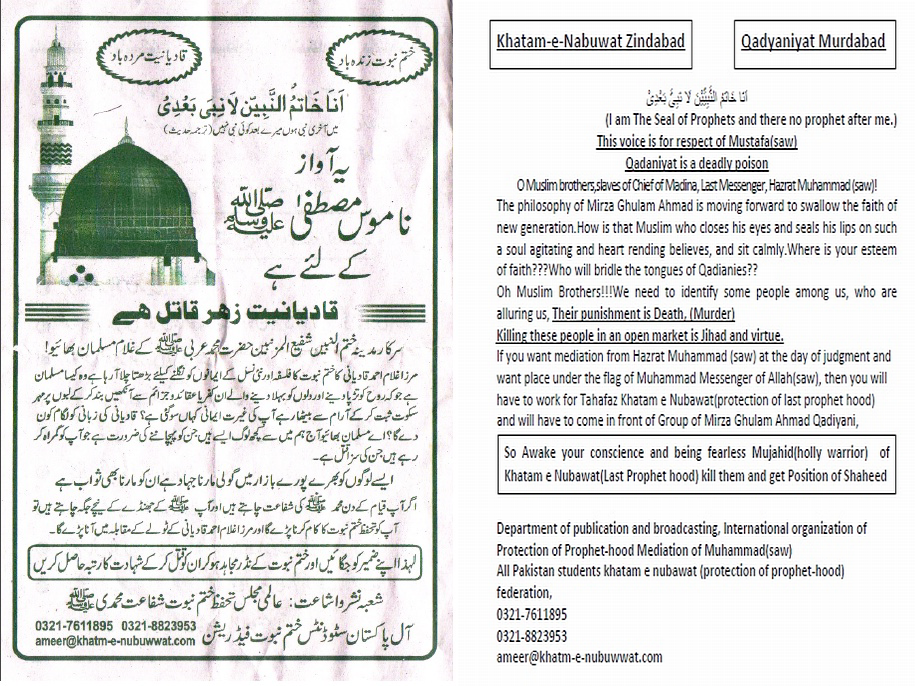
Pakistan remains on the list of countries of ‘particular concern’ for the US Commission on International Religious Freedoms. Such state-backed discrimination has strengthened the hatred against Ahmedis propagated by extremist groups. This sentiment has found its way into mainstream society, mainly through the doings of sections of the media. While Friday’s killings shocked many, there was disturbingly muted comment from some quarters about the ‘controversial’ beliefs of the community – as if this justified murder. Some national leaders made it a point not to mention Ahmedis by name in statements condemning the act of terrorism against them.
Another game now appears to be afoot. There have been observations from police officers in Lahore that the militants who staged the attack had roots in North Waziristan. It is quite possible that these findings are not inaccurate. But there is suspicion that a part of the motive is to deflect criticism faced by the Punjab government for failing to act against groups in southern Punjab suspected of being linked to the attack. There is certainly evidence to back this. Those present at the Model Town place of worship say one of the young men pinned down by worshippers spoke in Seraiki, cursing those who had prevented him from completing his ‘mission’.
Initial claims of responsibility for the assault appeared to come from the Tehrik-e-Taliban, Punjab, and despite the denial of the Punjab government the fact is that this group has been linked to many of the recent spate of terrorist attacks. It of course is likely that it is working alongside forces based in the northwest, forming a new – and extremely dangerous – nexus.
Southern Punjab has for many years been the heartland of sectarian violence and also anti-Ahmedi sentiment. The groups guilty of repeatedly violating the law against the spread of religious hatred have never been charged. No attempt was ever made to prevent them from inciting violence against the Ahmedi community. In some cases the government, at various points in time, has connived in actions directed against Ahmedis. The refusal to go after extremist groups has almost certainly encouraged them.
For purposes of electoral gain, Punjab ministers have joined hands with leaders of the Sipah-e-Sahaba Pakistan, despite the fact that it is a banned organisation. Other banned groups continue to operate in the province. This dangerous situation of course increases the possibility of more violence in future with Punjab becoming a safe haven for militants.
The state of war we live in leaves no room for development or an improvement in the quality of human life. It presents fearful dangers to the state itself, with new fault lines zigzagging across it. The cracks have been widening rapidly. We must find ways to fill them in before the rifts grow deeper and the violence they generate assumes still more dangerous dimensions. The state needs to take the lead in this. Discrimination laid down in law must be ended and an even playing field created for all citizens.
Until his happens, we will remain a nation divided on the basis of religious belief, ethnicity and other factors which prevent us from discovering the tolerance we so badly need to create integrity and the willingness to live together within a territory shared by many diverse groups.
Email: kamilahyat@hotmail.com
Kamila Hyat
The writer is a freelance columnist and former newspaper editor
The different kinds of violence that run through our country have turned it into a zone where war, and the chaos it brings about, is a perpetual phenomenon.
Most recently Ahmedis have been its victims, with 90 killed in the bloodbath in Lahore. In past months Shias have suffered similar violence. Ethnic battles rage on in Karachi, the military fights extremists in the northwest and other kinds of killings take place in Balochistan where five teachers have been among the 128 shot dead in targeted killings over the past five months. Fourteen teachers have been among the 782 killed in targeted shootings in the province in the past three years. Attacks on Christians are reported every now and then as are different kinds of random violence that seem on the surface to be senseless. Mob action against those suspected of crime is becoming more and more frequent and, frighteningly, as the killing fields spread, the state’s law-enforcers seem to have been reduced to the role of spectators, who can, at best, only rush in after the spree of violence to pick bodies off the streets.
Certainly, this is what happened in Lahore. Threats to the Ahmedi community, coming in for almost a year in the Model Town area went largely unheeded. Security was stepped up but was obviously inadequate in the face of an attack as well-coordinated and planned as the siege that disrupted weekly prayers. It appears that intelligence agencies had failed to pick up on plans for the attack. Ahmedis report that after it took place the police response was delayed and the death toll could have been even higher had two young Ahmedi men not acted with immense courage and disarmed two of the suicide bombers, holding them captive for 30 minutes until the police made their way to the spot in Model Town. Even after the carnage, there is evidence the lessons have not been learned.
Arrangements for a mass funeral were altered by the Ahmedi community which saw the security as insufficient. Their fears are not out of place. Attacks at burials have been staged on more than one occasion by the militants to maximise the numbers they consign to death.
The events we saw on Friday go beyond the issue of a failure to offer security. They are rooted in the state’s discrimination against a particular community which in 1974 was declared ‘non-Muslim’ despite its own protestations to the contrary. Some ten years later specific laws against Ahmedis made it more likely they would be persecuted. According to the US State Department’s annual Human Rights Report issued in March 2010, 94 Ahmedis faced criminal charges in Pakistan for religious offences during the past year: 37 under the blasphemy laws and 57 under Ahmedi-specific laws.
Pakistan remains on the list of countries of ‘particular concern’ for the US Commission on International Religious Freedoms. Such state-backed discrimination has strengthened the hatred against Ahmedis propagated by extremist groups. This sentiment has found its way into mainstream society, mainly through the doings of sections of the media. While Friday’s killings shocked many, there was disturbingly muted comment from some quarters about the ‘controversial’ beliefs of the community – as if this justified murder. Some national leaders made it a point not to mention Ahmedis by name in statements condemning the act of terrorism against them.
Another game now appears to be afoot. There have been observations from police officers in Lahore that the militants who staged the attack had roots in North Waziristan. It is quite possible that these findings are not inaccurate. But there is suspicion that a part of the motive is to deflect criticism faced by the Punjab government for failing to act against groups in southern Punjab suspected of being linked to the attack. There is certainly evidence to back this. Those present at the Model Town place of worship say one of the young men pinned down by worshippers spoke in Seraiki, cursing those who had prevented him from completing his ‘mission’.
Initial claims of responsibility for the assault appeared to come from the Tehrik-e-Taliban, Punjab, and despite the denial of the Punjab government the fact is that this group has been linked to many of the recent spate of terrorist attacks. It of course is likely that it is working alongside forces based in the northwest, forming a new – and extremely dangerous – nexus.
Southern Punjab has for many years been the heartland of sectarian violence and also anti-Ahmedi sentiment. The groups guilty of repeatedly violating the law against the spread of religious hatred have never been charged. No attempt was ever made to prevent them from inciting violence against the Ahmedi community. In some cases the government, at various points in time, has connived in actions directed against Ahmedis. The refusal to go after extremist groups has almost certainly encouraged them.
For purposes of electoral gain, Punjab ministers have joined hands with leaders of the Sipah-e-Sahaba Pakistan, despite the fact that it is a banned organisation. Other banned groups continue to operate in the province. This dangerous situation of course increases the possibility of more violence in future with Punjab becoming a safe haven for militants.
The state of war we live in leaves no room for development or an improvement in the quality of human life. It presents fearful dangers to the state itself, with new fault lines zigzagging across it. The cracks have been widening rapidly. We must find ways to fill them in before the rifts grow deeper and the violence they generate assumes still more dangerous dimensions. The state needs to take the lead in this. Discrimination laid down in law must be ended and an even playing field created for all citizens.
Until his happens, we will remain a nation divided on the basis of religious belief, ethnicity and other factors which prevent us from discovering the tolerance we so badly need to create integrity and the willingness to live together within a territory shared by many diverse groups.
Email: kamilahyat@hotmail.com





 Posts
Posts


