The only chance to cleanse the state is to return to a secular identity.
NEW DELHI, India — It isn’t a topic that’s making headlines in Pakistan. But it’s a debate that’s been raised countless times since the country’s birth in August 1947: Should Pakistan be secular?
Dogged by internal crises, the rise of a growing intolerant extremist segment and a deliberately apathetic state and military response, Pakistan’s future seems bleak.
Imagine a reinvention. Get rid of the “Islamic” part of the Islamic Republic of Pakistan. Shred all copies and records of the 1973 constitution and repeal a series of self-serving amendments to the constitution as well as bigoted anti-minority and anti-women laws. What you may be left with is the skeleton for a secular democracy.
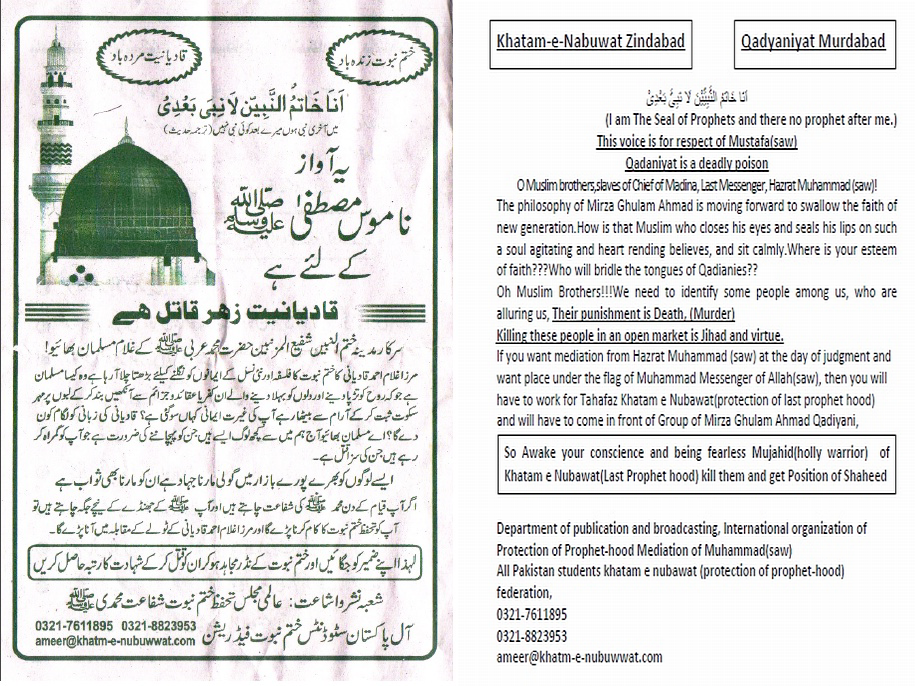
A spate of recent terror attacks suggests this might be Pakistan’s only way of battling its inner demons. On May 28, armed militants attacked two mosques of the Ahmadiya community in Lahore. Ninety-seven people died and dozens were wounded.
Then on July 1 there were twin suicide attacks on Data Darbar also in Lahore, one of the largest and most visited Sufi shrines in Pakistan. The attack on the shrine was extraordinarily bold because it was an attack on Pakistan’s majority of Sunni barelvi believers. Some 43 people died.
In Faisalabad, on July 2, two Christian brothers were arrested for violating the Blasphemy Law. They’ve been accused of writing a pamphlet with derogatory comments about Prophet Muhammad. [
Both of them were killed on 19th by an unknown gunmen in fron of City Court, while in Police custody.] In Waris Pura, a locality of some 100,000 Christians, Muslim mobs have been threatening to burn homes and kill Christians if both brothers are not executed.
The simple fact is that the state has, especially over the last 40 years, allowed for the persecution of its minorities. It has rewarded its majority to discriminate against them.
Sound harsh? A little exaggerated? Here are the facts.
Lets start with the Ahmadiyas. In 1974, under the supposedly liberal leadership of Zulfiqar Ali Bhutto, parliament passed a law declaring Ahmadiyas non-Muslims. This was a reward to the Jamaat-e-Islami party in Pakistan for spreading virulent anti-Ahmadiya hate speech and demanding their removal from the esteemed list of Pakistan-approved Muslim identities.
As if that wasn’t enough, Pakistan’s favorite general, General Zia ul Haq — whose arched eyebrows would have given Jack Nicholson some sleepless nights — presided over
Ordinance XX in 1984. The ordinance spelt out the following: Ahmadiyas were not allowed to call themselves Muslims, to pray in regular mosques, to read out Quranic verses, or to “pose as Muslims.”
Move now to Faisalabad where street protests against two Christian brothers are mounting. No one has witnessed the brothers writing the pamphlet. As members of a tiny minority they’re unlikely to have wanted to defile anything Muslim in public or in private.
But the problem for Rashid and Sajid Emmanuel is something called the Blasphemy Law. Another gift of Zia ul Haq, the 1986 law carries the penalty of death for anyone who desecrates the Quran or defiles the name of Prophet Muhammad.
Many dubious claims invoking blasphemy have been made against innocent Muslims, Hindus and Christians alike since the law was first passed. Surrounded by a volatile public whose religious sensitivity is beyond reason, the accused often gets his or her death sentence before the matter even reaches the court.
Pakistan has always struggled to define itself. In the absence of a concrete identity, Islam has been used and manipulated for political ends. In 1958 the official tag of “Islamic” Republic was added to its name.
Pakistan’s founder, the barrister Mohammad Ali Jinnah, had no such plan for Pakistan. On Aug. 11, 1947, when addressing the first constituent assembly, he told Pakistanis, “You are free; you are free to go to your temples, you are free to go to your mosques or to any other place of worship in this State of Pakistan. You may belong to any religion or caste or creed — that has nothing to do with the business of the State.
“You will find that in course of time Hindus would cease to be Hindus and Muslims would cease to be Muslims, not in the religious sense, because that is the personal faith of each individual, but in the political sense as citizens of the State.”
That was not Jinnah’s singular speech on secularism.
Sadly, he died in 1948 and what has happened since then is a sad and dangerous tale.
As the 2010 report of the United States commission on International Religious Freedom puts it: “Religiously discriminatory legislation has fostered an atmosphere of intolerance” in Pakistan.
Over the years Pakistanis have watched as minority groups and women have been targeted. Yet with the exception of a few activist groups and human rights organizations, the majority of Pakistanis have maintained a condemnable silence.
The difference was palpable in national reactions to the two, separate attacks on religious communities in Lahore.
“This act of violence was unanimously — politicos, religiosos and all — vociferously ‘condemned’ and the country saw many protests, demos and city shut-downs,” Amina Gilani wrote, referring to the attacks on Data Darbar, in The Tribune, one of Pakistan’s English-language dailies. “A somewhat different reaction to the event of May 28 … The reaction of the majority — politicos, religiosos and all — was comparatively rather muted. It raised no suggestions for a national get-together.”
How does Pakistan turn over a new leaf? Pakistan’s only salvation to cleanse the state and its mindset is to return to a secular identity.
“[We] will need a revolution of the national mindset and a whole new constitution,” said Ardeshir Cowasjee, a longtime writer and editorialist. “[We] will also need a whole and entire new brand of politicians, or leaders of whatever type. We need to do away with ‘Islamic’ and with the Objectives Resolution before we can even begin to make progress — plus ditch quickly the Hadood Ordinances and the blasphemy laws and all Islamic provisions, which govern this country. So it has to be secularism all the way.”
That’s a lot of work for any country, more so for one in crisis.
Still there are forces moving in that direction. On Christmas Day last year, Haji Adeel, a major political leader of the Awami National Party and a Pakistani senator, advocated a return to secularism. Adeel found himself the target of a host of critics including the Islamic right. But he also found supporters, and set off debate in various circles about the idea.
Now that Saudi-style and Saudi-funded Wahhabi Islam has reached the popular shrine of Data Ganj Baksh, perhaps more Pakistanis will see that the anti-American, anti-Israeli and anti-colonialist body that defines itself as the Taliban, is also anti-them.
Still, even if secularism is Pakistan’s yellow brick road to saving itself, it’s going to take a lot more than changing the constitution and axing a few laws. This is a battle for changing mindsets, and Pakistanis are in it for the long haul.
 Washington: Noting that serious problems remain in Pakistan with regard to religious freedom, the Obama administration has expressed its concern over the existence of laws that are “discriminatory” against religious minorities.







 Posts
Posts


