Showing posts with label impunity. Show all posts

Thursday, June 2, 2011

A question of faith: ‘Repeal blasphemy law or make it flawless’

Express Tribune, Pakistan
Pakistan
A question of faith: ‘Repeal blasphemy law or make it flawless’
Published: June 2, 2011

Report documents the deteriorating state of minorities in Pakistan.
A Think Tank working on minority issues in Pakistan has called upon the government to repeal the blasphemy law, or at least amend it to remove all vague terminology to prevent its misuse.

The Jinnah Institute’s report, “A Question of Faith”, also calls for addition of a section in the Pakistan Penal Code making advocacy of religious hatred or incitement to discrimination or violence a punishable offence.

The institute has published 23 recommendations, including the removal of impunity for prayer leaders in mosques, police and judicial reforms and clarification of the status of Federal Shariat Court and the Council of Islamic Ideology. It also calls for an appointment of a “Special Ombudsman” to protect the rights of women and minorities.

The research team interviewed 125 people including minority representatives, victims and non-governmental organisations’ workers all over Pakistan between December 2010 and April 2011. It documents the deterioration in the political, social and economic status of members of religious minorities in Pakistan, “particularly the rising tide of vigilante violence against them”, according to a press release issued by the institute.

The report focuses on Christians, Hindus and Ahmadis, three prominent minority groups in the country. According to the report, the conditions for Christians have deteriorated over the years. The Christians “are on the frontline of the persecution and violence against minority communities.”

Interviews with Christians of different age groups and professions revealed that many of them felt they “are treated as second-class citizens and discriminated against in all aspects of life.” Moreover, most of those who can, do move away from Pakistan. Those who choose to stay back do so because of a “strong sense of commitment to the country and being ‘Pakistani’.”

Christians in rural areas have to deal with instances of their land being grabbed by local Muslim residents and in some of the more serious incidents, the Christian residents did not come back to their homes.

Eighty per cent of the Hindus in Pakistan live in Sindh, and “are victims of caste and wider religious discrimination,” said the report. They do not own lands and work on daily wages, a consequence of them not having any permanent settlement. The report said, “One day, they are with one landlord, the next day with another. And this is how they spend a life of debt, with no accountability or education.”

Their castes have translated into daily life. For instance, Hindus from a lower caste might be restricted to a separate water well in a school, “from which even the Muslims will not drink”.

Higher caste Hindus have their own set of problems to contend with. They live in a state of insecurity and are frequently kidnapped for ransom. For instance, 82-year-old Lakki Chand Garji, a prominent Hindu spiritual leader, was kidnapped on December 21, 2010 and is yet to be traced and rescued.

Then there’s the matter of Hindus being suspected of having sympathy for India. Some Hindus said that “they dealt with the repercussions of the destruction of the Babri Masjid across the border in India in 1992.”

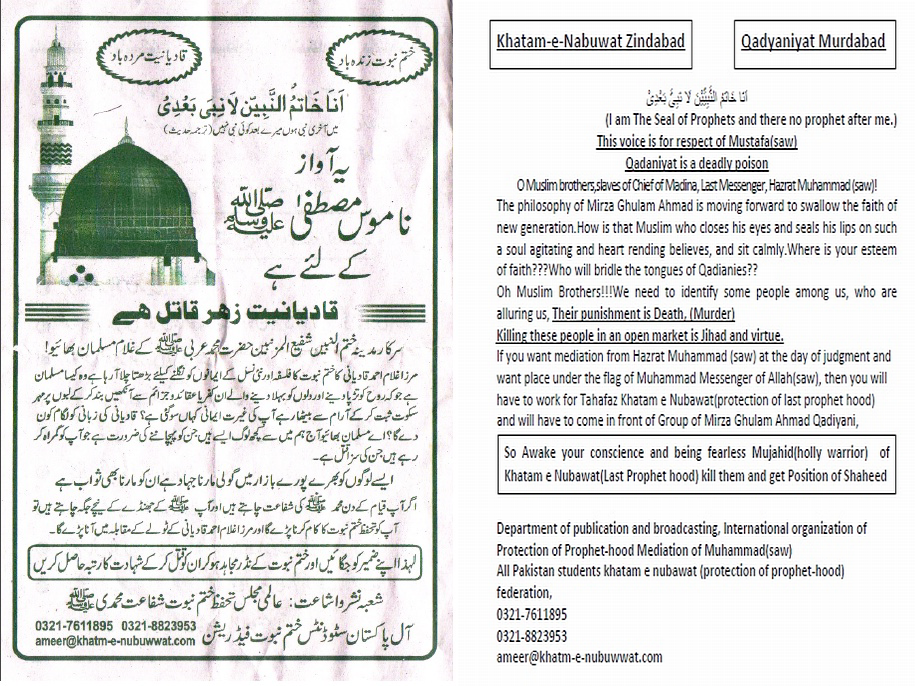
Violence against the Ahmaddiya community has also been on the rise in the past three years, according to the report. The report attributed the increase in violence to maulvis “promoting such attacks and inciting violence in their sermons and in the media.”

Sherry Rehman, President of Jinnah Institute, introduced the report on Tuesday and spoke about the need to reinstate the model of inclusive citizenship envisioned by Mohammed Ali Jinnah.

Published in The Express Tribune, June 2nd, 2011.

Wednesday, June 1, 2011

Report on status of religious minorities launched

The News - Internet Edition
Wednesday, Junne 1, 2011,
Jamadi-us-Sani 28, 1432 A.H.
Islamabad
Report on status of religious minorities launched

Wednesday, June 01, 2011

A report on the status of religious minorities in Pakistan, titled ‘A Question of Faith’, was launched by the Jinnah Institute. The report is a research study, compiled over the period December 2010-April 2011 and documents the deterioration in the political, social and economic status of members of religious minorities in Pakistan, particularly the rising tide of vigilante violence against them, says a press release.

The report was prepared in consultation with members of several religious minorities across the country, human rights organisations and policy experts. It lists recommendations for the redressal of grievances through constitutional amendments, political and judicial reform, sensitisation of media and revision of educational curricula that imparts discrimination or hatred against minorities.

Findings of the report indicate that minorities in the country connect strongly with a Pakistani national identity, even as they are persecuted on the basis of their religion. It is emphasised that the Pakistani state needs to take steps towards ensuring that citizens of the country do not continue to fall victim to cruelty and vigilantism and that a critical mass of Pakistanis has to help arrest the discrimination and persecution against minorities.

Sherry Rehman, President of Jinnah Institute, introduced the report and spoke about the need to reinstate the model of inclusive citizenship envisioned by Mohammed Ali Jinnah. Mariam Faruqi, lead researcher and author of the report, gave a presentation on the findings and key recommendations contained in the study. Advisor to Prime Minister, Paul Bhatti, stated that a collective effort was required by all concerned to uphold values of human dignity, justice and peace and to create rights for minorities. Joseph Francis, Director CLAAS recalled the historical discrimination against the Christian population and pointed towards laws that lead to systemic discrimination. Krishan Sharma, prominent minority rights activist, presented a list of recommendations from his research paper that demanded repeal of those laws. Ali Dayan Hasan of Human Rights Watch commented on how laws relating to minorities in Pakistan were effectively instruments of coercion and questioned the sustainability of liberal pluralism in the country.

Friday, August 20, 2010

HRCP condemns denial of relief to Ahmedis

HRCP
Date: 20 August 2010
HRCP condemns denial of relief to Ahmedis

The HRCP is shocked by reports that government officials and local clerics have refused to provide shelter to around 500 flood-affected Ahmedi families from Dera Ghazi Khan, Muzaffargarh and Rajanpur districts

Lahore, August 20: The Human Rights Commission of Pakistan (HRCP) has expressed serious concern over the murder of two Ahmedis in the last three days and over reports of denial of shelter to members of the Ahmedi community displaced by massive floods in South Punjab, and has called upon the government to take urgent measures to ensure there is no discrimination on the basis of belief and that assistance and protection are not denied to a community that faces specific threats.

In a statement issued on Friday, HRCP said: “The unrelenting targeted killings of members of the Ahmedi community by extremists is a poor reflection on the State’s obligation to protect the lives of all subjects. This week, the murder of an Ahmedi in Sanghar and another, a doctor, in Karachi only highlights the impunity the perpetrators of such heinous crimes enjoy. Only bringing the culprits to justice and promoting tolerance in society would bring an end to these senseless killings and would give the Ahmedi community confidence that they can lead peaceful lives as equal citizens of Pakistan.

The HRCP is also shocked by reports that government officials and local clerics have refused to provide shelter to around 500 flood-affected Ahmedi families from Dera Ghazi Khan, Muzaffargarh and Rajanpur districts.

The Commission has noted with extreme concern reports of lack of provision of relief goods to the flood-affected Ahmedi families, expulsion of displaced Ahmedis from a government school in Dera Ghazi Khan and from rented lodgings elsewhere in South Punjab following clerics’ pressure as well as the issuance of edicts by clerics that the affected Ahmedis must not be provided help.

HRCP reiterates the urgent need for distribution of relief goods and extension of other support to the affected people without any discrimination on the basis of faith or gender. The fact that the Ahmedis are a vulnerable community on account of their religious beliefs must lead to specific assistance and protection measures for them, including protection of their lives and property.

The extensive scale of displacement and destruction by the massive floods has understandably stretched the resources of the government to their very limits. However, it is hoped that whatever little is available from any source will be distributed among those in need without discrimination on the basis of religious belief. It would be a greater tragedy than the devastation caused by the floods if the people cannot find enough humanity and compassion in their hearts to rise above personal biases to help without distinction fellow human beings that are in desperate need of help.”

Dr Mehdi Hasan
Chairperson


URL: http://www.hrcp-web.org/showprel.asp?id=158

Saturday, May 8, 2010

Terrorists grow where freedom does not

---OregonLive.com, USA
Hot Topic, International affairs, Terrorism, oped »
Terrorists grow where freedom does not
May 08, 2010, 4:23PM

By HARRIS ZAFAR

The alleged culprit in last weekend’s attempted terrorist attack in Times Square is a 30-year-old U.S. citizen of Pakistani descent who recently traveled back to Pakistan for bomb training. This is not the first time we have heard of a Muslim American of Pakistani descent attempting to kill fellow Americans.

Why does this keep happening? Is there something wrong with Pakistani people? I find myself asking this question so much because on paper, the description of Faisal Shahzad – the suspect in the attempted Times Square bombing – sounds a lot like me. Early 30s … American citizen … Pakistani ethnicity … American education … working a normal 9-to-5 job … from an educated family. How can two people with these similarities turn out so different? Why did he lean toward terrorist tendencies while I maintained my Islamic identity as a person who stands for peace, loyalty and freedom?

To understand this, one must understand the environment that Shahzad grew up in and how it formed a subtle but lasting impression on his mind. Whereas I was born and raised in the United States, Shahzad grew up in Pakistan and only came here 11 years ago. And it is there in Pakistan where Shahzad learned that it is OK to get rid of anyone who you disagree with. The mentality subconsciously instilled in young minds growing up in that society is that people with different views are bad and must be taken out.

Pakistan is one of the only countries in the world that prosecutes and persecutes its own citizens for what it calls “blasphemy.” Under the Pakistani Penal Code, any person found guilty of blasphemy is subject to either the death penalty or life imprisonment. The actual law states, “Whoever by words, either spoken or written or by visible representation, or by any imputation, innuendo, or insinuation, directly or indirectly, defiles the sacred name of the Holy Prophet Mohammed shall be punished with death, or imprisonment for life, and shall also be liable to fine.”

So how did this manifest itself in a way that would have a direct impact on a Pakistani citizen’s psyche? Well, this law has been used to prosecute more than 650 Christians in Pakistan for blasphemy. Even moderate Muslims in Pakistan – namely, the Ahmadiyya Muslim Community – have been charged under this law for blaspheming. Pakistan took it a step further in 1984 when it passed “Ordinance XX,” which prevented members of the Ahmadiyya Muslim Community from even calling themselves Muslims. If they do call themselves Muslims, they are subject to imprisonment and death.

Why such a bold law? Because Pakistani clerics disagreed with the Ahmadiyya Muslim Community’s belief that the promised messiah and reformer – the one Muslims have been waiting for – had come in the person of Mirza Ghulam Ahmad of Qadian. Pakistan passed laws to censor their thoughts and expressions and has exerted authority over minority religious groups to keep them quiet.

How ironic it is, then, that the Ahmadiyya Muslim Community USA was the first and foremost Muslim community in this country to speak out and condemn Shahzad’s actions. Its vice president and missionary-in-charge, Naseem Mahdi, made a bold statement Tuesday not only condemning the attempted terrorist plot but saying that any Muslim living in America who is not loyal to this country should go live in the land where they feel their loyalties belong. This is based on the Prophet Muhammad’s saying, “Love of one’s homeland (one’s place of residence) is a part of the Muslim’s faith.”

How such a community can be declared non-Muslim and punished by threats of imprisonment and death in Pakistan is beyond my comprehension. In order to avoid more Shahzads in the future, we need to set a precedent that differences in opinion or interpretation do not justify legal action. The average Pakistani citizen may not try to murder Americans himself or herself, but these people are vastly silent toward those who do. Their anti-blasphemy laws have desensitized them to the point where they have not the courage to speak out against morally repugnant actions and laws.

To save future generations from falling into the same pitfalls of subtle acceptance of extremism, or even full participation in terrorism like Shahzad, Pakistan must repeal these anti-blasphemy laws immediately. Pakistanis need to get to the root of the problem. Instead of hoping that our law enforcement officials can continue to heroically prevent future attacks from being successful, let’s put our efforts in preventing the idea of such attacks.

Harris Zafar is the national director of community service and local coordinator of faith outreach for a Muslim youth organization, and a freelance writer based in Portland.
Reach him at hrzafar@gmail.com.

© 2010 Oregon Live LLC. All Rights Reserved
URL : www.oregonlive.com/opinion/index.ssf/2010/05/terro...om.html

Sunday, May 2, 2010

Not the voice of the creator

---Dily Dawn, Pakistan
 
Not the voice of the creator
  By Ardeshir Cowasjee
  Sunday, 02 May, 2010

We inhabit a land where death no longer diminishes us, where those that hand it out do so with impunity, with no fear or trepidation.

Day after dreary day it goes on — a professor, a woman, shot and killed in a rickshaw in Quetta, four policemen blown up in Peshawar, five ‘activists’ shot dead in Karachi, and more, much more.

This land has a helmsman of little consequence and the sub-leadership is habitually frugal with the truth, always hoping that lies will sustain them. The future is hardly exhilarating, and we heedlessly plod on. We are not even told the truth when the latest political ‘triumph’ is bandied about, we are told about the 18th Amendment to the constitution, to many a non-event, to others an affront to democracy, and to those who brought it about a means to survive the parliamentary term extended to them.

The latest amendment has not restored the original 1973 constitution — those that claim that it has cannot be that ignorant, so they are resorting to mendacity in aid of expediency. The constitution is left, post-amendment, with vestiges of the 17th Amendment of military dictator Gen Pervez Musharraf, and with its greatest polluter, the 8th Amendment of military dictator Gen Ziaul Haq, littering its pages.

That being so, credit must be given where due — and due it is as far as one insertion is concerned, though the piece of legislation into which one word was restored should never have come into being. Part of the 8th Amendment was the inclusion into the constitution of the Objectives Resolution by Article 2(A) reproducing it in the annex and making it a substantive part of the constitution — and this notwithstanding the fact that the Objectives Resolution already formed its preamble.

There was one glaring difference in preamble and annex — why and how it came about has never been explained but it must be assumed that it was a mala fide exercise. One principle enunciated in the resolution pertains to the minorities: “Wherein adequate provisions shall be made for the minorities freely to profess and practise their religions and develop their cultures.” Such is recorded in the preamble. But in the annex the word ‘freely’ was omitted, thus altering the entire spirit of the provision. The missing word has now been re-inserted by the 18th Amendment — so on that score, well done!

The Objectives Resolution, legislation which would never have been permitted by the founder maker of this country, Mohammad Ali Jinnah, came into being in March 1949, a mere six months after his death when his loyal lieutenants succumbed to the pressures of the religious right which sought to impose its will on a country, the formation of which it had either opposed or stood by silently while the Muslim League struggled. It negated all that Jinnah had stood for, if we are to take as our guideline his famed address to the constituent assembly of Aug 11, 1947, when he declared that faith, caste or creed were to be put aside and all were to be equal citizens of one country, and, most importantly, that religion was not the business of the state.

The most ominous words spoken that March day when the resolution was passed by the constituent assembly were spoken by Hindu citizen of Pakistan, Sri Chattopadhyay, who represented 25 per cent of the then East Pakistan population.

“I do not consider myself as a member of the minority community. I consider myself as one of seven crores of Pakistanis. Let me retain that privilege.”

“I sadly remind myself of the great words of the Quaid-i-Azam that in state affairs the Hindu will cease to be a Hindu; the Muslim shall cease to be a Muslim. But alas, so soon after his demise what you do is that you virtually declare a state religion.”

“You could not get over the old world way of thinking. What I hear in this resolution is not the voice of the great creator of Pakistan — the Quaid-i-Azam, nor even that of the prime minister of Pakistan, the honourable Mr Liaquat Ali Khan but of the ulemas of the land.”

“This resolution in its present form epitomises that spirit of reaction. That spirit will not remain confined to the precincts of this house. It will send its waves to the countryside as well. I have been passing sleepless nights pondering what shall I now tell my people whom I have so long been advising to stick to the land of their birth.”

“And on the top of this all, by this resolution you condemn them to a perpetual state of inferiority. A thick curtain is drawn against all rays of hope, all prospects of an honourable life. After this what advice shall I tender? What heart can I have to persuade the people to maintain a stout heart?”

The waves indeed swept through the country, the first manifestations of intolerance, bigotry and their accompanying violence coming in 1953 with the anti-Ahmadi riots in Punjab. The rot grew and was given full impetus in 1977 when socialist democrat Zulfikar Ali Bhutto (who throughout his life showed few signs of fanatic zealotry) miserably surrendered to the mullah fraternity in the hope that he could cling on to a fast disappearing power seat. From then on, with the advent of Gen Ziaul Haq and his particular brand of religion, the descent has been swift.

Those who followed either exhibited little will to stem the rot or were hand in glove with the forces of darkness, the enemies of tolerance. Jinnah’s Pakistan has virtually ceased to exist, but there are still some who hope it has not yet been interred for ever.

arfc@cyber.net.pk

©2010 DAWN Media Group. All rights reserved
URL : www.dawn.com/wps/wcm/connect/...he-voice-of-the-creator-250-hh-05

Monday, September 21, 2009

Pakistan: Religion and politics [Opinion]

---The News, Pakistan
Monday, September 21, 2009,
Shawwal ul Mukkarram 01, 1430 A.H
Religion and politics

Rubina Saigol

Monday, September 21, 2009
The writer is an independent researcher specialising in social development

In the past few months, there has been a noticeable increase in religiously-motivated violence against minority communities, especially in Punjab. The most recent case is that of 20-year-old Robert Fanish Masih, whose mysterious death in the Sialkot district jail, where he was interned after accusations of defiling the Holy Quran, raises serious suspicions of foul play and murder. According to a press release by the Joint Action Committee, this incident is reminiscent of an earlier one in which Muhammad Yousaf, also accused of committing blasphemy, was found dead in jail and the authorities declared it to be a case of suicide.

Cases of murderous attacks against Christians by frenzied mobs have risen at an alarming rate. In March, a Christian woman was killed in Gujranwala where a church was attacked. On June 30, a mob destroyed more than 50 Christian houses in Bahmaniwala in Kasur district and looted and plundered the village. And on July 30, seven people were brutally murdered in the Gojra carnage.

The typical pattern in many of these cases is an accusation (usually false) of the commission of blasphemy by a rival. This is normally followed by announcements from mosques loudspeakers inciting people who then congregate and turn upon their own neighbours and erstwhile friends. As pointed out by the Human Rights Commission of Pakistan, the local administration and police often collude with the perpetrators or, at best, stand by and do nothing, themselves fearful of the mob. The state becomes an onlooker instead of intervening to protect its powerless citizens against the heinous crimes committed in broad daylight.

As the large number of blasphemy cases in the past have demonstrated, the real motive for instigating the crowd often has nothing to do with blasphemy. Frequently, disputes over money, property or other pecuniary matters lead to false accusations of blasphemy. An accusation of blasphemy is invariably deployed as a weapon to browbeat others into submission. In the famous case of Salamat Masih, a 14-year-old accused of writing blasphemous words on a wall, the quarrel among children started over pigeon fights. Had human rights activists like Asma Jahangir not saved his life, our state was about to send an innocent person — a child — to the gallows. The horrific implications of law cannot be overstated.

What has enabled religion to be used as a weapon to incite raw passions against fellow citizens to murder them with impunity? The immediate cause is the pernicious and widely abused blasphemy law as enunciated in Chapter XV of the Pakistan Penal Code. Sections 295 to 298 of the chapter refer to offences related to religion. Section 295 provides that, “Whoever destroys, damages or defiles any place of worship, or any object held sacred by any class of persons with the intention of thereby insulting the religion of any class of persons is likely to consider such destruction, damage or defilement as an insult to their religion, shall be punished with imprisonment of either description for a term which may extend to two years or with fine or with both.” In 1927, the British government added 295-A which reads that “whoever with deliberate and malicious intention of outraging the religious feelings of any class of His Majesty’s subjects, by words, either spoken or written, or by visible representation, insults or attempts to insult the religion or the religious beliefs of that class, shall be punished with imprisonment of either description for a term which may extend to two years, or with fine, or with both.” In 1991, the imprisonment term was extended from two to 10 years.

In 1982, at the peak of General Zia’s period, 295-B was added to include the desecration of the Holy Quran and to enhance punishment. This section reads as follows: “Whoever wilfully defiles, damages or desecrates a copy of the Holy Quran or of an extract therefrom, or uses it in any derogatory manner or for any unlawful purpose shall be punishable with imprisonment for life.” The Majlis-e-Shoora designed by Zia further added 295-C, which reads: “Whoever by word, either spoken or written, or by visible representation, or by any imputation, innuendo or insinuation, directly or indirectly, defiles the sacred name of the Holy Prophet Muhammad (Peace Be Upon Him) shall be punished with death or imprisonment for life, and shall also be liable to fine.” In 1990, the Federal Shariat Court constituted by Zia hammered the last nail in the coffin of sanity and justice by declaring that Islam provides punishment for hadd which is mandatory, therefore the words “imprisonment for life” should be removed from Section 295-C. Now, the only punishment for blasphemy was death. Section 298 relates to the Ahmadiyya community and institutionalises systemic prejudice against their right to practice their faith.

Before the Federal Shariat Court provided for the mandatory death penalty, no case of blasphemy was registered under Section 295-B or 295-C. This judgment paved the way for murder and created the environment in which vigilantism was encouraged and promoted. Manzoor Masih lost his life in a wanton act of murder outside the Lahore High Court. One of the court’s judges, Justice Arif Bhatti, who overturned the conviction of Salamat and Rehmat Masih by a lower court, was murdered by the purveyors of a grotesquely distorted religion. Niamat Ahmar, a poet and teacher, was butchered in Faisalabad by activists of the Sipah-e-Sahab-e-Pakistan; Bantu Masih and Mukhtar Masih were killed in police custody by fundamentalists while the authorities looked on. In 2008, two Ahmadis were murdered when a television anchor declared their community wajib-ul-qatl (deserving to be killed).

How has the state enabled this travesty of justice, this steady descent into inhumanity? The blasphemy law is only a part of the story; the issue of religious inequality and discrimination is much deeper. The entire problem began with the Objectives Resolution of 1949 when the state began to move in the direction of a theocracy. Its passage, despite the objections of the non-Muslim members of the Constituent Assembly, became possible because Jinnah’s vision, as outlined on August 11, 1947, was overlooked. Subsequently, every Constitution of Pakistan (1956, 1962 and 1973) carried a section on Islamic provisions which mandated that all laws would be enacted in line with religion.

Religious discrimination and inequality are institutionalised within the state structure. Article 2 of the Constitution declares that Islam is the state religion and Article 2-A makes the Objectives Resolution a substantive part of the Constitution. Non-Muslim citizens cannot hold two of the highest offices of the land and Islamic provisions of the Constitution (Articles 227-230) are designed to ensure that all laws conform to the Holy Quran and Sunnah. Citizens belonging to other faiths are systemically excluded and relegated to a secondary position. The increasingly religious character of the Constitution, with General Zia’s Eighth Amendment protecting his draconian vision and measures, violates the principle of equal citizenship on which the entire edifice of democracy rests.

Every provision that reduces the citizenship status of groups of people contradicts Article 25 (1) of the fundamental rights chapter which pronounces that all citizens are equal before the law. Similarly, Article 8 (1) avers that any law, custom or usage that is inconsistent with the rights conferred by this chapter shall be null and void. It follows that all the provisions that create discrimination and inequality among citizens should be removed. As Pakistanis focus on the task of reformulating their basic law and re-imagining their state, it seems prudent to separate religion from politics, as their mixture debases both religion and politics – the former by associating it purely with the attainment of political power and militant activity, the latter by making some more equal than others. Merely repealing the blasphemy law is not sufficient; we need to transform the basic framework from which such laws flow.

Email: rubinasaigol@hotmail.com

URL: www.thenews.com.pk/daily_detail.asp?id=199521

Friday, August 7, 2009

Letter to President Yudhoyono on Human Rights Concerns in Indonesia

---Human Rights Watch, USA

Letter to President Yudhoyono on Human Rights Concerns in Indonesia
August 6, 2009

Dr. H. Susilo Bambang Yudhoyono
President, Republic of Indonesia
Gedung Bina Graha
Jl. Veteran 16
Jakarta Pusat

Re: Human Rights Concerns in Indonesia

Dear President Yudhoyono,

Congratulations on your recent election success. Human Rights Watch would like to say selamat menunaikan tugas, good luck in carrying out your duties as president. We encourage you to build on the successes of your first term in office, and bring new energy to areas including human rights where important objectives have not yet been achieved.

For many years, Human Rights Watch has raised human rights issues with the Indonesian government. With another five-year term, you and your new coalition government have an opportunity, and the responsibility, to address continuing human rights concerns in Indonesia. As Indonesia is a party to the major human rights treaties, we urge you to ensure that Indonesia lives up to its international legal obligations.

To this end, we write to you with specific recommendations on the issues that have important implications for the human rights of Indonesians, specifically corruption, military business, impunity, religious freedom, freedom of expression, the situation in Papua, and child domestic workers. We urge you and your government to give high priority to each of these issues.

Corruption

Anti-corruption measures are critical to ensuring that human rights protections are enjoyed by all Indonesians. Corruption diverts money that could have been collected as tax revenue away from government coffers-funds that could otherwise have been spent on social spending, such as improving access to health services. To this end, we urge you to deliver on your campaign promises to fight corruption and improve the welfare of Indonesia’s citizens. We commend the progress made by the Anti-Corruption Commission (KPK), established under your first administration. Yet current trends undermine the effectiveness and very existence of the commission. In particular, to ensure its continued existence, the National Parliament must pass a bill to reestablish the KPK court by September 30, but the bill is not on the list of priority legislation for the parliament's attention. Further clauses in the bill are under debate that, if included in the final legislation, would erode the commission's effectiveness and independence, including by limiting the KPK to an investigative function and reducing the number of ad-hoc judges to sit on trial panels.

Anti-corruption efforts should be broadened to be effective. Sustained, rigorous efforts to root out corruption in the police, judiciary and military will help stem the loss of tax revenues from lucrative natural resources, especially the forestry and plantation sectors. Strong leadership from yourself and the Ministry of Forestry is needed to implement anti-corruption reforms, such as chain of custody mechanisms to ensure the legal origin of wood products and the full payment of forestry taxes.

We urge you to:
  • Act immediately to ensure the National Parliament enacts legislation to renew the KPK court, without eroding its authority or independence. If necessary issue an appropriate executive order until legislation can be passed;
  • Ensure corruption investigations sufficiently extend to the judiciary, police and military, including the use of anti-corruption and money laundering legislation to fight corruption in the forestry sector;
  • Stem the loss of government tax revenues from forestry corruption by finalizing chain of custody and revenue tracking mechanisms.
Military Business

Dismantling business activity by the armed forces (Tentara Nasional Indonesia or TNI) is widely recognized as a necessary pillar of military reform. But progress has been slow, despite a 2004 legal mandate requiring the government to shut down or take over all of the TNI’s business interests before October 2009. We understand that your government has recently decided on a course of action and is finalizing a presidential decree that sets out how it will proceed. We hope that, as the culmination of nearly five years of discussion and debate, this effort will embody a well-considered and comprehensive approach.

TNI involvement in the economy takes several forms: military-owned businesses; collaboration with the private sector (including protection payments); criminal enterprises; and various forms of corruption. Each is pernicious, amounting to an abuse of power as well as a misuse of state assets. Human Rights Watch has shown that money-making ventures by TNI foundations and cooperatives at all levels fuel human rights abuses and create conflicts of interest. Military involvement in illegal businesses, including in the logging and oil palm sector, undermines the rule of law and Indonesia’s anti-corruption agenda.

The fact that Indonesia’s military derives funds from ties to the private sector, including corporate security payments, presents another ongoing concern. Controversy over such payments has resurfaced in the wake of the series of deadly shootings in July 2009 near the Freeport McMoRan copper and gold mine in Papua. Although a 2004 presidential decree stipulates that responsibility for guarding major corporate sites should transfer from the military to the police, this handover has been incomplete. Company filings in the United States show that Freeport’s total spending on “support costs” for the 1,850 Indonesian soldiers and police who operated in and near its mine reached US$92 million through 2008, including US$8 million for 2008 alone. Some of these funds are dispersed as cash “allowances.”

We urge you to take firm action to end the involvement of Indonesia’s security forces in wide-ranging economic activities as follows:
  • Move expeditiously to issue the long-awaited presidential decree on TNI business reform and accompanying regulations. These measures should be comprehensive and without exceptions, incorporating robust accountability provisions for TNI business dealings (including the unauthorized sell-off of companies and the misuse of state assets) and associated abuses, and be complemented by strict enforcement of the ban on all military business activity;
  • Reject a proposal to transfer TNI businesses to the nominal control of the civilian-led Ministry of Defense, where uniformed military personnel exercise great influence, and instead name an impartial body to take temporary control of such businesses until they are liquidated or sold off. Adopt and enforce similar measures prohibiting business activity in any form by the police;
  • Call for a full, impartial, and transparent investigation of company payments for government security, ensuring that regular reporting on the progress of such investigations takes place and is shared with the Secretariat of the Voluntary Principles on Security and Human Rights, as well as corporations operating in Indonesia that have joined the initiative.
  • Act to end the practice whereby the presence of government security forces at major corporate sites is underwritten by the companies. Develop an alternative system of financing for public security such that the cost of security is paid from government coffers and the funds directed to this purpose are independently audited, and publicly disclosed in detail.
Impunity

There is still widespread impunity for members of the security forces responsible for serious violations of human rights. Indonesian military officers and militia leaders have yet to be brought to justice for the atrocities committed by their forces in East Timor, Papua, Aceh, the Malukus, Kalimantan, and elsewhere.

A bellwether test is the case of Munir bin Thalib, a respected human rights advocate murdered on a Garuda Indonesia flight five years ago. In 2004, you yourself said that finding Munir’s murderer is “the test of our history.” On December 31, 2008, a Jakarta court acquitted Maj. Gen. Muchdi Purwopranjono, a former deputy in the State Intelligence Agency, of Munir’s murder in a trial marred by witness coercion and intimidation. On June 15, 2009, the Indonesian Supreme Court rejected an appeal by state prosecutors of Muchdi’s acquittal.

Human Rights Watch understands the difficulties in investigating a murder allegedly involving a state intelligence operation. But there are serious concerns about events in the lead-up to the trial and the quality of the evidence. Witnesses were possibly intimidated into changing their statements, a key witness fled the country and the prosecution was weak.

During your previous term as president, you succeeded in ending the conflict in Aceh through the signing of a peace agreement between the Indonesian government and the Free Aceh Movement. But there is still no serious effort to establish a truth and reconciliation commission and a tribunal to look at crimes committed after the August 2005 peace agreement, as required by the 2006 Law on Aceh Governance. The tribunal was supposed to be in operation by August 31, 2007. For there to be lasting peace, those involved in extrajudicial killings and other abuses need to be held accountable.

We urge you to:
  • Establish a new independent investigation into the murder of Munir bin Thalib with strong measures to protect witnesses;
  • Set up an inquiry into allegations that witnesses in the trial of Maj. Gen. Muchdi Purwopranjono were intimidated into changing their statements;
  • Encourage Aceh governor Irwandi Yusuf to establish the human rights tribunal as well as the Aceh Commission on Truth and Reconciliation. The Aceh commission can be established by provincial decree, without waiting for the establishment of the national commission.
Religious Freedom

Countries around the world, including the United States, are looking to Indonesia to lead in religious tolerance. In an October 2008 Newsweek interview you said that, “Indonesia has always tried to demonstrate and project moderate Islam. Indonesia is not immune to the radicalism, but this is exactly why we must maintain our identity as a moderate, tolerant nation.”

A June 2008 decree ordering the Ahmadiyah to cease public religious activities, and continuing violent attacks on Ahmadis and Christians show religious intolerance in Indonesia is on the rise. Following the Ahmadiyah decree, Islamist militants have closed Ahmadiyah mosques in Cianjur, West Java and attacked Ahmadiyah mosques in Greater Jakarta. In Lombok, around 160 Ahmadiyah members have been displaced from their homes since February 2006 because Islamist militants attacked and burned down their houses in Ketapang. The West Nusa Tenggara government has forbidden Ahmadis from returning to their homes, citing security concerns.

Another decree requiring anyone building “a house of worship” to receive prior approval from other religious leaders has been used by Muslim clerics and Islamist militants to block the building of churches. Christian groups say that mobs forcibly closed or burned down more than 480 churches between 1969 and 2007 mainly in Java and Sumatra. On June 14, Islamist militants and government officials tried to demolish two church buildings in a village in Bekasi outside Jakarta because they had not secured approval from Muslim leaders. Members of church groups have been forced to hold meetings in private homes. The religious activities of one group should never be beholden to the approval of others.

Meanwhile, Sharia-based local law in provincial Aceh as well as in regencies in West Sumatra, West Java, Banten, South Sulawesi and West Nusa Tenggara violate the right to religious freedom and the rights of women, such as by forcing all women to wear the veil.

We urge you to:
  • Abolish the decree banning Ahmadiyah religious practices;
  • Protect religious minorities such as Ahmadis and Christians from violent attacks. While focusing efforts on Islamist militants, make clear to all religious communities that infringements on the rights to religious freedom will not be tolerated.
  • Establish a presidential team to review all local laws that might improperly infringe upon the right to freedom of religion under the Indonesian constitution and Indonesia’s obligations under international human rights law.
Freedom of Expression

Indonesia has a diverse and lively media, but the right to freedom of expression has been undermined by the use of criminal and civil defamation laws to silence criticism of the government. Offenses in Indonesia’s criminal code such as treason or rebellion (makar) and “inciting hatred” (haatzai artikelen) are used to suppress peaceful acts of free expression, including demonstrations and acts of flag-rising in Papua and the Moluccas where there are separatist movements. Under the 2001 Papuan Special Autonomy Law, symbols of Papuan identity such as a flag or song are permitted, but article 6 of Government Regulation 77/2007 prohibits the display of the Morning Star flag in Papua, the South Maluku Republic flag in Ambon, and the Crescent Moon flag in Aceh. Currently there are more than 170 people, including at least 43 in Papua, who are imprisoned throughout Indonesia for peacefully exercising their right to freedom of expression.

We urge you to:
  • Revoke regulations and provisions in the Indonesian Criminal Code that violate the internationally recognized right to freedom of expression;
  • Order the release of those currently in prison for peaceful acts of free expression.
Situation in Papua

In a 2005 speech, you said you would solve Papuan problems “peacefully, fairly and with dignity,” and in 2006 you said you would use “persuasion and dialogue” rather than violence in dealing with Papuan activists. Human Rights Watch takes no position on the right to self-determination, but we have long expressed concerns about ongoing abuses by the security forces in Papua and a complete lack of accountability. Restrictions on access by foreign human rights monitors and journalists to Papua exacerbate a climate where security forces can act with impunity by keeping abuses out of the public eye and making investigations more difficult.

Both army troops and police units, particularly mobile paramilitary units (Brigade Mobil or Brimob), engage in largely indiscriminate village “sweeping” operations through the Central Highlands in pursuit of suspected militants, using excessive, often brutal and at times lethal force against civilians. In routine policing, officers sometimes use excessive force. In Merauke, Kopassus soldiers have routinely arrested Papuans without legal authority, beating and mistreating those they take back to their barracks including by forcing them to chew chilies. In Jayapura, prison guards continue to torture inmates inside the Abepura prison. Such abuses contribute to continuing public unrest in Papua.

At the Freeport goldmine in Timika, violence has escalated recently with the killing of three people including one Australian in July 2009. Police arrested at least 20 Papuans in relation to the killings and have declared eight as suspects but they have had no access to lawyers. Media photographs showed the police had roughed up some detainees when making arrests.

We urge you to:
  • End restrictions on access to Papua for independent observers, including diplomats, foreign journalists, and human rights organizations, so that they can visit Papua without need for specific permission or approval;
  • Order an independent and impartial investigation into allegations of human rights violations in Papua, including killings, torture, arbitrary arrest and detention. Such an investigation should hold security forces accountable and bring the perpetrators of such abuses to justice;
  • State publicly that Kopassus and Kostrad troops should not be involved in law enforcement activities, which are the responsibility of the police, and call on the head of Kopassus, Maj. Gen. Pramono Edhie Wibowo, to publicly list the duties of Kopassus in Papua.
Child Domestic Workers

Hundreds of thousands of girls in Indonesia, some as young as 11, are employed as domestic workers in other people’s households, performing tasks such as cooking, cleaning, laundry, child care, and sometimes working at their employers’ businesses. Many girls work 14 to 18 hour days, seven days a week, with no day off. Many employer’s forbid these child domestic workers from leaving the house where they work, isolating them from the outside world and thus placing them at higher risk of abuse. Many employers withhold paying any salary until the child returns home-and many employers fail to pay the children at all or pay less than what they promised. In the worst cases, girls are physically, psychologically, and sexually abused by their employers of their employers’ family members, in addition to being exploited for their labor.

Indonesia’s labor law-the Manpower Act of 2003-excludes all domestic workers from the basic labor rights afforded to formal workers, such as a minimum wage, overtime pay, an eight-hour workday and 40-hour workweek, weekly day of rest, and vacation. This has a discriminatory impact on women and girls, who constitute the vast majority of domestic workers. This exclusion in the law also serves to perpetuate the devaluing of domestic work and domestic workers.

We urge you to:
  • Pass a Domestic Workers Law in time for the 2010 International Labor Organization Conference on Decent Work for Domestic Workers, that guarantees that domestic workers receive the same rights as other workers, such as a written contract, a minimum wage, overtime, a weekly day of rest, an eight-hour workday, rest periods during the day, national holidays, vacation, paid sick leave, workers compensation, and social security;
  • Instruct your Ministry of Manpower and provincial and district governments to strictly enforce 15 as the minimum age of employment for all sectors, including domestic work. Give priority to underage domestic workers for removal and recovery assistance to help them return to school, and rebuild their lives;
  • Ensure that police have the commitment and resources necessary to comply with their obligations under the Domestic Violence Act, in particular to provide temporary protection to a victim within 24 hours of knowing or receiving a report of violence in the household.
Thank you for your consideration. We would appreciate the opportunity to discuss these and other human rights issues with you and members of your administration.

Sincerely,

Brad Adams
Executive Director, Asia division
Human Rights Watch

CC: Vice President-elect, Boediono;
Vice President, Jusuf Kalla;
Speaker of the House of Representatives, Dr. Haj Ahmed Mahmin M.C.;
Speaker of the Regional Representatives Council, Agung Laksono
Minister of Foreign Affairs, Dr.Nur Hassan Wirajuda;
Minister of Defense, Prof. Dr. Juwono Sudarsono;
Minister of Justice and Human Rights, Andi Mattalata, SH, MH;
Minister of Manpower and Transmigration, Erman Suparno;
Chief of Army, Lt-Gen Agustadi Sasongko Purnomo;
Ambassador to the UN, H.E. Marty Natalegawa
Ambassador to the US, H.E. Sudjadnan Parnohadiningrat.

URL: www.hrw.org/en/news/2009/08...erns-indonesia

 
^ Top of Page