Showing posts with label Muhammad Yousaf. Show all posts

Thursday, January 28, 2010

Martyrdom of Professor Muhammad Yusuf

Video report on the martyrdom of Professor Muhammad Yusuf. Presentation of MTA Studios Pakistan.

Retired Professor Muhammad Yusuf (aged 70) was killed around 7:30am on 5th January, 2010 by two masked gunmen in Rachna Town, Ferozwala, Lahore when he was tending his son's grocery shop.

Sunday, January 24, 2010

Ahmadi leader’s family offered to withdraw case: accused

---Daily Times, Pakistan
Friday, January 22, 2010

Ahmadi leader’s family offered to withdraw case: accused

*Claim they want Khatam-e-Nabuwat Youth Wing dismantled
*Family deny allegation, say accused conducting anti-Ahmadi propaganda

LAHORE: The four men accused of murdering Professor Muhammad Yousaf, an Ahmadi leader from Ferozewala, have claimed that the man’s family has offered to withdraw the case against them if the Khatam-e-Nabuwat Youth Wing (KNYW) is shut down. Muhammad Ahmed Faridi, Inamullah – the president of the KNYW — Ashraf and Haji Arshad, all currently being held at the Ferozwala Police Station, told Daily Times on Thursday that the complainant had sent them various messages, offering to withdraw the case against them provided that the men guaranteed that they quit the KNYW and dismantled its operations, a claim that the complainant denies. Faridi said Inamullah had been “indirectly” contacted by the complainant, with an offer to withdraw the case against the men if they would quit the KNYW. They said they would never quit the KNYW, going as far as saying that they would prefer to die before they thought of leaving the organisation. Pakistan Muslim League-Nawaz Member of the Provincial Assembly Pir Ashraf Rasool, who is allegedly favouring the accused, told Daily Times that the complainant had asked him to offer the compromise to the accused. He said the accused had informed him that they were ready to face imprisonment or even the death sentence for the sake their beliefs. Fatehul Din, Yousaf’s son, told Daily Times that no one had made any such offer to the four men, adding that the accused were trying to divert attention from the real issue. He said they were trying to gain sympathy in the public and were trying to fuel public bias against Ahmadis. rana tanveer

URL: www.dailytimes.com.pk/default.asp?page=2010\01\22\story_22-1-2010_pg7_31

Wednesday, January 20, 2010

Ahmadi leader’s murder in Ferozewala: Police yet to ‘book’ suspects in custody

--- Daily Times, Pakistan
Tuesday, January 19, 2010

Ahmadi leader’s murder in Ferozewala : Police yet to ‘book’ suspects in custody
  • Men not produced in court, no paperwork against them yet
  • Bereaved family claims politicians ‘restraining’ police from taking action
  • DSP declines comment
By Rana Tanveer

LAHORE: The ‘arrest’ of four people in connection with an Ahmadi leader’s murder was meant to merely pacify the bereaved family, as police have not made the case against them official, nor have their names been mentioned in any paperwork. In addition, the men are yet to be interrogated, Ferozewala police sources told Daily Times on Monday.

On January 13, Ferozewala police arrested Muhammad Ahmed Faridi, Inamullah, Ashraf and Haji Arshad, for their involvement in the January 5 murder of a local Ahmadi leader, Muhammad Yousaf.

Sources said police had arrested the men only to placate the aggrieved party, but had not fulfilled all the legal formalities.

They said certain influential individuals were pressing police not to book them and keep them in lock for some time before declaring them innocent and releasing them without presenting them in court.

When contacted, Ferozewala Deputy Superintendent of Police Tariq Gujjar avoided comment on the issue.

Fatehul Din, son of the slain Ahmadi leader Muhammad Yousaf, told Daily Times that police was using ‘delaying tactics’ to hush up the case. “The police are probably serious about pursuing the matter, but certain influential politicians are pressing them to hush it up.”

Din said he had even submitted a proof of the accused’s involvement in the case to the investigation officer, adding that he had pictures proving the men in custody were provoking locals against Ahmadis in the area.

He said there had been no development in the investigation as police had been restrained from performing their duties. Din said the accused were given ‘undue protocol’ at the police station.

His counsel, Muhammad Abu Bakar, told Daily Times that according to Section 167(2) of the Criminal Procedure Code (CrPC), police were bound to produce the accused before a magistrate for a physical remand within 24 hours of the arrest.

URL: www.dailytimes.com.pk/default.asp?page=2010\01\19\story_19-1-2010_pg13_4

Thursday, January 14, 2010

Ahmadi leader’s murder suspects ‘visit’ police again

---Daily Times, Pakistan
Thursday, January 14, 2010

Ahmadi leader’s murder suspects ‘visit’ police again

*
None of the accused have moved court for bail despite being named in FIR 8 days ago
*
Complainant denies SP’s claim that he had asked police not to arrest accused
*
MPA says four men are innocent and he advised them not to get bail

By Rana Tanveer


LAHORE: All four men accused of murdering a local Ahmadi leader in Ferozewala appeared before the Sheikhupura superintendent of police (SP) (Investigation), accompanied by a Pakistan Muslim League-Nawaz (PML-N) member of the provincial assembly, to “prove their innocence” on Wednesday.

Eight days have passed since the victim’s family nominated the four men in the FIR but the police have yet to formally arrest the suspects despite getting two chances – when the men visited the police station with PML-N MPA Pir Ashraf Rasool to ‘prove their innocence’. It is important to mention here that the suspects have not moved the court for bail so far.

According to details, two assailants gunned down 70-year-old Muhammad Yousaf while he was at his general store on January 5. A first information report (FIR) was registered at the Ferozewala Police Station, wherein Muhammad Ahmed Fridi, Inamullah son of Shaukat Ali, Ashraf and Haji Arshad were named as the accused. The two assailants were not named in the FIR.

Consent: Syed Amin Bukhari, the SP, told Daily Times that the accused were not on bail and according to the law they should be arrested, but with the consent of the complainant the police had given them a chance to prove their innocence.

The SP said both parties had appeared before him, adding that he had given them a few days to resolve the matter through a local panchayat. He said the accused had guaranteed their cooperation and would not evade the police.

Influence: However, Faatehul Din, the complainant and son of the murdered Ahmadi leader, told Daily Times the accused had been given undue favour by the police and PML-N MPA Pir Ashraf Rasool. He said he had never asked the police not to arrest the accused. He said the MPA accompanied the accused to the office of the SP to influence the police.

Suspects are innocent: The MPA told Daily Times that the four men were innocent. He said he had advised the four not to get bails as they were innocent, adding that the competent authority to decide the case were the police and the courts. Ashraf said he was ready to hand over the men to police custody.

Saleemud Din, a spokesperson for the Jamaat-e-Ahmadia, told Daily Times the accused were being given undue favour.

URL: www.dailytimes.com.pk/default.asp?page=2010\01\14\story_14-1-2010_pg13_1

Protect Ahmadis [Editorial]

---Daily Times, Pakistan
Wednesday, January 13, 2010

Second Editorial: Protect Ahmadis

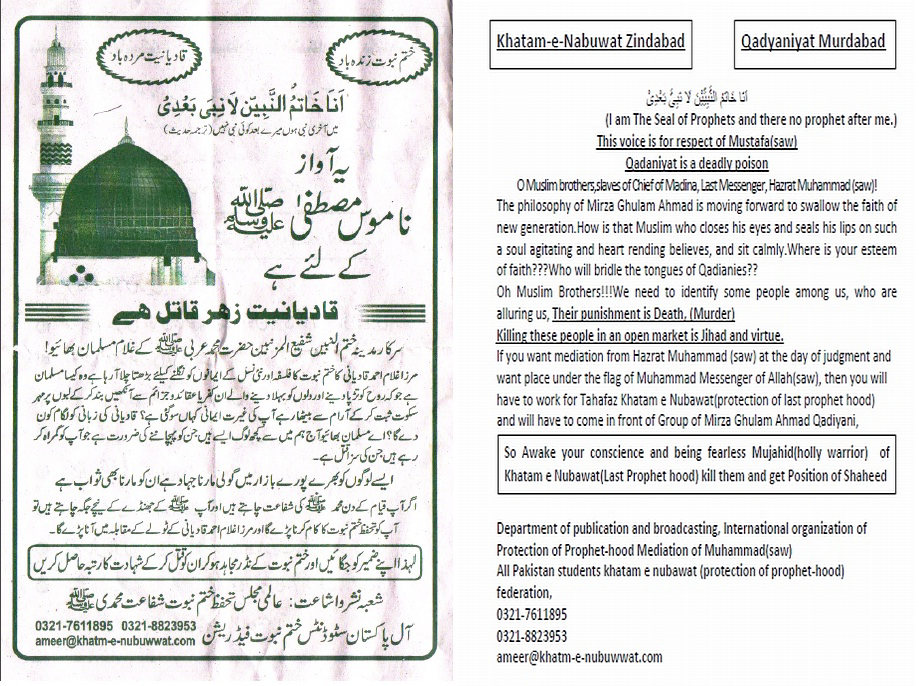
The recent incident of murder of an Ahmadi leader in Ferozewala, a city of Sheikhupura district situated near Lahore, is a sad reflection of how society chooses to treat a section of the minorities, variously known as Mirzais or Qadianis in Pakistan. What is more disconcerting though, is the apathy — rather collusion — of the state, which not only allows such incidents to take place under its very nose, it tends to protect the perpetrators. According to a series of reports published in this paper, Professor Mohammad Yousaf, leader of the Ahmadi community in Ferozewala, had sought police protection against sectarian zealots in his locality who had been threatening him. Allegedly, in response to this, two unidentified assailants shot him dead while he was at his general store. It was with some effort the family managed to lodge the FIR against the two murderers and four abettors known to the victim, who live in the same area. Instead of arresting the accused and investigating further, it is reported that the police let the four abettors go when they visited the police station with PML-N’s member of the Punjab Assembly Pir Ashraf Rasool. Meanwhile, both the police and the nominees in the FIR have been pressurising the family to withdraw the murder case. Alarmingly, even after the ghastly retribution visited upon Mohammad Yousaf, Khatam-e-Nabuwat Youth Wing’s signboard on the main roundabout of the town, which urges believers to kill and maim Islam’s enemies and to socially boycott Ahmadis, has not been removed.

While we are witnessing the gruesome consequences of promoting extremist Islam in the form of suicide attacks, this incident shows another dimension of the free rein given to hate-mongering mullahs. Most often the paranoia and hatred against Ahmadis inspired by self-styled Islamic leaders has taken a murderous turn. Not long ago, a TV presenter incited the wholesale murder of Ahmadis by declaring it an obligation for Muslims, as a result of which two targeted killings took place in Sindh. This continues unabated because of the failure of the concerned authorities to take action against the culprits. Apparently, it is due to a deep bias that runs through the entire system. There is a visible nexus of protection as demonstrated in this case. Whether they are Muslim or non-Muslim, the state is responsible to protect all citizens of Pakistan against oppression. It is these kinds of cases that really require judicial activism, as the legislature and executive have both been found siding with the perpetrators rather than the victims. *

URL: www.dailytimes.com.pk/default.asp?page=2010\01\13\story_13-1-2010_pg3_1

Wednesday, January 13, 2010

Ahmadi leader killed in Ferozwala: Police let suspects leave with PML-N MPA

---Daily Times, Pakistan
Tuesday, January 12, 2010

Ahmadi leader killed in Ferozwala: Police let suspects leave with PML-N MPA

* IO says nominated suspects allowed to leave on guarantee of MPA Pir Ashraf Rasool
* Complainants claim efforts being made to exonerate Yousaf’s killers

By Rana Tanveer

LAHORE: Four suspects – who remained at large for six days after their nomination in a first information report in the murder of a local Ahmadi leader were brought to a police station on Monday, but police let them leave with a member of the provincial assembly instead of arresting them, sources in the Ferozewala Police Station told Daily Times.

The sources said the MPA, a member of the Pakistan Muslim League-Nawaz (PML-N), had brought the four suspects – Muhammad Ahmed Fridi, Inamullah, Ashraf and Haji Arshad – to the police station, and they remained there for more than an hour. They said the investigation officer listened to their side of the story, wherein they claimed they were innocent and had been wrongly implicated in the case. Following this, the police – instead of arresting them on the basis of their nomination in the FIR – let them go with the MPA, said the sources.

According to the FIR registered with the Ferozewala Police Station on January 5, two armed assailants attacked 70-year-old Muhammad Yousaf while he was at his general store in the presence of Yousaf’s sons, Fatehuddin and Mahmood Yousaf. The FIR said Yousaf was shot six times in the chest and arms and he died immediately. Yousaf was allegedly killed for reporting the assailants to police over their reported involvement in the spread of religious hatred against the Ahmadi sect and provoking people to kill Ahmadis. According to the FIR, Muhammad Ahmed Fridi, Inamullah, Ashraf and Haji Arshad abetted Yousaf’s murder.

The policeman in charge of the investigation, Sub-Inspector Rai Zulfiqar Ali, told Daily Times that the suspects came to the police station with PML-N MPA Pir Ashraf Rasool, and conceded they were allowed to leave, “as the complainant party did not come to the police station”.

MPA’s guarantee: He said the suspects were summoned to the police station on Monday to listen to arguments from both sides. He said although the four men had been named in the FIR, they were allowed to leave on the MPA’s guarantee. “The MPA will bring them to the police station on Tuesday (today),” he said.

Zulfiqar said police were trying locate the two assailants – who had not yet been identified. He said after three raids were conducted to arrest the four suspects named in the FIR, the MPA brought them to the police station.

Exonerate suspects: Yousaf’s son Fatehuddin told Daily Times that police and the MPA were giving the suspects “an undue favour”. He said efforts were being made to “exonerate the suspects because they are influential”.

He claimed that the MPA had been “sheltering the suspects since the day of the murder … they have been living with him”. He said while police summoned his family to the station on Monday, they did not go because “we were feeling insecure because of their influence”.

Azhar Siddique advocate, an expert in criminal law, told Daily Times that the police decision to let the suspects go was “gross misconduct and illegal”. He said the development showed that police were biased against the complainants.

Meanwhile, the Jamaat Ahmadia Lahore adopted a resolution against the murder of a member of their sect. Spokesman Munawar Shahid told Daily Times that his group strongly condemned the role of “extremists spreading religious hatred”. He said that with such incidents on the rise, the government must take serious notice of alleged atrocities against Ahmadis.

URL: www.dailytimes.com.pk/default.asp?page=2010\01\12\story_12-1-2010_pg13_1

Wednesday, January 6, 2010

Ahmadi leader shot dead in Ferozewala (Pakistan)

--- Daily Times, Pakistan
Wednesday, January 06, 2010

Ahmadi leader shot dead in Ferozewala

* Victim’s son claims police took no action despite being intimated about threats

By Rana Tanveer

LAHORE: An Ahmadi leader was gunned down allegedly for seeking police protection against sectarian zealots in Ferozewala police precincts on Tuesday.

The family of 70-year-old victim Muhammad Yousaf — leader of the Ahmadi community in Ferozwala — alleged that extremists killed him for demanding police to stop them from creating religious strife in the area. Earlier, extremists had gathered together, carrying placards and signboards bearing slogans against the Ahmadis.

Ferozewala Police Station House Officer (SHO) Muhammad Munir told Daily Times that police had registered the first information report (FIR) against unidentified persons for Yousaf’s murder. Although no one had been arrested so far, the murderers would be brought to justice, he added.

According to complainant Fatehul Deen — son of the deceased — two armed assailants on a motorbike sprayed bullets at his father around 8am when he was sitting at his general store, where he (Fateh) and his brother were also present. He said his father died instantly while he and his brother narrowly escaped the attack.

No action: Fateh alleged that the assailants were the henchmen of local religious leader Muhammad Ahmed Faridi. He alleged that two men — Inamullah and Shaukat — were also involved in his father’s murder.

Fateh said that on December 29, Faridi erected a huge signboard at the main roundabout in Ferozewala Bazaar, which bore slogans provoking people against the Ahmadis. He said the accused also made phone calls to him and other Ahmadis in the area, threatening them to leave the area or else face dire consequences. Fateh said despite being intimated about these threats, police took no action against the accused that had resulted in his father’s death.

URL: www.dailytimes.com.pk/default.asp?page=2010...2010_pg7_5

Monday, September 21, 2009

Pakistan: Religion and politics [Opinion]

---The News, Pakistan
Monday, September 21, 2009,
Shawwal ul Mukkarram 01, 1430 A.H
Religion and politics

Rubina Saigol

Monday, September 21, 2009
The writer is an independent researcher specialising in social development

In the past few months, there has been a noticeable increase in religiously-motivated violence against minority communities, especially in Punjab. The most recent case is that of 20-year-old Robert Fanish Masih, whose mysterious death in the Sialkot district jail, where he was interned after accusations of defiling the Holy Quran, raises serious suspicions of foul play and murder. According to a press release by the Joint Action Committee, this incident is reminiscent of an earlier one in which Muhammad Yousaf, also accused of committing blasphemy, was found dead in jail and the authorities declared it to be a case of suicide.

Cases of murderous attacks against Christians by frenzied mobs have risen at an alarming rate. In March, a Christian woman was killed in Gujranwala where a church was attacked. On June 30, a mob destroyed more than 50 Christian houses in Bahmaniwala in Kasur district and looted and plundered the village. And on July 30, seven people were brutally murdered in the Gojra carnage.

The typical pattern in many of these cases is an accusation (usually false) of the commission of blasphemy by a rival. This is normally followed by announcements from mosques loudspeakers inciting people who then congregate and turn upon their own neighbours and erstwhile friends. As pointed out by the Human Rights Commission of Pakistan, the local administration and police often collude with the perpetrators or, at best, stand by and do nothing, themselves fearful of the mob. The state becomes an onlooker instead of intervening to protect its powerless citizens against the heinous crimes committed in broad daylight.

As the large number of blasphemy cases in the past have demonstrated, the real motive for instigating the crowd often has nothing to do with blasphemy. Frequently, disputes over money, property or other pecuniary matters lead to false accusations of blasphemy. An accusation of blasphemy is invariably deployed as a weapon to browbeat others into submission. In the famous case of Salamat Masih, a 14-year-old accused of writing blasphemous words on a wall, the quarrel among children started over pigeon fights. Had human rights activists like Asma Jahangir not saved his life, our state was about to send an innocent person — a child — to the gallows. The horrific implications of law cannot be overstated.

What has enabled religion to be used as a weapon to incite raw passions against fellow citizens to murder them with impunity? The immediate cause is the pernicious and widely abused blasphemy law as enunciated in Chapter XV of the Pakistan Penal Code. Sections 295 to 298 of the chapter refer to offences related to religion. Section 295 provides that, “Whoever destroys, damages or defiles any place of worship, or any object held sacred by any class of persons with the intention of thereby insulting the religion of any class of persons is likely to consider such destruction, damage or defilement as an insult to their religion, shall be punished with imprisonment of either description for a term which may extend to two years or with fine or with both.” In 1927, the British government added 295-A which reads that “whoever with deliberate and malicious intention of outraging the religious feelings of any class of His Majesty’s subjects, by words, either spoken or written, or by visible representation, insults or attempts to insult the religion or the religious beliefs of that class, shall be punished with imprisonment of either description for a term which may extend to two years, or with fine, or with both.” In 1991, the imprisonment term was extended from two to 10 years.

In 1982, at the peak of General Zia’s period, 295-B was added to include the desecration of the Holy Quran and to enhance punishment. This section reads as follows: “Whoever wilfully defiles, damages or desecrates a copy of the Holy Quran or of an extract therefrom, or uses it in any derogatory manner or for any unlawful purpose shall be punishable with imprisonment for life.” The Majlis-e-Shoora designed by Zia further added 295-C, which reads: “Whoever by word, either spoken or written, or by visible representation, or by any imputation, innuendo or insinuation, directly or indirectly, defiles the sacred name of the Holy Prophet Muhammad (Peace Be Upon Him) shall be punished with death or imprisonment for life, and shall also be liable to fine.” In 1990, the Federal Shariat Court constituted by Zia hammered the last nail in the coffin of sanity and justice by declaring that Islam provides punishment for hadd which is mandatory, therefore the words “imprisonment for life” should be removed from Section 295-C. Now, the only punishment for blasphemy was death. Section 298 relates to the Ahmadiyya community and institutionalises systemic prejudice against their right to practice their faith.

Before the Federal Shariat Court provided for the mandatory death penalty, no case of blasphemy was registered under Section 295-B or 295-C. This judgment paved the way for murder and created the environment in which vigilantism was encouraged and promoted. Manzoor Masih lost his life in a wanton act of murder outside the Lahore High Court. One of the court’s judges, Justice Arif Bhatti, who overturned the conviction of Salamat and Rehmat Masih by a lower court, was murdered by the purveyors of a grotesquely distorted religion. Niamat Ahmar, a poet and teacher, was butchered in Faisalabad by activists of the Sipah-e-Sahab-e-Pakistan; Bantu Masih and Mukhtar Masih were killed in police custody by fundamentalists while the authorities looked on. In 2008, two Ahmadis were murdered when a television anchor declared their community wajib-ul-qatl (deserving to be killed).

How has the state enabled this travesty of justice, this steady descent into inhumanity? The blasphemy law is only a part of the story; the issue of religious inequality and discrimination is much deeper. The entire problem began with the Objectives Resolution of 1949 when the state began to move in the direction of a theocracy. Its passage, despite the objections of the non-Muslim members of the Constituent Assembly, became possible because Jinnah’s vision, as outlined on August 11, 1947, was overlooked. Subsequently, every Constitution of Pakistan (1956, 1962 and 1973) carried a section on Islamic provisions which mandated that all laws would be enacted in line with religion.

Religious discrimination and inequality are institutionalised within the state structure. Article 2 of the Constitution declares that Islam is the state religion and Article 2-A makes the Objectives Resolution a substantive part of the Constitution. Non-Muslim citizens cannot hold two of the highest offices of the land and Islamic provisions of the Constitution (Articles 227-230) are designed to ensure that all laws conform to the Holy Quran and Sunnah. Citizens belonging to other faiths are systemically excluded and relegated to a secondary position. The increasingly religious character of the Constitution, with General Zia’s Eighth Amendment protecting his draconian vision and measures, violates the principle of equal citizenship on which the entire edifice of democracy rests.

Every provision that reduces the citizenship status of groups of people contradicts Article 25 (1) of the fundamental rights chapter which pronounces that all citizens are equal before the law. Similarly, Article 8 (1) avers that any law, custom or usage that is inconsistent with the rights conferred by this chapter shall be null and void. It follows that all the provisions that create discrimination and inequality among citizens should be removed. As Pakistanis focus on the task of reformulating their basic law and re-imagining their state, it seems prudent to separate religion from politics, as their mixture debases both religion and politics – the former by associating it purely with the attainment of political power and militant activity, the latter by making some more equal than others. Merely repealing the blasphemy law is not sufficient; we need to transform the basic framework from which such laws flow.

Email: rubinasaigol@hotmail.com

URL: www.thenews.com.pk/daily_detail.asp?id=199521

 
^ Top of Page