 | Pakistan |
A question of faith: ‘Repeal blasphemy law or make it flawless’
Published: June 2, 2011
 Report documents the deteriorating state of minorities in Pakistan. |
A Think Tank working on minority issues in Pakistan has called upon the government to repeal the blasphemy law, or at least amend it to remove all vague terminology to prevent its misuse.
The Jinnah Institute’s report, “A Question of Faith”, also calls for addition of a section in the Pakistan Penal Code making advocacy of religious hatred or incitement to discrimination or violence a punishable offence.
The institute has published 23 recommendations, including the removal of impunity for prayer leaders in mosques, police and judicial reforms and clarification of the status of Federal Shariat Court and the Council of Islamic Ideology. It also calls for an appointment of a “Special Ombudsman” to protect the rights of women and minorities.
The research team interviewed 125 people including minority representatives, victims and non-governmental organisations’ workers all over Pakistan between December 2010 and April 2011. It documents the deterioration in the political, social and economic status of members of religious minorities in Pakistan, “particularly the rising tide of vigilante violence against them”, according to a press release issued by the institute.
The report focuses on Christians, Hindus and Ahmadis, three prominent minority groups in the country. According to the report, the conditions for Christians have deteriorated over the years. The Christians “are on the frontline of the persecution and violence against minority communities.”
Interviews with Christians of different age groups and professions revealed that many of them felt they “are treated as second-class citizens and discriminated against in all aspects of life.” Moreover, most of those who can, do move away from Pakistan. Those who choose to stay back do so because of a “strong sense of commitment to the country and being ‘Pakistani’.”
Christians in rural areas have to deal with instances of their land being grabbed by local Muslim residents and in some of the more serious incidents, the Christian residents did not come back to their homes.
Eighty per cent of the Hindus in Pakistan live in Sindh, and “are victims of caste and wider religious discrimination,” said the report. They do not own lands and work on daily wages, a consequence of them not having any permanent settlement. The report said, “One day, they are with one landlord, the next day with another. And this is how they spend a life of debt, with no accountability or education.”
Their castes have translated into daily life. For instance, Hindus from a lower caste might be restricted to a separate water well in a school, “from which even the Muslims will not drink”.
Higher caste Hindus have their own set of problems to contend with. They live in a state of insecurity and are frequently kidnapped for ransom. For instance, 82-year-old Lakki Chand Garji, a prominent Hindu spiritual leader, was kidnapped on December 21, 2010 and is yet to be traced and rescued.
Then there’s the matter of Hindus being suspected of having sympathy for India. Some Hindus said that “they dealt with the repercussions of the destruction of the Babri Masjid across the border in India in 1992.”
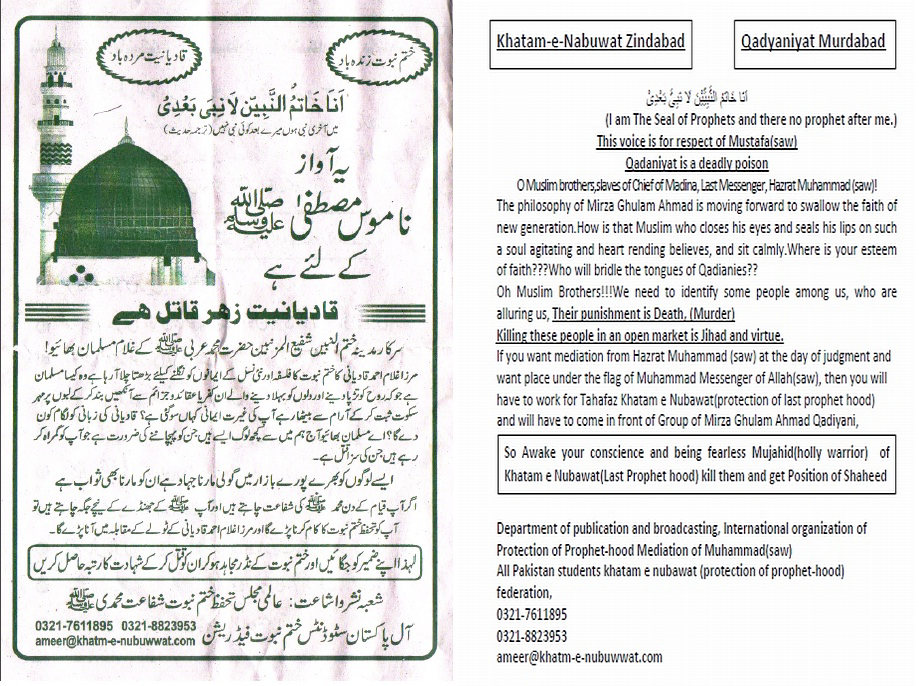
Violence against the Ahmaddiya community has also been on the rise in the past three years, according to the report. The report attributed the increase in violence to maulvis “promoting such attacks and inciting violence in their sermons and in the media.”
Sherry Rehman, President of Jinnah Institute, introduced the report on Tuesday and spoke about the need to reinstate the model of inclusive citizenship envisioned by Mohammed Ali Jinnah.
Published in The Express Tribune, June 2nd, 2011.







 Posts


