Showing posts with label Sherry Rehman. Show all posts

Thursday, June 2, 2011

A question of faith: ‘Repeal blasphemy law or make it flawless’

Express Tribune, Pakistan
Pakistan
A question of faith: ‘Repeal blasphemy law or make it flawless’
Published: June 2, 2011

Report documents the deteriorating state of minorities in Pakistan.
A Think Tank working on minority issues in Pakistan has called upon the government to repeal the blasphemy law, or at least amend it to remove all vague terminology to prevent its misuse.

The Jinnah Institute’s report, “A Question of Faith”, also calls for addition of a section in the Pakistan Penal Code making advocacy of religious hatred or incitement to discrimination or violence a punishable offence.

The institute has published 23 recommendations, including the removal of impunity for prayer leaders in mosques, police and judicial reforms and clarification of the status of Federal Shariat Court and the Council of Islamic Ideology. It also calls for an appointment of a “Special Ombudsman” to protect the rights of women and minorities.

The research team interviewed 125 people including minority representatives, victims and non-governmental organisations’ workers all over Pakistan between December 2010 and April 2011. It documents the deterioration in the political, social and economic status of members of religious minorities in Pakistan, “particularly the rising tide of vigilante violence against them”, according to a press release issued by the institute.

The report focuses on Christians, Hindus and Ahmadis, three prominent minority groups in the country. According to the report, the conditions for Christians have deteriorated over the years. The Christians “are on the frontline of the persecution and violence against minority communities.”

Interviews with Christians of different age groups and professions revealed that many of them felt they “are treated as second-class citizens and discriminated against in all aspects of life.” Moreover, most of those who can, do move away from Pakistan. Those who choose to stay back do so because of a “strong sense of commitment to the country and being ‘Pakistani’.”

Christians in rural areas have to deal with instances of their land being grabbed by local Muslim residents and in some of the more serious incidents, the Christian residents did not come back to their homes.

Eighty per cent of the Hindus in Pakistan live in Sindh, and “are victims of caste and wider religious discrimination,” said the report. They do not own lands and work on daily wages, a consequence of them not having any permanent settlement. The report said, “One day, they are with one landlord, the next day with another. And this is how they spend a life of debt, with no accountability or education.”

Their castes have translated into daily life. For instance, Hindus from a lower caste might be restricted to a separate water well in a school, “from which even the Muslims will not drink”.

Higher caste Hindus have their own set of problems to contend with. They live in a state of insecurity and are frequently kidnapped for ransom. For instance, 82-year-old Lakki Chand Garji, a prominent Hindu spiritual leader, was kidnapped on December 21, 2010 and is yet to be traced and rescued.

Then there’s the matter of Hindus being suspected of having sympathy for India. Some Hindus said that “they dealt with the repercussions of the destruction of the Babri Masjid across the border in India in 1992.”

Violence against the Ahmaddiya community has also been on the rise in the past three years, according to the report. The report attributed the increase in violence to maulvis “promoting such attacks and inciting violence in their sermons and in the media.”

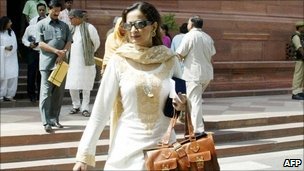
Sherry Rehman, President of Jinnah Institute, introduced the report on Tuesday and spoke about the need to reinstate the model of inclusive citizenship envisioned by Mohammed Ali Jinnah.

Published in The Express Tribune, June 2nd, 2011.

Wednesday, June 1, 2011

Report on status of religious minorities launched

The News - Internet Edition
Wednesday, Junne 1, 2011,
Jamadi-us-Sani 28, 1432 A.H.
Islamabad
Report on status of religious minorities launched

Wednesday, June 01, 2011

A report on the status of religious minorities in Pakistan, titled ‘A Question of Faith’, was launched by the Jinnah Institute. The report is a research study, compiled over the period December 2010-April 2011 and documents the deterioration in the political, social and economic status of members of religious minorities in Pakistan, particularly the rising tide of vigilante violence against them, says a press release.

The report was prepared in consultation with members of several religious minorities across the country, human rights organisations and policy experts. It lists recommendations for the redressal of grievances through constitutional amendments, political and judicial reform, sensitisation of media and revision of educational curricula that imparts discrimination or hatred against minorities.

Findings of the report indicate that minorities in the country connect strongly with a Pakistani national identity, even as they are persecuted on the basis of their religion. It is emphasised that the Pakistani state needs to take steps towards ensuring that citizens of the country do not continue to fall victim to cruelty and vigilantism and that a critical mass of Pakistanis has to help arrest the discrimination and persecution against minorities.

Sherry Rehman, President of Jinnah Institute, introduced the report and spoke about the need to reinstate the model of inclusive citizenship envisioned by Mohammed Ali Jinnah. Mariam Faruqi, lead researcher and author of the report, gave a presentation on the findings and key recommendations contained in the study. Advisor to Prime Minister, Paul Bhatti, stated that a collective effort was required by all concerned to uphold values of human dignity, justice and peace and to create rights for minorities. Joseph Francis, Director CLAAS recalled the historical discrimination against the Christian population and pointed towards laws that lead to systemic discrimination. Krishan Sharma, prominent minority rights activist, presented a list of recommendations from his research paper that demanded repeal of those laws. Ali Dayan Hasan of Human Rights Watch commented on how laws relating to minorities in Pakistan were effectively instruments of coercion and questioned the sustainability of liberal pluralism in the country.

Saturday, February 5, 2011

Republic of Fear and Bigotry

Express Tribune, Pakistan
OINION
Republic of Fear and Bigotry
Nasim Zehra
By Nasim Zehra
Published: February 5, 2011
The writer is director current affairs at Dunya TV and a former fellow at Asia Center, Harvard University nasim.zehra@tribune.com.pk

Last week in our Senate, two revealing incidents took place. One, the refusal of a senator to lead the fateha for the assassinated Governor Salmaan Taseer. Second, a privilege motion moved by Senator Mandokhel, calling upon the deputy chairman of the Senate to declare a Pakistani woman a blasphemer because, in a text message, she had referred to the late governor as shaheed. Mandokhel sahib’s contention is that since Salmaan Taseer was a blasphemer, anyone calling him shaheed is also a blasphemer. On February 3, responding to the senator’s insistence that the chairman Senate give a ruling on the matter, the chairman said he would do so later. The Senate session was then prorogued.

In the last few weeks, new blasphemy cases have been filed, one of them against a first-year student. The 17-year-old, reported to the police for writing something blasphemous on his examination paper, is now in prison. Also, last week a sessions court handed down a death sentence, along with a Rs200,000 fine, to a man of Jalalpur Peerwala for committing blasphemy. The accused was reportedly mentally challenged.

Against the backdrop of these incidents, a factual review of the developments that took place after PPP MNA Sherry Rehman proposed the initial bill, alongside initial government moves to review Article 295, is essential. Of course, the current outcome of this move has been that the prime minister has announced the withdrawal of Ms Rehman’s bill.

The new aspect to the prime minister’s February 3 announcement was that he had consulted Ms Rehman and that she had agreed to withdraw her bill. Her statement, however, indicates that it was more or less a unilateral move by the prime minister but that she would abide by it because of party discipline. More importantly, as she explained, the withdrawal announcement was unnecessary since the bill had not even been tabled. What is truly ironic is that in the same statement in which the prime minister announced the withdrawal of the bill, he invited various political parties to come forward and discuss ways on how to prevent misuse of the existing law — which is precisely what Ms Rehman’s proposed amendment bill was seeking to address.

Meanwhile, of the many developments that took place after the sessions court’s judgment against Aasia Bibi, six are especially noteworthy.

The first is that while human rights groups have been working on the issue of misuse of the blasphemy law for years, it was when the PPP-led government announced a committee to amend the laws that Ms Rehman tabled her bill. She shared it with all party leaders and made it a point to inform the chief whip of the government of her plans — and he did not ask her to hold off for a while. She consulted with several lawyers about the bill and did not submit it in secret. The proposed amendment created a wave of awareness that has finally led everyone (including the Council of Islamic Ideology) to concede that changes are required to end the existing law’s misuse. Even the religious parties have taken this position of reform repeatedly in various forums. All this contradicts the claims of those who now hold the view that the introduction of this bill was an ill-timed move.

Two, the government blundered along, making contradictory moves and statements on the issue of amending the blasphemy law ever since Aasia Bibi’s conviction. They set up a committee to review it and created a parliamentary subcommittee headed by MNA Nafisa Shah. But at the first whiff of criticism by other groups, the law minister announced that the amendment will take place “over my dead body”.

On one hand, the Punjab governor, when he was alive, criticised the law and lobbied for Aasia’s presidential pardon while on the other, the same government’s law and interior ministers were saying quite the opposite. Instead of ironing out these stark contradictions, the departure of the JUI from the coalition convinced the government that backtracking on the amendment would buy it survival security. Hence, Sherry Rehman’s bill was not a victim of bad timing but, in fact, a victim of the PPP’s bad politics.

Three, every backtracking move by the government emboldened those who equated amendment of the man-made law with blasphemy. Parties like the PTI, the PML-N and the PML-Q have become actively engaged in street protests organised by the ‘religious right’ that are shadow-boxing with imaginary blasphemers.

Four, in pursuit of what the government believes to be survival-mode politics, the government and the PPP have practically abandoned Sherry Rehman. She has been provided some security outside her house but no government ministers have spoken in parliament against the death threats that she has been receiving. Almost no one has spoken for her at other public forums either. The government has not opted to be part of her defence in the Lahore High Court where there is a case demanding that she be disbarred from parliament. She is also involved, again unsupported by the PPP, in a blasphemy case in Multan.

Five, the big names of the legal community who led the lawyers’ movement seem to have opted for selective commitment to rule of law by not taking a clear-cut position to stand by Sherry Rehman — barring exceptions like Salman Akram Raja and Hina Jilani. Six, against the backdrop of increasing cases of blasphemy being registered — against a student, a doctor and a Dera Ghazi Khan imam and his son — Ms Rehman stands vindicated on both the call for amending the existing law and on the timing of such a proposed amendment.

The government’s blundering over amending Article 295 of the Pakistan Penal Code will qualify as a textbook example of how expedient politics can take nations down a path of disaster. Clearly, in the Senate, the chairman has found it difficult to give a ruling against Senator Mandokhel’s incredible demand that an activist be denounced as a blasphemer. Equally incredible is the imprisonment of a 17-year-old on blasphemy charges. And, not least of all, the news that no one is representing the prosecution in the court as the case of Governor Salmaan Taseer’s murder proceeds is shocking.

In the coming days, it is not unlikely that, led by the short-sighted politics of the PPP and of other parliamentary parties, Pakistan’s politics and state will have, in fact, weakened the best Islamic values within Pakistan, undermined parliamentary politics and strengthened the constituency of those who want to see Pakistan turn into the Republic of Fear and Bigotry.

Published in The Express Tribune, February 6th, 2011.

Thursday, February 3, 2011

Pakistan MP drops effort to repeal blasphemy laws

South Asia
3 February 2011 Last updated at 14:11 GMT
Pakistan MP drops effort to repeal blasphemy laws

Many in Pakistan are opposed to any effort to alter the blasphemy lawsMany in Pakistan are opposed to any effort to alter the blasphemy laws
A Pakistani politician has dropped her attempt to amend the country's controversial blasphemy laws, accusing her party of appeasing extremists.

Pakistan People's Party MP Sherry Rehman made her decision after the government ruled out changing the law.

Correspondents say Ms Rehman is one of only a few politicians prepared to speak out on the blasphemy law.

They say there has been a climate of fear since the murder of Punjab governor Salman Taseer who opposed it.

Mr Taseer was killed in January by one of his bodyguards, who later admitted murdering the governor because he had spoken out against the blasphemy law.

Hundreds of people are in prison on charges under the law. Critics say it has been used to persecute minority faiths and is sometimes exploited by people pursuing grudges against others.

It has been under scrutiny since a Christian, Asia Bibi, was sentenced to death in November. Ms Bibi denies insulting the Prophet Muhammad in her Punjab village in June 2009.

'Blow-back'

Ms Rehman told the BBC in January that she received death threats every half hour, but would defy them.

However, in a statement received by the BBC on Thursday, she said she would not be proceeding with her proposed bill following remarks by Prime Minister Yousuf Raza Gilani earlier in the week.

"Since the PM announced that there cannot even be discussion on procedural amendments, and the committee announced by the party to amend the laws has been disbanded, then as a PPP representative I had no option but to abide by the party's decision in parliament.

She added: "Appeasement of extremism is a policy that will have its blow-back."

Sherry Rahman
Mr Gilani had said that no amendment in the law could be considered. He also disbanded a committee set up to determine how to amend the laws.

The BBC's Syed Shoaib Hasan in Karachi says politicians in Pakistan are increasingly reluctant to amend the law - many are afraid of being targeted in the way Mr Taseer was.

He says Ms Rehman's courageous stance against what is seen by some experts as a flawed law has few public supporters.

Ms Rehman stressed that she had not agreed to "withdraw" her private member's bill.

"There was never any question of withdrawing the bill as the Speaker had never admitted it on the agenda," she said.

Ms Rehman added that if the Speaker had allowed her bill "perhaps some of our colleagues would have understood that it was not suggesting total repeal of the law, but protecting our great Prophet's name against injustices done via procedures introduced by [former President] Zia ul-Haq.

"It was a question of protecting our citizens from injustice done in the name of a religion that values peace and tolerance more than anything else," she said.

Her statement came as Human Rights Watch urged the government to release a boy of 17 who is under arrest in Pakistan, accused of blaspheming against the Prophet Muhammad in a high school exam.

Friday, January 21, 2011

In Pakistan, Islamic hard-liners expanding their grip on society

Los Angeles Times
WORLD
In Pakistan, Islamic hard-liners expanding their grip on society
The killing of a governor opposed to the nation's blasphemy law, and the warm reception for his accused killer, has exposed Islamic fundamentalists' growing sway over the nation.
Pakistanis chant slogans as they gather to show their support outside the Rawalpindi home of Mumtaz Hussain Qadri, who is accused of killing Punjab Gov. Salman Taseer. (Aamir Qureshi, AFP/Getty Images / January 21, 2011)
By Alex Rodriguez, Los Angeles Times
January 21, 2011

Reporting from Rawalpindi, Pakistan — Above a dank, darkened teahouse pungent with the aroma of green chili peppers, a bright blue banner depicts a neighborhood cleric, Qari Hanif Qureshi, declaring: “Anyone opposing laws protecting the sanctity of the prophet Muhammad is condemned!“

Such dire exhortations from local imams are embraced by millions of impoverished Pakistanis scraping by in squalid, dust-choked city neighborhoods and mud-hut settlements.

Mumtaz Hussain Qadri, a 26-year-old police commando assigned to guard Punjab Gov. Salman Taseer, says Qureshi’s preachings inspired him to assassinate Taseer on Jan. 4. And on a recent afternoon inside the teahouse, another Qureshi follower, Muhammad Zahir, said he was equally moved.

“If I were there, I would have done the same thing,” says Zahir, 26, scooping up boiled lentils with a piece of bread. “Qadri has brought honor upon his family. He’s a hero now.”

The killing, carried out by a man who saw Taseer as an apostate for opposing Pakistan’s blasphemy law, has exposed the rising influence that Islamic fundamentalism has over Pakistani society, a mind-set that increasingly radicalizes the nuclear-armed nation, breeds intolerance and further weakens Islamabad’s feeble civilian government.

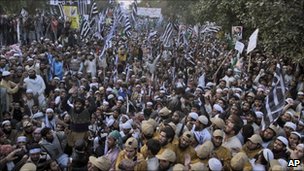
Led by clerics at the helm of the country’s religious political parties and its hard-line mosques and madrasas, the extremists demonstrated their reach after Taseer was assassinated in an upscale neighborhood of Islamabad. Days later, fundamentalist clerics rallied more than 40,000 people on the streets of Karachi in support of Qadri. A day earlier in Qadri’s Rawalpindi neighborhood, at least 4,000 people had gathered in front of the accused assassin’s house, chanting, “Salute to your bravery, Mumtaz!“

At Qadri’s court appearances, lawyers have showered him with flower petals and kissed his cheeks, a worrisome sign that his support stretches far beyond Pakistan’s underclass and into the upper echelons of society.

Hard-line clerics are now turning their anger toward another leading member of the ruling Pakistan People’s Party, lawmaker Sherry Rehman, who, like Taseer, called for changes aimed at reforming the blasphemy law after a Pakistani Christian woman accused of insulting the prophet Muhammad was given the death penalty.

Journalist Ali Kamran Chishti attended a Jan. 7 gathering in Karachi at which Munir Ahmed Shakir, imam of the Sultan mosque, labeled Rehman an infidel for proposing changes to the law to remove the death penalty as an option for punishment and require prosecutors to prove that the alleged blasphemy was intentional and not inadvertent. Pakistan’s blasphemy law makes it a crime to defame the prophet Muhammad or Islam, but is often used as a tool to repress minorities.

“This kind of rhetoric radicalizes people,” Chishti said. Imams such as Shakir, he added, “are slowly poisoning minds and making people intolerant. Praising people like Qadri is indirectly saying to society that anyone who takes this line [against the blasphemy law] should be shot dead. This is wrong.”

The outpouring of praise for Qadri also sends disturbing signals to Washington. At a time when the Obama administration is hoping for a more reliable ally in the U.S.-declared war on terrorism, the Taseer assassination and its aftermath suggest extremism in Pakistan may be going mainstream.

“A mind-set has been created that has to be undone,” said Ijaz Khan, who heads the international relations department at the University of Peshawar. “It poses a serious existential challenge to the so-called liberal community of this country.

“We still do not know how many more Qadris are out there,” Khan added, “and what will happen next.”

Pakistan’s religious extremists thrive on street power rather than on ballot-box appeal. In elections in 2008, religious parties collectively garnered less than 5% of the vote. Founded as a moderate Islamic state, Pakistan is governed by the largely secular Pakistan People’s Party.

But in the thousands of mosques and madrasas across the nation, fundamentalists enjoy a captive audience. Hard-line clerics delivering fiery Friday sermons are seen as more credible than the country’s government leaders.

“If there was economic development and more job opportunities on the horizon, they wouldn’t be as apt to listen to these clerics,” said Hasan Askari Rizvi, a Lahore-based security analyst. “At least not all the time.”

The rise of the Islamists has its origins in the military rule of Gen. Zia ul-Haq, who in the 1980s forced a more conservative brand of Islam on the country. That resulted in the start-up of legions of madrasas, many of which became incubators for extremism.

Even state education under Zia “socialized young minds into religious orthodoxy,” Rizvi said. “Now these people who studied in high schools and state universities from 1985 onward are the ones who support this kind of far-right religious orientation.”

The large show of support for Qadri has both stunned and intimidated Pakistani secularists. Though several commentators on television and in newspapers have denounced the praise Qadri has received, top leaders within President Asif Ali Zardari’s administration have been conspicuously quiet amid the furor.

The government has even tried to sound conciliatory: This week Prime Minister Yousuf Raza Gilani stressed that authorities have no plans to tamper with the country’s blasphemy law — a clear attempt to appease hard-line religious leaders angered by talk of amendments to the law.

Whether such gestures calm the toxic debate over Taseer’s assassination remains to be seen. The Sunni Ittehad Council, an influential assembly of Pakistani Muslim clerics, has vowed to hold rallies in major cities in defense of the blasphemy law this month.

“If we want peace in our country,” said Hanif Tayyab, the council’s general secretary, “we should try to understand that freedom of expression has some limits.”

alex.rodriguez@latimes.com

Copyright © 2011, Los Angeles Times
URL: www.latimes.com/news/nationworld/world/la...3266594.story

Tuesday, January 18, 2011

Rally against changes in blasphemy laws

The News - Internet Edition
Tuesday, January 18, 2011,
Safar 13, 1432 A.H.
Lahore
Rally against changes in blasphemy laws

By Our Correspondent
LAHORE

TRAFFIC on and around The Mall came to an absolute halt and remained choked for over three hours on Monday evening after Tahaffuz Namoos-e-Risalat Mahaz (TNRM) took out a large rally against the moves to amend blasphemy laws of Holy Prophet (SAW), particularly the demand by Pope Benedict to repeal the legislation, besides expressing solidarity with Mumtaz Qadri, the Elite Police guard who gunned down former Punjab Governor Salman Taseer.

The protestors riding trucks, wagons and other vehicles marched from Data Darbar to Governor’s House in over two hours while the police blocked the roads leading to The Mall, which caused a massive traffic mess. Long queues of vehicles were lined up in every direction during the closing hours in the evening causing serious problems to commuters in a rush to reach home.

Addressing the slogan chanting and banners waving protesters, TNRM leaders demanded an immediate end to the moves for amending blasphemy laws by dissolving the parliamentary committee headed by Minorities Minister Shahbaz Bhatti and withdrawal of the bill tabled by Sherry Rehman. They also demanded exoneration of Mumtaz Qadri and bringing an end to vulgarity on media.

The TNRM leaders also announced to take out another rally in support of Mumtaz Qadri on January 19 (tomorrow), which would march from Lahore to Rawalpindi up to the house of Mumtaz Qadri for expressing solidarity with him.

TNRM president Allama Raza-e-Mustafa said rulers must display with their actions that they cared for the sentiments and emotions of 98 per cent Muslim majority in Pakistan and shun the anti-people policies of trampling their religious feelings and subjecting them to price hike and inflation.

Raghib Naeemi said silence of so-called liberals over Pope Benedict’s absurd demand had forced Pakistanis to come out on streets. Dr Ashraf Asif Jalali said the world must see that 98 per cent Muslims backed Mumtaz Qadri and consider them as their hero.

Naeem Noori warned the rulers against plundering public wealth and enforcing secularism in place of Islam, saying that Islam loving people would throw them out of power. Mohammad Ali Naqshbandi said Muslims in Pakistan would never allow the western conspiracy against blasphemy laws succeed in the country and guard the Islamic laws with their lives.

Others who addressed the protesters included Mohammad Ali Naqshbandi, Khadim Hussain Rizvi, Naeem Javed Noori, Shaukat Qadri, Nawaz Bashir Jalali, Ziaul Haq Naqshbandi, Ajmal Shah Gilani, Haseeb Qadri, Mufti Masoodur Rehman, Mujahdi Abdul Rasool, Mohammad Khan Leghari and others.

Thursday, December 23, 2010

Pandora’s Law

Newsline, Pakistan
Home »
News & Politics
Pandora’s Law
23 December 2010By Aftab Alexander Mughal
Pandora's Law

Following the pronouncement of the death sentence against a Christian woman, Aasiya Bibi, on a charge of blasphemy, the case and the controversial law pertaining to this alleged crime are once again the subject of heated debate.

Aasiya’s case and the resultant prevailing situation are full of ironies. The state that purports to offer ‘special protection’ to its minority communities finds itself in a dilemma. Even before the president could consider a mercy petition filed by Punjab Governor Salmaan Taseer and appeals by assorted international human rights organisations to spare Aasiya Bibi’s life, the chief justice of the Punjab High Court, where the case is to be sent, has already issued a verdict: there is no room for pardon in a blasphemy case.

And while the governor – a PPP stalwart – has taken an unequivocal stand on the issue, Federal Law Minister, Babar Awan, also from the PPP, has made his position on the larger issue this case has resurrected, crystal clear. Stated Awan, “In my presence as law minister, no one should think of finishing the [blasphemy] law.”

Meanwhile, the Punjab Law Minister, the PML-N’s Rana Sanaullah, has said that he believes Aasiya’s conviction is a miscarriage of justice, even while his party is an avid proponent itself of the death sentence for this charge – doing away with the lesser punishment of life imprisonment for this crime during its time in government.

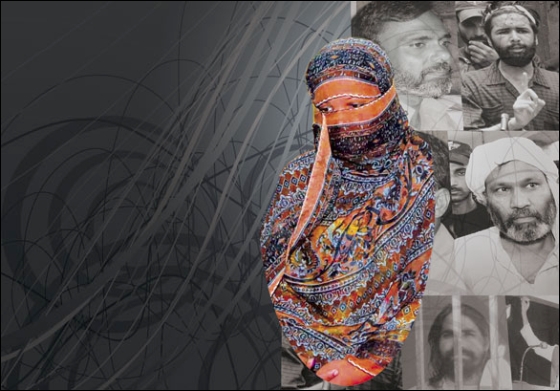
Aasiya’s “crime” was by all accounts a simple spat with two Muslim women of her village who refused to drink water from a glass she had touched because they said it had been defiled due to her faith and caste. The women taunted her and when she responded, they lodged a complaint of blasphemy against her at the Nankana Sahib district and sessions court. Aasiya, the mother of a special child, was arrested and has languished in jail for over a year on account of these charges. Now the executioner’s noose looms ominously over her head. While the mounting pressure on the government by activists on both sides (the anti- and pro-pardon for Aasiya) of the divide promises to engender heated debate, the outcome of this case will hold greater significance because of the bigger debate it has thrown up – i.e. the validity of the Blasphemy Law. Aasiya’s fate will graphically determine the ethos of the country today and the direction in which it is moving.
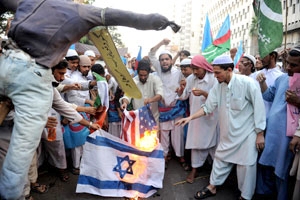
Some observers say that the Blasphemy Law is used to exploit vulnerable minority groups and encourage Islamist extremism. Photo: AFP
Several non-governmental organisations (NGOs) in Pakistan have long been calling for a repeal of the Blasphemy Law because it has repeatedly been used to persecute the minorities, especially in the rural areas. Parliamentary Secretary for Science and Technology Aasia Nasir, a Christian member of parliament said, “Discrimination against minorities is widespread. We need to sensitise the public and bring an attitudinal change to eliminate this menace from society.”

However, given the entrenchment of attitudes, that seems a near impossible undertaking in the short term. Prominent Deobandi and Barelvi clerics and the chief of the Sunni Ittehad Council (SIC) Sahibzada Fazal Karim have declared in no uncertain terms that they will not allow a repeal of the Blasphemy Law.

The genesis of the Blaspehmy Law lies in colonial times. A blasphemy law, Section 295, was added to the Indian Penal Code (IPC) in 1860 during the British Raj. In 1927, another law, Section 295-A, IPC, was added to prevent tension between Hindus and Muslims. At its creation, Pakistan adopted the same laws, ostensibly in order to promote religious harmony in Pakistan.

The existing Blasphemy Law, which actually affords ‘protection’ to only one religion, and that too being a moot point – Islam – was introduced in the 1980s by General Zia-ul-Haq. Through the introduction of this law he wanted to please Islamic parties who supported his illegitimate martial law government. Most controversial among the law are sections 295-B and C of the Pakistan Penal Code (PPC). Section 295-B, was introduced in 1982, which is against any insult to the Holy Quran, and the crime is punishable with life imprisonment. Section 295-C, PPC which was added by an act of parliament in 1986, made it a criminal offence to use derogatory remarks against the Holy Prophet (PBUH) and made the crime punishable with life imprisonment or death. In 1992, during former prime minister Nawaz Sharif’s rule, the sentence of life imprisonment was removed, and now the death sentence exists as the only punishment for this offence. Given the harshness of the punishments, Retired Justice Rana Bhagwandas, a Hindu, who once served as acting chief justice of Pakistan, said, “Who would be senseless enough to commit blasphemy in Pakistan?”
A woman walks past burnt out buildings in Gojra after accusations of blasphemy led to mob violence. Photo: AFP / File
That notwithstanding, hundreds of individuals in Pakistan have been charged with blasphemy. As a Christian leader pointed out, “These laws have been widely misused against religious minorities, as well as against many Muslims to settle personal scores. The Blasphemy Law is thus a danger to all Pakistanis, an affront to the rule of law and also against the concept of basic human rights and equality among the citizens of the state.” Human Rights Watch spokesman Ali Dayan endorsed this view, contending that the Blasphemy Law is used to exploit vulnerable minority groups and encourage Islamist extremism.

Well-known international human rights organisation Amnesty International chimed in, stating, “This law, while purporting to protect Islam and religious sensitivities of the Muslim majority, is vaguely formulated and arbitrarily enforced by the police and judiciary in a way which amounts to harassment and persecution of religious minorities.”

Between 1927 and 1986, there were less than 10 reported cases of blasphemy. The National Commission of Justice and Peace (NCJP), a human rights body of the Catholic Bishops Conference of Pakistan, reports that between 1986 and August 2009, at least 974 people have been charged for defiling the Holy Quran or insulting the Prophet Muhammad (PBUH). Those charged include 479 Muslims, 340 Ahmadis, 119 Christians, 14 Hindus and 10 from other religions. In 2009, no less than 112 cases were registered against 57 Ahmadis, 47 Muslims and eight Christians.

In most of the blasphemy cases filed, people convicted in the lower courts have been released by the higher courts, but invariably they had to spend years in jail before they were deemed innocent. To date no one has ever been executed for blasphemy under court orders. However, about 34 people have been murdered by individuals or crazed mobs for alleged blasphemy against the Holy Quran or for insulting the Prophet Muhammad (PBUH).
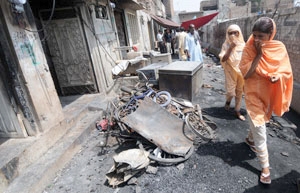
Photo: AFP
Photo: AFP
Many organisations have been campaigning for the repeal of the Blasphemy Law, which they think creates a wide space for discrimination against religious minorities, especially Ahmadis and Christians. And, while it is true that earlier this law was used mainly against minorities, a number of Muslims have also been victimised. The law has mainly been striking against vulnerable, poor members of minority communities who live in remote areas.

A history of blasphemy cases reveals that once a person is blamed for blasphemy against Islam, its holy personages or the Holy Quran, he/she has no place in society. The accused can be killed before the police’s intervention, in police custody or during his/her trial. Often the police fail to register FIRs due to local pressure. The courts are also not free from such pressures and have been known to convict people without concrete proof. And even if a court pardons the accused, he/she continues to live in fear since he/she is only too likely to be stalked and targeted by Muslim zealots. The more fortunate ones go into exile. For others, it is death or a life in hiding.

The Blasphemy Law has also created serious problems for the judiciary, especially the subordinate courts. “In almost each case brought before them, they come under such heavy pressure from agitators that they are afraid of applying their minds to the papers before them,” wrote senior journalist and human rights campaigner, I.A. Rehman in a column published in a local newspaper. Thus, campaigners contend, invariably decisions by courts in these cases are made not on merit, but under pressure.

In the last two months at least five blasphemy cases have been registered. Recently, three members of a Christian family were forced to flee their home because of alleged blasphemy. In mid-September, Tasawwar Masih, a Christian youth of Sargodha, was accused by Muslim youths of insulting Prophet Muhammad (PBUH), and was forced to leave the area along with his family.

In Sialkot district, Punjab, another Christian, Walayat Masih, was charged with blasphemy. His accusers contended that a copy of the Holy Quran with a few of its pages burned was found in front of his house. A crowd of people gathered around Masih’s front door and it was only through police intervention that a lynching was averted.

In Lahore, three Muslim men, Shaheed Hassan Butt, Sheikh Shahid and Nawazish, were accused of having trashed some pages of the Holy Quran. The original complaint and the subsequent class action suit against them were levelled by leaders of the Ahl-e-Hadith mosque.
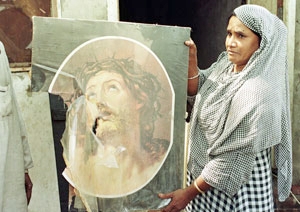
Photo: AFP
Photo: AFP
On July 19, 2010, two Christian brothers, Pastor Rashid Emmanuel, 32, and Sajid Emmanuel, 30, who were being led out of a court by a police escort in Faisalabad City after a trial hearing in a blasphemy case, were gunned down by a religious zealot.

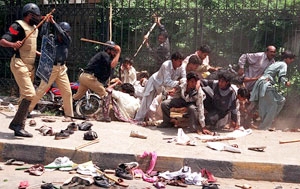
On August 1, 2009, a Christian locality in Gojra, Punjab was attacked and nine Christians were killed, 18 were injured, and more than 120 Christian homes destroyed by a Muslim mob who were enraged by the allegation that a Christian in a nearby village, Korian, had desecrated the Holy Quran. Among the victims was 50-year-old Hameed Masih, who was shot dead, and seven of his family members, including women and small children (the youngest was just four years old), who were burnt alive.

On November 12, 2005, some 2,000 Muslims attacked a Christian locality in Sangla Hill, Punjab. They destroyed and burnt several houses and desecrated a few churches in the area. The attack was sparked by an alleged case of blasphemy of the Holy Quran.

On February 6, 1997, about 3,000 Muslims attacked a Christian village, Shantinagar (land of peace), located 10 kilometres south-east of Khanewal in the Punjab. About 80% of the village was destroyed. The mob ransacked 785 houses, 13 churches and over 1,500 Bibles, hymn books and religious commentaries were burnt. The perpetrators alleged that Christians had committed blasphemy against the Holy Quran.

Over the years, many attempts have been made to review the Blasphemy Law, but none have been successful because of the pressure exerted by religious groups – a small but powerful minority, wielding influence at all levels of government. The sad truth is that no government has had the courage to confront religious intolerance and the growing trend of violence associated with it. On April 20, 2000, former president, General Pervez Musharraf announced a procedural change in the Blasphemy Law, but within a month he backed down because of protests from Islamic parties whose support he needed to perpetuate his illegitimate rule.

After the Gojra incident, on August 7, 2009, Prime Minister Yousuf Raza Gilani hinted at a review of the Blasphemy Law. He stated that a committee would discuss “laws detrimental to religious harmony.” More than a year later, nothing has been heard of about this committee. The National Assembly’s Standing Committee on Minorities, meanwhile, also proposed a review of the Blasphemy Law. Although his party’s stand is still vague on the issue, PML-N leader Javed Hashmi courageously stated in the house that the law has to be changed to prevent persecution of innocent Pakistanis.

He was not alone in his crusade. Last October, Pakistan’s former information minister, Sherry Rehman from the Pakistan Peoples Party, and Jameela Gilani from the Awami National Party, both Muslim MNAs, called for a repeal of the Blasphemy Law. Rehman has now submitted a private members bill in the National Assembly Secretariat calling for an end to the death penalty.

In February 2010, the Federal Minister for Minorities’ Affairs, Shahbaz Bhatti, stated that the Blasphemy Law has been misused on several occasions and declared that Pakistan is planning to revise the law within the year. He maintained that this was necessary because this law has been misused on several occasions. In response to his statement, religious parties began demanding his removal.

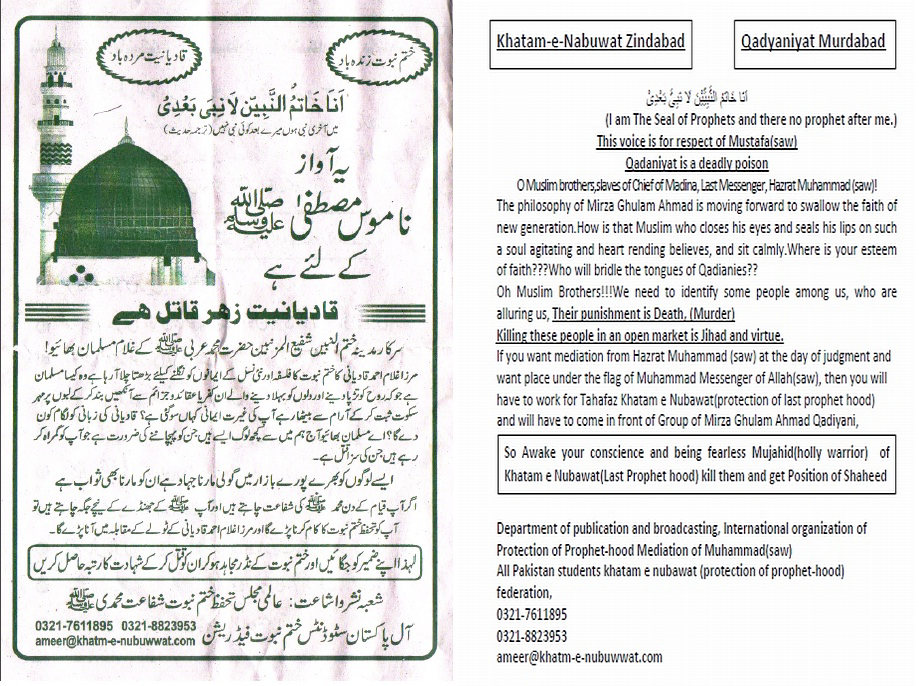
It is interesting to note that two-thirds of all blasphemy cases in Pakistan have been registered in the Punjab where militant organisations have a strong presence. According to a report, from 1986 to date 4,000 blasphemy cases have been reported in the country. Of these, 69% have been registered in the Punjab, 25% were reported in Sindh and 2.5% in Khyber-Pakhtunkhwa. The seven districts of Punjab that have had the most blasphemy cases reported are Lahore, Faisalabad, Sialkot, Kasur, Sheikhupura, Gujranwala and Toba Tek Singh. The involvement of Aalmi Majlis-e-Tahuffuz-e-Khatm-e-Nabuwwat and other hard-line religious groups can be traced in most of these cases.

It is widely believed that the provincial government of the PML-N has close contacts with the province’s militant outfits. Not surprisingly then, during the first week of November, Punjab Chief Minister Shahbaz Sharif withdrew charges of rioting and vandalism that had been levelled against different clerics in Lahore. Due to this kind of appeasement perhaps, militant groups like the Majlis-e-Ahrar and Lashkar-e-Jhangvi, widely believed to be offshoots of the Tehreek-e-Taliban Pakistan, which is responsible for almost all the suicide attacks in Pakistan, are finding it easier to operate in the province. “The PML-N has intellectual and ideological leanings towards the extreme right. The Punjab government has been cushioning extremism and does not recognise extremism as a real problem,” stated political analyst Hassan Askari Rizvi.

Against this backdrop, it is no mystery why the Minority Rights Group (MRG) International ranks Pakistan as the world’s sixth-most dangerous country for minorities. “Very often, mob violence and police brutality in such cases follow a sluggish court procedure subjecting the accused to lengthy periods in jail, legal costs and repeated court appearances,” says a MRG report. And Dawn’s editorial read, “Blasphemy laws have become a ticket in the hands of the majority to persecute and victimise the minority communities if they don’t easily submit to their inferior status in society.”

Prominent human rights advocate and newly-elected President of the Supreme Court Bar Association, Asma Jahangir, has suggested that all blasphemy cases should be tried in the High Courts for more transparency. She also contends that all cases relating to blasphemy must be investigated by superior police officials.

Whether the parliament will show the resolve to follow such procedures, or even amend, let alone do away with the Blasphemy Law, however, remains to be seen. To begin with, the right-wing groups in parliament have dug in their heels on the issue and this government does not appear strong enough, either in terms of will or numbers, to be able to make any substantial changes in the law. But even in the unlikely event of this happening, minorities will only find marginal safety. Ever-increasing religious intolerance cannot be done away with by amending laws alone.

It requires a change of mindset. And that, only a focused and committed programme by the government and civil society together can bring about – a utopian hope in a country as riven by ideological schisms as Pakistan today.


Monday, December 13, 2010

Pak clerics warn of protests if blasphemy laws are amended

December 13, 2010
Pak clerics warn of protests if blasphemy laws are amended
Updated on Monday, December 13, 2010, 15:32

Rawalpindi: Religious parties in Pakistan have warned that they will launch a movement called the Tehreek Namoos-e-Risalat (TNR), if the government moves to amend the country’s blasphemy laws.

Talking to reporters after attending an all parties Namoos-e-Risalat conference here on Sunday, Markazi Jamaat Ahle Sunnat Ameer Pir Atiqur Rehman said that Jamiat Ulema-e-Pakistan (JUP) president Dr Abul Khair Muhammad Zubair had been nominated as the convener of the newly formed group.

The Daily Times quoted him, as saying further that a six-member action committee, comprising Liaqat Baloch, Maulana Abdul Ghafoor Haidri, Abdul Rauf Farooqi, Sikandar Abbas Gillani and Maulana Muhammad Abbas, had been formed to evolve the TNR’s future strategy.

“The purpose of the meeting was to convey a message to the government that the nation would not tolerate any type of amendment in the blasphemy law, especially in the article 295-C of the Constitution,” Dr Abul Khair Zubair, a religious leader, said.

“The future strategy will be evolved in a meeting to be held in Islamabad on December 15,” he added.

Dr Zubair further said that the heads of all the five Wafaqul Madaris (religious educational boards) had also ratified the outcome of the conference.

Syed Munawar Hassan, Qazi Hussain Ahmed, Maulana Fazlur Rehman, Professor Sajid Mir, Allama Sajid Naqvi, Mufti Muneebur Rehman, Dr Abul Khair Zubair, Pir Atiqur Rehman, Hamidul Haq Haqqani, Liaqat Baloch, Maulana Abdul Ghafoor Haidri, Abdul Rauf Farooqi, Sikandar Abbas Gillani and Maulana Muhammad Abbas attended the conference.

ANI

Wednesday, December 1, 2010

JUP threatens Sherry Rehman; to observe protest on 3rd

The News - Internet Edition
Wednesday, December 01, 2010
Zilhajj 24, 1431 A.H.
Karachi
JUP threatens Sherry Rehman; to observe
protest on 3rd

Wednesday, December 01, 2010
By Our Correspondent

Sherry RehmanJamiat-e-Ulema-e-Pakistan has announced to stage protest demonstrations across the country on December 3 against the bid to repeal blasphemy law and in this connection a forum - Tahfuz-e-Namoos-e-Risalt - headed by Sahibzada Abul Khair has been formed to monitor the situation with special reference to protecting the blasphemy law.

The announcement was made at an all parties conference (APC) held on Tuesday under the auspices of Jamiat-e-Ulema-e-Pakistan with Sahibzada Abul Khair in the chair. Others who attended the meeting included Syed Munawar Hasan, Ameer Jamat-e-Islami; Abdul Ghafoor Hyderi, General Secretary JUI(F); Mufti Muneeb-ur-Rehman, President Tanzeem-ul-Madaris Ahle Sunnat; Pir Mian Abdul Khaliq of Bhar Chowndi and PML leaders.

The APC resolved that any change in the blasphemy law would not be accepted and PPP MNA Sherry Rehman was particularly warned that if she tried to amend the laws the people of the country would besiege her.

The APC demanded of the government to avoid repealing blasphemy law and the punishment given under section 295-C should not be amended.

The meeting also demanded that PPP should explain its position on the private bills that were formulated by Ms Rehman and condemned Asma Jehangir and other NGOs for their campaign to amend the Islamic law “on the behest of the West”.

It also demanded for suspending all the powers of the President with regard to pardoning the punishment given under blasphemy law and condemned Governor Punjab Salman Taseer for extending “unnecessary” support to Asiya Bibi, saying, if she had any reservations she should appeal in court.

Tuesday, November 16, 2010

Time to repeal the blasphemy law

Express Tribune, Pakistan
OPINION
Time to repeal the blasphemy law
Nasim Zehra
Nasim Zehra
November 16, 2010
The writer is director current affairs, Dunya TV and a former fellow at Asia Center, Harvard University nasim.zehra@tribune.com.pk

In June 2008, Asiya Bibi, a Pakistani farm worker and mother of five, fetched water for others working on the farm. Many refused the water because Asiya was Christian. The situation got ugly. Reports indicate Asiya was harassed because of her religion and the matter turned violent. Asiya, alone in a hostile environment, naturally would have attempted to defend herself but was put in police custody for her protection against a crowd that was harming her.

However, that protection move turned into one that was to earn Asiya a death sentence. A case was filed against her under sections 295-B and C of the Pakistan Penal Code, claiming that Asiya was a blasphemer. Her family will appeal against the judgment in the Lahore High Court.

The Asiya case raises the fundamental question of how Pakistan’s minorities have been left unprotected since the passage of the blasphemy law. There may have been no hangings on account of the law but it has facilitated the spread of intolerance and populist rage against minorities, often leading to deaths. There is also a direct link between the Zia-ist state’s intolerance against minorities and the rise of criminal treatment of Ahmadis.

Cases have ranged from the Kasur case to the more recent Gojra case, from the mind-boggling row of cases between 1988-1992 against 80-year-old development guru Dr Akhtar Hameed Khan, to the case of the son of an alleged blasphemer, an illiterate brick kiln worker who was beaten to death by a frenzied mob.

Although doctor sahib faced prolonged mental torture, he was saved from the maddening rage that has sent to prison, and in some cases devoured, many innocent, poor and hence unprotected Pakistanis.

There is a long list, prepared by the Human Rights Commission of Pakistan, of unjust punishments handed down to Pakistani citizens whose fundamental rights the state is obliged to protect. Beyond punishments, minorities live in constant fear of being lethally blackmailed by those who want to settle other scores.

Yet most political parties have refrained from calling for the law’s repeal or improvement in its implementation mechanism. When, in the early 90s, I asked Nawaz Sharif sahib to criticise the hounding of Dr Khan, his response was a detailed recall of the story in which Prophet Muhammad (pbuh) went to ask after the health of a non-Muslim woman who repeatedly threw garbage over him. He condemned what was happening but said politics prevented him from doing so publicly. Later, General Musharraf, advised by other generals, reversed his announcement of changing the law’s implementation mechanism. Small crowds protested against it. Among politicians, very few exceptions include the PPP parliamentarian Sherry Rehman and, more recently, the ANP’s Bushra Gohar, who asked for its amendment and repeal.

Already sections of the judiciary have been critical of flawed judgements passed by lower courts in alleged blasphemy cases. Recently in July, Lahore High Court Chief Justice Khawaja Sharif quashed a blasphemy case against 60-year-old Zaibunnisa and ordered her release after almost 14 years in custody. According to the judgment, the “treatment meted out to the woman was an insult to humanity and the government and the civil organisations should be vigilant enough to help such people.” Surely the Bench should know the plethora of abuses that Pakistan’s minorities have suffered because of an evidently flawed law.

A message more appropriate, perhaps, would be to repeal the black law that grossly undermines the Constitution of Pakistan and indeed the teachings of Prophet Muhammad, one of the most tolerant and humane law-givers humankind has known. This environment of populist rage, fed by the distorted yet self-serving interpretation of religion principally by Zia and a populist mixing of religion and politics by a politically besieged Zulfikar Ali Bhutto, must be emphatically challenged. A collective effort to roll back these laws must come from parliament, the lawyers’ forums, the judiciary, civil society groups and the media.

Published in The Express Tribune, November 17th, 2010.

Monday, August 16, 2010

Former Pakistan Federal Minister says persecution of Ahmadis ‘un-Islamic’

Ahmadiyya Muslim Jamaat International
16th August 2010
PRESS RELEASE
Former Pakistan Federal Minister says persecution of Ahmadis ‘un-Islamic’
Also spoke about the ongoing cruelty inflicted upon Ahmadis in Pakistan

In a recent episode of the MTA International Islamic talk show ‘Rah-e-Huda’, the former Minister for Communications in Pakistan, Sherry Rehman, spoke about the ongoing persecution and cruelty inflicted upon Ahmadis in Pakistan. During the broadcast she said:

“If we look at the Ahadith (sayings) of the Holy Prophetpbuh, it is clear that whatever is happening to Ahmadis is completely un-Islamic”

Expressing her disappointment and concern, Sherry Rehman said that because of the long history of persecution borne by the Ahmadiyya Muslim Jamaat in Pakistan there seemed little prospect that its security could be guaranteed by the State in the future. She also said that Article 20 of the Pakistani Constitution granted minorities very comprehensive rights and that because the Government had declared Ahmadis to be a minority they should at least be afforded those rights and protections.

She further commented:

“Once again I will say that these blasphemy laws of ours people justify in the pure name of the Holy Prophetpbuh to inflict persecution upon people and this is completely against the spirit of Islam”

Sherry Rehman went on to say that that the media in Pakistan requires proper regulation. She said that if the media considered itself to be a mature part of civilised society then it should adopt a moral code. In light of this she suggested that a Press Complaints Commission, based on the UK model, ought to be adopted in Pakistan. Moreover, she said, that both the government and media should have faith in such a commission.

It should be noted that although the Government of Pakistan has declared the Ahmadiyya Muslim Jamaat to be a non-Muslim minority sect in Pakistan, the Ahmadiyya Muslim Jamaat has never accepted this status. Ahmadi Muslims believe that their founder, Hadhrat Mirza Ghulam Ahmad of Qadian is the Promised Messiah and Promised Reformer, whose advent was foretold by the Holy Prophet Muhammadpbuh. The Ahmadiyya Muslim Jamaat follows the principle of “Love for All, Hatred for None” and believes that every individual has the right to practise his faith or religion with freedom and without any form of compulsion.

Also Available in Urdu: Press Release in Urdu

22 Deer Park Road, London, SW19 3TL UK
Tel/Fax: 020 8544 7613 Mob: 077954 90682
Email: press @ ahmadiyya.org.uk
Press Secretary AMJ International
 
^ Top of Page