 |
WORLD |
In Pakistan, Islamic hard-liners expanding their grip on society
The killing of a governor opposed to the nation's blasphemy law, and the warm reception for his accused killer, has exposed Islamic fundamentalists' growing sway over the nation.
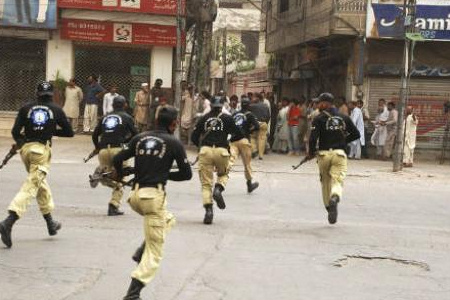
 Pakistanis chant slogans as they gather to show their support outside the Rawalpindi home of Mumtaz Hussain Qadri, who is accused of killing Punjab Gov. Salman Taseer. (Aamir Qureshi, AFP/Getty Images / January 21, 2011) |
By Alex Rodriguez, Los Angeles Times
January 21, 2011
Reporting from Rawalpindi, Pakistan — Above a dank, darkened teahouse pungent with the aroma of green chili peppers, a bright blue banner depicts a neighborhood cleric, Qari Hanif Qureshi, declaring: “Anyone opposing laws protecting the sanctity of the prophet Muhammad is condemned!“
Such dire exhortations from local imams are embraced by millions of impoverished Pakistanis scraping by in squalid, dust-choked city neighborhoods and mud-hut settlements.
Mumtaz Hussain Qadri, a 26-year-old police commando assigned to guard Punjab Gov. Salman Taseer, says Qureshi’s preachings inspired him to assassinate Taseer on Jan. 4. And on a recent afternoon inside the teahouse, another Qureshi follower, Muhammad Zahir, said he was equally moved.
“If I were there, I would have done the same thing,” says Zahir, 26, scooping up boiled lentils with a piece of bread. “Qadri has brought honor upon his family. He’s a hero now.”
The killing, carried out by a man who saw Taseer as an apostate for opposing Pakistan’s blasphemy law, has exposed the rising influence that Islamic fundamentalism has over Pakistani society, a mind-set that increasingly radicalizes the nuclear-armed nation, breeds intolerance and further weakens Islamabad’s feeble civilian government.
Led by clerics at the helm of the country’s religious political parties and its hard-line mosques and madrasas, the extremists demonstrated their reach after Taseer was assassinated in an upscale neighborhood of Islamabad. Days later, fundamentalist clerics rallied more than 40,000 people on the streets of Karachi in support of Qadri. A day earlier in Qadri’s Rawalpindi neighborhood, at least 4,000 people had gathered in front of the accused assassin’s house, chanting, “Salute to your bravery, Mumtaz!“
At Qadri’s court appearances, lawyers have showered him with flower petals and kissed his cheeks, a worrisome sign that his support stretches far beyond Pakistan’s underclass and into the upper echelons of society.
Hard-line clerics are now turning their anger toward another leading member of the ruling Pakistan People’s Party, lawmaker Sherry Rehman, who, like Taseer, called for changes aimed at reforming the blasphemy law after a Pakistani Christian woman accused of insulting the prophet Muhammad was given the death penalty.
Journalist Ali Kamran Chishti attended a Jan. 7 gathering in Karachi at which Munir Ahmed Shakir, imam of the Sultan mosque, labeled Rehman an infidel for proposing changes to the law to remove the death penalty as an option for punishment and require prosecutors to prove that the alleged blasphemy was intentional and not inadvertent. Pakistan’s blasphemy law makes it a crime to defame the prophet Muhammad or Islam, but is often used as a tool to repress minorities.
“This kind of rhetoric radicalizes people,” Chishti said. Imams such as Shakir, he added, “are slowly poisoning minds and making people intolerant. Praising people like Qadri is indirectly saying to society that anyone who takes this line [against the blasphemy law] should be shot dead. This is wrong.”
The outpouring of praise for Qadri also sends disturbing signals to Washington. At a time when the Obama administration is hoping for a more reliable ally in the U.S.-declared war on terrorism, the Taseer assassination and its aftermath suggest extremism in Pakistan may be going mainstream.
“A mind-set has been created that has to be undone,” said Ijaz Khan, who heads the international relations department at the University of Peshawar. “It poses a serious existential challenge to the so-called liberal community of this country.
“We still do not know how many more Qadris are out there,” Khan added, “and what will happen next.”
Pakistan’s religious extremists thrive on street power rather than on ballot-box appeal. In elections in 2008, religious parties collectively garnered less than 5% of the vote. Founded as a moderate Islamic state, Pakistan is governed by the largely secular Pakistan People’s Party.
But in the thousands of mosques and madrasas across the nation, fundamentalists enjoy a captive audience. Hard-line clerics delivering fiery Friday sermons are seen as more credible than the country’s government leaders.
“If there was economic development and more job opportunities on the horizon, they wouldn’t be as apt to listen to these clerics,” said Hasan Askari Rizvi, a Lahore-based security analyst. “At least not all the time.”
The rise of the Islamists has its origins in the military rule of Gen. Zia ul-Haq, who in the 1980s forced a more conservative brand of Islam on the country. That resulted in the start-up of legions of madrasas, many of which became incubators for extremism.
Even state education under Zia “socialized young minds into religious orthodoxy,” Rizvi said. “Now these people who studied in high schools and state universities from 1985 onward are the ones who support this kind of far-right religious orientation.”
The large show of support for Qadri has both stunned and intimidated Pakistani secularists. Though several commentators on television and in newspapers have denounced the praise Qadri has received, top leaders within President Asif Ali Zardari’s administration have been conspicuously quiet amid the furor.
The government has even tried to sound conciliatory: This week Prime Minister Yousuf Raza Gilani stressed that authorities have no plans to tamper with the country’s blasphemy law — a clear attempt to appease hard-line religious leaders angered by talk of amendments to the law.
Whether such gestures calm the toxic debate over Taseer’s assassination remains to be seen. The Sunni Ittehad Council, an influential assembly of Pakistani Muslim clerics, has vowed to hold rallies in major cities in defense of the blasphemy law this month.
“If we want peace in our country,” said Hanif Tayyab, the council’s general secretary, “we should try to understand that freedom of expression has some limits.”
alex.rodriguez@latimes.com
Copyright © 2011, Los Angeles Times
URL: www.latimes.com/news/nationworld/world/la...3266594.story
URL: www.latimes.com/news/nationworld/world/la...3266594.story







 Posts


