Showing posts with label Ordinance XX. Show all posts

Friday, May 27, 2011

A minority without rights

The Friday Times
May 27 -
June 02, 2011
Vol. XXIII, No. 15
TFT Special

A minority without rights
Yasser Latif Hamdani
Last year’s attacks on the Ahmadiyya community are part of a bigger problem where nobody’s places of worship are safe. What is different, however, is the indifference and apathy showed by the administration
-
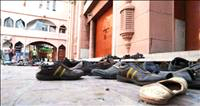
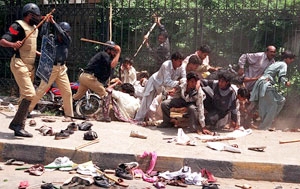
May 28, 2010: Lahore attack on Ahmadiyya Mosques
Even if Ahmadis are considered non-Muslim, they have rights under the constitution of the Islamic Republic of Pakistan as citizens of Pakistan which have been violated time and again. Ordinance XX of 1984 for example makes it a crime for Ahmadis to even use the Islamic greeting of “Assalamualaikum” and other Islamic symbols and religious verses. This hits at the root of the Ahmadi mode of worship
No Muslim in Pakistan can get a passport unless he signs a statement abusing Ahmadis and their religious beliefs. Therefore, every time the state prints a passport form, it effectively militates against several constitutional provisions and section 295-A of Pakistan Penal Code which safeguards against malicious or willful writings against the founders of any religion practised by a class of persons in Pakistan
“An unIslamic authority can survive but an unjust authority cannot,” said Hazrat Ali (AS), the fourth righteously guided caliph of Islam.

This simple observation has turned out to be true all through Islamic history, most notably in the Mughal Empire. The heterodox Akbar laid the real foundations of the empire on tolerance and justice for all communities in the realm, and his great grandson the pious and orthodox Aurangzeb Alamgir laid the foundations of its disintegration because of his discriminatory and unjust policy against Non-Sunnis and Non-Muslims.

These are poignant lessons for the Islamic Republic of Pakistan - which long fancied itself the successor state of the Mughal Empire and which has since General Zia’s hypocritical Islamisation embarked on a terrible course similar to the end of the Mughal Empire.

May 28 will mark the one-year anniversary of the deadly attacks on Ahmadi places of worship (it is a crime to call them mosques under the draconian anti-Ahmadiyya law, but a rose is a rose by any name). These attacks, just like the attacks on Shia imambargahs and Sunni ibadatgahs, are part of a bigger security problem that the country faces. What is different is the official indifference and apathy for Ahmadis displayed by the administration.

The most haunting thing about the tragedy was the question that the local leader of the Ahmaddiya community asked of the government in a press conference the next day. “You do not consider us Muslims, but at least tell us whether we are citizens of Pakistan.” This question should worry all those Pakistanis who want to see Pakistan a progressive and egalitarian state that treats all its citizens fairly and equitably.

In 1974, Pakistan’s National Assembly declared Ahmadis non-Muslim for the purposes of law and constitution. A legitimate question may be raised as to whether the constitution of Pakistan as framed in 1973 even empowered the National Assembly to exercise the power to ex-communicate an entire sect. The Islamic provisions blended into the constitution were subject to interpretation of all schools of thought that were recognised as Muslim at the time. Therefore, arguably, the National Assembly overstepped its boundaries when it declared Ahmadis non-Muslim.

In 1947, Pakistan had laid claim to Gurdaspur because the “Muslim holy place” of Qadian was located there and Gurdaspur as a whole was Muslim majority only with the inclusion of Ahmadis in Muslim numbers.

Even if Ahmadis are considered non-Muslim, they have rights under the constitution of the Islamic Republic of Pakistan as citizens of Pakistan which have been violated time and again. Ordinance XX of 1984 for example makes it a crime for Ahmadis to even use the Islamic greeting of “Assalamualaikum” and other Islamic symbols and religious verses. This hits at the root of the Ahmadi mode of worship. It defeats the purpose of Article 20 of the constitution which gives citizens the right to practice and propagate their faiths and offends Article 2-A, which after the necessary correction by the 18th Amendment, promises all religious minorities can practice their faith freely.

The Objectives Resolution had been incorporated as Article 2-A by General Zia’s regime. However the word “freely” was omitted in connection with the right of religious minorities to practice their religions and develop their cultures. Since 1974, Ahmadis were a non-Muslim minority and their status was a double-edged sword for the Zia regime. The Objectives Resolution was introduced in its mutilated form only to target them. The 18th Amendment corrected a longstanding wrong when it restored the word “freely”, but the damage had already been done.

In Zaheeruddin v State, the Supreme Court of Pakistan declared that placing restrictions on Ahmadis did not violate the constitutional religious freedom. It was a terrible decision because the majority opinion resorted to using principles of intellectual property law to determine exclusive ownership of religious symbols such as use of Islamic vocabulary for those determined to be Muslims. The judgment also went on to say that a Muslim cannot be but outraged at the use of Islamic symbols by Ahmadis. It goes on to condone acts of violence and religious sentiment used to persecute minorities. Dr Martin Lau, a renowned legal scholar, very poignantly argued that after the aforesaid judgment all religious freedom effectively stands abolished in Pakistan.

Under Article 2-A, the constitution ensures something more than religious freedom for religious minorities - it ensures a special status and requires the state to aid and allow the minorities every opportunity to develop their religions and cultures. When it comes to Ahmadis however, the state goes out of its way to demonise and discriminate against the community. No Muslim in Pakistan can get a passport unless he signs a statement abusing Ahmadis and their religious beliefs. Therefore every time the state prints a passport form, it effectively militates against several constitutional provisions and against 295-A of the Pakistan Penal Code which safeguards against malicious or willful writings against the founders of any religion practised by a class of persons in Pakistan.

By restoring the word “freely” in Article 2-A, the government has given our judiciary another opportunity to correct a wrong that was committed by a martial law regime. The judiciary has to act to safeguard the citizens of Pakistan because the legislature in Pakistan can only go so far. Challenging bigotry is answered with 26 bullets. The minister of minorities was killed for standing up for the original idealism of Pakistan. Under the circumstances, the legislature can only give the smallest of rooms and the judiciary must rush in to re-establish religious freedom which is not only constitutionally ensured in Pakistan, but also part of the International Convention of Civil and Political Rights which Pakistan has signed and ratified.

Till then, the Ahmaddiya community - which played a major role in the making of Pakistan and which has contributed magnificently to its progress - will remain effectively stripped of citizenship rights in Pakistan.

Yasser Latif Hamdani lives in Lahore

Thursday, December 23, 2010

Pandora’s Law

Newsline, Pakistan
Home »
News & Politics
Pandora’s Law
23 December 2010By Aftab Alexander Mughal
Pandora's Law

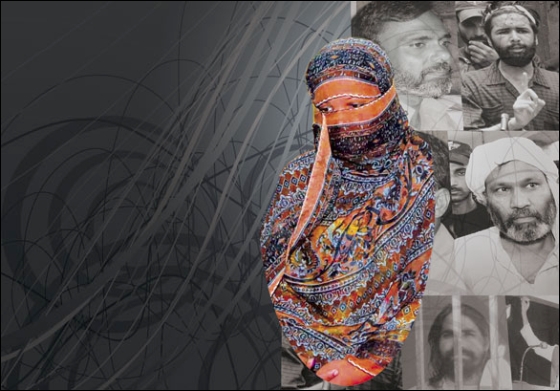
Following the pronouncement of the death sentence against a Christian woman, Aasiya Bibi, on a charge of blasphemy, the case and the controversial law pertaining to this alleged crime are once again the subject of heated debate.

Aasiya’s case and the resultant prevailing situation are full of ironies. The state that purports to offer ‘special protection’ to its minority communities finds itself in a dilemma. Even before the president could consider a mercy petition filed by Punjab Governor Salmaan Taseer and appeals by assorted international human rights organisations to spare Aasiya Bibi’s life, the chief justice of the Punjab High Court, where the case is to be sent, has already issued a verdict: there is no room for pardon in a blasphemy case.

And while the governor – a PPP stalwart – has taken an unequivocal stand on the issue, Federal Law Minister, Babar Awan, also from the PPP, has made his position on the larger issue this case has resurrected, crystal clear. Stated Awan, “In my presence as law minister, no one should think of finishing the [blasphemy] law.”

Meanwhile, the Punjab Law Minister, the PML-N’s Rana Sanaullah, has said that he believes Aasiya’s conviction is a miscarriage of justice, even while his party is an avid proponent itself of the death sentence for this charge – doing away with the lesser punishment of life imprisonment for this crime during its time in government.

Aasiya’s “crime” was by all accounts a simple spat with two Muslim women of her village who refused to drink water from a glass she had touched because they said it had been defiled due to her faith and caste. The women taunted her and when she responded, they lodged a complaint of blasphemy against her at the Nankana Sahib district and sessions court. Aasiya, the mother of a special child, was arrested and has languished in jail for over a year on account of these charges. Now the executioner’s noose looms ominously over her head. While the mounting pressure on the government by activists on both sides (the anti- and pro-pardon for Aasiya) of the divide promises to engender heated debate, the outcome of this case will hold greater significance because of the bigger debate it has thrown up – i.e. the validity of the Blasphemy Law. Aasiya’s fate will graphically determine the ethos of the country today and the direction in which it is moving.

Some observers say that the Blasphemy Law is used to exploit vulnerable minority groups and encourage Islamist extremism. Photo: AFP
Several non-governmental organisations (NGOs) in Pakistan have long been calling for a repeal of the Blasphemy Law because it has repeatedly been used to persecute the minorities, especially in the rural areas. Parliamentary Secretary for Science and Technology Aasia Nasir, a Christian member of parliament said, “Discrimination against minorities is widespread. We need to sensitise the public and bring an attitudinal change to eliminate this menace from society.”

However, given the entrenchment of attitudes, that seems a near impossible undertaking in the short term. Prominent Deobandi and Barelvi clerics and the chief of the Sunni Ittehad Council (SIC) Sahibzada Fazal Karim have declared in no uncertain terms that they will not allow a repeal of the Blasphemy Law.

The genesis of the Blaspehmy Law lies in colonial times. A blasphemy law, Section 295, was added to the Indian Penal Code (IPC) in 1860 during the British Raj. In 1927, another law, Section 295-A, IPC, was added to prevent tension between Hindus and Muslims. At its creation, Pakistan adopted the same laws, ostensibly in order to promote religious harmony in Pakistan.

The existing Blasphemy Law, which actually affords ‘protection’ to only one religion, and that too being a moot point – Islam – was introduced in the 1980s by General Zia-ul-Haq. Through the introduction of this law he wanted to please Islamic parties who supported his illegitimate martial law government. Most controversial among the law are sections 295-B and C of the Pakistan Penal Code (PPC). Section 295-B, was introduced in 1982, which is against any insult to the Holy Quran, and the crime is punishable with life imprisonment. Section 295-C, PPC which was added by an act of parliament in 1986, made it a criminal offence to use derogatory remarks against the Holy Prophet (PBUH) and made the crime punishable with life imprisonment or death. In 1992, during former prime minister Nawaz Sharif’s rule, the sentence of life imprisonment was removed, and now the death sentence exists as the only punishment for this offence. Given the harshness of the punishments, Retired Justice Rana Bhagwandas, a Hindu, who once served as acting chief justice of Pakistan, said, “Who would be senseless enough to commit blasphemy in Pakistan?”

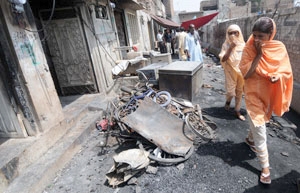
A woman walks past burnt out buildings in Gojra after accusations of blasphemy led to mob violence. Photo: AFP / File
That notwithstanding, hundreds of individuals in Pakistan have been charged with blasphemy. As a Christian leader pointed out, “These laws have been widely misused against religious minorities, as well as against many Muslims to settle personal scores. The Blasphemy Law is thus a danger to all Pakistanis, an affront to the rule of law and also against the concept of basic human rights and equality among the citizens of the state.” Human Rights Watch spokesman Ali Dayan endorsed this view, contending that the Blasphemy Law is used to exploit vulnerable minority groups and encourage Islamist extremism.

Well-known international human rights organisation Amnesty International chimed in, stating, “This law, while purporting to protect Islam and religious sensitivities of the Muslim majority, is vaguely formulated and arbitrarily enforced by the police and judiciary in a way which amounts to harassment and persecution of religious minorities.”

Between 1927 and 1986, there were less than 10 reported cases of blasphemy. The National Commission of Justice and Peace (NCJP), a human rights body of the Catholic Bishops Conference of Pakistan, reports that between 1986 and August 2009, at least 974 people have been charged for defiling the Holy Quran or insulting the Prophet Muhammad (PBUH). Those charged include 479 Muslims, 340 Ahmadis, 119 Christians, 14 Hindus and 10 from other religions. In 2009, no less than 112 cases were registered against 57 Ahmadis, 47 Muslims and eight Christians.

In most of the blasphemy cases filed, people convicted in the lower courts have been released by the higher courts, but invariably they had to spend years in jail before they were deemed innocent. To date no one has ever been executed for blasphemy under court orders. However, about 34 people have been murdered by individuals or crazed mobs for alleged blasphemy against the Holy Quran or for insulting the Prophet Muhammad (PBUH).

Photo: AFP
Photo: AFP
Many organisations have been campaigning for the repeal of the Blasphemy Law, which they think creates a wide space for discrimination against religious minorities, especially Ahmadis and Christians. And, while it is true that earlier this law was used mainly against minorities, a number of Muslims have also been victimised. The law has mainly been striking against vulnerable, poor members of minority communities who live in remote areas.

A history of blasphemy cases reveals that once a person is blamed for blasphemy against Islam, its holy personages or the Holy Quran, he/she has no place in society. The accused can be killed before the police’s intervention, in police custody or during his/her trial. Often the police fail to register FIRs due to local pressure. The courts are also not free from such pressures and have been known to convict people without concrete proof. And even if a court pardons the accused, he/she continues to live in fear since he/she is only too likely to be stalked and targeted by Muslim zealots. The more fortunate ones go into exile. For others, it is death or a life in hiding.

The Blasphemy Law has also created serious problems for the judiciary, especially the subordinate courts. “In almost each case brought before them, they come under such heavy pressure from agitators that they are afraid of applying their minds to the papers before them,” wrote senior journalist and human rights campaigner, I.A. Rehman in a column published in a local newspaper. Thus, campaigners contend, invariably decisions by courts in these cases are made not on merit, but under pressure.

In the last two months at least five blasphemy cases have been registered. Recently, three members of a Christian family were forced to flee their home because of alleged blasphemy. In mid-September, Tasawwar Masih, a Christian youth of Sargodha, was accused by Muslim youths of insulting Prophet Muhammad (PBUH), and was forced to leave the area along with his family.

In Sialkot district, Punjab, another Christian, Walayat Masih, was charged with blasphemy. His accusers contended that a copy of the Holy Quran with a few of its pages burned was found in front of his house. A crowd of people gathered around Masih’s front door and it was only through police intervention that a lynching was averted.

In Lahore, three Muslim men, Shaheed Hassan Butt, Sheikh Shahid and Nawazish, were accused of having trashed some pages of the Holy Quran. The original complaint and the subsequent class action suit against them were levelled by leaders of the Ahl-e-Hadith mosque.

Photo: AFP
Photo: AFP
On July 19, 2010, two Christian brothers, Pastor Rashid Emmanuel, 32, and Sajid Emmanuel, 30, who were being led out of a court by a police escort in Faisalabad City after a trial hearing in a blasphemy case, were gunned down by a religious zealot.

On August 1, 2009, a Christian locality in Gojra, Punjab was attacked and nine Christians were killed, 18 were injured, and more than 120 Christian homes destroyed by a Muslim mob who were enraged by the allegation that a Christian in a nearby village, Korian, had desecrated the Holy Quran. Among the victims was 50-year-old Hameed Masih, who was shot dead, and seven of his family members, including women and small children (the youngest was just four years old), who were burnt alive.

On November 12, 2005, some 2,000 Muslims attacked a Christian locality in Sangla Hill, Punjab. They destroyed and burnt several houses and desecrated a few churches in the area. The attack was sparked by an alleged case of blasphemy of the Holy Quran.

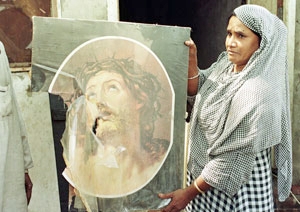
On February 6, 1997, about 3,000 Muslims attacked a Christian village, Shantinagar (land of peace), located 10 kilometres south-east of Khanewal in the Punjab. About 80% of the village was destroyed. The mob ransacked 785 houses, 13 churches and over 1,500 Bibles, hymn books and religious commentaries were burnt. The perpetrators alleged that Christians had committed blasphemy against the Holy Quran.

Over the years, many attempts have been made to review the Blasphemy Law, but none have been successful because of the pressure exerted by religious groups – a small but powerful minority, wielding influence at all levels of government. The sad truth is that no government has had the courage to confront religious intolerance and the growing trend of violence associated with it. On April 20, 2000, former president, General Pervez Musharraf announced a procedural change in the Blasphemy Law, but within a month he backed down because of protests from Islamic parties whose support he needed to perpetuate his illegitimate rule.

After the Gojra incident, on August 7, 2009, Prime Minister Yousuf Raza Gilani hinted at a review of the Blasphemy Law. He stated that a committee would discuss “laws detrimental to religious harmony.” More than a year later, nothing has been heard of about this committee. The National Assembly’s Standing Committee on Minorities, meanwhile, also proposed a review of the Blasphemy Law. Although his party’s stand is still vague on the issue, PML-N leader Javed Hashmi courageously stated in the house that the law has to be changed to prevent persecution of innocent Pakistanis.

He was not alone in his crusade. Last October, Pakistan’s former information minister, Sherry Rehman from the Pakistan Peoples Party, and Jameela Gilani from the Awami National Party, both Muslim MNAs, called for a repeal of the Blasphemy Law. Rehman has now submitted a private members bill in the National Assembly Secretariat calling for an end to the death penalty.

In February 2010, the Federal Minister for Minorities’ Affairs, Shahbaz Bhatti, stated that the Blasphemy Law has been misused on several occasions and declared that Pakistan is planning to revise the law within the year. He maintained that this was necessary because this law has been misused on several occasions. In response to his statement, religious parties began demanding his removal.

It is interesting to note that two-thirds of all blasphemy cases in Pakistan have been registered in the Punjab where militant organisations have a strong presence. According to a report, from 1986 to date 4,000 blasphemy cases have been reported in the country. Of these, 69% have been registered in the Punjab, 25% were reported in Sindh and 2.5% in Khyber-Pakhtunkhwa. The seven districts of Punjab that have had the most blasphemy cases reported are Lahore, Faisalabad, Sialkot, Kasur, Sheikhupura, Gujranwala and Toba Tek Singh. The involvement of Aalmi Majlis-e-Tahuffuz-e-Khatm-e-Nabuwwat and other hard-line religious groups can be traced in most of these cases.

It is widely believed that the provincial government of the PML-N has close contacts with the province’s militant outfits. Not surprisingly then, during the first week of November, Punjab Chief Minister Shahbaz Sharif withdrew charges of rioting and vandalism that had been levelled against different clerics in Lahore. Due to this kind of appeasement perhaps, militant groups like the Majlis-e-Ahrar and Lashkar-e-Jhangvi, widely believed to be offshoots of the Tehreek-e-Taliban Pakistan, which is responsible for almost all the suicide attacks in Pakistan, are finding it easier to operate in the province. “The PML-N has intellectual and ideological leanings towards the extreme right. The Punjab government has been cushioning extremism and does not recognise extremism as a real problem,” stated political analyst Hassan Askari Rizvi.

Against this backdrop, it is no mystery why the Minority Rights Group (MRG) International ranks Pakistan as the world’s sixth-most dangerous country for minorities. “Very often, mob violence and police brutality in such cases follow a sluggish court procedure subjecting the accused to lengthy periods in jail, legal costs and repeated court appearances,” says a MRG report. And Dawn’s editorial read, “Blasphemy laws have become a ticket in the hands of the majority to persecute and victimise the minority communities if they don’t easily submit to their inferior status in society.”

Prominent human rights advocate and newly-elected President of the Supreme Court Bar Association, Asma Jahangir, has suggested that all blasphemy cases should be tried in the High Courts for more transparency. She also contends that all cases relating to blasphemy must be investigated by superior police officials.

Whether the parliament will show the resolve to follow such procedures, or even amend, let alone do away with the Blasphemy Law, however, remains to be seen. To begin with, the right-wing groups in parliament have dug in their heels on the issue and this government does not appear strong enough, either in terms of will or numbers, to be able to make any substantial changes in the law. But even in the unlikely event of this happening, minorities will only find marginal safety. Ever-increasing religious intolerance cannot be done away with by amending laws alone.

It requires a change of mindset. And that, only a focused and committed programme by the government and civil society together can bring about – a utopian hope in a country as riven by ideological schisms as Pakistan today.

Saturday, August 28, 2010

The other Pakistani crisis

Posted on Thu, Aug. 26, 2010Philadelphia Inquirer, USA
Worldview: The other Pakistani crisis
Intolerance and violence threaten to tear the country to pieces.
Trudy Rubin
By Trudy Rubin
Inquirer Opinion Columnist
A shocking e-mail on Monday informed me of a Philadelphian murdered in Pakistan.

Habib Peer, 60, was a hardworking Pakistani American who had raised three children and run two businesses in the city. He considered himself a devout Muslim and was a leader in his Ahmadiyya Muslim community. Last week, he was shot dead by masked men in the southern Pakistani city of Sanghar, where he was helping the family of his brother - who had been murdered four years before.

Both brothers were killed by militants who believe the Ahmadis are apostates. Since 1974, Pakistan’s constitution has labeled its two to four million Ahmadis “non-Muslim” because their beliefs contradict traditional Islam. (They follow a 19th-century mystic they believe was the messiah predicted by the prophet Muhammad.) In no Muslim country is the repression of Ahmadis so severe or so officially sanctioned as in Pakistan.

Peer’s death, however, exposes a crisis affecting all Pakistanis. It reflects a struggle for the soul of the country as daunting as the physical struggle to survive this month’s devastating floods.

Pakistan faces a Herculean challenge in coping with flood damage, and Muslim militants are eager to take advantage. As Pakistan’s leaders now recognize, these militants present a huge threat to their (nuclear-armed) state.

A recent security assessment by Pakistan’s military spy agency concluded, for the first time, that the biggest threat to national security comes from Islamic militants, not India. Some of these militants are probably providing shelter for al-Qaeda’s leadership, including Osama bin Laden, and the Pakistani army is targeting some groups.

Yet there are other jihadis dedicated to sectarian murder that are not on the military’s hit list. Some of these militants were originally trained by Pakistani security services to fight against India in the disputed territory of Kashmir.

Sipah-e-Sahaba, for example, openly calls for the slaying of Shiite Muslims, who make up about 10 to 15 percent of the population; it continues to operate freely. The Pakistani elite largely stays silent, and sectarian violence grows.

In April, I visited a Shiite friend in Karachi who was nearly killed in December, when a suicide bomber blew up 43 people during the Shiite religious celebration of Ashura. Her back and thighs were penetrated by large shards of metal from the bomb, which went off five feet from her; her brother and sister-in-law were killed.

Militants have also been attacking Sufi shrines, which they consider irreligious, although Sufi saints and shrines are highly regarded in South Asia. Pakistani Christians are attacked, too. Fueled by young graduates of radical religious schools, sectarian and ethnic violence is tearing at the social fabric of Karachi, Pakistan’s largest city.

Yet Pakistan’s leaders rarely stand up to religious fanatics who target fellow Pakistanis. When it comes to Ahmadis, the state practically cheers the violence on.

On May 28, gunmen struck at two Ahmadi mosques in Lahore, killing 93 people. After this outrage, the powerful Pakistani politician Nawaz Sharif (whose party has shown sympathy for militants) had the decency to insist that his Ahmadi “brothers and sisters” are an “asset to the country.” He was denounced by religious parties and clerics around the country.

Pakistan’s founder, Mohammed Ali Jinnah, who envisioned an inclusive and tolerant state, must be turning in his grave.

As Pakistanis begin to recover from the floods, they must decide what kind of country they want to live in. Their only Nobel Prize winner, physicist Abdus Salam, was an Ahmadi; when the physics faculty at Quaid-i-Azam University invited him to lecture in 1979, it was thwarted by a religious student group that threatened violence. Is this the country Pakistanis want?

The endless sectarian killings show - contrary to legions of Pakistani conspiracy theorists - that the country is besieged not by the West, but by Muslim militants who use violence.

In the Peer case, militants killed members of a community that opposes religious wars and bloodshed. Will Pakistan’s leaders have the courage to denounce these and other sectarian murders? Will they change the laws that expose Ahmadis to blasphemy charges and death?

To recover from the physical challenge of the flood, Pakistanis will have to pull together in spirit, not pit different communities against one another. The rest of the world can help Pakistan with rebuilding, but only Pakistanis can make their country whole.

Wednesday, August 25, 2010

U.S. citizen slain over his religion in his native Pakistan

Philadelphia Inquirer, USA
Posted on Wed, Aug. 25, 2010
U.S. citizen slain over his religion in his native Pakistan

By David O’Reilly
Inquirer Staff Writer
Pir Habibur Rehman

When Habib Peer closed his Germantown newsstand last year and moved back to Pakistan, his passport made no note of his religion.

Since 1990 he had been a resident and citizen of the United States, where being an Ahmadiyya Muslim is no offense. But in his homeland, Peer’s faith made him a target, his family said.

On Thursday, as he drove with a young nephew through the southern city of Sanghar, two motorbikes approached his car. One of the masked drivers fired a handgun twice through the open window, instantly killing the 60-year-old Peer.

His nephew, 13, survived to describe the assassination. “That’s just how [the boy’s] father died,” recalled Mujeeb Chaudhary, Peer’s brother-in-law and a Philadelphia pharmacist.

“It was a targeted killing, only because of his religion.”

Four years earlier, Peer’s brother, Pasha, a physician who cared for the poor of Sanghar, was shot twice in the head as he left his clinic one evening. His killer ran off and was never found.

Widowed the year his brother died, Peer had moved back to Pakistan to care for Pasha’s widow, whom he married, and to help raise his brother’s children.

Ahmadis follow the Indian mystic Mirza Gulam Ahmad, who in 1887 announced that he was the messiah, or Mahdi, predicted in early Islamic writings as one who would purify Islam near the end of time.

Nearly all Muslims view Ahmad as a heretic, and his followers as inauthentic Muslims. Although tolerated in some Muslim nations, they are especially disdained in Pakistan, whose constitution and passports identify Ahmadis as non-Muslim.

That nation’s four million Ahmadis are forbidden by law to publicly practice their religion, and they can be jailed for blasphemy if they greet Sunni or Shiite Muslims with the traditional “salaam alaykum” or wear Muslim garb.

Mainstream mullahs and imams denounce Ahmadis, with some blaming their presence for the floods ravaging Pakistan. “Some [leaders] even tell their people it is their duty to kill us,” said Chaudhary, who came to the United States in 1972 and is president of the 450-member Philadelphia-area Ahmadiyya community.

The failure of the Pakistani government to suppress such virulent talk, he said, is tantamount to “state-sponsored terrorism.”

Chaudhary added, “The authorities made very little effort for Pasha, and they will do the same for Habib.”

Nadeem Kiani, press attache at the Pakistani embassy in Washington, denied on Tuesday that his government fosters a climate of hostility toward religious minorities, including Ahmadis.

Pir Habibur Rehman“Yes, they are considered a religious minority,” he said, “but they have complete protection and all the constitutional rights.”

Kiani said he was not familiar with Peer’s murder, but said “if any person is murdered, there are legal ways for the family to prosecute the person accused,” although “these can take time.”

Nicole Thompson, a spokeswoman for the State Department, said Tuesday that the Obama administration was “in constant engagement with the government of Pakistan on issues of religious freedom.”

Teresita Schaffer, former U.S. ambassador to Sri Lanka, said Tuesday that the Ahmadiyya community’s cause “is far down on [the State Department’s] list,” though recent violence against Ahmadis is among the worst that nation has seen since its founding in the 1940s.

Schaffer cited the May grenade and assault-weapon attacks by the Pakistani Taliban on two Ahmadi mosques in Lahore that left 78 worshippers dead and dozens severely wounded.

Ahmadis, she said, “are a very controversial part of the community… . The people willing to raise their voices in their defense are few.”

In 2002, the House of Representatives issued a bipartisan resolution calling on Pakistan to repeal the second amendment of its constitution, declaring Ahmadis non-Muslim, and its blasphemy laws.

Since then, the Pakistani government has only toughened its blasphemy laws, Chaudhary said.

On Friday, the Human Rights Commission of Pakistan released a statement expressing dismay over Peer’s murder and that of another Ahmadi in Karachi earlier in the week.

The commission wrote that it also was concerned by reports of denial of shelter to Ahmadis displaced by massive floods in south Punjab.

Although some Muslims are upset by the resistance to a proposed Islamic cultural center near Ground Zero, Chaudhary said he welcomed such debate as “proof of America’s freedom of speech and freedom to practice religion.”

In March, he said, the Philadelphia-area Ahmadi community plans to break ground for a new mosque, with dome and minaret, on West Glenwood Avenue near Temple University. The plan, he said, has encountered no hostility from the neighborhood.

Chaudhary said he was delighted when an employee in the city zoning office asked him, “When will you have your jumma prayers?“ - Friday services.

“Here it is easy to take for granted,” he said, “but this is the greatness of America.”

Monday, August 23, 2010

PAKISTAN: Two more Ahmadis murdered in target killings

AHRC Logo
Asian Human Rights Commission — Statement
PAKISTAN: Two more Ahmadis murdered in target killings
FOR IMMEDIATE RELEASE
AHRC-STM-178-2010
August 23, 2010
A Statement by the Asian Human Rights Commission
PAKISTAN: Two more Ahmadis murdered in target killings

Two more Ahmadis, Dr. Najam al-Hasan and Pir Habib al-Rehman have been murdered in religiously motivated killings. Once again, no one has been arrested and the likelihood of anyone being prosecuted is virtually nil.

Dr. al-Hasan was leaving his clinic in Karachi, the capital of Sindh province, and had just entered his car when he was shot dead by a group of assailants, who remain unidentified. Dr. al-Hasan was just 39 years old and a professor at the Dow Medical University, Karachi.

Pir Habib-al-Rehman, a resident of Sanghar city, Sindh province, was on his way to his farm when two masked assailants approached his vehicle and shot him twice. One of the shots fired struck his head. He was rushed to the hospital but was pronounced dead on arrival. Pir Habib al-Rehman was a US citizen and had been in Pakistan on personal business. He is the second US citizen in two years to be killed for being an Ahmadi. In 2006 Pir Habib’s brother, Dr. Pir Mujeeb al-Rehman, was also killed for being an Ahmadi Muslim in Sanghar city. Previously in September, 2008, Dr. Abdul Mannan Siddiqi, also a US citizen, was brutally killed in Mirpurkhas.

Since the anti-Ahmadiyya Ordinance XX in 1984, 20 Ahmadi doctors have been killed in sectarian attacks, ten of whom were murdered in Sindh province. Dr. Najam al-Hasan becomes the second Ahmadi to be killed in Karachi this year because of his religion. Such violence is a result of the continuing hatred that is spread throughout Pakistan against Ahmadiyya Muslims.

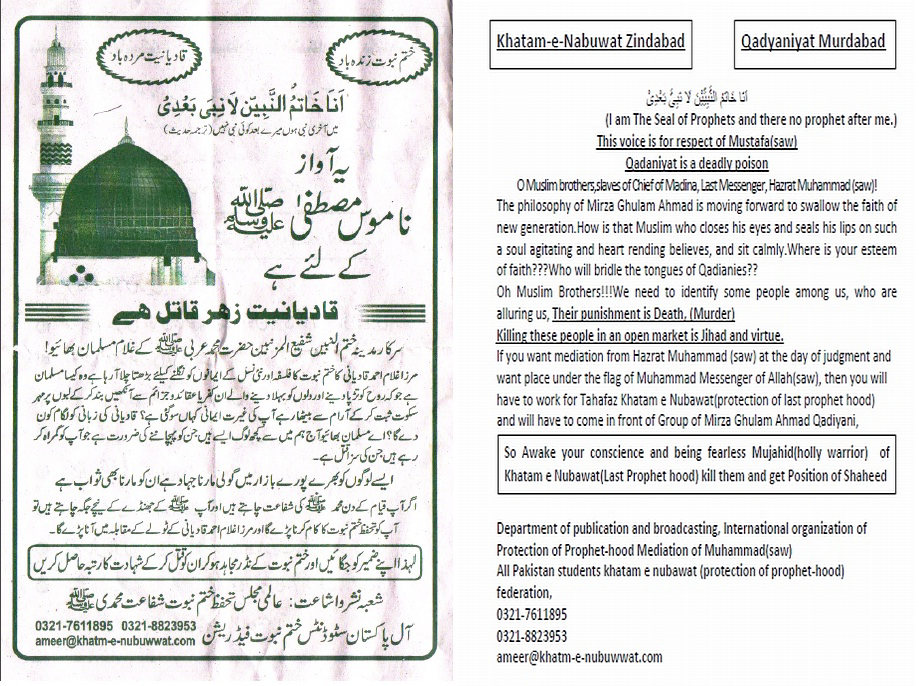
Violent assaults against Ahmadis are carried out in the name of religion and all too often they are premeditated and well organised. It is most unfortunate that certain parts of the media in Pakistan are being used to incite the sentiments of people against Ahmadis and inflame the already raging fire of sectarianism in the country. It is unacceptable that some of the main media and press is aiding the fundamentalist and extremist agenda by openly declaring Ahmadis to be Wajibul Qatl (must be murdered) which is leading to the deaths of innocent Pakistanis. The fundamentalists encourage these deaths by claiming that the killers will be entitled to place in heaven.

The recent attacks on Ahmadis in Lahore have shown that it is open season for extremist and fundamentalist mullahs to spill their venom against Ahmadis which has resulted in the persecution of Ahmadis in various cities and towns of Pakistan. This lack of law and order is resulting in increasing agitation and lawlessness in Pakistan which does not bode well for the country moving forward.

It is also deplorable to learn that during the current national emergency (flooding) Ahmadi victims have been denied aid and have been turned away from shelters. In view of the fact that the government of Pakistan has been asking for millions of dollars in international aid they have a duty to explain this to the funding countries. The aid is being provided for all Pakistanis and this includes the extremists, fundamentalists, Ahmadis and Christians alike. The AHRC calls on the government of Pakistan to end this inhumane and barbaric treatment.

The AHRC urges the authorities in Pakistan to safeguard the security and dignity of all its citizens irrespective of race, religion or creed. In particular it is the Ahmadis who have been denied basic fundamental human rights and whose tormentors and killers are never brought to justice.

In the case of the recent killings the government of Pakistan must show its sincerity to the world and the countries funding the aid by ensuring that minority groups will receive the same degree of aid that the majority are receiving. The killers of Dr. Najam al-Hasan and Pir Habib al-Rehman must be brought to justice.

# # #

About AHRC: The Asian Human Rights Commission is a regional non-governmental organisation monitoring and lobbying human rights issues in Asia. The Hong Kong-based group was founded in 1984.

Thursday, August 19, 2010

American Citizen Murdered in Pakistan due to Government Sanctioned Religious Extremism

Ahmadiyya Muslim Community, USA
In the name of Allah, the Gracious, the Ever Merciful
Muslims who believe in the Messiah
Mirza Ghulam Ahmad Qadiani(AS)
For Immediate Release:
August 19, 2010
Press Release
Contact:
Waseem Sayed, Spokesperson
909-636-4397
waseem.sayed@ahmadiyya.us
American Citizen Murdered in Pakistan due to Government Sanctioned Religious Extremism
Pakistan’s lack of freedom of religion claims a second life this week
Pir Habeeb ur Rehman
Pir Habibur Rehman, resident of Philadelphia, Pennsylvania, was brutally murdered today while in his native country of Pakistan at around 9:30 AM, Pakistani time. Mr. Rehman was in Sindh, Pakistan, when he stopped at a traffic light while driving his nephew and workers to his farm. At that time, two masked gunmen approached his vehicle and opened fire. He was rushed to the hospital but was pronounced dead on arrival. His nephew and workers survived the incident.

Mr. Rehman was a tireless worker for the Ahmadiyya Muslim Community. As Vice President of Muslim Television Ahmadiyya’s USA Studios and the community’s international website (alislam.org), he channeled Philadelphia’s motto of brotherly love into his ability to lead strong teams. He owned a photography store and newspaper stand in Philadelphia and is survived by his wife, two daughters, and a son.

Mr. Rehman is the second member of the Ahmadiyya Muslim Community to be killed in the first week of Ramadan in Pakistan. Dr. Najam al-Hasan, a pediatrician, was shot and killed earlier this week outside of the medical clinic in Karachi where he worked. These appalling acts are a result of Pakistan’s constitution, which subjects the Ahmadiyya Muslim Community to intolerance, injustice, and death with over 260 murders to date since 1974.

Such state-sponsored persecution is due to constitutional amendments declaring members of the Ahmadiyya Muslim Community as “non-Muslim” and criminalizing their religious activities. Amnesty International reports that Pakistan does not prosecute those who kill members of this community, thereby leading killers to continually attack these peaceful Muslims without fear of legal action. Mr. Rehman’s brother, Dr. Pir Mujeeb ur Rehman, was murdered 4 years earlier due to the same extremism perpetuated by these laws.

“We call on the US government to engage Pakistan to repeal its laws that violate human rights” said Dr. Nasim Rehmatullah, Vice President of the Ahmadiyya Muslim Community USA. “Such senseless killing will continue until these laws are revoked.”

About the Ahmadiyya Muslim Community:
Ahmadiyya Muslim Community is a dynamic, reformist and fast growing international movement within Islam. Founded in 1889, the Community spans over 190 countries with membership exceeding tens of millions. Ahmadiyya Muslim Community USA, established in 1920, is the first American-Muslim organization.

Ahmadiyya Muslim Community is the only Islamic organization to believe that the long-awaited messiah has come in the person of Mirza Ghulam Ahmad (1835-1908) of Qadian. Ahmad claimed to be the metaphorical second coming of Jesus of Nazareth and the divine guide, whose advent was foretold by the Prophet of Islam, Muhammad. The Community believes that God sent Ahmad, like Jesus, to end religious wars, condemn bloodshed and reinstitute morality, justice and peace. Ahmad’s advent has brought about an unprecedented era of Islamic revival and moderation. He divested Islam of fanatical beliefs and practices by vigorously championing Islam’s true and essential teachings.

# # #
15000 Good Hope Rd Silver Spring, MD 20905
Phone: 301-879-0110 fax: 301-879-0115
www.ahmadiyya.us 1-800-Why-Islam

Tuesday, August 17, 2010

Another Ahmadi Muslim doctor brutally martyred in Karachi

Ahmadiyya Muslim Jamaat International
17th August 2010
PRESS RELEASE
Another Ahmadi Muslim doctor brutally martyred in Karachi
20 Ahmadi Doctors have been killed since 1984 anti-Ahmadiyya laws

It is with great sadness and regret that the Ahmadiyya Muslim Jamaat hereby confirms that a well-known Ahmadi Muslim, Dr Najam al-Hasan (39) was martyred in a religiously motivated attack last night in Karachi, at approximately 12:15am local time.

Dr Najam al-Hasan was leaving his clinic and had just entered his car when he was shot dead by a group of assailants, who as of yet, remain unaccounted for. Upon hearing the noise of gunfire, his brother, whose medical store is adjacent to the clinic, rushed to the scene only to discover that the victim had already succumbed to his injuries.

Dr Najam al-Hasan was a peaceful and law abiding citizen and a much renowned pediatrician. He was also a serving assistant professor at Dow University of Health Sciences. Dr Najam al-Hasan is survived by his wife, and three young children.

Since the promulgation of the anti-Ahmadiyya specific Ordinance XX in 1984, 20 Ahmadi Doctors have been killed in sectarian attacks, 10 of whom were murdered in Sindh. Dr Najam al-Hasan becomes the second Ahmadi to be killed in Karachi this year because of his religion. Such violence results from the continuing hatred that is spread throughout Pakistan against the Ahmadiyya Muslim Jamaat.

Violent assaults against Ahmadis that are carried out in the name of religion are all too often premeditated and well organised. It is most unfortunate that certain parts of the media in Pakistan are being used to incite the sentiments of people against Ahmadis and inflame the already raging fire of sectarianism in the country.

22 Deer Park Road, London, SW19 3TL UK
Tel/Fax: 020 8544 7613 Mob: 077954 90682
Email: press @ ahmadiyya.org.uk
Press Secretary AMJ International

Wednesday, August 11, 2010

Interview: I. A. Rehman, Secretary-General, HRC

Newsline, Pakistan
Home » News & Politics,
People, Q & A
Interview: I. A. Rehman, Secretary-General, HRCP
31 JULY 2010By Talib Qizilbash
“The blasphemy law is damaging Islam”
- I. A. Rehman, Secretary-General, HRCP

I A Rehman
Q: You have been directly involved in supporting human rights in Pakistan for decades. It seems as though the rights of religious minorities have diminished over the years. Is this true?

A: It is true that the rights of religious minorities have shrunk over the past couple of decades. There are several main reasons. Firstly, the majority community (Muslim) has been following a more and more conservative interpretation of its belief, and the seeds of an exclusivist (hence intolerant) belief sown by Zia-ul-Haq have produced a bumper crop. Next, the wars in Afghanistan have thrown up a militant force that is extremely intolerant of any worldview other than its own; it uses violence to suppress all ‘others’ (non-Muslims, Ahmedis, Shias, Barelvis, et al). Thirdly, the political parties dare not distance themselves from extremists. Also, the government has neither the will nor the capacity to prevent persecution of minorities. The religious minorities are considered part of western or Indian communities or their sympathisers and are increasingly targeted in reaction to what is perceived as the West’s crusade against Islam or Muslim people. And finally, the rise of the new Right after the retreat of the Left in the West-ruled world has produced a backlash.

Q: How does the situation for religious minorities compare, for instance, to the current state of women’s rights and children’s rights?

A: Women and children are exploited. In some parts of the country they are gradually winning their rights while in other parts they are losing the rights they had till some years ago (namely, girls’ right to education). But Muslim women and children are not as badly off as minorities as they are not under a threat of liquidation. The non-Muslim women and children share the fate of their menfolk and are even more vulnerable than the latter.

Q: In many cases of violence against religious minorities, there is mob violence: people are worked into frenzy over an alleged case of blasphemy and buildings are burned, people are killed. Can the government do anything to fight this belief in mob ‘justice’ and to help instil the sanctity of the rule of law and every citizen’s right to a fair trial?

A: Mob violence has become the rule for two main reasons. Firstly, society has become more intolerant than before and has been thoroughly brutalised. Secondly, the clerics, judges, et al., have consistently propagated the view that the people have a right to kill blasphemers. The government is unable to stop such violence as its functionaries have been infected by the virus of intolerance and share the mob’s views; the government is afraid of the conservative population’s backlash; and the government’s writ has become weak in all areas.

Q: Our police and judicial system has been infected too?

A: Yes, the community police and courts have been infected. Ahmedis are killed in broad daylight. Eyewitnesses do not depose against the criminals. The police are not keen to investigate cases. Policemen themselves have killed blasphemy suspects. The system has lost the capacity to punish those who persecute the minorities.

Q: Is it possible to have “transparent and fair investigations” after attacks on minorities when violence and intimidation are often used as a tool by extremists to coerce the police, politicians and even the victims?

A: No. The extremists do resort to violence and intimidation to coerce the police, politicians, courts and even the victims. However, except for the victims, all others are amenable to slight pressure because they themselves are in various stages of conversion to minority-bashing.

Q: Has the HRCP succeeded in providing any relief to minorities vis-à-vis any changes in laws and any instances of usurpation of their rights?

A: I must clarify that not all acts of violence upon and persecution of minorities are rooted in laws and many of them can be dealt with under the law. HRCP campaigned for the abolition of separate electorates and this objective has been largely achieved. HRCP (backed by other NGOs) also succeeded in blocking the move to have a column for religion on identity cards, HRCP has consistently called for withdrawal of the blasphemy law and Ordinance XX of Zia-ul-Haq.

Q: From whom has the HRCP faced the most threats and intimidation in this regard?

A: The biggest threats to HRCP have come from extremists flying religious standards.

Q: Before the attacks on the Ahmedi community in Lahore in May, authorities in Punjab were told about threats against the community but no extra protection was given. Should the Punjab government be held indirectly responsible for the slaughter and in cases like this should people file cases against the government for a dereliction of duty in the hope of setting some type of precedent?

A: Yes, the Punjab government had been warned. It can fairly be indicted for the slaughter. It is doubtful if anyone will risk his life by filing a case against the government. You have no idea of the animus against the Ahmedis: hospitals are even afraid of disclosing that they have treated the wounded Ahmedis. Try to persuade the media to call the Ahmedis killed “shaheeds” or even to stop calling them Qadianis and you will find out where you are living.

Q: In terms of the Ahmedi community, it seems like it is more than a case of freedom of religion. There is economic discrimination promoted by the government via land auctions where those who oppose the finality of the Prophethood are barred from participating. How can this be legal?

A: Of course, it is much more than a case of freedom of belief. The economic, social and political motives have always been there. The government policies have fuelled discrimination. Further, Ahmedi-baiting is lucrative business. For quite a few, persecution of Ahmedis is a means of living and gaining social influence.

Q: What progress has been made in the fight against forced conversions and forced marriages in the case of Hindus?

A: Not much progress. In most cases efforts to recover forcibly converted and married girls fail. As a Hindu advocate puts it, the police, the courts and the community at large lack the capacity to do justice to victims. There are only a couple of exceptions over the past many years. Justice is possible where society and police have not totally given up their secular ideals.

Q: There have also been cases of land grabbing by way of destroying Hindu temples, Sikh property and Christian churches, and then occupying the land. How has the government addressed this problem and what solutions has the HRCP spearheaded?

A: Land grabbing is a national pastime. The government leads the way by seizing non-Muslim properties attached to shrines, churches, temples and public welfare trusts. The official managers of these properties are known for corruption. HRCP has not been able to adequately address this problem and it is one of the issues the newly formed HRCP working group on the rights of communities vulnerable because of belief has been asked to take up. As a matter of principle these properties should be restored to the original owners. As for trusts, their incomes must be spent on achieving the objectives their founders had set for themselves.

Q: Do minority MNAs and MPAs play any role in alleviating the problems of their respective communities or are they merely token representatives?

A: The minority MNAs / MPAs are not taken seriously by the government and it can easily please them. In the given situation, they do try to help their communities in the feudal way – that is, people close to them benefit more from their patronage/benevolence than those who are at a distance from them (just like the pure Muslim legislators).

Q: What initiatives have the federal and provincial ministries of minority affairs implemented in improving the situation for minorities in the country in the past decade?

A: In the past decade the most significant step has been the annulment of the system of separate electorates (not yet fully implemented).

Q: The blasphemy law is misused to persecute minorities or frame people to settle personal feuds. In its 2009 report on the state of human rights, the HRCP has recommended that the blasphemy law be repealed. Is this likely, and what would need to happen in both the public and political spheres for this recommendation to gather momentum and strength and be implemented?

A: Case studies have established abuse of the blasphemy law for petty, often personal, ends. HRCP is consistent in demanding repeal of this law because it is damaging Islam and causing havoc to the majority community’s mindset besides making the lives of minorities utterly hazardous. The repeal of the law in the near future is unlikely. This will be possible only when a large number of people (Muslims) realise the prohibitive cost of keeping this law active.

No Room for the ‘Other’

Newsline, Pakistan
Home » News & Politics
No Room for the ‘Other’
31 JULY 2010By Talib Qizilbash
No room for the 'Other'
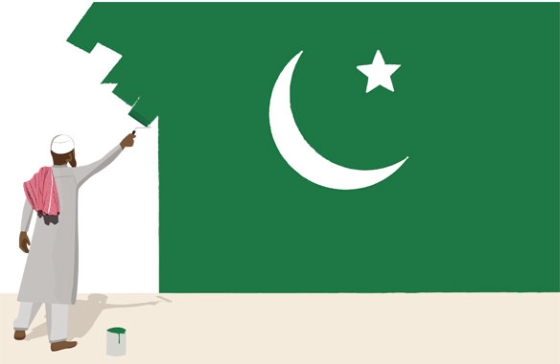
Re-making Pakistan: Extremists are trying to paint religious minorities right out of the original picture of Pakistan. Illustration: Danish Khan

When Nazir Bhatti hit the streets on February 13, 1997 to take part in a peaceful procession, he wasn’t prepared for the backlash. Just a week earlier, in the village of Shanti Nagar in the Punjab, thousands of angry Muslims descended on the mostly Christian community chanting slogans and carrying rifles, daggers, sticks, and hand-made bombs – their blood was boiling over allegations that a Quran was found ripped to pieces and that Christian names were spotted scrawled over some of the pages. The punishment they meted out was brutal: churches were razed, Bibles were burned, over 700 houses were destroyed and 2,500 locals had to flee.

Around the country, people were horrified. In Karachi, Bhatti led a protest march involving over 1,000 people. It wasn’t long before things turned ugly. Police tossed tear gas and fired shots into the crowd, accusing protesters of attacking first. One person was killed and three injured.

As a leader of the procession, and someone who had stood in the general elections earlier that month, Bhatti was singled out by police. “Twenty-one false cases were filed against me in two hours,” says Bhatti. Murder and blasphemy were among the charges. “The police launched FIRs against 383 people that night.”

He spent the next year in hiding in Lahore and Islamabad. He tried to wait it out, hoping that the cases would be withdrawn. Fighting them wasn’t an option. “Getting bail for 21 serious charges would have been next to impossible.” In 1998, he fled Pakistan. He’s been in the US ever since.

More than 12 years later, religious minorities in Pakistan continue to be treated as second- and third-rate citizens. Each year there are hundreds of incidents involving threats, violence, fabricated allegations of blasphemy, mob ‘justice,’ forced conversions and land-grabbing that target minorities. From his home on the US east coast, Bhatti, who is the editor of the Pakistan Christian Post, says that most people in the Pakistani Christian ex-pat community in Philadelphia have faced threats and violence, including kidnapping and allegations of blasphemy.

Among those in the community is a former elected MPA from Punjab who fled with her husband after publicly speaking out against discrimination. “Many of those who have left do not like to talk about their stories to the press. They fear retaliation against their families and relatives back home.” Thousands of miles away and years later, minorities still fear the culture and systems that rule Pakistan.

Of course, Christians are not the only persecuted community in Pakistan. Hindus, Sikhs and Ahmedis are all threatened and vilified in what the Human Rights Commission of Pakistan (HRCP) calls “an xenophobic atmosphere created and promoted by conservative clerics and a section of the media.” Minorities are often placed at the centre of conspiracies against Pakistan and Islam. “They cannot freely practice their religion and present their point of view without risking their life, honour and property, as is evident from attacks on them.”

And violent attacks seem to be on the rise. “The year 2009 was one of the worst for Ahmedis in Pakistan from a human rights perspective,” said the HRCP in their last annual report on the status of Ahmedis. “Eleven Ahmedis were murdered for their faith. Since the promulgation of the anti-Ahmadiyya law in 1984, there was never a year when more than 11 Ahmedis were killed.”

No one could have guessed how much worse things were about to become in so little time. Eighty-six Ahmedis were killed and 124 injured as worshippers gathered for prayers on a Friday in late May in Lahore. The co-ordinated attacks were the worst to hit the Ahmedi community. “More people were killed in a single day than in the past 16 years put together,” reported the HRCP. This says a lot, since the persecution of Ahmedis has been constant over the years. In 1974, Ahmedis were declared non-Muslims and a decade later, General Zia-ul-Haq promulgated Ordinance XX that basically criminalised Ahmedi worship.

The persecution continues: Ahmedi families bury the victims of the May 2010 Lahore attacks.
The recent Ahmedi tragedy in Lahore on May 28, focused more global attention on Pakistan. And while international condemnation of the attacks was swift and severe, outsiders had already been monitoring the plight of minorities in Pakistan with concern. In the latest Annual Report of the United States Commission on International Religious Freedom, which covers the one-year period up to March 31, 2010, the government-funded organisation recommended that “the State Department designate five additional ‘countries of particular concern’ (CPCs)” for egregious violations of religious freedom; Pakistan was one of them, along with Iraq, Nigeria, Turkmenistan and Vietnam. The US State Department already has eight countries on their list of CPCs: Burma, China, Eritrea, Iran, North Korea, Saudi Arabia, Sudan and Uzbekistan.

The report states, “The religious freedom situation in Pakistan remains deeply troubling, with further deterioration possible due to the actions of religiously motivated extremists, some of whom have ties to Al-Qaeda or to the Afghan Taliban. The current Zardari government has taken positive actions to promote religious tolerance. However, the government has failed to reverse the continuing erosion in the social and legal status of members of religious minority communities and in the ability of members of the majority Muslim community to discuss sensitive religious and social issues freely.”

Those “positive actions” referred to include the creation of a distinct federal minister for minorities and giving the post a cabinet rank. The post was given to MNA Shahbaz Bhatti, who has said he is working towards making revisions to the blasphemy laws.

“We are making changes and amendments in these laws so that these laws cannot be misused, [including to] create insecurity among minorities. We are in the process of consultation, and after consulting with all the stakeholders, such as political parties, Islamic religious scholars and Ulema, and representatives of minorities, we will table a bill in the parliament.”

But revisions to discriminatory legislation are unlikely to be enough in an environment where intolerance and mob violence rule.

In fact, society has become more intolerant than before, says I. A. Rehman, Secretary-General of the HRCP. Worse still, clerics and even some judges have consistently propagated the view that people have a right to kill blasphemers, he says. “The government is unable to stop such violence as its functionaries have been infected by the virus of intolerance and the government is afraid of the conservative population’s backlash.”

In Punjab, there is serious concern that the provincial government is septic with extremist sympathisers. Reports of Punjab Law Minister Rana Sanaullah rubbing shoulders with Maulana Muhammad Ahmed Ludhianvi, the leader of Sipah-e-Sahaba Pakistan (SSP), a banned organisation, at an election rally, do no wonders for the credibility of the PML-N administration in Punjab. There even were reports of MPA Sanaullah visiting the group’s madrassa. Besides being anti-Shia, the SSP was accused by Minister for Minorities Bhatti of being behind the Gojra attacks that targeted Christians in 2009.

Moreover, the Punjab government openly promotes the political and economic ostracisation of the Ahmedi community. Government land auctions purposefully exclude Ahmedis, even in Rabwah, the headquarters of their community since 1948 and a place where they should feel secure. During an auction this year, authorities refused to sell land to any buyer that did not certify that they believed in the Khatme Nabuwwat (Finality of the Prophethood). Buyers also had to undertake that they “would never resell it ever to Ahmedis.” Further, according to the HRCP, the DCO Chiniot, in a letter dated May 10, 2010, and under pressure from Muslim clerics in the area, pushed for barring Ahmedis from a land auction because “the Qadianis being rich in land will buy the land, and Muslim occupants who are at present in occupation of the land will be ousted. This will result in the strengthening of Qadianis in Chenab Nagar (Rabwah).”

In fact, there seems to be a concerted effort to weaken the Ahmedi community and non-Sunni sects. The federal government decided recently that it would appoint conservative cleric Mohammad Khan Sheerani to head the Council of Islamic Ideology (CII), a non-political, non-partisan governmental body that advises lawmakers and the executive on Islamic law. The problem is that the appointee is a member of the JUI-F from Balochistan. Rights groups, including the Women’s Action Forum (WAF), have expressed their concerns over the decision. Dawn reports, “WAF said the stewardship of the CII in the hands of religio-political parties would negate any gains Pakistani society has made, and ensure that civil society groups remain enmeshed in defending the status quo instead of catalysing progressive changes.” Moreover, the move would take the top position away from a moderate cleric and put it in the hands of a conservative. The JUI-F is a Deobandi group.

And in April, using public funds, the Punjab government sponsored and held an “end of the Prophethood” conference at Badshahi mosque in Lahore. At the event clerics and participants burnt an effigy of the founder of the Ahmedi community and “unrestrainedly proposed the denial of religious freedom to Ahmedis,” reported the HRCP.

In Rabwah, Ahmedis have seen conservative forces being pushed into the community for some time. In 2006 the HRCP reported that certain groups were facilitated by the government “to hold the most provocative and slanderous anti-Ahmedi conferences at Rabwah,” the headquarters of the Ahmedis. “Aalmi Majlis Khatme Nabuwwat is based in Multan and Lahore, but they now hold their big annual meeting at Rabwah. Every year the authorities allow such three or four major events at Rabwah. Participants are often a serious threat to peace … .” There were also allegations that extremist anti-Ahmedi clerics were being installed in mosques in the area.

After the May attacks in Lahore, it is unclear how the investigation is proceeding and what kind of justice will be meted out to the perpetrators of the crime. The Gojra incident doesn’t set a good precedent, though.

Christian community targeted: No evidence of blasphemy was found in relation to the Gojra attacks. Photo: AFP
Last year on August 1, Muslim extremists besieged a Christian neighbourhood in Gojra, an area of Toba Tek Singh in Punjab. Houses were looted and burned. Eight people were killed. The riots were sparked by allegations of blasphemy against a Christian man, Talib Masih, who was accused of tearing pages of the Quran and using the paper in celebrations at a mehndi party for his son on July 25: the paper was mixed with rupee notes and tossed at the groom. Attacks against the Christian community started in Korian, Talib Masih’s village, on July 30 and they spread to Gojra two days later.

The Gojra attacks are a classic example of how locals take the law into their own hands. A group of Muslims first tried to haul Masih in front of a Panchayat and get him to admit to his crime. He wouldn’t. So they beat him up and that evening they ransacked Korian. Soon announcements were blaring over the loudspeakers of mosques in villages across the area. Local Muslims were riled up and told to punish the blasphemers.

A judicial inquiry headed by Lahore High Court Judge Iqbal Hameedur Rehman was completed in September 2009. The report, which has yet to be made fully public, recommends that those responsible for “commission and omission” be held accountable. The report also proposes amendments to Pakistan Penal Code sections associated with anti-blasphemy laws, including section 295 all the way through to section 298, which lists the anti-Ahmedi laws.

According to a Daily Times report, “The tribunal reached the conclusion that the riots were a result of the ‘inability of law-enforcement agencies to assess the gravity of the situation, inadequate precautionary and preventative measures taken by law-enforcement agencies, a lukewarm stance by the Toba Tek Singh DPO, the failure of intelligence agencies in providing prompt and correct information, a defective security plan, the irresponsible behaviour of the administration, the complete failure of police while discharging their duties, the non-enforcement of Section 144 of the Criminal Procedure Code, omissions to take steps under sections 107 and 151 of the CrPC, the lack of a decision to invoke the Punjab Maintenance of Public Order (MPO) 1960 – which amounts to letting the miscreants loose to wreak havoc during the course of the riots – and several other factors.’”

An HRCP fact-finding mission that took place prior to the judicial review found that “no desecration of the Holy Quran took place in Korianwala village.” The HRCP team wrote that “though claims were made that desecration of the Holy Quran allegedly occurred in Korianwala on July 25, no case had been registered until 9:45 PM on July 30, shortly after a Muslim mob had attacked and torched Christians’ houses in the village. A number of accounts suggest that the Muslim mob attacked Christians’ houses and a case for defiling of the Holy Quran was lodged only after some Panchayat members who had been blackmailing Talib for money realised that he was either unwilling or unable to pay them any money.”

Eleven months later, after the HRCP report, the judicial inquiry and plenty of time for police investigations, the victims of the crime have seen no justice. Under the anti-terrorism act, charges were laid against at least 17 people, including police officials, but no one has been convicted. A member of the HRCP fact-finding team, Mehboob Khan, informed Newsline that all the accused are out on bail, but the charges still stand.

It is not surprising that the Punjab government has received criticism over the handling of the Gojra incident.

On May 11, the Lahore High Court directed the provincial government to immediately withdraw the appointment of DIG Ahmad Raza Tahir as Lahore capital city police officer. In Justice Iqbal Hameedur Rehman’s inquiry, Tahir, who was a Faisalabad regional police officer at the time of the attacks, was blamed for his failure in controlling the riots.

In so many cases over the years, police officers have not only been accused of failing to do their duties in instances where political and religious leaders try to rouse crowds into a frenzy but also been accused of participating in the rioting.

Pakistani Flag. Photo: AFP
Photo: AFP
Meanwhile, back in Philadelphia, Nazir Bhatti says things are getting worse in Pakistan. “The government is doing nothing. They always say they are protecting minorities, but there are always more blasphemy cases being registered against innocent Christians.” And it is not just trumped-up charges of blasphemy. “There are many cases of forcible conversions in upper Punjab. And it is not just Christians. They are doing the same to Hindus too.”

Dr Ramesh Kumar Vankwani, a patron and founder of the Pakistan Hindu Council, says forced conversions are a big problem. “We filed a constitutional petition on forced conversions in the Supreme Court three years ago, but till now we have received no response,” he says. There seems to be little legal protection for minority communities when it comes to forced conversions. Girls are kidnapped for 15 to 20 days, says Dr Vankwani, and during that time, under duress, they are converted and are married. “Often they are told, ‘Accept Islam and you will be released.’”

Later, when they are allowed to meet their families, the girl is asked to give a statement about how she converted willfully. “Usually, when a girl gives her statement, she is crying,” says Dr Vankwani. “How can she give a free statement when in the custody of her kidnappers?” Only when they are alone, and not under immediate threat from their new ‘families’ do many of these girls find the courage to disclose what really happened. Sadly, the families of victims are also often too scared to register cases against the perpetrators in the face of retribution.

Hindus are susceptible to kidnappings across the nation. In Battagram in Khyber-Pakhtunkhwa, where a small community of Hindu families has lived in peace for generations, threats of violence have been reported. The head of the small Battagram Hindu community was given a choice by the Taliban: pay Jizya (a minority tax) or be abducted, or worse, killed.

The Sikh community in the northwest has not been immune either. Hundreds of Sikh families living in Orakzai Agency have been approached by the Taliban to pay a protection tax, sometimes in the millions of rupees. Some paid, others didn’t. Some Sikhs chose to flee instead. In April 2009, a few unlucky ones who delayed their departure and missed a payment deadline had to watch as the Taliban responded by razing their homes.

Across Pakistan religious minorities are persecuted in many ways. A lack of tolerance and an unfair legal system create a situation where the cards are stacked against them. Bishop Ijaz Inayat of the Holy Trinity Church in Karachi was an outspoken critic of the Gojra riots. In fact, he is an outspoken critic of the state of the nation. “The population is not educated,” he says. “The majority of the people do not know a lot about Islam. As a result they are exploited by certain groups to maintain a crisis situation.” They are fed lies, he says. “They are told that killing an Ahmedi is jannat ki chabi.”

But he is hopeful that changes can come. “There needs to be a national policy,” he says, “a clear-cut policy.” He says it would involve both the government and the media. “The masses need to be educated that all human beings are equal. They need to know that this is an human issue rather than a religious one.”

Of course, with the constant misuse of the blasphemy law, it is also a legal one. The HRCP in its 2009 annual report on the state of human rights says clearly why the blasphemy laws should be repealed and why simple revisions won’t suffice: “Allegations of blasphemy or defiling of religious scriptures, irrespective of their veracity, do not warrant vigilante attacks. Nor do they absolve the government of its primary duty to protect all citizens. Effective prosecution of offenders would serve as a deterrent to future attacks, while a lack of it would encourage impunity. The federal government must take action to ensure that laws on the statute books are not abused to harass or ostracise citizens.”

Thursday, June 10, 2010

First Right Step Forward

India Journal, India
First Right Step Forward
Date Submitted: Thu Jun 10, 2010
By: Mansoor Ishfaq (California USA)

When the departure of the dictatorship was in the planning stages, the million dollar question was who will lead the “Most Dangerous Country in the World”? From the short list, Benazir Bhutto, Pakistan People Party (PPP), was considered a moderate politician and champion of women rights. On the other hand, Nawaz Sharif, Pakistan Muslim League (PML-N) was a well respected figure in the religious circle. When Ordinance XX passed in 1984 against Ahmadi Muslims (Ahmadis), Sharif was then Zia Ul Haq’s right hand and was a close friend of religious parties serving in the cold war.

Due to her moderate approach, Bhutto was always considered more effective in the war on terror than Sharif. Bhutto would strike a deal with Gen. Pervez Musharraf which made it possible for both candidates to return to the country and to run in the upcoming general elections. In the same general elections, to get the political edge, Nawaz Sharif loudly spoke against war in terror and made allies with religious parties.

After the restoration of democracy, once again religious fundamentalists flourished under PML-N’s led government in the Punjab and terrorists established a base in southern Punjab. Under Shehbaz Sharif, younger brother of Nawaz and the current sitting Punjab chief minister, the worst attacks have been launched against religious minorities in Pakistan’s history.

The May 28th slaughtering of peace loving citizens of Pakistan demonstrated that under the Punjab government, sporadic attacks against Ahmadis have mushroomed into an epidemic. Initial investigation of the May 28th attacks suggests that during the terrorist’s weeklong preparations, the men stayed in Raiwind, the headquarters of Tablighi Jamaat, and official place of residence of Sharif brothers. The men had also taken shelter at the Ibrahim Mosque, a center of the Tablighi Jamaat in central Lahore.

Neither of the Sharif brothers visited a hospital where wounded Ahmadis were receiving treatment. The recent alliance between PML-N and Sipah-Sahaba (SSP), a banned anti-Shia outfit, during Jhang bi-elections confirmed continuation of PML-N policy. To ensure the PML-N-led Punjab government could preserve and nurture the party’s vote bank, it allowed the display of, and in some cases even sponsored, banners and billboards inciting hatred against Ahmadis. One such banner was recently placed on Mall Road outside the Lahore High Court and translated, read: “Jews, Christians, Ahmadis are enemies of Islam.” The other was a billboard put up last year, reportedly, for the Aalmi Majlis Tahaffuz-i-Khatm-i-Nabuwat, reading “Friendship with Ahmadis is rebellion against the Prophet, peace be upon him.” Even after all the violence on May 28th, the banners were not removed. But, while speaking to a private television channel, the advisor to Punjab Chief Minister Zaeem Qadri defended that the banners could not be removed for fear of “adverse reaction against the government”.

Soon after the May 28th massacre, two Khatme Nabuwat conferences were held in the Punjab. The first conference took place in Sargodha in which PML-N’s Senator Sajid Mir made a fresh call for removing all Ahmadis from key positions. The second conference was held on June 8, 2010 in Muslim Town Lahore, in which thirteen ulema attended including government officials such as Secretary Shariat Court’s Mulana Zahid Rashdi, a banned Jamat ud Dawa’s Amir Hamza, PML-N’s provincial minister Molana Ilyas Chanyouti and Jama’at E Islami’s Dr Fareed Piracha. In a press conference following the meeting, it was declared that the May 28th massacre was the work of forces who would like to repeal anti-Ahmadi laws. May 28th was linked to the Face book controversy and the government plan of clearing south Punjab from terrorists. Nawaz Sharrif was asked to retract his use of “brothers and sisters” for Ahmadis. A warning was issued to Ahmadis to leave the country and to the government to not to change the anti-Ahmadi Laws. Otherwise it was said, “the result will be worst than 1974 massacre”.

Nawaz Sharif took the first right step forward by calling Ahmadis “brothers and sisters”. The next step is to protect these “brothers and sisters”. PML-N shall understand that it is not an old Pakistan. The international stage is evolving faster than ever and support of fundamentalists is political suicide. A lesson can be learned from the fundamental religious parties who lost in the general election. Pakistan can progress only with a moderate philosophical approach where all its citizens, regardless of their faith, have equal protections and opportunities. By shedding the notion of “fundamentalist supporter”, PML-N can play a vital role in the future Pakistan.
 
^ Top of Page