When Nazir Bhatti hit the streets on February 13, 1997 to take part in a peaceful procession, he wasn’t prepared for the backlash. Just a week earlier, in the village of Shanti Nagar in the Punjab, thousands of angry Muslims descended on the mostly Christian community chanting slogans and carrying rifles, daggers, sticks, and hand-made bombs – their blood was boiling over allegations that a Quran was found ripped to pieces and that Christian names were spotted scrawled over some of the pages. The punishment they meted out was brutal: churches were razed, Bibles were burned, over 700 houses were destroyed and 2,500 locals had to flee.
Around the country, people were horrified. In Karachi, Bhatti led a protest march involving over 1,000 people. It wasn’t long before things turned ugly. Police tossed tear gas and fired shots into the crowd, accusing protesters of attacking first. One person was killed and three injured.
As a leader of the procession, and someone who had stood in the general elections earlier that month, Bhatti was singled out by police. “Twenty-one false cases were filed against me in two hours,” says Bhatti. Murder and blasphemy were among the charges. “The police launched FIRs against 383 people that night.”
He spent the next year in hiding in Lahore and Islamabad. He tried to wait it out, hoping that the cases would be withdrawn. Fighting them wasn’t an option. “Getting bail for 21 serious charges would have been next to impossible.” In 1998, he fled Pakistan. He’s been in the US ever since.
More than 12 years later, religious minorities in Pakistan continue to be treated as second- and third-rate citizens. Each year there are hundreds of incidents involving threats, violence, fabricated allegations of blasphemy, mob ‘justice,’ forced conversions and land-grabbing that target minorities. From his home on the US east coast, Bhatti, who is the editor of the Pakistan Christian Post, says that most people in the Pakistani Christian ex-pat community in Philadelphia have faced threats and violence, including kidnapping and allegations of blasphemy.
Among those in the community is a former elected MPA from Punjab who fled with her husband after publicly speaking out against discrimination. “Many of those who have left do not like to talk about their stories to the press. They fear retaliation against their families and relatives back home.” Thousands of miles away and years later, minorities still fear the culture and systems that rule Pakistan.
Of course, Christians are not the only persecuted community in Pakistan. Hindus, Sikhs and Ahmedis are all threatened and vilified in what the Human Rights Commission of Pakistan (HRCP) calls “an xenophobic atmosphere created and promoted by conservative clerics and a section of the media.” Minorities are often placed at the centre of conspiracies against Pakistan and Islam. “They cannot freely practice their religion and present their point of view without risking their life, honour and property, as is evident from attacks on them.”
And violent attacks seem to be on the rise. “The year 2009 was one of the worst for Ahmedis in Pakistan from a human rights perspective,” said the HRCP in their last annual report on the status of Ahmedis. “Eleven Ahmedis were murdered for their faith. Since the promulgation of the anti-Ahmadiyya law in 1984, there was never a year when more than 11 Ahmedis were killed.”
No one could have guessed how much worse things were about to become in so little time. Eighty-six Ahmedis were killed and 124 injured as worshippers gathered for prayers on a Friday in late May in Lahore. The co-ordinated attacks were the worst to hit the Ahmedi community. “More people were killed in a single day than in the past 16 years put together,” reported the HRCP. This says a lot, since the persecution of Ahmedis has been constant over the years. In 1974, Ahmedis were declared non-Muslims and a decade later, General Zia-ul-Haq promulgated
Ordinance XX that basically criminalised Ahmedi worship.

The persecution continues: Ahmedi families bury the victims of the May 2010 Lahore attacks.
The recent Ahmedi tragedy in Lahore on May 28, focused more global attention on Pakistan. And while international condemnation of the attacks was swift and severe, outsiders had already been monitoring the plight of minorities in Pakistan with concern. In the latest Annual Report of the United States Commission on International Religious Freedom, which covers the one-year period up to March 31, 2010, the government-funded organisation recommended that “the State Department designate five additional ‘countries of particular concern’ (CPCs)” for egregious violations of religious freedom; Pakistan was one of them, along with Iraq, Nigeria, Turkmenistan and Vietnam. The US State Department already has eight countries on their list of CPCs: Burma, China, Eritrea, Iran, North Korea, Saudi Arabia, Sudan and Uzbekistan.
The report states, “The religious freedom situation in Pakistan remains deeply troubling, with further deterioration possible due to the actions of religiously motivated extremists, some of whom have ties to Al-Qaeda or to the Afghan Taliban. The current Zardari government has taken positive actions to promote religious tolerance. However, the government has failed to reverse the continuing erosion in the social and legal status of members of religious minority communities and in the ability of members of the majority Muslim community to discuss sensitive religious and social issues freely.”
Those “positive actions” referred to include the creation of a distinct federal minister for minorities and giving the post a cabinet rank. The post was given to MNA Shahbaz Bhatti, who has said he is working towards making revisions to the blasphemy laws.
“We are making changes and amendments in these laws so that these laws cannot be misused, [including to] create insecurity among minorities. We are in the process of consultation, and after consulting with all the stakeholders, such as political parties, Islamic religious scholars and Ulema, and representatives of minorities, we will table a bill in the parliament.”
But revisions to discriminatory legislation are unlikely to be enough in an environment where intolerance and mob violence rule.
In fact, society has become more intolerant than before, says I. A. Rehman, Secretary-General of the HRCP. Worse still, clerics and even some judges have consistently propagated the view that people have a right to kill blasphemers, he says. “The government is unable to stop such violence as its functionaries have been infected by the virus of intolerance and the government is afraid of the conservative population’s backlash.”
In Punjab, there is serious concern that the provincial government is septic with extremist sympathisers. Reports of Punjab Law Minister Rana Sanaullah rubbing shoulders with Maulana Muhammad Ahmed Ludhianvi, the leader of Sipah-e-Sahaba Pakistan (SSP), a banned organisation, at an election rally, do no wonders for the credibility of the PML-N administration in Punjab. There even were reports of MPA Sanaullah visiting the group’s madrassa. Besides being anti-Shia, the SSP was accused by Minister for Minorities Bhatti of being behind the Gojra attacks that targeted Christians in 2009.
Moreover, the Punjab government openly promotes the political and economic ostracisation of the Ahmedi community. Government land auctions purposefully exclude Ahmedis, even in Rabwah, the headquarters of their community since 1948 and a place where they should feel secure. During an auction this year, authorities refused to sell land to any buyer that did not certify that they believed in the Khatme Nabuwwat (Finality of the Prophethood). Buyers also had to undertake that they “would never resell it ever to Ahmedis.” Further, according to the HRCP, the DCO Chiniot, in a letter dated May 10, 2010, and under pressure from Muslim clerics in the area, pushed for barring Ahmedis from a land auction because “the Qadianis being rich in land will buy the land, and Muslim occupants who are at present in occupation of the land will be ousted. This will result in the strengthening of Qadianis in Chenab Nagar (Rabwah).”
In fact, there seems to be a concerted effort to weaken the Ahmedi community and non-Sunni sects. The federal government decided recently that it would appoint conservative cleric Mohammad Khan Sheerani to head the Council of Islamic Ideology (CII), a non-political, non-partisan governmental body that advises lawmakers and the executive on Islamic law. The problem is that the appointee is a member of the JUI-F from Balochistan. Rights groups, including the Women’s Action Forum (WAF), have expressed their concerns over the decision. Dawn reports, “WAF said the stewardship of the CII in the hands of religio-political parties would negate any gains Pakistani society has made, and ensure that civil society groups remain enmeshed in defending the status quo instead of catalysing progressive changes.” Moreover, the move would take the top position away from a moderate cleric and put it in the hands of a conservative. The JUI-F is a Deobandi group.
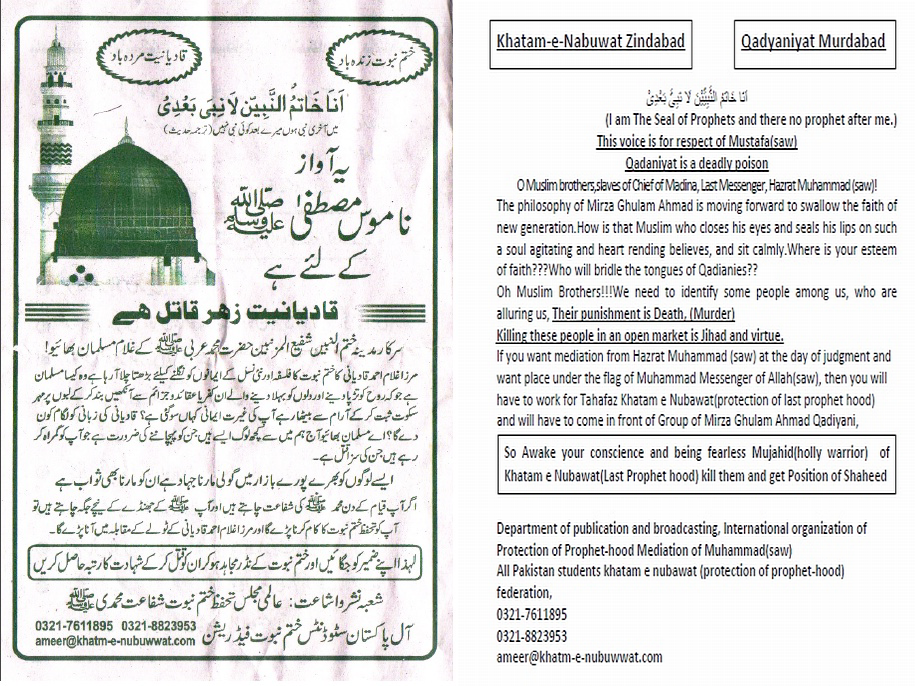
And in April, using public funds, the Punjab government sponsored and held an “end of the Prophethood” conference at Badshahi mosque in Lahore. At the event clerics and participants burnt an effigy of the founder of the Ahmedi community and “unrestrainedly proposed the denial of religious freedom to Ahmedis,” reported the HRCP.
In Rabwah, Ahmedis have seen conservative forces being pushed into the community for some time. In 2006 the HRCP reported that certain groups were facilitated by the government “to hold the most provocative and slanderous anti-Ahmedi conferences at Rabwah,” the headquarters of the Ahmedis. “Aalmi Majlis Khatme Nabuwwat is based in Multan and Lahore, but they now hold their big annual meeting at Rabwah. Every year the authorities allow such three or four major events at Rabwah. Participants are often a serious threat to peace … .” There were also allegations that extremist anti-Ahmedi clerics were being installed in mosques in the area.
After the May attacks in Lahore, it is unclear how the investigation is proceeding and what kind of justice will be meted out to the perpetrators of the crime. The Gojra incident doesn’t set a good precedent, though.

Christian community targeted: No evidence of blasphemy was found in relation to the Gojra attacks. Photo: AFP
Last year on August 1, Muslim extremists besieged a Christian neighbourhood in Gojra, an area of Toba Tek Singh in Punjab. Houses were looted and burned. Eight people were killed. The riots were sparked by allegations of blasphemy against a Christian man, Talib Masih, who was accused of tearing pages of the Quran and using the paper in celebrations at a mehndi party for his son on July 25: the paper was mixed with rupee notes and tossed at the groom. Attacks against the Christian community started in Korian, Talib Masih’s village, on July 30 and they spread to Gojra two days later.
The Gojra attacks are a classic example of how locals take the law into their own hands. A group of Muslims first tried to haul Masih in front of a Panchayat and get him to admit to his crime. He wouldn’t. So they beat him up and that evening they ransacked Korian. Soon announcements were blaring over the loudspeakers of mosques in villages across the area. Local Muslims were riled up and told to punish the blasphemers.
A judicial inquiry headed by Lahore High Court Judge Iqbal Hameedur Rehman was completed in September 2009. The report, which has yet to be made fully public, recommends that those responsible for “commission and omission” be held accountable. The report also proposes amendments to Pakistan Penal Code sections associated with anti-blasphemy laws, including section 295 all the way through to section 298, which lists the anti-Ahmedi laws.
According to a Daily Times report, “The tribunal reached the conclusion that the riots were a result of the ‘inability of law-enforcement agencies to assess the gravity of the situation, inadequate precautionary and preventative measures taken by law-enforcement agencies, a lukewarm stance by the Toba Tek Singh DPO, the failure of intelligence agencies in providing prompt and correct information, a defective security plan, the irresponsible behaviour of the administration, the complete failure of police while discharging their duties, the non-enforcement of Section 144 of the Criminal Procedure Code, omissions to take steps under sections 107 and 151 of the CrPC, the lack of a decision to invoke the Punjab Maintenance of Public Order (MPO) 1960 – which amounts to letting the miscreants loose to wreak havoc during the course of the riots – and several other factors.’”
An HRCP fact-finding mission that took place prior to the judicial review found that “no desecration of the Holy Quran took place in Korianwala village.” The HRCP team wrote that “though claims were made that desecration of the Holy Quran allegedly occurred in Korianwala on July 25, no case had been registered until 9:45 PM on July 30, shortly after a Muslim mob had attacked and torched Christians’ houses in the village. A number of accounts suggest that the Muslim mob attacked Christians’ houses and a case for defiling of the Holy Quran was lodged only after some Panchayat members who had been blackmailing Talib for money realised that he was either unwilling or unable to pay them any money.”
Eleven months later, after the HRCP report, the judicial inquiry and plenty of time for police investigations, the victims of the crime have seen no justice. Under the anti-terrorism act, charges were laid against at least 17 people, including police officials, but no one has been convicted. A member of the HRCP fact-finding team, Mehboob Khan, informed Newsline that all the accused are out on bail, but the charges still stand.
It is not surprising that the Punjab government has received criticism over the handling of the Gojra incident.
On May 11, the Lahore High Court directed the provincial government to immediately withdraw the appointment of DIG Ahmad Raza Tahir as Lahore capital city police officer. In Justice Iqbal Hameedur Rehman’s inquiry, Tahir, who was a Faisalabad regional police officer at the time of the attacks, was blamed for his failure in controlling the riots.
In so many cases over the years, police officers have not only been accused of failing to do their duties in instances where political and religious leaders try to rouse crowds into a frenzy but also been accused of participating in the rioting.

Photo: AFP
Meanwhile, back in Philadelphia, Nazir Bhatti says things are getting worse in Pakistan. “The government is doing nothing. They always say they are protecting minorities, but there are always more blasphemy cases being registered against innocent Christians.” And it is not just trumped-up charges of blasphemy. “There are many cases of forcible conversions in upper Punjab. And it is not just Christians. They are doing the same to Hindus too.”
Dr Ramesh Kumar Vankwani, a patron and founder of the Pakistan Hindu Council, says forced conversions are a big problem. “We filed a constitutional petition on forced conversions in the Supreme Court three years ago, but till now we have received no response,” he says. There seems to be little legal protection for minority communities when it comes to forced conversions. Girls are kidnapped for 15 to 20 days, says Dr Vankwani, and during that time, under duress, they are converted and are married. “Often they are told, ‘Accept Islam and you will be released.’”
Later, when they are allowed to meet their families, the girl is asked to give a statement about how she converted willfully. “Usually, when a girl gives her statement, she is crying,” says Dr Vankwani. “How can she give a free statement when in the custody of her kidnappers?” Only when they are alone, and not under immediate threat from their new ‘families’ do many of these girls find the courage to disclose what really happened. Sadly, the families of victims are also often too scared to register cases against the perpetrators in the face of retribution.
Hindus are susceptible to kidnappings across the nation. In Battagram in Khyber-Pakhtunkhwa, where a small community of Hindu families has lived in peace for generations, threats of violence have been reported. The head of the small Battagram Hindu community was given a choice by the Taliban: pay Jizya (a minority tax) or be abducted, or worse, killed.
The Sikh community in the northwest has not been immune either. Hundreds of Sikh families living in Orakzai Agency have been approached by the Taliban to pay a protection tax, sometimes in the millions of rupees. Some paid, others didn’t. Some Sikhs chose to flee instead. In April 2009, a few unlucky ones who delayed their departure and missed a payment deadline had to watch as the Taliban responded by razing their homes.
Across Pakistan religious minorities are persecuted in many ways. A lack of tolerance and an unfair legal system create a situation where the cards are stacked against them. Bishop Ijaz Inayat of the Holy Trinity Church in Karachi was an outspoken critic of the Gojra riots. In fact, he is an outspoken critic of the state of the nation. “The population is not educated,” he says. “The majority of the people do not know a lot about Islam. As a result they are exploited by certain groups to maintain a crisis situation.” They are fed lies, he says. “They are told that killing an Ahmedi is jannat ki chabi.”
But he is hopeful that changes can come. “There needs to be a national policy,” he says, “a clear-cut policy.” He says it would involve both the government and the media. “The masses need to be educated that all human beings are equal. They need to know that this is an human issue rather than a religious one.”
Of course, with the constant misuse of the blasphemy law, it is also a legal one. The HRCP in its 2009 annual report on the state of human rights says clearly why the blasphemy laws should be repealed and why simple revisions won’t suffice: “Allegations of blasphemy or defiling of religious scriptures, irrespective of their veracity, do not warrant vigilante attacks. Nor do they absolve the government of its primary duty to protect all citizens. Effective prosecution of offenders would serve as a deterrent to future attacks, while a lack of it would encourage impunity. The federal government must take action to ensure that laws on the statute books are not abused to harass or ostracise citizens.”









 Posts
Posts


