Showing posts with label ordinance. Show all posts

Monday, June 27, 2011

Sensitive investigations: Police ignore court’s ruling on blasphemy cases

Express Tribune, Pakistan
Pakistan
Punjab
Sensitive investigations: Police ignore court’s ruling on blasphemy cases
By Rana Tanveer
Published: June 27, 2011
All accused will be given full right of defence by the board of inquiry.

LAHORE: Provincial police is either ignorant or dismissive of Lahore High Court’s instructions regarding the investigation of blasphemy cases, piling misery on those accused of the offence.

A division bench of the Lahore High Court comprising Justice Ali Nawaz Chawhan and Justice Rustam Ali Malik, while deciding a murder reference in offences under section 295-A and 295-C in August 2002, directed the inspector-general of police (IGP) Lahore “to ensure that whenever [a blasphemy] case is registered, it be entrusted for purposes of investigation to a team of at least two gazette investigating officers, preferably those conversant with Islamic jurisprudence.”

In the event that the officers are not conversant with Islamic law, “a scholar of known reputation and integrity may be added to the team … [to] investigate whether a [blasphemy] offence is committed or not,” the ruling added.

The ruling conceded that cases of blasphemy are on the rise and at times, “elements of mischief have also been observed to be involved.”

Since the passing of this ruling, however, not a single case has been investigated by a panel of two gazette officers and one religious scholar, The Express Tribune has learnt.

The cases are usually investigated by assistant sub-inspectors, or in the event of a high-profile case, the inspector in charge of investigation.

Neither the deputy superintendent police (DSP) nor an SP get involved in such cases owing to their sensitivity, sources say.

Guilty until proven innocent

Shahid Butt, a blasphemy accused presently on bail, told The Express Tribune that despite his struggle, the SP concerned refuses to be involved in the investigation.

Inspector Aftab Shah of Batapur police station had been investigating into his case, he added.

Because of incompetent investigators, I spent five months in prison, said Butt, adding that he was released when his case was taken up by the court.

LHC judgment ‘not mandatory’

Superintendent of Police (Investigation) Capt (r) Liaqat Ali Malik told The Express Tribune that all cases of blasphemy are investigated by an SP.

An inspector, or any official below this rank, does not have the authority to investigate such cases according to law, he said.

When asked about the LHC judgment which made two SPs mandatory to investigate blasphemy cases, Malik said that they follow the Pakistan Penal Code and the Criminal Procedure Code.

Any judgment besides those was not binding upon them, he added. Advocate Muhammad Anis Saadi, however, told The Express Tribune that the LHC judgment was binding upon the police officers.

If the LHC had issued instructions to the IGP in this regard, the IGP must have conveyed the message to all SPs concerned to ensure its implementation, he added.

An SP, on condition of anonymity, said that no such instructions had been received from the IGP office.

He added that most SPs are ignorant of the issue and adopt the conventional methods in investigating blasphemy cases.

Published in The Express Tribune, June 27th, 2011.

Sunday, June 19, 2011

Ahmadis in Karachi: Pulpit pounding, barricades, prayers but no peace

Express Tribune, Pakistan
Pakistan
Sindh
Ahmadis in Karachi: Pulpit pounding, barricades, prayers but no peace
By Saba Imtiaz
Published: June 19, 2011
The minority has been under constant attack even though it keeps a low profile.

KARACHI: On a Friday afternoon, there is pin-drop silence around the Ahmadi place of worship in Karachi’s Drigh Road area. Worshippers quietly enter through a side door, watched over by a number of men on patrol and security cameras affixed to the building.

Just down the lane, the imam of Bilal Masjid peppers his sermon with anti-Ahmadi remarks. The strains of his sermon can be heard throughout the neighbourhood, including the men standing guard outside their place of worship.

Friday prayers are under way in both buildings, but only one congregation is allowed to practice its faith openly.

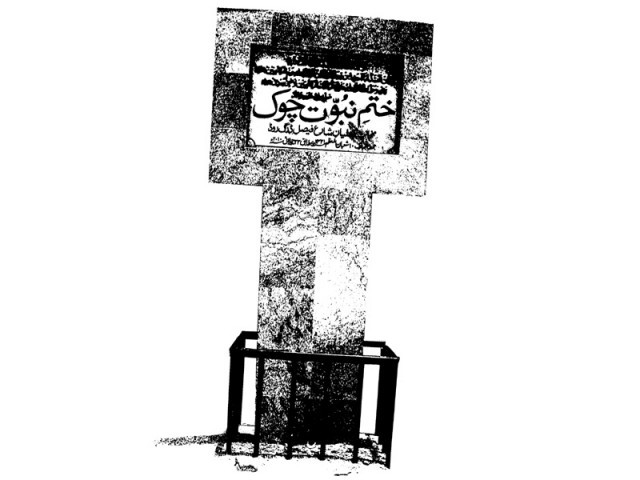
At the crossroads of the mosque and the place of worship is a marker for the ‘Khatm-e-Nabuwwat’ roundabout, a silent but potent public reminder of the power of the religio-political party in Pakistan. “There was a rally here a few months ago,” recalls a resident. “About 2,000 people attended and it was organised by the Tahaffuz Namoos-e-Risalat movement. They reaffirmed their faith in the finality of the Prophethood (peace be upon him), and then decided to rename this roundabout as a memento of the rally. After all, we are all Muslims, this is our faith.”

Sunni Tehreek (ST) flags flutter in the area, whose walls are covered with grafitti, declaring the area to be Sunni Nagar. “These clerics, Sunni Tehreek… they’re all one and the same,” remarks a shopkeeper who has worked near the Ahmadi place of worship for 25 years. He has witnessed the area’s clerics raging against the Ahmadiyya community for placing barricades near their place of worship. There have been incidents of firing in the area as well. Thoughtfully, he says, “The problem is that Muslims have increasingly become intolerant.”

A poster for a June 2 Tahaffuz Namoos-e-Risalat conference is still plastered to the wall of the Ahmadis’ building. A few months ago, activists reportedly barged in and demanded that the Kalima, a verse declaring Muslim faith, be erased from a wall within the place of worship’s premises.

“This centre has been here since before you or I were born,” says the shopkeeper. Another resident said it was at least 40 years old.

Attendance at prayers at Ahmadi places of worship in Karachi has slowly picked up after the 2010 Lahore attacks. “We have stopped women and children from coming to the centres because we fear that they will be targeted first, similar to the Lahore attacks,” says Masood Khan, a senior representative of the Ahmadiyya community. “Praying is also difficult and it gets quite suffocating – we have to close all the windows and doors so that no sound can be heard outside.”

Outside is where a mob — literally and physically —exists. Just like the cleric at Bilal Masjid, mosque speakerphones are regularly used to incite hatred.

While Punjab has been the breeding ground for anti-Ahmadi sentiment, the minority in Sindh faces targeted assassinations, discrimination and blasphemy cases filed on flimsy charges. Reviled due to a decades-old campaign, Ahmadis have nowhere to turn to, not even the state. A lieutenant, who was awarded the Sword of Honour, was forced to leave the navy because his faith meant he would never be promoted. A woman was widowed twice because her husbands were practicing doctors. Flyers are openly distributed, asking people to boycott Ahmadi-run businesses and execute their owners.

“We have brought these incidents … to the police’s notice so many times,” says Khan. “But they do nothing beyond occasionally sending a policeman or two.”

The police also have their own biases. Khan recalls that two officers refused to drink water offered to them by Ahmadis. “The Central Investigation Department has several men in its custody who confessed that they wanted to target Ahmadis and Shias. But they have never been presented in court.”

Even then, Khan says, the police in Karachi are better than those in the Punjab. Khan praises former Sindh home minister Zulfiqar Mirza for proactively listening to their problems. “The police will at least send someone. The security apparatus was concerned after the attacks in Lahore and we discussed measures. But we asked for Rangers to be deployed on Fridays and that has not happened.”

After a lifetime spent in fear, Ahmadis in Karachi who can afford to relocate are packing up their bags. At least 300 to 400 people have reportedly left. The Ahmadiyya community in Karachi is at least 20,000 strong.

Others hail from rural Sindh, especially Sanghar. This district has seen numerous cases of violence and Section 295-C cases (which carries the death penalty) filed by a cleric, Maulana Hamadi. “[He] sits in Sanghar and files cases against people sitting miles away in Rabwah!” exclaims Qaiser Shahzad, a Karachi-based businessman.

In Karachi, Ahmadis living in Mehmoodabad have been gunned down in the past decade, with up to six cases in the last three years alone. One of them included a doctor who chose to work in the poor area. He was killed as he stopped at a speed breaker on his way home. Twenty-five families from Manzoor Colony have emigrated.

“We don’t tell our children that they will face discrimination. We don’t want to poison their minds at a young age,” Khan says. “But at school they are inevitably discriminated against. Our girls come back home and say they don’t want to go to college.”

Ahmadi families prefer sending their children to schools run by Parsis and Christians – also minorities. According to Shahzad, admissions are a no-go once school realise what the family’s faith is.

Intolerance has spread to other areas as well. In Badin, an Ahmadi centre was targeted during an event for women. Incited by a cleric, men besieged the centre for eight hours. It took Zulfiqar Mirza (who was elected as an MPA from Badin) to clamp down. In January, a leaflet threatening an Ahmadi businessman was circulated in Goth Saban Dasti in Badin, which stated: “Such an apostate should be killed and his business should be banned all over Pakistan. We demand that the government of Pakistan take immediate action, otherwise the people will have to do this job on their own.”

Karachi’s business community, according to Khan and Shahzad, is generally accepting of Ahmadis, especially those whose operations have been established for decades. However, Shahzad says in a resigned tone, “You can tell the difference in the way they meet us. They work with us because they have to.”

Discrimination has also swept the armed forces and civil bureaucracy. “From Chaudhry Zafarullah to high-ranking generals, Ahmadis were always represented in the top ranks. But now we barely have a few people at top positions in the civil bureaucracy. In Ziaul Haq’s era, this [discrimination] was implemented — there are no promotions. Ahmadis don’t even clear interviews for government or military jobs now, despite being highly qualified.”

Discrimination, Khan says, is also found among old friends. “I know that they don’t want to dine with me.”

“Look, people believe that we are wajibul qatl [liable to be killed]. This thought is reflected in our assemblies.”

Anti-Ahmadi sentiment and extremism, the men said, has increased in society over the past few years. Laws pertaining to Ahmadis — particularly those introduced in the 1980s — have provided legal backing to the hate being propagated in society. Anti-Ahmadi graffiti routinely appears near places of worship, and the gate of one building was fired on recently in Steel Town. Yet, Khan and Shahzad say, they have learned to live with the ever-present fear. “We are sitting openly,” says Khan. “But someone has to come forward on behalf of the community. We don’t consider ourselves minorities. We are Pakistanis. This is our country.”

Legal exclusion

In 1952, religious parties demanded the removal of Pakistan’s first foreign minister, Sir Chaudhry Zafarullah Khan, who was an Ahmadi. In 1974, after violent demonstrations took place, Jamaat-e-Islami factions demanded that Ahmadis be declared non-Muslims. A constitutional amendment was passed to exclude Ahmadis from Islam. In 1984, amendments were made to ban the usage of Islamic symbols and practices for Ahmadis, such as calling their places of worship a mosque.

Source: International Crisis Group report: ‘The State of Sectarianism in Pakistan’, Jinnah Institute report: ‘A Question of Faith’

A profile

The Sunni Tehreek is a religio-political party that follows the Barelvi school of thought. It has actively campaigned against any amendments to or repeal of the country’s blasphemy laws. ST activists protested against Punjab Governor Salmaan Taseer prior to his assassination on June 4 and have supported his assassin Malik Mumtaz Hussain Qadri.

Published in The Express Tribune, June 19th, 2011.

Tuesday, June 14, 2011

Pakistani terrorists threaten Ahmadi community

MSN News, Indonesia

14/06/2011
Pakistani terrorists threaten Ahmadi community

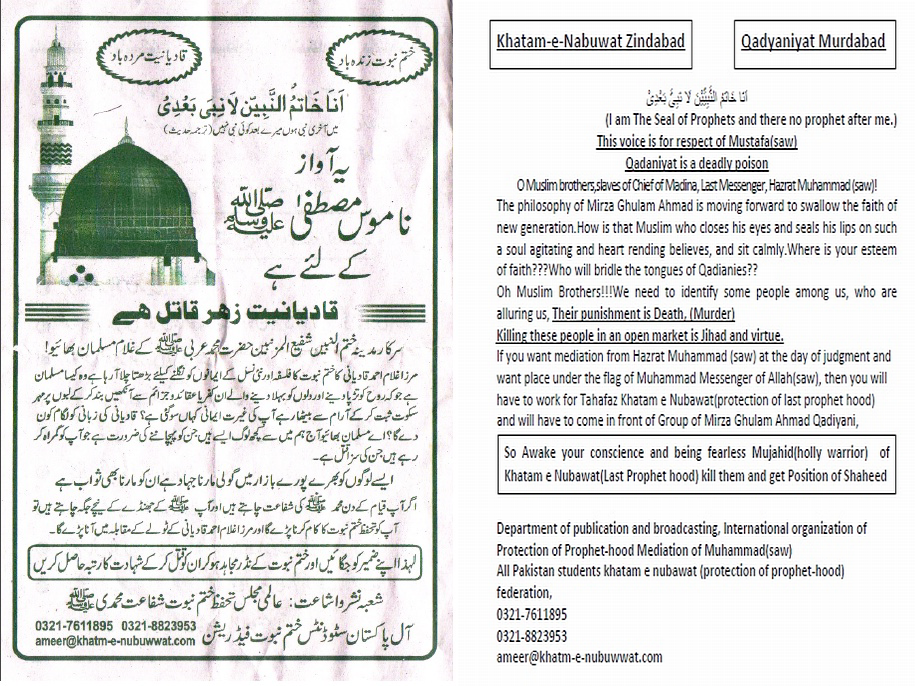
Copy of Poster urging people to be brave and kill Ahmadis. (Click to enlarge)
Islamabad, June 14 (IANS) Pakistani terrorists have issued a hit-list of prominent businessmen from the Ahmadi community, saying those who ‘misguide’ the country would be punished with death.

Terrorists have begun distributing pamphlets that say they would start ‘target killings’ of prominent members of the Ahmadi community. The attacks would be launched in Faisalabad, the Daily Times reported.

The Ahmadiyya is an Islamic religious movement founded near the end of the 19th century, originating with the life and teachings of Mirza Ghulam Ahmad (1835-1908). The followers of the Ahmadiyya sect are referred to as Ahmadis or Ahmadi Muslims.

Sources in law enforcement agencies said different terrorist outfits have joined hands against the Ahmadi community.

The outfits said the Ahmadis of the country were involved in conspiracies against Islam and Pakistan.

The pamphlets state that the act of killing an Ahmadi made an individual a ‘holy warrior’ and the person who would do so ‘would also be blessed by the Holy Prophet on the Day of Judgement’, according to the daily.

‘O Muslim brothers. There are some people among us who are misguiding us and their punishment is death,’ said one of the pamphlets, while another asked if there was anybody who had the courage to teach the Ahmadis a lesson.

One of the pamphlets was distributed by an extremist group that calls itself All Pakistan Students Khatam-e-Nabuwat Federation.

A few Ahmadis told the Daily Times they had been victims of constant persecution by terrorists for decades.

Asian Human Rights Commission Representative Baseer Naveed said it was a matter of serious concern that such pamphlets were being distributed.

Naveed said the government bothered to take steps only after people actually start getting murdered.

Terrorists chalk out plan to target Ahmedis

Daily Times, Pakistan
Tuesday,
June 14, 2011

Terrorists chalk out plan to target Ahmedis

By Afnan Khan

Copy of Poster urging people to be brave and kill Ahmadis. (Click to enlarge)
LAHORE: Terrorists have chalked out a plan regarding target killings of prominent members of the Ahmedi community in the country, starting from Faisalabad, which is the second biggest industrial hub of the province and hometown of Punjab Law Minister, Rana Sanaullah.

Sources in the local law enforcement agencies also revealed that different terrorist organisations have joined together in the mission and they have initiated the campaign through distribution of pamphlets and organising conferences in local seminaries against the Ahmedis.

They also issued a list of prominent Ahmedi businessmen living in Faisalabad and surrounding areas by mentioning their names and addresses, saying that the Ahmedi citizens of the country were involved in conspiracies against Islam and Pakistan.

The pamphlets, containing hit-list of locals who have been working and living in the areas since generations, also state that the act of killing an Ahmedi made an individual a holy warrior and the person who would do so would also be blessed by the Holy Prophet (PBUH) on the Day of Judgment.

“O Muslim brothers. There are some people among us who are misguiding us and their punishment is death,” one of the pamphlets read, further asking if there was anybody who had the courage to teach the Ahmedis a lesson.

The distributed hate material urges people to wake up, become fearless holy warriors and start killing Ahmedis.

One of the pamphlets was distributed by an extremist group named All Pakistan Students Khatam-e-Nabuwat Federation. The hit-list of Ahmedi citizens not only contains names of 32 prominent businessmen but also comprises senior teachers and prominent doctors. Some of the local Ahmedis, while talking to told Daily Times, said, that they had remained a victim of constant persecution by the state and terrorists for decades but none of the previous incidents matched this newly organised campaign against them.

They added that they had informed the government and law enforcement authorities about the threats but to no avail. They said that the local Ahmedis are living under extreme tension after knowing about this campaign and there is no surety from any side, be it the government or any other concerned authority.

Asian Human Rights Commission Representative, Baseer Naveed, told Daily Times that it was a matter of serious concern that these pamphlets were being distributed openly in a city from where more than four ministers were in the cabinets of Punjab and the federal government. He said that the local Ahmedis had requested these ministers many a times in the past to help them, however, they turned a deaf ear to all their appeals.

He stated that a large number of Ahmedis as well as Christians had been living in Faisalabad and its neighbouring cities since the past many years, however, recently the killings, abductions and torture by extremists against these communities had increased under the very nose of the government.

Naveed added that it was a sorry state of affairs that our government had become so reckless that they would only bother to take any steps only when people sctually start getting murdered.

He said that it was astonishing that the Provincial Law Minister Rana Sanaullah and opposition leader in Punjab Assembly (PA), Raja Riaz, even though belonging to the same city, conveniently turned a blind eye to the entire situation. Sanaullah was also accused of having ties with a banned terrorist outfit in the area, whose operatives were also accused of planning, executing and leading the massacre of Christians in Gojra in 2009.

However, Punjab government spokesperson and Pakistan Muslim League-Nawaz Senator Pervaiz Rashid told Daily Times that he was not aware about the issue but will immediately ask the local law enforcers to probe and take action against these hate mongers.

He said that the Punjab government had a clear policy regarding protecting the rights of each and every citizen and they will not let these terrorists hijack the whole society. He said that these are the same people who were involved in bombing mosques, shrines and other religious places and their sole aim is to sabotage the country but the government will deal with these people through iron hands.

Monday, June 13, 2011

Textile City: Politicians turn blind eye to hate pamphlets

Express Tribune, Pakistan
Pakistan
Punjab
Textile City: Politicians turn blind eye to hate pamphlets
By Shamsul Islam
Published: June 13, 2011
Rights organisation fears mass target killings of Ahmadis in Faisalabad.
FAISALABAD: A rights organisation said it feared large-scale targeted killing of Ahmadis in Faisalabad after pamphlets labelling members of the Ahmadiyya community “Wajibul Qatl” (‘liable to be murdered’), and inciting people to publicly attack followers of the faith, were openly and widely circulated in Faisalabad.

Copy of Poster urging people to be brave and kill Ahmadis. (Click to enlarge)
In a statement issued here on Saturday, the Asian Human Rights Commission (AHRC) said that “the government has been made fully aware of the threats to the Ahmadiyya community [and] the AHRC urges the government to take immediate action to prevent such killings and destruction of their industrial and commercial establishments.”

The statement bemoaned the insensitivity of elected representatives from the district to the precarious situation brewing in the city.

“The Ahmadiyya community has informed all members of national and provincial assemblies elected from Faisalabad and the local administration through the district commissioner of this serious threat but no one is taking action,” the statement said.

“It is astonishing that provincial law minister Rana Sanaullah, and leader of the opposition in Punjab Assembly Raja Riaz are both aware of the mass appeal to kill Ahmadis but both of them are turning a blind eye to the situation,” it added.

The politicians fear losing their right-wing vote bank by standing up for Ahmadiyya community, the statement said.

“It is alleged that Rana Sanaullah who belongs to Faisalabad, had previously supported the movement against Ahmadis by providing official support to Majlis-e-Khatm-e-Nabuwwat,” the statement added.

The AHRC said it has received information that a plan has been chalked out to kill the owners and family members of 36 commercial and industrial establishments belonging to Ahmadiyya community.

If target killings start, the government will be answerable not only to the Ahmadiyya community but also to citizens of Pakistan and the international community, the statement added.

Published in The Express Tribune, June 13th, 2011.

Saturday, June 11, 2011

PAKISTAN: Extremists openly plan to kill hundreds of Ahmadis—government turns a blind eye

AHRC Logo
News / AHRC News

PAKISTAN: Extremists openly plan to kill hundreds of Ahmadis—government turns a blind eye

June 11, 2011

The Asian Human Rights Commission has received information from Faisalabad city of Punjab province, the second largest industrial and commercial city of the country that a plan has been chalked out to kill the owners and their family members of 36 commercial and industrial establishments belonging to Ahmadiyya community. The plan includes the people working in those establishments which means more than 150 persons are targeted. Doctors and other professionals are not exempt from this threat. For two weeks now pamphlets and advertisements have been distributed calling the citizens to kill people from the Ahmadis community. This should be done in the open and crowded market places as a Jihad (holy war). Killing, beating and punishing them would be rewarded by God. The pamphlets were published by the All Pakistan Student Khatm-e-Nabowat Federation and were issued by the information department of Aalmi Majlis-e-Khatm-eNabowat Shafaat-e- Muhammadi with their phone numbers and email address.

The Asian Human Rights Commission cannot reproduced here the copy of the pamphlet for security reasons as it bears the names of commercial and industrial establishments and the names of targeted persons. However, we reproduce below the English translation of the pamphlet which was written in the local language, Urdu.

  • The original leaflet and its translation in English are available for download here: Leaflet of Ahmadis killing announcement (Urdu, English). For security reasons, the names of the Ahmadiyya community members who were targeted in the leaflet have been removed. The English translation is on page two.

These pamphlets are being distributed on a mass scale, openly in the city from where more than four ministers are in the cabinets of Punjab and federal governments. These ministers have failed to take action on this plan of killing people from a religious minority group because they fear these extremists as they themselves would also be declared supporters of Ahmadis or infidels. In Faisalabad and its neighboring cities a good number of Ahmadis and Christians have been residing for at least a century but for some decades now these minority community people have been killed and abducted by the extreme Muslim organizations to purify the ‘Muslim areas’.

The Ahmadiyya community has informed all the members of national and provincial assemblies elected from Faisalabad and the local administration through the Commissioner of the district of this serious threat but no one is taking action. Indeed, nothing will happen until the killings start. It is astonishing that the provincial law minister, Mr. Rana Sanaullah, and leader of the opposition in Punjab assembly, Mr. Raja Riaz, are from the same city and they both know about the mass appeal to kill the Ahmadis but both of them are turning a blind eye to the situation and be doing so show their unwillingness to go against the Muslim extremists as they would lose their constituencies of Muslim voters.

It is alleged that Mr. Rana Sanaullah, who also belongs to Faisalabad, had previously supported the movement against Ahmedis by providing every official support to Majlis-e-Khatm-e-Nabowat (the movement directly aimed at Ahmadis) in holding public meetings from the government funds.

The killing list prepared by Muslim extremists mention also mentions one industrial group from which three partners were killed in a target killing during the month of April 2011 in a span of one week. But even then the administration and ministers did not take note of such threats.

In the recent years when the government of Shahbaz Sharif came to power in Punjab province the Ahmadis and Christians were targeted and many were killed, their houses were burnt and many were booked under the Blasphemy laws including their women and children. On May 28, 2010, over 88 Ahmadis were killed in two gun and bomb attacks at Ahmadi places of worship in the Garhi Shahu and Model Town areas in Lahore. Investigations were launched and arrests were made but little has come out of the investigations. During 2010, 99 members of the community were killed and 64 Ahmadis were charged with blasphemy.

After the distribution of the lists of the Ahmadis to be killed it is clear that in the coming days there would be target killings of Ahmadis at a large scale level. Now that the government has been made fully aware of the threats to the Ahmadis community the AHRC urges the government to take immediate action to prevent such killings and the destruction of their industrial and commercial establishments. Once the killings start it will be too late and the government will not be able to use the excuse that they had not time to prepare. The government will be answerable, not only to the Ahmadiyya community but also the citizens of Pakistan and the international community. Action must be taken against any person or group openly declaring their nefarious designs of mass killings.

In the past it was also observed that in the case of Aasia Bibi, a Christian lady booked in Blasphemy laws, the Muslim fundamentalists were openly announcing the killing of those persons who are providing support to those accused of blasphemy. Huge rewards were offered to persons who killed these people But the government in pursuit of its appeasement policies towards the extremists have ignored the announcements and the result were the murders of former governor of Punjab, Mr. Salman Taseer, and former federal minister of minorities, Mr. Shabaz Bhatti. Therefore the time is ripe for the government to maintain the rule of law and prosecute all those who want to kill the members of religious minority group of Ahmadiyya by provoking the ordinary Muslims of Pakistan.

Document ID: AHRC-STM-077-2011
URL: www.humanrights.asia/news/ahrc-news/AHRC-STM-077-2011

Thursday, June 9, 2011

Targeting minorities: No friend to Ahmadis in Faisalabad

Express Tribune, Pakistan
Pakistan
Punjab
Targeting minorities: No friend to Ahmadis in Faisalabad
By Shamsul Islam
Published: June 9, 2011
Pamphlets calling them liable to be murdered and inciting people to kill them being openly distributed.

FAISALABAD: Pamphlets labelling members of the Ahmadiyya community “Wajibul Qatl” (‘liable to be murdered’), and inciting people to publicly attack followers of the faith, are being openly and widely circulated in Punjab’s textile industry hub Faisalabad, The Express Tribune has learnt.

Copy of Poster urging people to be brave and kill Ahmadis. (Click to enlarge)
Even more startling is the fact that the pamphlet contains a list of names of Ahmadi industrialists, doctors and businesses. The first name is that of a cloth house, three owners of which were gunned down in a brazen attack last year.

The pamphlets bear the name of the All-Pakistan Students Khatm-e-Nubuwat Federation and are being handed out at all main shopping plazas and important commercial centres of the city.

The pamphlet says: “To shoot such people is an act of jihad and to kill such people is an act of sawab.”

Reacting sharply over distribution of such literature, Umoor-e-Aama Jama’at Ahmadiyya, Faisalabad, has said that the propaganda campaign being carried out unhindered by some fanatic religious groups under patronage of law-enforcing agencies and the provincial government.

The jama’at has also blamed the Punjab government for ignoring myriad protests lodged by the province’s Ahmadiyya community. It says that such religious fanatics are being encouraged by inaction on the part of government agencies.

The jama’at’s secretary Mahmood Ahmad, in an email addressed to the province’s home secretary and police chief, and Faisalabad’s regional police officer, has written: “We have time and again approached police authorities against hate literature but nothing has been done so far. This collapse of law and order can be traced to the cowardice, inefficiency and incompetence of law enforcement agencies.”

Ahmad points out that it is easy to trace the pamphlet’s source as even its publisher’s mobile number is brazenly given in print. This also shows the publisher’s disdain towards Pakistan’s laws and agencies enforcing them.

“Our mouths have been taped shut. Our hands have been tied. I am writing this in the hope that somewhere somehow this letter finds its way to a patriotic police or other official who takes a fearless stand for the sake of Pakistan,” the email says.

Corroborating the view expressed by Ahmad, police officials seemed reluctant to take the matter seriously.

City police chief Rai Tahir Hussain also said he had no information about the pamphlets.

Faisalabad DSP Mian Khalid also pleaded ignorance on the matter, and said that the Kotwali SHO would have the information.

When contacted, SHO Malik Muhammad Shahid said that since no complaint has been made, there was no question of taking action.

Published in The Express Tribune, June 9th, 2011.

Thursday, June 2, 2011

A question of faith: ‘Repeal blasphemy law or make it flawless’

Express Tribune, Pakistan
Pakistan
A question of faith: ‘Repeal blasphemy law or make it flawless’
Published: June 2, 2011

Report documents the deteriorating state of minorities in Pakistan.
A Think Tank working on minority issues in Pakistan has called upon the government to repeal the blasphemy law, or at least amend it to remove all vague terminology to prevent its misuse.

The Jinnah Institute’s report, “A Question of Faith”, also calls for addition of a section in the Pakistan Penal Code making advocacy of religious hatred or incitement to discrimination or violence a punishable offence.

The institute has published 23 recommendations, including the removal of impunity for prayer leaders in mosques, police and judicial reforms and clarification of the status of Federal Shariat Court and the Council of Islamic Ideology. It also calls for an appointment of a “Special Ombudsman” to protect the rights of women and minorities.

The research team interviewed 125 people including minority representatives, victims and non-governmental organisations’ workers all over Pakistan between December 2010 and April 2011. It documents the deterioration in the political, social and economic status of members of religious minorities in Pakistan, “particularly the rising tide of vigilante violence against them”, according to a press release issued by the institute.

The report focuses on Christians, Hindus and Ahmadis, three prominent minority groups in the country. According to the report, the conditions for Christians have deteriorated over the years. The Christians “are on the frontline of the persecution and violence against minority communities.”

Interviews with Christians of different age groups and professions revealed that many of them felt they “are treated as second-class citizens and discriminated against in all aspects of life.” Moreover, most of those who can, do move away from Pakistan. Those who choose to stay back do so because of a “strong sense of commitment to the country and being ‘Pakistani’.”

Christians in rural areas have to deal with instances of their land being grabbed by local Muslim residents and in some of the more serious incidents, the Christian residents did not come back to their homes.

Eighty per cent of the Hindus in Pakistan live in Sindh, and “are victims of caste and wider religious discrimination,” said the report. They do not own lands and work on daily wages, a consequence of them not having any permanent settlement. The report said, “One day, they are with one landlord, the next day with another. And this is how they spend a life of debt, with no accountability or education.”

Their castes have translated into daily life. For instance, Hindus from a lower caste might be restricted to a separate water well in a school, “from which even the Muslims will not drink”.

Higher caste Hindus have their own set of problems to contend with. They live in a state of insecurity and are frequently kidnapped for ransom. For instance, 82-year-old Lakki Chand Garji, a prominent Hindu spiritual leader, was kidnapped on December 21, 2010 and is yet to be traced and rescued.

Then there’s the matter of Hindus being suspected of having sympathy for India. Some Hindus said that “they dealt with the repercussions of the destruction of the Babri Masjid across the border in India in 1992.”

Violence against the Ahmaddiya community has also been on the rise in the past three years, according to the report. The report attributed the increase in violence to maulvis “promoting such attacks and inciting violence in their sermons and in the media.”

Sherry Rehman, President of Jinnah Institute, introduced the report on Tuesday and spoke about the need to reinstate the model of inclusive citizenship envisioned by Mohammed Ali Jinnah.

Published in The Express Tribune, June 2nd, 2011.

Wednesday, June 1, 2011

Report on status of religious minorities launched

The News - Internet Edition
Wednesday, Junne 1, 2011,
Jamadi-us-Sani 28, 1432 A.H.
Islamabad
Report on status of religious minorities launched

Wednesday, June 01, 2011

A report on the status of religious minorities in Pakistan, titled ‘A Question of Faith’, was launched by the Jinnah Institute. The report is a research study, compiled over the period December 2010-April 2011 and documents the deterioration in the political, social and economic status of members of religious minorities in Pakistan, particularly the rising tide of vigilante violence against them, says a press release.

The report was prepared in consultation with members of several religious minorities across the country, human rights organisations and policy experts. It lists recommendations for the redressal of grievances through constitutional amendments, political and judicial reform, sensitisation of media and revision of educational curricula that imparts discrimination or hatred against minorities.

Findings of the report indicate that minorities in the country connect strongly with a Pakistani national identity, even as they are persecuted on the basis of their religion. It is emphasised that the Pakistani state needs to take steps towards ensuring that citizens of the country do not continue to fall victim to cruelty and vigilantism and that a critical mass of Pakistanis has to help arrest the discrimination and persecution against minorities.

Sherry Rehman, President of Jinnah Institute, introduced the report and spoke about the need to reinstate the model of inclusive citizenship envisioned by Mohammed Ali Jinnah. Mariam Faruqi, lead researcher and author of the report, gave a presentation on the findings and key recommendations contained in the study. Advisor to Prime Minister, Paul Bhatti, stated that a collective effort was required by all concerned to uphold values of human dignity, justice and peace and to create rights for minorities. Joseph Francis, Director CLAAS recalled the historical discrimination against the Christian population and pointed towards laws that lead to systemic discrimination. Krishan Sharma, prominent minority rights activist, presented a list of recommendations from his research paper that demanded repeal of those laws. Ali Dayan Hasan of Human Rights Watch commented on how laws relating to minorities in Pakistan were effectively instruments of coercion and questioned the sustainability of liberal pluralism in the country.

Monday, May 30, 2011

PAKISTAN: A year on from the Lahore attacks but Ahmedis still suffering

AHRC Logo
Opinion / Columns
PAKISTAN: A year on from the Lahore attacks but Ahmedis still suffering

FOR PUBLICATION
AHRC-ETC-017-2011
May 30, 2011

An article by Nasim Malik published by the Asian Human Rights Commission

PAKISTAN: A year on from the Lahore attacks but Ahmedis still suffering


A day of ghastly sight of gristly, gruesome bloodshed of Ahmadis in Lahore Pakistan

A year after the terrifying horrendous massacre of 86 Ahmadis of the Ahmadiyya Muslim Community in Lahore, Pakistan the world remains deeply in shock, appalled by that act of religious terrorism, cold bloodedly covered up by the government of Pakistan.

The 86 murdered were part of a Friday worship service in Darul Zikr mosque in Lahore and Baitul Noor mosque in Model, Town, Lahore. During the course of this carnage nearly 150 people were seriously injured.

The very next day the security forces arrested 6 terrorists who confessed that they had carried out the attack on the Darul Zikr mosque but no action to this day has been taken against anyone. Both the mosques are in close proximity of police stations who could clearly hear the gun shots and blasts but they did not show up on site until the terrorists had exhausted all their ammunition stock. Even on arrival the police did not allow the emergency services to enter the mosque which could have saved many innocent lives of worshippers.

The families of the victims of this carnage received no support or assistance from the government whatsoever and the widows and the orphans are left to suffer and fend for themselves.

The government of Pakistan usurped the fundamental basic human rights, rights of religious freedom of Ahmadis in Pakistan by declaring them non-Muslims in 1974. This was perpetuated by the infamous Ordinance XX promulgated by General Zia ul Haq under which Ahmadi Muslims can be sentenced to death or imprisoned for practising the Islamic faith or using the Islamic scriptures or epithets.

Over 200 Ahmadi Muslims have been murdered in Pakistan for following their faith since 1974 and several hundred prosecuted and imprisoned under the infamous Blasphemy laws.

Pakistan today is infected with Islamists persisting in their hard-line interpretation of Islam based on force and violence to promote their objectives and promote terrorist activities resulting in frightful loss of innocent lives on a daily basis.

The federal government has taken no effective bold step to curb and eliminate the activities of extremists who are continuing to erode the very values on which Pakistan was established.

The political parties in Pakistan too have shown no indication to confront the religious bigotry, extremism and violence which has shattered the social and economic fabric of the society.

Pakistan is a signatory to the UN Human Rights Charter and its ancillary declarations but is attitude and treatment of minorities particularly Ahmadis is deplorable.

Ahmadis now well established in 198 countries of the world have earned a worldwide reputation of being a very tolerant law abiding and peace loving community. They have been treated horribly, unjustly and discriminately to the extent they cannot even vote but they have never protested or acted against the state of Pakistan.

Ahmadi generals shed their blood in the Pakistan wars to protect its integrity and today the government of Pakistan is not showing the slightest regard for the rights, safety and security of Ahmadis in Pakistan.

The 28 May 2010 massacre gives an undeniable slur of cruelty and atrocity upon Pakistan and its continued injustice and violation of the fundamental rights of Ahmadis will not go in vain. It is time that the government of Pakistan sanely attends to its obligations towards all its subjects without discrimination to save itself from a path of destruction on which it is treading. It is now high time for the government of Pakistan to act.

——————
The views shared in this article do not necessarily reflect those of the AHRC, and the AHRC takes no responsibility for them.

About the Author:
Mr. Nasim Malik was a Swedish Socialdemocrat politician and was elected as a reserve member of the Swedish Parliament and President of the International Wing of the Socialdemocrats Kalmar. He can be reached at nasim.malik@kalmar.se


Sunday, May 29, 2011

One year after attack on Ahmadis

Express Tribune, Pakistan
Opinion
EDITORIAL
One year after attack on Ahmadis
By Editorial
Published: May 29, 2011
Local residents and rescue workers take cover during an attack on an Ahmadi worship centre in Lahore's Garhi Shahu neighborhood on May 28, 2010. PHOTO: FILE
Local residents and rescue workers take cover during an attack on an Ahmadi worship centre in Lahore’s Garhi Shahu neighborhood on May 28, 2010. PHOTO: FILE

Ahmadis across the country remember the horror that struck Lahore a year ago on May 28th, 2010. At least 88 Ahmadis died that day in coordinated gun and bomb attacks on two places of worship used by the community in Lahore. Ahmadis are, of course, not permitted under special laws directed towards them, to call these places ‘mosques’. We wonder how many other citizens remain concerned about the terrible events that took place that day or the fact that even now no justice has been obtained for those killed by the unknown attackers. There seems to have been no determined effort on the part of authorities in Punjab to track down those responsible or to ensure that such an incident never takes place again.

In the current environment, it is more than likely that this will happen. Ahmadis in our society have been pushed to the very sidelines, and little has been done to protect them from ferocious clerics who dub them as infidels or worse on the basis of their beliefs. As a result of this the four million or so Ahmadis in the country continue to feel threatened and insecure. Dozens are killed each year in attacks based on belief. In 2010, this number stood at 99. They are also persecuted by other means. For instance, discrimination against Ahmadis in matters of employment or even admission to schools is no longer uncommon. In some communities, they have been declared outcasts, banished from marriage functions or other events.

There is only one way to change this. In the first place an example must be set by drawing the Ahmadis back into the mainstream of the population. This can best be done by removing from the statute books the specific laws that give them a diminished status. As part of the same process, it is also vital that those behind the attacks in Lahore be tracked down and brought to book. This is the only way to ensure that an example is set which prevents others from adopting a similar course of action and offers a community that has remained under siege almost since the creation of Pakistan some measure of safety.

Published in The Express Tribune, May 29th, 2011.

Saturday, May 28, 2011

Ghari Shahu attacks anniversary: 88 Ahmadis killed. 1 year on. 0 justice.

Express Tribune, Pakistan
Pakistan
Ghari Shahu attacks anniversary: 88 Ahmadis killed. 1 year on. 0 justice.
By Rana Tanveer
Published: May 28, 2011
A policeman stands guard inside the compound of an Ahmadi worship place, May 30, 2010. PHOTO: REUTERS/FILE
LAHORE: As grieved Ahmadi families prepare to mark the first anniversary of the deadliest attack on their community in Pakistan’s history, investigations stand still.

On Friday, May 28, 2010, over 88 people were killed in twin gun-and-bomb attacks at Ahmadi places of worship in the Garhi Shahu and Model Town areas in Lahore. Investigations were launched and arrests were made but little has come out of the investigations.

According to police, a charge-sheet against the accused was prepared after investigations and has been submitted before an anti-terrorism court in Lahore. “The remaining attackers were killed in the operation and no other attackers or facilitators have been identified,” Civil Lines Superintendent of Police (Investigations) Captain (retd) Liaquat Ali Malik told The Express Tribune. “Police responded effectively and killed all of the attackers.”

But many members of the Ahmadiyya community believe that the police response was sluggish.

In its annual report released in January, the London-based Ahmadiyya Jama’at said that police took a long time to arrive in numbers and the delayed response led to more casualties due to lack of medical assistance for the injured. “There was inadequate supervision of the police operation. The contingent present at Garhi Shahu received no orders to mount a prompt counter-attack,” the report says.

Ahmadiyya Jama’at Pakistan spokesperson Saleemuddin says that the police has made scant progress in investigations. “The two attackers against whom a charge-sheet was prepared were tackled by worshippers themselves in Model Town. The police has neither identified any other attacker nor has it taken the matter seriously,” he said.

Ahmadis have many fears over their protection in the country. According to the Ahmadiyya Jama’at, 99 members of the community were killed in 2010. The number is confirmed by the Human Rights Commission of Pakistan (HRCP) in its State of Human Rights 2010 report. The HRCP adds that 64 Ahmadis were charged with blasphemy that year.

The Lahore attacks, according to Ahmadiyya Jama’at, were not a big surprise as the provincial government had been forewarned by various sources about the likelihood of such an attack.

Even after the attack, no special measures were taken to secure Ahmadi places of worship. In September 2010, a suicide bomber blew himself up at the entrance of a worship place in Mardan, Khyber-Pakhtunkhwa, where worshippers were offering Friday prayers.

The Ahmadi population, estimated to be around four million, has been marginalised since Pakistan’s parliament declared Ahmadis non-Muslims in 1974. Ten years later, in 1984, then president General Ziaul Haq enacted an ordinance forbidding Ahmadis from calling themselves Muslims and refer to their places of worship as mosques. Under the law, Ahmadis can serve up to three years in prison for “posing as Muslims”.

Saleemuddin believes that the silence over the plight of Ahmadis could lead to more such attacks. “If anti-Ahmadi laws are not repealed, their lives in Pakistan [will continue to] remain in danger,” he says.

Published in The Express Tribune, May 28th, 2011.

Thursday, July 8, 2010

Religious intolerance of Pakistan is a global threat

Duluth News Tribune, Canada
Religious intolerance of Pakistan is a global threat
On May 28, with memories of the despicable attempt of a Pakistani-American Muslim to kill scores of New Yorkers still fresh in our minds, Pakistani Muslim terrorists brutally killed 86 innocent people while they offered Friday prayers. The twin mosque attack was in Lahore, Pakistan. The two events took place on two opposite corners of the globe but shared a striking similarity.
By: Imran Hayee, Duluth News Tribune        July 08, 2010

On May 28, with memories of the despicable attempt of a Pakistani-American Muslim to kill scores of New Yorkers still fresh in our minds, Pakistani Muslim terrorists brutally killed 86 innocent people while they offered Friday prayers. The twin mosque attack was in Lahore, Pakistan.

The two events took place on two opposite corners of the globe but shared a striking similarity. In both events, the victims were non-Muslims, according to Pakistani law, and the terrorists belonged to the same Pakistani extremist organization, the Tehrik Taliban Pakistan.

Over the past few years, it has seemed that almost every terrorist act anywhere on the globe somehow has involved Pakistan. Why? Finding a clear answer may be a complex exercise, but the unyielding and state-sanctioned religious intolerance in Pakistan is the major contributing factor for this phenomenon.

Soon after its founding, Pakistan succumbed to the demands of religious extremists who started a concerted campaign to establish a puritanical fundamentalist state. The successive governments allowed this religious bigotry to flourish and distract the people from real issues of governance. Intolerance gradually crept into the fabric of Pakistani society. In 1974, the Pakistani government committed an unprecedented act of religious intolerance when it constitutionally defined who is a Muslim. In 1984, Ordinance XX and the subsequent anti-blasphemy laws institutionalized the persecution of minorities and religious dissidents with severe punishment and even death for those non-Muslims “impersonating” Muslims.

The unfounded but patronized religious intolerance of the Pakistani government has encouraged extremist clerics to define their own obscurantist version of Islam. Their version allows no tolerance for divergent views; killing any non-Muslim or heretic is their favorite slogan. Christians, Jews, Hindus and Buddhists are their obvious targets, but any Muslims who do not see the world through their eyes are not spared. Many extremist clerics spread this philosophy of hate and intolerance through their madrassas, or religious schools, by brainwashing innocent children and frustrated youth. The graduates of these madrassas are trained to do nothing but kill all who fall outside the realm of their narrow spectrum of life.

This kind of religious intolerance is bound to outgrow the geographical boundaries of Pakistan and few such waves already have occurred with the outpour exponentially increasing. Whether it be the World Trade Center bombing in New York, the shoe bomber’s foiled attempt to blow a U.S.-bound plane, the 7/7 subway attacks in London, the massive hotel and synagogue killings in Mumbai or the recent botched Times Square bombing attempt, each incident has its roots submerged in the philosophy of hatred and the religious intolerance of Pakistan.

If not reverted, this monster can perpetrate unparalleled damage to humanity and civilized culture throughout the world.

To protect against future acts of terrorism, America and the world must act now to pressure the government of Pakistan to uproot the seed of religious intolerance by repealing the anti-blasphemy laws and the current constitutional definition of Islam. Moreover, all madrassas which impart religious intolerance and hatred must be abolished. These madrassas could be nationalized by replacing hate-oriented elements of the intolerant religious education with traditional secular curriculum. This also will help provide jobs to many unemployed, educated, Pakistani youths who otherwise become vulnerable to the ploy of extremist clerics.

The suggested approach is not easy but necessary. Today, if this or a similarly effective approach is not deployed, then tomorrow, each radical madrassa in Pakistan will emerge as a fertile recruiting place for the militant extremists and terrorists, like al-Qaeda. I hope the world and America deal with this Pakistani religious intolerance before it is too late.

Imran Hayee of Duluth is an associate professor and the director of graduate studies in the electrical and computer engineering department at the University of Minnesota Duluth. He is UMD’s only Pakistani-American Muslim faculty member. He flew to Pakistan the day of the May 28 twin mosque terrorist attacks because his brother-in-law was among the 86 victims. He wrote this for the News Tribune upon his recent return.

 
^ Top of Page