 | Pakistan Sindh |
Ahmadis in Karachi: Pulpit pounding, barricades, prayers but no peace
By Saba Imtiaz
Published: June 19, 2011
Published: June 19, 2011
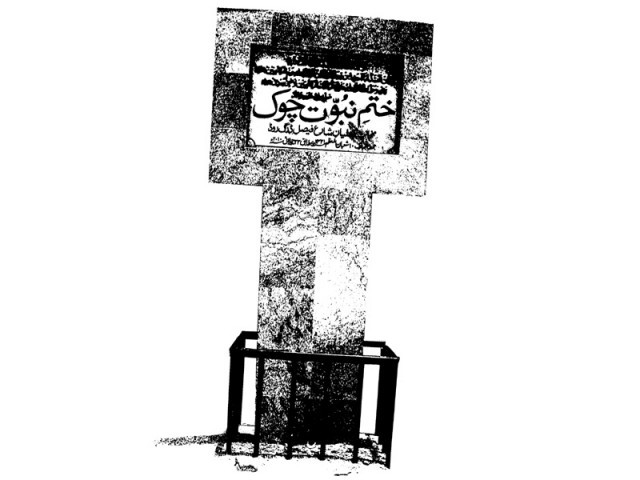 The minority has been under constant attack even though it keeps a low profile. |
KARACHI: On a Friday afternoon, there is pin-drop silence around the Ahmadi place of worship in Karachi’s Drigh Road area. Worshippers quietly enter through a side door, watched over by a number of men on patrol and security cameras affixed to the building.
Just down the lane, the imam of Bilal Masjid peppers his sermon with anti-Ahmadi remarks. The strains of his sermon can be heard throughout the neighbourhood, including the men standing guard outside their place of worship.
Friday prayers are under way in both buildings, but only one congregation is allowed to practice its faith openly.
At the crossroads of the mosque and the place of worship is a marker for the ‘Khatm-e-Nabuwwat’ roundabout, a silent but potent public reminder of the power of the religio-political party in Pakistan. “There was a rally here a few months ago,” recalls a resident. “About 2,000 people attended and it was organised by the Tahaffuz Namoos-e-Risalat movement. They reaffirmed their faith in the finality of the Prophethood (peace be upon him), and then decided to rename this roundabout as a memento of the rally. After all, we are all Muslims, this is our faith.”
Sunni Tehreek (ST) flags flutter in the area, whose walls are covered with grafitti, declaring the area to be Sunni Nagar. “These clerics, Sunni Tehreek… they’re all one and the same,” remarks a shopkeeper who has worked near the Ahmadi place of worship for 25 years. He has witnessed the area’s clerics raging against the Ahmadiyya community for placing barricades near their place of worship. There have been incidents of firing in the area as well. Thoughtfully, he says, “The problem is that Muslims have increasingly become intolerant.”
A poster for a June 2 Tahaffuz Namoos-e-Risalat conference is still plastered to the wall of the Ahmadis’ building. A few months ago, activists reportedly barged in and demanded that the Kalima, a verse declaring Muslim faith, be erased from a wall within the place of worship’s premises.
“This centre has been here since before you or I were born,” says the shopkeeper. Another resident said it was at least 40 years old.
Attendance at prayers at Ahmadi places of worship in Karachi has slowly picked up after the 2010 Lahore attacks. “We have stopped women and children from coming to the centres because we fear that they will be targeted first, similar to the Lahore attacks,” says Masood Khan, a senior representative of the Ahmadiyya community. “Praying is also difficult and it gets quite suffocating – we have to close all the windows and doors so that no sound can be heard outside.”
Outside is where a mob — literally and physically —exists. Just like the cleric at Bilal Masjid, mosque speakerphones are regularly used to incite hatred.
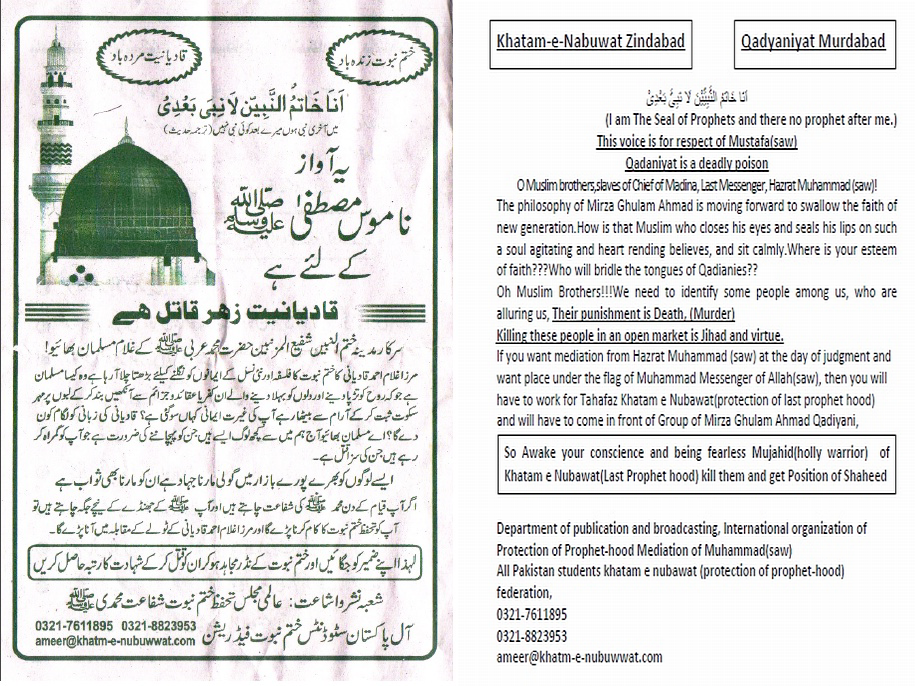
While Punjab has been the breeding ground for anti-Ahmadi sentiment, the minority in Sindh faces targeted assassinations, discrimination and blasphemy cases filed on flimsy charges. Reviled due to a decades-old campaign, Ahmadis have nowhere to turn to, not even the state. A lieutenant, who was awarded the Sword of Honour, was forced to leave the navy because his faith meant he would never be promoted. A woman was widowed twice because her husbands were practicing doctors. Flyers are openly distributed, asking people to boycott Ahmadi-run businesses and execute their owners.
“We have brought these incidents … to the police’s notice so many times,” says Khan. “But they do nothing beyond occasionally sending a policeman or two.”
The police also have their own biases. Khan recalls that two officers refused to drink water offered to them by Ahmadis. “The Central Investigation Department has several men in its custody who confessed that they wanted to target Ahmadis and Shias. But they have never been presented in court.”
Even then, Khan says, the police in Karachi are better than those in the Punjab. Khan praises former Sindh home minister Zulfiqar Mirza for proactively listening to their problems. “The police will at least send someone. The security apparatus was concerned after the attacks in Lahore and we discussed measures. But we asked for Rangers to be deployed on Fridays and that has not happened.”
After a lifetime spent in fear, Ahmadis in Karachi who can afford to relocate are packing up their bags. At least 300 to 400 people have reportedly left. The Ahmadiyya community in Karachi is at least 20,000 strong.
Others hail from rural Sindh, especially Sanghar. This district has seen numerous cases of violence and Section 295-C cases (which carries the death penalty) filed by a cleric, Maulana Hamadi. “[He] sits in Sanghar and files cases against people sitting miles away in Rabwah!” exclaims Qaiser Shahzad, a Karachi-based businessman.
In Karachi, Ahmadis living in Mehmoodabad have been gunned down in the past decade, with up to six cases in the last three years alone. One of them included a doctor who chose to work in the poor area. He was killed as he stopped at a speed breaker on his way home. Twenty-five families from Manzoor Colony have emigrated.
“We don’t tell our children that they will face discrimination. We don’t want to poison their minds at a young age,” Khan says. “But at school they are inevitably discriminated against. Our girls come back home and say they don’t want to go to college.”
Ahmadi families prefer sending their children to schools run by Parsis and Christians – also minorities. According to Shahzad, admissions are a no-go once school realise what the family’s faith is.
Intolerance has spread to other areas as well. In Badin, an Ahmadi centre was targeted during an event for women. Incited by a cleric, men besieged the centre for eight hours. It took Zulfiqar Mirza (who was elected as an MPA from Badin) to clamp down. In January, a leaflet threatening an Ahmadi businessman was circulated in Goth Saban Dasti in Badin, which stated: “Such an apostate should be killed and his business should be banned all over Pakistan. We demand that the government of Pakistan take immediate action, otherwise the people will have to do this job on their own.”
Karachi’s business community, according to Khan and Shahzad, is generally accepting of Ahmadis, especially those whose operations have been established for decades. However, Shahzad says in a resigned tone, “You can tell the difference in the way they meet us. They work with us because they have to.”
Discrimination has also swept the armed forces and civil bureaucracy. “From Chaudhry Zafarullah to high-ranking generals, Ahmadis were always represented in the top ranks. But now we barely have a few people at top positions in the civil bureaucracy. In Ziaul Haq’s era, this [discrimination] was implemented — there are no promotions. Ahmadis don’t even clear interviews for government or military jobs now, despite being highly qualified.”
Discrimination, Khan says, is also found among old friends. “I know that they don’t want to dine with me.”
“Look, people believe that we are wajibul qatl [liable to be killed]. This thought is reflected in our assemblies.”
Anti-Ahmadi sentiment and extremism, the men said, has increased in society over the past few years. Laws pertaining to Ahmadis — particularly those introduced in the 1980s — have provided legal backing to the hate being propagated in society. Anti-Ahmadi graffiti routinely appears near places of worship, and the gate of one building was fired on recently in Steel Town. Yet, Khan and Shahzad say, they have learned to live with the ever-present fear. “We are sitting openly,” says Khan. “But someone has to come forward on behalf of the community. We don’t consider ourselves minorities. We are Pakistanis. This is our country.”
Legal exclusion
In 1952, religious parties demanded the removal of Pakistan’s first foreign minister, Sir Chaudhry Zafarullah Khan, who was an Ahmadi. In 1974, after violent demonstrations took place, Jamaat-e-Islami factions demanded that Ahmadis be declared non-Muslims. A constitutional amendment was passed to exclude Ahmadis from Islam. In 1984, amendments were made to ban the usage of Islamic symbols and practices for Ahmadis, such as calling their places of worship a mosque.
Source: International Crisis Group report: ‘The State of Sectarianism in Pakistan’, Jinnah Institute report: ‘A Question of Faith’
A profile
The Sunni Tehreek is a religio-political party that follows the Barelvi school of thought. It has actively campaigned against any amendments to or repeal of the country’s blasphemy laws. ST activists protested against Punjab Governor Salmaan Taseer prior to his assassination on June 4 and have supported his assassin Malik Mumtaz Hussain Qadri.
Published in The Express Tribune, June 19th, 2011.
Just down the lane, the imam of Bilal Masjid peppers his sermon with anti-Ahmadi remarks. The strains of his sermon can be heard throughout the neighbourhood, including the men standing guard outside their place of worship.
Friday prayers are under way in both buildings, but only one congregation is allowed to practice its faith openly.
At the crossroads of the mosque and the place of worship is a marker for the ‘Khatm-e-Nabuwwat’ roundabout, a silent but potent public reminder of the power of the religio-political party in Pakistan. “There was a rally here a few months ago,” recalls a resident. “About 2,000 people attended and it was organised by the Tahaffuz Namoos-e-Risalat movement. They reaffirmed their faith in the finality of the Prophethood (peace be upon him), and then decided to rename this roundabout as a memento of the rally. After all, we are all Muslims, this is our faith.”
Sunni Tehreek (ST) flags flutter in the area, whose walls are covered with grafitti, declaring the area to be Sunni Nagar. “These clerics, Sunni Tehreek… they’re all one and the same,” remarks a shopkeeper who has worked near the Ahmadi place of worship for 25 years. He has witnessed the area’s clerics raging against the Ahmadiyya community for placing barricades near their place of worship. There have been incidents of firing in the area as well. Thoughtfully, he says, “The problem is that Muslims have increasingly become intolerant.”
A poster for a June 2 Tahaffuz Namoos-e-Risalat conference is still plastered to the wall of the Ahmadis’ building. A few months ago, activists reportedly barged in and demanded that the Kalima, a verse declaring Muslim faith, be erased from a wall within the place of worship’s premises.
“This centre has been here since before you or I were born,” says the shopkeeper. Another resident said it was at least 40 years old.
Attendance at prayers at Ahmadi places of worship in Karachi has slowly picked up after the 2010 Lahore attacks. “We have stopped women and children from coming to the centres because we fear that they will be targeted first, similar to the Lahore attacks,” says Masood Khan, a senior representative of the Ahmadiyya community. “Praying is also difficult and it gets quite suffocating – we have to close all the windows and doors so that no sound can be heard outside.”
Outside is where a mob — literally and physically —exists. Just like the cleric at Bilal Masjid, mosque speakerphones are regularly used to incite hatred.
While Punjab has been the breeding ground for anti-Ahmadi sentiment, the minority in Sindh faces targeted assassinations, discrimination and blasphemy cases filed on flimsy charges. Reviled due to a decades-old campaign, Ahmadis have nowhere to turn to, not even the state. A lieutenant, who was awarded the Sword of Honour, was forced to leave the navy because his faith meant he would never be promoted. A woman was widowed twice because her husbands were practicing doctors. Flyers are openly distributed, asking people to boycott Ahmadi-run businesses and execute their owners.
“We have brought these incidents … to the police’s notice so many times,” says Khan. “But they do nothing beyond occasionally sending a policeman or two.”
The police also have their own biases. Khan recalls that two officers refused to drink water offered to them by Ahmadis. “The Central Investigation Department has several men in its custody who confessed that they wanted to target Ahmadis and Shias. But they have never been presented in court.”
Even then, Khan says, the police in Karachi are better than those in the Punjab. Khan praises former Sindh home minister Zulfiqar Mirza for proactively listening to their problems. “The police will at least send someone. The security apparatus was concerned after the attacks in Lahore and we discussed measures. But we asked for Rangers to be deployed on Fridays and that has not happened.”
After a lifetime spent in fear, Ahmadis in Karachi who can afford to relocate are packing up their bags. At least 300 to 400 people have reportedly left. The Ahmadiyya community in Karachi is at least 20,000 strong.
Others hail from rural Sindh, especially Sanghar. This district has seen numerous cases of violence and Section 295-C cases (which carries the death penalty) filed by a cleric, Maulana Hamadi. “[He] sits in Sanghar and files cases against people sitting miles away in Rabwah!” exclaims Qaiser Shahzad, a Karachi-based businessman.
In Karachi, Ahmadis living in Mehmoodabad have been gunned down in the past decade, with up to six cases in the last three years alone. One of them included a doctor who chose to work in the poor area. He was killed as he stopped at a speed breaker on his way home. Twenty-five families from Manzoor Colony have emigrated.
“We don’t tell our children that they will face discrimination. We don’t want to poison their minds at a young age,” Khan says. “But at school they are inevitably discriminated against. Our girls come back home and say they don’t want to go to college.”
Ahmadi families prefer sending their children to schools run by Parsis and Christians – also minorities. According to Shahzad, admissions are a no-go once school realise what the family’s faith is.
Intolerance has spread to other areas as well. In Badin, an Ahmadi centre was targeted during an event for women. Incited by a cleric, men besieged the centre for eight hours. It took Zulfiqar Mirza (who was elected as an MPA from Badin) to clamp down. In January, a leaflet threatening an Ahmadi businessman was circulated in Goth Saban Dasti in Badin, which stated: “Such an apostate should be killed and his business should be banned all over Pakistan. We demand that the government of Pakistan take immediate action, otherwise the people will have to do this job on their own.”
Karachi’s business community, according to Khan and Shahzad, is generally accepting of Ahmadis, especially those whose operations have been established for decades. However, Shahzad says in a resigned tone, “You can tell the difference in the way they meet us. They work with us because they have to.”
Discrimination has also swept the armed forces and civil bureaucracy. “From Chaudhry Zafarullah to high-ranking generals, Ahmadis were always represented in the top ranks. But now we barely have a few people at top positions in the civil bureaucracy. In Ziaul Haq’s era, this [discrimination] was implemented — there are no promotions. Ahmadis don’t even clear interviews for government or military jobs now, despite being highly qualified.”
Discrimination, Khan says, is also found among old friends. “I know that they don’t want to dine with me.”
“Look, people believe that we are wajibul qatl [liable to be killed]. This thought is reflected in our assemblies.”
Anti-Ahmadi sentiment and extremism, the men said, has increased in society over the past few years. Laws pertaining to Ahmadis — particularly those introduced in the 1980s — have provided legal backing to the hate being propagated in society. Anti-Ahmadi graffiti routinely appears near places of worship, and the gate of one building was fired on recently in Steel Town. Yet, Khan and Shahzad say, they have learned to live with the ever-present fear. “We are sitting openly,” says Khan. “But someone has to come forward on behalf of the community. We don’t consider ourselves minorities. We are Pakistanis. This is our country.”
Legal exclusion
In 1952, religious parties demanded the removal of Pakistan’s first foreign minister, Sir Chaudhry Zafarullah Khan, who was an Ahmadi. In 1974, after violent demonstrations took place, Jamaat-e-Islami factions demanded that Ahmadis be declared non-Muslims. A constitutional amendment was passed to exclude Ahmadis from Islam. In 1984, amendments were made to ban the usage of Islamic symbols and practices for Ahmadis, such as calling their places of worship a mosque.
Source: International Crisis Group report: ‘The State of Sectarianism in Pakistan’, Jinnah Institute report: ‘A Question of Faith’
A profile
The Sunni Tehreek is a religio-political party that follows the Barelvi school of thought. It has actively campaigned against any amendments to or repeal of the country’s blasphemy laws. ST activists protested against Punjab Governor Salmaan Taseer prior to his assassination on June 4 and have supported his assassin Malik Mumtaz Hussain Qadri.
Published in The Express Tribune, June 19th, 2011.








 Posts
Posts


