 |
Friday, September 16, 2011 |
EDITORIAL: Religious freedom in Pakistan
US Department of State’s July-December, 2010 International Religious Freedom Report has documented “major developments with respect to religious freedom in 198 countries and territories”. The report placed China, Eritrea, Iran, Myanmar, North Korea, Saudi Arabia, Sudan and Uzbekistan as “countries of particular concern” regarding religious freedom while 10 other countries, including Pakistan, were cited for failing to sufficiently protect religious rights. The report has raised important points regarding our country. On Pakistan, it says: “The government did not reform a blasphemy law that had been used to prosecute those who belong to religious minorities, and in some cases Muslims who promote tolerance. The government also used provisions of the penal code to prevent Ahmedis from practicing their religion. Members of other Islamic sects, Christians, Sikhs, and Hindus also reported governmental and societal discrimination…The government of Pakistan rarely prosecuted perpetrators of extremist attacks, deepening the climate of impunity.”
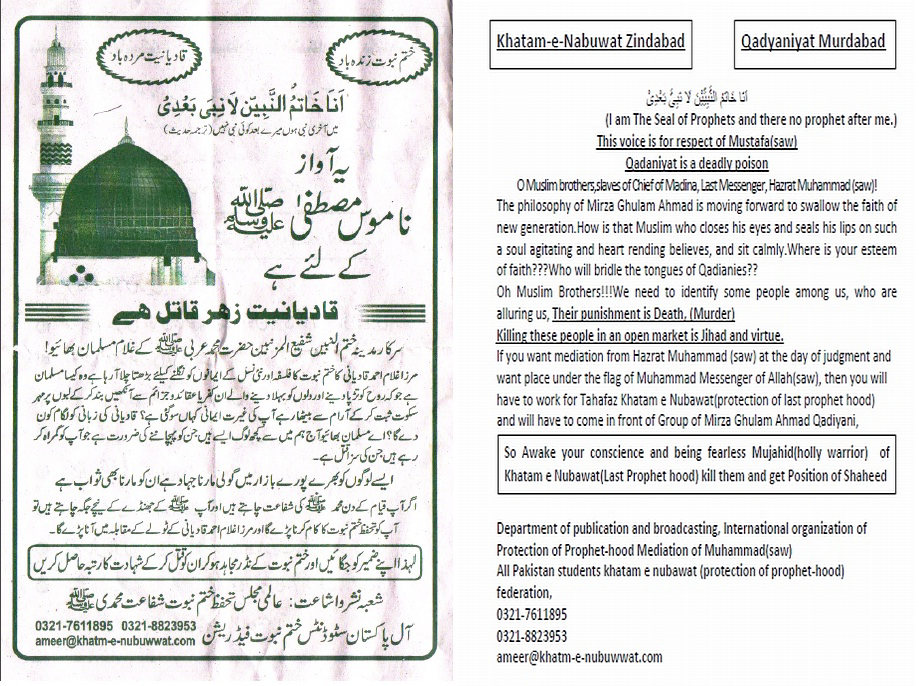
When late Governor Salmaan Taseer raised the issue of amending the blasphemy laws, he was silenced by a fanatic’s bullets. With Mr Taseer’s death, the issue of blasphemy laws also died a silent death. Minorities Minister Shahbaz Bhatti was the second victim of the religious fanatics who opposed anyone challenging the flawed blasphemy laws. These laws have been used to settle petty feuds, personal rivalries, property disputes, etc, both against the Muslims and non-Muslims by people with vested interests. Many Islamic scholars are of the opinion that Pakistan’s blasphemy laws are man-made and thus can be changed since they are not based on Islamic teachings. Unfortunately, anybody who dares to challenge the veracity of these laws as per Islamic jurisprudence are threatened, harassed and/or killed. The government has, by the looks of it, given up on any debate regarding the blasphemy laws in view of two publicised killings of politicians this year — Punjab Governor Salmaan Taseer and federal Minorities Minister Shahbaz Bhatti. Blasphemy laws are not the only flawed laws present in Pakistan’s statute books. General Ziaul Haq might not have been responsible for declaring the Ahmedis non-Muslims but the laws promulgated under his command banning the Ahmedis from practicing their religion openly led to the persecution of the Ahmediyya community. The hate campaign against the Ahmedis continues to date. Just this year, Tehrik-e-Tahafuz-e-Khatm-e-Nabuwat took out pamphlets openly inciting violence against the Ahmedis in Punjab. It has led to various attacks on Ahmedi citizens resulting in the deaths. So far, the Punjab government has not just failed to nab the culprits but it has also turned a blind eye to such hate-mongering campaigns in the province. Sectarian violence is rampant all over Pakistan. Many Shias have lost their lives at the hands of banned sectarian outfits like the Lashkar-e-Jhangvi (LeJ) and Sipah-e-Sahaba Pakistan (SSP). These outfits have the overt and covert support of our intelligence agencies, which is why no action has been taken against them either. Christians, Hindus and Sikhs do not feel safe in this hostile environment. Religious minorities are treated worse than second-class citizens in our country.
There are many reasons for religious intolerance in Pakistan. Madrassas, jihadi organisations, textbooks with distorted history, sermons by illiterate and intolerance clerics, etc, are but a few reasons why Pakistan remains one of the most intolerant societies worldwide. The government must bring about educational reforms and close down religions seminaries or at least bring them into the mainstream. Hate literature should be banned. The military’s flawed policies of supporting sectarian outfits and other religious organisations must come to an end apart from making Pakistan’s constitution secular in letter and spirit. *

 What I can gather from the Ahmedis now is that, while they consider the treatment meted out to them as unjust and immoral, they are willing to go about their lives if they are allowed to do so with dignity and the freedom to live their lives according to their own rights




 Posts


