Showing posts with label minority groups. Show all posts

Saturday, July 31, 2010

Ahmadi faithful targeted by Islamic extremists and local government

Sepro News
World:  Global
Indonesia: West Java, Ahmadi faithful targeted by Islamic extremists and local government
Three days of clashes between Ahmadi Muslims and Islamic extremists. The radical Muslims wish to close their mosques with support from local government. Head of the extremists: “The Ahmadiyya should be banned. Our demand to eliminate them is non-negotiable.”
Saturday, July 31, 2010
By Asia News

Bandung – Tension remains high after three days of clashes between Islamic extremists and the Ahmadi community Manis Lor village, Kuningan district, West Java. On 26 July the police tried to close some mosques of the Ahmadi community. The police failed in their attempts following the massive protests of the faithful.

The next day another attempt was made by a group of 500 Islamic extremists, backed by state employees, who tried to close the mosques clashing with thousands of Ahmadi faithful armed with stones and sticks. The clashes ended yesterday and there are no victims.

The Ahmadis are Muslims who revere as a prophet, not only Muhammad, but Mirza Ghulam Ahmad (**). For this reason they are considered heretics and targeted by Islamic extremists. According to statistics, in 2009 33 attacks took place against the Ahmadis by extremists. In the first six months of 2010, the number of violence has dropped to four.

“Such problems should be approached with caution and tolerance,” said Djoko Suyanto, Minister of Security and Political and Legal Affairs. The Minister, in a meeting with President Yudhoyono expressed regret for the number of injuries and damaged properties of the Ahmadi community.

Hesty Amirwulan, a member of the Indonesian Commission for Human Rights (Komnas Ham), said that the clashes are a sign of how the law has little force in the country. As Ifdal Kasim, the chairman of Komnas Ham, noted “closing places of worship is against the Constitution.”

The Islamic extremists who attacked the Ahmadis are part of the Gapas (Movement against the illegal sects and non-believers). After asking the local administration to dissolve the sect, Andi Mulyono, head of Gapas, said: “The Ahmadiyya should be banned; our demand to eliminate them is non-negotiable.”

Since 1954, 3 thousand Ahmadi Muslims are residents in Kunnigan district, the largest Ahmadi community in the country. Sujan Deden, executive director of the community, condemned the violence of extremists: “They have no legal basis for banning us.”

In a press release, the Indonesian Interfaith Forum, said: “The presence of the Ahmadis should be respected by all parties in the country, including the government, since they have existed in Indonesia since 1950.”

Source: Asia News

Ahmadiyya Muslim Community believe in Prophet Muhammad(saw) as last Law-bearing prophet and also that Hadhrat Mirza Ghulam Ahmad(as) of Qadian is Promised Mahdi and Promised Messiah as prophesied in Ahadith. Please visit Alislam.org/messiah for further info.


Friday, July 30, 2010

President orders police to be strict in call to disband Ahmadiyah

NATIONAL
Fri, 07/30/2010
5:41 PM

President orders police to be strict in call to disband Ahmadiyah
The Jakarta Post, Jakarta

Under threat: Followers of Islamic sect Jamaah Ahmadiyah leave An-Nur mosque at Manis Lor village, Kuningan, West Java, after Friday prayers. Clash broke out between members of more than five Muslim organizations from outside Kuningan and Ahmadiyah followers on Thursday, damaging scores of houses and injuring at least three people. JP/R. Berto Wedhatama

President Susilo Bambang Yudhoyono has instructed the National Police to be strict in handling disputes surrounding the call to disband Islamic sect Jamaah Ahmadiyah in Kuningan regency, West Java, a minister said on Friday.

Speaking at the Presidential Office in Jakarta, Minister of Political, Legal and Security Affairs Djoko Suyanto said that the police had to be strict especially in anticipating any anarchic action conducted by whoever or whichever organizations.

“A stern action has to be done on any anarchic action by anybody, everywhere, whichever organization. The police have been instructed to do so. The President has also asked me that the police have to be strict,” he said as quoted by the Antara news agency.

Djoko made the remarks following a clash between members of more than five Muslim organizations from outside Kuningan regency and Ahmadiyah followers residing in Manis Lor village, Jalaksana district, Kuningan.

The clash happened when organization members, who demand the disbandment of Ahmadiyah, forced their way to enter Ahmadiyah followers’ compound on Thursday. Police officers in charge of maintaining order were pelted with stones.

As Ahmadiyah followers felt they were cornered, they fought back, attacking members of the Muslim organizations. Several people were injured in the incident.

Thursday, July 29, 2010

Fresh attack targets Ahmadiyah members

NATIONAL
Thu, 07/29/2010 10:17 PM

Fresh attack targets Ahmadiyah members
Nana Rukmana, The Jakarta Post, Kuningan, West Java

Clash broke out between angry mob and members of the Islamic sect Jamaah Ahmadiyah in Kuningan regency, West Java Thursday, damaging scores of houses and injuring at least three people.

Coordinating Political, Legal and Security Affairs Minister Djoko Suyanto regretted the incident and told people to stop resorting to violence.

“The problem should be peacefully taken care of, not through violence which only disadvantages all,” he told Antara news agency.

The incident immediately drew criticism, with the National Commission on Human Rights member Hesty Armiwulan saying it shows the country’s poor law enforcement.

“The government should find solution to this problem, rather than to take side with one group and violating the other’s rights,” she said.

The clash erupted after some 500 protesters, claiming to come from several hard-line Islamic groups, forced their way into the sect’s complex at Manis Lor village, located some 40 km south of Cirebon city and is home to some 3,000 Ahmadiyah followers.

They soon pelted stones and wooden sticks against each others.

Upon order from Kuningan regent Aang Suganda, public order officers closed down eight Ahmadiyah mosques in the village on Monday and Wednesday. But the residents later opened up the seals.

On Tuesday the Setara Institute for Democracy and Peace announced the result of its survey, which revealed rampant use of violence to suppress the religious freedom of minority groups in the country.

Thursday, April 29, 2010

Pakistan’s Punjab region on knife-edge as extremists take hold, says governor

---Guardian, UK
News > World > Pakistan
Pakistan’s Punjab region on knife-edge as extremists take hold, says governor
Politicians accused of backing banned groups as minorities suffer violence and intimidation
Saeed Shah Faisalabad
guardian.co.uk, Thursday 29 April 2010 19.31 BST


Pakistan’s heartland Punjab province is an extremist “bomb” ready to explode, the region’s highest official has warned, with the recent targeting of minority groups seen by some as evidence of jihadists’ grip on the area.

The provincial governor accused the regional government, led by former prime minister Nawaz Sharif’s party, of tolerating or even supporting extremists, who are said to operate openly in Punjab free from the military operations waged against Taliban guerrillas in the area bordering Afghanistan.

“The Sharifs are creating a potential bomb here in Punjab,” said Salman Taseer, the governor of Punjab, who was appointed by the national government. “These [militant] groups are armed and dangerous. There is no way you can accommodate these people. There has to be zero tolerance.”

In recent weeks, a spate of armed robberies and kidnappings of the Ahmedi sect in the city of Faisalabad was traced to members of Jamaat-ud-Dawa, the group previously known as Lashkar-e-Taiba that was blamed for the devastating 2008 terrorist attack on Mumbai. Three Ahmedis were also shot dead, thought to be the work of the same group.

Sharif’s opponents accuse his party, the opposition Pakistan Muslim League-N – whose support comes partly from the religious right – of accommodating extremists such as Sipah-e-Sahaba, a banned sectarian group blamed for the deaths of hundreds of Shias.

In Jhang town, a byelection last month saw Sharif’s party openly court Sipah-e-Sahaba supporters. Punjab’s law minister, Rana Sanaullah, was pictured on the campaign trail with the alleged head of the group, Ahmed Ludhianvi.

Experts believe that the Pakistani Taliban is deeply influenced by Sipah-e-Sahaba, with the Taliban’s leader, Hakimullah Mehsud, a former member.

Sheikh Waqas Akram, an opposition member of parliament from Jhang, which is the headquarters of Sipah-e-Sahaba, likened the situation in Punjab to the Swat valley, where official inaction allowed the Taliban to take over in 2008. “There can be 10 Swats in Punjab, if you don’t check them [extremists],“ said Akram.

But Sanaullah denied the claims, saying that while banned groups operated in the province there was no “Talibanisation” in Punjab. “Not a single street where you can say there is a no-go area,” he said.

Sanaullah said that groups based in the north-west were behind the terrorist attacks in Punjab, not local organisations, adding that “95% of the people of Sipah-e-Sahaba are not terrorists”. He said: “We must persuade these persons to put aside their guns, to participate in elections. They have the right to vote, so why can’t I ask them [Sipah-e-Sahaba] for votes?“

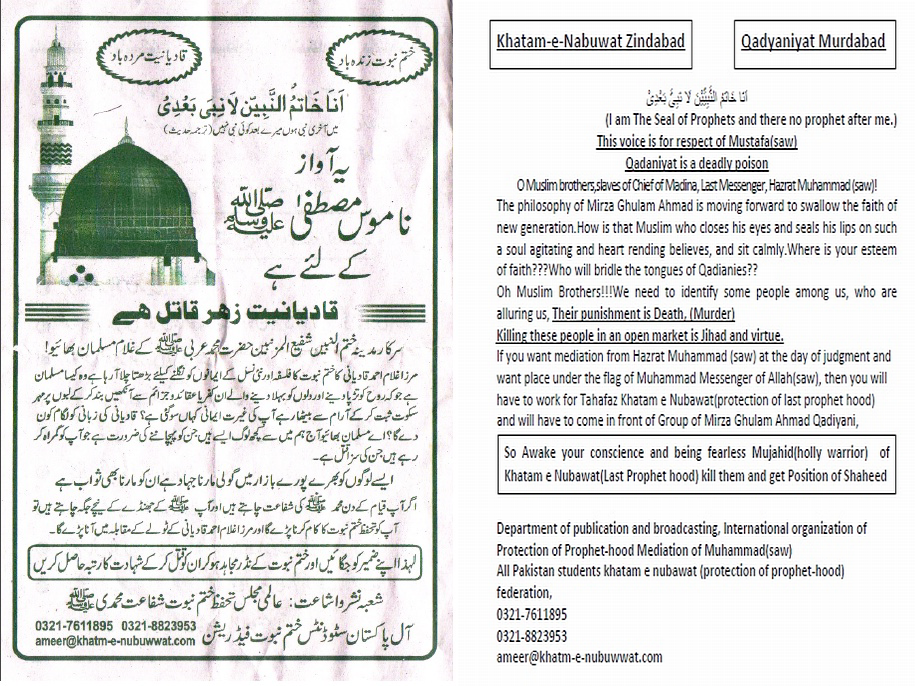
Over the last year the affluent Ahmedi community in Faisalabad has been rocked by a campaign of violence and intimidation, which intensified in recent weeks. Ahmedi are classified as non-Muslims under Pakistani law, for believing that Muhammad was not the final prophet.

Police arrested four suspects last month. Three days later, on 1 April, three members of an Ahmedi family were shot dead as they returned from work. Their car was sprayed with bullets, in what police believe was a “very professional” hit and possible revenge for the arrests.

“The four people in jail are in Jamaat-ud-Dawa,” said senior Faisalabad police officer Abid Hussain. “They told us that they got a decree from a maulvi (priest) in their group that says that robbing, kidnapping and killing Ahmedis is allowed and would be rewarded in heaven.”

The city’s Ahmedi community have restricted their movements and some have hired bodyguards.

“We are now scared to leave the house, when the door bell rings, we are frightened about who might be there. Outside, we feel always like someone is following us,” said Mohammad Iqbal Ahmed, whose son and nephew were kidnapped in March and returned after the payment of a £20,000 ransom.

© Guardian News and Media Limited 2010
URL : www.guardian.co.uk/world/2010/apr/29/pakistan-punjab-taliban
 
^ Top of Page