Sunday, February 6, 2011

Police Arrive to Secure Site of Ahmadiyah Conflict in Umbulan

Jakarta Globe, Indonesia
HOME
Police Arrive to Secure Site of Ahmadiyah Conflict in Umbulan
February 06, 2011

Banten. The district secretary of the village of Cikeusik said on Sunday that hundreds of police had arrived to secure the site of the bloody Ahmadiyah clash in the village of Pendeuy in Umbulan.

“The situation is currently returning to normal. We no longer see members of the Ahmadiyah community or other villagers at the scene of the conflict,” Najmudin said.

Six followers of the Ahamadiyah Islamic sect were killed in a clash with residents in Umbulan village, Cikeusik subdistrict, Pandeglang district, on Sunday morning, a community leader said.

Najmudin added that the villagers of Cikeusik were still keeping vigil in the area, fearing a possible recurrence of an attack.

He explained that the bloody incident, which six had reportedly died, was triggered when a group of people headed for the home of a man named Suparman, whose house was being used for Ahmadiyah-related activities.

Najmudin said that the group had demanded that he stopped holding such activities in Cikeusik.

According to him, one of the Ahmadis attacked a resident of Cikeusik named Sarta with a sharp weapon, and that Sarta’s hand was nearly hacked off.

“Had the Ahmadiyah not attacked this resident, I don’t believe this incident would have occurred,” he said.

Copyright 2010 The Jakarta Globe
URL: www.thejakartaglobe.com/home/police...umbulan/421066

Six Ahmadiyah Followers Killed in Clash in Banten: Witness

Jakarta Globe, Indonesia
HOME
Six Ahmadiyah Followers Killed in Clash in Banten: Witness
February 06, 2011

Pandeglang, Banten. Six followers of the Ahamadiyah Islamic sect were killed in a clash with residents in Umbulan village, Cikeusik subdistrict, Pandeglang district, here on Sunday morning, a community leader said.

“I saw six people were killed. They are all followers of Ahmadiyah,” Cikeusik community leader Lukman told ANTARA.

Lukaman said the identities of the dead victims were not known yet but all of them were outsiders and members of the banned Ahmadiyah Islamic sect.

Also, a native of the village, Umbulan Sarta, was stabbed on his right arm. “His right arm was almost cut off. He was stabbed by a follower of the Ahmadiyah,” he said.

Lukman explained that initially residents had no intention to take violent acts. Villagers just wanted the followers of the Ahmadiyah to disband themselves.

“Villagers want that the Ahmadiyah dissolve because it has been declared by the Indonesian Ulemas Council (MUI) as heretic but they ignored the villagers’ call,” Lukman said.

Lukman said that on Saturday night, dozens of Ahmadiyah followers from Bogor, West Java, arrived in Cikeusik village on two four-wheel vehicles and spent the night at the house of Parman, the leader of the local Ahmadiyah group.

On Sunday morning, about a thousand residents from various regions in Banten, among others from Cibaliung sub-district, Cikeusik district and Malingping subdisrict, Lebak district, picketed Parman’s house.

When the residents arrived at Parman’s house, the Ahmadiyah followers had already prepared different kinds of sharp weapons such as samurai, machetes and spears.

“Then, a follower of Ahmadiyah stabbed in the right arm of Sarta causing his arm almost cut off,” Lukman said.

“The stabbing of Sarta immediately triggered the clash,” he added.

Antara

(Editor’s Note: Police later clarified that three members of the Ahmadiyah Islamic sect were killed, not six.)


Pakistan is headed for a clerical tsunami: analysts

Express Tribune, Pakistan
Pakistan
Pakistan is headed for a clerical tsunami: analysts
By Salman Siddiqui
Published: February 6, 2011
Clerical Tsunami
KARACHI: Pakistan is heading towards a faith-based ‘clerical tsunami’ and a bleak future dominated by radical clerics is dawning upon, unless people stand up to the challenge and fight back. This was the warning delivered by a panel of senior analysts at the Karachi Literature Festival.

Pervez Hoodbhoy lashed out at the ‘liberal elite’ who don’t venture out of their posh housing societies to see the reality and ‘the mass of discontent’ all around us. He said one doesn’t have to go too far to see the messages being broadcast from the mosques in the country and warned that Pakistan would become a faith-based theocratic state.

“The question now is what kind of a theocracy it would be,” Hoodboy said, reminding everyone that even if religious groups from various sects unite in the pursuit of power, eventually they too would fight among themselves.

He said that even though it may seem that rival religious groups are united over the blasphemy law in the aftermath of Salman Taseer’s murder, “we’ve seen that the Deobandis and the Barelvis are ready to kill each other (on any given opportunity).”

Zahid Hussain sounded an upbeat note and said he believed that a miracle was still possible. He said it was depressing that the state wasn’t taking any steps to stop the fundamentalists from broadcasting their twisted messages and gave the example of a recently held rally in Lahore addressed by leading religious figures, who openly said that there would be more Mumtaz Qadris.

He lambasted the government. “Instead of taking any action, our own Interior Minister Rehman Malik went on air to say that he too would have shot someone dead if he/she committed blasphemy.”

Blasting the government for its ‘criminal silence’, Hussain said he believed the majority of Pakistanis don’t subscribe to the extremists’ narrative. “What is happening is that people are just giving up very easily.”

Khaled Ahmed said the writ of the state was vanishing increasingly from many areas, including Balochistan and tribal areas, pointing out that “there are no go areas even in parts of interior Sindh and Karachi.”

Ahmed Rashid said Pakistan missed out on two important opportunities to bring about a complete change in its policies. The first was in 1992 when the Soviet Union collapsed.

“The biggest event we missed was globalisation,” he said, adding that the Pakistani ruling elite, including Nawaz Shairf and Benazir didn’t capitalise on the message of that era in order to progress.

He said the end of the cold war passed by Pakistan without any noticeable changes in policy because we were too focused on our own internal power struggles.

Rashid said the second chance was after 9/11. “After 9/11, the message was clear that Pakistan can no longer continue to use militant groups like Lashkar-e-Taiba and Jaish-e-Muhammad for its purposes.”

He said Pakistan’s entire national security paradigm has been bogged down by its India-centric policy, where instead of competing in trade and technology, we continue to indulge in an arms race.

Published in The Express Tribune, February 6th, 2011.

Saturday, February 5, 2011

Republic of Fear and Bigotry

Express Tribune, Pakistan
OINION
Republic of Fear and Bigotry
Nasim Zehra
By Nasim Zehra
Published: February 5, 2011
The writer is director current affairs at Dunya TV and a former fellow at Asia Center, Harvard University nasim.zehra@tribune.com.pk

Last week in our Senate, two revealing incidents took place. One, the refusal of a senator to lead the fateha for the assassinated Governor Salmaan Taseer. Second, a privilege motion moved by Senator Mandokhel, calling upon the deputy chairman of the Senate to declare a Pakistani woman a blasphemer because, in a text message, she had referred to the late governor as shaheed. Mandokhel sahib’s contention is that since Salmaan Taseer was a blasphemer, anyone calling him shaheed is also a blasphemer. On February 3, responding to the senator’s insistence that the chairman Senate give a ruling on the matter, the chairman said he would do so later. The Senate session was then prorogued.

In the last few weeks, new blasphemy cases have been filed, one of them against a first-year student. The 17-year-old, reported to the police for writing something blasphemous on his examination paper, is now in prison. Also, last week a sessions court handed down a death sentence, along with a Rs200,000 fine, to a man of Jalalpur Peerwala for committing blasphemy. The accused was reportedly mentally challenged.

Against the backdrop of these incidents, a factual review of the developments that took place after PPP MNA Sherry Rehman proposed the initial bill, alongside initial government moves to review Article 295, is essential. Of course, the current outcome of this move has been that the prime minister has announced the withdrawal of Ms Rehman’s bill.

The new aspect to the prime minister’s February 3 announcement was that he had consulted Ms Rehman and that she had agreed to withdraw her bill. Her statement, however, indicates that it was more or less a unilateral move by the prime minister but that she would abide by it because of party discipline. More importantly, as she explained, the withdrawal announcement was unnecessary since the bill had not even been tabled. What is truly ironic is that in the same statement in which the prime minister announced the withdrawal of the bill, he invited various political parties to come forward and discuss ways on how to prevent misuse of the existing law — which is precisely what Ms Rehman’s proposed amendment bill was seeking to address.

Meanwhile, of the many developments that took place after the sessions court’s judgment against Aasia Bibi, six are especially noteworthy.

The first is that while human rights groups have been working on the issue of misuse of the blasphemy law for years, it was when the PPP-led government announced a committee to amend the laws that Ms Rehman tabled her bill. She shared it with all party leaders and made it a point to inform the chief whip of the government of her plans — and he did not ask her to hold off for a while. She consulted with several lawyers about the bill and did not submit it in secret. The proposed amendment created a wave of awareness that has finally led everyone (including the Council of Islamic Ideology) to concede that changes are required to end the existing law’s misuse. Even the religious parties have taken this position of reform repeatedly in various forums. All this contradicts the claims of those who now hold the view that the introduction of this bill was an ill-timed move.

Two, the government blundered along, making contradictory moves and statements on the issue of amending the blasphemy law ever since Aasia Bibi’s conviction. They set up a committee to review it and created a parliamentary subcommittee headed by MNA Nafisa Shah. But at the first whiff of criticism by other groups, the law minister announced that the amendment will take place “over my dead body”.

On one hand, the Punjab governor, when he was alive, criticised the law and lobbied for Aasia’s presidential pardon while on the other, the same government’s law and interior ministers were saying quite the opposite. Instead of ironing out these stark contradictions, the departure of the JUI from the coalition convinced the government that backtracking on the amendment would buy it survival security. Hence, Sherry Rehman’s bill was not a victim of bad timing but, in fact, a victim of the PPP’s bad politics.

Three, every backtracking move by the government emboldened those who equated amendment of the man-made law with blasphemy. Parties like the PTI, the PML-N and the PML-Q have become actively engaged in street protests organised by the ‘religious right’ that are shadow-boxing with imaginary blasphemers.

Four, in pursuit of what the government believes to be survival-mode politics, the government and the PPP have practically abandoned Sherry Rehman. She has been provided some security outside her house but no government ministers have spoken in parliament against the death threats that she has been receiving. Almost no one has spoken for her at other public forums either. The government has not opted to be part of her defence in the Lahore High Court where there is a case demanding that she be disbarred from parliament. She is also involved, again unsupported by the PPP, in a blasphemy case in Multan.

Five, the big names of the legal community who led the lawyers’ movement seem to have opted for selective commitment to rule of law by not taking a clear-cut position to stand by Sherry Rehman — barring exceptions like Salman Akram Raja and Hina Jilani. Six, against the backdrop of increasing cases of blasphemy being registered — against a student, a doctor and a Dera Ghazi Khan imam and his son — Ms Rehman stands vindicated on both the call for amending the existing law and on the timing of such a proposed amendment.

The government’s blundering over amending Article 295 of the Pakistan Penal Code will qualify as a textbook example of how expedient politics can take nations down a path of disaster. Clearly, in the Senate, the chairman has found it difficult to give a ruling against Senator Mandokhel’s incredible demand that an activist be denounced as a blasphemer. Equally incredible is the imprisonment of a 17-year-old on blasphemy charges. And, not least of all, the news that no one is representing the prosecution in the court as the case of Governor Salmaan Taseer’s murder proceeds is shocking.

In the coming days, it is not unlikely that, led by the short-sighted politics of the PPP and of other parliamentary parties, Pakistan’s politics and state will have, in fact, weakened the best Islamic values within Pakistan, undermined parliamentary politics and strengthened the constituency of those who want to see Pakistan turn into the Republic of Fear and Bigotry.

Published in The Express Tribune, February 6th, 2011.

Friday, February 4, 2011

Hand out blinkers for blasphemy law

Express Tribune, Pakistan
Pakistan
Hand out blinkers for blasphemy law
By Khaled Ahmed
Published: February 4, 2011
The govt, opposition, clergy and even some journalists have behaved in a similar way with regards to blasphemy law.
The government has bitten the dust and can’t be blamed for it too much because all politicians in the opposition too have behaved the same way while the clergy upped the ante on blasphemy law.

The PPP lost its governor in Punjab at the hands of a religious fanatic which the police had ignored in its ranks; and its MNA Sherry Rehman has been made to take back her proposed legislation aimed at humanising the said law in Pakistan. The British Raj did much better on the subject after Muslims as a minority in India complained that their religion was increasingly coming under communal attack. In 1927, Article 295 was added to the Penal Code under which ‘deliberate and malicious acts intended to outrage religious feelings of any class by insulting its religious belief’ became a culpable offence. It suggested a maximum of ten months in jail as punishment and the law did very well in the field. There were only 10 blasphemy cases in the 58 years between 1927 and 1985. Since that year, the number of blasphemy cases has soared to more than 4,000.

Journalists are not free of the blot of intolerance: Chief Reporter The News Ansar Abbasi wrote in Jang (12 Jan 2011) that he and a number of conservative lawyers in Lahore got together to file a petition in 1984 at the Federal Shariat Court asking for a law against insult to the Prophet (PBUH). In July 1984, a lady lawyer (Asma Jahangir – KA) had insulted the Prophet (PBUH) in Islamabad during a speech. This was followed by unrest in the meeting:

‘On this Appa Nisar Fatima, [mother of PML-N leader Ahsan Iqbal who hailed from General Zia’s conservative district of Jalundhar in India] presented the bill about 295-C of the Penal Code. It was approved but Law Minister Iqbal Ahmad Khan changed the text at the last minute to assign “death or life” as punishment for blasphemy. Nisar Fatima took the matter back to Federal Shariat Court saying the punishment for blasphemy was a hadd and could not be less than death. Hearing started on first April 1987. Dr Tahirul Qadri held that evidence of intent was not required (sic!) before quickly killing the blasphemer. The Court gave the government till 1991 to amend the Section 295-C. Prime Minister Nawaz Sharif had to obey’.

Associate Professor and Head of Department of Law & Policy, Lahore University of Management Sciences (LUMS), Osama Siddique and BA Hons (Oxen) Zahra Hayat, have contributed a paper on blasphemy law which notes that determination of ‘intent’ was no longer a requirement before punishing accused blasphemers.: ‘The absence of an intent requirement in Sections 295-B, 295-C, and 298-A has made it possible for blasphemy charges that may otherwise have failed the mens rea test to spawn lengthy trials continuing to the appellate level’.

Was the ‘nass’ (clear edict) of death for blasphemy mentioned in the Holy Quran? Listen to a TV discussion here to find how Jamaat-e-Islami leader Fareed Paracha ‘proves’ this. He quotes Sura Ahzab verse number 56 saying: Allah and His angels send Darood on the Prophet (PBUH). Then he quotes verse 57 saying: whoever hurts the Prophet (PBUH) will go to Hell. But after that he omits verses 58, 59 and 60 and quotes verse 61 instead, which says: kill them wherever you find them. The verses he omitted actually talk about munafiqeen (hypocrites).

Not even his spiritual mentor Maulana Maududi in his monumental work of exegesis ‘Tafheem al-Quran’ interprets the above verses to mean that blasphemers had to be punished with death. Today, we cope with the humiliation that comes from having this law on our statute books because no one is prepared to think rationally.

The minorities – the poorest stratum of our society who had received assurances of equal treatment from the founder of the state, Quaid-e-am Muhammad Ali Jinnah – have to bear the brunt of this hatred of ourselves. When the world is outraged by what we do to women and the minorities here, we respond with xenophobia.

The politician, when not resting his head in a pile of sand, wears blinkers so that he can avoid facing up to the moral fallout from blasphemy law.

Published in The Express Tribune, February 4th, 2011.

Thursday, February 3, 2011

Pakistan MP drops effort to repeal blasphemy laws

South Asia
3 February 2011 Last updated at 14:11 GMT
Pakistan MP drops effort to repeal blasphemy laws

Many in Pakistan are opposed to any effort to alter the blasphemy lawsMany in Pakistan are opposed to any effort to alter the blasphemy laws
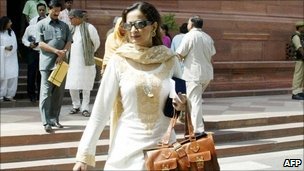
A Pakistani politician has dropped her attempt to amend the country's controversial blasphemy laws, accusing her party of appeasing extremists.

Pakistan People's Party MP Sherry Rehman made her decision after the government ruled out changing the law.

Correspondents say Ms Rehman is one of only a few politicians prepared to speak out on the blasphemy law.

They say there has been a climate of fear since the murder of Punjab governor Salman Taseer who opposed it.

Mr Taseer was killed in January by one of his bodyguards, who later admitted murdering the governor because he had spoken out against the blasphemy law.

Hundreds of people are in prison on charges under the law. Critics say it has been used to persecute minority faiths and is sometimes exploited by people pursuing grudges against others.

It has been under scrutiny since a Christian, Asia Bibi, was sentenced to death in November. Ms Bibi denies insulting the Prophet Muhammad in her Punjab village in June 2009.

'Blow-back'

Ms Rehman told the BBC in January that she received death threats every half hour, but would defy them.

However, in a statement received by the BBC on Thursday, she said she would not be proceeding with her proposed bill following remarks by Prime Minister Yousuf Raza Gilani earlier in the week.

"Since the PM announced that there cannot even be discussion on procedural amendments, and the committee announced by the party to amend the laws has been disbanded, then as a PPP representative I had no option but to abide by the party's decision in parliament.

She added: "Appeasement of extremism is a policy that will have its blow-back."

Sherry Rahman
Mr Gilani had said that no amendment in the law could be considered. He also disbanded a committee set up to determine how to amend the laws.

The BBC's Syed Shoaib Hasan in Karachi says politicians in Pakistan are increasingly reluctant to amend the law - many are afraid of being targeted in the way Mr Taseer was.

He says Ms Rehman's courageous stance against what is seen by some experts as a flawed law has few public supporters.

Ms Rehman stressed that she had not agreed to "withdraw" her private member's bill.

"There was never any question of withdrawing the bill as the Speaker had never admitted it on the agenda," she said.

Ms Rehman added that if the Speaker had allowed her bill "perhaps some of our colleagues would have understood that it was not suggesting total repeal of the law, but protecting our great Prophet's name against injustices done via procedures introduced by [former President] Zia ul-Haq.

"It was a question of protecting our citizens from injustice done in the name of a religion that values peace and tolerance more than anything else," she said.

Her statement came as Human Rights Watch urged the government to release a boy of 17 who is under arrest in Pakistan, accused of blaspheming against the Prophet Muhammad in a high school exam.

 
^ Top of Page