
Showing posts with label Dissent. Show all posts

Friday, December 3, 2010

COMMENT: The blasphemer must not be pardoned

Daily Times, Pakistan
Friday,
December 03, 2010

COMMENT: The blasphemer must not be pardoned — Abbas Zaidi

Allah has very, very explicitly said in the very beginning of the Quran that whosoever kills one human being is guilty of killing the entire humanity. Thus, by wanting to kill humans in the name of the Prophet (PBUH), these mullahs, in letter and spirit, want to launch an insane jihad against Allah

Hundreds of mullahs have taken to the streets to warn against the possible pardon President Zardari might grant Aasia Bibi, who allegedly blasphemed against Prophet Muhammad (PBUH). They say that if Aasia Bibi, the Christian blasphemer, is pardoned, they will launch a jihad against the government and the entire world and kill all the blasphemers. Aasia Bibi must not be pardoned. Otherwise, the lives of around five billion humans might be jeopardised. And now the Lahore High Court has also passed an order on the petition of a private citizen that the president cannot pardon Aasia Bibi because the case is sub judice. Why do mullahs so fanatically react to each case of perceived or alleged blasphemy?

The logic is very simple. Non-Muslims have, roughly speaking, two views of Prophet Muhammad (PBUH): (1) they (for instance, Christians and Jews) do not consider him to be a prophet at all, and (2) they (Hindus, Buddhists, and the rest) are not bothered about the issue at all. Now this is not acceptable as far as our furious mullahs are concerned. They demand that the world positively accept him to be the last prophet. Which effectively means that non-Muslims either convert or be ready for the sword.

Was Prophet Muhammad (PBUH) the last prophet of Islam or the world? This is a tricky issue, which the mullahs are not prepared to deal with. If he were the last prophet of Islam, then it would be unfair on our part to force non-Muslims to accept him as the last prophet of Islam. If prophet Muhammad (PBUH) was the last prophet of humankind, then we must look for guidance in the Holy Quran. And if the Holy Quran says that he was the last prophet of humanity, then we must seek guidance from the Book of Allah and see if Allah instructs us Muslims to wage a jihad against those who deny Prophet Muhammad’s (PBUH) prophetic finality. If Allah gives no such an instruction, then we Muslims must fear His wrath because Allah has very, very explicitly said in the very beginning of the Quran that whosoever kills one human being is guilt of killing the entire humanity. Thus, by wanting to kill humans in the name of the Prophet (PBUH), these mullahs, in letter and spirit, want to launch an insane jihad against Allah.

But my plea that Aasia Bibi must not be pardoned is based upon a different logic. If Aasia Bibi is pardoned, it would establish her guilt. The president of Pakistan has a constitutional privilege to pardon anyone who has been punished for some offence. Now this implies that the person pardoned is indeed guilty. Thus, it would mean that Aasia Bibi did, in fact, commit a crime of immensely heinous nature, which resulted in the death penalty verdict against her.

In 1992, the Pakistan government formulated the blasphemy law whose fruit Aasia Bibi is made to taste today. At that time, I wrote against the law saying that it would be misused by criminals and criminal-minded people to settle personal scores and commit acts of robbery and snatching people’s possessions. Many people resented my argument and blamed me for being a Jewish agent. Three mullahs came over to ‘see’ me in the newspaper office where I worked. Those were different times. Now I may be dealt with in a different manner. However, certain things never change. In 1992, I wrote that the stature of Prophet Muhammad (PBUH) was not so weak as to need, of all the people, Pakistanis for protection. I say the same thing today: the great Prophet (PBUH) needs no protection from a country which, year after year, is a contender for the top slot on the international list of the most corrupt countries. The Prophet (PBUH) does not need to be protected by the fascists who commit the ultimate blasphemy against Allah by killing people, His creation, in His prophet’s name.

The writer is a researcher with a PhD in sociolinguistics. He can be reached at hellozaidi@gmail.coma

URL: www.dailytimes.com.pk/default.asp?page=2010\12\03\story_3-12-2010_pg3_6

Wednesday, December 1, 2010

No minority rights in Pakistan

Daily Times, Pakistan
Wednesday,
December 01, 2010

COMMENT: No minority rights in Pakistan — Shahid Saeed

We live in such an ideologically insecure country hell-bent on maintaining our brand as an Islamic Republic that we undercount and under-report the percentage of minorities in our census. There is a barrier the size of the Great Wall of China that prevents minorities from becoming successful citizens in Pakistan

Amidst the outrage over the sentencing to death of Aasia Bibi, a 45-year old mother of five, over charges of blasphemy that seem difficult to prove and have triggered a debate on the blasphemy law itself, what has been conveniently ignored is the fact that the said incident occurred after people refused to drink water brought by Aasia Bibi, considering it to be napaak (impure). Ironically, it is socially acceptable that people belonging to the poor Christian community are treated despicably, considered unhygienic, called names such as choora (sewer cleaner), regardless of their actual profession. The accusers who refused to drink water brought by Aasia Bibi were somehow acting within religious guidelines. I would like to ask them whether they would act in the same manner if Aasia Bibi and her likes were to be replaced by white Caucasian Christian women. I am pretty positive that there would be no qualms in accepting that glass of water or food touched by Christians who are not chooras. Clearly, then, it is not a matter of religion but socio-economic status that makes people discriminate in such an outrageous and horrific manner in the name of religion.

A few years ago, the Capital Development Authority (CDA) had put up a banner on the Islamabad Expressway inviting the Christian biradari (community) to apply for janitorial jobs vacant at the CDA. Historically, Christians from poor backgrounds have served as janitors and cleaners, and many continue to do so whilst fighting social injustice, but for a government department to declare janitorial jobs solely reserved for Christians is disgusting. Our society tolerates, accepts and practises shameful, abominable and repulsive behaviour every day, all in the name of religion. My head hangs in shame.

We live in a country where, for a long time, elections were carried out under religious apartheid as minorities were denied their right to universal franchise by forcing separate electorates on them. The freedom to profess religion guaranteed by Article 20 of the constitution has been meaningless in the light of the legal and social discrimination against minorities. Article 20 grants people of all faiths freedom to “profess, practice and propagate” their religion, but the Second Amendment and Ordinance XX prohibit the Ahmedis from practising their religion openly and denies them the right to call themselves Muslims by categorising their faith for them. We guarantee them freedom of religion, only as long as the majority can feel secure by calling itself the constitutional Muslims and prohibiting the Ahmedis from nearly everything that they believe in, including the right to name their small town of Rabwah, as it has been rechristened Chenab Nagar. The insecurity of the majority sects has been written down in the Second Amendment and Ordinance XX and continues with constant court cases against the Ahmedis.

The fact is there are no minority rights in Pakistan. Minority members of parliament have to begin their speeches by first praising Islam and the government of Pakistan for guaranteeing them whatever limited rights they have, and still they are looked down upon by the ulema (sitting mostly on the treasury desks). It is as if we are doing a favour to them by extending basic humanitarian rights. The Hindu community has faced constant harassment and the number of forced conversions in Sindh has been on a constant rise. The Christian community faces social barriers of enormous proportions and has been the target of innumerable terrorist attacks too. Starting from partition when the Sikh and Hindu populations were killed in massive numbers, minority faiths have suffered immensely. The anti-Ahmedi agitation of 1953 started the wave of mass harassment and persecution that continues to this day. Temples have been razed, churches have been burnt and poor people lynched and killed in the name of religion.

From Shantinagar to Gojra, the history of this land is full of the murder of minorities at the hands of the self-proclaimed righteous guardians of religious boundaries. In a country where sectarian terrorism consumed thousands of lives and minorities have been forced to live in fear, Article 20 is nothing but hollow words.

We live in such an ideologically insecure country hell-bent on maintaining our brand as an Islamic Republic that we undercount and under-report the percentage of minorities in our census. There is a barrier the size of the Great Wall of China that prevents minorities from becoming successful citizens in Pakistan. The wall has been raised by legal and social measures that persecute them and discriminate against them. The majority Muslim population, hijacked by a significant number of hardline religious leaders and their followers, has made life for the minorities a living hell. They use mosque loudspeakers for telling them that they will inevitably go to hell in their afterlife.

With the passage of the Objectives Resolution, the fate of minorities in this country was sealed forever and the dream of the state envisaged in Jinnah’s August 11, 1947 speech had died. The report of the Court of Inquiry constituted under the Punjab Act II of 1954 to enquire into the Punjab Disturbances of 1953, commonly known as the Justice Munir report, had then answered some valid questions about the role of religion in the state. The ulema — disunited as they are on a million issues and unable to come to a single definition of a Muslim — were then nearly united, and still are, on how to treat minorities: they shall be zimmies and “will have no say in the making of law and no right to administer the law” and would not be allowed to propagate their religion. Summarising, the good Justices Munir and MR Kayani wrote: “It is this lack of bold and clear thinking, the inability to understand and take decisions which has brought about in Pakistan a confusion which will persist and repeatedly create situations of the kind we have been inquiring into until our leaders have a clear conception of the goal and of the means to reach it…The sublime faith called Islam will live even if our leaders are not there to enforce it. It lives in the individual, in his soul and outlook, in all his relations with God and men, from the cradle to the grave, and our politicians should understand that if Divine commands cannot make or keep a man a Musalman, their statutes will not.”

These words have proven to be prophetic and stand so apt for today, albeit with the caveat that we no longer have liberal judges who did not think secularism was a bogeyman. The 11-year rule of ‘Islamisation’ has changed our attitudes, ideologies and beliefs immensely, and now we teach our children lies that never were a part of our history. We are confused about the very ideology behind the creation of this country, what it was meant to be, what it has become and what it should be. The confusion persists, but with laws that demand a blind Safia Bibi to produce four witnesses to support her claim of rape, laws that allow honour killings to take place through forgiveness granted under diyat and laws that sentence people to death over fake blasphemy charges, we have arrived at a point where it is clear that theocracy has failed us. Only a secular, progressive and democratic Pakistan can guarantee social progress for the people of this country. Rest assured, the future looks bleak if things are to continue the way they are now.

The writer is interested in history and public policy. He can be reached at shahid@live.com.pk

Tuesday, November 30, 2010

ROVER’S DIARY: Much ado about blasphemy

Daily Times, Pakistan
Tuesday,
November 30, 2010

ROVER’S DIARY: Much ado about blasphemy — Babar Ayaz

Babar AyazA cursory view of the whole debate about the Blasphemy Law shows that there are many saner and more intellectually sound Muslims who do not support the existing draconian law. Except for a small extremist coterie of bigots, many politicians are all for removing Section 295-B and C

Way back on March 6, 1927, Bertrand Russell delivered a lecture to the National Secular Society, South London Branch, at Battersea Town Hall. It was subsequently published in pamphlet form that same year. This essay achieved fame when Paul Edward published a compilation of Russell’s essays on religion, titled Why I Am Not a Christian and Other Essays. In his lecture, he talked about his agnostic views about God and questioned certain Christian values.

The blasphemy and blasphemous libel laws were part of the British common law at that time. The laws had existed since the 17th century and were punishable by the common law courts. This law was not invoked against Russell by the Church or the British government, although a police case was registered against one rationalist, Harry Boulter, in 1908. He repeated the offence in 1909 and was jailed for six months for speaking against religion.

The last person sent to prison for blasphemy in Britain was John William Gott in December 1921. He had three previous convictions for blasphemy when he was prosecuted for publishing two pamphlets titled Rib Ticklers, or Questions for Parsons and God and Gott. While Russell’s intellectual criticism of Christ and God was tolerated by British society, Gott’s satire of the biblical story of Jesus was found punishable. He was sentenced to nine months hard labour. As he was suffering from some incurable illness, he died shortly after he was released. The case became the subject of public outrage.

There were outbursts by religious lobbies against the subsequent writing and art work, which they considered were blasphemous but the law was not invoked and freedom of expression was respected. The debate about this law gained currency when British author Salman Rushdie’s novel, The Satanic Verses, was published in 1988. Strong reaction against Rushdie in Muslim countries and an Iranian fatwa sanctioning that he should be killed “stimulated debate on this topic”, with some arguing that the same protection should be extended to all religions, while others claimed the UK’s ancient blasphemy laws were an anachronism and should be abolished. Despite much discussion surrounding the controversy, the law was not amended. The law was however abolished in 2008. The lobbying for the abolition was done by the National Secular Society and was signed by leading figures including Lord Carey, former Archbishop of Canterbury, who urged that the laws be abandoned.

In 2006, a Dalit intellectual Kancha Ilaiah, who is Head of the Political Science Department of Osmania University in Hyderabad (India) wrote Why I am not Hindu. He wrote with “passionate anger, laced with sarcasm on the caste system and Indian society”. The book criticises the Hindu gods and goddesses and provides socio-economic context to the Dalitbhujan gods and goddesses. There was indeed a strong reaction against the book from extremist Hindu organisations, but it was supported by many Hindu intellectuals and civil society activists. As Hinduism does not have the concept of blasphemy, such laws are absent in their tradition. Today, Section 295-A of the Indian Penal Code punishes “hate speech, insults or attempts to insult the religion or the religious beliefs of any citizen with deliberate and malicious intention of outraging religious feelings.” The law is not religion-specific.

There is enough literature written by Jews against Judaism. The Jewish right has always condemned such moves but has not been able to get them tried under any law. More recently, David Dvorkin published his paper Why I am not a Jew in the US. Nobody demanded that he should be tried and no attempt on his life was made. In any case, he could not have been tried in the US because freedom of expression is an inalienable right of the people under the First Amendment.

However, in 1995, a book was published in the US, Why I am not a Muslim. The writer used a pen name, Ibn Warraq, fearing the strong reaction from Muslim extremists. The question thus arises is why, in our Muslim society, is free thinking not challenged by rational argument by the Muslim theologists? Why do we need one of the most extensive and repressive blasphemy laws?

A cursory view of the whole debate about the Blasphemy Law shows that there are many saner and more intellectually sound Muslims who do not support the existing draconian law. Except for a small extremist coterie of bigots, many politicians are all for removing Section 295-B and C. To my pleasant surprise, even Rana Sanaullah, who is generally considered to be a fundamentalist, agreed to change in the law on a TV talk show recently.

Gutsy MNA Sherry Rehman is moving a bill in the National Assembly suggesting some changes in the Blasphemy Law. Her approach is pragmatic as she is of the view that the bill, demanding the abolition of the law, would not be possible at this juncture. Several sections of Pakistan’s Criminal Code comprise blasphemy laws. Section 295 forbids damaging or defiling a place of worship or a sacred object. Section 295-A forbids outraging religious feelings. Section 295-B forbids defiling the Quran. Section 295-C forbids defaming Prophet Mohammad (PBUH). Except for Section 295-C, the provisions of 295 require that an offence be a consequence of the accused person’s intent. Defiling the Quran merits imprisonment for life. Defaming Prophet Mohammad (PBUH) merits death with or without a fine.

The issue is that even according to Islamic history and tradition, the Prophet (PBUH) himself did not give the death sentence to anybody who opposed and even harmed him. Then are these bigots, who have endorsed section 295-C, justified to fight for it? These additions were made in Section 295 by General Ziaul Haq without any parliamentary sanction and thus should be deleted. Sherry’s proposed change is too soft because the courts are intimidated by Islamic extremists to give a verdict against the accused on technical grounds, as it did in the Aasia Bibi case.

Islamic teachings clearly say that Muslims should respect other people’s religions and should not hurt their feelings. This principle is precisely enunciated in 295-A, so the matter should rest there (unfortunately, all those Muslim invaders who destroyed temples and churches are revered in our Islamic history). So the problem is much more deep-rooted than the laws alone; there are psychological, historical, social and political reasons for the Muslims to be over-sensitive about the blasphemy issue. And, in this society where freedom of expression is limited, any intellectual discourse about these factors is risky.

The writer can be reached at ayazbabar@gmail.com

Monday, November 29, 2010

The Ilam Din fiasco and lies about Jinnah

Daily Times, Pakistan
Monday,
November 29, 2010

VIEW: The Ilam Din fiasco and lies about Jinnah — Yasser Latif Hamdani

Yasser Latif HamdaniJinnah’s record as a legislator tells us a different story altogether. He was an indefatigable defender of civil liberties. He stood for Bhagat Singh’s freedom and condemned the British government in the harshest language when no one else would

In the recent debate over the blasphemy law, a group of Jamaat-e-Islami-backed right-wing authors have come up with an extraordinary lie. It is extraordinary because it calls into question the professional integrity of the one man in South Asian history who has been described as incorruptible and honest to the bone by even his most vociferous critics and fiercest rivals, i.e. Mohammad Ali Jinnah. The lie goes something like this: ‘Ghazi’ Ilam Din ‘Shaheed’ killed blasphemer Hindu Raj Pal and was represented by Quaid-e-Azam at the trial who advised him to deny his involvement in the murder. ‘Ghazi’ and ‘Shaheed’ Ilam Din refused and said that he would never lie about the fact that he killed Raja Pal. Quaid-e-Azam lost the case and Ilam Din was hanged.

To start with, the story is entirely wrong. First of all, Jinnah was not the trial lawyer. Second, Ilam Din had entered the not guilty plea through his trial lawyer who was a lawyer from Lahore named Farrukh Hussain. The trial court ruled against Ilam Din. The trial lawyer appealed in the Lahore High Court and got Jinnah to appear as the lawyer in appeal. So there is no way Jinnah could have influenced Ilam Din to change his plea when the plea was already entered at the trial court level. Nor was Ilam Din exactly the ‘matchless warrior’ that Iqbal declared him to be — while simultaneously refusing to lead his funeral prayers. Indeed Ilam Din later filed a mercy petition to the King Emperor asking for a pardon.

The relevant case — in which Jinnah appeared — cited as Ilam Din vs. Emperor AIR 1930 Lahore 157 — makes interesting reading. It was a division bench judgement with Justice Broadway and Justice Johnstone presiding. Jinnah’s contention was that the evidence produced before the trial court was insufficient and the prosecution story was dubious. To quote the judgement, “He urged that Kidar Nath was not a reliable witness because (1) he was an employee of the deceased and, therefore, interested. (2) He had not stated in the First Information Report (a) that Bhagat Ram (the other witness) was with him, and (b) that the appellant had stated that he had avenged the Prophet. As to Bhagat Ram it was contended he, as an employee, was interested, and as to the rest that there were variations in some of the details.”

The court rejected this contention. The judgement continues that “Mr Jinnah finally contended that the sentence of death was not called for and urged as extenuating circumstances, that the appellant is only 19 or 20 years of age and that his act was prompted by feelings of veneration for the founder of his religion and anger at one who had scurrilously attacked him.” The court rejected this contention as well referring to Amir vs. Emperor, which was the same court’s decision a few years earlier. Interestingly, the curious reference to 19 or 20 years deserves some attention. Why did Jinnah as one of the leading lawyers refer specifically to an argument that had been exploded by the same court only two years earlier? That only Mr Jinnah can answer and I do not wish to speculate. Perhaps he was trying to argue what Clarence Darrow had argued successfully a few years ago in the famous Leopold and Loeb case involving two 19-year old college students who had committed the ‘perfect crime’. Clarence Darrow’s defence converted a death sentence to a life sentence.

Another corollary of the argument forwarded by our right-wing commentators is that since Jinnah defended Ilam Din in this murder trial, he favoured the ‘death sentence for blasphemy’. It is an odd derivative even for average intellects that most Pakistani ultra-rightwingers and Islamists possess. First of all, it is quite clear that Jinnah did not defend the actions of Ilam Din. He had attacked the evidence on legal grounds. Second, it is clear that there was no confession and Jinnah did not ask Ilam Din to change his plea. Third, when the court rejected Jinnah’s contentions, Jinnah’s argument was simply that a death sentence was too harsh for a man of 19 or 20, with the obvious implication that sentence should be changed to life imprisonment.

We can only conjecture as to what Jinnah’s reasons as a lawyer and politician to agree to be the lawyer for the appellant before the high court were. In any event, a lawyer’s duty is to accord an accused the best possible defence. Just because a lawyer agrees to defend an accused does not mean that the lawyer concurs with the crime. One is reminded of the famous Boston Massacre in 1770 when British soldiers opened fire and killed five civilians who were protesting against them. The British soldiers hired John Adams as a lawyer, who got five of the accused acquitted, arguing that a sentry’s post is his castle. Does that mean that John Adams was in favour of British rule in the US? If so, it is rather ironic that he was the prime mover and the guiding spirit behind the American declaration of independence. Similarly, when Clarence Darrow defended Leopold and Loeb, was he in any way suggesting that the crime that those two young men had committed was justified?

Jinnah’s record as a legislator tells us a different story altogether. He was an indefatigable defender of civil liberties. He stood for Bhagat Singh’s freedom and condemned the British government in the harshest language when no one else would. In the debate on 295-A of the Indian Penal Code, a much more sane and reasonable law than our 295-B and 295-C, Jinnah had sounded a warning against the misuse of such laws in curbing academic freedoms and bona fide criticisms. I have quoted that statement in my previous two articles.

There cannot be any question that Jinnah the legislator would have balked at the idea that his defence of a murder convict is now being used by some people to justify a law that is ten times more oppressive and draconian than the one he had cautioned against. To this day, I have only found him alone to have had the courage to state in the Assembly on September 11, 1929: “If my constituency is so backward as to disapprove of a measure like this then I say, the clearest duty on my part would be to say to my constituency, ‘you had better ask somebody else to represent you’.”

The writer is a lawyer. He also blogs at http://pakteahouse.wordpress.com and can be reached at yasser.hamdani@gmail.com

Thursday, November 25, 2010

Chenab Nagar Ahmedis terrified of ‘hate campaigns’

Daily Times, Pakistan
Thursday,
November 25, 2010

Chenab Nagar Ahmedis terrified of ‘hate campaigns’

MTKN hoardingBy Afnan Khan

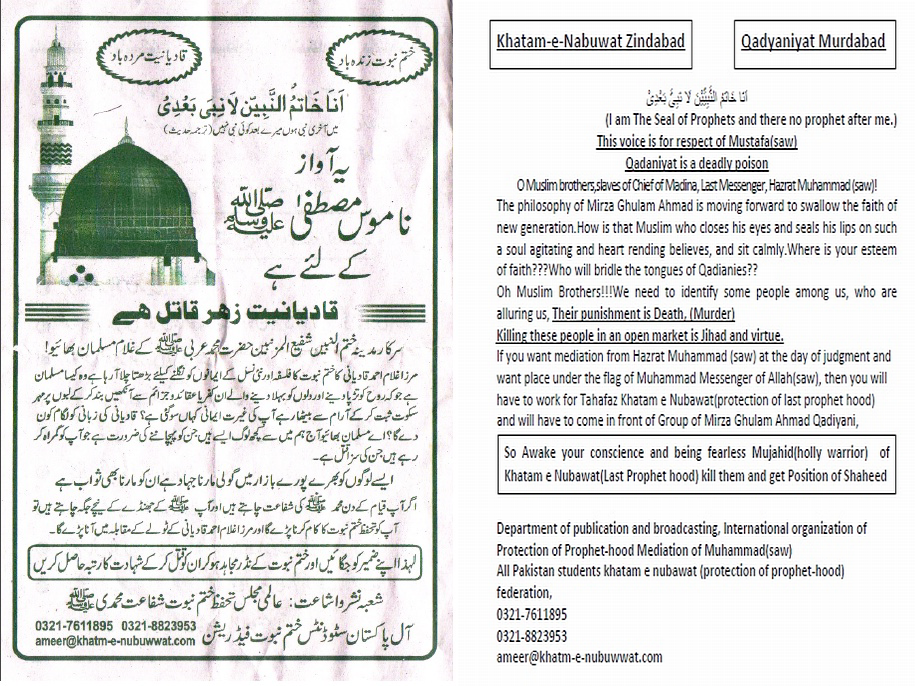
LAHORE: Thousands of Ahmedis of Chenab Nagar (formerly Rabwah) are living in a curfew-like situation while awaiting another disaster, as extremists keep pressurising them by running “hate campaigns” through anti-Ahmedi conferences, distribution of provocative material and inviting participants from terror-ridden areas like Waziristan, in their events.

The over 66,000 people living in this small town have been subjected to persecution and deadly attacks since the 1970s when the then parliament of former premier Zulfikar Ali Bhutto initiated a move to declare them non-Muslims.

However, the situation worsened after the killing of over 85 Ahmedis in a terrorist attack on their worship places on May 28 in Lahore this year. Community representatives in the area told Daily Times that extremist clerics were boosting their hate campaign against the community and their insecurity had reached to a record high because the so-called anti- Ahmedi conferences now comprised a large number of participants and seminary students from terror-ridden areas like Waziristan and other parts of Khyber Pakhtunkhwa.

They also added that the strength of these religious seminaries was increasing, as the participants from KP and southern Punjab were promoting extremist religious ideologies they were receiving from these special conferences in Chenab Nagar and its surrounding cities, including Chiniot, Jhang, Faisalabad and Sargodha.

The community members told Daily Times that the extremist seminaries were also purchasing more and more property in the surrounding localities and such a situation had made it very difficult for the Ahmedis to move around, as target killings, violence and persecution were increasing by the day.

“We used to live in harmony and respect with the members of other communities in the surrounding areas, but now it has become very suffocating for us and our children, especially after the recent terrorist attacks on our worship places in Lahore. They (extremists) are allowed by government and local authorities to launch a hate and violence spree against us in broad daylight as posters, stickers and pamphlets against us are being distributed everywhere and there is nobody to stop them,” Usman Ahmed, a resident of Chenab Nagar, stated.

He added that the government was equally responsible for what the Ahmedis were going through across the country, as they had never taken any concrete steps to end this vicious cycle of hatred in the name of religion.

“People from all classes and walks of life are living in Chenab Nagar and are waiting for another bolt from the blue after the terrorist attacks in Lahore because the hatred against us is in full swing and at the worst degree right under the nose of the authorities,” he said.

The residents also said that the teachers in schools had started singling out Ahmedi students, and a number of potential students were even being denied admissions in various government schools and institutions of the area. They said that 2010 was the most violent and tragic year for Ahmedis in the country as the number of those who had been killed this year was 99.

“This single indicator along with the increasing number of violent cases, presence of so many religious seminaries in the area and the full-throttle hate campaign against us is enough to realise that terrorists wanted to wipe us from the face of the Earth and our government’s silence over the situation is criminal,” Amir, another resident of Chenab Nagar, said.

Residents of the area said that there were several hardliner seminaries in the area but those most actively against the Ahmedis and posed a direct threat to them included Jamia Usmania, Muslim Colony, Madrassa Masjid Khatam-e-Nabuwat, Muslim Colony, Madrassa Jamia Ahrar Kot, Wasawa and Jamia Masjid, Nalka Adda.

However, the chief of Jamia Usmania, Qari Shabbir Usmani, told Daily Times that the allegations levelled against the seminaries, including Jamia Usmania, were “a bunch of lies made up by the Ahmedis”.

He said that they organised conferences only to sensitise people that the Ahmedis were non-Muslims and nobody should consider them a Muslim, adding that they neither distributed any hate material against them nor convinced anybody to kill Ahmedis or use violence against them. Qari Shabbir added that if they were really doing something illegal against the Ahmedis, then they must have faced action by the government or law enforcement agencies by now, and since they had not received any complaints, it proved their (seminaries) point. However, he alleged that the Ahmedis themselves were terrorists and if law enforcement agencies peeped into their colonies, they would find several terrorists and weapons hidden inside the residential areas. He added that Ahmedis were the real enemies of Islam and they were not only conspiring against the state but also blasphemed against the Holy Prophet (PBUH) and his followers. The Punjab government spokesman could not be reached for comment despite repeated attempts.

URL: www.dailytimes.com.pk/default.asp?page=2010\11\25\story_25-11-2010_pg7_25

Tuesday, November 23, 2010

COMMENT: No to blasphemy laws

Daily Times, Pakistan
Tuesday,
November 23, 2010

COMMENT: No to blasphemy laws — Marvi Sirmed

Marvi SirmedOne is amazed at the audacity of the advocates of blasphemy laws, who think of themselves as vigilant guards of not only the Almighty, but religious personages as well, thereby creating an illusion that God and the Prophet (PBUH) might not be able to deal with the blasphemer

It is nothing much, just one more conviction under the Blasphemy Law of Pakistan. This time, it is a woman. Aasia Bibi gets her fate written by an Additional Sessions Court in Nankana Sahib, District Sheikhupura. We have, it seems, successfully saved the honour of Prophet Mohammad (PBUH).

A simplistic, popular argument in favour of the faulty black laws of blasphemy has been that, as committed Muslims, we cannot let blasphemers get off scot-free. And since the law of the land asks for capital punishment for the crime of blasphemy, it is obligatory to pursue such cases with public vigilance. To an ordinary thinking mind, this increasing insecurity about the honour of Islam, the Holy Prophet (PBUH) and Holy Quran looks ridiculously misplaced. Ever since the blasphemy laws were promulgated in the Indo-Pak subcontinent, they seem to have instigated violence against religious minorities.

Blasphemy accusations were regularly levelled against the Sufi mystics before and during Mughal India. In most of these cases, orthodox schools of religious thought used blasphemy as a pretext for settling other scores. One can see it in the case of Sufi saint Sarmad Shaheed who was beheaded by Aurangzeb, Baba Bulleh Shah who was thrown out of his native Kasur on charges of blasphemy, and even Rahman Baba who was accused of being an atheist and had to defend the conspiracies to oust him from his village, Hazar Khwani, in Mohmand district of the then Peshawar province.

It, however, remained largely an activity of the royal courts to invoke blasphemy against Sufis or political opponents. The scourge of popular vigilantism entered Indian society after the 1860s Blasphemy Law inclusion in the India penal code. There was no looking back after this, especially after Pakistan came into being. The first major case of blasphemy that got public attention and a permanent imprint on the Muslim mind was that of Ilam Din (called Ghazi and Shaheed simultaneously). Ilam Din, as the legend goes, was an ordinary Muslim son of a carpenter and irregular mosque-goer. It was the oratory of the clerics Maulana Ahmed Saeed Dehlvi and Amir-e-Shariat in a protest meeting against the publication of a profane book against Prophet Mohammad (PBUH) that instigated the carpenter’s son to get up, hold up the dagger and stab the publisher to death. This act of murder without any conviction by a court of law (the matter was still sub judice) was hailed by all and sundry, including the entire range of Muslim political leaders. Ilam Din is still revered for this “valour”, “act of piety for sheer love of Prophet Mohammad (PBUH)” and for being “a matchless warrior”, as Dr Sir Allama Iqbal was quoted as saying at Ilam Din’s funeral in the Encyclopaedia of World Muslims.

After Pakistan came into being, we had to rely on the excessive use of Islamic symbolism to justify our existence as a separate entity from parent India, and to avoid a further breakdown through the generous provision of religious adhesive to an otherwise multi-ethnic, multi-cultural federation. The Islamisation of laws was an easy tool to adopt that outlook. It was no later than the early 1950s that pogroms against the Hindu population started in Khulna and other parts of East Pakistan, but also the fierce attacks on Ahmedis and Christians in West Pakistan. The existing Blasphemy Law provided an easy solution for pushing minorities against the wall. What is most troublesome is that even in those days popular vigilantism was allowed to let go unchecked, rather it was patronised.

Aasia Bibi’s case is not the only shame Pakistan has had to suffer; we have many such cases to our credit, especially after 1992 when 295-C was further amended to make death the obligatory blasphemy sentence. A cursory look at the data amply shows a sudden surge in blasphemy cases post-1992.

Section 295 of the Pakistan penal code prohibits “injuring or defiling a place of worship with intent to insult the religion of any class”. Section 295-A forbids “deliberate and malicious acts intended to outrage the religious feelings of any class by insulting its religion or religious beliefs”. Section 295-B puts a bar on “defiling, etc, of the Holy Quran”. Section 295-C forbids the “use of derogatory remarks, etc, in respect of the Holy Prophet (PBUH)”. There is an additional Section 298 that forbids “uttering words, etc, with deliberate intent to wound religious feelings”. Three more sections, Section 298-A (use of derogatory remarks, etc, in respect of holy personages), 298-B (misuse of epithets, descriptions and titles, etc, reserved for certain holy personages or places) and Section 298-C (person of the Ahmedi group, etc, calling himself a Muslim or preaching or propagating his faith) make a further mockery of every principle of justice and equality in a modern state.

The basic problem with these sections is that none of them qualifies and determines the variables like “deliberate” and “malicious” attempts of profanity/defamation. In the backdrop of this ambiguity, the absolute unwanted character of these legislative provisions has not only suppressed the religious minorities manifold, but also given rise to uncontrollable public vigilantism and violence in society.

According to a recent report by the National Commission for Justice and Peace (NCJP), a total of 964 people had been charged under the Blasphemy Law in Pakistan from 1986 to 2009. Out of these, NCJP says, 479 were Muslims, 340 Ahmedis, 119 Christians, 14 Hindus, and 10 others. It may be noted that none of the blasphemy convicts have been executed so far, but 32 people charged with blasphemy have been extra-judicially killed. No serious enquiry into their murders has yet been seen. Many of these murders have either been committed in the custody of police or in front of authorities. But powerful religious groups manage to go scot-free in every murder, thereby strengthening the view that the life of minority citizens has no value and depends on their conduct under sheer suppression by a furious majority.

One is amazed at the audacity of the advocates of blasphemy laws, who think of themselves as vigilant guards of not only the Almighty, but religious personages as well, thereby creating an illusion that God and the Prophet (PBUH) might not be able to deal with the blasphemer and would need the help of Tehrik-e-Khatam-e-Nabuwat and the like. In my view, they themselves are the biggest blasphemers.

It needs to be strongly voiced in every public sphere today that Pakistan, with a majority Muslim population, does not need blasphemy laws. The presence of these laws hints at Muslim insecurity as well of lack of confidence in our own selves. Let us not make laws for the already powerful majority. A blasphemy law without a strong blasphemy libel law is merely a tool of suppression. It is not 295-C that is the problem, it is the way we have written our statute and the way we are shaping our worldview that has become the problem. Root it out before it roots us out. Pakistan cannot afford any more shame.

The writer is a rights activist and independent blogger. She can be reached at marvi@marvisirmed.com

Monday, November 22, 2010

VIEW: Blasphemy Law

Daily Times, Pakistan
Monday,
November 22, 2010

VIEW: Blasphemy Law — Yasser Latif Hamdani

Yasser Latif HamdaniNothing will cripple the terrorists more decisively than a tolerant, moderate and democratic Pakistan that respects human rights and treats all its citizens equally. No victory would be permanent if such a Pakistan is not achieved

Arundhati Roy committed blasphemy of another kind when she asked the Americans to reconsider their alliance with India without resolving the Kashmir issue in accordance with the wishes of the Kashmiri people. Earlier she had upset many Indians when she claimed that Kashmir was not an integral part of India, a statement that had every gung-ho Indian, those Oscar Wilde’s vicious patriots and there are about a billion of them, baying for her blood, proving that India is and will remain an intolerant society for some time to come.

Well, taking inspiration from her, Pakistanis should also ask President Obama why his government continues to aid a government and a country that continues to trample on the rights of its own people. No I am not talking about India. I am talking about Pakistan, where the state continues to persecute religious minorities by using a law that cannot be justified on any grounds, whether democracy or Islam. In my previous article I briefly touched on the issue of the Blasphemy Law and the verdict against the Christian woman, a mother of five, who was beaten up and then handed over to the police. It is likely that she will get a presidential pardon. That however is not enough. In the process Pakistan has been humiliated for the umpteenth time simply because we want to appease the mullahs as we have done so consistently since 1949, who in any event have declared a war on Pakistan. I had predicted this much in my article.

So when Obama says “we will act if Pakistan is unwilling or unable to act”, he should walk the walk as well. Nothing will cripple the terrorists more decisively than a tolerant, moderate and democratic Pakistan that respects human rights and treats all its citizens equally. No victory would be permanent if such a Pakistan is not achieved. President Obama, the US, the IMF, the World Bank and the entire western world should immediately stop assisting Pakistan in every field from humanitarian aid to military aid till Pakistan puts its house in order. Being a signatory and having ratified the International Convention on Political and Civil Rights, Pakistan is bound by international law and its own constitution to provide all its citizens the right to life and liberty and religious belief unconditionally.

I do not favour arguments referring to religious interpretation, but our Blasphemy Law is untenable even from an Islamic angle. There is nothing in the Holy Quran or even the Hadith that definitively prescribes such a Blasphemy Law. On the contrary we have a clear example set by the Holy Prophet (PBUH) when he forgave his worst enemies and offenders like Hinda. Almost everyone knows the story of the old woman who would throw garbage daily on the path that the Holy Prophet (PBUH) took. When she fell ill, the Holy Prophet (PBUH) went to visit her and nursed her back to health. Less known is the story of another old woman who the Holy Prophet (PBUH) helped by carrying wood to her house. Along the way, not knowing the identity of her helper, she began to speak about the “trouble maker” of Makkah. It was only after their journey was at an end that the Holy Prophet (PBUH) told her that he was the same Muhammad (PBUH) she had spent the greater part of the journey abusing. This was the Holy Prophet’s (PBUH) character. This is why he is referred to as Rahmatul-lil-Alameen or the mercy for all worlds.

Islamic law and jurisprudence is derived from four sources, known as the Usul-ul-Fiqh (fundamentals of the law), i.e. the Holy Quran, the Sunnah, Qiyas (analogy) and Ijma (consensus). The Holy Quran is silent on the issue of blasphemy. The Sunnah of the Holy Prophet (PBUH) seems to suggest the exact opposite. By using Qiyas, one can only conclude that the Blasphemy Law is patently un-Islamic and there is no Ijmah or consensus amongst the scholars of Islam on the punishment of blasphemy.

Islamic civilisation has a rich history of not only tolerating but even celebrating dissent. Needless to say some of the greatest scientists in Islamic history, Al Razi, the father of medicine, and Avicenna, would have been lynched many times over had Islam actually favoured a Blasphemy Law as is currently on the statute books of Pakistan. I am told that our local textbooks on science all have a chapter on the achievements of Muslim scientists and the contribution of Islamic civilisation to science and enlightenment of humanity. It is forgotten that this was achieved by a culture of tolerance, acceptance and openness. In my last column, I quoted the founder of this nation as stating as clearly as possible that bona fide criticisms and investigations into religion must be protected and safeguarded from any Blasphemy Law. So must be the fundamental rights of life, liberty and religious belief.

A nation is its laws ultimately. The intolerance permeating down to every segment of our society is the direct result of the laws that evade common sense and logic. It is therefore time to repeal the Blasphemy Law.

The writer is a lawyer. He also blogs at http://pakteahouse.wordpress.com and can be reached at yasser.hamdani@gmail.com

 
^ Top of Page