 | Wednesday, December 01, 2010 |
COMMENT: No minority rights in Pakistan — Shahid Saeed
We live in such an ideologically insecure country hell-bent on maintaining our brand as an Islamic Republic that we undercount and under-report the percentage of minorities in our census. There is a barrier the size of the Great Wall of China that prevents minorities from becoming successful citizens in Pakistan
Amidst the outrage over the sentencing to death of Aasia Bibi, a 45-year old mother of five, over charges of blasphemy that seem difficult to prove and have triggered a debate on the blasphemy law itself, what has been conveniently ignored is the fact that the said incident occurred after people refused to drink water brought by Aasia Bibi, considering it to be napaak (impure). Ironically, it is socially acceptable that people belonging to the poor Christian community are treated despicably, considered unhygienic, called names such as choora (sewer cleaner), regardless of their actual profession. The accusers who refused to drink water brought by Aasia Bibi were somehow acting within religious guidelines. I would like to ask them whether they would act in the same manner if Aasia Bibi and her likes were to be replaced by white Caucasian Christian women. I am pretty positive that there would be no qualms in accepting that glass of water or food touched by Christians who are not chooras. Clearly, then, it is not a matter of religion but socio-economic status that makes people discriminate in such an outrageous and horrific manner in the name of religion.
A few years ago, the Capital Development Authority (CDA) had put up a banner on the Islamabad Expressway inviting the Christian biradari (community) to apply for janitorial jobs vacant at the CDA. Historically, Christians from poor backgrounds have served as janitors and cleaners, and many continue to do so whilst fighting social injustice, but for a government department to declare janitorial jobs solely reserved for Christians is disgusting. Our society tolerates, accepts and practises shameful, abominable and repulsive behaviour every day, all in the name of religion. My head hangs in shame.
We live in a country where, for a long time, elections were carried out under religious apartheid as minorities were denied their right to universal franchise by forcing separate electorates on them. The freedom to profess religion guaranteed by Article 20 of the constitution has been meaningless in the light of the legal and social discrimination against minorities. Article 20 grants people of all faiths freedom to “profess, practice and propagate” their religion, but the Second Amendment and Ordinance XX prohibit the Ahmedis from practising their religion openly and denies them the right to call themselves Muslims by categorising their faith for them. We guarantee them freedom of religion, only as long as the majority can feel secure by calling itself the constitutional Muslims and prohibiting the Ahmedis from nearly everything that they believe in, including the right to name their small town of Rabwah, as it has been rechristened Chenab Nagar. The insecurity of the majority sects has been written down in the Second Amendment and Ordinance XX and continues with constant court cases against the Ahmedis.
The fact is there are no minority rights in Pakistan. Minority members of parliament have to begin their speeches by first praising Islam and the government of Pakistan for guaranteeing them whatever limited rights they have, and still they are looked down upon by the ulema (sitting mostly on the treasury desks). It is as if we are doing a favour to them by extending basic humanitarian rights. The Hindu community has faced constant harassment and the number of forced conversions in Sindh has been on a constant rise. The Christian community faces social barriers of enormous proportions and has been the target of innumerable terrorist attacks too. Starting from partition when the Sikh and Hindu populations were killed in massive numbers, minority faiths have suffered immensely. The anti-Ahmedi agitation of 1953 started the wave of mass harassment and persecution that continues to this day. Temples have been razed, churches have been burnt and poor people lynched and killed in the name of religion.
From Shantinagar to Gojra, the history of this land is full of the murder of minorities at the hands of the self-proclaimed righteous guardians of religious boundaries. In a country where sectarian terrorism consumed thousands of lives and minorities have been forced to live in fear, Article 20 is nothing but hollow words.
We live in such an ideologically insecure country hell-bent on maintaining our brand as an Islamic Republic that we undercount and under-report the percentage of minorities in our census. There is a barrier the size of the Great Wall of China that prevents minorities from becoming successful citizens in Pakistan. The wall has been raised by legal and social measures that persecute them and discriminate against them. The majority Muslim population, hijacked by a significant number of hardline religious leaders and their followers, has made life for the minorities a living hell. They use mosque loudspeakers for telling them that they will inevitably go to hell in their afterlife.
With the passage of the Objectives Resolution, the fate of minorities in this country was sealed forever and the dream of the state envisaged in Jinnah’s August 11, 1947 speech had died. The report of the Court of Inquiry constituted under the Punjab Act II of 1954 to enquire into the Punjab Disturbances of 1953, commonly known as the Justice Munir report, had then answered some valid questions about the role of religion in the state. The ulema — disunited as they are on a million issues and unable to come to a single definition of a Muslim — were then nearly united, and still are, on how to treat minorities: they shall be zimmies and “will have no say in the making of law and no right to administer the law” and would not be allowed to propagate their religion. Summarising, the good Justices Munir and MR Kayani wrote: “It is this lack of bold and clear thinking, the inability to understand and take decisions which has brought about in Pakistan a confusion which will persist and repeatedly create situations of the kind we have been inquiring into until our leaders have a clear conception of the goal and of the means to reach it…The sublime faith called Islam will live even if our leaders are not there to enforce it. It lives in the individual, in his soul and outlook, in all his relations with God and men, from the cradle to the grave, and our politicians should understand that if Divine commands cannot make or keep a man a Musalman, their statutes will not.”
These words have proven to be prophetic and stand so apt for today, albeit with the caveat that we no longer have liberal judges who did not think secularism was a bogeyman. The 11-year rule of ‘Islamisation’ has changed our attitudes, ideologies and beliefs immensely, and now we teach our children lies that never were a part of our history. We are confused about the very ideology behind the creation of this country, what it was meant to be, what it has become and what it should be. The confusion persists, but with laws that demand a blind Safia Bibi to produce four witnesses to support her claim of rape, laws that allow honour killings to take place through forgiveness granted under diyat and laws that sentence people to death over fake blasphemy charges, we have arrived at a point where it is clear that theocracy has failed us. Only a secular, progressive and democratic Pakistan can guarantee social progress for the people of this country. Rest assured, the future looks bleak if things are to continue the way they are now.
The writer is interested in history and public policy. He can be reached at shahid@live.com.pk
Amidst the outrage over the sentencing to death of Aasia Bibi, a 45-year old mother of five, over charges of blasphemy that seem difficult to prove and have triggered a debate on the blasphemy law itself, what has been conveniently ignored is the fact that the said incident occurred after people refused to drink water brought by Aasia Bibi, considering it to be napaak (impure). Ironically, it is socially acceptable that people belonging to the poor Christian community are treated despicably, considered unhygienic, called names such as choora (sewer cleaner), regardless of their actual profession. The accusers who refused to drink water brought by Aasia Bibi were somehow acting within religious guidelines. I would like to ask them whether they would act in the same manner if Aasia Bibi and her likes were to be replaced by white Caucasian Christian women. I am pretty positive that there would be no qualms in accepting that glass of water or food touched by Christians who are not chooras. Clearly, then, it is not a matter of religion but socio-economic status that makes people discriminate in such an outrageous and horrific manner in the name of religion.
A few years ago, the Capital Development Authority (CDA) had put up a banner on the Islamabad Expressway inviting the Christian biradari (community) to apply for janitorial jobs vacant at the CDA. Historically, Christians from poor backgrounds have served as janitors and cleaners, and many continue to do so whilst fighting social injustice, but for a government department to declare janitorial jobs solely reserved for Christians is disgusting. Our society tolerates, accepts and practises shameful, abominable and repulsive behaviour every day, all in the name of religion. My head hangs in shame.
We live in a country where, for a long time, elections were carried out under religious apartheid as minorities were denied their right to universal franchise by forcing separate electorates on them. The freedom to profess religion guaranteed by Article 20 of the constitution has been meaningless in the light of the legal and social discrimination against minorities. Article 20 grants people of all faiths freedom to “profess, practice and propagate” their religion, but the Second Amendment and Ordinance XX prohibit the Ahmedis from practising their religion openly and denies them the right to call themselves Muslims by categorising their faith for them. We guarantee them freedom of religion, only as long as the majority can feel secure by calling itself the constitutional Muslims and prohibiting the Ahmedis from nearly everything that they believe in, including the right to name their small town of Rabwah, as it has been rechristened Chenab Nagar. The insecurity of the majority sects has been written down in the Second Amendment and Ordinance XX and continues with constant court cases against the Ahmedis.
The fact is there are no minority rights in Pakistan. Minority members of parliament have to begin their speeches by first praising Islam and the government of Pakistan for guaranteeing them whatever limited rights they have, and still they are looked down upon by the ulema (sitting mostly on the treasury desks). It is as if we are doing a favour to them by extending basic humanitarian rights. The Hindu community has faced constant harassment and the number of forced conversions in Sindh has been on a constant rise. The Christian community faces social barriers of enormous proportions and has been the target of innumerable terrorist attacks too. Starting from partition when the Sikh and Hindu populations were killed in massive numbers, minority faiths have suffered immensely. The anti-Ahmedi agitation of 1953 started the wave of mass harassment and persecution that continues to this day. Temples have been razed, churches have been burnt and poor people lynched and killed in the name of religion.
From Shantinagar to Gojra, the history of this land is full of the murder of minorities at the hands of the self-proclaimed righteous guardians of religious boundaries. In a country where sectarian terrorism consumed thousands of lives and minorities have been forced to live in fear, Article 20 is nothing but hollow words.
We live in such an ideologically insecure country hell-bent on maintaining our brand as an Islamic Republic that we undercount and under-report the percentage of minorities in our census. There is a barrier the size of the Great Wall of China that prevents minorities from becoming successful citizens in Pakistan. The wall has been raised by legal and social measures that persecute them and discriminate against them. The majority Muslim population, hijacked by a significant number of hardline religious leaders and their followers, has made life for the minorities a living hell. They use mosque loudspeakers for telling them that they will inevitably go to hell in their afterlife.
With the passage of the Objectives Resolution, the fate of minorities in this country was sealed forever and the dream of the state envisaged in Jinnah’s August 11, 1947 speech had died. The report of the Court of Inquiry constituted under the Punjab Act II of 1954 to enquire into the Punjab Disturbances of 1953, commonly known as the Justice Munir report, had then answered some valid questions about the role of religion in the state. The ulema — disunited as they are on a million issues and unable to come to a single definition of a Muslim — were then nearly united, and still are, on how to treat minorities: they shall be zimmies and “will have no say in the making of law and no right to administer the law” and would not be allowed to propagate their religion. Summarising, the good Justices Munir and MR Kayani wrote: “It is this lack of bold and clear thinking, the inability to understand and take decisions which has brought about in Pakistan a confusion which will persist and repeatedly create situations of the kind we have been inquiring into until our leaders have a clear conception of the goal and of the means to reach it…The sublime faith called Islam will live even if our leaders are not there to enforce it. It lives in the individual, in his soul and outlook, in all his relations with God and men, from the cradle to the grave, and our politicians should understand that if Divine commands cannot make or keep a man a Musalman, their statutes will not.”
These words have proven to be prophetic and stand so apt for today, albeit with the caveat that we no longer have liberal judges who did not think secularism was a bogeyman. The 11-year rule of ‘Islamisation’ has changed our attitudes, ideologies and beliefs immensely, and now we teach our children lies that never were a part of our history. We are confused about the very ideology behind the creation of this country, what it was meant to be, what it has become and what it should be. The confusion persists, but with laws that demand a blind Safia Bibi to produce four witnesses to support her claim of rape, laws that allow honour killings to take place through forgiveness granted under diyat and laws that sentence people to death over fake blasphemy charges, we have arrived at a point where it is clear that theocracy has failed us. Only a secular, progressive and democratic Pakistan can guarantee social progress for the people of this country. Rest assured, the future looks bleak if things are to continue the way they are now.
The writer is interested in history and public policy. He can be reached at shahid@live.com.pk

 A cursory view of the whole debate about the Blasphemy Law shows that there are many saner and more intellectually sound Muslims who do not support the existing draconian law. Except for a small extremist coterie of bigots, many politicians are all for removing Section 295-B and C
 Jinnah’s record as a legislator tells us a different story altogether. He was an indefatigable defender of civil liberties. He stood for Bhagat Singh’s freedom and condemned the British government in the harshest language when no one else would
 By Afnan Khan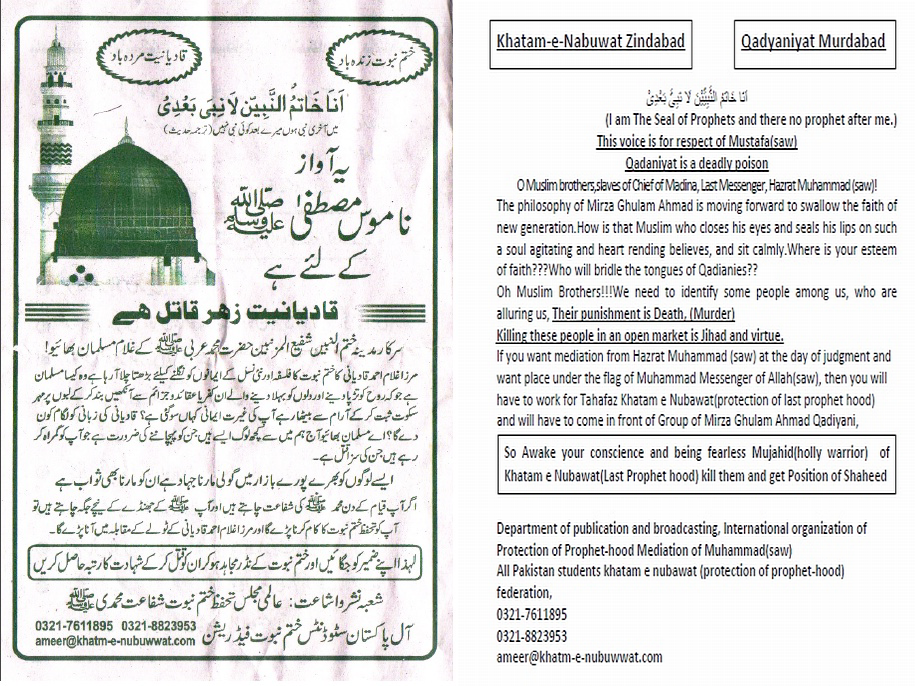




 Posts
Posts


