 | Tuesday, November 30, 2010 |
ROVER’S DIARY: Much ado about blasphemy — Babar Ayaz
 A cursory view of the whole debate about the Blasphemy Law shows that there are many saner and more intellectually sound Muslims who do not support the existing draconian law. Except for a small extremist coterie of bigots, many politicians are all for removing Section 295-B and C
Way back on March 6, 1927, Bertrand Russell delivered a lecture to the National Secular Society, South London Branch, at Battersea Town Hall. It was subsequently published in pamphlet form that same year. This essay achieved fame when Paul Edward published a compilation of Russell’s essays on religion, titled Why I Am Not a Christian and Other Essays. In his lecture, he talked about his agnostic views about God and questioned certain Christian values.
The blasphemy and blasphemous libel laws were part of the British common law at that time. The laws had existed since the 17th century and were punishable by the common law courts. This law was not invoked against Russell by the Church or the British government, although a police case was registered against one rationalist, Harry Boulter, in 1908. He repeated the offence in 1909 and was jailed for six months for speaking against religion.
The last person sent to prison for blasphemy in Britain was John William Gott in December 1921. He had three previous convictions for blasphemy when he was prosecuted for publishing two pamphlets titled Rib Ticklers, or Questions for Parsons and God and Gott. While Russell’s intellectual criticism of Christ and God was tolerated by British society, Gott’s satire of the biblical story of Jesus was found punishable. He was sentenced to nine months hard labour. As he was suffering from some incurable illness, he died shortly after he was released. The case became the subject of public outrage.
There were outbursts by religious lobbies against the subsequent writing and art work, which they considered were blasphemous but the law was not invoked and freedom of expression was respected. The debate about this law gained currency when British author Salman Rushdie’s novel, The Satanic Verses, was published in 1988. Strong reaction against Rushdie in Muslim countries and an Iranian fatwa sanctioning that he should be killed “stimulated debate on this topic”, with some arguing that the same protection should be extended to all religions, while others claimed the UK’s ancient blasphemy laws were an anachronism and should be abolished. Despite much discussion surrounding the controversy, the law was not amended. The law was however abolished in 2008. The lobbying for the abolition was done by the National Secular Society and was signed by leading figures including Lord Carey, former Archbishop of Canterbury, who urged that the laws be abandoned.
In 2006, a Dalit intellectual Kancha Ilaiah, who is Head of the Political Science Department of Osmania University in Hyderabad (India) wrote Why I am not Hindu. He wrote with “passionate anger, laced with sarcasm on the caste system and Indian society”. The book criticises the Hindu gods and goddesses and provides socio-economic context to the Dalitbhujan gods and goddesses. There was indeed a strong reaction against the book from extremist Hindu organisations, but it was supported by many Hindu intellectuals and civil society activists. As Hinduism does not have the concept of blasphemy, such laws are absent in their tradition. Today, Section 295-A of the Indian Penal Code punishes “hate speech, insults or attempts to insult the religion or the religious beliefs of any citizen with deliberate and malicious intention of outraging religious feelings.” The law is not religion-specific.
There is enough literature written by Jews against Judaism. The Jewish right has always condemned such moves but has not been able to get them tried under any law. More recently, David Dvorkin published his paper Why I am not a Jew in the US. Nobody demanded that he should be tried and no attempt on his life was made. In any case, he could not have been tried in the US because freedom of expression is an inalienable right of the people under the First Amendment.
However, in 1995, a book was published in the US, Why I am not a Muslim. The writer used a pen name, Ibn Warraq, fearing the strong reaction from Muslim extremists. The question thus arises is why, in our Muslim society, is free thinking not challenged by rational argument by the Muslim theologists? Why do we need one of the most extensive and repressive blasphemy laws?
A cursory view of the whole debate about the Blasphemy Law shows that there are many saner and more intellectually sound Muslims who do not support the existing draconian law. Except for a small extremist coterie of bigots, many politicians are all for removing Section 295-B and C. To my pleasant surprise, even Rana Sanaullah, who is generally considered to be a fundamentalist, agreed to change in the law on a TV talk show recently.
Gutsy MNA Sherry Rehman is moving a bill in the National Assembly suggesting some changes in the Blasphemy Law. Her approach is pragmatic as she is of the view that the bill, demanding the abolition of the law, would not be possible at this juncture. Several sections of Pakistan’s Criminal Code comprise blasphemy laws. Section 295 forbids damaging or defiling a place of worship or a sacred object. Section 295-A forbids outraging religious feelings. Section 295-B forbids defiling the Quran. Section 295-C forbids defaming Prophet Mohammad (PBUH). Except for Section 295-C, the provisions of 295 require that an offence be a consequence of the accused person’s intent. Defiling the Quran merits imprisonment for life. Defaming Prophet Mohammad (PBUH) merits death with or without a fine.
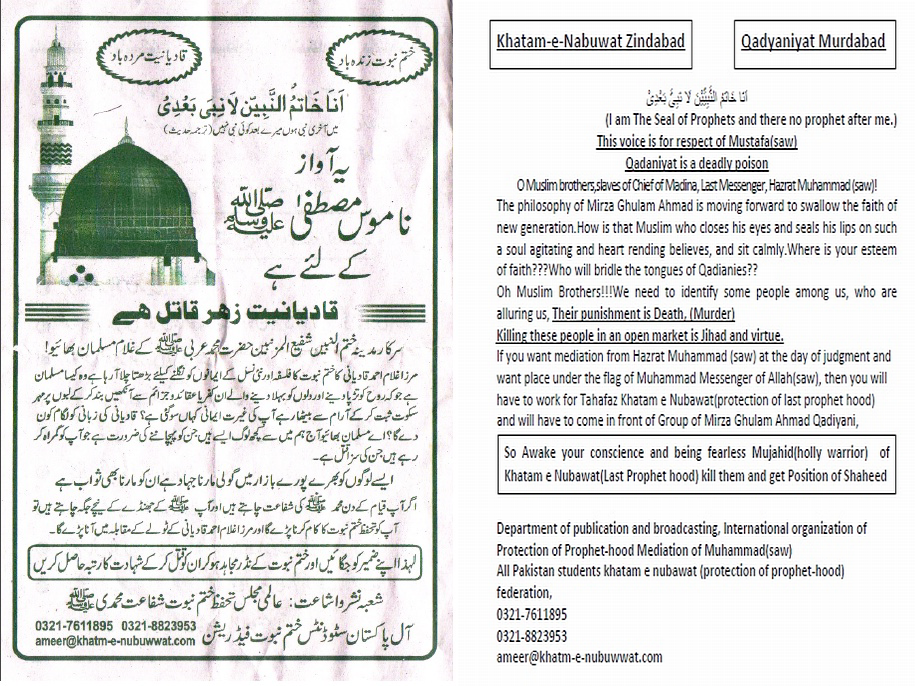
The issue is that even according to Islamic history and tradition, the Prophet (PBUH) himself did not give the death sentence to anybody who opposed and even harmed him. Then are these bigots, who have endorsed section 295-C, justified to fight for it? These additions were made in Section 295 by General Ziaul Haq without any parliamentary sanction and thus should be deleted. Sherry’s proposed change is too soft because the courts are intimidated by Islamic extremists to give a verdict against the accused on technical grounds, as it did in the Aasia Bibi case.
Islamic teachings clearly say that Muslims should respect other people’s religions and should not hurt their feelings. This principle is precisely enunciated in 295-A, so the matter should rest there (unfortunately, all those Muslim invaders who destroyed temples and churches are revered in our Islamic history). So the problem is much more deep-rooted than the laws alone; there are psychological, historical, social and political reasons for the Muslims to be over-sensitive about the blasphemy issue. And, in this society where freedom of expression is limited, any intellectual discourse about these factors is risky.
The writer can be reached at ayazbabar@gmail.com





 Posts
Posts


