Showing posts with label religious tyranny. Show all posts

Wednesday, January 5, 2011

The End of Jinnah’s Pakistan

   Wednesday, January 5, 2011
Wall Street Journal, USA
The End of Jinnah’s Pakistan
Governor Salmaan Taseer's murder raises questions about the future of Pakistan’s Western-educated elites.

By SADANAND DHUME

Every time you think things can’t possibly get worse in Pakistan, along comes something to prove you wrong. On Tuesday, in possibly the country’s most consequential political shock since the 2007 murder of former Prime Minister Benazir Bhutto, Salmaan Taseer, the 65-year-old governor of Punjab province, was gunned down in an upscale Islamabad market by one of his police bodyguards. The reason: the governor’s plain-spoken defense of Asia Bibi, an illiterate Christian woman sentenced to death under Pakistan’s harsh blasphemy laws. According to press reports, Taseer’s killer pumped nine bullets into him for daring to call the blasphemy provision a “black law.”

Muhammad Ali Jinnah, far right, at the 1947 partition conference.
Needless to say, Taseer was right. Pakistan’s blasphemy laws belong more in a chronicle of medieval horrors than in a modern society, let alone one that receives billions of dollars in Western largesse. Since the mid-1980s, blasphemy—including criticizing the prophet Mohammed—has carried a mandatory death sentence. Amnesty International calls the laws “vaguely formulated and arbitrarily enforced” and “typically employed to harass and persecute religious minorities.” Over the past quarter century, at least 30 people have been lynched by mobs after being accused of blasphemy. Many others have been forced to flee the country. Though Christians make up less than 2% of Pakistan’s population, they account for about half the country’s blasphemy cases.

In a larger sense, however, the significance of Taseer’s murder lies in what it says about the future of nuclear-armed Pakistan. Carved out of the Muslim-majority provinces of British India in 1947, the country has long struggled to reconcile two competing visions of its reason for being. Is Pakistan, as imagined by its founder, Muhammad Ali Jinnah—a London-trained barrister with a fondness for pork sandwiches and two-toned spats—merely a homeland for the subcontinent’s Muslims? Or was it created to echo the far more ambitious formulation of Abul Ala Maududi, the radical Islamist ideologue born roughly a generation after Jinnah: for the enforcement of Islamic Shariah law upon every aspect of society and the state?

Taseer broadly belonged to Jinnah’s Pakistan. He was educated as a chartered accountant in England, founded a successful telecom company, and published the country’s leading liberal newspaper in English. (Though, as the son of a famous Urdu poet, Taseer was perhaps more culturally authentic than his nation’s founder.) By contrast, Taseer’s killer, a 26-year-old named Mumtaz Qadri, symbolizes Maududi’s vision. In photographs, he’s bearded and moustache-less, in the manner prescribed by fundamentalist Islam. That Mr. Qadri could defy South Asia’s usually rigid codes of hierarchy by murdering someone far above his station jibes with the contempt radical Islamists often feel for traditional elites. According to press reports, Mr. Qadri showed no remorse for the murder.

The murder highlights anew the way in which Pakistan’s English-speaking classes resemble a small island of urbanity surrounded by a rising tide of fundamentalist zeal. They have only themselves to blame for their predicament. From independence onward, successive governments—military and civilian alike—have ridden the tiger of fundamentalism out of political expediency, misplaced piety or geopolitical ambition. A statistic from Zahid Hussain’s “Frontline Pakistan” is telling: When Pakistan gained independence in 1947 it housed 137 madrassas. That number has since swelled to about 13,000, between 10% and 15% of which are linked to sectarian militancy (Sunni versus Shia) or terrorism.

For many analysts, Pakistan’s slide began during the prime ministership of Zulfiqar Ali Bhutto, the debonair, Scotch-swilling feudal from Sindh first elected in 1970. Believing that he could co-opt the then small fundamentalist lobby, Bhutto banned alcohol and gambling and shuttered night clubs. He replaced the traditional Sunday holiday with Friday and declared the tiny heterodox Ahmadiyya sect to be non-Muslim. Bhutto promoted the pious and ultimately treacherous Zia ul-Haq to head the army.

After Zia seized power in a coup in 1977, the Islamization of Pakistan took off in earnest. The general set up Shariah courts, began government collection of zakat (an Islamic alms tax), denuded libraries of books deemed un-Islamic, and mandated compulsory prayer for civil servants and marks in their personnel files for piety. In the 1980s, army officers were instructed to read “The Quranic Concept of War,” a book by a zealous officer, Brigadier General S.K. Malik, which argues that “terror struck in the hearts of the enemies is not only a means, it is the end in itself.” Many of these officers subsequently rotated through the notorious Inter-Services Intelligence whose links to violent fundamentalist groups fighting NATO troops in Afghanistan and India in Kashmir are widely regarded as too deep to sever entirely.

Since the terrorist attacks of 9/11, the U.S. has worked hard to stem the rising tide of fundamentalism in Pakistan. First it backed the military strongman Gen. Pervez Musharraf. When he failed to deliver, policy makers in Washington held out hope that a democratically elected government, armed with greater legitimacy, would fight a better fight. But so far—despite co-operating with stepped-up U.S. drone strikes against militants in the country’s remoter reaches—the regime of President Asif Ali Zardari and Prime Minister Yousaf Raza Gillani has hardly succeeded in stemming the tide of fundamentalist anger in either Pakistan or Afghanistan.

Perhaps Governor Taseer’s murder will lead the country’s squabbling politicians and scheming generals to come together in a renewed bid to save Jinnah’s country from Maududi’s vision. Perhaps Pakistani society will be outraged enough to act against the thousands of madrassas that poison the country daily. But if the past is any guide to the future, it may not be a good idea to hold your breath. Jinnah, it can safely be assumed, is spinning in his grave.

Mr. Dhume is a columnist for WSJ.com and a resident fellow at the American Enterprise Institute in Washington, DC.

URL: http://online.wsj.com/article/SB10001424052748704723104576062961607588454.html

Monday, December 13, 2010

VIEW: Shame on us

Daily Times, Pakistan
Monday,
December 13, 2010

VIEW: Shame on us — Yasser Latif Hamdani

Yasser Latif HamdaniOn the Blasphemy Law, the mullah knows he is on a weak footing both constitutionally and with reference to Islam. He knows that there is no moral sanction in Islam to deprive people of their freedom of thought and expression. He knows that, historically, Islamic civilisation has not only tolerated but protected dissent


After my article ‘Aasia Bibi and due process’ (Daily Times, December 6, 2010) last week, Muhammad Zubair of Business Plus invited me to speak on his show along with Dr Meraj-ul-Huda of the Jamaat-e-Islami on the issue of the Blasphemy Law.

The good doctor waxed eloquent about how those opposing the Blasphemy Law had no faith in the constitution and the courts. However, when I pointed out some of the grounds on which the law, in its current form, was entirely unconstitutional, he dropped nothing less than a bombshell as someone who claims to defend the constitution. The senior Jamaat-e-Islami leader claimed that parliament had no right anymore to amend the Blasphemy Law. This blatant denial of the rights of the elected representatives of Pakistan, rights that according to Jamaat-e-Islami vested in General Ziaul Haq, rubbishes all claims of Jamaat-e-Islami to be a party committed to a democratic polity.

As if that were not enough, Dr Huda proceeded to show me just how far people like him would go in lying through their teeth to prove their point. When I quoted Jinnah’s warning about the misuse of Article 295-A and how it might be used to silence academic freedom and bona fide criticism of religion, he claimed that Jinnah had only said that because there was mention of “Her Majesty” in that clause. Perhaps Dr Huda did not bother to research the issue before proving himself to be the poster boy for foot-in-the-mouth disease. Article 295-A deals strictly with scurrilous remarks about founders of various faiths and not Her Majesty. Article 295-A came out in response to the events in Lahore surrounding the Raj Pal controversy.

That Jamaat-e-Islami has a history of shamelessly distorting history is well known. Its sinister role against Pakistan and the people of Pakistan is also well documented in history. What I cannot believe is that, even after being exposed over and over again, the Meraj-ul-Hudas, the Professor Ghafoors, the Munawar Hasans and the Qazi Hussains still shamelessly appear on television to lie over and over again and that too in the name of Islam. Is there no shame at long last?

The truth is that our mullah — the true enemy of Islam — is now stubbornly standing in the way of the progress of this country towards a civilised and democratic state based on the rule of law. On the Blasphemy Law, the mullah knows he is on a weak footing both constitutionally and with reference to Islam. He knows that there is no moral sanction in Islam to deprive people of their freedom of thought and expression. He knows that, historically, Islamic civilisation has not only tolerated but protected dissent. The greatest Muslim scientists, celebrated far and wide, were committed atheists, many of whom would have also fallen foul of Pakistan’s draconian laws. In Islamic history, no caliphate or Muslim empire has ever instituted legally the death penalty for blasphemy, not even the heartless Aurangzeb. There was no such law under the much mourned Ottoman Empire either. Historically, there are some incidents, few and far between, where people were put to death for claiming to be divine. The chivalrous Salauddin was misled by sectarian fanatics into killing El-Suhrawardy. Before that, Nooruddin Zangi had arrived in Medina and killed two men after accusing them of being Jews and trying to defile, God forbid, the holy mosque.

A state does not legislate, however, on the basis of exception. If Islam is the higher law by which we are to conduct ourselves, we must investigate as to what the general rule in Islam is. One is reminded of an incident soon after the conquest of Egypt by Muslims. Amr bin Aas (RA) was appointed governor of the new province. In a city square where the governor resided was a statue of Jesus Christ held sacred by the Coptic Christians. One night, some Muslim soldier allegedly broke the nose off of the statue and then disappeared. The Copt leaders protested and lodged a complaint with the governor. They demanded, as restitution, the right to build and similarly defile a statue of the Holy Prophet (PBUH). Amr bin Aas (RA) politely told them their request was not possible as the Holy Prophet (PBUH) was the most sacred personage to him but he offered to have his own nose cut off instead as punishment. These were those fine traditions of tolerance and religious harmony, too fine for the philistines as it were, that made Islamic lands centres of excellence, learning and enlightenment while the entire world was in darkness. Today, what we have instead is the picture that our mullah is hell-bent on painting of Islam and of the Holy Prophet (PBUH). The mullah is the worst blasphemer and the biggest enemy of the Holy Prophet (PBUH) today.

Finally, above all else, Islam abhors hypocrisy. What else do you call it then when our clerical class shamelessly applies different standards to different situations? A non-Muslim cannot become the president of Pakistan because he is a non-Muslim but the Blasphemy Law applies to him or her equally. Shame on us.

The writer is a lawyer. He also blogs at http://pakteahouse.net and can be reached at yasser.hamdani@gmail.com

Monday, November 22, 2010

VIEW: Blasphemy Law

Daily Times, Pakistan
Monday,
November 22, 2010

VIEW: Blasphemy Law — Yasser Latif Hamdani

Yasser Latif HamdaniNothing will cripple the terrorists more decisively than a tolerant, moderate and democratic Pakistan that respects human rights and treats all its citizens equally. No victory would be permanent if such a Pakistan is not achieved

Arundhati Roy committed blasphemy of another kind when she asked the Americans to reconsider their alliance with India without resolving the Kashmir issue in accordance with the wishes of the Kashmiri people. Earlier she had upset many Indians when she claimed that Kashmir was not an integral part of India, a statement that had every gung-ho Indian, those Oscar Wilde’s vicious patriots and there are about a billion of them, baying for her blood, proving that India is and will remain an intolerant society for some time to come.

Well, taking inspiration from her, Pakistanis should also ask President Obama why his government continues to aid a government and a country that continues to trample on the rights of its own people. No I am not talking about India. I am talking about Pakistan, where the state continues to persecute religious minorities by using a law that cannot be justified on any grounds, whether democracy or Islam. In my previous article I briefly touched on the issue of the Blasphemy Law and the verdict against the Christian woman, a mother of five, who was beaten up and then handed over to the police. It is likely that she will get a presidential pardon. That however is not enough. In the process Pakistan has been humiliated for the umpteenth time simply because we want to appease the mullahs as we have done so consistently since 1949, who in any event have declared a war on Pakistan. I had predicted this much in my article.

So when Obama says “we will act if Pakistan is unwilling or unable to act”, he should walk the walk as well. Nothing will cripple the terrorists more decisively than a tolerant, moderate and democratic Pakistan that respects human rights and treats all its citizens equally. No victory would be permanent if such a Pakistan is not achieved. President Obama, the US, the IMF, the World Bank and the entire western world should immediately stop assisting Pakistan in every field from humanitarian aid to military aid till Pakistan puts its house in order. Being a signatory and having ratified the International Convention on Political and Civil Rights, Pakistan is bound by international law and its own constitution to provide all its citizens the right to life and liberty and religious belief unconditionally.

I do not favour arguments referring to religious interpretation, but our Blasphemy Law is untenable even from an Islamic angle. There is nothing in the Holy Quran or even the Hadith that definitively prescribes such a Blasphemy Law. On the contrary we have a clear example set by the Holy Prophet (PBUH) when he forgave his worst enemies and offenders like Hinda. Almost everyone knows the story of the old woman who would throw garbage daily on the path that the Holy Prophet (PBUH) took. When she fell ill, the Holy Prophet (PBUH) went to visit her and nursed her back to health. Less known is the story of another old woman who the Holy Prophet (PBUH) helped by carrying wood to her house. Along the way, not knowing the identity of her helper, she began to speak about the “trouble maker” of Makkah. It was only after their journey was at an end that the Holy Prophet (PBUH) told her that he was the same Muhammad (PBUH) she had spent the greater part of the journey abusing. This was the Holy Prophet’s (PBUH) character. This is why he is referred to as Rahmatul-lil-Alameen or the mercy for all worlds.

Islamic law and jurisprudence is derived from four sources, known as the Usul-ul-Fiqh (fundamentals of the law), i.e. the Holy Quran, the Sunnah, Qiyas (analogy) and Ijma (consensus). The Holy Quran is silent on the issue of blasphemy. The Sunnah of the Holy Prophet (PBUH) seems to suggest the exact opposite. By using Qiyas, one can only conclude that the Blasphemy Law is patently un-Islamic and there is no Ijmah or consensus amongst the scholars of Islam on the punishment of blasphemy.

Islamic civilisation has a rich history of not only tolerating but even celebrating dissent. Needless to say some of the greatest scientists in Islamic history, Al Razi, the father of medicine, and Avicenna, would have been lynched many times over had Islam actually favoured a Blasphemy Law as is currently on the statute books of Pakistan. I am told that our local textbooks on science all have a chapter on the achievements of Muslim scientists and the contribution of Islamic civilisation to science and enlightenment of humanity. It is forgotten that this was achieved by a culture of tolerance, acceptance and openness. In my last column, I quoted the founder of this nation as stating as clearly as possible that bona fide criticisms and investigations into religion must be protected and safeguarded from any Blasphemy Law. So must be the fundamental rights of life, liberty and religious belief.

A nation is its laws ultimately. The intolerance permeating down to every segment of our society is the direct result of the laws that evade common sense and logic. It is therefore time to repeal the Blasphemy Law.

The writer is a lawyer. He also blogs at http://pakteahouse.wordpress.com and can be reached at yasser.hamdani@gmail.com

Monday, June 21, 2010

Pakistan’s Medieval Constitution

   Monday, June 21, 2010
Wall Street Journal, USA
Pakistan’s Medieval Constitution
It is the only Muslim nation to explicitly define who is or is not a ‘Muslim.’

By MIRA SETHI

In the early hours of May 28, Khalid Solangi was shaken awake by his wife. She told him that she’d heard news of a bloody attack on two Ahmadi mosques in Pakistan. Khalid’s older brother, an Ahmadi Muslim American, had recently flown to Lahore for a wedding and they feared he was one of the victims. “My wife said to me, ‘Your brother has never missed the Friday prayer.’”

And so Khalid dialed his sister-in-law’s number. She confirmed the worst: Her husband had called from his cellphone minutes earlier, asking her to pray for him and the others trapped inside the mosque. “The next thing we heard was that my brother had been martyred,” said Khalid. “He had gone to Pakistan for a wedding. He didn’t even live there.”

When the dust from the bombs settled and the Taliban gunmen stopped their shooting, nearly 100 innocent Muslims lay dead inside the mosques where they had gathered for Friday prayer. This wasn’t the first act of terror committed against this minority Muslim sect.

Since 1953, when the first anti-Ahmadi riots broke out in newly independent Pakistan, the Ahmadi community has lived under constant threat. In 1974, Pakistan amended its constitution to declare Ahmadis non-Muslims.

Ten years later, among a slew of anti-blasphemy laws—one of them famously known as “Ordinance XX”—the military dictator Zia ul-Haq made it a crime for Ahmadis to call themselves Muslims. They were forbidden from declaring their faith publicly, using the traditional Islamic greeting, and referring to their places of worship as mosques. In short, virtually any public act of worship or devotion by an Ahmadi can be treated as a criminal offense punishable by death.

Unsurprisingly, attacks on the Ahmadi community followed. In 2005 eight Ahmadis were gunned down in a mosque in a small town in Punjab, Pakistan’s most populous province. A year later a mob burned down Ahmadi homes and shops in a small village in the province, forcing more than a 100 Ahmadis to flee.

Last winter, while I was home in Lahore, I drove to a beige building near my house to get my passport renewed. The officer, in a small effort to assist me, made Xs next to the lines that needed my signature. First I signed the badly photocopied sheet, again and again. Then I found myself being asked to confirm that Mirza Ghulam Ahmad—a 19th century Punjabi reformer and founder of the Ahmadi movement—was an “imposter.”

This is standard. Every Pakistani Muslim applying for a passport must sign a statement deriding Ahmad, but I had forgotten about the procedure.

I asked the officer what would happen if I didn’t sign above the line. He looked at me blankly: “You don’t want passport?“

Later that day I went with my friends to a restaurant in Old Lahore—the city’s historic quarter—where cramped alleys lead to centuries-old Mughal mosques, forts and gateways. We ate kebabs and shared a hookah. On our way home, passing Lahore’s busiest road, I saw a banner on a building facing the Lahore High Court: “Jews, Christians and Ahmadis are enemies of Islam.” We passed a patch of grass where a bronze statue of Queen Victoria had once stood. It has been replaced by a tall glass box containing a Quran.

That the Ahmadi movement agrees with every tenet of Islam, save the additional belief that Mirza Ghulam Ahmad came to the Muslim community as a promised messiah, is irrelevant. The legal system has left minorities such as Christians and Hindus, and within Islam, Ahmadis and Shiites, socially and politically isolated.

Routinely, the graffiti along Lahore’s stylish boulevards will proclaim that Shiites are infidels. More than 100 Christian houses were burned in a town in central Pakistan last year over a claim that a Christian had defiled the Quran. That same year, 37 Ahmadis were charged under the blasphemy laws.

Pakistan is the only Muslim nation to explicitly define who is or is not a “Muslim” under its constitution. This serves only one purpose: to embolden groups like the Pakistani Taliban who use the laws as justification to declare Ahmadis as “wajib ul qatl” or “worthy of death.” As long as the state continues to decide who is and is not a Muslim—a personal, private question—we will continue to see attacks on minorities and medieval banners in the public square.

Ms. Sethi is a Robert L. Bartley Fellow at the Journal this summer.

The liabilities of our state

Daily Times, Pakistan
Monday, June 21, 2010

VIEW: The liabilities of our state — Yasser Latif Hamdani

The state is not only negligent of its duty in protecting the faith of the Ahmedis, it is directly criminally liable under its own Blasphemy Law every time it prints a passport or an identity card application

A first information report, commonly known as an FIR, has been lodged in Lahore against Facebook under section 295 C of the Pakistan Penal Code (PPC). Legally, this raises some very poignant questions about the criminal liability of a corporation, i.e. a business with legal identity.

The issue has been the subject of much litigation, most notably and recently the Citizens United v Federal Election Commission, 558 US 50 (2010), in which the US Supreme Court held that any limits on a corporation’s political funding would be tantamount to a violation of the first amendment to the US constitution. It remains to be seen, of course, if the corporations are going to get the right to vote as well but needless to say, this judgement has, for all practical purposes, created room for all sorts of mischief, including criminal liability for a corporation. Therefore, a criminal case against Facebook, absurd as it may seem, is legally possible, thanks to the landmark American judgement above, amongst other things, even if the established Pakistani case law might exempt it on other grounds.

What I am interested in, however, is not Facebook, which is, after all, a foreign company, but the criminal liability that may now also be extended to the ‘state’ in Pakistan, which is also, like a corporation, a legal artificial person. That a sovereign state — yes we do love the word sovereign, do we not? — is a legal person under the law is an undisputed fact. This primarily means that the state in Pakistan is collectively bound by the laws of Pakistan, including but not limited to the PPC. Now consider Section 295-A of the PPC, which states: “Deliberate and malicious acts intended to outrage religious feelings of any class by insulting its religion or religious beliefs: Whoever, with deliberate and malicious intention of outraging the religious feelings of any class of the citizens of Pakistan, by words, either spoken or written, or by visible representations insults the religion or the religious beliefs of that class, shall be punished with imprisonment of either description for a term which may extend to 10 years, or with fine, or with both.”

Now let us here revisit some facts. The Second Amendment has, quite regrettably, laid down in no uncertain terms that members of the Ahmediyya sect, of either the Qadiani or Lahori jamaats, form a separate religion, with distinct religious beliefs. Now, with that in mind, let us dwell upon the declaration that every Pakistani Muslim is asked to sign when getting either his national identity card or his passport:

I consider Mirza Ghulam Ahmad Qadiani to be an imposter prophet…” I spent some time looking for a positive meaning of the word ‘imposter’ or ‘impostor’ but found none whatsoever. The meanings I did find were: one who fakes, charlatan, fake, faker, fraud, humbug, mountebank, phoney, pretender, quack. If this is not ‘insulting’ and a ‘deliberate’ and ‘malicious’ act to outrage the feelings of a community then I do not know what is. Now clearly, constitutionally recognised Muslims in the territories of Pakistan do not believe that Mirza Ghulam Ahmad Qadiani was a nabi or a prophet. Those who believe in his prophethood are no longer recognised, according to the Second Amendment of the constitution of the Islamic Republic of Pakistan, as Muslims. Yet, it goes without saying that in doing so and admitting that they form a separate faith unto themselves, there are constitutional and legal protections that apply to the Ahmedis and their faith. The state is not only negligent of its duty in protecting the faith of the Ahmedis, it is directly criminally liable under its own Blasphemy Law every time it prints a passport or an identity card application. It goes without saying that no petitioner is going to petition, no lawyer is going to take the case and no judge is going to rule according to the law in this matter. Moral courage is lacking in our country, especially when it comes to enforcing the rights of minorities.

However, does the state not have any responsibility to at least attempt to abide by its own laws? Parliament recently restored the word ‘freely’ to the Objectives Resolution as it forms the substantive part of Pakistan’s constitution under Article 2-A. Even without the word ‘freely’, the resolution promised that “adequate provision shall be made for the minorities to profess and practise their religions and develop their cultures”. On the contrary, the state has made every provision to hamper the profession and practice of the Ahmedi minority’s religion. It has, indeed, through Ordinance XX of 1984, clamped down on and, for all practical purposes, criminalised the Ahmedi mode of worship.

Pakistan recently ratified the International Covenant of Political and Civil Rights. Article 18 of the said covenant — which may not be derogated — lays down:

“1. Everyone shall have the right to freedom of thought, conscience and religion. This right shall include freedom to have or to adopt a religion or belief of his choice, and freedom, either individually or in community with others and in public or private, to manifest his religion or belief in worship, observance, practice and teaching.

2. No one shall be subject to coercion, which would impair his freedom to have or to adopt a religion or belief of his choice.” In Pakistan, after Zaheeruddin v the State, there is no scope for the implementation of this covenant, regardless of the good intentions of the present government. So long as Pakistan does not return to Jinnah’s original conception of an impartial state based on justice, fair play and complete equality of citizenship, it is bound to rank amongst the worst human rights violators and abusers in the world.

Yasser Latif Hamdani is a lawyer. He also blogs at http://pakteahouse.wordpress.com and can be reached at yasser.hamdani@gmail.com

Thursday, June 3, 2010

Our tolerant society

Daily Times, Pakistan
Thursday, June 03, 2010

PENSIEVE: Our tolerant society — Farrukh Khan Pitafi

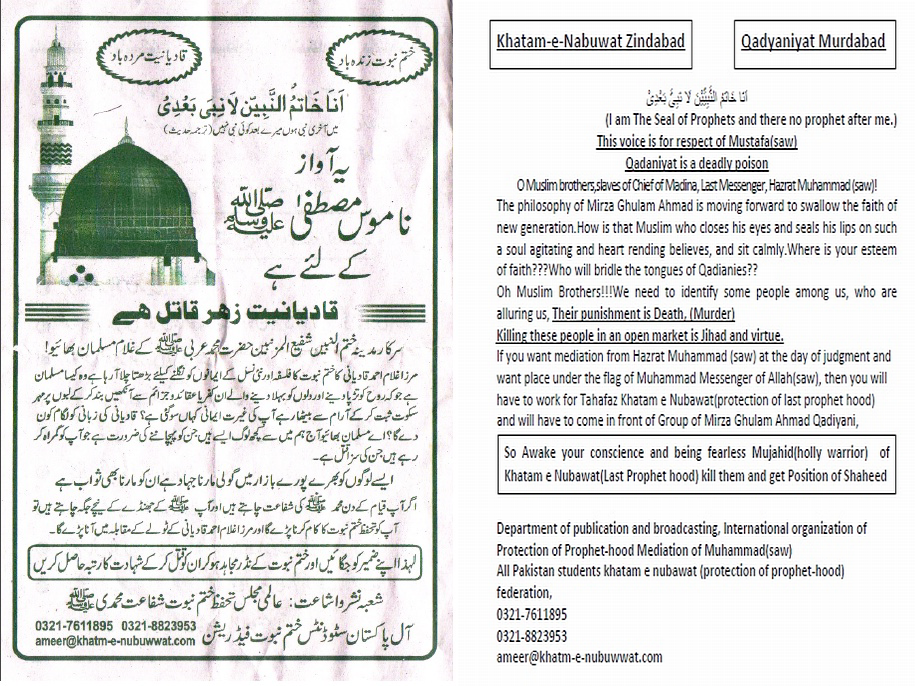
Many of us journalists were continuously receiving e-mails from the Taliban and the Asian Tigers. One such e-mail congratulated Muslims on the Friday attacks on the Ahmedis and invited them to kill more Ahmedis and even Shias

Last week I expressed my concern over the rising intolerance in our society and how the antics of the powers that be would essentially add to the general disquiet. But today I need not press that point again. The very same week, terrorists attacked Lahore again and ruthlessly killed nearly 100 Ahmedis during their prayers or Friday congregation. The misery of the situation was that we could not even call their worship place a mosque, nor their worship, prayers. This is because a law forbids us to say any such thing. I would have been complacent but when everyone can pour out venom on the tube against the 18th Amendment despite its being a part of the constitution, I think I am entitled to challenge a law that is an absolute negation of basic rights.

Let me make it clear that I am not a judge of any creed’s philosophy, but I was raised in a fashion to express wariness of the Ahmedi ideology. Old habits, they say, die hard and I think I am still not mature enough to actually fight for the rights of the Ahmediyya community. What I am about to say is purely based on selfish reasons and the instinct of self-preservation. I honestly believe that a state should have nothing to do with any faith at all. When a state is allowed to judge your faith and impose restrictions on your freedom owing to some preconceived notions, a dangerous precedent is created, which can be used against any faith, creed or school of thought. Verily, a country that has witnessed the Rawalpindi Conspiracy Case, Zia’s shariah laws and Pervez Musharraf’s ‘enlightened moderation’ can definitely attack any point of view and try to ban it. If the state were to choose my faith for me, even the concept of freedom of choice in any religion would be compromised. This is only one important point. There are umpteen others.

I am sure you are not new to our sectarian history. If the Sipah-e-Sahaba had its way, all Shias would have been declared non-Muslims. Had the Taliban held sway, we all would have been declared infidels. The point is that the precedent that was created through constitutionally excommunicating the Ahmedis from Islam can be invoked again and again and, perhaps, yet again. There comes a time when you have to stand up and stop the appeasement of the irrational few. That time, for me, has come.

Even if your constitution, undermining its own commitment to basic rights and religious freedoms, decides to exclude a group from the majority religion of the country, that should not make the members of that group lesser citizens. I have grown up listening to theories about the alleged conspiracies of this community but, with due respect, what I have witnessed thus far is exactly the opposite. I have seen how conspiratorially a loyal, patriotic community of taxpayers and law-abiding citizens is being ostracised in our society. And how we are taught, albeit between the lines, that the Ahmedis are virtually untouchables. This is quite heartrending to tell you the truth and can just as easily happen to you. The sooner we wake up the better it is for all of us. We should do every bit to reintegrate this segment back into society, even though it now seems impossible to reintegrate them into the faith. And for that we will have to, at least, throw all the restrictions imposed during the time of Ziaul Haq out the window.

Let us now come back to the issue at hand, that of the rise of intolerance. I firmly believe that the recent debate about Facebook and blasphemy has a lot to do with the incident in Lahore. Believe me I have no intention of questioning a court’s decision to ban a social networking site in the country, even though it was really an unpleasant experience for me. However, once the ban was imposed, the Pakistan Telecommunication Authority (PTA) went on an unrestricted witch-hunt, banning a number of other sites including YouTube (which was mercifully restored last week). And when some of us tried to protest against the ban, we had to endure the wrath of the great defenders of the faith. I could feel it coming already. When there is so much anger in society and the real offender is out of your reach, you try to find an easy scapegoat in the same society. This publicised and even glorified outrage at things that took place beyond our borders, gave the terrorists the courage to attack yet again. And what more convenient target can you find than the Ahmediyya community. I say this because, despite repeated assaults by the terrorists thus far, this community had managed to stay away from the main conflict between the Taliban and the state. Then you are bound to ask yourself: why this community and why now?

Ironically, when the PTA was busy banning foreign sites, many of us journalists were continuously receiving e-mails from the Taliban and the Asian Tigers. One such e-mail congratulated Muslims on the Friday attacks on the Ahmedis and invited them to kill more Ahmedis and even Shias. If you cannot see any double standards here, then you will probably never see them.

And while I was in pain thinking about this state of affairs, something equally troubling came to my notice. Those who had seized control of a children’s library in Islamabad in the wake of the Red Mosque fiasco were exonerated by the court on the basis of lack of evidence. Is it only me who remembers that Ghazi Abdur Rashid and Um-e-Hassan both used to address the media from the very same place? What other evidence could there be? Somehow I fear that our state, which was supposed to be the custodian of our rights and property, is once again desirous of bringing us back to General Zia’s dark ages and hence consciously appeasing the extremists even when their brethren are butchering our soldiers and citizens alike.

The writer is an independent columnist and a talk show host. He can be reached at farrukh.khan@pitafi.com


Wednesday, June 2, 2010

COMMENT: Last Friday

Daily Times, Pakistan
Wednesday, June 02, 2010

COMMENT: Last Friday — Munir Attaullah

Is there any doubt that the Ahmedi community is the victim of state discrimination through specific legislation, and active persecution by fanatic religious elements that the authorities turn a blind eye to?

Last Friday’s horrible act of senseless terrorism conveyed more than one message to this allegedly basha’oor nation. How many of us have understood it, given the powerful hold of right wing and religious ideologies on our minds? Weighing up the media coverage, is it worth my discussing the matter also?

The answer to the latter question is a resounding “Yes”. It is the duty of every right-minded person to strengthen and amplify that barely audible collective voice of reason of the precious few courageous people in our midst, struggling to be heard over the cacophony of bigotry and hate. I take my cue from Shakespeare: “From that it is disposed: therefore it is meet. That noble minds keep ever with their likes; for who is so firm that cannot be seduced?”

Or, browbeaten into terrified silence, he might have added. The motto of my college (now GCU) is ‘Courage to Know’, a translation of the Latin phrase Sapre Aude that Kant used to symbolise the birth of the Age of Reason in Europe. Our problem (and that of the Islamic world) is not that we lack people who have ‘the courage to know’. We have our share of such people. The problem is, rather, the extreme paucity of people having ‘the courage to speak’.

Put that down to the battle that was lost in the Islamic world centuries ago, when Imam Ghazali’s philosophical views prevailed. Since then, the ulema-e-karam, often in connivance with the ruler of the day, have granted themselves a lucrative monopoly: that of being the sole guardians and interpreters of the authentic word of God. When debates on social issues are diverted on to the slippery slope of religion, sooner or later one will invariably crash into the barrier labelled ‘The word of God’. Then try countering the blackmail implicit in the threat, “Are you challenging the Word of God?” Ask Fouzia Wahab what happens when your words are deliberately misinterpreted in a twisted way to suit convenient ends.

And then there is the fact of life, which is social apathy and indifference to most problems and unjust laws that do not touch us directly. Why get involved when there is little to gain and possibly much to lose? I confess this conundrum is a hard nut to crack. So, without adducing lengthy theoretical reasons or justifications, I am simply going to state my bias: my overwhelming preference (as that of many others) is for a concerned, caring and tolerant society where we do whatever we can for the disadvantaged, the deprived and the ill-treated. And I infinitely prefer tolerance and compassion over hate.

Let us, therefore, look at Friday’s tragedy in the context of the above preamble. Is there any doubt that the Ahmedi community is the victim of state discrimination through specific legislation, and active persecution by fanatic religious elements that the authorities turn a blind eye to? Ask the Human Rights Commission of Pakistan (HRCP), or any of the numerous international agencies concerned with human rights issues, who are unanimous in their opinion. But, of course, all such people and agencies are Israeli stooges and the enemies of Islam. Are they not? And have not the legal challenges mounted by the Ahmedis (admittedly a long time ago) against the offending legislation all been summarily dismissed by our judicature using convoluted and disingenuous arguments?

I have a question for those of our constitutional law activists who are ever ready to challenge the constitutional validity of this or that ordinance, or constitutional amendment. Mr Roedad Khan claimed the National Reconciliation Ordinance (NRO) violated his human rights; and on a recent talk show, I heard Barrister Akram Shaikh claim that the imposition of value-added tax (VAT), by sending millions below the poverty line, would amount to a violation of the basic human right to live, against which he would certainly file a petition. Would it be too much to publicly ask them and their likes if they think the anti-Ahmedi laws are, or are not, a violation of the human rights of millions of Pakistanis? And if they are, will they please stand up and file a petition in this regard also?

Which question naturally leads on to what we might expect from our newly independent judiciary, committed to the laudable aim of fearlessly doing justice to one and all, regardless of whether the heavens should fall or not. In this new era, will their lordships look favourably upon a petition, filed, say, by the HRCP, to review these vicious laws that are a blight upon our name in the international community and leave many of us hanging our head in shame?

Do you want my guess what our basha’oor nation will do? Nothing. It will be back to business as usual after a few days of ritual hand wringing and speech making. Incidentally, in many, if not all, such acts of terrorism, high functionaries of state have been quick to condole with the grieved and promise compensation. Yes, our tireless interior minister, and the Punjab law minister, did what they had to do. But where were the Sharifs? And, while Mr Rehman Malik was admirably blunt and typically fearless in what he said, why was Rana sahib keen to downplay the obviously sectarian dimension of the incident?

Above all, why did no one offer a thimble of compensation in this case? I suppose it was not politic to be seen as being supportive of the untouchables. Hunza is more important than the Ahmedi community.

The role of the media was broadly encouraging, though not without its moments of macabre humour that can result from silly laws. In the first flush of reporting, some media people, wholly innocently, used illegal words such as, attacks on Ahmedi ‘masajid’ where people were offering ‘namaaz’, without realising they were thereby committing an offence. But quite quickly, they learnt the politically correct language of ‘ibadatgahs’ and ‘prayers’.

“Are Ahmedis really wajib-al-qatl?” I was looking forward to the answer to this question an anchorperson promised to ask, after a routine commercial break, of a leader of the JI. Mysteriously, this explosive question was never posed or answered. Just as well.

I cannot end this column without saluting again those courageous few amongst us who make us proud by their fearless and outspoken public rejection of black laws and hate mongers. Taking names would be invidious — and unnecessary — but the usual suspects were not found wanting in coming to the fore once again.

Nor must I — or others — forget the Ahmedi community itself. It has borne all its suffering, humiliation, and provocation with immense fortitude and patience, and remains peaceful, model citizens in every way. I, and many, many others are with you in your hour of trial.

The writer is a businessman. A selection of his columns is now available in book form. Visit munirattaullah.com

 
^ Top of Page