
Showing posts with label wajib-al-qatl. Show all posts

Thursday, June 3, 2010

Our tolerant society

Daily Times, Pakistan
Thursday, June 03, 2010

PENSIEVE: Our tolerant society — Farrukh Khan Pitafi

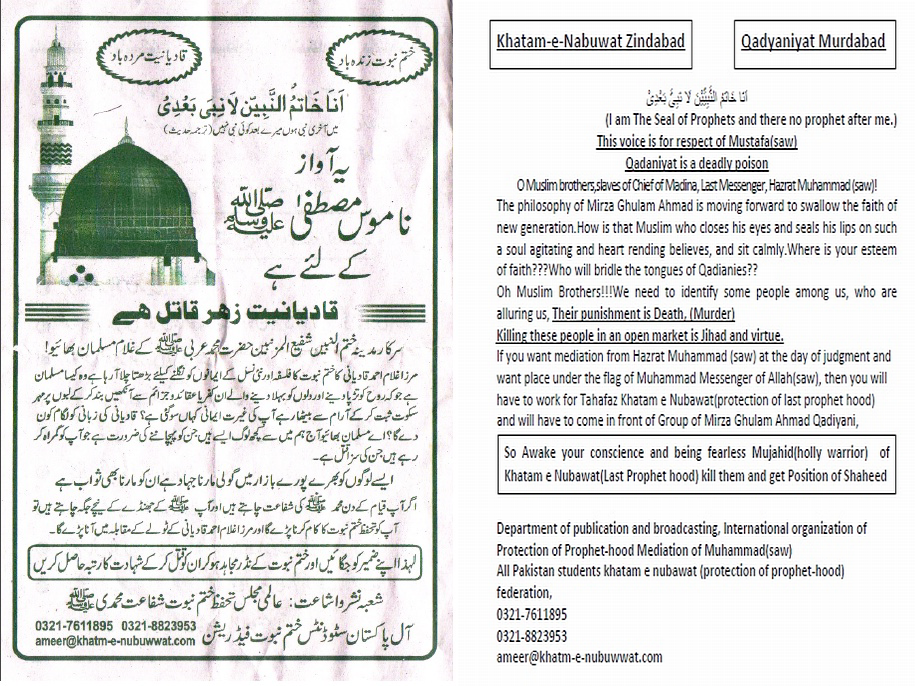
Many of us journalists were continuously receiving e-mails from the Taliban and the Asian Tigers. One such e-mail congratulated Muslims on the Friday attacks on the Ahmedis and invited them to kill more Ahmedis and even Shias

Last week I expressed my concern over the rising intolerance in our society and how the antics of the powers that be would essentially add to the general disquiet. But today I need not press that point again. The very same week, terrorists attacked Lahore again and ruthlessly killed nearly 100 Ahmedis during their prayers or Friday congregation. The misery of the situation was that we could not even call their worship place a mosque, nor their worship, prayers. This is because a law forbids us to say any such thing. I would have been complacent but when everyone can pour out venom on the tube against the 18th Amendment despite its being a part of the constitution, I think I am entitled to challenge a law that is an absolute negation of basic rights.

Let me make it clear that I am not a judge of any creed’s philosophy, but I was raised in a fashion to express wariness of the Ahmedi ideology. Old habits, they say, die hard and I think I am still not mature enough to actually fight for the rights of the Ahmediyya community. What I am about to say is purely based on selfish reasons and the instinct of self-preservation. I honestly believe that a state should have nothing to do with any faith at all. When a state is allowed to judge your faith and impose restrictions on your freedom owing to some preconceived notions, a dangerous precedent is created, which can be used against any faith, creed or school of thought. Verily, a country that has witnessed the Rawalpindi Conspiracy Case, Zia’s shariah laws and Pervez Musharraf’s ‘enlightened moderation’ can definitely attack any point of view and try to ban it. If the state were to choose my faith for me, even the concept of freedom of choice in any religion would be compromised. This is only one important point. There are umpteen others.

I am sure you are not new to our sectarian history. If the Sipah-e-Sahaba had its way, all Shias would have been declared non-Muslims. Had the Taliban held sway, we all would have been declared infidels. The point is that the precedent that was created through constitutionally excommunicating the Ahmedis from Islam can be invoked again and again and, perhaps, yet again. There comes a time when you have to stand up and stop the appeasement of the irrational few. That time, for me, has come.

Even if your constitution, undermining its own commitment to basic rights and religious freedoms, decides to exclude a group from the majority religion of the country, that should not make the members of that group lesser citizens. I have grown up listening to theories about the alleged conspiracies of this community but, with due respect, what I have witnessed thus far is exactly the opposite. I have seen how conspiratorially a loyal, patriotic community of taxpayers and law-abiding citizens is being ostracised in our society. And how we are taught, albeit between the lines, that the Ahmedis are virtually untouchables. This is quite heartrending to tell you the truth and can just as easily happen to you. The sooner we wake up the better it is for all of us. We should do every bit to reintegrate this segment back into society, even though it now seems impossible to reintegrate them into the faith. And for that we will have to, at least, throw all the restrictions imposed during the time of Ziaul Haq out the window.

Let us now come back to the issue at hand, that of the rise of intolerance. I firmly believe that the recent debate about Facebook and blasphemy has a lot to do with the incident in Lahore. Believe me I have no intention of questioning a court’s decision to ban a social networking site in the country, even though it was really an unpleasant experience for me. However, once the ban was imposed, the Pakistan Telecommunication Authority (PTA) went on an unrestricted witch-hunt, banning a number of other sites including YouTube (which was mercifully restored last week). And when some of us tried to protest against the ban, we had to endure the wrath of the great defenders of the faith. I could feel it coming already. When there is so much anger in society and the real offender is out of your reach, you try to find an easy scapegoat in the same society. This publicised and even glorified outrage at things that took place beyond our borders, gave the terrorists the courage to attack yet again. And what more convenient target can you find than the Ahmediyya community. I say this because, despite repeated assaults by the terrorists thus far, this community had managed to stay away from the main conflict between the Taliban and the state. Then you are bound to ask yourself: why this community and why now?

Ironically, when the PTA was busy banning foreign sites, many of us journalists were continuously receiving e-mails from the Taliban and the Asian Tigers. One such e-mail congratulated Muslims on the Friday attacks on the Ahmedis and invited them to kill more Ahmedis and even Shias. If you cannot see any double standards here, then you will probably never see them.

And while I was in pain thinking about this state of affairs, something equally troubling came to my notice. Those who had seized control of a children’s library in Islamabad in the wake of the Red Mosque fiasco were exonerated by the court on the basis of lack of evidence. Is it only me who remembers that Ghazi Abdur Rashid and Um-e-Hassan both used to address the media from the very same place? What other evidence could there be? Somehow I fear that our state, which was supposed to be the custodian of our rights and property, is once again desirous of bringing us back to General Zia’s dark ages and hence consciously appeasing the extremists even when their brethren are butchering our soldiers and citizens alike.

The writer is an independent columnist and a talk show host. He can be reached at farrukh.khan@pitafi.com


Wednesday, June 2, 2010

COMMENT: Last Friday

Daily Times, Pakistan
Wednesday, June 02, 2010

COMMENT: Last Friday — Munir Attaullah

Is there any doubt that the Ahmedi community is the victim of state discrimination through specific legislation, and active persecution by fanatic religious elements that the authorities turn a blind eye to?

Last Friday’s horrible act of senseless terrorism conveyed more than one message to this allegedly basha’oor nation. How many of us have understood it, given the powerful hold of right wing and religious ideologies on our minds? Weighing up the media coverage, is it worth my discussing the matter also?

The answer to the latter question is a resounding “Yes”. It is the duty of every right-minded person to strengthen and amplify that barely audible collective voice of reason of the precious few courageous people in our midst, struggling to be heard over the cacophony of bigotry and hate. I take my cue from Shakespeare: “From that it is disposed: therefore it is meet. That noble minds keep ever with their likes; for who is so firm that cannot be seduced?”

Or, browbeaten into terrified silence, he might have added. The motto of my college (now GCU) is ‘Courage to Know’, a translation of the Latin phrase Sapre Aude that Kant used to symbolise the birth of the Age of Reason in Europe. Our problem (and that of the Islamic world) is not that we lack people who have ‘the courage to know’. We have our share of such people. The problem is, rather, the extreme paucity of people having ‘the courage to speak’.

Put that down to the battle that was lost in the Islamic world centuries ago, when Imam Ghazali’s philosophical views prevailed. Since then, the ulema-e-karam, often in connivance with the ruler of the day, have granted themselves a lucrative monopoly: that of being the sole guardians and interpreters of the authentic word of God. When debates on social issues are diverted on to the slippery slope of religion, sooner or later one will invariably crash into the barrier labelled ‘The word of God’. Then try countering the blackmail implicit in the threat, “Are you challenging the Word of God?” Ask Fouzia Wahab what happens when your words are deliberately misinterpreted in a twisted way to suit convenient ends.

And then there is the fact of life, which is social apathy and indifference to most problems and unjust laws that do not touch us directly. Why get involved when there is little to gain and possibly much to lose? I confess this conundrum is a hard nut to crack. So, without adducing lengthy theoretical reasons or justifications, I am simply going to state my bias: my overwhelming preference (as that of many others) is for a concerned, caring and tolerant society where we do whatever we can for the disadvantaged, the deprived and the ill-treated. And I infinitely prefer tolerance and compassion over hate.

Let us, therefore, look at Friday’s tragedy in the context of the above preamble. Is there any doubt that the Ahmedi community is the victim of state discrimination through specific legislation, and active persecution by fanatic religious elements that the authorities turn a blind eye to? Ask the Human Rights Commission of Pakistan (HRCP), or any of the numerous international agencies concerned with human rights issues, who are unanimous in their opinion. But, of course, all such people and agencies are Israeli stooges and the enemies of Islam. Are they not? And have not the legal challenges mounted by the Ahmedis (admittedly a long time ago) against the offending legislation all been summarily dismissed by our judicature using convoluted and disingenuous arguments?

I have a question for those of our constitutional law activists who are ever ready to challenge the constitutional validity of this or that ordinance, or constitutional amendment. Mr Roedad Khan claimed the National Reconciliation Ordinance (NRO) violated his human rights; and on a recent talk show, I heard Barrister Akram Shaikh claim that the imposition of value-added tax (VAT), by sending millions below the poverty line, would amount to a violation of the basic human right to live, against which he would certainly file a petition. Would it be too much to publicly ask them and their likes if they think the anti-Ahmedi laws are, or are not, a violation of the human rights of millions of Pakistanis? And if they are, will they please stand up and file a petition in this regard also?

Which question naturally leads on to what we might expect from our newly independent judiciary, committed to the laudable aim of fearlessly doing justice to one and all, regardless of whether the heavens should fall or not. In this new era, will their lordships look favourably upon a petition, filed, say, by the HRCP, to review these vicious laws that are a blight upon our name in the international community and leave many of us hanging our head in shame?

Do you want my guess what our basha’oor nation will do? Nothing. It will be back to business as usual after a few days of ritual hand wringing and speech making. Incidentally, in many, if not all, such acts of terrorism, high functionaries of state have been quick to condole with the grieved and promise compensation. Yes, our tireless interior minister, and the Punjab law minister, did what they had to do. But where were the Sharifs? And, while Mr Rehman Malik was admirably blunt and typically fearless in what he said, why was Rana sahib keen to downplay the obviously sectarian dimension of the incident?

Above all, why did no one offer a thimble of compensation in this case? I suppose it was not politic to be seen as being supportive of the untouchables. Hunza is more important than the Ahmedi community.

The role of the media was broadly encouraging, though not without its moments of macabre humour that can result from silly laws. In the first flush of reporting, some media people, wholly innocently, used illegal words such as, attacks on Ahmedi ‘masajid’ where people were offering ‘namaaz’, without realising they were thereby committing an offence. But quite quickly, they learnt the politically correct language of ‘ibadatgahs’ and ‘prayers’.

“Are Ahmedis really wajib-al-qatl?” I was looking forward to the answer to this question an anchorperson promised to ask, after a routine commercial break, of a leader of the JI. Mysteriously, this explosive question was never posed or answered. Just as well.

I cannot end this column without saluting again those courageous few amongst us who make us proud by their fearless and outspoken public rejection of black laws and hate mongers. Taking names would be invidious — and unnecessary — but the usual suspects were not found wanting in coming to the fore once again.

Nor must I — or others — forget the Ahmedi community itself. It has borne all its suffering, humiliation, and provocation with immense fortitude and patience, and remains peaceful, model citizens in every way. I, and many, many others are with you in your hour of trial.

The writer is a businessman. A selection of his columns is now available in book form. Visit munirattaullah.com

 
^ Top of Page