Showing posts with label foundations of intolerance. Show all posts

Tuesday, November 23, 2010

COMMENT: No to blasphemy laws

Daily Times, Pakistan
Tuesday,
November 23, 2010

COMMENT: No to blasphemy laws — Marvi Sirmed

Marvi SirmedOne is amazed at the audacity of the advocates of blasphemy laws, who think of themselves as vigilant guards of not only the Almighty, but religious personages as well, thereby creating an illusion that God and the Prophet (PBUH) might not be able to deal with the blasphemer

It is nothing much, just one more conviction under the Blasphemy Law of Pakistan. This time, it is a woman. Aasia Bibi gets her fate written by an Additional Sessions Court in Nankana Sahib, District Sheikhupura. We have, it seems, successfully saved the honour of Prophet Mohammad (PBUH).

A simplistic, popular argument in favour of the faulty black laws of blasphemy has been that, as committed Muslims, we cannot let blasphemers get off scot-free. And since the law of the land asks for capital punishment for the crime of blasphemy, it is obligatory to pursue such cases with public vigilance. To an ordinary thinking mind, this increasing insecurity about the honour of Islam, the Holy Prophet (PBUH) and Holy Quran looks ridiculously misplaced. Ever since the blasphemy laws were promulgated in the Indo-Pak subcontinent, they seem to have instigated violence against religious minorities.

Blasphemy accusations were regularly levelled against the Sufi mystics before and during Mughal India. In most of these cases, orthodox schools of religious thought used blasphemy as a pretext for settling other scores. One can see it in the case of Sufi saint Sarmad Shaheed who was beheaded by Aurangzeb, Baba Bulleh Shah who was thrown out of his native Kasur on charges of blasphemy, and even Rahman Baba who was accused of being an atheist and had to defend the conspiracies to oust him from his village, Hazar Khwani, in Mohmand district of the then Peshawar province.

It, however, remained largely an activity of the royal courts to invoke blasphemy against Sufis or political opponents. The scourge of popular vigilantism entered Indian society after the 1860s Blasphemy Law inclusion in the India penal code. There was no looking back after this, especially after Pakistan came into being. The first major case of blasphemy that got public attention and a permanent imprint on the Muslim mind was that of Ilam Din (called Ghazi and Shaheed simultaneously). Ilam Din, as the legend goes, was an ordinary Muslim son of a carpenter and irregular mosque-goer. It was the oratory of the clerics Maulana Ahmed Saeed Dehlvi and Amir-e-Shariat in a protest meeting against the publication of a profane book against Prophet Mohammad (PBUH) that instigated the carpenter’s son to get up, hold up the dagger and stab the publisher to death. This act of murder without any conviction by a court of law (the matter was still sub judice) was hailed by all and sundry, including the entire range of Muslim political leaders. Ilam Din is still revered for this “valour”, “act of piety for sheer love of Prophet Mohammad (PBUH)” and for being “a matchless warrior”, as Dr Sir Allama Iqbal was quoted as saying at Ilam Din’s funeral in the Encyclopaedia of World Muslims.

After Pakistan came into being, we had to rely on the excessive use of Islamic symbolism to justify our existence as a separate entity from parent India, and to avoid a further breakdown through the generous provision of religious adhesive to an otherwise multi-ethnic, multi-cultural federation. The Islamisation of laws was an easy tool to adopt that outlook. It was no later than the early 1950s that pogroms against the Hindu population started in Khulna and other parts of East Pakistan, but also the fierce attacks on Ahmedis and Christians in West Pakistan. The existing Blasphemy Law provided an easy solution for pushing minorities against the wall. What is most troublesome is that even in those days popular vigilantism was allowed to let go unchecked, rather it was patronised.

Aasia Bibi’s case is not the only shame Pakistan has had to suffer; we have many such cases to our credit, especially after 1992 when 295-C was further amended to make death the obligatory blasphemy sentence. A cursory look at the data amply shows a sudden surge in blasphemy cases post-1992.

Section 295 of the Pakistan penal code prohibits “injuring or defiling a place of worship with intent to insult the religion of any class”. Section 295-A forbids “deliberate and malicious acts intended to outrage the religious feelings of any class by insulting its religion or religious beliefs”. Section 295-B puts a bar on “defiling, etc, of the Holy Quran”. Section 295-C forbids the “use of derogatory remarks, etc, in respect of the Holy Prophet (PBUH)”. There is an additional Section 298 that forbids “uttering words, etc, with deliberate intent to wound religious feelings”. Three more sections, Section 298-A (use of derogatory remarks, etc, in respect of holy personages), 298-B (misuse of epithets, descriptions and titles, etc, reserved for certain holy personages or places) and Section 298-C (person of the Ahmedi group, etc, calling himself a Muslim or preaching or propagating his faith) make a further mockery of every principle of justice and equality in a modern state.

The basic problem with these sections is that none of them qualifies and determines the variables like “deliberate” and “malicious” attempts of profanity/defamation. In the backdrop of this ambiguity, the absolute unwanted character of these legislative provisions has not only suppressed the religious minorities manifold, but also given rise to uncontrollable public vigilantism and violence in society.

According to a recent report by the National Commission for Justice and Peace (NCJP), a total of 964 people had been charged under the Blasphemy Law in Pakistan from 1986 to 2009. Out of these, NCJP says, 479 were Muslims, 340 Ahmedis, 119 Christians, 14 Hindus, and 10 others. It may be noted that none of the blasphemy convicts have been executed so far, but 32 people charged with blasphemy have been extra-judicially killed. No serious enquiry into their murders has yet been seen. Many of these murders have either been committed in the custody of police or in front of authorities. But powerful religious groups manage to go scot-free in every murder, thereby strengthening the view that the life of minority citizens has no value and depends on their conduct under sheer suppression by a furious majority.

One is amazed at the audacity of the advocates of blasphemy laws, who think of themselves as vigilant guards of not only the Almighty, but religious personages as well, thereby creating an illusion that God and the Prophet (PBUH) might not be able to deal with the blasphemer and would need the help of Tehrik-e-Khatam-e-Nabuwat and the like. In my view, they themselves are the biggest blasphemers.

It needs to be strongly voiced in every public sphere today that Pakistan, with a majority Muslim population, does not need blasphemy laws. The presence of these laws hints at Muslim insecurity as well of lack of confidence in our own selves. Let us not make laws for the already powerful majority. A blasphemy law without a strong blasphemy libel law is merely a tool of suppression. It is not 295-C that is the problem, it is the way we have written our statute and the way we are shaping our worldview that has become the problem. Root it out before it roots us out. Pakistan cannot afford any more shame.

The writer is a rights activist and independent blogger. She can be reached at marvi@marvisirmed.com


Monday, November 22, 2010

VIEW: Blasphemy Law

Daily Times, Pakistan
Monday,
November 22, 2010

VIEW: Blasphemy Law — Yasser Latif Hamdani

Yasser Latif HamdaniNothing will cripple the terrorists more decisively than a tolerant, moderate and democratic Pakistan that respects human rights and treats all its citizens equally. No victory would be permanent if such a Pakistan is not achieved


Arundhati Roy committed blasphemy of another kind when she asked the Americans to reconsider their alliance with India without resolving the Kashmir issue in accordance with the wishes of the Kashmiri people. Earlier she had upset many Indians when she claimed that Kashmir was not an integral part of India, a statement that had every gung-ho Indian, those Oscar Wilde’s vicious patriots and there are about a billion of them, baying for her blood, proving that India is and will remain an intolerant society for some time to come.

Well, taking inspiration from her, Pakistanis should also ask President Obama why his government continues to aid a government and a country that continues to trample on the rights of its own people. No I am not talking about India. I am talking about Pakistan, where the state continues to persecute religious minorities by using a law that cannot be justified on any grounds, whether democracy or Islam. In my previous article I briefly touched on the issue of the Blasphemy Law and the verdict against the Christian woman, a mother of five, who was beaten up and then handed over to the police. It is likely that she will get a presidential pardon. That however is not enough. In the process Pakistan has been humiliated for the umpteenth time simply because we want to appease the mullahs as we have done so consistently since 1949, who in any event have declared a war on Pakistan. I had predicted this much in my article.

So when Obama says “we will act if Pakistan is unwilling or unable to act”, he should walk the walk as well. Nothing will cripple the terrorists more decisively than a tolerant, moderate and democratic Pakistan that respects human rights and treats all its citizens equally. No victory would be permanent if such a Pakistan is not achieved. President Obama, the US, the IMF, the World Bank and the entire western world should immediately stop assisting Pakistan in every field from humanitarian aid to military aid till Pakistan puts its house in order. Being a signatory and having ratified the International Convention on Political and Civil Rights, Pakistan is bound by international law and its own constitution to provide all its citizens the right to life and liberty and religious belief unconditionally.

I do not favour arguments referring to religious interpretation, but our Blasphemy Law is untenable even from an Islamic angle. There is nothing in the Holy Quran or even the Hadith that definitively prescribes such a Blasphemy Law. On the contrary we have a clear example set by the Holy Prophet (PBUH) when he forgave his worst enemies and offenders like Hinda. Almost everyone knows the story of the old woman who would throw garbage daily on the path that the Holy Prophet (PBUH) took. When she fell ill, the Holy Prophet (PBUH) went to visit her and nursed her back to health. Less known is the story of another old woman who the Holy Prophet (PBUH) helped by carrying wood to her house. Along the way, not knowing the identity of her helper, she began to speak about the “trouble maker” of Makkah. It was only after their journey was at an end that the Holy Prophet (PBUH) told her that he was the same Muhammad (PBUH) she had spent the greater part of the journey abusing. This was the Holy Prophet’s (PBUH) character. This is why he is referred to as Rahmatul-lil-Alameen or the mercy for all worlds.

Islamic law and jurisprudence is derived from four sources, known as the Usul-ul-Fiqh (fundamentals of the law), i.e. the Holy Quran, the Sunnah, Qiyas (analogy) and Ijma (consensus). The Holy Quran is silent on the issue of blasphemy. The Sunnah of the Holy Prophet (PBUH) seems to suggest the exact opposite. By using Qiyas, one can only conclude that the Blasphemy Law is patently un-Islamic and there is no Ijmah or consensus amongst the scholars of Islam on the punishment of blasphemy.

Islamic civilisation has a rich history of not only tolerating but even celebrating dissent. Needless to say some of the greatest scientists in Islamic history, Al Razi, the father of medicine, and Avicenna, would have been lynched many times over had Islam actually favoured a Blasphemy Law as is currently on the statute books of Pakistan. I am told that our local textbooks on science all have a chapter on the achievements of Muslim scientists and the contribution of Islamic civilisation to science and enlightenment of humanity. It is forgotten that this was achieved by a culture of tolerance, acceptance and openness. In my last column, I quoted the founder of this nation as stating as clearly as possible that bona fide criticisms and investigations into religion must be protected and safeguarded from any Blasphemy Law. So must be the fundamental rights of life, liberty and religious belief.

A nation is its laws ultimately. The intolerance permeating down to every segment of our society is the direct result of the laws that evade common sense and logic. It is therefore time to repeal the Blasphemy Law.

The writer is a lawyer. He also blogs at http://pakteahouse.wordpress.com and can be reached at yasser.hamdani@gmail.com

Monday, June 21, 2010

The liabilities of our state

Daily Times, Pakistan
Monday, June 21, 2010

VIEW: The liabilities of our state — Yasser Latif Hamdani

The state is not only negligent of its duty in protecting the faith of the Ahmedis, it is directly criminally liable under its own Blasphemy Law every time it prints a passport or an identity card application

A first information report, commonly known as an FIR, has been lodged in Lahore against Facebook under section 295 C of the Pakistan Penal Code (PPC). Legally, this raises some very poignant questions about the criminal liability of a corporation, i.e. a business with legal identity.

The issue has been the subject of much litigation, most notably and recently the Citizens United v Federal Election Commission, 558 US 50 (2010), in which the US Supreme Court held that any limits on a corporation’s political funding would be tantamount to a violation of the first amendment to the US constitution. It remains to be seen, of course, if the corporations are going to get the right to vote as well but needless to say, this judgement has, for all practical purposes, created room for all sorts of mischief, including criminal liability for a corporation. Therefore, a criminal case against Facebook, absurd as it may seem, is legally possible, thanks to the landmark American judgement above, amongst other things, even if the established Pakistani case law might exempt it on other grounds.

What I am interested in, however, is not Facebook, which is, after all, a foreign company, but the criminal liability that may now also be extended to the ‘state’ in Pakistan, which is also, like a corporation, a legal artificial person. That a sovereign state — yes we do love the word sovereign, do we not? — is a legal person under the law is an undisputed fact. This primarily means that the state in Pakistan is collectively bound by the laws of Pakistan, including but not limited to the PPC. Now consider Section 295-A of the PPC, which states: “Deliberate and malicious acts intended to outrage religious feelings of any class by insulting its religion or religious beliefs: Whoever, with deliberate and malicious intention of outraging the religious feelings of any class of the citizens of Pakistan, by words, either spoken or written, or by visible representations insults the religion or the religious beliefs of that class, shall be punished with imprisonment of either description for a term which may extend to 10 years, or with fine, or with both.”

Now let us here revisit some facts. The Second Amendment has, quite regrettably, laid down in no uncertain terms that members of the Ahmediyya sect, of either the Qadiani or Lahori jamaats, form a separate religion, with distinct religious beliefs. Now, with that in mind, let us dwell upon the declaration that every Pakistani Muslim is asked to sign when getting either his national identity card or his passport:

I consider Mirza Ghulam Ahmad Qadiani to be an imposter prophet…” I spent some time looking for a positive meaning of the word ‘imposter’ or ‘impostor’ but found none whatsoever. The meanings I did find were: one who fakes, charlatan, fake, faker, fraud, humbug, mountebank, phoney, pretender, quack. If this is not ‘insulting’ and a ‘deliberate’ and ‘malicious’ act to outrage the feelings of a community then I do not know what is. Now clearly, constitutionally recognised Muslims in the territories of Pakistan do not believe that Mirza Ghulam Ahmad Qadiani was a nabi or a prophet. Those who believe in his prophethood are no longer recognised, according to the Second Amendment of the constitution of the Islamic Republic of Pakistan, as Muslims. Yet, it goes without saying that in doing so and admitting that they form a separate faith unto themselves, there are constitutional and legal protections that apply to the Ahmedis and their faith. The state is not only negligent of its duty in protecting the faith of the Ahmedis, it is directly criminally liable under its own Blasphemy Law every time it prints a passport or an identity card application. It goes without saying that no petitioner is going to petition, no lawyer is going to take the case and no judge is going to rule according to the law in this matter. Moral courage is lacking in our country, especially when it comes to enforcing the rights of minorities.

However, does the state not have any responsibility to at least attempt to abide by its own laws? Parliament recently restored the word ‘freely’ to the Objectives Resolution as it forms the substantive part of Pakistan’s constitution under Article 2-A. Even without the word ‘freely’, the resolution promised that “adequate provision shall be made for the minorities to profess and practise their religions and develop their cultures”. On the contrary, the state has made every provision to hamper the profession and practice of the Ahmedi minority’s religion. It has, indeed, through Ordinance XX of 1984, clamped down on and, for all practical purposes, criminalised the Ahmedi mode of worship.

Pakistan recently ratified the International Covenant of Political and Civil Rights. Article 18 of the said covenant — which may not be derogated — lays down:

“1. Everyone shall have the right to freedom of thought, conscience and religion. This right shall include freedom to have or to adopt a religion or belief of his choice, and freedom, either individually or in community with others and in public or private, to manifest his religion or belief in worship, observance, practice and teaching.

2. No one shall be subject to coercion, which would impair his freedom to have or to adopt a religion or belief of his choice.” In Pakistan, after Zaheeruddin v the State, there is no scope for the implementation of this covenant, regardless of the good intentions of the present government. So long as Pakistan does not return to Jinnah’s original conception of an impartial state based on justice, fair play and complete equality of citizenship, it is bound to rank amongst the worst human rights violators and abusers in the world.

Yasser Latif Hamdani is a lawyer. He also blogs at http://pakteahouse.wordpress.com and can be reached at yasser.hamdani@gmail.com

Thursday, June 3, 2010

Our tolerant society

Daily Times, Pakistan
Thursday, June 03, 2010

PENSIEVE: Our tolerant society — Farrukh Khan Pitafi

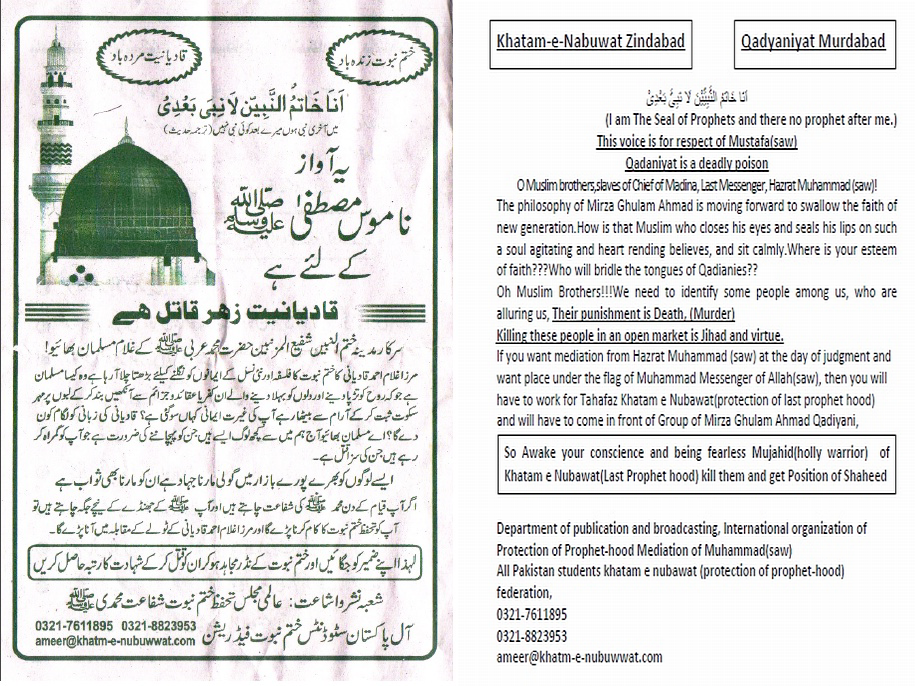
Many of us journalists were continuously receiving e-mails from the Taliban and the Asian Tigers. One such e-mail congratulated Muslims on the Friday attacks on the Ahmedis and invited them to kill more Ahmedis and even Shias

Last week I expressed my concern over the rising intolerance in our society and how the antics of the powers that be would essentially add to the general disquiet. But today I need not press that point again. The very same week, terrorists attacked Lahore again and ruthlessly killed nearly 100 Ahmedis during their prayers or Friday congregation. The misery of the situation was that we could not even call their worship place a mosque, nor their worship, prayers. This is because a law forbids us to say any such thing. I would have been complacent but when everyone can pour out venom on the tube against the 18th Amendment despite its being a part of the constitution, I think I am entitled to challenge a law that is an absolute negation of basic rights.

Let me make it clear that I am not a judge of any creed’s philosophy, but I was raised in a fashion to express wariness of the Ahmedi ideology. Old habits, they say, die hard and I think I am still not mature enough to actually fight for the rights of the Ahmediyya community. What I am about to say is purely based on selfish reasons and the instinct of self-preservation. I honestly believe that a state should have nothing to do with any faith at all. When a state is allowed to judge your faith and impose restrictions on your freedom owing to some preconceived notions, a dangerous precedent is created, which can be used against any faith, creed or school of thought. Verily, a country that has witnessed the Rawalpindi Conspiracy Case, Zia’s shariah laws and Pervez Musharraf’s ‘enlightened moderation’ can definitely attack any point of view and try to ban it. If the state were to choose my faith for me, even the concept of freedom of choice in any religion would be compromised. This is only one important point. There are umpteen others.

I am sure you are not new to our sectarian history. If the Sipah-e-Sahaba had its way, all Shias would have been declared non-Muslims. Had the Taliban held sway, we all would have been declared infidels. The point is that the precedent that was created through constitutionally excommunicating the Ahmedis from Islam can be invoked again and again and, perhaps, yet again. There comes a time when you have to stand up and stop the appeasement of the irrational few. That time, for me, has come.

Even if your constitution, undermining its own commitment to basic rights and religious freedoms, decides to exclude a group from the majority religion of the country, that should not make the members of that group lesser citizens. I have grown up listening to theories about the alleged conspiracies of this community but, with due respect, what I have witnessed thus far is exactly the opposite. I have seen how conspiratorially a loyal, patriotic community of taxpayers and law-abiding citizens is being ostracised in our society. And how we are taught, albeit between the lines, that the Ahmedis are virtually untouchables. This is quite heartrending to tell you the truth and can just as easily happen to you. The sooner we wake up the better it is for all of us. We should do every bit to reintegrate this segment back into society, even though it now seems impossible to reintegrate them into the faith. And for that we will have to, at least, throw all the restrictions imposed during the time of Ziaul Haq out the window.

Let us now come back to the issue at hand, that of the rise of intolerance. I firmly believe that the recent debate about Facebook and blasphemy has a lot to do with the incident in Lahore. Believe me I have no intention of questioning a court’s decision to ban a social networking site in the country, even though it was really an unpleasant experience for me. However, once the ban was imposed, the Pakistan Telecommunication Authority (PTA) went on an unrestricted witch-hunt, banning a number of other sites including YouTube (which was mercifully restored last week). And when some of us tried to protest against the ban, we had to endure the wrath of the great defenders of the faith. I could feel it coming already. When there is so much anger in society and the real offender is out of your reach, you try to find an easy scapegoat in the same society. This publicised and even glorified outrage at things that took place beyond our borders, gave the terrorists the courage to attack yet again. And what more convenient target can you find than the Ahmediyya community. I say this because, despite repeated assaults by the terrorists thus far, this community had managed to stay away from the main conflict between the Taliban and the state. Then you are bound to ask yourself: why this community and why now?

Ironically, when the PTA was busy banning foreign sites, many of us journalists were continuously receiving e-mails from the Taliban and the Asian Tigers. One such e-mail congratulated Muslims on the Friday attacks on the Ahmedis and invited them to kill more Ahmedis and even Shias. If you cannot see any double standards here, then you will probably never see them.

And while I was in pain thinking about this state of affairs, something equally troubling came to my notice. Those who had seized control of a children’s library in Islamabad in the wake of the Red Mosque fiasco were exonerated by the court on the basis of lack of evidence. Is it only me who remembers that Ghazi Abdur Rashid and Um-e-Hassan both used to address the media from the very same place? What other evidence could there be? Somehow I fear that our state, which was supposed to be the custodian of our rights and property, is once again desirous of bringing us back to General Zia’s dark ages and hence consciously appeasing the extremists even when their brethren are butchering our soldiers and citizens alike.

The writer is an independent columnist and a talk show host. He can be reached at farrukh.khan@pitafi.com


Wednesday, June 2, 2010

COMMENT: Last Friday

Daily Times, Pakistan
Wednesday, June 02, 2010

COMMENT: Last Friday — Munir Attaullah

Is there any doubt that the Ahmedi community is the victim of state discrimination through specific legislation, and active persecution by fanatic religious elements that the authorities turn a blind eye to?

Last Friday’s horrible act of senseless terrorism conveyed more than one message to this allegedly basha’oor nation. How many of us have understood it, given the powerful hold of right wing and religious ideologies on our minds? Weighing up the media coverage, is it worth my discussing the matter also?

The answer to the latter question is a resounding “Yes”. It is the duty of every right-minded person to strengthen and amplify that barely audible collective voice of reason of the precious few courageous people in our midst, struggling to be heard over the cacophony of bigotry and hate. I take my cue from Shakespeare: “From that it is disposed: therefore it is meet. That noble minds keep ever with their likes; for who is so firm that cannot be seduced?”

Or, browbeaten into terrified silence, he might have added. The motto of my college (now GCU) is ‘Courage to Know’, a translation of the Latin phrase Sapre Aude that Kant used to symbolise the birth of the Age of Reason in Europe. Our problem (and that of the Islamic world) is not that we lack people who have ‘the courage to know’. We have our share of such people. The problem is, rather, the extreme paucity of people having ‘the courage to speak’.

Put that down to the battle that was lost in the Islamic world centuries ago, when Imam Ghazali’s philosophical views prevailed. Since then, the ulema-e-karam, often in connivance with the ruler of the day, have granted themselves a lucrative monopoly: that of being the sole guardians and interpreters of the authentic word of God. When debates on social issues are diverted on to the slippery slope of religion, sooner or later one will invariably crash into the barrier labelled ‘The word of God’. Then try countering the blackmail implicit in the threat, “Are you challenging the Word of God?” Ask Fouzia Wahab what happens when your words are deliberately misinterpreted in a twisted way to suit convenient ends.

And then there is the fact of life, which is social apathy and indifference to most problems and unjust laws that do not touch us directly. Why get involved when there is little to gain and possibly much to lose? I confess this conundrum is a hard nut to crack. So, without adducing lengthy theoretical reasons or justifications, I am simply going to state my bias: my overwhelming preference (as that of many others) is for a concerned, caring and tolerant society where we do whatever we can for the disadvantaged, the deprived and the ill-treated. And I infinitely prefer tolerance and compassion over hate.

Let us, therefore, look at Friday’s tragedy in the context of the above preamble. Is there any doubt that the Ahmedi community is the victim of state discrimination through specific legislation, and active persecution by fanatic religious elements that the authorities turn a blind eye to? Ask the Human Rights Commission of Pakistan (HRCP), or any of the numerous international agencies concerned with human rights issues, who are unanimous in their opinion. But, of course, all such people and agencies are Israeli stooges and the enemies of Islam. Are they not? And have not the legal challenges mounted by the Ahmedis (admittedly a long time ago) against the offending legislation all been summarily dismissed by our judicature using convoluted and disingenuous arguments?

I have a question for those of our constitutional law activists who are ever ready to challenge the constitutional validity of this or that ordinance, or constitutional amendment. Mr Roedad Khan claimed the National Reconciliation Ordinance (NRO) violated his human rights; and on a recent talk show, I heard Barrister Akram Shaikh claim that the imposition of value-added tax (VAT), by sending millions below the poverty line, would amount to a violation of the basic human right to live, against which he would certainly file a petition. Would it be too much to publicly ask them and their likes if they think the anti-Ahmedi laws are, or are not, a violation of the human rights of millions of Pakistanis? And if they are, will they please stand up and file a petition in this regard also?

Which question naturally leads on to what we might expect from our newly independent judiciary, committed to the laudable aim of fearlessly doing justice to one and all, regardless of whether the heavens should fall or not. In this new era, will their lordships look favourably upon a petition, filed, say, by the HRCP, to review these vicious laws that are a blight upon our name in the international community and leave many of us hanging our head in shame?

Do you want my guess what our basha’oor nation will do? Nothing. It will be back to business as usual after a few days of ritual hand wringing and speech making. Incidentally, in many, if not all, such acts of terrorism, high functionaries of state have been quick to condole with the grieved and promise compensation. Yes, our tireless interior minister, and the Punjab law minister, did what they had to do. But where were the Sharifs? And, while Mr Rehman Malik was admirably blunt and typically fearless in what he said, why was Rana sahib keen to downplay the obviously sectarian dimension of the incident?

Above all, why did no one offer a thimble of compensation in this case? I suppose it was not politic to be seen as being supportive of the untouchables. Hunza is more important than the Ahmedi community.

The role of the media was broadly encouraging, though not without its moments of macabre humour that can result from silly laws. In the first flush of reporting, some media people, wholly innocently, used illegal words such as, attacks on Ahmedi ‘masajid’ where people were offering ‘namaaz’, without realising they were thereby committing an offence. But quite quickly, they learnt the politically correct language of ‘ibadatgahs’ and ‘prayers’.

“Are Ahmedis really wajib-al-qatl?” I was looking forward to the answer to this question an anchorperson promised to ask, after a routine commercial break, of a leader of the JI. Mysteriously, this explosive question was never posed or answered. Just as well.

I cannot end this column without saluting again those courageous few amongst us who make us proud by their fearless and outspoken public rejection of black laws and hate mongers. Taking names would be invidious — and unnecessary — but the usual suspects were not found wanting in coming to the fore once again.

Nor must I — or others — forget the Ahmedi community itself. It has borne all its suffering, humiliation, and provocation with immense fortitude and patience, and remains peaceful, model citizens in every way. I, and many, many others are with you in your hour of trial.

The writer is a businessman. A selection of his columns is now available in book form. Visit munirattaullah.com

 
^ Top of Page