Friday, January 21, 2011

In Pakistan, Islamic hard-liners expanding their grip on society

Los Angeles Times
WORLD
In Pakistan, Islamic hard-liners expanding their grip on society
The killing of a governor opposed to the nation's blasphemy law, and the warm reception for his accused killer, has exposed Islamic fundamentalists' growing sway over the nation.
Pakistanis chant slogans as they gather to show their support outside the Rawalpindi home of Mumtaz Hussain Qadri, who is accused of killing Punjab Gov. Salman Taseer. (Aamir Qureshi, AFP/Getty Images / January 21, 2011)
By Alex Rodriguez, Los Angeles Times
January 21, 2011

Reporting from Rawalpindi, Pakistan — Above a dank, darkened teahouse pungent with the aroma of green chili peppers, a bright blue banner depicts a neighborhood cleric, Qari Hanif Qureshi, declaring: “Anyone opposing laws protecting the sanctity of the prophet Muhammad is condemned!“

Such dire exhortations from local imams are embraced by millions of impoverished Pakistanis scraping by in squalid, dust-choked city neighborhoods and mud-hut settlements.

Mumtaz Hussain Qadri, a 26-year-old police commando assigned to guard Punjab Gov. Salman Taseer, says Qureshi’s preachings inspired him to assassinate Taseer on Jan. 4. And on a recent afternoon inside the teahouse, another Qureshi follower, Muhammad Zahir, said he was equally moved.

“If I were there, I would have done the same thing,” says Zahir, 26, scooping up boiled lentils with a piece of bread. “Qadri has brought honor upon his family. He’s a hero now.”

The killing, carried out by a man who saw Taseer as an apostate for opposing Pakistan’s blasphemy law, has exposed the rising influence that Islamic fundamentalism has over Pakistani society, a mind-set that increasingly radicalizes the nuclear-armed nation, breeds intolerance and further weakens Islamabad’s feeble civilian government.

Led by clerics at the helm of the country’s religious political parties and its hard-line mosques and madrasas, the extremists demonstrated their reach after Taseer was assassinated in an upscale neighborhood of Islamabad. Days later, fundamentalist clerics rallied more than 40,000 people on the streets of Karachi in support of Qadri. A day earlier in Qadri’s Rawalpindi neighborhood, at least 4,000 people had gathered in front of the accused assassin’s house, chanting, “Salute to your bravery, Mumtaz!“

At Qadri’s court appearances, lawyers have showered him with flower petals and kissed his cheeks, a worrisome sign that his support stretches far beyond Pakistan’s underclass and into the upper echelons of society.

Hard-line clerics are now turning their anger toward another leading member of the ruling Pakistan People’s Party, lawmaker Sherry Rehman, who, like Taseer, called for changes aimed at reforming the blasphemy law after a Pakistani Christian woman accused of insulting the prophet Muhammad was given the death penalty.

Journalist Ali Kamran Chishti attended a Jan. 7 gathering in Karachi at which Munir Ahmed Shakir, imam of the Sultan mosque, labeled Rehman an infidel for proposing changes to the law to remove the death penalty as an option for punishment and require prosecutors to prove that the alleged blasphemy was intentional and not inadvertent. Pakistan’s blasphemy law makes it a crime to defame the prophet Muhammad or Islam, but is often used as a tool to repress minorities.

“This kind of rhetoric radicalizes people,” Chishti said. Imams such as Shakir, he added, “are slowly poisoning minds and making people intolerant. Praising people like Qadri is indirectly saying to society that anyone who takes this line [against the blasphemy law] should be shot dead. This is wrong.”

The outpouring of praise for Qadri also sends disturbing signals to Washington. At a time when the Obama administration is hoping for a more reliable ally in the U.S.-declared war on terrorism, the Taseer assassination and its aftermath suggest extremism in Pakistan may be going mainstream.

“A mind-set has been created that has to be undone,” said Ijaz Khan, who heads the international relations department at the University of Peshawar. “It poses a serious existential challenge to the so-called liberal community of this country.

“We still do not know how many more Qadris are out there,” Khan added, “and what will happen next.”

Pakistan’s religious extremists thrive on street power rather than on ballot-box appeal. In elections in 2008, religious parties collectively garnered less than 5% of the vote. Founded as a moderate Islamic state, Pakistan is governed by the largely secular Pakistan People’s Party.

But in the thousands of mosques and madrasas across the nation, fundamentalists enjoy a captive audience. Hard-line clerics delivering fiery Friday sermons are seen as more credible than the country’s government leaders.

“If there was economic development and more job opportunities on the horizon, they wouldn’t be as apt to listen to these clerics,” said Hasan Askari Rizvi, a Lahore-based security analyst. “At least not all the time.”

The rise of the Islamists has its origins in the military rule of Gen. Zia ul-Haq, who in the 1980s forced a more conservative brand of Islam on the country. That resulted in the start-up of legions of madrasas, many of which became incubators for extremism.

Even state education under Zia “socialized young minds into religious orthodoxy,” Rizvi said. “Now these people who studied in high schools and state universities from 1985 onward are the ones who support this kind of far-right religious orientation.”

The large show of support for Qadri has both stunned and intimidated Pakistani secularists. Though several commentators on television and in newspapers have denounced the praise Qadri has received, top leaders within President Asif Ali Zardari’s administration have been conspicuously quiet amid the furor.

The government has even tried to sound conciliatory: This week Prime Minister Yousuf Raza Gilani stressed that authorities have no plans to tamper with the country’s blasphemy law — a clear attempt to appease hard-line religious leaders angered by talk of amendments to the law.

Whether such gestures calm the toxic debate over Taseer’s assassination remains to be seen. The Sunni Ittehad Council, an influential assembly of Pakistani Muslim clerics, has vowed to hold rallies in major cities in defense of the blasphemy law this month.

“If we want peace in our country,” said Hanif Tayyab, the council’s general secretary, “we should try to understand that freedom of expression has some limits.”

alex.rodriguez@latimes.com

Copyright © 2011, Los Angeles Times
URL: www.latimes.com/news/nationworld/world/la...3266594.story

Thursday, January 20, 2011

Religious frenzy grips Pakistan

Thursday, January 20, 2010, Safar 14, 1432 
Religious frenzy grips Pakistan
Random Thoughts
Burhanuddin Hasan
There is hardly any doubt that Muslims, can lay down their lives to uphold and protect the honour and dignity of the Holy Prophet Mohammad (Peace be upon him). His name comes after God in Quran and as Maulana Roomi says “You are ,in short, the most exalted after God.” In Sura Al Ahzab God says “God and His angels shower blessing on the Prophet (PBUH). O believers you too send darood and salam to him (PBUH)”. The Holy Prophet Mohammad (PBUH) has the most exalted position among all Prophets sent by God. He (PBUH) was the only one called to the heavens by God on the night of Mairaj to honour him (PBUH) with his nearness. How can any Muslim have the courage to say a single word against his (PBUH) honour? If anybody does, he should be given death sentence with the due process of law. The Blasphemy Law was enacted during General Ziaul Haq’s rule. This was a man-made law and like all man-made laws could be reviewed from time to time if it is being misused by human beings like all laws. It is not a divine law enacted by God in Quran like some other laws. There are 57 Muslim countries in the world which, do not have any such law on their Statute Books.

The Blasphemy Law has been used in some cases in Pakistan and culprits have been punished if their crime was proved in a court of law. The punishment was awarded by a judge like all punishments. Nobody should take this law into his or her hands and execute the culprit without the due process. In the case of a Christian girl Asia; she was booked under the Blasphemy Law and was awarded death penalty by a court of law. She sent a mercy petition to the Governor of Punjab Mr Salman Taseer who met her in good faith and promised to take up her mercy petition with the President for favourable consideration. He had a feeling that the girl might have been framed like many other cases of Blasphemy. Media unduly sensationalized this story as it does in many such cases these days to gain popularity.

The JUI Chief Maulana Fazlur Rehman who had left the Government on the sacking of one of his ministers in the Federal Cabinet by Prime Minister Gilani, pounced on this issue to take his revenge and gave a call for a nationwide agitation on the issue of Namoos-e-Risaalat, which was totally out of context but could add fuel to the fire of his revenge against the Prime Minister. All religious parties, which keep waiting for such an opportunity to hit the government, joined the agitation taking out big rallies all over the country. It should never be forgotten that these parties; particularly Jamat-e-Islami and the Deobandi group represented by Maulana Fazlur Rehman have always been against the very concept of Pakistan promoted by Iqbal and Jinnah for the Muslims of India as a modern forward looking State as against a theocratic one which was the demand of religious parties..However, when Pakistan came into being they converged on it to change its ideology. They did not succeed but they keep trying. Iqbal who was a great philosopher and scholar of Islam has written a lot about the ignorance of Mullahs.

But it is regrettable that our educational institutions are not teaching these words to our youth who are blindly following the very Mullahs who were against Pakistan. Returning to the tragic murder of Salman Taseer by his misguided security guard who is being idolized by some youth under the influence of the Mullahs is highly regrettable. They should realize that this was not a case of violation of the Holy Prophet’s Namoos (Naoozo Billah). It was a humanitarian effort and his duty as the Governor of Punjab to find out whether a girl belonging to the Christian minority community who claims that she has been falsely framed in a crime she did not commit, is right or wrong? It was his duty to put the girl’s petition to the President. This was by no means a violation of the Namoos-e Risaalat .The security guard who was on duty to protect the life of the Governor, is guilty of murder and will certainly be punished. Those who are idolizing him should also be punished.

It seems the government which is surrounded by all sorts of fears for its survival is hesitating to take bold action against the political parties which have opened the Pandora’s Box over the blasphemy issue at this time when the country is facing economic crises, religious terrorism and corruption. This matter if not tackled with courage and bold action against those elements that unnecessarily launched a mass hysteria on this highly explosive issue, may destabilize the country. One would expect the Supreme Court to take notice of this issue and take action against the criminal elements who are exploiting the name of Islam for an issue which is basically legal.

The media too needs to be directed to use restraint in reporting and commenting on the delicate and sensitive subject of blasphemy. Full marks to PPP Chairman Bilawal Bhutto Zardari who has raised his voice in defense of minority communities and has denounced the uncalled for religious frenzy, let loose by the Mullahs which may destabilize the country.

© Pakistan Observer 1998-2011, All rights reserved
URL: http://pakobserver.net/detailnews.asp?id=72090

Ahmadiyah Villagers Still Enduring Abuse From Neighbors After Attack

Jakarta Globe, Indonesia
NEWS
Ahmadiyah Villagers Still Enduring Abuse From Neighbors After Attack
Ulma Haryanto | January 20, 2010

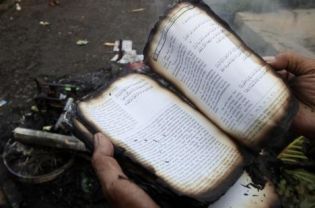
A follower of the minority Islamic sect, Ahmadiyah, holding a burnt copy of the Koran in Ciampea, West Java, after violence directed at the Islamic sect earlier this month. In what is likely to be a hugely controversial - if not illegal - decision, authorities in West Nusa Tenggar plan to relocated 20 sect families to a deserted island in Lombok. (Reuters Photo/Dadang Tri)
Indonesia. More than three months after their homes, school and mosque were torched, members of a beleaguered Ahmadiyah community near Bogor continue to be persecuted by their neighbors.

The community of about 600 was the target of a mob of 200 hard-liners on Oct. 1 in an attack that saw their homes looted and set on fire.

During a visit to Cisalada village by the Jakarta Globe on Wednesday, several of the homes were being rebuilt while others had simply had their broken windows covered with cardboard.

The mosque and school were fully renovated, although the mosque still sported a police line and its entrance was boarded up with large planks of wood.

“It’s just a cover,” says Rahmat Ali, 33, a resident. “We enter the mosque through a side door.”

The trauma from last year’s attack, he adds, will take a long time to get over, particularly for the children. “One neighborhood kid had nightmares about the incident for weeks,” he says.

But even now, the community is not allowed to rebuild in peace. On Tuesday, neighboring villagers blockaded the entrance to the community’s residential complex and taunted any Ahmadiyah follower passing by.

The entrance opens onto the road leading to Pasar Salasa and Kebon Kopi villages, where the mob from the Oct. 1 attack had come from.

“Some of us still avoid the road to this day,” Rahmat says. “We use the main road or take the long way around that goes through Cimanggu village.”

Seventh-graders Dinar Agnelia, 12, and Alisya Alka, 13, were not afforded that option. They were bullied and had to plead to be allowed through on their way home from school.

“There were these young men, some of them from junior high, blocking the road,” Dinar says. “They told us to use another road.”

But because the other roads were also blocked, they had to plead their way past.

Mira Susila, 32, received worse treatment as she tried to get through to pick up her visiting grandmother.

“There were women standing there, shouting to the men to rape me if I passed,” she says. “They said: ‘The Ahmadiyah should find their own way. Don’t let them pass.’?”

The blockade, which began at 11 a.m., was finally ended at 5 p.m. when Bogor Police, soldiers and administration officials met with leaders from Cisalada.

Rahmat says the community has been bullied since the 1940s. “We’ve asked the government to mediate, but it never works,” he says.

Copyright 2010 The Jakarta Globe
URL: www.thejakartaglobe.com/home/ahmadiyah-...attack/417962

Indonesian Prosecutors ‘Dead’ Wrong in Sect Stabbing Claim in Bogor

Jakarta Globe, Indonesia
NEWS
Indonesian Prosecutors ‘Dead’ Wrong in Sect Stabbing Claim in Bogor
Ulma Haryanto | January 20, 2010

Ahmad Nuryamin, 35, was arrested and accused of a stabbing he says he was forced to confess to during torture. (JG Photo/ Nivell Rayda)
Indonesia. Prosecutors in Bogor on Wednesday admitted making a big mistake in their indictment of an Ahmadiyah sect member who was accused of stabbing a teenager during a mob attack on an Ahmadi settlement in October.

The indictment against Ahmad Nuryamin, 35, said a forensic test done on the victim’s “dead body” had shown stab wounds. But the defense counsel had argued that the victim, 15-year-old Rendi Apriansyah from neighboring Pasar Salasa village, was alive and only wounded — not dead.

In their response to last week’s defense statement at the court in Cibinong, Bogor, the team of prosecutors on Wednesday admitted to the mistake. “We admit that we were careless,” Prosecutor Nuraeni Aco told the court.

However, Nuraeni said the defendant was carrying a knife at the time of the incident and that the prosecutors would leave it to the court to decide whether he stabbed the victim or not.

“We believe it was suspicious for Nuryamin to have a knife with him at nighttime, because farmers don’t work at night,” she said.

Nuryamin has argued that, as a farmer, he carried the knife every day and that the victim had bumped into him in the confusion and darkness during the Oct. 1 attack by a mob of mainstream Muslims on Cisalada, a village that is home to some 600 members of the Ahmadiyah community. He said his knife had still been in its sheath at the time of the alleged attack.

“Rendi himself could not rightly identify the suspect,” Muhammad Isnur, a member of the Jakarta Legal Aid Foundation (LBH) and Nuryamin’s legal counsel, told reporters after the hearing. “First he said it was a long-bearded old man with a white shirt. The police arrested two elderly men, neither of whom carried a sharp weapon,” he said.

Police attention fell upon Nuryamin after a boy’s report that he had overheard him saying that he might have stabbed someone.

Nuryamin was arrested for questioning three days later.

He signed a confession that he had stabbed Rendi during the night of the attack when hundreds of assailants burned and looted homes, schools and a mosque in Cisalada.

But the defendant, who faces up to 10 years in jail for assault on a minor, claims he only signed the confession after being tortured by two police officers.

Nuryamin’s mother, Rohmatika, said that after he had been interrogated by the police, “I saw his face was full of bruises, his lips were bleeding and he had difficulty hearing.”

Judge Eddy Wibisono adjourned the trial to Jan. 27 to hear the prosecutors’ reply.

A different panel of judges at the same court on Wednesday heard the case of three teenagers who allegedly destroyed property during the same attack on Cisalada. Judge Atriwati adjourned their trial until Jan 26.

Authorities have declared the Ahmadiyah religion to be a deviant sect, and its followers have been the repeated target of attacks, especially in West Java and West Nusa Tenggara, by mainstream Muslim neighbors.

Copyright 2010 The Jakarta Globe
URL: www.thejakartaglobe.com/home/indonesian...in-bogor/417964

Wednesday, January 19, 2011

'Apartheid' in Pakistan

The Washington Post
On Faith > Guest Voices
‘Apartheid’ in Pakistan
By N. Mahmood Ahmad and Amjad Mahmood Khan
Wednesday, January 19, 2011
More than seven months have passed since the Pakistani Taliban attacked two Ahmadiyya Muslim mosques in Lahore massacring 86 Ahmadi Muslims and injuring more than a hundred more. In November, in connection with the release of the State Department’s Annual Report on International Religious Freedom, Secretary of State Hillary Clinton specially noted the carnage against Ahmadiyya holy sites. The Secretary also observed that such “infringements on religious freedom strain the bonds that sustain democratic societies” - a statement that is more profound than it may appear to be at first glance, for it draws a direct linkage between the protection of religious freedom and the very survival of democracy.

Indeed, the systematic persecution of Ahmadi Muslims in Pakistan is Exhibit A in the case that religious intolerance can fatally weaken liberal democracy. The State Department’s annual report concerning Pakistan, which makes mention of Ahmadi Muslims on 101 occasions, details what can only be described as religio-political apartheid directed at Ahmadi Muslims in Pakistan. Not only are members of the community expressly declared non-Muslims under the constitution and the subject of specific anti-Ahmadi provisions in Pakistan’s penal code (commonly referred to as the “blasphemy laws”), but they are also denied the most basic right in a democracy - the right to vote - through a series of extraordinary legal provisions.

From 1947 until 1978, all Pakistanis had an equal vote irrespective of creed. But in 1977, the military dictator Zia ul Haq took power, and the following year, he decreed that non-Muslims would have to register on separate “non-Muslim” electoral rolls. Apart from disenfranchising non-Muslims who did not want to be segregated in that manner, the decree was specifically targeted against Ahmadi Muslims because it would force them to disavow their Muslim identity by registering as “non-Muslims” on the electoral rolls. Naturally, Ahmadi Muslims, forced into a Hobson’s choice that would require them to declare themselves non-Muslims regardless of which option they chose, have had to sit out national, state and local elections.

The separate electorate system for Muslims and non-Muslims remained in place even after Pakistan returned to a democratic form of government. Ironically, Pervez Musharraf, yet another military dictator of a more liberal bent than Zia, issued an executive order calling for its elimination in 2002. President Musharraf was duly hailed as a benevolent despot for restoring the rights of non-Muslims and Ahmadis, but the true extent of the power of Pakistan’s religious extremist element became apparent when, within a matter of months, he was forced to reverse course.

While continuing to allow non-Muslims to cast their votes alongside Muslims in a joint electorate, subsequent amendments to Musharraf’s original Order specifically stated that the “status of Ahmadis [was] … to remain unchanged.” As a result, Ahmadi Muslims presently are the only religious community in Pakistan who cannot freely vote.

This system of religious segregation at the voting booths is enforced through national identity cards that require each individual to list their confessional creed, and anyone wishing to be listed as a Muslim must denounce the Ahmadiyya Muslim Community’s founder - Mirza Ghulam Ahmad - as a false prophet and his followers as non-Muslim.

Pakistan’s apartheid regime is not only a human rights travesty, but also a national tragedy since Ahmadi Muslims are considered to be among Pakistan’s most literate and educated citizenry (notably, the country’s only Nobel Laureate, Dr. Abdus Salam, was an Ahmadi Muslim - having ignored his achievements during his life, the Pakistani state ordered that the word “Muslim” be effaced from his gravestone).

Since Musharraf backtracked on the issue of voting rights for Ahmadis in 2002, Pakistan has been graced with yet another democratic government, this time led by Asif Zardari. And yet, there has been no public discussion regarding the re-enfranchisement of Ahmadis, and the religious parties have consistently blocked any attempts to amend the constitution to remove the declaration of Ahmadis as non-Muslims. It bears noting that Mr. Zardari’s father-in-law, the late Zulfiqar Ali Bhutto, was responsible for the enactment of that declaration into the constitution.

There can be no doubt that something is rotten in the state of Pakistan. Secretary Clinton’s remarks provide an astute diagnosis: state-sanctioned religious intolerance lies at the very heart of Pakistan’s problems, and there is nothing that the extremists are more willing to fight to preserve than the apartheid regime enforced upon Ahmadi Muslims by the Pakistani state. These extremists include not only the terrorists but also their fellow travelers, such as the Jamat-e-Islami, a political party which has made the anti-Ahmadi cause its raison d’etre.

Thus, the true test of Pakistan’s mettle will be if it can stand up and finally rid itself of the ugly stain of religious persecution and once again be counted among the community of free and democratic nations. And President Zardari can demonstrate that he is committed to that goal by signing an executive order re-enfranchising Ahmadis. And it is incumbent upon the United States, along with the wider international community, to match its rhetoric with action in pressing for equal voting rights for Ahmadis.

N. Mahmood Ahmad is an attorney based in Washington, D.C. Amjad Mahmood Khan, an attorney based in Los Angeles, is national director of public affairs for the Ahmadiyya Muslim Community USA.

By N. Mahmood Ahmad and Amjad Mahmood Khan | January 19, 2011; 1:30 PM ET

Tuesday, January 18, 2011

Rally against changes in blasphemy laws

The News - Internet Edition
Tuesday, January 18, 2011,
Safar 13, 1432 A.H.
Lahore
Rally against changes in blasphemy laws

By Our Correspondent
LAHORE

TRAFFIC on and around The Mall came to an absolute halt and remained choked for over three hours on Monday evening after Tahaffuz Namoos-e-Risalat Mahaz (TNRM) took out a large rally against the moves to amend blasphemy laws of Holy Prophet (SAW), particularly the demand by Pope Benedict to repeal the legislation, besides expressing solidarity with Mumtaz Qadri, the Elite Police guard who gunned down former Punjab Governor Salman Taseer.

The protestors riding trucks, wagons and other vehicles marched from Data Darbar to Governor’s House in over two hours while the police blocked the roads leading to The Mall, which caused a massive traffic mess. Long queues of vehicles were lined up in every direction during the closing hours in the evening causing serious problems to commuters in a rush to reach home.

Addressing the slogan chanting and banners waving protesters, TNRM leaders demanded an immediate end to the moves for amending blasphemy laws by dissolving the parliamentary committee headed by Minorities Minister Shahbaz Bhatti and withdrawal of the bill tabled by Sherry Rehman. They also demanded exoneration of Mumtaz Qadri and bringing an end to vulgarity on media.

The TNRM leaders also announced to take out another rally in support of Mumtaz Qadri on January 19 (tomorrow), which would march from Lahore to Rawalpindi up to the house of Mumtaz Qadri for expressing solidarity with him.

TNRM president Allama Raza-e-Mustafa said rulers must display with their actions that they cared for the sentiments and emotions of 98 per cent Muslim majority in Pakistan and shun the anti-people policies of trampling their religious feelings and subjecting them to price hike and inflation.

Raghib Naeemi said silence of so-called liberals over Pope Benedict’s absurd demand had forced Pakistanis to come out on streets. Dr Ashraf Asif Jalali said the world must see that 98 per cent Muslims backed Mumtaz Qadri and consider them as their hero.

Naeem Noori warned the rulers against plundering public wealth and enforcing secularism in place of Islam, saying that Islam loving people would throw them out of power. Mohammad Ali Naqshbandi said Muslims in Pakistan would never allow the western conspiracy against blasphemy laws succeed in the country and guard the Islamic laws with their lives.

Others who addressed the protesters included Mohammad Ali Naqshbandi, Khadim Hussain Rizvi, Naeem Javed Noori, Shaukat Qadri, Nawaz Bashir Jalali, Ziaul Haq Naqshbandi, Ajmal Shah Gilani, Haseeb Qadri, Mufti Masoodur Rehman, Mujahdi Abdul Rasool, Mohammad Khan Leghari and others.

 
^ Top of Page