Saturday, February 6, 2010

Court to stage debate on religious freedom

--- The Jakarta Post, Jakarta
Headlines    Fri, 02/05/2010 9:22 AM

Court to stage debate on religious freedom

Ary Hermawan, The Jakarta Post, Jakarta


The Constitutional Court will see one of its longest hearings as it becomes a forum for clerics, activists, pundits and artists to debate whether the country should revoke a 45-year-old blasphemy law to uphold freedom of religion.

The court opened Thursday the first hearing of a judicial review filed by a number of human rights groups against the 1965 Blasphemy Law, which they said was adverse to human rights principles and irrelevant to a democratic Indonesia.

The review has been strongly opposed by the government and major Muslim organizations as well as hardline groups including the Islam Defender’s Front (FPI), whose members staged a rally outside the court Thursday.

The court is set to present 31 experts, including sociologist Imam Prasodjo, poet Emha Ainun Nadjib, novelist Andrea Hirata and filmmaker Garin Nugroho, to share their opinions on the issue.

“The examination will be extensive,” court chief Mahfud M.D said. “We usually hold a hearing every fourteen days, but in this case, we will hold it weekly.” The examination will take at least four months.

The petitioners will present experts including Ahmad Syafii Maarif, Franz Magnis-Suseno, Luthfi Assyaukanie and Cole Durham, professor of law from the US, who will speak at the court via a teleconference.

Syafii will be speaking against his colleagues in Muhammadiyah, which, like Nahdlatul Ulama (NU), officially expressed its opposition to the judicial review. Ten Islamic organizations, including Hizbut Tahrir Indonesia, will also be given a say in court.

The government and the House of Representatives are against the judicial review.

In Thursday’s hearing, Religious Affairs Minister Suryadharma Ali demanded the court reject the activists’ request on the grounds that no petitioners had their constitutional rights denied because of the law.

“We ask the court to decide if the judicial review request is unacceptable,” the minister said Suryadharma also said the law had for decades served to maintain harmony in religiously diverse Indonesia. “Annulling the law will create conflict, instability and disharmony. It is urgently needed to endorse religious tolerance.”

Justice and Human Rights Minister Patrialis Akbar argued that religious freedom did not mean people could practice their beliefs regardless of existing laws.

Chairuman Harahap, representing the legislators, concurred with Patrialis, saying the law remained relevant though it was created decades ago. “From a sociological perspective, a law should be in line with the will of the people,” he said.

Uli Parulian Sihombing, a lawyer for petitioners, said they were not asking for absolute freedom, but assurance that religious interpretation on certain religious teachings were not subject to prosecution by the state. Uli referred to the case of Jamaah Ahmadiyah, an Islamic sect that has been declared heretical and banned by the government.

In 2008, a pro-Ahmadiyah group called the National Alliance for the Freedom of Faith and Religion, was attacked by FPI and Hizbut Tahrir members, who strongly supported the government’s move to ban Ahmadiyah.

URL: www.thejakartapost.com/news/2010/02/05/cour...ligious-freedom.html

Friday, February 5, 2010

Minister defends blasphemy law

--- The Straits Times, Singapore
Breaking News

February 4, 2010 Thursday
Updated 9:33 pm
Minister defends blasphemy law

As Islamic hardliners protested outside, Justice and Human Rights Minister Patrialis Akbar told a Constitutional Court hearing that the law guaranteed tolerance in the pluralistic state. — PHOTO: AFP
JAKARTA - INDONESIA on Thursday defended its blasphemy law as vital to religious harmony in the mainly Muslim country as human rights groups tried to demonstrate in court the legislation was unconstitutional.

As Islamic hardliners protested outside, Justice and Human Rights Minister Patrialis Akbar told a Constitutional Court hearing that the law guaranteed tolerance in the pluralistic state. ‘We’re worried that religious harmony, which is now strong, will be torn apart because of this unclear petition…. This kind of request should be ignored,’ he said on the first day of the hearings.

A coalition of human rights groups said the 1965 law contravened the freedom of religion which is guaranteed in the constitution.

‘This law justifies state interference in the interpretation of religious teachings. We’re no longer an authoritarian state so this kind of law should be revoked,’ human rights activist Asmara Nababan told AFP. ‘The state should guarantee that everybody has the right to their own religious beliefs, as this is a basic human right.’

Under the blasphemy law, it is illegal to ‘publicise, recommend or organise public support’ for different interpretations of five recognised faiths or any religion other than those five. The five belief systems protected in the law are Buddhism, Christianity, Confucianism, Hinduism and Islam. The blasphemy law was used in 2008 to effectively ban the Islamic Ahmadiyah sect in the face of violent protests by Muslim extremists.

Ahmadiyah followers believe the sect’s founder, Mirza Ghulam Ahmad, was the final prophet of Islam rather than Mohammed, breaking one of the religion’s tenets. The sect’s mosques have been burned and Ahmadis have been forced underground for fear of further attacks by radical Islamic vigilante groups. — AFP

URL: www.straitstimes.com/BreakingNews/SEAsia/Story/STIStory_486549.html

Militant groups ready to defend controversial law

--- The Jakarta Post, Jakarta
National   Thu, 02/04/2010 10:15 AM

Militant groups ready to defend controversial law

The Jakarta Post, Jakarta

The Islamic Defenders Front (FPI) and Hizbut Tahrir Indonesia (HTI) said they would defend the controversial blasphemy law, calling the move to scrap the 45-year-old law as an attempt to “liberalize” and destroy Islam.

The two radical groups have met with Religious Affairs Minister Suryadharma Ali to lend their support to the government to fight against the plan of human rights groups to have the law reviewed by the Constitutional Court.

The review is backed by promoters of pluralism, including recipient of the Magsasay Award and Muhammadiyah patron Ahmad Syafii Maarif and the late Abdurrahman “Gus Dur” Wahid, widely respected in the Nahdlatul Ulama.

FPI lawyer Munarman said the judicial review request had no legal standing because the NGOs are not religious organizations.

The individuals joining the petition were not those whose Constitutional rights had been denied, and therefore had no right to file a judicial review, he said on the group’s website.

HTI spokesman Ismail Yusanto called on Muslims to support the government to defend Islam from any assaults, including the judicial review of the blasphemy law.

The group had appointed the Muslim Lawyers Team, or TPM, as its representative in the hearing at the Constitutional Court, scheduled to commence on Thursday.

They had filed a request at the court to be given a say in the hearing. “The MK has not responded to our request yet,” Mahendradatta of TPM told The Jakarta Post.

The TPM, which also represent a group called the Peace Alliance Against Blasphemy of Islam (ADA API), accused the petitioners of using the slogan of freedom of religion as a cover to discredit religions.

“They are actually seeking ‘freedom to insult religions’,” Mahendradatta said.

He said Hizbut Tahrir members and other Muslim groups will attend the hearings to show their support for the government.

“Thousands of Muslims are apprehensive about the review. They may be curious and want to attend the hearings,” claimed Mahendradtta, who was also a defense lawyer for the Bali bombers.

Uli Parulian Sihombing, a lawyer for the review petitioners, deplored the meeting between the religious minister and the militant groups. “A minister should not conduct such a meeting. The worst thing is, we are also informed that the meeting used state funds,” he told the Post.

Suryadharma Ali said his ministry and the Law and Human Rights Ministry have made preparations to counter the arguments of the rights activists.

He blasted the judicial review request as “irrational”, saying that it would only hurt the existing six officially recognized religions — Islam, Catholicism, Protestanism, Hinduism, Buddhism and Confucianism — and create disharmony.

The minister said freedom of religion as guaranteed in the Constitution should be practiced in accordance with the existing regulations, which he said were made to protect other people’s rights to freedom of religion.

The minister took the view that the emergence of religious sects was a form of blasphemy against existing religions.

The government, he said as quoted by Antara, had the responsibility to do whatever it could do to maintain religious harmony.

Thursday, February 4, 2010

Editorial: Holier than thou

--- The Jakarta Post, Indonesia
Opinion Thu, 02/04/2010 9:29 AM
Editorial: Holier than thou

The Jakarta Post, Jakarta

When you call my name, it’s like a little prayer, sang Madonna, the diva with a Catholic background who later followed the Kaballah faith, which is based on an ancient Jewish belief system.

If any of her Indonesian fans had followed suit (though the singer has reportedly left the sect), their fate might well have followed a continuous trend — being ostracized from their communities. This despite the fact that even though the explanation to the 1965 law on blasphemy states that apart from the officially sanctioned religions, “It does not mean other religions such as the Jewish [faith], Zoroastrianism, Shinto, or Taoism are banned in Indonesia. They are entitled to a full guarantee [as stated in the Constitution], and are to be left alone, as long as they do not violate regulations or other laws.”

The crimes under this law include “deliberately persuading … general support [for] interpretations of a religion followed in Indonesia, or engaging in religious activities that duplicate the teachings of that religion, where those interpretations and activities violate the principle teachings of the said religion.” The officially sanctioned religions are Islam, Christianity, Catholicism, Hindu, Buddhism and Confucianism The first president Sukarno signed the 1965 law, passed, among other reasons, to secure the “goals of the National Revolution and national development” and noting, at that time, the widespread emergence of various sects “which violate religious laws and teachings”.

Until today, reports of obscure sects come and go; at some time, somewhere, someone will claim to hear a voice, “like an angel sighing … feels like flying”, so the song goes — and somehow gain a few or a multitude of converts. Lia Eden, serving time following her conviction for blasphemy, is famously one of these self-proclaimed angels of a somewhat chilling but not unique sect, in which followers torture themselves. Followers of the Ahmadiyah are harassed everywhere, accused of not acknowledging the Prophet Muhammad, a basic tenet of Islam.

Today at the Constitutional Court, we hope to hear the wisest of the wise in a hearing of a judicial review request of the 1965 law. We may see the usual crop of demonstrators around the building near the State Palace, who will loudly defend the Almighty, demanding that the law remains unchanged. The petitioners, grouped in the Advocacy Alliance for Freedom of Religion, demand the law be annulled. The government, its lawyer said, creates policies which potentially justify conflict against certain religious groups.

The group echoes earlier critics, who have pointed out the law’s contradiction with the 1945 Constitution which states the equal right of all citizens to freedom of worship in their faiths; although atheism is not recognized.

It is hoped that the experts to address the court hearing will enlighten us on what laws are really for. Are they instruments of the state to facilitate relationships between citizens of diverse backgrounds and interests, and faiths? Are they instruments of those in power, those that follow the principle of “L’etat c’est moi”, and use the law at whim? The 1965 law continued to be effective in the Soeharto years, while he actually inserted official sanction of the synchretist beliefs, aliran kepercayaan, of which he was a follower.

Annul the law — and remove the state’s blessing of those who insist on the monopoly to say they are holier than thou.

URL: www.thejakartapost.com/news/2010/02/04/editorial-holier-thou.html

PAKISTAN: The year 2009 was worst for Ahmedis

---Asian Human Rights Commission, Hong Kong

Asian Human Rights Commission — Statement

PAKISTAN: The year 2009 was worst for Ahmedis

FOR IMMEDIATE RELEASE
AHRC-FST-009-2010
February 3, 2010

A Statement from Ahmadiyya Jamaat forwarded by the Asian Human Rights Commission

PAKISTAN: The year 2009 was worst for Ahmedis

The year 2009 was one of the worst for Ahmadis (a religious minority community) in Pakistan. Eleven Ahmadis were murdered for their faith. Since the promulgation of the anti-Ahmadiyya law in 1984, there has never been a year when less than 11 Ahmadis were killed. Apart from this, numerous attempts have been made on the lives of Ahmadis by their opponents who felt encouraged by the jaundiced attitude of the authorities against Ahmadis.

The federal government maintained its posture as if in continual denial of the human rights and freedom of religion of Ahmadis. The provincial governments, particularly in the Punjab and Azad Kashmir openly supported the Mullas (Muslim fundamentalist leaders) in their anti-Ahmadiyya campaign.

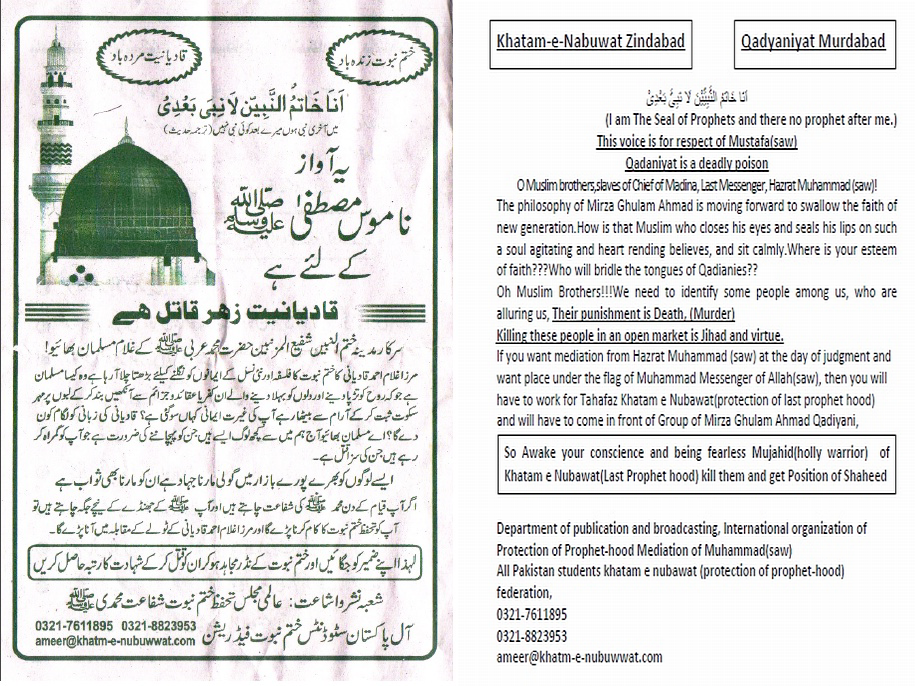
The government of the Punjab sponsored and held an ‘end of the prophet hood conference’ at the Badshahi Mosque in the provincial capital city of Lahore on April 11, 2009. At the occasion they even burnt an effigy of the holy founder of the Ahmadiyya community. Clerics, one after another, unrestrainedly proposed the denial of religious freedom to Ahmadis and indulged in slander and abuse. The conference was paid for with public funds. The federal Minister of Religious Affairs also addressed the conference.

On July 1, 2009 Mr Shahbaz Sharif, the Chief Minister of the Punjab province, presided over a meeting of high ranking clerics on the issue of terrorism. At the end of the conference a Declaration was issued and in its clause 2 the conference declared that “Anyone who is guilty, directly or indirectly, openly or by implication, of even minor insolence to the Holy Prophet (PBUH) is an infidel (Kafir), apostate (Murtad) and must be put to death (Wajib-ul-Qatl).” They linked this statement in the text to the ‘end of prophethood’. The declaration was given wide publicity through an advertisement campaign in the vernacular press.

The Central Police Office of Azad Kashmir issued an office circular dated March 5, 2009 on the subject of Suppression of Ahmadiyyat. A prominent sectarian leader Mr. Pir Atiqur Rahman has been appointed Minister of Auqaf (Religious Trusts) of Azad Kashmir government.

In District Layyah of Punjab province, five Ahmadis including four school-going children were arrested on a fabricated charge of blasphemy. They suffered in prison for almost six months before they were released on bail.

Thirty two Ahmadis of Lathianwala, Punjab province, were accused of blasphemy in a single case on July 25, 2009 with FIR 486/09 at Police Station Khurarianwala, Punjab. The authorities took four months to drop the fabricated charge of blasphemy. A heavy police contingent raided their mosque and homes on August 10, 2009 and removed all religious and Arabic inscriptions on their walls. YouTube displayed the video of the outrage under title: Acts of Blasphemy by Pakistani Authorities.

Seventy-four Ahmadis were booked during the year under anti-Ahmadiyya and religious laws on spurious grounds. These laws carry penalties of death and long-term imprisonments. A woman school teacher, Ms Bushra Naheed was booked on March 5, 2009 under section PPC 295-A, which is section of law that deals with deliberate and malicious act to outrage religious feelings of any class by insulting the religion or religious beliefs. The charge is triable in an anti-terrorist court, and it is punishable by ten years imprisonment. The lady was only accused of speaking harshly to a woman worker.

Ahmadiyya mosques continued to be targeted throughout the year. One mosque in Kalaswala, Punjab, was destroyed by miscreants while another was attacked by a grenade in Sialkot. Freedom of worship was denied to Ahmadis at Chiniot and Tatle Aali by police officials. A police party used chisels, cement and paint to remove all Arabic inscriptions from the Ahmadiyya mosque in Lathianwala, Punjab.

At Pir Mahal, District Toba Tek Singh Mullas agitated, attacked and defiled an Ahmadiyya graveyard in June 2009. The local authorities, rather than taking action against the clerics, proceeded to cancel the allotment order of the graveyard land to Ahmadis.

A Summary of the Persecution of Ahmadis in Pakistan
From January 1 — December 31, 2009

Ahmadis murdered for their faith

  1. Mr. Saeed Ahmad was killed in Kotri on Jan 19, 09.
  2. Mr. Mubashir Ahmad was shot dead on Feb 20, 09 in Karachi.
  3. Mr. Shiraz Bajwa and his wife Noreen Bajwa both doctors were brutally murdered on Mar 14, 09 in Multan.
  4. Mian Laiq Ahmad was killed in Faisalabad on May 29, 09.
  5. Two Ahmadis, Mr. Khalid Rasheed and Mr. Zafar Iqbal were shot dead on Jun 24, 09 in Quetta.
  6. Rana Ata-ul-Karim was murdered on Jul 06, 09 in Multan.
  7. Mr. M. Ahmad Farooqi was shot dead on Sep 26, 09 in Uch Sharif,Bahawalpur.
  8. Zulfiquar Mansur was murdered brutally on Sep 11, 09. He had been abducted a month earlier.
  9. Rana Saleem Ahmad, the Deputy Amir of Jamaat Ahmadiyya Sanghar was shot dead on Nov 26, 09.

Ahmadis behind bars

  1. Mr. Muhammad Iqbal was imprisoned for life in a fabricated case of blasphemy. He was arrested in March 2004, and is currently incarcerated in the Central Jail, Faisalabad. An appeal has been filed with the Lahore High Court against the decision of the Sessions Court. It is registered as Criminal Appeal No. 89/2005. He is now in the sixth year of his imprisonment.
  2. Three Ahmadis; Mr. Basharat, Mr. Nasir Ahmad and Mr. Muhammad Idrees along with seven others of Chak Sikandar, Punjab province, were arrested in September 2003 on a false charge of murdering a cleric. The police, after due investigation found no evidence against the accused. Yet they faced a ‘complaint trial’ for a crime they did not commit. They are being held on death row at a prison in Jehlum, while their appeal lies with the Lahore High Court. They are now in the seventh year of their incarceration. Their appeal to the Lahore High Court is registered as Criminal Appeal No. 616/2005 dated 26 April 2005.
  3. Dr. Muhammad Asghar was arrested on a fabricated charge of blasphemy in June 2008. The judge rejected his plea for bail. The police investigation found him innocent. Subsequently his plea for bail was rejected by the High Court — and the Supreme Court. The Supreme Court has directed his expeditious trial which is now in progress. It is learnt that his plea for bail has now been accepted by the Supreme Court, but he was still in prison on December 31.

Ahmadis who were made to face charges

  1. Thirty-seven Ahmadis were wrongfully booked under the dreaded blasphemy laws.
  2. Fifty-seven Ahmadis were charged under Ahmadi-specific laws.
  3. Ms. Bushra Naheed, an Ahmadi school teacher was falsely charged under PPC 295-A, triable in Anti-terrorism court. She is accused only of speaking harshly to a woman worker.
  4. An Ahmadiyya mosque was desecrated in Lathianwala; Kalima (Islamic Creed) and Islamic terminology written on the walls of the mosque as well as Ahmadis’ houses was covered with cement and paint by the police. A case was registered against 32 Ahmadis under 295-A, 295-C and 298-C, etc.

Murder Attempts

  1. A murder attempt was made on Mr. Muhammad Iqbal Abid, an Ahmadi religious teacher on February 25, 2009 at Vehari.
  2. An Ahmadi college lecturer, Mr. Mubashir Ahmad Tahir escaped death from murderers in Chakwal. He received serious injuries when they tried to behead him.
  3. An Ahmadi lawyer Mr. Riasat Ali Bajwa was attacked on May 4, 2009.
  4. Another Ahmadi Mr. Javed Ahmad escaped a murder attempt on August 12, 2009 in Kunri.
  5. Mr. Luqman Ahmad Gondal s/o Mr. Nasir Ahmad Gondal (president of the local Ahmadiyya community) closely escaped an attempt on his life on September 12, 2009.
  6. Mr. Muhammad Ayaz, 20-years old son of a former president of the district Ahmadiyya community became the target of an attack on his life on February 7, 2009.
  7. Dr Pervaiz Zareef of Bhati Gate, Lahore closely escaped an attempt on his life on November 25, 2009.

Abduction of Ahmadis

  1. Qamar Ahmad, an Ahmadi was abducted by two men in the vicinity of his home at about 21:30 on March 16, 2009. He was left unconscious on roadside.
  2. Mr. Bashir Ahmad Advocate, President of the local Ahmadiyya community, Achini Payan, near Peshawar was abducted on April 1, 2009. He has not been recovered yet.
  3. Mr. Rashid Karim, a well-known Ahmadi in Faisalabad, was abducted on May 9, 2009. He was released 5 months later after payment of heavy ransom.
  4. Mr. Zulfiquar Mansur was abducted at Quetta in September 2009. A month later his dead body was recovered from roadside in city’s suburbs.

Miscellaneous

  1. Four school-going children of 9th and 10th grade were falsely charged under PPC 295-C in Layyah; they remained incarcerated for about 6 months.
  2. An Ahmadiyya mosque was attacked with a grenade in Sialkot.
  3. A gang of religious extremists, comprising approximately 50 men attacked an Ahmadiyya mosque in the village of Kalaswala on October 27 and destroyed it.
  4. All Ahmadi teachers were fired from Qurban High School in Lahore under the pressure of mullas.
  5. Four rockets were launched against an Ahmadi-owned industrial plant in Feb 09.
  6. Anti-Ahmadiyya Khatm-e-Nabuwwat Conference was held in the Royal Mosque, Lahore under the auspices of the provincial government in April 2009.
  7. An Ahmadiyya graveyard was attacked and desecrated by rioters in Pir Mahal, Toba Tek Singh in June 09. Thereafter the authorities cancelled the land allotment order issued by them to Ahmadis 20 years ago.
  8. Two Ahmadis were assaulted for their faith on August 7, 2009 in Nankana.
  9. A Khatme Nabuwwat Conference was held in Rabwah by rabid mullas on 15, 16 October 2009. It is worth noting that Ahmadis, who are 95% of the Rabwah population, are not allowed to hold their gatherings and sports competitions in this town, while the authorities allow the fundamentalists to hold conferences in Rabwah, in which they use highly provocative language against Ahmadi residents of Rabwah.
  10. SHO Police Station Chiniot City, ordered Ahmadis of Kot Muhammad Yar to stop their weekly Friday worship.
  11. Ahmadis of Tatle Aali, District Gujranwala were forbidden by the local police to congregate for prayers.

# # #

About AHRC: The Asian Human Rights Commission is a regional non-governmental organisation monitoring and lobbying human rights issues in Asia. The Hong Kong-based group was founded in 1984

URL: www.ahrchk.net/statements/mainfile.php/2009statements/2397/

Right to Worship Still Under Threat, Watchdog Warns

---Jakarta Globe, Indonesia
February 03, 2010
Nurfika Osman

Right to Worship Still Under Threat, Watchdog Warns

In another blow to Indonesia’s drive for religious tolerance, a report released on Wednesday said 200 violations against freedom of worship were filed with state agencies in 2009, involving 139 cases.

Hendardi, the chairman of the Setara Institute for Democracy and Peace, said the violations occurred because of the country’s poor efforts in upholding religious freedom.

“The 1945 Constitution [Article 28 A paragraph 2] guarantees freedom of religion or belief … yet these rights are seriously neglected and not enforced as the violations continue to occur,” Hendardi said. “The government is half-hearted in upholding the right to worship.”

He said that the institute monitors freedom of religion in Jakarta, Banten West Java, Central Kalimantan, North Sulawesi, Gorontalo, Bali, Maluku, West and East Nusa Tenggara, and North, West, and South Sumatra.

“West Java has the highest number of violations, with 57 cases, followed by Jakarta with 38 cases,” he said, adding that Banten was third with 10.

He said state agencies and officials often prohibited believers of certain faiths, such as Christians and the Ahmadiyah sect of Islam, from praying or building places of worship.

“We also found government officials discriminating groups such as Ahmadiyah and prohibiting them from using public facilities,” he said. “Officials from the Religious Affairs Ministry and the Indonesian Ulema Council [MUI] are among them.”

“The Ahmadiyah remains the most persecuted community having fallen victim in 33 cases recorded in 2009,” Hendardi said.

The most flagrant abuse last year was the attack on Ahmadiyah supporters by the FPI and other hard-line Islamic groups at a pro-tolerance rally at Monas. Many Ahmadiyyah followers, he said, were being rejected by their villages in West Nusa Tenggara.

Other violations against the Muslim sect, such as burning their mosques and limiting their access to conduct prayer, were also recorded last year.

According to the report, there were fewer violations of the right to worship than in 2008, which saw 265 cases.

Rohadi Abdul Fatah, the director of Islam and Shariah law at the Ministry of Religious Affairs, denied Setara’s accusations.

“That is a lie and their research lacks strong referencing. Our officials always work according to the law and procedure,” Rohadi told the Jakarta Globe. “We never harm other groups, by, for example, prohibiting them from using public facilities or burning their places of worship. That is totally against human rights and the law.”

Regarding the Ahmadiyah, he said that the ministry did not tolerate them, but that did not mean the ministry did not protect them.

“We keep persuading the Ahmadiyah through education and communication so that they will return to the right path of Islam,” he said. “We don’t tolerate anyone who harms them even though their belief is not acceptable in Islam.”

Slamet Effendy Yusuf, the head of interreligious harmony department at the MUI, agreed.

“The Setara research is not correct and they never confirm what they have found to MUI,” Slamet said.

“We have committed no violations. In fact, whenever there are interreligious disputes, we are the ones who encourage dialogue to settle the disputes.”

Regarding the establishment of worship places, both said that devotees of every religion had to first ask local residents.

“There are no restrictions to establishing a church or any kind of place of worship because the freedom to do so is governed by a joint ministerial regulation,” Slamet said.

“However, the regulation states that permission should be sought from the local residents.”

Copyright 2010 The Jakarta Globe
 
^ Top of Page