Showing posts with label Setara Institute for Democracy and Peace. Show all posts

Wednesday, April 7, 2010

Intolerant Islamic groups versus religious minorities

---The Jakarta Post, Indonesia
Features | Wed, 04/07/2010 8:32 AM
Intolerant Islamic groups versus religious minorities

A. Junaidi, The Jakarta Post, Jakarta

A wind of change swept through civil and political liberties under the so-called reform era – which was marked by the downfall of president Soeharto’s authoritarian regime 12 years ago.

But overtime, growing religious conservatism, if not downright radicalism, also crept through Indonesian society. Religious conflicts became unavoidable, and the victims, of course are the minorities.

The latest spat, which occurred last Friday, involved a group of people under the aegis of the Parung Ulema Forum who demanded Catholics cancel their Good Friday mass at their Saint Johannes Baptista Church in Bogor, West Java.

Earlier this year, another Muslim group protested against the building of the Filadelfia Huria Kristen Batak Protestant (HKBP) church in Bekasi, also in West Java. Subjected to relentless pressure, Bekasi Regent Sa’aduddin unilaterally banned the construction, forcing the congregation to hold its Sunday service in an open field nearby.

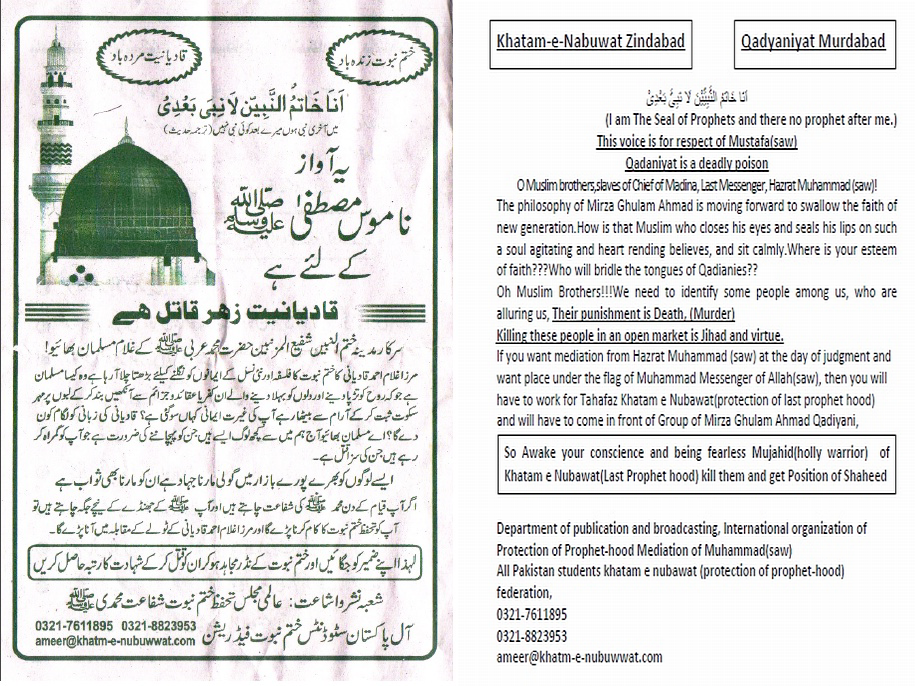
Tensions has not only flared up between certain Muslim groups and Christians, but also “inside” the Muslim community. The “victims” tend to hold different interpretations of Islamic teachings. Muslim hardliners, for instance, have been targeting the likes of Jamaah Ahmadiyah.

Many followers of traditional beliefs have also complained about the “threat” of increasing conservatism.

According to a report issued by the Setara Institute for Democracy and Peace, there were 200 violations of freedom of worship last year. The institute recorded 265 similar cases in 2008 and 135 cases in 2007.

Setara added that in many of the cases, state officials were either “actively” involved or guilty by “lack of action” or “omission”. State institutions involved include the police, the ministry of religious affairs, mayors, regents and courts.

According to the report, the Indonesian Ulema Council, the Islam Defender Front and the Forum of Islamic Community or FUI were the main culprits behind most of the violations of freedom of worship. Most of the cases occurred in West Java, Jakarta and Banten.

Setara is one of several organizations – including Imparsial, the Policy Research and Advocacy (Elsam), the Indonesian Human Rights and Legal Aid Association (PBHI), the Institute for Studies on Human Rights and Democracy (Demos), the Desantara Foundation, the Indonesian Legal Aid Foundation (YLBHI), which filed a petition asking the Constitutional Court to revoke the 1965 Blasphemy Law, deemed as discriminatory against certain religious groups.

High-profile personalities who joined the groups include late former president Abdurrahman “Gus Dur” Wahid, Muslim activist M. Dawam Rahardjo, noted Islamic scholar Ahmad Syafii Maarif and women activist Musdah Mulia.

The petitioners believe the law can trigger sectarian conflicts as it only officially recognizes five religions: Islam, Catholicism, Protestantism, Buddhism and Hinduism. Gus Dur’s administration later acknowledged Confucianism as an official religion. One article of the Blasphemy Law bans people from interpreting religious teachings differently from official religions.

The law is believed to violate the State Constitution, which guarantees freedom of religion.

The court has been conducting hearings every Wednesday and Friday to hear the opinions of petitioners, government officials and dozens of experts.

URL:
www.thejakartapost.com/news/2010/04/07/int...minorities.html

Monday, March 1, 2010

Blasphemy Law Leads to Human Rights Abuses: Activists

---Jakarta Globe, Indonesia
March 01, 2010 - Nivell Rayda
Blasphemy Law Leads to Human Rights Abuses: Activists

Liberal religious and human rights activists on Monday called on the government to overturn the 1965 law on blasphemy and replace it with one that better protected freedom of religion.

Dawam Raharjo, president director of the Religious and Philosophical Study Institute (LSAF), said the law, which is being reviewed by the Constitutional Court, paved the way for serious human rights abuses and allowed minority religious groups to be persecuted.

“There is no alternative but to annul the law. The government should replace the law with one that actually protects religious freedom,” he said. “The law only provides the opportunity and legal basis for mainstream religious groups to intimidate minorities.”

Dawam said police were reluctant to protect religious minorities because of the law.

“The majority of intimidation cases end up with the arrests of the minority followers while the attackers are protected,” he said. “There is little protection for citizens to practice their beliefs.”

Hendardi, chairman of the Setara Institute for Democracy and Peace, a human rights group, said his organization had uncovered hundreds of cases of abuse of religious minorities.

“These range from burning and destroying places of worship and banning minorities from practicing their beliefs to acts of violence and threats [against individuals],” he said.

“The 1945 Constitution guarantees freedom of religion and belief, yet these rights are neglected and unenforced. Meanwhile, there are people who are forced to practice their religion in secrecy out of fear of intimidation.”

Last Friday, New York-based Human Rights Watch wrote to US President Barrack Obama, urging him to make human rights issues, including the blasphemy law, key discussion points during his visit to Indonesia from March 20-22.

The group questioned the Indonesian government’s commitment to religious freedom because it continued to defend the antiquated blasphemy law.

The minister of religious affairs, Suryadharma Ali, and the minister of justice and human rights, Patrialis Akbar, both from conservative Muslim parties, the United Development Party (PPP) and National Mandate Party (PAN), respectively, have condemned the court’s review.

They have insisted that the law “ensured freedom of religion,” and argued that changing it would “create horizontal conflicts.”

“It is the government’s prerogative to say that,” Hendardi said. “But our data suggests otherwise — that the law inhibits freedom of religion.”

The law recognizes only six religions: Islam, Protestantism, Catholicism, Buddhism, Hinduism and Confucianism. Other religions are officially banned.

The law also prohibits alternative interpretations of recognized religions, particularly Islam.

In 2008, the government used the law to formally ban Ahmadiyah, a minority Islamic sect, because it held that its founder, Mirza Ghulam Ahmad, was the last prophet of Islam, a claim that contradicts mainstream Muslim beliefs.

Copyright 2010 The Jakarta Globe
URL: www.thejakartaglobe.com/news/blasp...-rights-abuses-activists/361433

Thursday, February 4, 2010

Right to Worship Still Under Threat, Watchdog Warns

---Jakarta Globe, Indonesia
February 03, 2010
Nurfika Osman

Right to Worship Still Under Threat, Watchdog Warns

In another blow to Indonesia’s drive for religious tolerance, a report released on Wednesday said 200 violations against freedom of worship were filed with state agencies in 2009, involving 139 cases.

Hendardi, the chairman of the Setara Institute for Democracy and Peace, said the violations occurred because of the country’s poor efforts in upholding religious freedom.

“The 1945 Constitution [Article 28 A paragraph 2] guarantees freedom of religion or belief … yet these rights are seriously neglected and not enforced as the violations continue to occur,” Hendardi said. “The government is half-hearted in upholding the right to worship.”

He said that the institute monitors freedom of religion in Jakarta, Banten West Java, Central Kalimantan, North Sulawesi, Gorontalo, Bali, Maluku, West and East Nusa Tenggara, and North, West, and South Sumatra.

“West Java has the highest number of violations, with 57 cases, followed by Jakarta with 38 cases,” he said, adding that Banten was third with 10.

He said state agencies and officials often prohibited believers of certain faiths, such as Christians and the Ahmadiyah sect of Islam, from praying or building places of worship.

“We also found government officials discriminating groups such as Ahmadiyah and prohibiting them from using public facilities,” he said. “Officials from the Religious Affairs Ministry and the Indonesian Ulema Council [MUI] are among them.”

“The Ahmadiyah remains the most persecuted community having fallen victim in 33 cases recorded in 2009,” Hendardi said.

The most flagrant abuse last year was the attack on Ahmadiyah supporters by the FPI and other hard-line Islamic groups at a pro-tolerance rally at Monas. Many Ahmadiyyah followers, he said, were being rejected by their villages in West Nusa Tenggara.

Other violations against the Muslim sect, such as burning their mosques and limiting their access to conduct prayer, were also recorded last year.

According to the report, there were fewer violations of the right to worship than in 2008, which saw 265 cases.

Rohadi Abdul Fatah, the director of Islam and Shariah law at the Ministry of Religious Affairs, denied Setara’s accusations.

“That is a lie and their research lacks strong referencing. Our officials always work according to the law and procedure,” Rohadi told the Jakarta Globe. “We never harm other groups, by, for example, prohibiting them from using public facilities or burning their places of worship. That is totally against human rights and the law.”

Regarding the Ahmadiyah, he said that the ministry did not tolerate them, but that did not mean the ministry did not protect them.

“We keep persuading the Ahmadiyah through education and communication so that they will return to the right path of Islam,” he said. “We don’t tolerate anyone who harms them even though their belief is not acceptable in Islam.”

Slamet Effendy Yusuf, the head of interreligious harmony department at the MUI, agreed.

“The Setara research is not correct and they never confirm what they have found to MUI,” Slamet said.

“We have committed no violations. In fact, whenever there are interreligious disputes, we are the ones who encourage dialogue to settle the disputes.”

Regarding the establishment of worship places, both said that devotees of every religion had to first ask local residents.

“There are no restrictions to establishing a church or any kind of place of worship because the freedom to do so is governed by a joint ministerial regulation,” Slamet said.

“However, the regulation states that permission should be sought from the local residents.”

Copyright 2010 The Jakarta Globe

Thursday, January 28, 2010

‘Government complicity’ lets religious conflict go on

---The Jakarta Post, Indonesia
Headlines Thu, 01/28/2010 9:33 AM

‘Government complicity’ lets religious conflict go on

The Jakarta Post, Jakarta

A damning report on freedom of worship in Indonesia has blasted state agencies and government officials for complicity in violating this fundamental right.

The Setara Institute for Democracy and Peace released Wednesday its Report on the Condition of Religious and Faith Freedom in Indonesia, revealing 200 violations against freedom of worship throughout 2009.

The institute claimed state agencies had been involved in 139 of the cases — 101 of the cases saw “active” involvement by state officials, while the 38 others were by omission.

“Over the last three years, we have found that violations against freedom of religion remain rampant,” Setara Institute chairman Hendardi said at a press conference.

“This is mostly because the government is half-hearted in its upholding of the right to worship.”

State institutions outed by the report include the police, which Setara claimed were involved in 48 cases, the Religious Affairs Ministry (14 cases), mayors (eight cases), regents (six cases) and courts (six cases).

“State agencies often prohibit certain groups from praying or building a place of worship,” Hendardi said.

“We also found government officials discriminated against other groups, prohibiting them from using public facilities.”

He added that in many cases of attacks by Muslim mobs on congregations of other faiths, the authorities turned a blind eye and sided with the offending majority.

An attack against supporters of the Ahmadiyah sect in Jakarta, for instance, led to arrests of Ahmadiyah members, and not their attackers.

The police claimed they did this to protect the Ahmadis.

Setara also categorized 86 cases in their findings as crimes that should have been dealt with by law enforcement officials.

The violators in 29 of these cases were the Indonesian Ulema Council (MUI), the hard-line Islam Defenders Front or FPI (nine cases), and the Forum of Islamic Community or FUI (six cases).

“The Ahmadis remained the most persecuted community, falling victim in 33 separate cases during 2009,” Hendardi said.

“Christians were next with 12 cases, then followers of the Satria Piningit Weteng Buwono sect with 10 cases.”

The number of cases last year was lower than in 2008, when Setara highlighted 265 violations.

The most prominent case in 2008 was the attack on Ahmadiyah supporters by the FPI and other hard-line Islamic groups at a pro-tolerance rally at the National Monument in Jakarta.

In 2007, Setara recorded only 135 violations of freedom of worship.

The institute monitors freedom of worship in 12 provinces: North, West and South Sumatra; Banten, Jakarta, West Java, Central Kalimantan, North Sulawesi, Gorontalo, Bali, West and East Nusa Tenggara, and Maluku.

West Java had the highest number of violations, with 57 cases, followed by Jakarta with 38 cases and Banten with 10 cases.

With violations on the rise from three years ago, the Setara Institute urged the government to pass legislation on religious tolerance as soon as possible.

“We also ask the government to integrate lessons on tolerance and pluralism into the national education curriculum,” said deputy chairman Bonar Tigor Naipospos.

He also called on President Susilo Bambang Yudhoyono to make good on a campaign promise to revoke all bylaws violating freedom of worship. (bbs)

URL: www.thejakartapost.com/news/2010/01/28/%E2%80%98govern...eligious-conflict-go.html
 
^ Top of Page