Showing posts with label tyranny. Show all posts

Monday, November 8, 2010

SBY urged to prove RI’s tolerance

NATIONAL
Mon, 11/08/2010
9:31 AM

SBY urged to prove RI’s tolerance
Arghea Desafti Hapsari, The Jakarta Post, Jakarta

Ahead of US President Barack Obama’s visit to Indonesia, Human Rights Watch (HRW) has urged President Susilo Bambang Yudhoyono to repudiate statements made by religious affairs minister on banning the Ahmadiyah congregation.

The US-based Human Rights Watch recently said in a letter to Yudhoyono that the President should uphold freedom of religion.

“Yudhoyono should take clear steps to protect religious freedom, starting with loudly rejecting any ban on the Ahmadis, and ensuring that those responsible for attacks on Ahmadiyah homes and mosques are prosecuted,” HRW deputy Asia director Phil Robertson said.

“President Yudhoyono gave a nationwide speech about religious tolerance in the US, but what will he tell visiting US President Barack Obama about the Ahmadiyah mosques burned in Indonesia?” he added. Obama is scheduled to visit Indonesia on Tuesday.

Ahmadiyah mosques and homes in Indonesia have been the target of intimidation and a series of attacks, reportedly not only committed by civilians, but also by the authorities. The latest incident occurred on Friday in North Jakarta, where the city authority supported the demands of 20 university students who demanded the closure of an Ahmadiyah mosque in the municipality.

Yudhoyono previously told an audience at Harvard University that Indonesia “has shown that Islam, modernity and democracy — plus economic growth and national unity — can be a powerful partnership.”

The President also said Indonesia wanted to ensure that tolerance and respect for religious freedom was part of its “trans-generational DNA”, and that the nation was a powerful example of how Islam, democracy and modernity can go “hand in hand”.

In a report released in August, the Setara Institute for Peace and Democracy recorded 291 incidents categorized as violations of freedom of faith in Indonesia. Of this number, 33 targeted followers of Jamaah Ahmadiyah, which has an estimated 200,000 followers.

Religious Affairs Minister Suryadharma Ali has repeatedly called for the Ahmadiyah faith to be banned in Indonesia. In late August he claimed that after seeking divine advice, he concluded that banning Ahmadiyah would be the best solution.

In a press statement, HRW said President Yudhoyono had failed to repudiate those statements, leading many to believe he supported the idea.

Anti-Ahmadiyah violence has increased since Yudhoyono announced a prohibition on teachings or public displays of the Ahmadiyah religion in June 2008, HRW said.

“President Yudhoyono should order Minister Suryadharma to stop playing with fire with his demands to ban the Ahmadiyah,” Robertson said.

Chairman of the House of Representatives’ Commission VIII overseeing religious affairs, Abdul Kadir Karding, told The Jakarta Post on Sunday that he found Suryadharma’s statements “unwise”.

Saturday, October 30, 2010

Religious Affairs Minister to ban Ahmadiyah

NATIONAL
Sat, 10/30/2010
10:35 AM

Religious Affairs Minister to ban Ahmadiyah
The Jakarta Post, Jakarta

GARUT, West Java: Religious Affairs Minister Suryadharma Ali said he wanted to disband Ahmadiyah but he did not offer timetable for the sect’s dissolution.

He said that after a long period of contemplation and asking for divine advice, he concluded that banning Ahmadiyah would be the best solution for all the problems relating to the group, which mainstream Muslims view as heretical.

Suryadharma said that Ahmadiyah should abandon Islam and stop using Islamic symbols such as the Koran and mosques.

“If they refuse to join the mainstream, they must not use Islamic symbols,” he said as quoted by tempointeraktif.com.

Suryadharma and strict Muslims have objected to Ahmadiyah’s refusal to acknowledge that Muhammad was Islam’s last prophet.

Local Ahmadiyah leader Rahmat Syukur Maskawan rejected the minister’s ideas, saying that, fundamentally, Ahmadis were Muslims who believed that Mirza Ghulam Ahmad was the person who continued Muhammad’s propagation of Islam. — JP

Wednesday, October 13, 2010

Ahmadis may be relocated to an island ‘for their own good’

HEADLINES
Wed, 10/13/2010
10:05 AM

Ahmadis may be relocated to an island ‘for their own good’
Panca Nugraha, The Jakarta Post, Mataram

It is proposed that Ahmadiyah followers be relocated to an island, some 60 kilometers south of West Nusa Tenggara capital Mataram, as the West Lombok regency administration is seeking “to provide protection for these displaced people”.

“We have discussed the plan in a coordination meeting with the regency’s officials and community and religious leaders. They’re probably going to be relocated,” the regency administration’s spokesman Ispan Junaedi said on Tuesday.

Over a hundred of the followers of the Islamic sect have taken shelter at Wisma Transito building in Mataram after being kicked out of their homes in Ketapang hamlet in Lingsar district on Feb. 4, 2006.

West Lombok Regent Zainy Arony had earlier told reporters the relocation plan was intended to protect Ahmadiyah followers.

He said the plan was made based on human rights consideration since under the law, and despite their beliefs, they are Indonesian citizens, who were protected.

“We also hope the provincial administration to play a role in assisting solve the problem,” Zainy said.

Ahmadiyah followers said they did not know about the plan.

“I just found out about the plan after an interview with a BBC London journalist. We regret the plan has not involved us,” Ahmadiyah provincial chapter head Jauzi Djafar told The Jakarta Post on Tuesday.

He said the relocation plan may be an acceptable solution for the refugees, who have been denied their rights for the past five years, but they had to be involved in the plan.

He said that the 127 Ahmadiyah followers living in the shelter were still hoping they could return to their homes in Ketapang hamlet.

He said the regency administration would need to provide houses and to ensure their safety.

“Why don’t they just compensate them for their assets lost in Ketapang so they can find new places to live outside the shelter?” Jauzi said

“And if there is guarantee of their safety, why there is a need to be relocated? Why not return them to their hometown as before? We’re confused about this plan.”

Religious Affairs Minister Suryadharma Ali claimed in Medan, North Sumatra on Monday that disbanding Ahmadiyah “would cause fewer problems than keeping it in existence”, insisting this was not discriminatory since the sect spread false Islamic teachings.

He said that the 2008 joint ministerial decree on the sect, which banned the Ahmadis from propagating their views — allegedly leading to attacks on the sect by hardline Muslims, would not be changed.

The latest attack against the sect, believed to have some 200,000 followers across the country, took place in Bogor, West Java, when some 20 people threw stones and set fire to Ahmadiyah houses and places of worship in Ciampea. A mosque, five houses, a car and two motorcycles were burned in the attack.

Monday, October 11, 2010

Ahmadis continue to live in fear

CITY
Mon, 10/11/2010
10:30 AM

Ahmadis continue to live in fear
The Jakarta Post, Bogor/West java

Intimidated by rumors of another assault, more than 600 residents in the isolated Cisalada neighborhood in Ciampea Udik village, Bogor, are living in fear after fresh violence.

“I’m afraid to go to the traditional market because other residents might try to kill me,” 51-year-old Lela (not her real name) told The Jakarta Post last week.

Lela and her husband live in a house only a dozen meters away from a mosque that was torched on Friday.

“I cannot erase the horrific memory of dozens of young men from Pasar Salasa and Kebon Kopi [areas] suddenly attacking our neighborhood,” she said.

Lela was referring to an incident that took place last Friday evening, when approximately 20 people attacked Cisalada residents at around 7:15 p.m. Assailants threw stones and Molotov cocktails, and burned more than 30 Koran at an Ahmadiyah mosque that was under construction. The mob disbursed but later returned in larger numbers and set fire to five houses, a car and two motorcycles.

So far, none of the assailants have been apprehended, but one Ahmadi was arrested on Monday for allegedly stabbing one of the attackers.

Yellow police lines surrounded the remains of shattered buildings when the Post visited the area.

Soldiers and police officers used empty houses as makeshift base camps. Five police trucks were parked in schoolyard that no longer had glass in its window frames. Some officers patrolled the area with rifles slung around their shoulders.

Lacking confidence in the authorities’ ability to prevent further attacks, some residents decided to move their families to other areas in Bogor, West Java.

Ali, a 34-year-old university student living in Jakarta, came home to visit his mother and help her move to temporarily stay with relatives

“I’m worried about her, especially considering these rumors of an even larger assault,” he said.

A nearby house belonging to Ali’s uncle was allegedly raided by the angry mob during the incident.

Even though the incident was immediately reported to the nearest police precinct, located only 7 kilometers away, the police finally arrived two hours after the initial assault, neighborhood unit chief Edi Humaedi said.

“I watched the mob marching toward us, and one hooligan even asked for my permission to burn our mosque. Can you imagine such a thing? They were just young kids,” Edi said.

He said he would defend his belief and neighborhood, to death if necessary, if another mob attacked his community.

Another resident from nearby Pasar Salasa, Dodon, 51, said he was angry with Ahmadiyah followers because their teachings were blasphemous and insulted Islam.

“Their Koran is different from ours. They have removed several verses and they believe that the Prophet Mohammad wasn’t the last prophet,” Dodon told the Post, although he also admitted to never read the Ahmadis’ scripture. (rch)

Ahmadiyah followers insist they are Muslims

NATIONAL
Mon, 10/11/2010
9:19 AM

Ahmadiyah followers insist they are Muslims

JAKARTA: Ahmadiyah congregation members have refuted suggestions made by mainstream Indonesian Muslims that they should abandon Islam and form a new religion.

“We object to those who do not consider us a part of Islam,” Ahmadi’s Garut branch executive Rahmat Syukur Maskawan said, as quoted by tempointeraktif.com on Sunday.

In response to the growing animosity, Indonesia’s largest Islamic organization, Nahdlatul Ulama (NU), suggested last week that Ahmadiyah followers should no longer claim that they are a part of Islam.

Followers of the sect would suffer from isolation if they insist on associating themselves with Islam while at the same time violating the basic teachings of the religion, NU deputy secretary-general Enceng Shobirin said.

The campaign to outlaw Ahmadiyah, a frequent target of persecution, was political. Rahmat said, adding that he deplored the statement made by NU and questioned the organization’s commitment to defending minority groups and upholding pluralism.

Ahmadiyah has been declared “heretical” by the Indonesian Ulema Council for saying that its founder, Mirza Ghulam Ahmad, was a prophet. Such belief is against the dominant view among Muslims that Muhammad was God’s last prophet. — JP

Friday, October 8, 2010

Editorial: Tyranny of the majority

EDITORIAL
Fri, 10/08/2010
9:45 AM

Editorial: Tyranny of the majority

The ongoing controversy over whether religious sect Ahmadiyah has the right to persist and it’s followers the right to freely profess their beliefs illustrates the long-standing issue that this nation has failed and is failing to protect the rights of it’s minorities.

Dubbed the world’s third-largest democracy, Indonesia has been facing difficulties in adopting and adapting itself to that very principle of democracy that is the respect for and protection of minorities.

Minority groups in Indonesia, including the approximately 200,000 Ahmadis, have to face the ugly fact that they are small in number and therefore prone to marginalization, discrimination and sometimes even persecution.

As of today, hundreds of Ahmadis on Lombok Island in West Nusa Tenggara have been living in shelters since their expulsion from their homes in February 2006. They have been denied their economic right to live a better life and their right to vote as evidenced when the local poll commission scrapped them from the voter roll in last year’s elections.

Worse, their children have had to experience the ordeal. Only last month the local government moved to provide free education for Ahmadi children.

The latest in a string of attacks on Ahmadiyah followers last week indicates the absence of any form of protection for minorities. Hundreds of Ahmadiyah members living in an enclave in the West Java regency of Bogor lost not only their belongings but perhaps also their hopes for a peaceful life in this country.

Regardless of the cause of last week’s arson attack, Ahmadiyah has been perceived as a threat to mainstream Muslims and a cause of destabilization. With ulema and Muslim figures failing to promote dialog, and instead fighting for a ban against Ahmadiyah, hard-line groups have found clemency in carrying out acts of violence against the religious sect.

Solutions for the Ahmadiyah problem initiated by Muslim leaders have so far constituted one-way traffic, in which the majority dictates and enforces it’s will on the minority. It is tyranny of the majority that is currently plaguing the country’s efforts to deal with Ahmadiyah.

Sadly, this is how this nation understands democracy. Political parties form a coalition within the House of Representatives annihilate dissenting voices during decision-making processes. Democracy has been hijacked to help the majority groups fulfill their interests.

In the Ahmadiyah case, the government as the representation of the state has failed to draw a line to protect the weak or the minority vis-à-vis the majority. But democracy prevails only if the rights of the minority are protected.

The enforcement of the 2008 joint ministerial decree on Ahmadiyah spoke volumes about the government’s perceptions on the rights of the strong, as the regulation amputated the basic rights of the Islamic sect’s followers and reinforced a stigma on them as an unwanted society.

A plan to review the decree that many expect will result in a permanent solution to the Ahmadiyah issue will be translated into a permanent ban against the religious sect as long as the tyranny of majority is at play. A new decree banning the sect would read as an expression of supreme power and illustrate that the government has failed to listen to their wishes.

British political philosopher John Stuart Mill noted that the danger of the tyranny of the majority lay not just in the infringements of individuals’ rights or the marginalization of a political minority, but in the oppression of minority groups in society based simply on criteria such as skin color, ethnicity, nationality, religion, or sexual orientation. Ahmadiyah and other minority groups deserve equal rights, unless of course this nation no longer believes in democracy.

Tuesday, June 1, 2010

Pakistan: Massacre of Minority Ahmadis


Pakistan: Massacre of Minority Ahmadis
Attack on Hospital Treating Victims Shows How State Inaction Emboldens Extremists
June 1, 2010

The mosque attacks and the subsequent attack on the hospital, amid rising sectarian violence, underscore the vulnerability of the Ahmadi community.
Ali Dayan Hasan, senior South Asia researcher
(New York) — Pakistan’s federal and provincial governments should take immediate legal action against Islamist extremist groups responsible for threats and violence against the minority Ahmadiyya religious community, Human Rights Watch said today.

On May 28, 2010, extremist Islamist militants attacked two Ahmadiyya mosques in the central Pakistani city of Lahore with guns, grenades, and suicide bombs, killing 94 people and injuring well over a hundred. Twenty-seven people were killed at the Baitul Nur Mosque in the Model Town area of Lahore; 67 were killed at the Darul Zikr mosque in the suburb of Garhi Shahu. The Punjabi Taliban, a local affiliate of the Pakistani Taliban, called the Tehrik-e-Taliban Pakistan (TTP), claimed responsibility.

On the night of May 31, unidentified gunmen attacked the Intensive Care Unit of Lahore’s Jinnah Hospital, where victims and one of the alleged attackers in Friday’s attacks were under treatment, sparking a shootout in which at least a further 12 people, mostly police officers and hospital staff, were killed. The assailants succeeded in escaping.

“The mosque attacks and the subsequent attack on the hospital, amid rising sectarian violence, underscore the vulnerability of the Ahmadi community,” said Ali Dayan Hasan, senior South Asia researcher at Human Rights Watch. “The government’s failure to address religious persecution by Islamist groups effectively enables such atrocities.”

The US Department of State annual report on human rights recorded the killing of 11 Ahmadis for their faith in 2009.

Human Rights Watch called on Pakistan’s government to immediately introduce legislation in parliament to repeal laws discriminating against religious minorities such as the Ahmadis, including the penal statute that makes capital punishment mandatory for “blasphemy.”

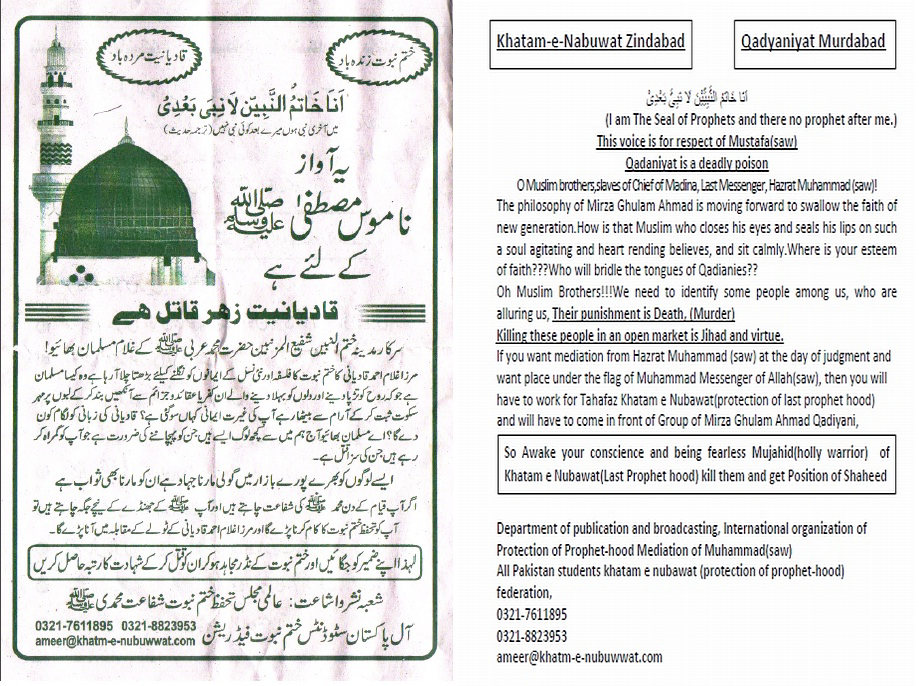
Human Rights Watch also urged the government of Punjab province, controlled by former prime minister Nawaz Sharif’s Pakistan Muslim League (Nawaz) party, to investigate and prosecute as appropriate campaigns of intimidation, threats, and violence against the Ahmadiyya community by Islamist groups such as the Sunni Tehrik, Tehrik-e-Tahafaz-e-Naomoos-e-Risalat, Khatm-e-Nabuwat and other groups acting under the Taliban’s umbrella. Leaders of these groups have frequently threatened to kill Ahmadis and attack the mosques where the killings took place. The anti-Ahmadiyya campaign has intensified in the past year, exemplified by the government allowing groups to place banners seeking the death of “Qadianis” (a derogatory term for Ahmadis) on the main thoroughfares of Lahore.

The independent, non-governmental Human Rights Commission of Pakistan (HRCP) and Ahmadi community leaders told Human Rights Watch that they had repeatedly brought these threats to the notice of Punjab Chief Minister Shahbaz Sharif, the provincial government, and the police controlled by the provincial authorities, and that they had asked for enhanced security for Ahmadiyya mosques given their vulnerability to attack. However, Human Rights Watch research found that the provincial government failed to act on the evidence or to ensure meaningful security to the mosques.

On May 30, Zaeem Qadri, advisor to Punjab Chief Minister Shahbaz Sharif, said in an interview on Dunya TV that the provincial government had failed to remove the threatening banners from the city’s thoroughfares in order to prevent “adverse reaction against the government” by the groups responsible. On the same day, a Taliban statement “congratulated” Pakistanis for the attacks, calling people from the Ahmadiyya and Shia communities “the enemies of Islam and common people” and urging Pakistanis to take the “initiative” and kill every such person “in range.

“The Punjab government is either in denial about threats to Ahmadis and other minorities or is following a policy of willful discrimination,” said Hasan. “The Punjab government’s law enforcement authorities need to dispense with traditional prejudices and proactively protect heterodox communities like the Ahmadis, who now are in clear and serious danger from both the Taliban and sectarian militant groups historically supported by the state. ”

Founded in 1889 by Mirza Ghulam Ahmad, the Ahmadiyya community is a religious group that identifies itself as Muslim. Estimates suggest at least two million Ahmadis live in Pakistan. Ahmadis differ with other Muslims over the exact definition of Prophet Mohammad being the “final” monotheist prophet. Many Muslims consider the Ahmadiyya to be non-Muslims.

The persecution of the Ahmadiyya community is wholly legalized, even encouraged, by the Pakistani government. Pakistan’s penal code explicitly discriminates against religious minorities and targets Ahmadis in particular by prohibiting them from “indirectly or directly posing as a Muslim.” Ahmadis are prohibited from declaring or propagating their faith publicly, building mosques or even referring to them as such, or making the call for Muslim prayer.

Pakistan’s “Blasphemy Law,” as section 295-C of the Penal Code is known, makes the death penalty mandatory for blasphemy. Under this law, the Ahmadiyya belief in the prophethood of Mirza Ghulam Ahmad is considered blasphemous insofar as it “defiles the name of Prophet Muhammad.” In 2009, at least 50 Ahmadis were charged under various provisions of the blasphemy law across Pakistan. Many of these individuals remain imprisoned.

Since the military government of Gen. Zia-ul-Haq unleashed a wave of persecution in the 1980s, violence against the Ahmadiyya community has never really ceased. Ahmadis continue to be killed and injured, and have their homes and businesses burned down in anti-Ahmadi attacks. The authorities continue to arrest, jail and charge Ahmadis for blasphemy and other offenses because of their religious beliefs. In several instances, the police have been complicit in harassment and the framing of false charges against Ahmadis, or stood by in the face of anti-Ahmadi violence.

“Ahmadis unfortunately become easy targets in times of religious and political insecurity,” said Hasan. “The Pakistani government has emboldened the extremists by failing to take action. It needs to repeal the laws used to persecute Ahmadis, and it must prosecute those responsible for anti-Ahmadi intimidation and violence.”

However, the government seldom brings charges against perpetrators of anti-Ahmadi violence and discrimination. Research by Human Rights Watch indicates that the police have failed to apprehend anyone implicated in such activity in the last several years.

Since 2000, an estimated 400 Ahmadis have been formally charged in criminal cases, including blasphemy. Several have been convicted and face life imprisonment or death sentences pending appeal. The offenses charged included wearing an Islamic slogan on a shirt, planning to build an Ahmadi mosque in Lahore, and distributing Ahmadi literature in a public square. As a result, thousands of Ahmadis have fled Pakistan to seek asylum in countries including Canada and the United States.

Human Rights Watch said that the Pakistani government continues to actively encourage legal and procedural discrimination against Ahmadis. For example, all Pakistani Muslim citizens applying for passports are obliged to sign a statement explicitly stating that they consider the founder of the Ahmadi community an “imposter” and consider Ahmadis to be non-Muslims.

“Under Pakistan’s Blasphemy Law, virtually any public act of worship or devotion by an Ahmadi can be treated as a criminal offense,” said Hasan “Ahmadis could be sentenced to death for simply professing their faith.”

Human Rights Watch urged concerned governments and inter-governmental bodies to press the Pakistani government to:

  1. Repeal the Blasphemy Law;
  2. Prosecute those responsible for harassing, and planning and executing attacks against the Ahmadiyya and other minorities; and
  3. Take steps to encourage religious tolerance within Pakistani society.

“Pakistan’s continued use of its blasphemy law against Ahamdis and other religious minorities is despicable,” said Hasan. “As long as such laws remain on the books, Pakistan will remain a laboratory for abuse in the name of religion.”

Background on the Ahmadiyya community

The Ahmadiyya Muslim Community, the official name of the community, is a contemporary messianic movement founded in 1889 by Mirza Ghulam Ahmad (1839–1908), who was born in the Punjabi village of Qadian, now in India. The relevant discriminatory laws in the Pakistani constitution and extremist Islamist groups derogatorily refer to the Ahmadiyya community as the “Qadiani” community, a term derived from the birthplace of the founder of the movement. In 1889, Ahmad declared that he had received divine revelation authorizing him to accept the baya’ah, or allegiance of the faithful. In 1891, he claimed to be the expected mahdi or messiah of the latter days, the “Awaited One” of the monotheist community of religions, and the messiah foretold by the Prophet Mohammed. Ahmad described his teachings, incorporating both Sufi and orthodox Islamic and Christian elements, as an attempt to revitalize Islam in the face of the British Raj, proselytizing Protestant Christianity, and resurgent Hinduism. Thus, the Ahmadiyya community believes that Ahmad conceived the community as a revivalist movement within Islam and not as a new religion.

Members of the Ahmadiyya community (“Ahmadis”) profess to be Muslims. They contend that Ahmad meant to revive the true spirit and message of Islam that the Prophet Mohammed introduced and preached. Virtually all mainstream Muslim sects believe that Ahmad proclaimed himself as a prophet, thereby rejecting a fundamental tenet of Islam: Khatme Nabuwat (literally, the belief in the “finality of prophethood” – that the Prophet Mohammed was the last of the line of prophets leading back through Jesus, Moses, and Abraham). Ahmadis respond that Mirza Ghulam Ahmad was a non-law-bearing prophet subordinate in status to Prophet Mohammed; he came to illuminate and reform Islam, as predicted by Prophet Mohammed. For Ahmad and his followers, the Arabic Khatme Nabuwat does not refer to the finality of prophethood in a literal sense – that is, to prophethood’s chronological cessation – but rather to its culmination and exemplification in the Prophet Mohammed. Ahmadis believe that “finality” in a chronological sense is a worldly concept, whereas “finality” in a metaphoric sense carries much more spiritual significance.

The exact size of the Ahmadiyya community worldwide is unclear, but estimates suggest they number under 10 million, mostly concentrated in India and Pakistan but also present in Bangladesh, Indonesia, Ghana, Burkina Faso, Gambia, Europe, and North America.

Background on persecution of the Ahmadiyya in Pakistan

The Ahmadiyya community has long been persecuted in Pakistan. Since 1953, when the first post-independence anti-Ahmadiyya riots broke out, the relatively small Ahmadi community in Pakistan has lived under threat. Between 1953 and 1973, this persecution was sporadic but, in 1974, a new wave of anti-Ahmadi disturbances spread across Pakistan. In response, Pakistan’s parliament introduced amendments to the constitution which defined the term “Muslim” in the Pakistani context and listed groups that were deemed to be non-Muslim under Pakistani law. Put into effect on September 6, 1974, the amendment explicitly deprived Ahmadis of their identity as Muslims.

In 1984, Pakistan’s penal code was amended yet again. As a result of these amendments, five ordinances that explicitly targeted religious minorities acquired legal status: a law against blasphemy; a law punishing the defiling of the Quran; a prohibition against insulting the wives, family, or companions of the Prophet of Islam; and two laws specifically restricting the activities of Ahmadis. On April 26, 1984, Gen. Muhammad Zia-ul-Haq issued these last two laws as part of Martial Law Ordinance XX, which amended Pakistan’s Penal Code, sections 298-B and 298-C.

Ordinance XX undercut the activities of religious minorities generally, but struck at Ahmadis in particular by prohibiting them from “indirectly or directly posing as a Muslim.” Ahmadis thus could no longer profess their faith, either orally or in writing. Pakistani police destroyed Ahmadi translations of and commentaries on the Quran and banned Ahmadi publications, the use of any Islamic terminology on Ahmadi wedding invitations, the offering of Ahmadi funeral prayers, and the displaying of the Kalima (the statement that “there is no god but Allah, Mohammed is Allah’s prophet,” the principal creed of Muslims) on Ahmadi gravestones. In addition, Ordinance XX prohibited Ahmadis from declaring their faith publicly, propagating their faith, building mosques, or making the call for Muslim prayer. In short, virtually any public act of worship or devotion by an Ahmadi could be treated as a criminal offense.

With the passage of the Criminal Law Act of 1986, parliament added section 295-C to the Pakistan Penal Code. The “Blasphemy Law,” as it came to be known, made the death penalty mandatory for blasphemy. General Zia-ul-Haq and his military government institutionalized the persecution of Ahmadis as well as other minorities in Pakistan with section 295-C. The Ahmadi belief in the prophethood of Mirza Ghulam Ahmad was now considered blasphemous insofar as it “defiled the name of Prophet Muhammad.” Therefore, theoretically, Ahmadis could be sentenced to death for simply professing their faith. Though the numbers vary from year to year, Ahmadis have been charged every year under the Blasphemy laws since their introduction.

In 2009, at least 37 Ahmadis were charged under the general provisions of the Blasphemy Law and over 50 were charged under Ahmadi-specific provisions of the law. For example, in January 2009, five Ahmadis, including four children, were charged with blasphemy in Layyah district of Punjab province. The children were released after being jailed for six months. In July 2009, activists of the Sunni Tehreek, a militant group, staged protests until the local police in Faisalabad district of Punjab province agreed to register blasphemy cases against 32 Ahmadis for writing Quranic verses on the outer walls of their houses. The police registered cases against them under sections 295-A and 295-C. Throughout 2009, Ahmadi graveyards were threatened with desecration, and Ahmadi mosques continued to receive threats. In 2008, at least 15 Ahmadis were charged under various provisions of the Blasphemy Law. In addition to blasphemy charges, Ahmadis have sporadically come under physical attack. For example, in June 2006, a mob burned down Ahmadi shops and homes in Jhando Sahi village near the town of Daska in Punjab province, forcing more than 100 Ahmadis to flee. The police, though present at the scene, failed to intervene or arrest any of the culprits. However, the authorities charged seven Ahmadis under the blasphemy law. The Ahmadis subsequently returned to their homes. In October 2005, masked gunmen attacked Ahmadi worshippers in a mosque in the near the town of Mandi Bahauddin in Punjab province. Eight Ahmadis were killed and 18 injured in the attack. The perpetrators remain at large.

 
^ Top of Page