Showing posts with label controversy. Show all posts

Saturday, October 30, 2010

Religious Affairs Minister to ban Ahmadiyah

NATIONAL
Sat, 10/30/2010
10:35 AM

Religious Affairs Minister to ban Ahmadiyah
The Jakarta Post, Jakarta

GARUT, West Java: Religious Affairs Minister Suryadharma Ali said he wanted to disband Ahmadiyah but he did not offer timetable for the sect’s dissolution.

He said that after a long period of contemplation and asking for divine advice, he concluded that banning Ahmadiyah would be the best solution for all the problems relating to the group, which mainstream Muslims view as heretical.

Suryadharma said that Ahmadiyah should abandon Islam and stop using Islamic symbols such as the Koran and mosques.

“If they refuse to join the mainstream, they must not use Islamic symbols,” he said as quoted by tempointeraktif.com.

Suryadharma and strict Muslims have objected to Ahmadiyah’s refusal to acknowledge that Muhammad was Islam’s last prophet.

Local Ahmadiyah leader Rahmat Syukur Maskawan rejected the minister’s ideas, saying that, fundamentally, Ahmadis were Muslims who believed that Mirza Ghulam Ahmad was the person who continued Muhammad’s propagation of Islam. — JP

Wednesday, October 13, 2010

Ahmadis may be relocated to an island ‘for their own good’

HEADLINES
Wed, 10/13/2010
10:05 AM

Ahmadis may be relocated to an island ‘for their own good’
Panca Nugraha, The Jakarta Post, Mataram

It is proposed that Ahmadiyah followers be relocated to an island, some 60 kilometers south of West Nusa Tenggara capital Mataram, as the West Lombok regency administration is seeking “to provide protection for these displaced people”.

“We have discussed the plan in a coordination meeting with the regency’s officials and community and religious leaders. They’re probably going to be relocated,” the regency administration’s spokesman Ispan Junaedi said on Tuesday.

Over a hundred of the followers of the Islamic sect have taken shelter at Wisma Transito building in Mataram after being kicked out of their homes in Ketapang hamlet in Lingsar district on Feb. 4, 2006.

West Lombok Regent Zainy Arony had earlier told reporters the relocation plan was intended to protect Ahmadiyah followers.

He said the plan was made based on human rights consideration since under the law, and despite their beliefs, they are Indonesian citizens, who were protected.

“We also hope the provincial administration to play a role in assisting solve the problem,” Zainy said.

Ahmadiyah followers said they did not know about the plan.

“I just found out about the plan after an interview with a BBC London journalist. We regret the plan has not involved us,” Ahmadiyah provincial chapter head Jauzi Djafar told The Jakarta Post on Tuesday.

He said the relocation plan may be an acceptable solution for the refugees, who have been denied their rights for the past five years, but they had to be involved in the plan.

He said that the 127 Ahmadiyah followers living in the shelter were still hoping they could return to their homes in Ketapang hamlet.

He said the regency administration would need to provide houses and to ensure their safety.

“Why don’t they just compensate them for their assets lost in Ketapang so they can find new places to live outside the shelter?” Jauzi said

“And if there is guarantee of their safety, why there is a need to be relocated? Why not return them to their hometown as before? We’re confused about this plan.”

Religious Affairs Minister Suryadharma Ali claimed in Medan, North Sumatra on Monday that disbanding Ahmadiyah “would cause fewer problems than keeping it in existence”, insisting this was not discriminatory since the sect spread false Islamic teachings.

He said that the 2008 joint ministerial decree on the sect, which banned the Ahmadis from propagating their views — allegedly leading to attacks on the sect by hardline Muslims, would not be changed.

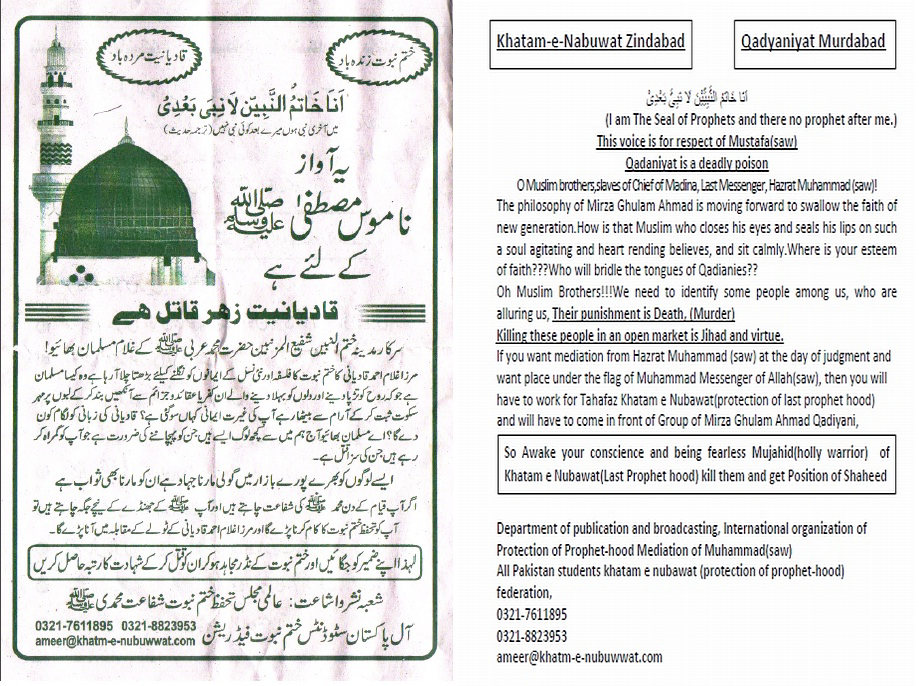
The latest attack against the sect, believed to have some 200,000 followers across the country, took place in Bogor, West Java, when some 20 people threw stones and set fire to Ahmadiyah houses and places of worship in Ciampea. A mosque, five houses, a car and two motorcycles were burned in the attack.

Monday, October 11, 2010

Ahmadis continue to live in fear

CITY
Mon, 10/11/2010
10:30 AM

Ahmadis continue to live in fear
The Jakarta Post, Bogor/West java

Intimidated by rumors of another assault, more than 600 residents in the isolated Cisalada neighborhood in Ciampea Udik village, Bogor, are living in fear after fresh violence.

“I’m afraid to go to the traditional market because other residents might try to kill me,” 51-year-old Lela (not her real name) told The Jakarta Post last week.

Lela and her husband live in a house only a dozen meters away from a mosque that was torched on Friday.

“I cannot erase the horrific memory of dozens of young men from Pasar Salasa and Kebon Kopi [areas] suddenly attacking our neighborhood,” she said.

Lela was referring to an incident that took place last Friday evening, when approximately 20 people attacked Cisalada residents at around 7:15 p.m. Assailants threw stones and Molotov cocktails, and burned more than 30 Koran at an Ahmadiyah mosque that was under construction. The mob disbursed but later returned in larger numbers and set fire to five houses, a car and two motorcycles.

So far, none of the assailants have been apprehended, but one Ahmadi was arrested on Monday for allegedly stabbing one of the attackers.

Yellow police lines surrounded the remains of shattered buildings when the Post visited the area.

Soldiers and police officers used empty houses as makeshift base camps. Five police trucks were parked in schoolyard that no longer had glass in its window frames. Some officers patrolled the area with rifles slung around their shoulders.

Lacking confidence in the authorities’ ability to prevent further attacks, some residents decided to move their families to other areas in Bogor, West Java.

Ali, a 34-year-old university student living in Jakarta, came home to visit his mother and help her move to temporarily stay with relatives

“I’m worried about her, especially considering these rumors of an even larger assault,” he said.

A nearby house belonging to Ali’s uncle was allegedly raided by the angry mob during the incident.

Even though the incident was immediately reported to the nearest police precinct, located only 7 kilometers away, the police finally arrived two hours after the initial assault, neighborhood unit chief Edi Humaedi said.

“I watched the mob marching toward us, and one hooligan even asked for my permission to burn our mosque. Can you imagine such a thing? They were just young kids,” Edi said.

He said he would defend his belief and neighborhood, to death if necessary, if another mob attacked his community.

Another resident from nearby Pasar Salasa, Dodon, 51, said he was angry with Ahmadiyah followers because their teachings were blasphemous and insulted Islam.

“Their Koran is different from ours. They have removed several verses and they believe that the Prophet Mohammad wasn’t the last prophet,” Dodon told the Post, although he also admitted to never read the Ahmadis’ scripture. (rch)

Ahmadiyah followers insist they are Muslims

NATIONAL
Mon, 10/11/2010
9:19 AM

Ahmadiyah followers insist they are Muslims

JAKARTA: Ahmadiyah congregation members have refuted suggestions made by mainstream Indonesian Muslims that they should abandon Islam and form a new religion.

“We object to those who do not consider us a part of Islam,” Ahmadi’s Garut branch executive Rahmat Syukur Maskawan said, as quoted by tempointeraktif.com on Sunday.

In response to the growing animosity, Indonesia’s largest Islamic organization, Nahdlatul Ulama (NU), suggested last week that Ahmadiyah followers should no longer claim that they are a part of Islam.

Followers of the sect would suffer from isolation if they insist on associating themselves with Islam while at the same time violating the basic teachings of the religion, NU deputy secretary-general Enceng Shobirin said.

The campaign to outlaw Ahmadiyah, a frequent target of persecution, was political. Rahmat said, adding that he deplored the statement made by NU and questioned the organization’s commitment to defending minority groups and upholding pluralism.

Ahmadiyah has been declared “heretical” by the Indonesian Ulema Council for saying that its founder, Mirza Ghulam Ahmad, was a prophet. Such belief is against the dominant view among Muslims that Muhammad was God’s last prophet. — JP

Friday, October 8, 2010

Editorial: Tyranny of the majority

EDITORIAL
Fri, 10/08/2010
9:45 AM

Editorial: Tyranny of the majority

The ongoing controversy over whether religious sect Ahmadiyah has the right to persist and it’s followers the right to freely profess their beliefs illustrates the long-standing issue that this nation has failed and is failing to protect the rights of it’s minorities.

Dubbed the world’s third-largest democracy, Indonesia has been facing difficulties in adopting and adapting itself to that very principle of democracy that is the respect for and protection of minorities.

Minority groups in Indonesia, including the approximately 200,000 Ahmadis, have to face the ugly fact that they are small in number and therefore prone to marginalization, discrimination and sometimes even persecution.

As of today, hundreds of Ahmadis on Lombok Island in West Nusa Tenggara have been living in shelters since their expulsion from their homes in February 2006. They have been denied their economic right to live a better life and their right to vote as evidenced when the local poll commission scrapped them from the voter roll in last year’s elections.

Worse, their children have had to experience the ordeal. Only last month the local government moved to provide free education for Ahmadi children.

The latest in a string of attacks on Ahmadiyah followers last week indicates the absence of any form of protection for minorities. Hundreds of Ahmadiyah members living in an enclave in the West Java regency of Bogor lost not only their belongings but perhaps also their hopes for a peaceful life in this country.

Regardless of the cause of last week’s arson attack, Ahmadiyah has been perceived as a threat to mainstream Muslims and a cause of destabilization. With ulema and Muslim figures failing to promote dialog, and instead fighting for a ban against Ahmadiyah, hard-line groups have found clemency in carrying out acts of violence against the religious sect.

Solutions for the Ahmadiyah problem initiated by Muslim leaders have so far constituted one-way traffic, in which the majority dictates and enforces it’s will on the minority. It is tyranny of the majority that is currently plaguing the country’s efforts to deal with Ahmadiyah.

Sadly, this is how this nation understands democracy. Political parties form a coalition within the House of Representatives annihilate dissenting voices during decision-making processes. Democracy has been hijacked to help the majority groups fulfill their interests.

In the Ahmadiyah case, the government as the representation of the state has failed to draw a line to protect the weak or the minority vis-à-vis the majority. But democracy prevails only if the rights of the minority are protected.

The enforcement of the 2008 joint ministerial decree on Ahmadiyah spoke volumes about the government’s perceptions on the rights of the strong, as the regulation amputated the basic rights of the Islamic sect’s followers and reinforced a stigma on them as an unwanted society.

A plan to review the decree that many expect will result in a permanent solution to the Ahmadiyah issue will be translated into a permanent ban against the religious sect as long as the tyranny of majority is at play. A new decree banning the sect would read as an expression of supreme power and illustrate that the government has failed to listen to their wishes.

British political philosopher John Stuart Mill noted that the danger of the tyranny of the majority lay not just in the infringements of individuals’ rights or the marginalization of a political minority, but in the oppression of minority groups in society based simply on criteria such as skin color, ethnicity, nationality, religion, or sexual orientation. Ahmadiyah and other minority groups deserve equal rights, unless of course this nation no longer believes in democracy.

 
^ Top of Page