 |
HOME |
‘Victim’ Reveals Sinister Workings Of NII Recruiters
Fitri R. | May 03, 2011
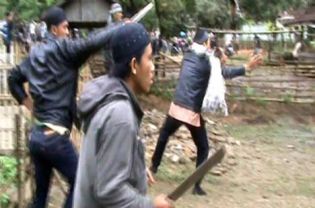
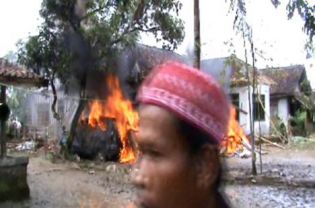
Rights activists have claimed to see disturbing similarity in the deadly mob attack on an Ahmadi community, above, in Cikeusik, Banten, in February, and religious violence targeting Christians in Central Sulawesi and Maluku, below, from 2000-07. Activists say both conflicts show evidence of being instigated by agent provocateurs. (AP, AFP, JG Photos)
After weeks of tweaking and trials and errors, an activist at a prominent human rights group was finally able to connect his laptop computer to an old 32-inch cathode-ray tube television at home.
Although he had seen it about 20 times already, Hendi (not his real name) was eager to watch the 40-minute video of the bloody attack on the Ahmadiyah minority sect in the Cikeusik subdistrict of Banten on a screen with a much bigger resolution than that of his laptop.
“I’m curious to learn who these people who wear the blue and green ribbons are. The fact that they wear ribbons to distinguish friends from foe suggests that they don’t know each other,” he told the Jakarta Globe after asking not to reveal his identity because he was far from concluding his research.
Witnesses say around 20 attackers wearing the ribbons on their jackets and shirts were among the first to arrive at the scene on Feb. 6 and could be seen provoking others to attack a house belonging to an Ahmadi. More than 1,000 people eventually joined the assault which resulted in the death of three Ahmadis.
Hendi said he was curious how the attackers, who witnesses say were not from the area, knew which house to attack.
Obsessed with learning who these people were, Hendi scrutinized every frame of the video, listening to a barrage of sounds and noises and scribbling in his notebook every time he heard an audible conversation.
“They were highly skilled in martial arts, can be seen provoking the masses to attack Ahmadiyah and simply vanished just minutes into the riot,” he concluded, adding that this was precisely the pattern found in scores of sectarian conflicts that sprung up after the fall of Suharto.
Finding the Mastermind
Hendi said that he became fixated on digging up the truth that many of his activist friends chose to ignore after the Al Jazeera television station in March reported closer ties being forged by hard-line groups and several retired military generals.
The activist said that unless police were able to apprehend the provocateurs, the mastermind behind the Cikeusik attack would never be revealed.
But Hendi is not alone. Mufti Makaarim, executive director of the Institute for Defense, Security and Peace Studies, also thinks that there is more to the attack than meets the eye.
“Rogue elements within the military have used radical Muslims as proxies before to create diversions or push certain political agendas. They don’t want to be linked directly to sectarian conflicts,” he said, adding that religious violence had been used in the past to de-legitimize civilian-controlled governments.
Chep Hermawan, head of the Islamic Reform Movement (Garis), a hard-line group, has said that several retired generals had approached radical Muslim groups one month prior to the Cikeusik attack in a bid to topple President Susilo Bambang Yudhoyono by exploiting mainstream Muslims’ resistance toward the Ahmadiyah.
Chep named them as former Army chief of staff Gen. (ret.) Tyasno Sudarto; Maj. Gen. (ret.) Muchdi Purwoprandjono, former commander of the Army’s Special Forces (Kopassus); Maj. Gen. (ret.) Kivlan Zen, former commander of the Army’s Strategic Reserve Command (Kostrad); and Gen. (ret.) Fahrul Razi, a former deputy chief of staff.
IDSPS’ Mufti seemed hardly surprised. “These are old players,” he said.
Similar Patterns
In his book, “Civil Islam: Muslims and Democratization of Indonesia,” anthropology professor Robert Hefner said that during the Suharto regime, the government made use of hard-liners to act as agent provocateurs to de-legitimize criticisms toward his rule, particularly when calls were mounting for him to step down at the height of the 1997-98 Asian Financial Crisis. In the book, Hefner details numerous reports and anecdotes that detail links between the military and hard-liners.
He writes that during the May 1998 riots in Jakarta, a group of unidentified men started burning and looting businesses and homes owned by ethnic Chinese. The men provoked ordinary civilians to follow suit and by the time security forces arrived they had vanished, similar to Hendi’s observations of the Cikeusik attack 12 years later.
A similar pattern was reported during a religious conflict in East Java a year earlier, with efforts to break ties between the Nahdlatul Ulama, led by future President Abdurrahman “Gus Dur” Wahid, and syncretist Javanese Muslims.
NU probes quoted witnesses as saying that groups of men dressed in “ninja” outfits had been killing Muslims clerics as well as people believed to be black-magic sorcerers. But a series of rumors that sprang up after the violence would omit mention of the ninja-clad attackers and allege that the Muslim clerics and sorcerers had in fact been killing each other.
It would not be the last time such tactics would be reported.
In 2000, a string of religious conflicts between Muslims and Christians erupted in Poso, Central Sulawesi, and Ambon, Maluku. Several rights groups cited witnesses reporting ninja-clad bands of people killing both Muslim clerics and Christian priests.
Then-President Gus Dur accused a Maj. Gen. “K” and a civilian named “Gogon” to be behind in the conflicts in Poso and Ambon. But until he was forced to resign in 2001, Wahid never disclosed the full identities of those he accused.
At the time, Kivlan was one of only two major-generals in the military with that initial.
“Gogon” is the reported nickname of Ahmad Sumargono of the conservative Indonesian Islamic Propagation Council (DDII), a long-time friend of Muchdi and later a politician of the Star Crescent Party (PBB.)
Conflicts in Ambon and Poso went on until 2007, ending after the National Police toured the area with FPI leader Rizieq Shihab, who urged remnants of the Muslim militias to join FPI and fight new enemies: immorality and blasphemous sects. Some former militia members chose to join the Jemaah Islamiyah terror network.
Military Might
After the fall of Suharto in May 1998, the new government formed fact-finding teams to investigate the cause of the Jakarta riots as well as the kidnapping and murder of 14 student activists, according to Hefner.
In October 1998, one team probing the kidnapping of activists released its findings and concluded that it was conducted by a special unit inside the Army Special Forces Command (Kopassus). The team deemed former Kopassus commander Prabowo Subianto and his successor, Muchdi, responsible for the crime.
Prabowo would later go on to found the Great Indonesia Movement Party (Gerindra). Muchdi would go on to head the National Intelligence Agency (BIN). In 2009 he would be controversially acquitted for the 2004 murder of rights activist Munir Said Thalib.
In a postscript addendum after he concluded research into his book in November 1999, Hefner wrote that most disturbances at the time bore the telltale signs of agent provocateurs.
“Although its leaders have been removed from the heights of government, advocates of state terror remain ensconced in segments of the military and bureaucracy. The dismantlement of their shadowy network of vigilantes and gangsters will be one of the greatest challenges facing democratic Indonesia,” he wrote.
For Hendi, the evidence is still up for debate. But the patterns he says he sees are undeniable.
“What is intriguing for me about the Cikeusik attack is that it doesn’t follow the same pattern as other cases of violence on Ahmadiyah involving hard-liners,” Hendi said. “The attack bears more resemblance to the ones seen during the sectarian conflicts in Ambon or Poso.
“I think there is a good indication that one of the martial arts groups associated with a military figure might be involved.
“But unless police are able to arrest one of the provocateurs or at least have someone who would identify who they are and where they’re from, we won’t know who the true masterminds are.”
Copyright 2010 The Jakarta Globe
URL: www.thejakartaglobe.com/home/murky-men-behind-the-violence/438811
URL: www.thejakartaglobe.com/home/murky-men-behind-the-violence/438811







 Posts


