 | by Philip Shishkin February 13, 2011 |
World | |
Intolerant Indonesia
In Java, Muslim hardliners target ‘apostates’
In a jerky video that’s shaken up Indonesia, young men take turns whacking three prostrate, nearly naked bodies with wooden sticks. The blows land with sickening thumps. Rocks follow. The bodies twitch; the surrounding crowd is jubilant. Shouts of “God is great” can be heard. A policeman waves his hands but doesn’t interfere.
The three men killed in the video belonged to an offshoot of Islam known as Ahmadiyya, a faith that blends Islam’s core teachings with idiosyncratic interpretations that drive hardline Islamists crazy.
The video is especially jarring because Indonesia has long been known for its live-and-let-live religious ethos, and the Ahmadis, who have suffered harassment, or worse, in more conservative countries such as Saudi Arabia, Pakistan, and Afghanistan, have until recently been left alone in Indonesia, the world’s most populous Muslim nation, which holds as its official motto “Unity in diversity.”
Over the past decade, however, Indonesia’s religious compact has frayed, strained by the same fundamentalist forces that have long plagued other parts of the Muslim world. The struggle in Indonesia reflects the global debate within Islam, pitting a loud, radical fringe against a more liberal camp that may be larger but has shown less desire to shout. A recent string of violent episodes—including the killing of the three Ahmadis on Feb. 6—has raised the question: will Indonesia remain liberal?
In a survey conducted last year, the Setara Institute for Democracy and Peace polled 1,200 people in Greater Jakarta and found that nearly half of them wanted the government to outlaw Ahmadiyya, while a fifth were in favor of curbs on the group’s activities.
And the day after the irate crowd in Cikeusik, Banten province, murdered the three Ahmadis, Muslim rioters in unrelated attacks torched several Christian churches and attacked a courthouse, incensed over what they saw as an insufficiently harsh sentence given to a Christian man accused of blasphemy.
Islam came to Indonesia in the Middle Ages with traders and spread through the archipelago, supplanting earlier Hindu, Buddhist, and animist beliefs. Christianity made steady inroads too, largely as a byproduct of European colonization, and today Indonesia has a population of some 240 million, 86 percent of whom are Muslim.
In the early 1920s, as Indonesia was living through its last decades under Dutch colonial rule, three Indonesian Muslims set off on a journey to deepen their understanding of Islam. They first considered going to Cairo, the old seat of Islamic scholarship. But friends advised them to seek a fresher perspective, and so the trio ventured to India, where, in a small town called Qadian, in Punjab, they met a band of Muslims who believed that the messiah had already arrived in the form of Mirza Ghulam Ahmad, the local scion of a wealthy landowning family.
A turban tied jauntily over his head, Ahmad had come to prominence first as a writer of Islamic pamphlets and books before announcing that he was in fact the messiah sent by God to save the world. For mainstream Muslims, Ahmad’s claims represented a heretical departure from the belief that Muhammad, to whom the Quran was revealed, is God’s final prophet.
But there were tactical reasons, too, for mainstream resistance to the Ahmadis’ claims: Muslims in India and Afghanistan were using the Islamic concept of jihad, or holy war, to fight the British occupation, and the pacifism of the Ahmadis was seen to undermine the struggle. (Soon the Ahmadis were mocked as a fifth column, planted by the British, and during the early 1920s the king of Afghanistan ordered three Ahmadis to be stoned to death, in part because of their pacifist views.)
The three traveling Indonesians, however, were won over by the Ahmadi creed and went home to spread the word. Over the next several decades, shielded by Indonesia’s Constitution, which guarantees freedom of religion, the Ahmadi community began to grow. The secular regime of the Indonesian strongman Suharto kept a lid on religious tensions.
But as Indonesia began to dismantle Suharto’s authoritarian legacy, religious minorities came under pressure.
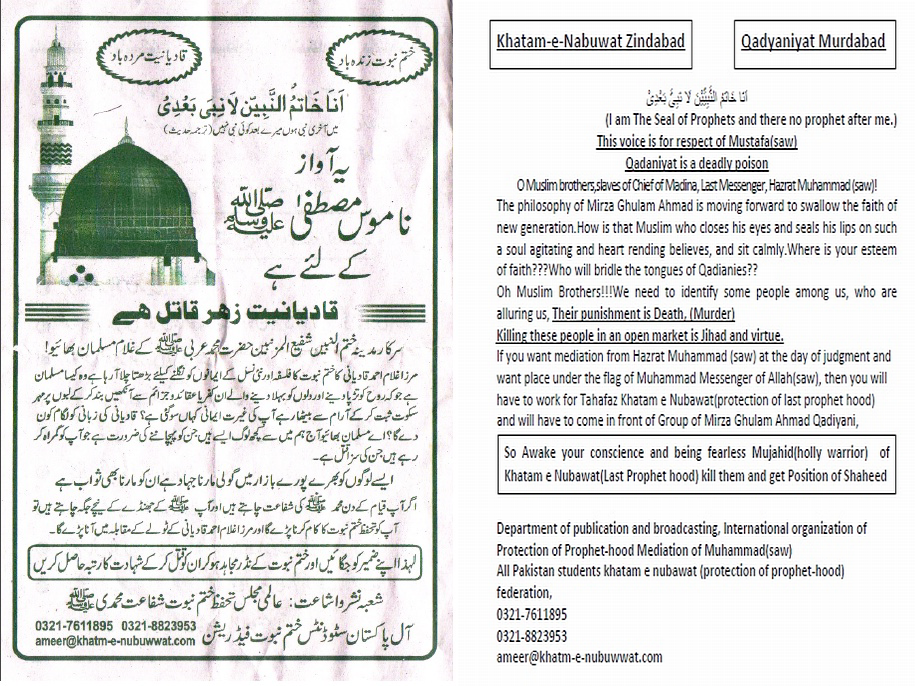
There are six major religions recognized under Indonesian secular law: Islam, Protestantism, Catholicism, Buddhism, Hinduism, and Confucianism. But in 2005 the country’s Ulema Council, the conservative gatekeeper of Sunni orthodoxy, issued a fatwa, or religious decree, branding the Ahmadiyya faith un-Islamic. Although secular law takes precedence over religious decrees in Indonesia, the anti-Ahmadiyya fatwa painted a target on the creed’s followers, and a 2008 secular law marginalized the Ahmadis even further: while adhering to the faith is still legal, spreading the creed is not.
It didn’t help matters that Indonesia’s minister of religious affairs told Parliament this summer that Ahmadiyya should be banned outright. Other officials mused about herding the Ahmadis onto an island reservation.
“They are trying to Talibanize Indonesia,” Naseem Mahdi, the chief Ahmadi missionary in the U.S., told me in December. Mahdi, who fled Pakistan in the 1980s, says the creeping persecution of the Ahmadis in Indonesia rings a bell. “This is exactly what happened in Pakistan.” Though initially free to practice, the Ahmadis were eventually hounded with a litany of repressive decrees. To get a Pakistani passport, for instance, one has to sign a statement calling Ahmadiyya’s founder an imposter.
The aging chairman of Indonesia’s Ulema Council, Amidhan Shaberah, told me that the problem resided with the Ahmadis. If only they stopped describing themselves as Muslims, no one would bother them, he said, employing the same rhetorical charge that had been leveled against them in Pakistan and Bangladesh. He bristled at the suggestion that extremist ideology was penetrating Indonesia, insisting that the Indonesian fatwa didn’t promote violence against the Ahmadis. “Muslim people are very tolerant,” he said.
But even when we spoke in December, two months before the grisly murders in Cikeusik, the Ahmadis had already become targets of harassment and violence, with vigilante mobs attacking Ahmadi communities, and local officials doing little to stop them. (The February murders did prompt Indonesia’s president to concede that the government should have done more to prevent the violence, and an inquiry is now underway.)
Anti-Ahmadiyya violence is often driven by “local political dynamics,” Ulil Abshar Abdalla, a liberal Islamic scholar and political analyst in Jakarta, told me before the killings. The government is “trapped in this dilemma: winning the support of Islamists by not stopping the attacks, or stopping the violence to win the support of the larger public.”
A typical incident took place in the village of Cisalada, a three-hour drive from Jakarta. Cisalada’s 600 or so residents are all Ahmadi, a speck in the otherwise Sunni Muslim–dominated countryside where brightly colored cinder-block houses cling closely together, as if afraid to be caught alone out in the open rice fields.
Trouble in Cisalada began this summer when local officials showed up at the mosque to inspect a new extension the Ahmadis were planning to build. The mosque had become a source of wild rumors for the neighboring Sunni Muslim village of Pasar Selasa. There was talk of a subterranean passageway and whispers of bizarre rituals. Parishioners ate bread before praying, a practice that smacked suspiciously of Christian mass. Worshipers didn’t even have a real imam, but instead drew inspiration at Friday prayers from a flat-screen television. And there was the story about the shrine’s minders building a replica of the Kaaba, the granite cube in Mecca that Muslims walk around in a meditative swirl. Once the Cisalada replica was complete, the rumor went, Ahmadi worshipers could skip the long trip to Mecca and fulfill their pilgrimage obligation by circling a cinder block right behind their mosque. The thrust of the rumors, none true, was clear: the Ahmadis were apostates. One day, a group of local officials came to the mosque and tore down the pillars of the new mosque extension. “They hate us,” said Ghulam Wahudin, a local Ahmadi leader, as he looked at the jagged concrete stumps poking through the weeds. Wahudin still seemed perplexed by the sudden hostility. “We’ve lived here since the 1930s, as neighbors [with the Sunnis]. They know us. We never had any disturbances.”
A local district official later said that the vandals had actually done the Ahmadis a favor. A vigilante mob led by a hardline cleric had been agitating for a bigger assault; by destroying the foundation of the new mosque, he said, the local officials had saved the village from greater harm.
If Cisalada officials were hoping to destroy the village to save it, they didn’t succeed. One October evening, a group of young men ran through Cisalada toward the mosque, throwing rocks and Molotov cocktails, while residents crouched inside their homes, heeding their leaders’ call not to fight back—if they resisted, they’d be crushed by the far more numerous Sunnis. Mubarak Ahmad, a village elder, said the attackers picked up a gas canister and entered the mosque. The kids, whom he recognized from Pasar Selasa, poured gasoline on the floor and set it on fire. Mubarak showed me a crate of burned Qurans that he said had been torched in the attack. Elsewhere in Cisalada, I saw other burned and wrecked houses.
As I drove to Pasar Selasa, the first thing I noticed was a big mosque with a façade of arches resting on carved pillars. A newspaper editorial posted by the entrance said STOP AHMADIYYA ACTIVITIES. An old caretaker named Djajani told me the locals were very upset about the Ahmadis’ mosque expansion. “It’s all about faith. And we saw them build a mosque not based on our faith,” he said. As for the trouble, he said, “what I heard was it was all spontaneous; young people get angry easily.”
In the scuffle near the burning mosque in Cisalada, police said, a local Ahmadi farmer had stabbed one of the youngsters—a 15-year-old boy named Rendi who lived in Pasar Selasa. After talking with Djajani I followed a noisy gaggle of kids down a maze of alleys to Rendi’s house.
His father, Dedi Permana, invited me into a dimly lit room and told me what he thought happened the night his son was stabbed. Rendi and his friends had been intrigued by the wild stories circulating about the Ahmadi mosque, and after school Rendi joined his friends to go to Cisalada. A brawl had ensued, but Rendi hadn’t taken part in throwing stones or burning the mosque, Permana said.
But when word got out that he had been stabbed—the first rumor was that Rendi was dead—the mob from Pasar Selasa torched the Ahmadi mosque in retaliation. When I asked if I could speak with Rendi directly, the father demurred—Rendi was on his PlayStation somewhere and couldn’t be found, he said.
Permana grew emotional as he spoke. “Long before this happened, people here knew there was something wrong with Ahmadiyya,” he said, repeatedly returning to the idea of revenge against the Ahmadis. “I’ve already sharpened my knives,” he said.
The three men killed in the video belonged to an offshoot of Islam known as Ahmadiyya, a faith that blends Islam’s core teachings with idiosyncratic interpretations that drive hardline Islamists crazy.
The video is especially jarring because Indonesia has long been known for its live-and-let-live religious ethos, and the Ahmadis, who have suffered harassment, or worse, in more conservative countries such as Saudi Arabia, Pakistan, and Afghanistan, have until recently been left alone in Indonesia, the world’s most populous Muslim nation, which holds as its official motto “Unity in diversity.”
Over the past decade, however, Indonesia’s religious compact has frayed, strained by the same fundamentalist forces that have long plagued other parts of the Muslim world. The struggle in Indonesia reflects the global debate within Islam, pitting a loud, radical fringe against a more liberal camp that may be larger but has shown less desire to shout. A recent string of violent episodes—including the killing of the three Ahmadis on Feb. 6—has raised the question: will Indonesia remain liberal?
In a survey conducted last year, the Setara Institute for Democracy and Peace polled 1,200 people in Greater Jakarta and found that nearly half of them wanted the government to outlaw Ahmadiyya, while a fifth were in favor of curbs on the group’s activities.
And the day after the irate crowd in Cikeusik, Banten province, murdered the three Ahmadis, Muslim rioters in unrelated attacks torched several Christian churches and attacked a courthouse, incensed over what they saw as an insufficiently harsh sentence given to a Christian man accused of blasphemy.
Islam came to Indonesia in the Middle Ages with traders and spread through the archipelago, supplanting earlier Hindu, Buddhist, and animist beliefs. Christianity made steady inroads too, largely as a byproduct of European colonization, and today Indonesia has a population of some 240 million, 86 percent of whom are Muslim.
In the early 1920s, as Indonesia was living through its last decades under Dutch colonial rule, three Indonesian Muslims set off on a journey to deepen their understanding of Islam. They first considered going to Cairo, the old seat of Islamic scholarship. But friends advised them to seek a fresher perspective, and so the trio ventured to India, where, in a small town called Qadian, in Punjab, they met a band of Muslims who believed that the messiah had already arrived in the form of Mirza Ghulam Ahmad, the local scion of a wealthy landowning family.
A turban tied jauntily over his head, Ahmad had come to prominence first as a writer of Islamic pamphlets and books before announcing that he was in fact the messiah sent by God to save the world. For mainstream Muslims, Ahmad’s claims represented a heretical departure from the belief that Muhammad, to whom the Quran was revealed, is God’s final prophet.
But there were tactical reasons, too, for mainstream resistance to the Ahmadis’ claims: Muslims in India and Afghanistan were using the Islamic concept of jihad, or holy war, to fight the British occupation, and the pacifism of the Ahmadis was seen to undermine the struggle. (Soon the Ahmadis were mocked as a fifth column, planted by the British, and during the early 1920s the king of Afghanistan ordered three Ahmadis to be stoned to death, in part because of their pacifist views.)
The three traveling Indonesians, however, were won over by the Ahmadi creed and went home to spread the word. Over the next several decades, shielded by Indonesia’s Constitution, which guarantees freedom of religion, the Ahmadi community began to grow. The secular regime of the Indonesian strongman Suharto kept a lid on religious tensions.
But as Indonesia began to dismantle Suharto’s authoritarian legacy, religious minorities came under pressure.
There are six major religions recognized under Indonesian secular law: Islam, Protestantism, Catholicism, Buddhism, Hinduism, and Confucianism. But in 2005 the country’s Ulema Council, the conservative gatekeeper of Sunni orthodoxy, issued a fatwa, or religious decree, branding the Ahmadiyya faith un-Islamic. Although secular law takes precedence over religious decrees in Indonesia, the anti-Ahmadiyya fatwa painted a target on the creed’s followers, and a 2008 secular law marginalized the Ahmadis even further: while adhering to the faith is still legal, spreading the creed is not.
It didn’t help matters that Indonesia’s minister of religious affairs told Parliament this summer that Ahmadiyya should be banned outright. Other officials mused about herding the Ahmadis onto an island reservation.
“They are trying to Talibanize Indonesia,” Naseem Mahdi, the chief Ahmadi missionary in the U.S., told me in December. Mahdi, who fled Pakistan in the 1980s, says the creeping persecution of the Ahmadis in Indonesia rings a bell. “This is exactly what happened in Pakistan.” Though initially free to practice, the Ahmadis were eventually hounded with a litany of repressive decrees. To get a Pakistani passport, for instance, one has to sign a statement calling Ahmadiyya’s founder an imposter.
The aging chairman of Indonesia’s Ulema Council, Amidhan Shaberah, told me that the problem resided with the Ahmadis. If only they stopped describing themselves as Muslims, no one would bother them, he said, employing the same rhetorical charge that had been leveled against them in Pakistan and Bangladesh. He bristled at the suggestion that extremist ideology was penetrating Indonesia, insisting that the Indonesian fatwa didn’t promote violence against the Ahmadis. “Muslim people are very tolerant,” he said.
But even when we spoke in December, two months before the grisly murders in Cikeusik, the Ahmadis had already become targets of harassment and violence, with vigilante mobs attacking Ahmadi communities, and local officials doing little to stop them. (The February murders did prompt Indonesia’s president to concede that the government should have done more to prevent the violence, and an inquiry is now underway.)
Anti-Ahmadiyya violence is often driven by “local political dynamics,” Ulil Abshar Abdalla, a liberal Islamic scholar and political analyst in Jakarta, told me before the killings. The government is “trapped in this dilemma: winning the support of Islamists by not stopping the attacks, or stopping the violence to win the support of the larger public.”
A typical incident took place in the village of Cisalada, a three-hour drive from Jakarta. Cisalada’s 600 or so residents are all Ahmadi, a speck in the otherwise Sunni Muslim–dominated countryside where brightly colored cinder-block houses cling closely together, as if afraid to be caught alone out in the open rice fields.
Trouble in Cisalada began this summer when local officials showed up at the mosque to inspect a new extension the Ahmadis were planning to build. The mosque had become a source of wild rumors for the neighboring Sunni Muslim village of Pasar Selasa. There was talk of a subterranean passageway and whispers of bizarre rituals. Parishioners ate bread before praying, a practice that smacked suspiciously of Christian mass. Worshipers didn’t even have a real imam, but instead drew inspiration at Friday prayers from a flat-screen television. And there was the story about the shrine’s minders building a replica of the Kaaba, the granite cube in Mecca that Muslims walk around in a meditative swirl. Once the Cisalada replica was complete, the rumor went, Ahmadi worshipers could skip the long trip to Mecca and fulfill their pilgrimage obligation by circling a cinder block right behind their mosque. The thrust of the rumors, none true, was clear: the Ahmadis were apostates. One day, a group of local officials came to the mosque and tore down the pillars of the new mosque extension. “They hate us,” said Ghulam Wahudin, a local Ahmadi leader, as he looked at the jagged concrete stumps poking through the weeds. Wahudin still seemed perplexed by the sudden hostility. “We’ve lived here since the 1930s, as neighbors [with the Sunnis]. They know us. We never had any disturbances.”
A local district official later said that the vandals had actually done the Ahmadis a favor. A vigilante mob led by a hardline cleric had been agitating for a bigger assault; by destroying the foundation of the new mosque, he said, the local officials had saved the village from greater harm.
If Cisalada officials were hoping to destroy the village to save it, they didn’t succeed. One October evening, a group of young men ran through Cisalada toward the mosque, throwing rocks and Molotov cocktails, while residents crouched inside their homes, heeding their leaders’ call not to fight back—if they resisted, they’d be crushed by the far more numerous Sunnis. Mubarak Ahmad, a village elder, said the attackers picked up a gas canister and entered the mosque. The kids, whom he recognized from Pasar Selasa, poured gasoline on the floor and set it on fire. Mubarak showed me a crate of burned Qurans that he said had been torched in the attack. Elsewhere in Cisalada, I saw other burned and wrecked houses.
As I drove to Pasar Selasa, the first thing I noticed was a big mosque with a façade of arches resting on carved pillars. A newspaper editorial posted by the entrance said STOP AHMADIYYA ACTIVITIES. An old caretaker named Djajani told me the locals were very upset about the Ahmadis’ mosque expansion. “It’s all about faith. And we saw them build a mosque not based on our faith,” he said. As for the trouble, he said, “what I heard was it was all spontaneous; young people get angry easily.”
In the scuffle near the burning mosque in Cisalada, police said, a local Ahmadi farmer had stabbed one of the youngsters—a 15-year-old boy named Rendi who lived in Pasar Selasa. After talking with Djajani I followed a noisy gaggle of kids down a maze of alleys to Rendi’s house.
His father, Dedi Permana, invited me into a dimly lit room and told me what he thought happened the night his son was stabbed. Rendi and his friends had been intrigued by the wild stories circulating about the Ahmadi mosque, and after school Rendi joined his friends to go to Cisalada. A brawl had ensued, but Rendi hadn’t taken part in throwing stones or burning the mosque, Permana said.
But when word got out that he had been stabbed—the first rumor was that Rendi was dead—the mob from Pasar Selasa torched the Ahmadi mosque in retaliation. When I asked if I could speak with Rendi directly, the father demurred—Rendi was on his PlayStation somewhere and couldn’t be found, he said.
Permana grew emotional as he spoke. “Long before this happened, people here knew there was something wrong with Ahmadiyya,” he said, repeatedly returning to the idea of revenge against the Ahmadis. “I’ve already sharpened my knives,” he said.






 Posts
Posts


