Showing posts with label religious edict. Show all posts

Friday, April 3, 2009

Ahmadiyah Ploy By Islamic Parties

Ahmadiyah Ploy By Islamic Parties
---Jakarta Globe
April 03, 2009
Muninggar Sri Saraswati

Ahmadiyah Ploy By Islamic Parties

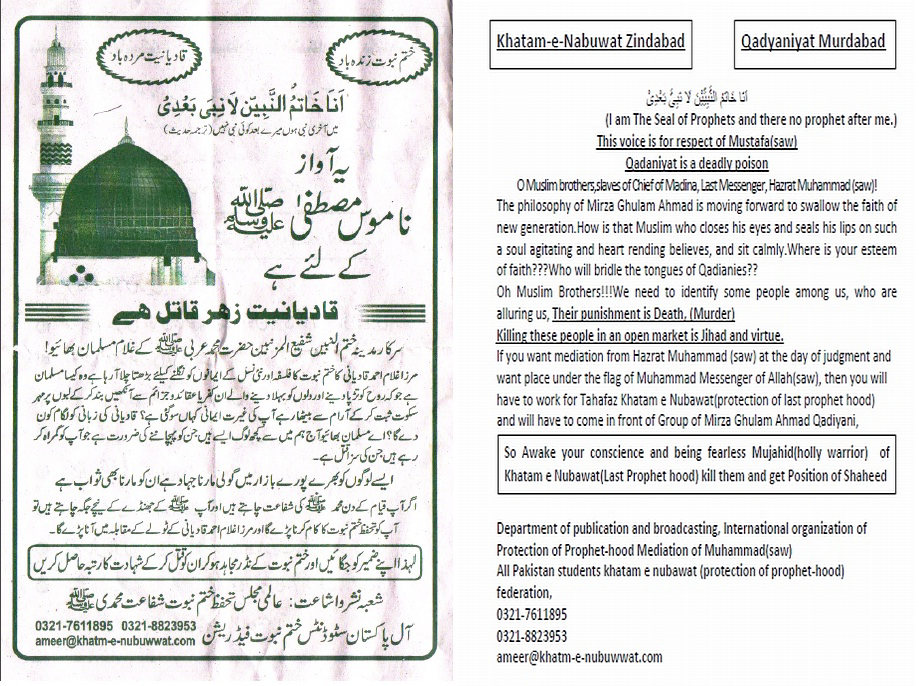
This week’s campaign sorties saw at least two Islamic parties try to boost their sagging popularity by calling for the government to outlaw Ahmadiyah, a controversial Islamic sect.

The Ahmadiyah, which has been in the country since 1920, has become a rallying point for Muslim hardliners since it was declared a deviant sect by the country’s highest authority on Islam, the Indonesian Council of Ulema, in 2008

Suryadharma Ali, the chairman of the United Development Party, or PPP, the country’s fourth largest party, addressing about 10,000 supporters at a party campaign rally here, called on the government to dissolve Ahmadiyah.

The call came as various l surveys showed that PPP’s popularity was on the wane and that Islamic political parties stood no chances against the secular nationalist ones in the April 9 legislative elections.

Another call for the dissolution of the group came from Yusril Ihza Mahendra, chairman of the supervisory council of the Crescent Star Party, or PBB, another party that had been singled out by surveys as facing a tough battle to win votes this year. Yusril, a former state secretary, told thousands of supporters during his party’s campaign rally in Padang, the capital of West Sumatra Province, that the president should disband Ahmadiyah and order it to form a new religion separate from Islam.

Komaruddin Hidayat, rector of the state-run Syarif Hidayatullah State Islamic University, said targeting Ahmadiyah as an enemy was not relevant to Indonesian voters at present.

“Campaigning for the elections is about offering ideas, not selling an issue to lure voters,” he said. Syamsuddin Haris, a political researcher for the Indonesian Institute of Sciences, or LIPI, said the use of Ahmadiyah in the parties’ campaigns was “stupid” and “unsuitable.”

“It will not be productive in attracting voters,” he said.

Copyright 2009 The Jakarta Globe
URL: www.thejakartaglobe.com/home/article/15184.html

Sunday, March 29, 2009

Indonesia: Islamic Party PPP Woos Hard-Liners

--- Jakarta Globe, Indonesia
National
March 29, 2009

Muninggar Sri Saraswati

Islamic Party PPP Woos Hard-Liners

The United Development Party, or PPP, has resorted to calling on the government to dissolve the controversial Islamic sect Ahmadiyah in an effort to appeal to conservative Muslim voters ahead of the April 9 legislative elections.

PPP chairman Suryadharma Ali, who is a member of President Susilo Bambang Yudhoyono’s cabinet, asserted during a campaign rally on Sunday that the Ahmadiyah sect had violated Islamic teachings, state-run Antara news agency reported.

“Ahmadiyah must be dissolved because it has disrespected the feelings and honor of Muslims,” he told more than 10,000 party supporters in Jakarta.

Suryadharma said the growing number of cases of insults against religion, be it Islam or the other state-recognized religions, had occurred due to what he called “over-the-line democracy,” where freedoms had been taken too far after the end of the late President Suharto’s authoritarian New Order regime.

“It is fine to be free, but every freedom has its limit,” he said.

An Islamic party set up during the New Order era, PPP has seen its popularity suffer over the last decade. In elections in 1997, shortly before the end of Suharto’s rule, it gained 20 percent of the vote, while in 1999 it secured 11 percent, and in 2004, only 8 percent.

The Ahmadiyah community has become a target in recent years for hard-line Muslims, who consider it “heretical.” Attacks against Ahmadiyah escalated in mid-2008, culminating in the government issuing a joint ministerial decree banning its activities, in particular “spreading interpretations and activities that deviate from the principal teachings of Islam.”

There are approximately 200,000 followers of Ahmadiyah who believe the sect’s founder, Mirza Ghulam Ahmad, was the last prophet of Islam — contradicting one of the fundamental doctrines of orthodox Islam.

Copyright 2009 The Jakarta Globe
URL: www.thejakartaglobe.com/news/national/article/14564.html

Saturday, March 21, 2009

Muslim Groups Demand Police Crackdown on Ahmadiyah Sect

---Jakarta Globe

National - March 21, 2009

Farouk Arnaz

Muslim Groups Demand Police Crackdown on Ahmadiyah Sect

A group of Muslim organizations led by M. Amin Djamaludin, director of the Institute for Research and Studies on Islam, or LPPI, submitted a petition to the National Police on Thursday demanding that police take firm action against Muslim sect Jamaah Ahmadiyah Indonesia, or JAI.

“Ahmadiyah members have broken a joint decree issued by the ministers of religious affairs and home affairs and the attorney general that restricts the sect’s activities,” Amin told reporters after submitting the petition.

After strong pressure from Muslim groups, Home Affairs Minister Mardiyanto, Religious Affairs Minister Maftuh Basyuni and Attorney General Hendarman Supandji signed a joint decree on June 10 last year banning the sect from propagating its beliefs. The decision sparked debate and criticism from human rights activists who saw the decree as a violation of human rights.

Amin said Ahmadiyah held a general assembly meeting at Manis Lor in Kuningan, West Java Province, on March 6 and 7.

“We also have a document showing that Ahmadiyah still continues to raise funds from its members to build schools and mosques in 2009 and 2010,” said Amin, adding that he was fully supported by the Muslim Lawyers Team, or TPM, and the Islamic Activists Forum, or FUI.

Ahmadiyah, an Islamic congregation founded by Mirza Ghulam Ahmad in India about 100 years ago, was legalized by the Indonesian government in 1953.

The Indonesian Council of Ulema, or MUI, the country’s highest authority on Islam, declared Ahmadiyah a “deviant” religious sect in an edict issued last year.

The MUI claims Ahmadiyah beliefs contravene Islamic teachings, because followers of the group believe that the Prophet Muhammad was not the last prophet. One group of Ahmadis believe that Mirza was the messiah promised in the Koran, while another considers him to be the last Muslim prophet.

Cholil Ridwan, a chairman of the MUI, issued an edict banning people from voting for the incumbent president in the upcoming election because of the government’s failure to outlaw the sect.

The House of Representatives’ religious affairs commission has also said that it would demand that the religious affairs minister take firm action against Ahmadiyah because it was continuing to promote its brand of religion.

Jamaah Ahmadiyah secretary Mubarik said on Thursday that everyone possessed the right to file complaints with the police.

“Following legal procedures is better than using violence like what happened at our campus in Parung,” he said, referring to a September 2005 incident in which hundreds of people vandalized a mosque and cars belonging to the sect’s members. Mubarik also denied suggestions that his group had broken the joint decree.

Insp. Gen. Saleh Saaf, head of the National Police intelligence unit, declined to comment on the petition on Thursday.

Copyright 2009 The Jakarta Globe
URL: www.thejakartaglobe.com/news/national/article/13779.html

Thursday, March 12, 2009

Ahmadiyah and Indonesian Democracy

---Jakarta Globe
Opinion

March 12, 2009

Wim Tangkilisan

Ahmadiyah and Indonesian Democracy


The Koran is very clear that “in matters of faith there shall be no coercion.”

And it stresses that “if it had been the will of your Lord that all the people of the world should be believers, then all the people of the earth would have believed! Would you now compel humankind against their will to believe?”

Now comes a Muslim leader, Cholid Ridwan, a chairman of the Indonesian Council of Ulema, or MUI, who warns the President of Indonesia that if he does not outlaw Ahmadiyah, an Indonesian-based Islamic sect, the council will issue a fatwa, or religious edict, prohibiting Indonesian Muslims from voting for President Susilo Bambang Yudhoyono in the upcoming presidential elections.

Ahmadiyah is a sect of Indian origin, with some links to Sufism. It is controversial because of its claim that its founder, Mirza Ghulam Ahmad, was the last of the prophets, [Author of this article is not correct about claim of Hadhrat Mirza Ghulam Ahmad (as). For Ahmadiyya beliefs please visit www.alislam.org] contrary to the basic tenet of Islam that the final of the prophets is Muhammad.

The sect is not new to controversy. In the 1930s, it was rumored that independence hero and former President Sukarno had become a propagator of Ahmadiyah. He denied it in writing, but in the process he wrote a few words of praise for the good behavior of its adherents. He was emphatic, however, that he was not one of them.

Today there are Muslim circles in Indonesia that clamor for an outright ban against the sect. That is old news. What is new is the election-related threat of a fatwa against the president if he does not outlaw the sect.

Democracy is not just about elections. Even more essential is the way minorities are treated by the majority.

Another Muslim leader, Umar Shihab, also a chairman of the MUI, says that Cholid speaks only for himself. Furthermore, he says no such fatwa is being prepared. No threat of one. But, in effect he says that it would be nice indeed if the president did outlaw the sect.

The presidential spokesman, Andi Mallarangeng, says that this is just one more sign that everyone has caught election fever. “We don’t need to worry about it at all,” he said.

What indeed is there to worry about then? We perhaps have more urgent things to concern ourselves with, like corruption in the House of Representatives and getting the economic stimulus package up and running.

But wait a minute. There are basic questions involved in this issue that need attention.

There is, of course, the question of what Islam really teaches about tolerance, about the command against coercion on matters of faith. Where does it say in the Koran or in the Hadith that an exception has to be made in the case of the Ahmadiyah? The Muslim faithful may wish to obtain some clarity on that.

Since I am not a Muslim, I should let this be a matter among Muslims. But as an Indonesian, I am most concerned about the political implications of the issue. And when I say political, I don’t mean electoral politics. President Yudhoyono, I think, will win or lose the election on the basis of his performance as leader of the nation, fatwa or no fatwa.

What I mean is Indonesian democracy. I mean Indonesia’s aspiration and claim to be the world’s third largest democracy. I mean the pride that the Indonesian people derive from our international reputation as living proof that Islam, democracy and modernization can flourish together.

I mean human rights. Freedom of thought. Freedom of speech. Freedom of association.

Democracy is not just about elections. Even more essential to democracy is the way minorities are treated by the majority — whether their rights are held sacred or trampled upon.

We take pride in our tradition of m usyawarah untuk m ufakat , or consultations leading to consensus, a process in which all views are spoken for and all interests are taken into account. But all I have been hearing about Ahmadiyah are the threats against them.

Wim Tangkilisan is the president and editor in chief of the Jakarta Globe.

URL: www.thejakartaglobe.com/opinion/article/12571.html
 
^ Top of Page