Showing posts with label Traitors. Show all posts

Sunday, June 6, 2010

Who decides our identity and how?

News on Sunday, Pakistan
Who decides our identity and how?
June 06, 2010
By Arshed H. Bhatti

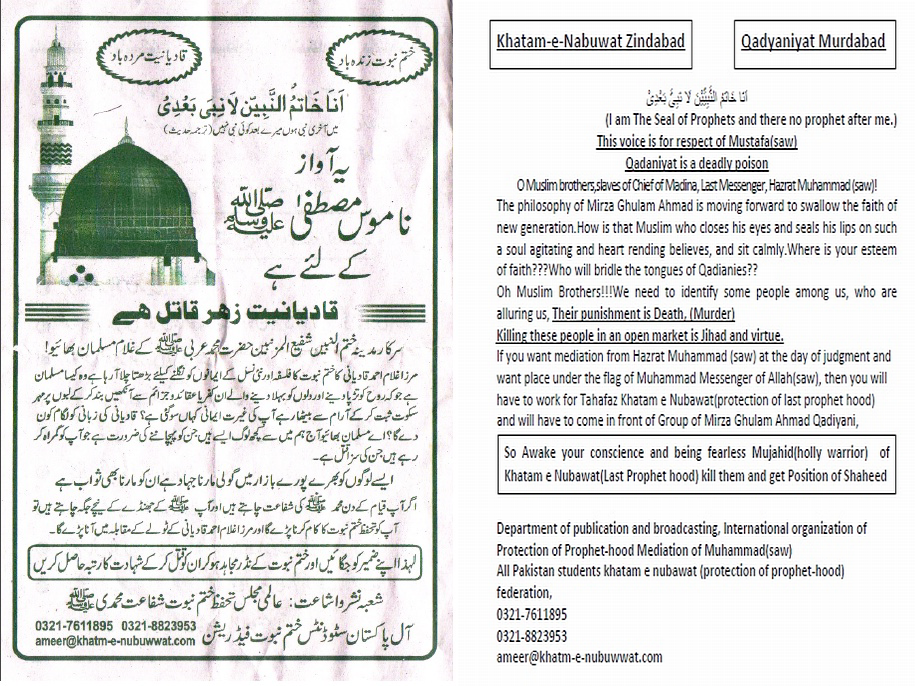
When my elder sister in Lahore, who I call my instant channel for ‘heartbreaking’ news, called to inform that Friday prayer congregations of Ahmadiyya community were attacked in Lahore, I was very sad but not surprised.

When my sister used the expressions of ‘masjid’ and ‘juma ki namaz’, she was not afraid of being penalised for deliberately or inadvertently committing blasphemy according to the laws introduced by General Zia in 1984: a mala fide postscript that followed the Second Amendment to the 1973 Constitution by a decade, declaring people subscribing to the Ahmadiyya faith as non-Muslim minority.

I was sad but not surprised for two reasons. One, a few months back, the colleagues at Civil Junction informed that they had spotted some bearded men taking photographs of the Baitul Zikar (a post-1984 title given to ‘mosque’ by Ahmadis to evade penalty and punishment) which is about 100 metres from my cafĂ©. Duly alarmed by this, we informed persons responsible for the security of the ‘mosque’, and held meetings with neighbours to deliberate precautions. That incident had sent a shudder down one’s spine that the faith-based hatred was about to unfold a new devious angle and Ahmadis were soon to replace shias as new kaafirs, in the eyes of the self ascribed guards of the fort of Islam who have taken it upon them to weed out all ‘others’ from the land of the pure!

The second reason is what most of us know intuitively: the harvest of hatred is ripe, ready and in our face following three decades of nurturing of reengineered, false and flawed faith-based identities of Pakistanis.

I wish to raise four points to invoke rethinking about our identities who shall decide that? Whether we may leave the verdict to Allah Almighty, for the Judgment Day, for hereafter or should we continue doing that ourselves.

First, the universal reference point of a person’s/group’s identity is primarily language and location. This was the first collective denial Pakistani in leadership succumbed to in 1949 when apprehending ‘provincialism’ they decided to base Pakistani identity atop Islam. Though in one’s view it was a deception to evade electoral politics and institute new non-people constituencies.

Second point, State can determine citizenship of its inhabitants but cannot dissect their worldviews or attempt to scout which divinity rules their imagination! In my view, State can determine or deny a person citizenship; it cannot decide or determine inner dynamics of sub-identity like faith or sexual orientation, both of which follow one’s heart, and more importantly the person is the ultimate judge, jury and benefactor of that sub-identity.

Third point, State should not meddle with (read, support or stymie) a citizen’s volitional membership of a community.

Fourth, law’s function is to determine the course of action the citizens ought to follow in order to eventually keep the social fabric of a society intact. If a certain law’s intent, prod or push goes beyond that, then this law is not a law per se. It is rather an intrusive tool to ensure social engineering of sorts.

It is about time Honourable Supreme Court under Chief Justice Iftkhar Muhammad Chaudhary had taken notice of these particular laws which, introduced by a dictator, have not only shaken the basic framework of the Constitution but are also eating up the social bonds citizens are promised as equal citizens.

Arshed is a political activist and can be reached at civil.junction.pakistan@gmail.com

Masked discrimination

News on Sunday, Pakistan
Masked discrimination
June 06, 2010
How the persecution of Ahmadis has often been linked to
larger issues in the past
By Ameem Lutfi
One of the ongoing debates regarding the recent attacks on the Ahmadi population is whether to primarily group these horrendous acts alongside other terrorist offensives that have plagued the country since the Afghan war or to list these among acts of sectarian violence on perhaps one of the most persecuted sect. I am not arguing that it cannot be both; a terrorist attack on an already oppressed sect, but am asking if there is something different about these attacks that sets them apart from other bombings and armed attacks on civilian population?

On the surface this might seem as an inconsequential question because regardless of the answer the underlying fact of the matter is that several innocent people lost their lives in the two deplorable attacks recently. But I believe that given the rise of the politics of statistic under which legitimacy of any argument heavily depends on the numbers backing the argument, this question gains added significance especially for the Ahmadi population. If the master narrative of these incidents ends up portraying these attacks as deliberate hits on the Ahmadi population, and not just another unfortunate terrorist activity, it will greatly strengthen the case being made regarding the persecution of the Ahmadi population.

Interestingly, if one looks at the history of the Ahmadis in our part of the world, one would find quite a few such debates in which we are left to figure out if an act of aggression faced by the community was an act of religious discrimination or just a manifestation of some other resentment. For example, during the colonial period when Ahmadis were seen as being pro-British, attacks on them were often conflated with the larger anti-colonial movement. Then, in the post-partition period, Khatm-e-Nabuwat and other such anti-Ahmadi movements were often perceived as not just an attack on the community but as movements challenging the government in power.

Another such incident which I would like to narrate here maps the anti-Ahmadi sentiment on to class antagonism (or, perhaps, it was the other way around?). While conducting field work in the Okara region I came across an unwritten history of a land struggle in the area. What was different about this particular struggle was the fact that the struggle was not only about the landless peasants taking on the landed gentry but also about a largely mainstream Muslim population taking on a small number of Ahmadi land owners. According to some of the oral narratives from a particular village (6 Chak), when the canal colonies were set up in the 1920s the land in the Chak was awarded to a church which was supposed to settle Christian tenant farmers there but close to partition, the church sold off the land to an Ahmadi Anjuman which further subleased it to other mazaras (tenant farmers). Then, sometime during Ayub’s rule, one of the mazaras who was not producing sufficient crop was threatened that land would be taken away from him. In response to this threat, he started to mobilise all the mazaras (who were by this point in time predominately Sunni-Muslim) to start a movement against the ‘Ahmadi’ landlords. After a period of intense fighting, both parties reached an agreement through the local panchayat under which substantial allowances were given to the mazaraes. One is left wondering if the situation would have been different if the landlords were mainstream Muslims.

I present these various examples to show that the persecution of the Ahmadis has often been linked to larger issues. These larger issues have largely served as a way to mask the underlying discrimination against a particular sect. Also other than the recent attacks, most of these movements have been popular movements which have addressed very real issues that were impacting everyday lives; thus, opposing them became a tricky affair. For example, in the mazarae issue, supporting the Ahmadi side was seen as being in favour of the landed gentry over the landless tenants!

It seems the Ahmadi issue has served as a crutch for other kind of protests to latch on to. The constant anti-Ahmadi rhetoric that we have been fed on has made anti-Ahmadiism an easy point around which people could be readily mobilised. What is perhaps most disturbing is that even issues that are known to be popular mobilisers such as the issue of land have had to be grafted on top of the anti-Ahmadi sentiment in order to get hyper-energised activists and popular support on their side.

This time around, though, the anti-Ahmadi actions are part of a very unpopular and brutal movement and, hence, one does not have to worry about siding with the unpopular ones by supporting a persecuted sect. What we do need to do this time around is to not only see the recent attacks as part of a larger phenomenon but also recognise the underlying hatred against the Ahmadis in society that would have served as a possible motivator for the perpetrators of the attack.

The eternal question - A profile of Tehrik-e-Khatm-e-Nabuwat

News on Sunday, Pakistan
The eternal question
June 06, 2010
A profile of Tehrik-e-Khatm-e-Nabuwat
By Waqar Gillani

The roots of Tehrik-e-Khatm-e-Nabuwat — the leading hardliner forum of Muslim clerics in Pakistan that is directed against the Ahmadiyya community — can be traced back to the 1880s when the Ahmadiyya school of thought was formally founded.

There are a number of religious forums of Muslim clerics but it was chiefly the Deoband school that launched the movement on the local as well as the international level, to corner Ahmadis not only in India but across the world.

The movement against Ahmadis gained momentum in 1934 when Majlis-e-Ahrar arranged a big gathering called Tahafuz-e-Khatm-e-Nabuwat Conference, held at Qadian, the headquarters of Ahmadis in the subcontinent. Attaullah Shah Bukhari of Majlis-e-Ahrar led the conference.

The movement’s history reads that after Pakistan came into being, as a result of the partition of the subcontinent, Chaudhry Zafarullah Khan, better known as Sir Zafarullah Khan, the first foreign minister of Pakistan, allegedly started patronising the Ahmadi sect and nurtured it using his office.

This was the first time that an all-parties movement to protect the finality of Prophet Muhammad (Peace be upon him) started to surface. This movement — eventually called Kul Jamaati Majlis-e-Aml Tahafuz-e-Khatm-e-Nabuwat — had three demands: a) removal of Zafarullah Khan from the foreign ministry; b) removal of Ahmadis from top government offices; and c) declaration of Ahmadis as non-Muslims. This was in 1949, when Majlis-e-Khatm-e-Nabuwat had just started working informally. The movement launched countrywide campaigns and protests resulting in a ban on Majlis-e-Ahrar in 1954. After the ban, a formal Majlis-e-Tahafuz-e-Khatm-e-Nabuwat emerged as the substitute to lead this anti-Ahmadi campaign. The clerics also launched Aalami Majlis-e-Tahafuz-e-Khatm-e-Nabuwat to counter Ahmadis across the world.

In 1973, the then president of Azad Jammu and Kashmir, Sardar Abdul Qayyum declared Ahmadis to be non-Muslims, a step which the Pakistani government had not yet taken. In the same year, Rabta-e-Alam-e-Islami Conference in Saudi Arabia also gave its stamp of approval to oust Ahmadis from the circle of Islam. The unfortunate beating of the students of Nishtar Medical College, Multan, on May 29, 1974, proved to be a major incident that infuriated this anti-Ahmadi movement. The students, going on train, started shouting against Ahmadis while reaching Rabwah – the headquarter city of Ahmadis in Pakistan – resulting in a strong reaction of Ahmadis to this gathering. The incident geared up the Khatm-e-Nabuwat movement that started a violent protest, finally bowing down the parliament to make law, declaring Ahmadis non-Muslims in December 1974. Leading clerics of the time like Mufti Mahmood Ahmed, Shah Ahmad Noorani, Professor Ghafoor Ahmed and many others participated in the 15-day debate on the parliament to declare Ahmadis non-Muslims. In 1976, the Khatm-e-Nabuwat people also set up a mosque and a seminary in the jurisdiction of Rabwah to show their impact.

After meeting the first agenda, Khatm-e-Nabuwat started the next phase of their campaign – to corner Ahmadis in Pakistan. They started demanding legal sanctions on Ahmadis barring them from using the title of Muslim. This campaign was at its peak when Maulana Yousaf of Jamia Banori, Karachi, and Punjab-based Maulana Khawaja Khan Muhammad (who died recently) were leading the Majlis-e-Amal Tahafuz-e-Khatam-e-Nabuwat in 1984 and 1985. The then dictator, General Ziaul Haq imposed legal sanctions on Ahmadis in 1984 through an ordinance barring them from using the title of Muslim, reading and reciting the Holy Quran, and stopping them to declare their worship places as mosque. The ordinance sections later became part of the Pakistan Penal Code (PPC), another target achieved by the Khatm-e-Nabuwat.

In 1985, Maulana Manzoor Ahmad Chinioti and Abdul Hafeez Makki and other clerics also launched a separate organisation titled International Khatm-e-Nabuwat Conference to further corner Ahmadis and force them to follow the legal sanctions of 1984.

In December 2009, another committee called Muttahida Tehrik-e-Khatm-e-Nabuwat Raabta Committee also surfaced in Lahore.

When the state was secular

News on Sunday, Pakistan
When the state was secular
June 06, 2010

Report of the Court of Inquiry constituted under Punjab Act II of 1954, to enquire into the Punjab Disturbances of 1953, also called Munir Report, carried an incisive analysis of the Ulema’s concept of the Islamic State and of a Muslim. Justice Muhammad Munir as president and Justice Kayani as member were appointed to investigate the causes of the trouble. The report concluded that the concept of a Muslim differed for different sects and if the fatwas of the Ulema were relied upon to determine whether an individual is Muslim or Kafir, then no sect could be called Muslim because of the lack of a single, coherent and unanimous definition of a Muslim and an Islamic State. Below are excerpts from this historic document:

An Islamic State

…The Quaid-i-Azam’s conception of a modern national State, it is alleged, became obsolete with the passing of the Objectives Resolution on 12th March 1949; but it has been freely admitted that this Resolution, though grandiloquent in words, phrases, and clauses, is nothing but a hoax, and that not only does it not contain even a semblance of the embryo of an Islamic State but its provisions, particularly those relating to fundamental rights, are directly opposed to the principles of an Islamic State…

The position of non-Muslims

…The ground on which the removal of Chaudhri Zafrullah Khan and other Ahmadis occupying key positions in the State is demanded is that the Ahmadis are non-Muslims; and that therefore, like zimmies in an Islamic State, they are not eligible for appointment to higher offices in the State. This aspect of the demand has directly raised a question about the position of non Muslims in Pakistan if we are to have an Islamic Constitution…

This being the position, the State will have to devise some machinery by which the distinction between a Muslim and a non-Muslim may be determined and its consequences enforced. The question, therefore, whether a person is or is not a Muslim will be of fundamental importance, and it was for this reason that we asked most of the leading ulema to give their definition of a Muslim…

The result of this part of the inquiry, however, has been anything but satisfactory, and if considerable confusion exists in the minds of our ulama on such a simple matter, one can easily imagine what the differences on more complicated matters will be…

Maulana Abul Ala Maudoodi, Amir, Jama’at-i-Islami

“Q. Please define a Muslim.

A. A person is a Muslim if he believes (1) in tauheed, (2) in all the prophets (ambiya), (3) all the books revealed by God, (4) in mala’ika (angels), and (5) yaum-ul-akhira (the Day of Judgment).

Q. Is a mere profession of belief in these articles sufficient to entitle a man to call himself a Musalman and to be treated as a Musalman in an Islamic State?

A. Yes.

Q. If a person says that he believes in all these things, does anyone have a right to question the existence of his belief?

A. The five requisites that I have mentioned above are fundamental, and any alteration in any one of these articles will take him out of the pale of Islam.”…

Apostasy

…Apostasy in an Islamic State is punishable with death…According to this doctrine, Chaudhri Zafrullah Khan, if he has not inherited his present religious beliefs but has voluntarily elected to be an Ahmadi, must be put to death. And the same fate should befall Deobandis and Wahabis, including Maulana Muhammad Shafi Deobandi, Member, Board of Talimat-i- Islami attached to the Constituent Assembly of Pakistan, and Maulana Daud Ghaznavi, if Maulana Abul Hasanat Sayyad Muhammad Ahmad Qadri, or Mirza Raza Ahmad Khan Barelvi, or any one of the numerous ulama who are shown perched on every leaf of a beautifnl tree in the fatwa, Exhibit D. E. 14, were the head of such Islamic State…

The net result of all this is that neither Shias nor Sunnis nor Deobandis nor Ahl-i-Hadith nor Barelvis are Muslims, and any change from one view to the other must be accompanied in an Islamic State with the penalty of death, if the Government of the State is in the hands of the party which considers the other party to be kafirs. And it does not require much imagination to judge the consequences of this doctrine, when it is remembered that no two ulema have agreed before us as to the definition of a Muslim…

The death penalty for irtidad has implications of a far-reaching character, and stamps Islam as a religion of fanatics, which punishes all independent thinking. The Qur’an again and again lays emphasis on reason and thought, advises toleration, and preaches against compulsion in religious matters…

Reaction on Muslims of non-Muslim states

…The ideology on which an Islamic State is desired to be founded in Pakistan must have certain consequences for the Musalmans who are living in countries under non-Muslim sovereigns. We asked Amir-i-Shari’at Sayyad Ataullah Shah Bukhari whether a Muslim could be a faithful subject of a non-Muslim State, and reproduce his answer:

“Q. In your opinion is a Musalman bound to obey orders of a kafir Government?

A. It is not possible that a Musalman should be a faithful citizen of a non-Muslim Government.

Q. Will it be possible for the four crore of Indian Muslims to be faithful citizens of their State?

A. No.”…

The answer is quite consistent with the ideology which has been pressed before us, but then if Pakistan is entitled to base its Constitution on religion, the same right must be conceded to other countries where Musalmans are in substantial minorities, or if they constitute a preponderating majority in a country where sovereignty rests with a. non-Muslim community. We therefore asked the various ulama whether, if non-Muslims in Pakistan were to be subjected to this discrimination in matters of citizenship, the ulama would have any objection to Muslims in other countries being subjected to a similar discrimination…

We have dwelt at some length on the subject of Islamic State not because we intended to write a thesis against or in favour of such State, but merely with a view to presenting a clear picture of the numerous possibilities that may in future arise if the true causes of the ideological confusion which contributed to the spread and intensity of the [recent anti-Ahmadi] disturbances are not precisely located.

Compiled by Minahil Zafar

A history of prejudice

News on Sunday, Pakistan
A history of prejudice
June 06, 2010
Tracing the roots of how the level of tolerance for the belief of the
‘other’ sharply declined
By I. A. Rehman

When the Second Amendment to the constitution was adopted in 1974, the government claimed honour and glory for having settled an 80-year-old problem. Each year since then has made the conscious citizens of Pakistan wonder as to how long will it take to end the problems generated by that amendment.

By the 80-year-old problem was meant the decades of anti-Ahmadiyya agitation, largely in Punjab, carried on spasmodically by Majlis-i-Ahrar, a lower middle class party that sought political support on the strength of a mix of nationalism and a puritanical and austere Islam. Many theories have been advanced on the genesis of the Ahrar-Ahmedi confrontation.

Some said the Ahrar had reacted to the Ahmedis’ renunciation of or reservation on Jihad and the claims of the founder of their movement to be a prophet or the promised Masih or a reformer. Some others attacked the Ahmedis for the favours they were said to be receiving from the British. According to another theory, the Ahrar could not bear Ahmedis’ success in recruiting to their fold the educated Muslim youth. Yet, till the early 1930s, a staunch Islamic revivalist and widely acclaimed lover of the Prophet (PBUH) like Iqbal saw nothing wrong in sitting with the Ahmedi chief in the Kashmir Committee, formed to extend succour to the Kashmiri victims of the Dogra tyranny. The Ahrar leaders eventually walked out of the committee after accusing the Ahmedis of using the Kashmir agitation for their own ends.

As the subcontinent’s struggle for freedom entered its final phase, the parties that put belief above politics among the Muslims and the Hindus both were marginalised. Their rout in the 1945-46 general election embittered them and the Ahrar decided to beat the Muslim League with the latter’s own weapon – the baton of belief, as their leaders put it. Soon after independence, they started defying the laws while agitating against the Ahmedis. They received a boost when the Punjab Muslim League sought their support in the 1951 election. Later on, the Daultana government colluded with them in using anti-Ahmadiyya agitation to harass, and possibly topple, the Nazimuddin ministry at the centre. The result was the anti-Ahmadiyya riots of 1953 and the Pakistani people’s first taste of post-colonial martial law.

The anti-Ahmedi agitation of 1953 could be suppressed because the Daultana government had relied on shady intrigue, the central government had in its ranks influential elements that were strong enough to reject anti-Ahmedi demands, and the troops Gen. Azam sent to clear the Wazir Khan Mosque of the agitators were still following the British scheme of staying out of religious controversy. But it offered some ominous lessons. The religious parties joined hands to jointly capture Ahrar’s platform and realised the huge potential of religion-based politics.

They thought they had a chance to capture power under a religious standard when the Ayub regime collapsed and a key minister in the Yahya government was keen to do the Daultana act by patronising the religious parties in the 1970 election. Their bitterness at losing the polls exceeded Ahrar’s anger at their 1946 defeat. Nobody was surprised when they started planning for a religion-based challenge to the Bhutto government. Suddenly the government obliged them by introducing an amendment to the constitution devised as a first step towards declaring the Ahmedis non-Muslims.

The decision of the Bhutto government to adopt this measure (Second Amendment of 1974) is still a riddle. The incidents of rioting in some parts of Punjab, that were used as a pretext, were too insignificant to warrant a constitutional amendment. The identity of troublemakers was not established; they could have been Ahmedi hotheads (as alleged by officials), they could have been mercenaries hired by state minions, or they could have been provocateurs working for the anti-Ahmedi lobby.

The Second Amendment was a curious piece of drafting. Article 260, which defines the terms and expressions used in the constitution, was used to decide a momentous issue such as an 80-year-old conflict. Clause (3) added at the end of the article said:

“(3) – A person who does not believe in the absolute and unqualified finality of the Prophethood of Muhammad (Peace be upon him), the last of the Prophets, or claims to be a Prophet, in any sense of the word or of any description whatsoever, after Muhammad (Peace be upon him), or recognises such a claimant as a prophet, is not a Muslim for the purposes of the Constitution or law.”

No attempt was made to conceal the purpose of the amendment – to push Ahmedis outside the pale of Islam. Some people thought any Ahmedi could escape attracting action under the new provision by simply affirming faith in the finality of the Prophet (PBUH). The commentary on the constitution bearing Justice Munir’s name says the Second Amendment “simply affirmed and declared (the) position as it existed under Shariat”. But the matter defied an over-simplified interpretation. General Zia saw the opening offered by the Second Amendment and went for the kill. In order to ensure that all Ahmedis were caught in the net of Article 260(3) he replaced the 1974 text with the following:

“(3) In the Constitution and all enactments and other legal instruments, unless there is anything repugnant in the subject or context; – (a) ‘Muslim’ means a person who believes in the unity and oneness of Almighty Allah, in the absolute and unqualified finality of the Prophethood of Muhammad (Peace be upon him), the last of the Prophets, and does not believe in, or recognise as a prophet or religious reformer, any person who claimed or claims to be a prophet, in any sense of the word or of any description whatsoever, after Muhammad (Peace be upon him); and (b) ‘non-Muslim’ means a person who is not a Muslim and includes a person belonging to the Christian, Hindu, Sikh, Buddhist or Parsi community, a person of the Qadiani Group or the Lahori Group (who call themselves ‘Ahmedis’ or by any other name), or a Bahai, and a person belonging to any of the scheduled castes.”

General Zia did not stop at that. Besides presiding over efforts to add 295-C to the PPC, he added Ahmedi-specific provisions to the Penal Code under which an Ahmedi can be punished for calling himself a Muslim or posing as such, or for calling his prayer house a mosque or for possessing a copy of the Holy Quran, or for inscribing Bismillah on his letter/invitation card.

What has added to the miseries of the Ahmadiyya community is the fact that while the liberal Muslims stopped addressing the situation caused by the consolidation of anti-Ahmedi campaigns once the Munir Inquiry Report was published, a number of factors have led to the rise of extremists who lack neither guns nor money and who use force and violence to establish their version of Islam. The level of tolerance for the belief of the ‘other’ has sharply declined. The result of these and related developments is admirably summed up by Hamid Khan in the following words:
“The Second Amendment was the beginning of the process of legal victimisation and persecution of the Ahmadiyya community in Pakistan, followed by Draconian laws and adverse judicial pronouncements against religious minorities in general. Members of the community have been pushed against the wall and are a constant target of threats and hyperbole on the part of political and religious bigots. Succeeding governments have failed to stem the tide of victimisation and have, at times, succumbed to the pressure. It is always an easy and convenient path for an incumbent government to gain cheap popularity and to appease the bigots by conceding their unreasonable demands without realising that political blackmail never ends. When the Ahmedis appealed to the courts for protection, they found themselves in the hands of judges who were not only totally unsympathetic to them but gave strong judgments against them, further restricting their freedom and civil rights”. (Constitutional and Political History of Pakistan.)

The biggest tragedy of Pakistan is the failure of the religious majority to realise that the persecution of a minority community will ultimately lead to its own destruction.

News on Sunday - Editorial

News on Sunday, Pakistan
Editorial
June 06, 2010

The contrary view has been heard so loud and clear, perhaps, for the first time in the last three decades. It took about 100 odd brutal killings of Ahmadis in Lahore that allowed this to happen. But will it change things? Perhaps, when the contrary view becomes louder still.

It is ironic how we in the media who kept silent each time the Ahmadis were persecuted and discriminated against – which they are on a regular basis – have finally found the courage to acknowledge the persecution and the discrimination. And that’s not where the irony ends. It started when within the first hour, the breaking news about the attack on Ahmadi ‘mosques’ changed to their “places of worship”. It continued when the law enforcers saw the hands of RAW in the attack which could not have been conducted by a Muslim. Nor was the irony lost when the attack was seen as a way to sabotage the country’s right to celebrate its nuclear status on the Yaum-e-Takbeer or how there were no spontaneous crowds against the Lahore attacks the way there were on Facebook issue and the Israeli attack on the aid carrying ship.

Were people scared to come out and speak up? Alongside the reaction and the outcry on the media came whispers about whether it was right to say funeral prayers for the non-Muslim Ahmadis. Once again people affirmed their faith by finding fault with others.

The two reactions set the ball rolling. It has indeed been a history of prejudice but how and why did we come to this point. What were the political compulsions that changed the secular moorings of the state to religious ones? Why did we find it so easy to sign this declaration every time we filled out a form to register for an identity card or a passport that we are not ahmadis? Why couldn’t we have stood up and protested? Why did we allow the state to exercise the right to declare a group of people non-Muslims? Is that why the state still finds itself unable to protect them?

It is ironic how the brutal killing of a hundred citizens of this country has forced us to ask these questions now. It is ironic why we did not raise them in the last thirty six years.


^ Top of Page