 | Pakistan Opinion |
White is black
 |
By Amina Jilani
June 05, 2010
June 05, 2010
The writer is a freelance columnist (amina.jilani@tribune.com.pk)
Has the time finally come for this nation to seriously consider removing the white strip from its national flag? Does anyone know or care what this strip symbolises? It has become obvious that few do, including the various leaderships who have topped us. The white strip, officially “one-fourth of the size of the flag nearest the mast” was added at the behest of the founder of this country to firmly denote the commitment of the nation-state to extending to its minority communities equal rights of citizenship — equal to all intents and purposes. And, remember, white is a call for peace.
Well, the equality was denuded within six months of the Founder’s death when on March 7, 1949, the Objectives Resolution was moved by none other than his loyal successor and chosen prime minister, Liaquat Ali Khan, and passed by the majority in the constituent assembly. Thus was the white strip rendered a joke, thus were intolerance and bigotry institutionalised with intent. Repercussions were not long coming. March 1953 saw the anti-Ahmadi disturbances in Punjab, which led to martial law. From then on, for the citizens of Pakistan equality became a distant dream.
That gentleman of secular tendencies, pseudo-socialist Zulfikar Ali Bhutto, furthered the cause of religiosity and all the rot that goes with it, with his 1973 constitution which apart from being chock-a-block with cynical provisions dictated by the majority religion, had as its preamble the Objectives Resolution, cementing the fact that the white strip was negated. He went a step further in 1974 when at the insistence of the pious Islamist party people he brought in his second amendment and in one fell swoop committed the first act of collective excommunication in the Muslim world — making a minority of those who since the birth of the country had been a part of the majority. The white strip since then is a shame we must all bear.
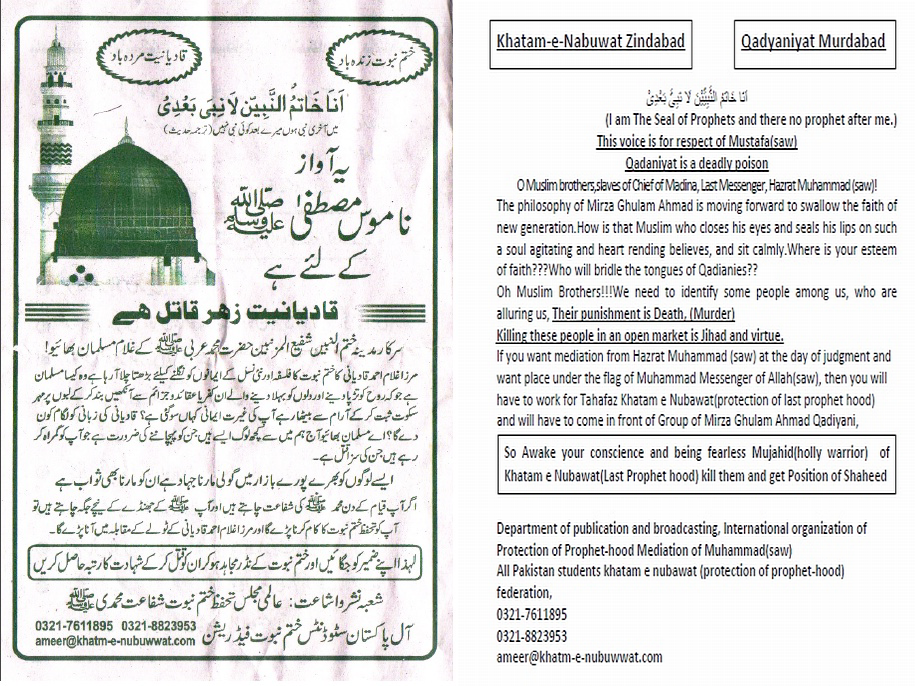
The massacres in Lahore on May 28 did not come out of the blue – the federal and provincial governments had fair warning. On February 7 the Washington Post carried a report by Pamela Constable relating how “a handful of radical clerics have been whipping up hostility” in Lahore towards the Ahmadis and other minority sects. And then there was the banner hung on The Mall that declared Jews, Christians and Ahmadis to be “enemies of Islam” and a signboard sponsored by the Punjab Government Auqaf Department pronouncing friends of Ahmadis to be enemies of Islam.
Over the past three decades the symbolism of the white strip on the country’s flag has been sullied beyond repair. We are hypocritical to the core. Spates of violence along religious and sectarian lines are the order of the day, yet few object — most ignore what is under their noses, they ignore the murder of citizens of Pakistan by their fellow citizens and jump up and down in what they take to be righteous indignation about wrongs done in foreign lands. The official reaction to May 28 was muted and meaningless, shaming — as were protests by the public in general. Gaza overtook Lahore in a canter, with ease.
There is really no need to schlep off to foreign waters to protest against murder and mayhem — there is more than enough of it here right at home, in the Islamic Republic of Pakistan. Putting our own house in order, ridding our own eyes of multiples motes is a must before we can with any justification adopt outside causes, mostly prompted by an unreasonable and unrealistic hatred for the sole superpower. It’s high time to get real.
Published in the Express Tribune, June 5th, 2010.
Well, the equality was denuded within six months of the Founder’s death when on March 7, 1949, the Objectives Resolution was moved by none other than his loyal successor and chosen prime minister, Liaquat Ali Khan, and passed by the majority in the constituent assembly. Thus was the white strip rendered a joke, thus were intolerance and bigotry institutionalised with intent. Repercussions were not long coming. March 1953 saw the anti-Ahmadi disturbances in Punjab, which led to martial law. From then on, for the citizens of Pakistan equality became a distant dream.
That gentleman of secular tendencies, pseudo-socialist Zulfikar Ali Bhutto, furthered the cause of religiosity and all the rot that goes with it, with his 1973 constitution which apart from being chock-a-block with cynical provisions dictated by the majority religion, had as its preamble the Objectives Resolution, cementing the fact that the white strip was negated. He went a step further in 1974 when at the insistence of the pious Islamist party people he brought in his second amendment and in one fell swoop committed the first act of collective excommunication in the Muslim world — making a minority of those who since the birth of the country had been a part of the majority. The white strip since then is a shame we must all bear.
The massacres in Lahore on May 28 did not come out of the blue – the federal and provincial governments had fair warning. On February 7 the Washington Post carried a report by Pamela Constable relating how “a handful of radical clerics have been whipping up hostility” in Lahore towards the Ahmadis and other minority sects. And then there was the banner hung on The Mall that declared Jews, Christians and Ahmadis to be “enemies of Islam” and a signboard sponsored by the Punjab Government Auqaf Department pronouncing friends of Ahmadis to be enemies of Islam.
Over the past three decades the symbolism of the white strip on the country’s flag has been sullied beyond repair. We are hypocritical to the core. Spates of violence along religious and sectarian lines are the order of the day, yet few object — most ignore what is under their noses, they ignore the murder of citizens of Pakistan by their fellow citizens and jump up and down in what they take to be righteous indignation about wrongs done in foreign lands. The official reaction to May 28 was muted and meaningless, shaming — as were protests by the public in general. Gaza overtook Lahore in a canter, with ease.
There is really no need to schlep off to foreign waters to protest against murder and mayhem — there is more than enough of it here right at home, in the Islamic Republic of Pakistan. Putting our own house in order, ridding our own eyes of multiples motes is a must before we can with any justification adopt outside causes, mostly prompted by an unreasonable and unrealistic hatred for the sole superpower. It’s high time to get real.
Published in the Express Tribune, June 5th, 2010.





 Posts
Posts


