Showing posts with label Zulfikar Ali Bhutto. Show all posts

Sunday, July 11, 2010

A little learning

Daily Dawn, Pakistan
Columnist

A little learning
   By Ardeshir Cowasjee
   Sunday, 11 Jul, 2010

Zulfikar Ali Bhutto brought in seven amendments, three concerned with 'fixing' the judiciary to his liking, two with furthering the cause of preventative detention, and one transforming a community of the majority into a minority, i.e. shaving it of its rights. - File Photo.
Zulfikar Ali Bhutto brought in seven amendments, three concerned with ‘fixing’ the judiciary to his liking, two with furthering the cause of preventative detention, and one transforming a community of the majority into a minority, i.e. shaving it of its rights. — File Photo.

It is said to be a dangerous thing. And we in this Islamic Republic know better than many that it indeed is. However, having said that it is always good to pick up bits of knowledge along the way and learn — and we need never stop learning.

A.G. Noorani, political analyst, advocate of the Supreme Court of India, writes for this newspaper. His column of July 3 dealt with the doctrine of the ‘basic structure of a constitution’ and how this cannot be changed by amendments. It was relevant to our constitution and the present matter in the Supreme Court of Pakistan dealing with the issue of the 18th Amendment to the 1973 constitution, during the hearings of which our learned justices referred to its ‘basic structure’ but did not define it.

To some, the basic structure is embodied in the fundamental rights guaranteed by a constitution, to others it is the form of government — parliamentary or presidential. What was the basic structure of the 1973 constitution when it was promulgated?

Well, if it was the fundamental rights (Articles 8 to 28), then the basic structure was changed within four hours of its promulgation on Aug 14, 1973 when a presidential order declared that the state of emergency imposed in 1971 would continue for an unspecified period and that 10 of the guaranteed fundamental rights stood non-justiciable, i.e. suspended. So decreed Zulfikar Ali Bhutto, maker and promulgator, and his president had no qualms in signing the order. (Fundamental rights were twice suspended subsequently, by Ziaul Haq and Pervez Musharraf.)

Bhutto brought in seven amendments, three concerned with ‘fixing’ the judiciary to his liking, two with furthering the cause of preventative detention, and one transforming a community of the majority into a minority, i.e. shaving it of its rights.

From this we must assume that our ‘basic structure’ is not fundamental rights. So what is it? Well, come 1985 and Ziaul Haq brought in his Eighth Amendment which totally changed the form of government from parliamentary to quasi presidential, and introduced into the constitution matters of religion — his own unique brand of religion — which impinged on 59 articles and sub-articles of the constitution, thus debasing its tenor and spirit.

He made the Objectives Resolution an annex to and substantive part of the constitution, thus further betraying the desire and objective of the founder-maker of the country, Mohammad Ali Jinnah, who had unequivocally instructed his constituent assembly that “You may belong to any religion, or caste, or creed — that has nothing to do with the business of the state.”

Would one not say that any basic structure was thus completely undone?

Now, this present government, with much trumpeting, has introduced the 18th Amendment which it declares falsely has ‘restored’ the original 1973 constitution. One must ask the legislators, and also our honourable Supreme Court justices, how this has possibly been achieved when the constitution remains littered with the religious aspects of the Eighth Amendment? Is parliament not misleading the nation, is it not collectively conniving in an untruth?

In his column, Mr Noorani told us that the author of ‘the basic structure’ doctrine was Prof Dietrich Conrad who headed the law department of the South Asia Institute of the University of Heidelberg from its founding in 1963 to his retirement in 1997 (he died in 2001). According to Mr Noorani, he “single-handedly inspired a revolution in constitutional law,” namely the ‘basic structure’ limitation on powers to amend constitutions.

Indian lawyers took note of the doctrine in 1965 and it was laid down by the Supreme Court in the Kesavananda Bharati case in 1973. Courts in Pakistan have wavered in their position on the question and fallen shy of expressing an opinion (can someone tell me otherwise?). According to Conrad “there are, beyond the wording of particular provisions, systematic principles underlying and connecting the provisions of the constitution … [which] give coherence to the constitution and make it an organic whole.”

As to the 1973 constitution, or more precisely the 1985 constitution which is what we toil under today, what is it that gives it coherence and makes it an organic whole? Can any man answer this? Abdul Hafeez Pirzada can certainly answer on behalf of what was the 1973 constitution, and my old friend, the Jadoogar of Jeddah, Sharifuddin Pirzada, could undoubtedly enlighten us on the 1985 version. We need them to speak up. The cause of anxiety about the 18th Amendment is clear — it is how it affects our judiciary.Whilst Conrad was examining the emergency provisions of the Indian constitution and their use he correctly asserted that emergency powers were never intended to be used to improve the economy of a country. Provisions for the imposition of a state of emergency, in any part of a country, were unsound and its use would lead to the generation of a feeling of alienation among the people of that part of the country.

On the concept of the rule of law, Conrad had it that this could not be attained unless the judicial machinery was reformed to provide expeditious and effective remedies against the violation of laws. He also stressed that the right to basic necessities of life be judicially enforced, and that the existence of different personal laws be re-examined in the light of the right to equality under the constitution.

The 18th Amendment has not only irritated the judicial appointments issue, it has also done little to ensure the right to equality for the country’s citizens.

arfc@cyber.net.pk

©2010 DAWN Media Group. All rights reserved

Tuesday, June 8, 2010

A sad place, indeed

Daily Dawn, Pakistan
Columnist

A sad place, indeed
    By Kamran Shafi
    Tuesday, 08 Jun, 2010
My piece of last week was more a personal journey in time: remembering old friends and recalling a time when there was no distinction between Sunnis and Shias and Ahmadis and Bohris and Aga Khanis and what have you, each worshipping his God in his own way, but all equal citizens of the state. - Reuters Photo
My piece of last week was more a personal journey in time: remembering old friends and recalling a time when there was no distinction between Sunnis and Shias and Ahmadis and Bohris and Aga Khanis and what have you, each worshipping his God in his own way, but all equal citizens of the state. — Reuters Photo

I have to start with the drama fast unfolding in the honourable Supreme Court, and the reaction to it that one meets on the street and on the Internet.

I wonder how conversant My Lords are with cyberspace, especially when one sees the utter abandon with which the Lahore High Court first ordered Facebook banned and a few days later restored.

In the interim Pakistan was made to look like a foolish country with foolish people who did not have any idea about what was good for them and what was not.

But surely, some of them will know what is going about on the Internet, particularly from bloggers from Sindh and Balochistan and Khyber Pakhtunkhwa about the ethnic makeup of the Supreme Court.

I say what I am saying with extreme humility, and as a good friend and supporter, nay as a loyal servant of an independent judiciary. I merely point out what I do to caution My Lords that parallels are being drawn between the present court and the hanging bench that despatched another Sindhi, that time the brilliant Zulfikar Ali Bhutto via the hangman’s noose: the four Punjabis on the bench convicting and the three non-Punjabis acquitting.

A noose that should never have been used according to Nasim Hassan Shah, one of the hanging judges, in several interviews he has given over the last five or so years.

What is the parallel you might well ask? ZAB, an elected leader of great note within the country, and of world renown abroad on the one hand, and the much-maligned Asif Zardari on the other? But this is the whole point, is it not? When the smaller provinces feel badly done by — Bhutto’s judicial murder; Nawab Akbar Bugti’s cold-blooded and targeted killing; the disappearance of many Baloch and Sindhi activists — the seeming relentlessness of Asif Zardari’s pursuit does not enter the equation.

This is what people in positions of authority in this poor and fraying federation must understand, and the sooner the better. Incidentally, the whole argument about ethnicity is just that: ethnicity and not the province in which someone or other resides or is domiciled.

One more time might I suggest too, that in order to demonstrate that they are not only interested in the laying low of the federal government in particular, and politicians and parliament in general, that My Lords step back to give and take some respite, and call other weighty matters before them in suo motu actions as well? At the top of which very long list is the matter of the disappeared which is really attaining alarming proportions.

Critically, it seems an absolute exercise in futility to have a retired judge heading a tribunal of inquiry on the disappeared when a bench of the Supreme Court itself cannot (will not?) summon an army officer above the rank of colonel before it.

To revert to the terrible atrocity perpetrated on our Ahmadi brothers and sisters, first off, my deep gratitude to the Pakistan Army for burying with full military honours the well-considered Maj-Gen (retd) Nasir Ahmed Chaudhry, a 90-year old gentleman who was gunned down in cold blood with the worshippers. Well done, my army, and may this spirit of loyalty and fairness and rectitude guide the high command in other matters too. Today I am a proud former soldier.

My piece of last week was more a personal journey in time: remembering old friends and recalling a time when there was no distinction between Sunnis and Shias and Ahmadis and Bohris and Aga Khanis and what have you, each worshipping his God in his own way, but all equal citizens of the state. This week we must look at the reaction of the state to the killings of Ahmadis as compared to that which is put on display when others are similarly butchered by people who cannot abide those who do not subscribe to their own, narrow beliefs.

For, it is a sad fact that others, whether they be Shias or Sunnis of this or that sect and creed and belief, all have been targets of the obscurantist killers of humanity. Indeed, our Christian and Hindu and Sikh brothers and sisters have likewise been targeted by cruel murderers. But every time that some outrage has taken place, political leaders have bestirred themselves and visited the homes of those killed. Why not this time?

The Ahmadis might be considered non-Muslim by the state; surely they are still Pakistani? Surely, then, all of the protections and succour that a state should provide its citizens are to be extended to them too?

Far more than this, please note that the compensation which is announced immediately for those killed or injured as a result of such wanton acts in the case of others, was announced five days after the event in the case of the Ahmadis (Rs500,000 and 100,000 respectively for those killed and injured). Indeed, look at the language used while announcing compensation: “Jo maraygaey” for those who were killed. Surely there are kinder terms that could have been used, such as “Jo jaan bahak huay”; “Jo halaak huay”; even “Jo faut huay”!

Why are we so cruel towards the poor Ahmadis, can some one please tell me?

Let me add in passing that my Ahmadi friends tell me that the reply of their community to the offer of compensation is that the community is well placed to look after its own, thank you very much, and that the compensation which is to be paid should be transferred to the people of Hunza-Gojal for the relief work which is ongoing and which will surely increase as the disaster widens.

Pakistan is a sad, sad place my friends; a twisted and pitiless and heartless caricature of what our founding fathers had in mind. I am heartbroken. Kudos, however, to Nawaz Sharif for openly saying that the Ahmadis are our brothers. Of course, it is another matter that the obscurantist elements have jumped down his throat! More strength to him I say.

kshafi1@yahoo.co.uk

©2010 DAWN Media Group. All rights reserved
Monday, May 3, 2010

A matter of faith

---Express Tribune, Pakistan

A matter of faith

By Basil Nabi Malik
May 03, 2010


The writer is a lawyer with Malik, Chaudhry, Ahmed and Siddiqi in Karachi (basil.nabi@tribune.com.pk)

It is common knowledge that we are duty bound to follow and respect the Constitution of Pakistan and each and every one of its articles. However, the same becomes a tad bit difficult when certain unpalatable clauses are added which really have no business being in the constitution.

For example, if I were to ask anyone as to the definition of a ‘Muslim’, I am guessing the last place they’d look would be in the Constitution of Pakistan. However, lo and behold Article 260 of our constitution actually defines the term. Ironically, all this happened during the time of Zulfikar Ali Bhutto, though he was, of course, pressured to do this by certain religious quarters.

Although it was clearly a political move, the method was unique. Rather than to go into the intricacies and complications of trying to forge a unanimously agreed-upon definition, which many thought was next to impossible and perhaps even unnecessary, he thought it fit to zero in on an exclusionary clause which ‘enlightened’ us on what a Muslim could not be.
.
However, clearly, this was the kind of medieval quackery that only ‘scheming politicians’ could think of. It took the likes of General Zia in 1985 to give us an affirmative definition of a Muslim, sans the discussions and attempts at consensus building, which in all likelihood, he probably found irrelevant. He did this in the form of the President’s Order No. 24 of 1985, whereby Article 260(3) was substituted with what can best be described as intriguing definitions of the terms ‘Muslim’ and ‘non-Muslim’.

The word ‘Muslim’ entailed: “a person who believes in the unity and oneness of Almighty Allah, in the absolute and unqualified finality of the Prophethood of Muhammad (pbuh), the last of the Prophets and does not believe in, or recognise as a prophet or religious reformer, any person who claimed or claims to be a prophet, in any sense of the word or of any description whatsoever, after Muhammad (pbuh)”. General Zia, however, didn’t leave it at that.

For some odd reason, he didn’t feel that the people of the country would actually be able to understand the term ‘Muslim’ and so the definition of ‘non-Muslim’ was also inserted. The term ‘non-Muslim’ was defined as: “a person who is not a Muslim and includes a person belonging to the Christian, Hindu, Sikh, Buddhist or Parsi community, a person of the Qadiani Group or the Lahori Group who call themselves ‘Ahmadis’ or by any other name or a Bahai and a person belonging to any of the Scheduled Castes”.

Effectively, in one stroke, General Zia did what Justice Munir in the Munir Report of 1954 dreaded and forewarned against: the adoption of certain religious worldviews at the expense of others, thereby inducing divisions in society. To be more exact, after asking a variety of the ulema as to what the definition of a Muslim would entail and receiving varying responses, Justice Munir said in the report that: “keeping in view the several definitions given by the ulema [defining the term Muslim], need we make any comment except that no two learned divines are agreed on this fundamental.”

The point is that what business is it of the state to get into this whole matter of defining who is a Muslim and who isn’t. One would have thought that this is a matter best left to individuals themselves and is something to be assessed by their conduct and actions — and in any case it is a private matter for each individual. It’s a pity that the 18th amendment chose to ignore this in the present constitution.

URL:
http://tribune.com.pk/story/10274/a-matter-of-faith/

Sunday, August 23, 2009

Not the business of the state — 2

--- daily DAWN, Pakistan
COLUMNISTS
Not the business of the state — 2
By Ardeshir Cowasjee
Sunday, 23 Aug, 2009 | 09:51 AM PST

Are we not supposed to all be equal citizens with equal rights as decreed by Mohammad Ali Jinnah, the man who founded and made the country? - Photo by Reuters/FileOn Aug 18, a letter from Citizen of Pakistan Naeem Sadiq of Karachi (naeemsadiq @ gmail.com) was printed in this newspaper of record. The subject was a ‘Request for suo moto notice’ and it was an appeal to the chief justice of the Sindh High Court.

Karachi’s Defence Housing Authority in its application form for the allotment of plots in its DHA City scheme has asked those applying to declare their religion and sect. This, states Naeem, is discriminatory and a violation of our fundamental rights. He contends that the intention of the DHA is to make segregated living zones for those of different religions and to further add to this division on sectarian grounds. The demand is at odds with Islam, the Quran and Sunnah making no mention of any ‘sects.’

As he writes: ‘Unless checked, this practice may soon extend to a declaration of religion and sect for other routing commercial transactions, such as buying a PIA ticket or obtaining a mobile telephone SIM.’ So, he has requested the chief justice of Sindh to ‘take suo moto notice and order the DHA to remove the requirement of religion and sect from its application forms and other related documents’.

Absolutely correct — it is not the business of the DHA to delve into the religion and sect of people wishing to purchase plots which it has advertised for sale.

In similar vein, Citizen Sadiq on July 25, 2009 addressed a letter to Chief Justice of Pakistan Iftikhar Chaudhry at Islamabad on the matter of compulsory zakat deductions by the banks of Pakistan, appealing to the Supreme Court in the public interest to take suo moto notice. His letter reads: ‘The Supreme Court of Pakistan in a landmark judgment on March 9, 1999 gave a ruling that members of all ‘fiqhs’ were entitled to exemption from compulsory deduction of zakat, and the federal government had no authority to reject the declaration of any Muslim seeking exemption from zakat, if it was made on a prescribed form. This judgment enables any Muslim to declare his/her ‘fiqh’ and thus seek exemption from compulsory deduction of zakat. De facto, it also recognises the right of individuals to practise their faith according to their own ‘fiqhs,’ and not be dictated by the government’s interpretation.

‘The historic judgment, while so well recognising the right of individuals in matters of their faith, made an irritating mess of how this right was to be practised. Firstly, it requires Muslims to declare their ‘fiqh.’ The great Prophet of Islam (PBUH) did not subscribe to any ‘sect’ or ‘fiqh.’ For his followers to be forced to invent, be branded and be divided by sects and ‘fiqhs’ is therefore an absolutely unethical and undesirable demand on the part of the government.

‘The second irritant relates to the requirement of making this declaration on a prescribed format, thus creating a serious bureaucratic and procedural difficulty for the ordinary citizens. They are required to fill a judicial stamped paper of Rs20 (available for Rs120), have it signed by a notary public and two witnesses before making a completely unnecessary declaration of their ‘fiqh.’ The form is also called CZ-50 affidavit.

‘This anomaly could be easily rectified if the Supreme Court, through a public interest suo moto notice, clarified its original judgment by requiring only those Muslims to give in writing (on a plain piece of paper) who do wish their zakat to be deducted by a bank. This would truly be in keeping with the Supreme Court verdict that all Muslims are entitled to exemption from compulsory deduction of zakat.’

By July 31, Naeem received a letter from the Supreme Court registrar advising him that the chief justice had been pleased to accept the application and ordered that the matter (Suo Moto Case No.12 of 2009) be heard on Aug 10 at Islamabad, and he was required to appear in person.

Two issues were raised at the hearing: (a) that the procedure for exemption from compulsory deduction of zakat was tedious, time-wasting, and cumbersome; and (b) that the state cannot compel its citizens to declare a specific ‘fiqh’ and thus be divided and boxed into one or the other schools of interpretation.

Chief Justice Chaudhry sitting with Justices Jawwad Khawaja and Ijaz Ahmad heard the submission, agreed that it was a pro bono case, and ordered the State Bank and the federation of Pakistan to appear before the court at the next hearing (which is fixed for Oct 5) and explain as to why this procedure cannot be simplified and improved in the light of issues raised by the appellant.

The state of Pakistan is intrusive when it comes to matters of religion. Why? Are we not supposed to all be equal citizens with equal rights as decreed by Mohammad Ali Jinnah, the man who founded and made the country? According to the original constitution as promulgated at noon on Aug 14, 1973 by Zulfikar Ali Bhutto, we were equal citizens of the state, with equal rights. But this equality was done away with in 1974 by Bhutto’s second amendment to his constitution, bending to the obscurantists and bigots, and an entire community was shorn of its rights and declared a minority.

Prior to this, in 1979 the same community was targeted by Ziaul Haq, general of the army and president of the republic, pious and God-fearing. He had decreed that all citizens, regardless of their religion, wishing to obtain a passport must sign a declaration that it is his/her belief that the Prophet of Islam is the final prophet and that any pretender that follows him is false.

Such is the business of the state.

arfc@cyber.net.pk

©2009 DAWN Media Group. All rights reserved

Friday, September 26, 2008

Threat to the state by Ayesha Siddiqa - [Opinion]

By Ayesha Siddiqa

MANY in Pakistan are shocked at the bomb blast outside the Marriott hotel in Islamabad which killed more than 50 people and wounded scores. It has made people nervous about further acts of violence, making life unsafe in the capital.

The question for many is that if law and order agencies are unable to protect important people in high-security areas, then what can be the fate of ordinary people?

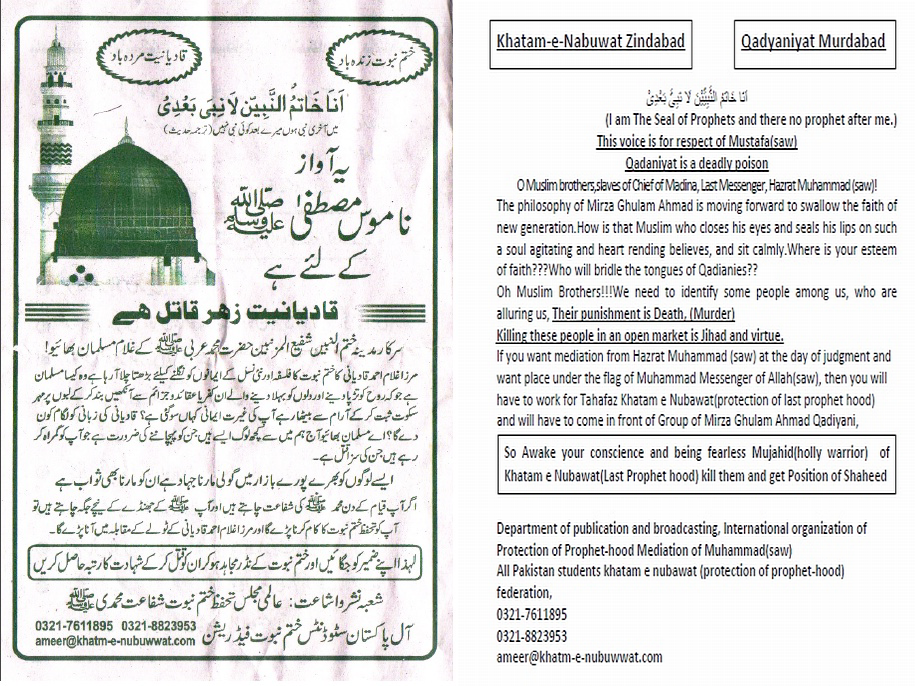
This, indeed, is an imperfect question considering that both society and state remain silent for the most part on other occasions when innocent people are murdered. The reference here is to the brutal murder of two Ahmadis in Sindh by those presumably incited by the views of a self-professed religious scholar who instructed his television viewers twice this month to kill Ahmadis for being non-Muslims and flouting the fundamentals of Islam. This is what one would call incitement to murder.

Pakistan’s Ahmadi community was declared non-Muslim by Zulfikar Ali Bhutto, which, technically speaking, settled the matter of dealing with this group of people by the state itself. Without getting into whether the decision was right or wrong, the fact is that the existing laws can challenge any member of the Ahmadi community who claims to be a Muslim. So, the alim did not have to take the law into his own hands. The two people who died were not challenging the state’s decision, but were threatened because of their faith. In any case, the two individuals were Pakistani citizens, who, like other minorities, have a right to be protected by the state. The problem didn’t end here but spread to other parts of the country. For instance, when the principal of the Quaid-i-Azam Medical College issued a notice to students to refrain from engaging in sectarian or religious conflicts, there was a protest in Bahawalpur asking for the lynching of the gent.

Unfortunately, civil society on the whole including our media has been silent on these murders. The Ahmadis have been declared non-Muslim by the state but they are still citizens of Pakistan and the murder of innocent people cannot be allowed. Luckily, the MQM had the sense to throw out the alim in question from the party but where are the voices that had cried in the past for defence of media freedom? Does freedom not include the security of ordinary people? It is sad to see that the television channel in question did not have the moral gumption to sack the ‘scholar’ or the producer of the programme. It is most unfortunate that the media, which considers itself the harbinger of freedom and democracy, has remained silent on this heinous crime.

While the MQM, which is considered problematic due to its policies and attitude, had the sense to sack the former minister, media gurus have remained silent. What is worse is that the US government, which otherwise raises all kinds of issues, has remained silent and kept its partnership with the channel in question.

This is not just about the murder of two people following a different set of religious beliefs, it also depicts the level of intolerance in society, its attitude towards whoever is considered as the ‘other’, and the perception of national security. Anyone who is not considered as part of the larger group or majority is considered a threat to the state. The same attitude is reflected in the perception of the larger issue of terrorism as well.

It is rather sad that the newly elected government is unable to convince the population that the war on terror is Pakistan’s issue rather than America’s agenda. Unfortunately, the government’s inability to convince the general public is because of the growing credibility gap.

The fact that the president did not think about cancelling his foreign visit and making himself available for his people after the blast has created the impression that he is more concerned about his American patron than ordinary Pakistanis. People understand that the main source of power of the new government is not the prime minister but the president who should have spent some extra time at home before flying away. Just imagine if George Bush had left the country within hours of 9/11.

Moreover, the lack of credibility increases due to statements issued by interior advisor, Rehman Malik who tried to convince the world that the attack was aimed at the leadership when it is now known that the Marriott was not the intended venue for the VIP dinner party. The guests were invited to the Prime Minister’s House where the party was eventually held at the time of the blast.

The credibility factor is important otherwise people will continue to think that the Taliban will save the country from an external threat posed by the US. Opinion right now is divided on how to interpret the internal terrorist attacks. Most of the people who died in the Marriott attack, those who were killed earlier and those that will fall prey to the Taliban onslaught in the future constitute ordinary Pakistanis. The regime should be able to convince the people that the Taliban or other militants are as bad for the country as is US intervention. Since two wrongs don’t make a right; Pakistan must select its own options to overcome the crisis rather than aligning itself with either party. The option is to engage other states like Russia, Iran, China, India and numerous European Union states, who do not sympathise with the American intervention, in a dialogue. At the same time, a consensus must be built within the country to examine our past linkages with the militants and to review our policy. We need to eliminate terrorism for our own advantage rather than anyone else’s.

The recent terror attack has challenged the writ of the newly elected government more than any other force. Today, the Pakistani government is divided into two: the political government and an invisible one. The latter is bound to build its credibility on the ashes of the political government, especially if it appears incapable to defend the nation.

In addition, the PPP must change its individual-dominated decision-making practices. While this has been the party’s tradition, it could work in the past because of the greater credibility of leaders such as Zulfikar Ali Bhutto and Benazir Bhutto. The same formula might not work now. Under the circumstances, people will feel greater unease in accepting the party’s policies.

The world is intently watching and judging the new government’s ability to fight the threat. The president must not appear as someone who cannot deliver on his promises. We need a strong leadership at this time to direct the state and society. It is only a capable leadership that can talk society out of the intolerance that eventually breeds greater violence.

The writer is an independent strategic and political analyst.

ayesha.ibd [at] gmail.com

© The DAWN Group of Newspapers, 2008
URL : www.dawn.com/2008/09/26/op.htm#1
 
^ Top of Page