Showing posts with label state persecution. Show all posts

Saturday, June 5, 2010

White is black

Express Tribune, Pakistan
Pakistan
Opinion
White is black
Amina Jilani
By Amina Jilani
June 05, 2010
The writer is a freelance columnist (amina.jilani@tribune.com.pk)
Has the time finally come for this nation to seriously consider removing the white strip from its national flag? Does anyone know or care what this strip symbolises? It has become obvious that few do, including the various leaderships who have topped us. The white strip, officially “one-fourth of the size of the flag nearest the mast” was added at the behest of the founder of this country to firmly denote the commitment of the nation-state to extending to its minority communities equal rights of citizenship — equal to all intents and purposes. And, remember, white is a call for peace.

Well, the equality was denuded within six months of the Founder’s death when on March 7, 1949, the Objectives Resolution was moved by none other than his loyal successor and chosen prime minister, Liaquat Ali Khan, and passed by the majority in the constituent assembly. Thus was the white strip rendered a joke, thus were intolerance and bigotry institutionalised with intent. Repercussions were not long coming. March 1953 saw the anti-Ahmadi disturbances in Punjab, which led to martial law. From then on, for the citizens of Pakistan equality became a distant dream.

That gentleman of secular tendencies, pseudo-socialist Zulfikar Ali Bhutto, furthered the cause of religiosity and all the rot that goes with it, with his 1973 constitution which apart from being chock-a-block with cynical provisions dictated by the majority religion, had as its preamble the Objectives Resolution, cementing the fact that the white strip was negated. He went a step further in 1974 when at the insistence of the pious Islamist party people he brought in his second amendment and in one fell swoop committed the first act of collective excommunication in the Muslim world — making a minority of those who since the birth of the country had been a part of the majority. The white strip since then is a shame we must all bear.

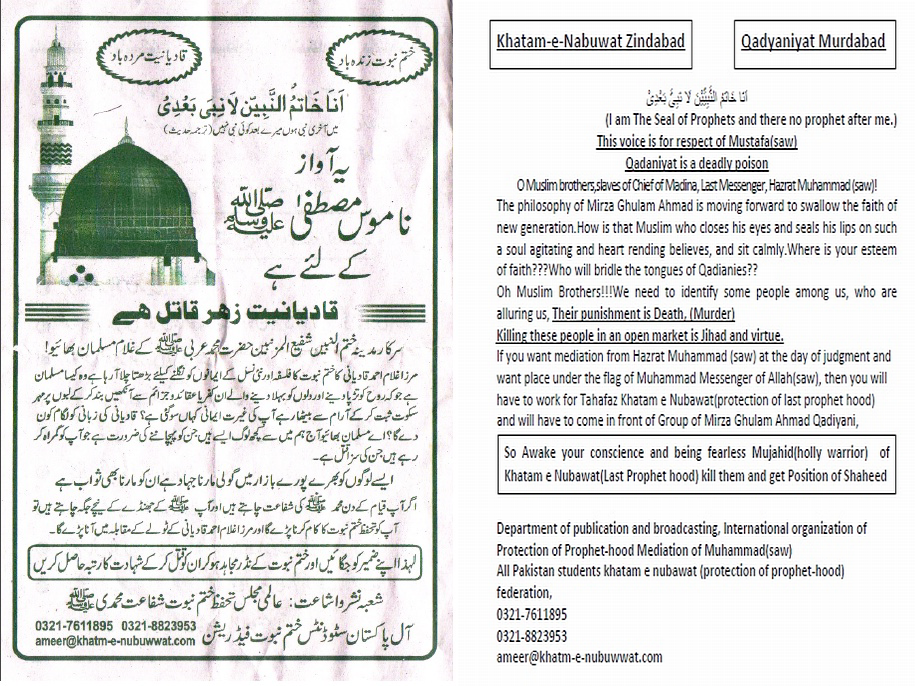
The massacres in Lahore on May 28 did not come out of the blue – the federal and provincial governments had fair warning. On February 7 the Washington Post carried a report by Pamela Constable relating how “a handful of radical clerics have been whipping up hostility” in Lahore towards the Ahmadis and other minority sects. And then there was the banner hung on The Mall that declared Jews, Christians and Ahmadis to be “enemies of Islam” and a signboard sponsored by the Punjab Government Auqaf Department pronouncing friends of Ahmadis to be enemies of Islam.

Over the past three decades the symbolism of the white strip on the country’s flag has been sullied beyond repair. We are hypocritical to the core. Spates of violence along religious and sectarian lines are the order of the day, yet few object — most ignore what is under their noses, they ignore the murder of citizens of Pakistan by their fellow citizens and jump up and down in what they take to be righteous indignation about wrongs done in foreign lands. The official reaction to May 28 was muted and meaningless, shaming — as were protests by the public in general. Gaza overtook Lahore in a canter, with ease.

There is really no need to schlep off to foreign waters to protest against murder and mayhem — there is more than enough of it here right at home, in the Islamic Republic of Pakistan. Putting our own house in order, ridding our own eyes of multiples motes is a must before we can with any justification adopt outside causes, mostly prompted by an unreasonable and unrealistic hatred for the sole superpower. It’s high time to get real.

Published in the Express Tribune, June 5th, 2010.

Sunday, May 9, 2010

Legitimate discrimination

---Express Tribune, Pakistan
Pakistan
Legitimate discrimination

By Basil Nabi Malik
May 09, 2010


The writer is a lawyer with Malik, Chaudhry, Ahmed and Siddiqi in Karachi (basil.nabi@tribune.com.pk)


In my preceding article, I talked about the precariousness of defining the terms ‘Muslim’ and ‘non-Muslim’ in the Constitution of Pakistan. This article, in continuation, attempts to follow the unfortunate consequences of doing exactly that.

In addition to Article 260 discussed in the previous article, the constitution also contains Article 20 which guarantees every citizen the “right to profess, practice, and propagate his religion”, whereas it’s sub-article (b) allows every religious denomination and every sect “the right to establish, maintain and manage its religious institutions”. Both are subject to “law, public order and morality”. Looking at the same, one would think that any discrimination on the basis of one’s religion would be a violation of said article.

In addition to this, Articles 4 and 25 of the constitution, which require citizens to be treated in accordance with the law and mandate that everyone be equal before the law, amongst others, also ensure that discrimination on the basis of religion is not allowed. If any discriminatory law is made targeting a group, the said law is liable to be struck down, subject to a “reasonable classification” founded on a reasonable distinction and on a reasonable basis.

And this may very well be the reason that provisions are usually content neutral, meaning that certain actions are made punishable for all and sundry who undertake them, rather than certain groups.

However, the inclusion of Article 260 in the constitution seems to have complicated the situation at hand and made lawful certain provisions which would otherwise be termed discriminatory and illegal.

A case in point would be Section 298-B and Section 298-C of the Pakistan Penal Code which relates to Qadianis. According to them, “any person of the Qadiani group or the Lahori Group” cannot refer his or her place of worship as ‘masjid’, cannot call the call to prayer ‘azaan’ or recite it in any way similar to that of Muslims. It is interesting that as per this law, if someone from another group undertook these actions, presumably this section would have no issues with that. As per Section 298-C, with respect to the two groups mentioned above, it would be a crime to ‘pose’ as a Muslim, refer to your faith as Islam, or do anything which “either spoken or written, or by visible representations or in any manner whatsoever outrages the religious feelings of Muslims”.

On the face of it, these two sections of the Pakistan Penal Code seem to be plainly discriminatory. However, it seems that the Supreme Court, in 1993 SCMR 1718, due to Article 260, had no option but to come to a different conclusion. In a majority decision, the Supreme Court in this landmark case held that these sections were legal and in line with the Constitution. Article 260(3) was used as the foundation upon which the said provisions were held to be intra vires of the Constitution, wherein the specifying of certain groups was declared a reasonable classification in terms of the said Article. Amongst other things, it was stated by the Supreme Court that such provisions were “in advancement of the Constitutional mandate and not in derogation of it”.

Hence, in a nutshell, whereas the inclusion of Article 260 in the Constitution of Pakistan was dubious for the many reasons already enunciated, its implications are nonetheless probing in as much as it allows for the propagation of discrimination on the basis of one’s beliefs on the touchstone of the constitution.

In light of this, perhaps the political forces should take some time out of their busy schedules to review the said legal provisions which directly impact the lives of certain segments of Pakistani society, rather than dillydallying on other issues.

URL: http://tribune.com.pk/story/11928/legitimate-discrimination/

Saturday, February 6, 2010

Pakistan and Ongoing Christian Persecution

--- The Seoul Times, Korea
Friday, February 05, 2010
Asia-Pacific

Letters from Tokyo

Pakistan and Ongoing Christian Persecution

By Lee Jay Walker
Tokyo Correspondent


Christians and other minorities in Pakistan continue to face enormous discrimination and persecution, and in extreme cases, but not rare cases, many Christians have been killed by either Muslim mobs or by state sanctioned policies. Therefore, the endless suffering and discrimination in Pakistan must come to light and the international community must put more pressure on the government of Pakistan to act, and to rescind brutal laws.

Pakistan is currently in crisis and much of the current crisis in self induced because it is clear that Pakistan supported radical Sunni Islam in Afghanistan and Kashmir for decades. Now the very same Sunni Islamic radicals who were supported by the security services in Pakistan have decided to turn Pakistan into another radical Sunni Islamic nightmare. Therefore, the ongoing “year zero Islamization” is leading to more hatred and this hatred is also being aimed at all minorities.

Even worse, for Christians, and other minorities like the Ahmadiyya Muslims and Hindus; they are suffering at the hands of radical Sunni Islamists, institutionalized laws which discriminate against minorities, government indifference, police bias, and every day discrimination where individual Muslims can abuse their power.

Emmanuel Y. Mani wrote an article on 11/10/2009 which was published on http://www.asianews.it and he stated that the “Blasphemy laws include Article 295, Sections B and C, and Article 298, Sections A, B and C, of the Pakistan Penal Code. These laws were incorporated into the criminal justice system between 1980 and 1986 by then President of Pakistan Zia-ul-Haq, supposedly to ensure respect for the Prophet Mohammed, his Companions and the Holy Qur’an. These laws are unique in the contemporary world because they allow dubious charges to be brought against people who have been subjected to extra judicial killings, arson and destruction of their property.”

“From 1986 to October 2009, at least 966 persons were accused under the blasphemy laws, 50% were Muslims, 35% Ahmadis, 13% Christians, 1% Hindus and 1% with no known religious background. At least 33 persons have been killed extra judicially after allegations were made against them; 15 were Muslims, 15 Christians, two Ahmadis and one Hindu.”

This law is not only being used against Christians, Hindus, and Ahmadiyya Muslims, but it is also being used by the dominant Sunni Islamic sect in Pakistan in order to crush all alternative voices or the law is being manipulated on any grounds in order to bypass real justice.

Last year on September 15th a young Christian male called Robert Fanish was found dead in his cell. Of course, the usual mantra was stated and a cover up was started from the start but clearly he had been tortured and victimized. The National Commission for Justice and Peace (NCJP) which is a Catholic-led advocacy group, however, stated that the brutal death of Robert Fanish was an “extra-judicial murder.”

Therefore, in modern day Pakistan this Sunni Islamic madness continues and now they are killing each other in the north of the nation, while causing mayhem in Afghanistan. At the same time, they are killing minority Christians, Shia Muslims and Ahmadiyya Muslims. It is like a state of madness with no end game apart from complete Sunni Islamization and then an internal Sunni Islamic war on the grounds of who is the most radical.

This madness led to 6 Christians being burnt alive last year and numerous other attacks. More recently, we have a 12 year old Christian girl called Shazia Bashir who was raped and tortured to death according to local Christians and advocacy groups.

Shazia Bashir was employed in the household of a wealthy Muslim lawyer and like many poor Christian domestic workers in Pakistan, she suffered abuse, however, her abuse would lead to her death but will justice be done in Pakistan?

A Protestant NGO, Sharing Life Ministry Life (SLMP), gave details about the young Christian girl. They stated that she had been working for eight months and that she had suffered constant stress and had been treated harshly before her death. This applied to ill treatment, verbal abuse and other forms of mistreatment.

SLMP chief coordinator Sohail Johnson commented “…that 99 per cent of Christian girls from poor families are hired by wealthy Muslims, and are often physically, psychologically and sexually abused.” He continued by stating that “In some cases, their employers marry them off to Muslim servants, and forcibly convert them to Islam.”

Sohail Johnson also mentioned about the failings of the government of Pakistan in protecting Christian girls. He states that “These vulnerable Christian girls do not have any state protection. We urge the government to ensure protection of these disadvantaged girls.”

Therefore, in 2009 we heard about Christians being burnt alive in Pakistan and many other cases of violence which was aimed at Christians and other minorities. Sadly, the same pattern is continuing but this time it is the brutal murder of a young Christian girl and many Christians doubt that justice will be done.
In Pakistan it is clear that Christians, Ahmadiyya Muslims, Hindus, and others, face an uphill struggle and death and persecution is never far away. However, what makes the situation worse is that it is not only radical Islamists who are persecuting all minorities but it is also the state apparatus of Pakistan.

The cycle of violence, intimidation, and persecution, can only be imagined from a distance. Yet the daily terror caused by Islamists and the betrayal of the institutions of Pakistan means that this nightmare is ongoing. However, will the international community just “turn a blind eye” or will outside pressure be put on Pakistan?
Lee Jay Walker serves as Tokyo Correspondent of The Seoul Times. He specializes in int'l relations and geopolitics. He is also involved in analyst work and research on business. After finishing BA degree in East European Studies at the University of London, he earned MA degree in Asia Pacific Studies at Nottingham Trent University. Website at http://www.leejaywalker.wordpress.com where work is published.
URL: http://theseoultimes.com/ST/?url=/ST/db/read.php?idx=9352
 
^ Top of Page