Tuesday, October 13, 2009

Pakistan: JUP stages rally to oppose changes in blasphemy law

---Daily Times, Pakistan
Tuesday, September 29, 2009

JUP stages rally to oppose changes in blasphemy law

KARACHI: The Jamiat Ulema-e-Pakistan and Sunni Barelvis staged a Naamoos-e-Risalat (PBUH) rally on Sunday to express their opposition to the plans for amendments to the blasphemy law.

The supporters marched on the MA Jinnah Road from Noorani Chowrangi to Rimpa Plaza where the officials of the JUP, Jamaat-e-Ahle Sunnat and other Sunni groups spoke. The Jamaat-e-Islami also had announced its support for the JUP rally. They expressed their support to the Pakistan Army and vented their anger on the US for enslaving Pakistanis in the cover of economic aid. They vowed they would accept death but they wouldn’t allow anyone to say anything or write anything against the Holy Prophet (PBUH).

The protesters were carrying the portraits of Shah Ahmed Noorani, the JUP’s deceased chief and the placards and banners with slogans against the Qadiani’ism. “Don’t repeal or amend the blasphemy law on the excuse that this law is misused. Other laws have also been misused time frequently,” JUP President Dr Abul Khair Mohammad Zubair said at the rally. Commenting over the Kerry-Lugar Bill, he said the bill was a conspiracy against the country’s armed forces, nuclear programme and the sovereignty of the country. He claimed the attack on the GHQ was a reaction to the Army’s opposition to the Kerry-Lugar bill. irfan ali

URL: www.dailytimes.com.pk/default.asp?pa...12-10-2009_pg7_24

Karachi’ites rally against repealing blasphemy law

---The daily Nation, Pakistan

Karachi’ites rally against repealing blasphemy law
By: Nisar Mehdi | Published: October 12, 2009

KARACHI — The Karachi’ites have vowed that they will sacrifice their lives but will not accept any amendment to the blasphemy law, let alone its repeal.

They warned the rulers not to take any step to amend or repeal the law, otherwise countrywide protest will be started. This was stated by the leaders of Jamiat Ulema-e-Pakistan and religious scholars on Sunday in a “Tahaffuz-e-Namoos-e-Risalat (PBUH) rally” which carried out from Numaish Chowrangi to Tibet Centre.

Central president of JUP, Dr Sahibzada Abul Khar Mohammad Zubair, Shah Anas Noorani, son of JUP founder Allama Shah Ahmed Noorani, Mufti Muneebur Rehman, Mufti Jameel Ahmed Naeemi, Siddique Rathor, Mufit Jan Mohammad Naeemi, Mufti Asif Jalali and others spoke on the occasion.

Thousands of Karachiites were participated in the rally to condemn the conspiracy to amend or repeal the blasphemy law. They were carrying the portrait of late JUP leader Shah Ahmed Noorani and the flags of JUP and banners with slogans against Qadiani’ism

Addressing the massive rally, JUP President Dr Abul Khair said that they had suffered all kinds of hardships but they had asked the rulers that they would not tolerate any amendment or repealing of the blasphemy law.

He asked the Governor Punjab Salman Taseer to not become Salman Rushdie through demanding to repeal blasphemy law in the name of protecting the minorities.

“Qadianis are hatching conspiracies against Pakistan to break the country and establish their own state.”

Commenting over the Kerry Lugar Bill, the JUP chief said that Kerry-Lugar Bill was the conspiracy against the Pakistan Armed Forces, nuclear programme and the sovereignty of the country.

Dr Khair claimed that attack on the GHQ was the result of the Army’s opposition of the KLB adding that the assailants may be those people involved in the attack on GHQ, who have played their role to induct the controversial clauses in the Kerry-Lugar Bill.

He praised the Pakistan Army for they made public their reservations on KLB and announced their full support to the Pakistan Army if they reject the US aid.

Shah Anas Noorani said that through KLB, US wanted to control the internal affairs of the country. The US want to amend the blasphemy law and control the nuclear programme of Pakistan. He termed that this is an evil bill and asked the government to stop their policies of appeasing the US and other foreign countries.

He warned that if the government would try to amend the blasphemy law then the slaves of Holy Prophet Mohammad (PBUH) will surround the parliament.

He applauded the Core Commanders conference in which they had expressed their reservation about the KLB and said that entire nation would back the decision of rejecting the foreign aid.

Grand Mufti Muneeb-ur-Rehman said that this massive rally was the first drop of rain and this was the warning for all those forces, which were hatching conspiracies to repeal the blasphemy law. He warned the countrywide protest would be held if the conspiracies against the blasphemy law not stopped.

He pointed out that the enemies of present government were in the sleeves of present government adding that Salman Taseer and Hussain Haqqani were the enemies of present government.

The supporters marched on MA Jinnah Road from Noorani Chowrangi to Rimpa Plaza where the officials of the JUP, Jamaat-e-Ahle Sunnat and other Sunni groups spoke.

They expressed their support to the Pakistan Army and vented their anger on the US for enslaving Pakistanis in the cover of economic aid. They vowed they would accept death but they wouldn’t allow anyone to say anything or write anything against Prophet Hazrat Mohammad (PBUH).

Siddique Rathore and Mufti Jameel Naeemi warned the government and the parliament to beware of the consequences of the amendment to the 295-C of Pakistan Penal Code that grants punishment to the non-Muslims.

Jamaat-e-Ahle Sunnat’s Mufti Naeemi announced that more rallies would be staged if the government doesn’t publicly announce its policy about the blasphemy law. He announced to hold the Ulema’s convention at Sindh level on November 8 to chalk-out the strategy.

Qazi Ahmed Noorani said: “Qadianis are non-Muslims and nobody can declare them as Muslims. It is obligatory on all the Muslims to believe in the final-hood of nubuwwat of last Prophet Hazrat Muhammad (PBUH).”

Almost all the speakers lashed out at Governor Punjab Salman Taseer and the Pakistani ambassador to the US, Hussain Haqqani, for their pro-amendment and the pro-US statements.

URL: www.nation.com.pk/pakistan-news...epealing-blasphemy-law/1

Saturday, October 10, 2009

South Asia, Militant Islam and Al Qaeda

---Weekly Blitz, Bangladesh

VOLUME - 4, ISSUE - 41, DHAKA, OCTOBER 07, 2009

South Asia, Militant Islam and Al Qaeda

Salah Uddin Shoaib Choudhury

For years, in a number of South Asian nations, Islamic militancy is continuing to gain strength, thus finally leaving potential threat to regional as well as global security and peace. On the other hand, Jihad and terrorism is being preached in Madrassas, not only in Muslim nations but also in several non-Muslim countries. Jihadist notions are also planted in the minds of people through ‘Dawah’ promoted by Tablighi Jamaat. First of all, it is essential to understand the latest situation of Madrassa education in Muslim and non-Muslim countries.

Madrassas in Pakistan and Bangladesh:

The madrassas in today’s Pakistan and Bangladesh, as in India, represent the legacy of the spectacular resurgence of Islamic religious education in India during the late nineteenth century, beginning with the establishment of the Deoband Madrassa in 1867.

In most of the madrassas there are no formal admission procedures. and legitimacy to the respective madrassas. Major policy decisions regarding doctrinal preferences, curriculum, and selection of teachers and students remain the exclusive prerogative of the ulema. Unlike Pakistan, Bangladesh has two kinds of madrassas: Quomi madrassas—estimated at more than 57,000 at the secondary, intermediate, and higher levels with about 5,762,000 students and 400,000 teachers. The Quomi madrassas are private, receive no financial support from the government, and are supported by local and foreign donations, mostly from the Middle East.

According to the latest data [2007–08) available to the madrassa education board, there are 6,906 non-government Alia madrassas in Bangladesh with the largest number, 12,740, at the dakhil level. The total number of students at all levels in the Alia system is 3,786,500. The number of teachers in these madrassas is 312,898. Unlike the graduates of Quomi madrassas, whose degrees are not recognized by the government and who pursue their careers in religious establishments and private businesses, the majority of the graduates of Alia madrassas merge into the general stream of education by continuing their education in colleges and universities. It is no wonder that a recent survey found that 32 percent of Bangladesh university teachers in the humanities and social sciences were graduates of Alia madrassas.

There are also elementary level madrassas known as maktabs, or ibtedai madrassas, first formally approved by Bangladesh’s the then President Ziaur Rahman in 1978. The Madrassa Education Board has approved 9,320 of all independent ibtedai madrassas, with 45,300 teachers and 689,865 students. But in reality there are more than 38,000 ibtedai madrassas with 130,000 teachers and close to four million students. This latter figure is supported by Bangladeshi Ministry of Education estimate made in 1992 which shows the total number of ibtedai madrassa at 17,279. More than 50 percent of students in Quomi madrassas and more than 70 percent of students in Alia madrassas come from an ibtedai background.

In Pakistan, the number of secondary and higher madrassas 12,000; Senior and graduate level madrassas 7,446; Deobandi madrassas 5,120; Barelvi madrassas 3,765; Ahl-i-Hadith madrassas 400; Shia madrassas 280; Number of all students Pakistani students in madrassas 15,765 and Afghan students 61,876. There are a few thousand madrassas in Pakistan which are not registered with the government. And, while in 1947, there was only 137 Madrassas in Pakistan, in 2001, the figure went upto 4,345.

There are approximately eighteen million students in various Madrassas in Pakistan, Bangladesh and India. Majority of these students come from poor families. In Pakistan, the majority of madrassa students belong to the rural areas of the North West Frontier Province [NWFP], Pakistani part of Kashmir, and Punjab. They are mostly drawn from the low strata of society. In a survey conducted in 1976, more than 80 percent of the madrassa students in Peshawar, Multan, and Gujranwala were found to be sons of small or landless peasants, rural artisans, or clergies of the village mosques. They remaining 20 percent came from families of small shopkeepers and rural laborers. A survey, conducted in 2000, found that 55 percent of madrassa students came from peasant families and petty traders. The interesting thing to note is that the number of students whose fathers were employed in lower level private sector jobs rose from 5 percent in 1976 to 35 percent in 2000. Only 3 percent of students in the 2000 survey said their fathers were imams [clergies] of the mosques. The majority of students come from large but low-income families. The 2000 survey found that 63 percent of madrassa students had five or more siblings, and 28 percent of them had seven or more brothers and sisters. In the case of Bangladesh, an overwhelming majority of Quomi madrassa students [82 percent] come from poor families of rural areas and small towns. Sylhet, Chittagong, Comilla, Noakhali and some northern districts have traditionally been the main base of recruitment for the Quomi madrassas.

Madrassas are breeding ground of Jihadists:

Several reports on internationa media including CNN, BBC etc, as well as Jessica Stern’s article in Foreign Affairs and Jeffrey Goldberg’s article in the New York Times Magazine, besides several dozen columns of Thomas Friedman, have suggested that the madrassas in Pakistan have become a hotbed of Islamic extremism and the breeding ground of terrorism. They have been variously described as dens of terror, jihad universities, jihad factories, and, as the then Indian Prime Minister Atal Behari Vajpayee described them, factories of terror.

There is no doubt that Madrassas have become actibely linked to terrorism and terrorist training camps. Many journalists and commentators have suggested that these madrassas teach Jihadist literature in their course of studies and that their entire curriculum is intended to produce holy warriors. It has also been suggested by many Western scholars that there is an inherent relationship between what is taught in the madrassas on the one hand and religious extremism, Talibanism, militancy, anti-Americanism, anti-Semitism and terrorism, on the other.

Madrassa students, through their reading of religious texts, become soldiers of Allah [God] and engage in militant activities against those they consider enemies of Islam [Clergies and teachers in Madrassas teach the students to hate Jews and Christians and term them as enemies of Islam, thus giving provocations of Jihad, alluring heaven and 72-virgins, if anyone would become martyr.

Understandably the US Congress keeps itself informed of the madrasa education in South Asia. A report by the Congressional Research Service [International Terrorism in South Asia] states that among the approximately ten thousand madrasas in Pakistan some that have been implicated in teaching militant anti-western, anti-American and anti-Hindu values. Many of these madrasas are financed and operated by Pakistani Islamist political parties and foreign entities. Foremost US analyst on South Asia Stephen Cohen states that the largest Islamic sects with the greatest control over religious schools are the Deobandis, who are among the most militant in their demand for Pakistan to become truly Islamic. Incidentally Deobandi groups were in the forefront of declaring Ahmadiyyas as non-Muslim in Pakistan. In Bangladesh, anti-Ahmadiyya activities started under the patronization of some Islamist clergies as well as some Islamist leaders thus finally causing series of attacks on Ahmadiyya mosques in various parts of the country under the leadership of Mufti Noor Hussain Noorani and Moulana Momtaji.

Radical Islam and Madrassa:

The Iranian Revolution and the Soviet occupation of Afghanistan, both in 1979, inspired a profound shift in the Muslim world—and in the madrasas. Iran’s mullahs had managed to overthrow the Shah and take power, undermining the idea that religious education was useless in worldly matters. Although Iranians belong to the minority Shiite sect of Islam, and their madrasas have always had a more political character than Sunni seminaries, the image of men in turbans and robes running a country provided a powerful demonstration effect and politicized madrasas everywhere.

Ayatollah Khomeini’s revolutionary regime promised to export its revolutionary Shiite ideas to other Muslim states. Khomeini invited teachers and students from madrasas in other countries to Tehran for conferences and parades, and he offered money and military training to radical Islamic movements. Iranians argued that the corrupt Arab monarchies must be overthrown just as Iranians had overthrown the Shah. Iran’s Arab rivals decided to fight revolutionary Shiite fundamentalism with their own version of Sunni fundamentalism. Saudi Arabia and other gulf countries began to pour money into Sunni madrasas that rejected the Shiite theology of Iran, fund ulema who declared the Shiite Iranian model unacceptable to Sunnis, and call for a fight against Western decadence rather than Muslim rulers.

When Awatollah Khomeini captured power in Tehran, he stared funding anti-West and anti-Semitic groups under the umbrella of ‘Al Quds Society’ and Iranian embassies in various countries openly or secretly continued to fund such activities. Even in the official newsletter published by the Iranian embassies in a number of countries, extreme propaganda against United States, Israel, Jews and Christians are continuing in the name of re-capturing the Al Aqsa [Temple Mount] by the Muslims through Jihad. Leaders and ministers in Khomeini’s regime even visited several Muslim and non-Muslim nations to deliver cash to the Islamist groups promoting Tehran’s theology. Unites of Hezbollah were created in several Muslim nations and were assigned to recruit members mostly from the madrassas.

In the midst of this conflict, and the madrasa boom it spawned, the United States helped create an Islamic resistance to communism in Afghanistan, encouraging Saudi Arabia and other oil-rich states to fund the Afghan resistance and its supporters throughout the Muslim world. Pakistan’s military ruler at the time, Gen. Mohammed Zia ul-Haq, decided to establish madrasas instead of modern schools in Afghan refugee camps, where 5 million displaced Afghans provided a natural supply of recruits for the resistance. The refugees needed schools; the resistance needed mujahideen. Madrasas would provide an education of sorts, but they would also serve as a center of indoctrination and motivation.

General Zia’s model spread throughout the Muslim world. Maulana Samiul Haq, headmaster of the Haqqania Madrasa, is a firebrand orator who led anti-U.S. demonstrations soon after the beginning of the war in Afghanistan. When asked if he thought it appropriate to involve his 5 and 6-year-old charges in political demonstrations, Haq remarked, “No one is too young to do the right thing.”

Later, he added, “Young minds are not for thinking. We catch them for the madrasas when they are young, and by the time they are old enough to think, they know what to think.”

The ‘success’ of General Zia’s experiment led to the creation of similar free schools in places as diverse as Morocco, Algeria, Indonesia, and the Philippines. Muslim immigrants in Europe and North America established madrasas alongside their mosques, ostensibly to teach religion to their children. Islam requires Muslims to set aside 2.5 percent of their annual savings as zakat [charity], and religious education is one area on which zakat can be spent. Madrasas do not need huge funds to run, though. Teachers’ salaries are low, the schools need no funding for research, and books are handed down from one generation to the next.

Madrasas have proliferated with zakat and financial assistance from the gulf states. [Some classrooms at Haqqania Madrassa in Pakistan have a small inscription informing visitors that Saudi Arabia donated the building materials for the classroom]. Modern technology has also played a role, whether by creating international financing networks or new methods of spreading the message, such as through online madrasas. Pakistan had 244 madrasas in 1956. By the end of 2004, the number had risen to 10,000. As many as 1 million students study in madrasas in Pakistan, compared with primary-school enrollment of 1.9 million. Most Muslim countries allocate insignificant portions of their budgets for education, leaving large segments of their growing populations without schooling. Madrasas fill that gap, especially for the poor. The poorest countries, such as Pakistan, Bangladesh, Somalia, Yemen, and Indonesia, boast the largest madrasa enrollment.

Islamist Militancy:

Islamist militancy is showing new signs of life in Bangladesh despite crackdowns.

According to a Christian Science Monitor [CSM] report, terrorist groups are showing a persistence and resilience that has left local authorities worried. However, the CSM says that militancy in Bangladesh is not on the scale or tone that exists in Pakistan or Afghanistan, but has shown a frightening persistence in recent years.

It says that in 2006, police and paramilitary forces systematically targeted and took down the top terrorist organization, Jamat’ul Mujahideen Bangladesh, or JMB. Seven of JMB’s leaders were hung in 2007.

One estimate suggested there were about 12,000 cadres actively operating in the country, mostly madrassa [Islamic seminary] teachers, students and clerics of mosques.

In April of this year, Bangladesh intelligence agencies declared that the Islamist terrorist groups are reorganizing with the aim of making a deadly comeback.

Bangladesh’s teeming cities and rugged countryside have proven an unlikely safe haven for some of the jihadi world’s most hardened operatives. In September 2009, police in Dhaka [capital city of Bangladesh] arrested an Afghan war veteran with ties to Lashkar-e-Taiba, the banned Pakistani terrorist organization held responsible for the Mumbai attacks in November 2008.

The Christian Science Monitor reported in June that Bangladesh was becoming a hideout for South Asia’s terrorists: Bangladeshi police in June uncovered a plot that used Bangladesh to funnel thousands of weapons to an Indian separatist group.

The police also arrested an operative working for notorious South Asian terrorist Daud Ibrahim, who is alleged to have ties to Al Qaeeda. The operative disclosed that 150 of Daud Ibrahim’s operatives are stationed in Bangladesh.

Religious extremism in Bangladesh:

Definition of political parties has changed for some from the time of Edmund Burke as “an organized assembly of men, united for working together for national interest” to one that may not accept members from the minority community and is insistent on establishing Islamic rule or Khilafat. Indeed the head of the Hizb-Ut-Tehrir [HuT], Hizbut Towhid [HT], Khelafat Majlish [KM] as did few other Islamist parties publicly announced that “we always want to oust all governments in all Muslim countries in the world to establish Khilafat states”. The world is already mired in the militant activities of al-Qaeda operatives, their latest victims being the carnage at Mumbai [India] and the Marriot Hotel in Islamabad [Pakistan].

In recent months, although Dhaka is governed by a political party having secularist ideology, notorious Islamist militancy group named Hizbut Towhid is allowed to openly publish and sell books and DVDs pronouncing Jews and Christians as ‘enemies of Islam’ and instigating the Muslims in waging ‘holy war’ against them. Hizbut Towhid denounces democracy and promotes Caliphate Rule in Bangladesh and other nations in the world. Leaders of this extremist group consider notorious terrorists like Osama Bin Laden as ‘hero of Islam’. It was already reported in local and international media that Hizbut Towhid has expanded its activities in a number of Asian nations as well ‘successfully’ created its base in some Western countries.

After Afghanistan, Islamic fundamentalism went global with its appeal to a section of Muslim society based on moral, cultural and political grounds. The Islamists argue that western culture particularly the one practiced by western women is essentially degenerative and incompatible with Quranic literalism. They argue that the values propagated by the West threaten Islamic “purity” and hence their advance is to be thwarted at any cost. Political argument is by far the easiest to sell to the wayward Muslim population who despite declaration of piety could have nursed in the darkest corner of their heart a desire to commit the original sin. The Islamists argue that the reasons for economic backwardness, political repression and societal dysfunction were caused by Western, particularly American assistance given to the repressive regimes in the Muslim world. The situation in Bangladesh is no exception. Under the embrella of “Organization for welfare of the reptariate soldiers from Afghanistan and Palestine”, militancy and anti-Semitic notions are planted in the minds of people. It was clearly proved that several terror patron nations, including Iran, is continuing to finance such activities. Later, a large number of people belonging to Organization for welfare of the reptariate soldiers from Afghanistan and Palestine, entered Harkat-Ul-Mujahedin Bangladesh, Harkatul Jihad [Huji] and other ferrocious Islamist militancy outfits. There are also evidences that a number of Islamist political parties in Bangladesh, as well as some ‘secularist’ forces have openly or secretly joined hands with such extremist Islamist groups either with ulterior political motive or for expanding their vote banks.

Democracy and Islam:

An inconclusive debate remains about the incompatibility of democracy with monotheistic religions. Robert Dahl in his classic book ‘Polyarchy’ had set eight essential requirements for democracy: - right to form and join organizations; freedom of expression; right to vote; eligibility for public office; right of political leaders to compete for support for vote; and institutions for making government policies dependant on vote and other expressions of preference. Other political scientists have added that democracy must also have a constitution that by itself is democratic in that it respects fundamental liberties and offers protection to minorities. Additionally democratically elected governments must rule within the confines of their constitutions, be bound by law and be accountable. From historical observations it has been found that religions place inherent obstacles in the way of democracy. Philosopher John Rawls found it particularly difficult in a pluralistic society in which citizens hold a variety of socially embedded, reasonable yet deeply opposed comprehensive doctrines to arrive at an overlapping consensus.

In the case of Islam some western scholars have found that because of its Prophet’s fusion of military and spiritual authority and because Quranic laws are deemed to be final the space for democratic debate for the formation of secular laws does not exist in Muslim societies. Some other scholars however have found that appropriation of political Islam by Islamic fundamentalists is untenable and millions of Muslims living outside the Arab world live in intermittent democracies and they may not become victims of so-called Islamic Free Election Trap in which fundamentalists use democratic means to get to power only to abolish democratic practices through legislation.

Democracy is a dynamic process and “a state’s raison d’etre does not lie in the protection of equal individual rights but in the guarantee of an inclusive process of opinion and will formation in which free and equal citizens reach an under standing on which goals and norms lie in the equal interest of all”.

Clearly then an ethical question would arise as perceived by Italian political scientist Luigi Bonante while discussing the difference between the individual and the state. He argues that while the state has sufficient tools to defend its rights and reject its duties; for the individual as recipient it is much harder to elude his duties than to achieve his freedom.

This kind of asymmetry of power during the BNP-Jamaat [2001-2006] rule in Bangladesh provides strong argument for the protection of human rights. The Orwellian tyranny of the majority was further compounded by increasing activism of Islamists who wish to recreate a truly Islamic society not simply by imposing the Sharia but by establishing an Islamic state where religious edicts will be integrated into all aspects of society.

Conclusion:

Jihad and Islamist militancy is gaining strength every day inside Madrassa in both Muslim and non-Muslim nations. Most of the Western nations, although are by now aware of the fact that Madrassas are the potential breeding grounds of Jihadists, there is no initiative yet to combat such notorious growth of millions of terrorists from such religious schools.

Western nations should also take urgent measures in giving strong signals to the developing countries in particular and the Muslim world in general to immediately adopt necessary measures in stopping hate speech, anti-Semitism and anti-West propaganda in the countries. This is so urgently required and the people in the West should not sit tight in taking such intiatives.

URL: www.weeklyblitz.net/index.php?id=1012

Thursday, October 8, 2009

US Lawmakers Press Pakistan on Religious Tolerance

---Voice of America, USA

US Lawmakers Press Pakistan on Religious Tolerance


08 October 2009


U.S. lawmakers want Pakistan to do more to fight religious intolerance, saying the issue should play a bigger role in U.S. assistance to and engagement with Pakistan in coming years. Witnesses at a congressional hearing testified that Pakistan’s blasphemy laws encourage extremism.

Pakistan’s blasphemy laws, which carry a potential death penalty for derogatory remarks or actions against Islam, the Koran or the Prophet Muhammad, have long been controversial within and outside the country.

Amnesty International, Human Rights Watch and other organizations say the laws have been used to squelch dissent and oppress Muslim and non-Muslim religious minorities, and have often led to violence.

Anti-Christian violence in the Pakistani city of Gojra this past August resulted in the deaths of at least seven Christians, with 50 homes burned.

Nina Shea, of the U.S. Commission on International Religious Freedom, says additional events since Gojra have underscored that religious tensions continue. “Since Gojra several reports have been made of Muslims tearing out pages of [a] Koran and leaving them on church property, including [at] the Associated Reform Presbyterian Church in another Punjab village on September. This was an apparent attempt to ignite more religious violence,” she said.


Shea and other witnesses support a non-binding resolution introduced in the House of Representatives by Republican Congressman Christopher Smith, who says radicalism poses a threat to Islam. “In the intermediate and long-term, certainly these radical Islamic jihadists and others are the greatest threat to Islam and to believers such as yourselves,” Smith said.

The resolution says U.S. non-military assistance, which will triple over the next five years, must support an interfaith dialogue begun by Pakistan’s Minister of Minorities Affairs Shabaz Bhatti, and help the government counter religiously-motivated hostility and violence.

It also urges Pakistan to repeal the anti-blasphemy laws, and investigate acts and punish perpetrators of religiously-motivated violence.

“The blasphemy law, and to be persecuting people because of their faith, we want a great relationship with Pakistan, but I think this is just unacceptable,” said Republican Representative Frank Wolf, who is among lawmakers supporting Smith’s resolution.

Non-Muslims make up less than five percent of Pakistan’s population of 175 million. Four million of the country’s Muslims are Ahmadis, who say they face increasing persecution.

Mujeeb Ijaz is an activist in the Ahmadiyya Muslim Community in the United States, and was among three witnesses appearing before the Tom Lantos Human Rights Commission.

He says Pakistan’s blasphemy laws are used by extremists to silence alternative views of Islam and definitions of such things as jihad. “Because of the government’s legalized official repression of minorities, the average Pakistani cannot question the clergy’s doctrines, even if they call for violence in the name of religion for fear that they become labeled as blasphemers. The nightmare scenario is to be tagged as a blasphemer, end up in prison, face police brutality, judicial indifference, social boycott and in many cases death at the hands of vigilantes,” he said.

Attorney Amjad Mahmood Khan, a lecturer on human rights, law, and governance in Muslim majority countries, says blasphemy laws have gained legitimacy and withstood legal challenges in Pakistan, but are not legitimate and even blatantly violate international human rights law and principles.

“The anti-blasphemy laws circumvent Article 55(c) of the U.N. Charter, and Article 18 of the Universal Declaration of Human Rights, to which Pakistan is a signatory. This is especially troubling since Pakistan was once firmly committed to abide by the Charter and Declaration. Second, the anti-blasphemy laws circumvent Articles 18, 19, 20, and 27 of the International Covenant on Civil and Political Rights [ICCPR] to which Pakistan is a signatory as of last year,” he said.

Representatives Smith and Wolf are urging President Barack Obama’s Special Representative for Pakistan and Afghanistan, Richard Holbrooke, to elevate the importance of the religious tolerance issue where U.S-Pakistan relations are concerned. Representative Wolf said he hopes that Mr. Holbrooke will have an opportunity to hold an in depth meeting with Pakistan’s minorities minister Bhatti.

When he visited Washington in September at the invitation of the Commission on International Religious Freedom, Bhatti said the Pakistan government is committed to reviewing and amending blasphemy laws so they “will not remain a tool in the hands of extremists.”

URL: www.voanews.com/english/2009-10-08-voa71.cfm

Aceh’s stoning bylaw draws more criticism from clerics

--- The Jakarta Post, Indonesia
Headlines Thu, 10/08/2009 11:41 AM

Aceh’s stoning bylaw draws more criticism from clerics

The Jakarta Post, Jakarta

The debate about whether to review Aceh’s bylaw that allows adulterers to be stoned heated up Tuesday, with religious leaders voicing their objection to the enactment of the law.

General secretary of the Indonesian Conference on Religion and Peace, Johannes Hariyanto, said that the bylaw, which was passed by the Aceh legislative council in September, went against the constitution.

“The bylaw is not based on Indonesia’s constitution, but on a law that originated outside the country.”

Eighty religious leaders, representing religions and beliefs from around the archipelago, attended the conference held in Jakarta from Monday to Tuesday, urging the President to review the bylaw.

The leaders also demanded that other laws and regulations hampering the freedom of religion in the country be reviewed.

Johannes said that although the constitution guaranteed the rights of all citizens to choose and practice their religion or belief, several laws and regulations stipulated otherwise.

He added the country had seen many instances of members of religious sects depending on the mercy of certain individuals to be able to practice their beliefs.

“One noteworthy case is that of the Ahmadiyah. The government does not have the right to decide whether this religion is wrong. The government has no authority on theological matters,” he told The Jakarta Post.

Ahmadiyah is a religious sect the Indonesian Ulema Council (MUI) says is heretical. Members of the sect have been attacked by various Muslim groups. Last year, the government allowed Ahmadiyah members to perform their religious activities but banned them from proselytizing new believers. Their decision was based on the 1965 law on religious blasphemy.

Ari Dwipayana, a political analyst and lecturer at Gadjah Mada University in Yogyakarta, said the blasphemy law was one of the laws the President needed to review.

“The law has become the government’s instrument to determine whether a religion or belief is official, and allows the establishment of bodies or institutions, such as the government’s Coordinating Body for Monitoring Mystical Beliefs in Society, with the authority to dissolve sects,” he said.

Ari said the 2006 law on administration discriminated against religious groups other than those officially endorsed as state religions — Islam, Catholicism, Protestantism, Buddhism, Hinduism and Confucianism.

He added that before the administration law came into effect, followers of unofficial religions had to declare themselves believers of one of the official religions in the religion section of their identity cards.

Johannes also highlighted President Susilo Bambang Yudhoyono’s recent speech made at Harvard University in the United States.

“He said Indonesia was the best example of Muslim tolerance, that although it was a Muslim-majority country, we could still live side by side and in peace. There are still Ahmadiyah followers in Mataram, who were pushed aside just because they have a different belief,” he added.

Some 130 Ahamadiyah members are still living in a shelter in Mataram after hard-line Muslims attacked their village in February 2006.

URL: www.thejakartapost.com/news/2009/10...-criticism-clerics.html

Wednesday, October 7, 2009

Pakistan: Abuse of Christians and Other Religious Minorities (Part Two)


October 7, 2009

Pakistan: Abuse of Christians and Other Religious Minorities (Part Two)

Adrian Morgan

Click here for Part One

Methodology of Oppression

Christians are not the only group to have been affected by Pakistan’s blasphemy laws. These statutes have been used against Hindus, Muslims, and members of the Ahmadiyya (or Ahmadi, Qadiani) sect, who consider themselves “Islamic” yet are shunned as heretics. The laws are also used to “punish” people as a result of feuds, arguments over land, and other reasons. In these cases, innocent Muslims are often the victims of the blasphemy statutes. But there are other ways of oppressing minorities in Pakistan.

Forcibly converting people is one means of oppression that has been used against minority groups. On May 26, 2006, a conference was held in a Lahore hotel, sponsored by the Minority Rights Commission of Pakistan (MRC). It was claimed at this meeting that although only 100 cases of forced conversions were reported in the Pakistan media, the true annual figure ranged between 500 and 600 a year.

I.A. Rehman, a member of the Human Rights Commission of Pakistan (HRCP) told the conference: “In Pakistan we do not have any law against forced conversion and converting from Islam to any other religion means death. To change this state of affairs, we must consider the issue as a struggle for democracy and invite Muslims as well to these meetings, so they can help us to better understand all points of view of the argument.”

The practice of forcing Hindu girls to convert has been documented in Pakistan. In November, 2005, there had been 19 such cases reported in Karachi, the main city in Sindh province. Hindus are generally in low numbers in Pakistan, but in Sindh, there are two districts (Jacobad and Larkana) where (according to the 1998 census) they comprise about 40 percent of the local population. Hindu girls were abducted, converted to Islam and hastily married to young Muslims before their families could trace them.

The most offensive method of forcible conversion is gang-rape. In the fall of 2005, a young Christian girl was allegedly gang-raped to force her to convert to Islam. The 12-year-old girl was abducted from her home and forced to have sex with numerous men. The case was presented by the All Pakistan Minorities Alliance (APMA). One former influential member of APMA, Shahbaz Batti, is now the Minorities Minister in the current government.

Christian news sites have several details of such cases of forcible conversions through rape that have taken place in Pakistan. A report by the Asian Human Rights Commission from March 2007 describes how a 15-year-old Shia Muslim girl was gang-raped in Layyah in Punjab province, as a means to force her to convert to Sunni Islam.

Ahmadis

Ahmadis are said to comprise less than one percent of Pakistan’s population. They are treated by the majority population and by the establishment in a manner that should invoke the outrage of “rights groups” like CAIR, but strangely, few groups are prepared to defend the rights of the Ahmadis. The group has as its slogan: “Love for All, Hatred for No One,” yet the group has received vilification from conventional Muslims. In Pakistan in 2005, more than 1,300 reports containing hate material against Ahmadis were published in the Urdu press. The group has also been subjected to violent attacks in Pakistan, Bangladesh and Indonesia.

The persecutions of the Ahmadiyya in Pakistan are similar to those endured by Christians. Occasionally villages are attacked, or individuals are accused of blasphemy, often in an attempt to invoke sectarian violence against the community of the “blasphemer.” Such an instance happened on June 24, 2006, when a village was attacked after allegations were made that two Ahmadi youths had burned a copy of the Koran. Seven Ahmadis had been arrested under Section 295-B of the Penal Code (desecration of Koran), but a mob nonetheless rampaged through the village of Jhando Shai in Punjab province. Thirteen Ahmadi families lived in the village. Twelve families were forced to flee, while their homes (and some shops) were burned down. The Ahmadi families who fled could not return to register complaints against those who had vandalized their abodes — the police had banned them from coming back.

Between 1986 and 1999, a total of 189 Ahmadis were imprisoned for contravening Section 295-C of the Penal Code. This outlaws blasphemy against the Prophet Mohammed, and is the most serious of the religious statutes, potentially meriting the death penalty.

In 2002, Ahmadi political candidates in the general election were forced to sign a pledge confirming that Mohammed was the final prophet (khatm-e-nabbuwat), essentially forcing them to deny the prophethood of their founder Ghulam Ahmad. The Ahmadis do, however, state that Muhammad was the last law-giving prophet.

The discriminatory oath seemed designed to oust Ahmadis from the political process. Not only are Ahmadi candidates placed in the uncomfortable position of either denying the tenets of their faith or sacrificing their rights to stand for election, the same oath must be signed by voters. As a result, Ahmadis are denied the right to partake in the political process.

The Ahmadiyya were officially declared to be non-Muslims on September 21, 1974. This declaration was made by the National Assembly, and became the second amendment to the constitution. The government then was under the leadership of Fazal Elahi Chaudry, of the PPP party.

The official demonization of the Ahmadis obviously contradicts Jinnah’s original vision of Pakistan as a nation where people of all faiths should be equal. The machinations of anti-democratic fanatics and dictators have betrayed not only Jinnah, but the first government after independence. The first foreign minister of Pakistan was Sir Zafrullah Khan (1893 - 1985), who was an Ahmadi. A figure of international politics, and champion of the Third World, Zafrullah Khan’s religion seems to be the reason why he is not remembered in Pakistan.

Political discrimination continues. The leaders of Pakistan’s Jamiat Ulema-i-Islam party (JUI) follow strict Deobandi beliefs. Sami ul-Haq, who leads the “S” wing of the party, heads the Haqqania madrassa which educated most of Afghanistan’s Taliban, including Mullah Omar (even though the latter did not finish his course). The “F” wing of JUI is led by Fazlur Rehman. Both have argued for Sharia law to replace Pakistan’s democracy. On September 29, 2009, Senator Dr. Khalid Mehmood Soomro of Jamiat Ulema-i-Islam (F) publicly condemned the exiled leader of the MQM party for supporting the Ahmadi. Soomro also condemned the governor of Punjab for supporting the Ahmadis, and vowed that JUI activists would ensure people knew about khatm-e-nabbuwat.

In December 2004, the Pakistani authorities removed the necessity of a column in a person’s passport that declared one’s religion. Briefly, it seemed that Ahmadis would be able to join the Haj pilgrimage to Mecca. However, in March 2005 government ministers restored the religious identification section on all Pakistani passports. They had apparently been pressured by fundamentalist groups.

Scattered as they are across Pakistan, the cohesion of Ahmadis as a group is maintained through publications. Now, the Internet is used to keep Ahmadis aware of what is happening to their communities both nationally and globally. On September 9, 2006, the offices of an Ahmadi newspaper in Rabwah, Punjab, were raided by police. The Blasphemy laws (298-B and 298-C of the Pakistan Penal Code), introduced in 1980 by dictator Zia ul-Haq to deny Ahmadis the right to present themselves as “Muslims,” were invoked to justify the raid. Additionally, the newspaper was said to have published “hate literature.” Arrests were made, some staff escaped. The Daily Alfazl newspaper, which was founded in 1911, was forced to stop printing. It continues, and has an online edition.

The Ahmadis face discrimination even after death. When an Ahmadi is buried in a Muslim graveyard, there are often protests, leading to exhumations and reburials, as happened to a 60-year old-woman in June 2007 and a 17-year-old Ahmadi girl in March 2006. This girl, Nadia Hanif, was reburied because local clerics, supported by extremists, campaigned against her body lying amongst “true” Muslims. A family spokesman said: “How can peace and harmony be built in society?” Between 1988 and 2006, there were a total of 28 Ahmadi exhumations from Muslim cemeteries. Attempts by Ahmadis to expand or alter their own cemeteries are limited by the actions of fanatical Muslims.

In April 2007, when Ahmadis wished to place a fence around a graveyard at Wagah Town near Lahore, a radical cleric declared this unacceptable. The cleric, Dr. Sarfaraz Ahmed Naeemi, promised retaliations if the government allowed it. He said that as the cemetery was near the Indian border, having it enclosed appeared to suggest they wanted a headquarters. Naeemi added: “The government should remember that according to our belief, apostates should be killed within three days. It is only the difference of opinion on this decree within Muslims that has stopped us from doing so.”

Ahmadis — like Christians — are killed for the sake of their faith. Between 1984 and 2004, at least 79 Ahmadis were killed. On March 1, 2007 a senior police officer shot dead Muhammad Ashraf, an Ahmadi man who was eating his breakfast in a hotel in a village near Lahore, Punjab province. Before shooting him, the policeman shouted: “You are an infidel, and are preaching an infidel creed in the area.”

Early on Friday October 7th, two gunmen burst into an Ahmadi mosque in Mong, Mandi Bahuddin town, 60 miles south of Islamabad, the capital. The assailants fired Kalashnikovs at Ahmadis who were offering morning prayers. Eight people were killed and 14 more were injured. The gunmen fled on a motorcycle of a third man, who waited outside. A witness said: “The floor of the one-room place of worship was littered with blood.”

On Monday January 19, 2009 a 55-year-old Ahmadi shopkeeper was shot dead in Kotri district, Sindh province. Saeed Ahmed had been returning home from work when he was shot in front of his house. The only reason for his killing, claimed an Ahmadi spokesman, was his faith. The spokesman blamed a media fatwa for allowing such killings to happen (see below).

Killings are horrific but when children are criminalized under the law on account of their faith, there can be no moral justification. In February 2007, it was revealed that police in Khushab district in Punjab province had registered a case against five young Ahmadis. Their “crime” had been to subscribe to an Ahmadi children’s magazine called Tasheezul Azhan. The police officer who made the case claimed the magazine was “banned” and contained “hate material,” even though it had been printed since 1906. Two of the accused were preteens. One was an 11-year-old girl, Nusrat Jahan, and one was an 8-year-old boy called Umair Ahmed.

In Layyah district in Punjab province, another incident involved children being criminalized. Four Ahmadi boys from the district were arrested on January 28th this year. The boys, named Muhammad Irfan, Tahir Imran, Tahir Mahmood and Naseeb Ahmad, were said in the FIR (First Information Report) to have written “blasphemous material” in the latrines of the Gulzar-e-Madina mosque in Kot Sultan. They were all charged under Section 295-C of the Blasphemy Laws. This statute, which outlaws the use of “derogatory remarks, etc., in respect of the Holy Prophet”, is the most serious, as it can lead to the death penalty.

Following a well-established pattern, the accusations of blasphemy were followed by mob violence. On January 29, 2009, a day after the arrests, a mob tried to burn Ahmadi houses in Layyah district. The protagonists of the violence were said to be banned Islamist extremist groups.

The case is serious. It is the first time since 1986, when Section 295-C of the PPC was introduced, that it has been used against children. The “banned groups” who led the agitation against the Layyah Ahmadiyya community, were the Sipah-i-Sahaba. Apparently a retired schoolteacher called Noor Elahi Kulachi, who is a member of the Sipah-i-Sahaba, led the campaign to have the children arrested. Kulachi approached a relative of a member of the National Assembly, who then convened a meeting. This had the boys branded as “guilty.”

On Friday January 30 a 45-year old man called Mubaser Ahmed was also arrested. The Asian Human Rights Commission (AHRC) released a statement. This asserted that the boys had not been part of the mosque where the graffiti was found, nor were they from the area.

The AHRC statement also read: “After contacting Dr Muhammad Azam, the district police officer (DPO) of Layyah, family members were told that the police were under pressure from fundamentalists to act against the children. If he did not arrest them, Azam said, the group had threatened to close down the whole city and attack the houses of Ahmedi sect members. Worried about civilian deaths, the officer arrested the children.”

On February 7, 2009, it was revealed that the four accused children had been sent to Dera Ghazi Khan Central Jail. A local community leader sent them books in jail, so they could review for their examinations. Members of the banned Islamist groups that were said to be responsible for attacking Ahmadiyya homes in Layyah were not charged or arrested.

I contacted a British Ahmadiyya mosque and was told that the four Ahmadi boys have since been bailed. Even though they are no longer in prison, they are still awaiting their trial for blasphemy.

In a country that receives so much money from Western nations, particularly from the United States, it is shocking that some officials and politicians flout the rule of law and show no respect for the human rights of others. On September 7, 2008, a former government minister repeatedly declared that as Ahmadis did not believe Mohammed to be the last prophet, it was necessary under Islamic teachings to kill them. He also persuaded his two guests to agree with the statement. Within 48 hours, two Ahmadis had been murdered.


Dr. Amir Liaquat Hussain had formerly been the religious affairs minister for Pakistan, and used to be with the MQM party. On July 4, 2007, he was forced to resign from his post as religious affairs minister, on the orders of the MQM party. The party was unhappy with Liaquat Hussain’s comments that Salman Rushdie should be killed for blasphemy.

Liaquat Hussein made his comments on the popular religious show that he had fronted as anchorman, called “Aalim Online,” This show is on Geo TV. Shortly after his calls for Ahmadis to be killed, the MQM party also dropped Liaquat Hussein from their main committee.

Eighteen hours after Liaquat Hussein called for Ahmadis to be killed as a “religious duty” (Wajib ul Qatal), six people walked into a clinic in Mirpur Khas, Sindh province. Here, Dr. Abdul Manan Siddiqui had a medical practice. They called for the doctor, an Ahmadi, to come to assist a patient. When the doctor came down to see them, he was shot eleven times and died. A woman and a guard were injured by gunfire. On September 9, 2008, a 75-year-old man was killed in Nawab Shah, Sindh province. Mr. Yousaf was a rice trader and head of his local Ahmadi group. He was shot at by men on motorbikes, hit three times, and died in an ambulance before it reached hospital.

On May 29, 2009 the Ahmadiyya Muslim Jamaat issued a press release. This stated that a 54-year-old Ahmadi man from Faisalabad in Pakistan had been killed in what appeared to be a targeted assassination. Mian Liaq Ahmad was driving home when he found a car blocking access to the road where he lived. Men jumped from a car and shot Mr Ahmad in the head. The press release stated: “He becomes the 5th Ahmadi to be martyred in 2009 and the 101st to be killed in Pakistan since anti-Ahmadiyya laws were introduced by the Government of General Zia-ul-Haq in 1984.”

Christians

In Part One I mentioned the case of Fanish “Robert” Masih, who was apparently murdered in his jail cell. His extra-judicial killing is not without precedent. On May 28, 2004 a Christian called Samuel Masih died from injuries. Samuel had been a suspect in a blasphemy case, and while incarcerated, he had developed tuberculosis. On May 22, 2004, he had been escorted to hospital by police guards. One of these police officers, Faryad Ali, hit Samuel on the head with a brick-cutter. Apparently, the police constable claimed that he wanted to gain a place in heaven by killing Samuel.

Christians are most frequently murdered in connection with blasphemy cases, but occasionally acts of naked sectarian violence are used against them. On Christmas Day 2002, three girls were killed in a grenade attack at a church. The incident happened in Chianwala, north of Lahore in Punjab province. The assailants who threw the grenade wore burkas. Two girls died instantly, and another died later. The victims were aged 6, 10 and 15.

The grenade attack happened after a local Muslim cleric told his congregation: “It is the duty of every good Muslim to kill Christians. You should attack Christians and not even have food until you have seen their dead bodies.” The cleric, Nazir Yaqub, was a supporter of banned group Jaish-e-Mohammed, which is linked with al Qaeda.

On September 25, 2002, seven Christians were killed in Karachi, Sindh province. On March 17, 2002 another church was attacked with grenades in Islamabad. Five people were killed and 45 were injured.

On Monday August 5, 2002, six people were killed at the Murree Christian School near Islamabad. On August 9, 2002 grenades were thrown into a Christian hospital in Taxila, 25 miles from Islamabad. Three nurses died.

The worst sectarian attack against Christians happened on October 28, 2001 when 18 people died after gunmen attacked a church service in St. Dominic’s church in Bahawalpur in Punjab province. In July 2002, four people were arrested in connection with the incident. Two of these belonged to the banned group Lashkar-i-Jhvangi.

Challenging the Blasphemy Laws

In May 2007 Christians in Charsadda in North-West Frontier Province, close to the Afghan border, were threatened by Islamists. A letter telling them to convert or die was circulated in the town. The threats came after a legal attempt to change the blasphemy laws had failed.

Attempting to challenge the blasphemy laws has always invoked the ire of Islamic fanatics. These are highly organized. Lashkar-Jhvangi comprises former fighters who were in Afghanistan, fighting the Soviets. Other groups, such as Tehrik-e-Tahafuz-e-Namoos-e-Risalat, have been instrumental in oppressing the “heretical” Ahmadiyya, and also challenging any proposed changes to the blasphemy legislation. The Tehrik-e-Tahafuz-e-Namoos-e-Risalat reappeared in the news in May last year demanding that Pakistan cut ties with the Netherlands and Denmark.

The aggression of this group was expressed by its leader, Hanif Tayyab, who said: “We put the government on one-month notice to expel these envoys and recall our ambassadors from the two countries, otherwise we will ask our followers to march on Islamabad.”

Lashkar-i-Jhvangi and Sipah-i-Sahaba appear to have been instrumental in many notorious instances of communal violence against Pakistani Christian communities (as well as their documented attacks upon Ahmadi and Shia Muslim communities). Often they invoke “blasphemy” accusations against individuals to better mobilize groups to violence against whole communities. This appeared to have happened at Sangla Hill in Punjab province in 2005, and also at Gojra in August this year.

The first major case of such communal violence happened against the Christian village of Shanti Nagar near Karachi, Sindh province. On February 6, 1997, thousands of Islamic protesters descended on the village with placards stating: “Kill the Christians because they are Blasphemers towards the Holy Quran and Holy Prophet.” In the village of Shanti Nagar 785 houses were destroyed, four churches were burned, and 2,500 people forced to flee. Two days before, Muslims had run riot in the town of Khanegal. In all, 13 churches were destroyed and 2,000 Bibles were destroyed. The mob violence, in which incendiary devices were used, had stemmed from the discovery of a ripped Koran, which had Christians’ names written on the pages.

The problems with attempting to challenge the blasphemy laws are plain: Anyone who attempts to alter the laws is seen as an “enemy of Islam,” and the Islamist groups can mobilize support with little resistance from the authorities.

Lawyers who have acted to defend those accused of blasphemy have been threatened. Aslam Pervaiz is one individual who had received death threats and had been assaulted for defending those accused of blasphemy. Sheikh Anis A Saadi is the Chairman of a free advocacy service and said in November 2008 that he has been subject to social stigma from defending alleged “blasphemers.” His office had been set on fire, he had been assaulted, and his family had received written threats from a “jihadi” group.

The Asian Human Rights Commission reports that a lawyer has been mentioned in a printed Urdu advertisement, placed in several newspapers. The lawyer in question is called Rao Zafar Iqbal, and he is head of the National Council for Human Rights. He received threatening letters in July 2009. These demanded that he stop defending religious minorities. They came from Jan Nisaran-e-Nabuwat and Aqeeda-e-Tahafuz-e-Kathme Nabuwat. When he went to Faisalabad police to request protection, they refused. He was then shot at.

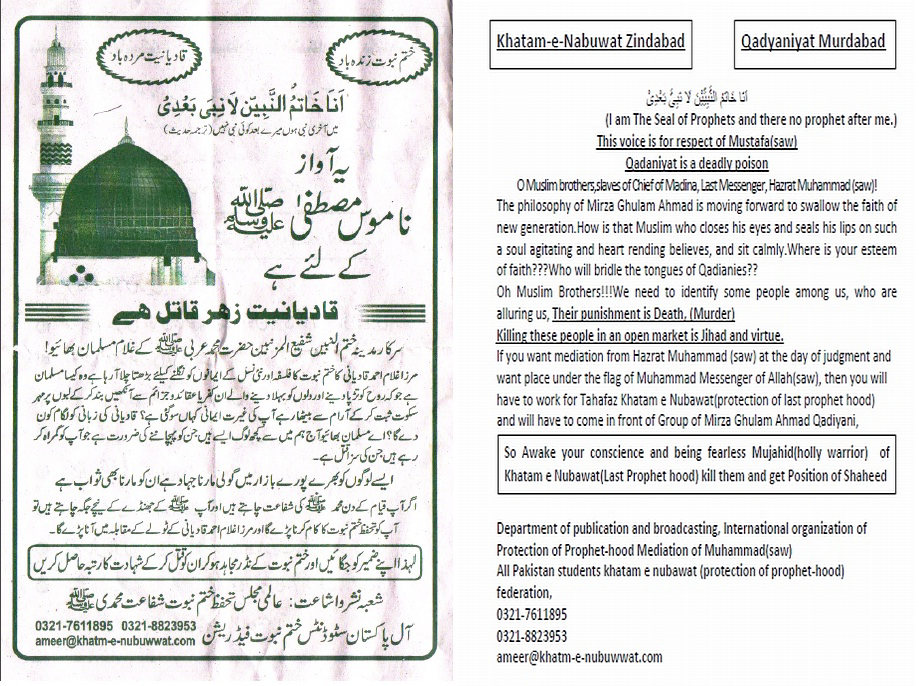
On August 4, 2009, an advertisement appeared in the Daily Pavel newspaper. It is reproduced above. This advertisement declared that Rao Zafar Iqbal is deserving of death, because he defended a man called Mohammed Ayube who claims to be Prophet Mohammed. Even though Ayube appears to be mentally ill, fatwas appeared against him in the Daily Pavel and Daily Express newspapers. The advertisement mentioning Rao Zafar Iqbal stated that murdering the lawyer would be doing a service to Islam.

The police appear to have taken no action against the newspapers, and in so many cases of alleged “blasphemy,” as well as when sectarian riots occur, the police are said to have stood back and done nothing.

When lawyers have been successful, and their clients are freed, the acquitted individuals have to flee for their lives. Several have been killed after gaining freedom. For example, Manzur Masih, Rahmat Masih and Salamat Masih had been arrested in May 1993, accused of blasphemy, under Section 295-C of the PPC.

The Christians were said to have passed pieces of paper into a mosque in Punjab province. The slips of paper allegedly bore insulting comments about Mohammed. The three had been accused by a cleric, Maulvi Fazl-e-Haq, who was a leader of the militant group Sipah-e-Sahaba, which at that time was not banned. Fazl-e-Haq claimed the three had also scribbled graffiti on the mosque wall.

At Lahore High Court, the three were acquitted, and set free, accompanied by another young man who had been falsely accused. Standing on the steps of the courthouse, the four were shot at by gunmen. Manzur Masih was killed. The judge who had acquitted him would also later be killed by extremists for freeing the Christians.

Bishop John Joseph, the first ethnic Pakistani to become Bishop of Faisalabad, attended the funeral of Manzur Masih, and even kissed the feet of the dead man. He vowed that he would be the next person to die under the blasphemy laws. Later, in his frustration, Bishop Joseph would give his own life. But even his own sacrifice brought no change to the laws.

FamilySecurityMatters.org Contributing Editor Adrian Morgan is a British based writer and artist. He has previously contributed to various publications, including the Guardian and New Scientist and is a former Fellow of the Royal Anthropological Society. He is currently compiling a book on the demise of democracy and the growth of extremism in Britain.

URL: www.familysecuritymatters.org/publications/id.4464/pub_detail.asp
 
^ Top of Page