Tuesday, October 6, 2009

Pakistan: Abuse of Christians and Other Religious Minorities (Part One)


October 6, 2009

Exclusive: Pakistan: Abuse of Christians and Other Religious Minorities (Part One)

Adrian Morgan

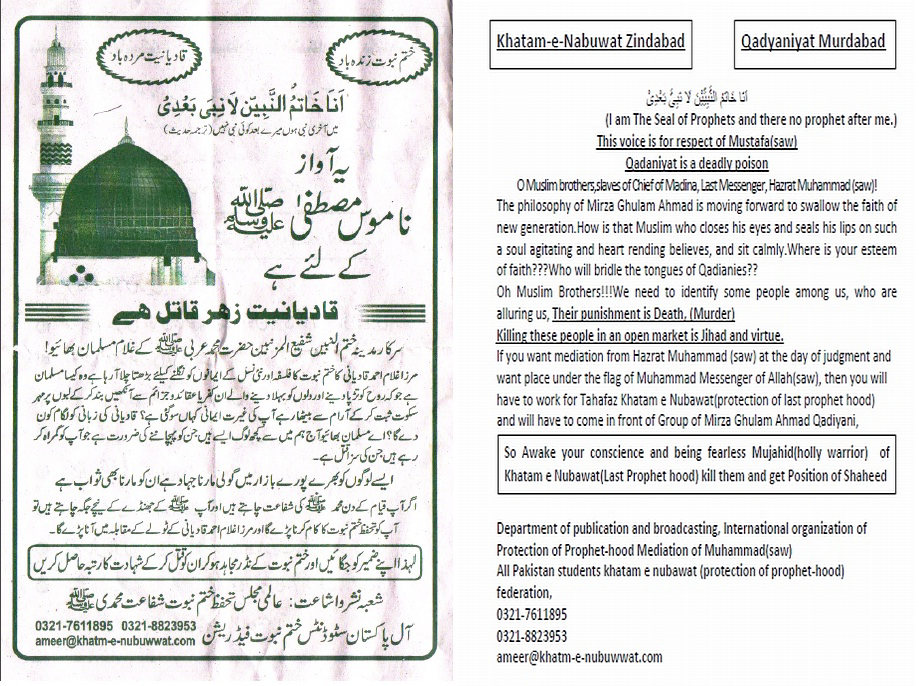
This year, Christians in Pakistan have suffered their worst persecutions for a decade. As a percentage of the population in the predominantly Muslim country, Christians number less than five percent. This year, seven Christians were burned alive in mob violence at Gojra in Punjab province. Four of these were women and one was a four-year-old child. In other parts, homes and churches have been destroyed and hundreds of Christians have been forced to flee their homes.

Pakistan’s discriminatory blasphemy laws have continued to be used to oppress minorities. As soon as a police complaint (FIR or First Information Report) is made about blasphemy the accused is compulsorily remanded in custody until trial. One Christian individual who was detained in this manner died violently on September 15th, even though the police who incarcerated him attempted to pass off his death as a suicide. In almost all the cases of legislative oppression and mob violence against Christians, blasphemy has been invoked as justification.

Recently Pakistan’s president, Asif Ali Zardari was on an international diplomatic tour, in which he visited Rome for three days. On Wednesday September 30th, he met with Italian Prime Minister Silvio Berlusconi and signed an agreement on intelligence-sharing and military cooperation. The persecution of Christians in Pakistan was briefly mentioned.

Zardari said: “We are confronting the problem of religious minorities in Pakistan. We support all religious minorities in our country. They have the same rights, whether it is their religious practices or political rights.” Berlusconi confirmed this, noting that he “found president Zardari to be very attentive.”

The following day (October 1st) Zardari visited Pope Benedict XVI at the Apostolic Palace of Castelgandolfo. The Vatican Press Office stated: “The cordial discussions provided an opportunity to examine the current situation in Pakistan, with particular reference to the fight against terrorism and the commitment to create a society more tolerant and harmonious in all its aspects.”

The Blasphemy Laws

The blasphemy laws as they are now employed derive from amendments made in the 1980s to Pakistan’s Penal Code (PPC). This legislation derives from 1860, as a set of statutes introduced by the British Raj for the governance of West Pakistan, then a predominantly Urdu-speaking region of India. The controversial amendments were introduced by the Islamist military dictator General Zia ul-Haq. This individual deposed Prime Minister Zulfiqar Ali Bhutto in 1977 and imposed martial law.

In 1980, ul-Haq introduced a Majlis-e-Shura (a council) of unelected advisers — many from the Islamist Jamaat-e-Islami party — to replace parliament. Later, he enacted sham elections. Zia ul-Haq retained connections with religious extremists, such as Maulana Muhammad Abdullah Shaheed who was imam at the Red Mosque (Lal Masjid) in Islamabad. Ul-Haq gave himself the role of President, with power above prime minister, and ruled Pakistan until his death in a plane crash on August 17, 1988. The main blasphemy amendments were introduced while Pakistan was under a military dictatorship, and not under a civil democracy.

Part XV of the PPC lists offenses involving religion. Originally, there were only four laws of this nature, numbered from 295 to 298, but these have been expanded to number 10. The laws generally invoked to oppress Christians (and also Hindus and the Ahmadiyya, an Islamic sect deemed by some to be heretical) are all the results of amendments. These are Sections 295-B, 295-C and less frequently Section 298-A.

Section 295-B which outlaws “Defiling, etc., of Holy Qur’an” originally arose as an amendment introduced in 1927 and revised in 1982. This states: “Whoever willfully defiles, damages or desecrates a copy of the Holy Qur’an or of an extract therefrom or uses it in any derogatory manner or for any unlawful purpose shall be punishable with imprisonment for life.”

Section 295-C prohibits “Use of derogatory remarks, etc., in respect of the Holy Prophet” and was introduced with the approval of General Zia ul-Haq and the Islamist Jammat-e-Islami party in 1982 and revised in 1986. This statute reads: “Whoever by words, either spoken or written, or by visible representation or by any imputation, innuendo, or insinuation, directly or indirectly, defiles the sacred name of the Holy Prophet Muhammad (peace be upon him) shall be punished with death, or imprisonment for life, and shall also be liable to fine.”

The death penalty option to Section 295-C was added in the Criminal Law (Amendment) Act, III of 1986, S. 2

Section 298-A deals with “Use of derogatory remarks, etc., in respect of holy personages”. This amendment was introduced in 1980, and states: “Whoever by words, either spoken or written, or by visible representation, or by any imputation, innuendo or insinuation, directly or indirectly, defiles the sacred name of any wife (Ummul Mumineen), or members of the family (Ahle-bait), of the Holy Prophet (peace be upon him), or any of the righteous Caliphs (Khulafa-e-Rashideen) or companions (Sahaaba) of the Holy Prophet (peace be upon him) shall be punished with imprisonment of either description for a term which may extend to three years, or with fine, or with both.”

Other sections of the PPC - 298-B and 298-C specifically target the Ahmadiyya. The first of these, introduced in 1980 prevents the Ahmadiyya from using devotional names to anyone other than Prophet Mohammed and his companions, and from calling any place of worship associated with anyone other than Mohammed as a “masjid” (mosque).

Section 298-C was also introduced in 1980, with a further amendment made in 1984. This forbids any Ahmadiyya from calling him or herself a “Muslim” and forbids any proselytizing of their religion. Sections 298-B and C both carry penalties of up to three years’ imprisonment and/or a fine.

Events Leading Up to the Gojra Violence

The violence in Gojra, in which Christians were burned to death, stemmed from a dispute that involved accusations of blasphemy. On Tuesday June 30th, a month before the atrocities, more than 110 Christian families were forced to flee their homes in the village of Bahminwala (Bahmina Wala) in Kasur district in Punjab province. The Christians were forced to hide in the fields around the village. They were driven out because Muslim mobs, encouraged by the local mosque, accused them all of blasphemy after one of their number had been listed in an FIR report.

The rampaging began after an incident that had occurred on the previous day. An argument broke out between a Christian farm laborer, 38-year old Sardar Masih (Arif Mashi), who was driving a tractor, and a Muslim riding a bicycle who came by and demanded that he should be allowed to pass. When this did not happen, the Muslim (Muhammad Riaz) apparently accused the Christian of being lower caste and a fight broke out.

According to Pakistan Christian Post, a mosque imam called Qari Lateef (Qari Latif) was consulted, and charges were filed against Sardar Masih at the local police station. These charges did not — it seems — include blasphemy, but the imam used his mosque loudspeaker system to make such accusations. In the ensuing unrest, electricity meters on Christian houses were smashed, Christian villagers were beaten, and houses were looted and burned.

The Daily Times newspaper sent journalists to the region. They met Shaan Ali and his brother Imran, who had both led the mob that attacked the Christians. Shaan Ali claimed, “The Christians had committed blasphemy.” He could not specify who had committed this blasphemy. Ahmed Ali Dhillon of the provincial assembly confirmed that Qari Latif, imam at the village mosque, had instigated the violence against the Christians.

A few days later after the violence, while Christians made public protest at their treatment, Pakistan’s minority minister Shahbaz Bhatti visited the village. Bhatti promised compensation to victims of the violence. Chief Justice Khawaja Mohammed Sharif at the Lahore High Court demanded that the local police chief for Kasur district appear to give their account of the events.

The events at Gojra followed — like so many similar cases of mob violence — the same trajectory as at Kasur, but the outcome was more horrific. Gojra is situated 99 miles west of Lahore in Punjab province. The spark that triggered the rampage began with an accusation that blasphemy had occurred. It was alleged that three Christians, Mukhtar Masih, Talib Masih and Talib’s son Imran, had desecrated pages of the Koran at a wedding ceremony in Korrian, outside Gojra town.

A case was registered against the three men under Section 295-B of the Pakistan Penal Code, but they were not immediately arrested. It is traditional for money to be presented at a wedding, and for those who are poor, “pretend money” is displayed. The Christians had allegedly cut up pieces of paper to look like money. There was no evidence from any sources that a Koran had actually been desecrated.

On Thursday July 30th, fearing reprisals for the alleged desecration, residents had fled from Korrian, leaving many houses empty. A mob gathered, and set fire to about 50 houses, also burning cattle. A kangaroo court was held in which Talib Masih was asked to apologize for desecrating Islam’s holy book. He denied having desecrated pages from the Koran and refused to apologize. Two churches were also set ablaze. The mob blocked the main road to the village, to prevent fire engines from putting out the fires.

Imran Masih was officially charged under Section 295-B of the Penal Code. Pages of the Koran were allegedly found among garbage outside the scene of the wedding on July 26th.

A second incident followed, on Saturday August 1st, which filled international newswires for the scale of its ferocity. The police did nothing as a mob of fanatical Muslims entered the town of Gojra and started to shoot. They threw Molotov cocktails at houses, burning down forty domiciles. The assailants were said to be from Lashkar-e-Jhvangi or its associated group Sipah-e-Saba. These groups have been involved in previous instances of sectarian violence against any minority that is not Sunni Muslim, including attacks upon Shia civilians.

Six of the individuals who died came from one family, that of Almass Hameed. A week after the event, Almass Hameed spoke from his hospital bed: “I think there were thousands. My elderly father went out to see what was happening and they shot and killed him. We were all shocked and crying. Before we knew it, they were breaking into the house.”

Mr. Hameed described how he and nine members of his extended family hid in an upstairs bedroom, and heard members of the mob breaking in, smashing items and dividing valuables between them. Some intruders beat on the bedroom door where Almass and others were hiding. The intruders threatened to burn them alive, and soon he could smell smoke as flames spread. He recalled: “We just couldn’t breathe. I grabbed my eldest son and managed to get out of the room through the flames, my brother came out with one of my daughters, but the rest were stuck and we had no way of rescuing them.”

Those who remained in the bedroom were Almass’ four-year old son Mousa, his 11-year-old daughter, his wife, her sister and her mother. Unable to escape, they were burned to death.

A Muslim youth blamed the event upon the Christians. He said: “We Muslims are the victims. We gathered to protest about what they did to the Koran in Korrian and just wanted to walk through their area, but they threw stones at us and fired shots. Of course it is bad that Christians died. But they provoked the Muslims here. I don’t understand why everyone is on their side.”

In the aftermath of the atrocity at Gojra, missionary schools were closed on Monday August 3rd.

A total of 800 individuals were charged with murder, including the local chief of police and the District Coordination Officer. Only 17 of these were actually named and placed in custody, with the remainder listed as “unknown” individuals. The charges had been brought by a local bishop. Shahbaz Sharif announced that 500,000 Rupees ($6,002) would be awarded for each family member that had died in the August 1st rioting.

The events in Gojra were to precipitate further attacks in a wave of “blasphemy hysteria”. At Mudrike in Lahore, immediately after the Gojra arson deaths, a Muslim factory owner was falsely accused of blasphemy. The incident took place on Tuesday August 4th. It involved Mian Najib, the owner of East Leather, a leather-processing factory at Khatiala Virkan near Muridke. Najib removed an out-of-date Islamic calendar from the wall of the factory and, it is alleged, burned it. Calendars of this nature often have verses or quotations from the Koran upon them, and as such, any destruction of these quotations is seen as destruction of the Koran.

A worker at the factory called Moulvi Shabber claimed to have seen this act, and incited revenge for this act. A crowd of hundreds attacked the East Leather factory. In the ensuing violence, a security guard was killed, along with a security guard. Several others were injured.

On Wednesday, August 5th at Sanghur in Sindh province, a 60-year-old Muslim woman was accused of blasphemy, and her home became surrounded by a mob, led by a local shopkeeper who accused her of blasphemy. The shop owner had said that Akhtari Begum had thrown around some pages of the Koran inside his store. She, for her part, claimed that she had thrown the book in which her credit entries had been kept by the shopkeeper, onto the ground. Police took the woman into custody, apparently sparing her life.

Other Incidents

The fact that Muslims too can become innocent victims of mob violence may perhaps be the key to having the Blasphemy Laws revoked. Traditionally, extremist Islamic groups, such as the Jamaat-e-Islami party, which had a part in writing the laws, have campaigned successfully for blasphemy laws to remain. In March 2008, for example, the Jamaat-e-Islami party (which seeks Sharia law and wants apostates from Islam to be executed under law) condemned political parties for ignoring its rallies in favor of enforcing the Blasphemy statutes.

The mention of agitation by the groups Lashkar-i-Jhvangi and Sipah-i-Sahaba in some of the recent attacks against the Christian minority suggests that the extremes of violence have been deliberately manipulated.

While the victims of the Gojra violence were buried, police took action against suspects and arrested 65 people, including Qari Abdul Khaliq Kashmiri, a leading figure in Sipah-i-Sahaba. The residence of Abid Farooqi, another member of the banned terror group, was raided, but Farooqi had fled. His father and two brothers were apprehended and taken into custody.

On November 12, 2005, a similar incident had taken place in Sangla Hill in Punjab province, where a false allegation of blasphemy had been made. Yousaf Masseh was accused of desecrating pages from the Koran, though it was claimed that he had been accused by two men who owed him money from gambling debts, and did not wish to pay. Masseh had been imprisoned, while a mob of about 1,500 Muslims, encouraged by loudspeaker announcements from a mosque, descended upon the Christian homes in Sangla HIll. Three churches, including a Catholic and a Protestant house of worship, a school, a youth hostel, a nunnery and two homes belonging to Protestant priests were destroyed.

Shortly after the orgy of destruction, Christian community leaders in Sangla Hill had been threatened over the phone by a man who identified himself as a member of Lashkar-i-Jhvangi. He warned them to accept his “deal” within two days or to “get ready to die.”

Lashkar-i-Jhvangi was the group believed responsible for the kidnap and decapitation of U.S. journalist Daniel Pearl. An offshoot of Sipah-i-Sahaba, Lashkar-i-Jhvangi came into existence in 1996. It was designated by the U.S. as a terrorist organization on January 30, 2003. Both Lashkar-i-Jhvangi and Sipah-i-Sahaba had been banned by President Musharraf in Pakistan on August 14, 2001. Sipah-i-Sahaba had been formed in Punjab province in the 1980s. Both groups have a Deobandi philosophy (the ideology which governs the actions of the Taliban in both Afghanistan and Pakistan) aimed for a Sunni state in Pakistan under sharia law.

In April 2009, Christians came under threat from Taliban-supporting militants in a community near Sarjani Town in a suburb of Karachi, in Sindh province. Buildings, including two houses and about six shops, were set on fire. Roadside traders’ stalls and carts were destroyed by fire. Gunfire broke out between groups and four people were injured. The violence broke out after graffiti on the walls of a church had been found on Wednesday April 22nd. The graffiti comprised of pro-Taliban slogans.

Christians responded by burning tires and throwing stones at passing vehicles. The two groups — Pakhtoons (Pashtun migrants from the Afghan borderlands) and Christians — faced each other down, and then gunfire broke out. Four people were injured, including an 11-year-old boy. One of the individuals who had been shot, a man called Irfan Masih, died later in hospital.

The graffiti which was chalked onto the wall of the Roman Catholic church in Sarjani town included: Taliban are coming,” “Long live Taliban” and “Be prepared to pay Jizya or embrace Islam.”

Jizya is a tax, listed in the Koran and the Hadiths, which non-Muslims were traditionally obliged to pay to Muslim overlords when a community was fully controlled by Islam and governed by the precepts of Sharia. In the Koran, Sura 9, verse 29, it is written (Yusufali’s translation): “Fight those who believe not in Allah nor the Last Day, nor hold that forbidden which hath been forbidden by Allah and His Messenger, nor acknowledge the religion of Truth, (even if they are) of the People of the Book, until they pay the Jizya with willing submission, and feel themselves subdued.”

During the incident in the Christian settlement (called Khuda ki Basti) near Sarjani Town, police were present but had done nothing to stop the incident. When the shooting began, only Christians were injured.

On August 28th in the city of Quetta in Baluchistan, southwestern Pakistan, six Christians were shot dead and seven more were injured. For months before the atrocity, Christians in the region had been receiving letters from Islamic fundamentalists which ordered them to convert to Islam or to die.

The most recent incident of prejudice against the Christian community involved the Blasphemy Laws. A 25-year-old Christian man from Sialkot in northeastern Punjab province, close to the Indian border, was arrested on Friday September 11th, accused of desecrating the Koran. A mob of about 100 people, most of them young men, made the accusations against Fanish Masih, who sometimes went under the name of Robert. The mob went on the rampage through Sambrial district and attacked a Roman Catholic church, setting it alight.

The alleged incident that provoked the violence was a claim that a Christian had snatched a Koran from a 10-year-old girl and had then desecrated it. No authentication of the incident has appeared from other sources, and it seems that — like almost all alleged cases of Koran desecration — it could be a baseless myth.

On Tuesday September 15th, police announced that Fanish Masih had committed suicide in his cell. The young man had been kept in a separate cell, and police maintained that he had tried to commit suicide by hanging himself with a narrow cord. This version was immediately contested. Asma Jahangir, the head of HRCP, the Human Rights Commission of Pakistan, claimed that “This is death in custody and the police authorities are responsible.”

Kamran Michael, the Punjabi provincial Minister for Minority Affairs said: “I have seen the body and there were torture marks on it.” It is obvious that there is a deep gash on Robert’s forehead, which appears to have been caused by impact from a sharp-edged object. The body was taken away by local Christians who demanded a private autopsy.

At the funeral of Fanish Masih on Wednesday September 16th, there was discontent. The body could not be buried in Fanish’s native village of Jaithikey-Sambrial for fear of inflaming tensions again. Instead, a memorial service was held in the grounds of a Christian school in the industrial city of Sialkot. There was ill feeling on the night before the funeral, and some Christians blocked roads, threw stones at vehicles and trashed 13 shops. On the day that Fanish was interred, there were clashes with police, and nine Christians were arrested.

The day of the funeral, the National Assembly Standing Committee on Minorities demanded an official inquiry into the circumstances of Robert Fanish Masih’s death in police custody.

While Pakistani newspaper editorials carried sincere expressions of regret about the treatment of Christian and other minorities in Pakistan, a bizarre turn of events took place in Toba Tek Singh, the district that included Gojra. On September 26th, it was announced that an individual called Ghulam Murtaza had filed a case against 129 Christians from Gojra.

Murtaza claimed that he had been among 12 Muslims who had been injured on August 1st, the day that seven Christians had been injured in Gojra. In this counterclaim, it was stated that one of the Muslims who was injured on the day of the rioting, Muhammad Asif, later died from injuries. The legal charges invoked the Anti-Terror Act as well as Sections from the Penal Code, including Section 295-C (insulting Prophet Mohammed), 280 (theft from a house), 436 (mischief by fire or explosive substance with intent to destroy house etc.), 324 (Qatl-i-amd or attempting to cause death of another), 148 (rioting, armed with deadly weapon), 149 (being part of an unlawful assembly and guilty of committing a crime) and Section 342 (wrongful confinement).

The individuals listed in Murtaza’s charge sheet included John Samuel, the Bishop of Gojra, and also Samuel’s two sons, and a local administrator.

Six days before Ghulam Murtaza brought his extraordinary set of charges against members of Gojra’s Christian community, 18 people who were held in custody for the violence of August 1st were released. A joint committee of Muslims and Christians, set up to enact reconciliation, had decided to declare the 18 individuals innocent. A similar committee had brought the same results — and consequence lack of punishment for offenders — in the aftermath of the Sangla Hill riots of 2005.

The Death of a Dream

When Pakistan broke free from British rule, it was led by Muhammad Ali Jinnah. It is hard to imagine that originally, the state of Pakistan was officially secular. Nowadays, Section 2 of the constitution maintains that “Islam shall be the State religion of Pakistan.” Jinnah was only in power for 13 months before he died. With him died the dream of a secular nation.

The current Constitution maintains in Section 20 A that, “subject to law, public order and morality, every citizen shall have the right to profess and propagate his religion”. Section 298-C of the Pakistan Penal Code deliberately suppresses this basic right in relation to the Ahmadiyya. These believe that Mirza Ghulam Ahmad, who founded their faith on March 23, 1889, is a prophet. In every other way they follow the tenets of the Koran, though they are banned by Saudi Arabia from performing one of the five pillars of Islam, making the Haj pilgrimage to Mecca.

One of the few heartening things to have emerged as a consequence of the recent attacks against Christians is a willingness on the part of respected Muslim commentators within Pakistan to voice their shock and shame at the events that have been allowed to take place on account of the Blasphemy Laws. For the first time in three decades, there appears to be a determination on the part of Pakistan’s elite to discuss the removal of the contentious and divisive laws.

Several writers have gone back to the historic speech made by Muhammad Ali Jinnah on August 11, 1947, the day of Pakistan’s Independence. As president of the new republic, Jinnah addressed the Constituent Assembly.

He included the following words: “You are free; you are free to go to your temples, you are free to go to your mosques or to any other place or worship in this State of Pakistan. You may belong to any religion or caste or creed that has nothing to do with the business of the State. As you know, history shows that in England, conditions, some time ago, were much worse than those prevailing in India today. The Roman Catholics and the Protestants persecuted each other. Even now there are some States in existence where there are discriminations made and bars imposed against a particular class. Thank God, we are not starting in those days. We are starting in the days where there is no discrimination, no distinction between one community and another, no discrimination between one caste or creed and another. We are starting with this fundamental principle that we are all citizens and equal citizens of one State.”

He added: “Now I think we should keep that in front of us as our ideal and you will find that in course of time Hindus would cease to be Hindus and Muslims would cease to be Muslims, not in the religious sense, because that is the personal faith of each individual, but in the political sense as citizens of the State.”

The evidence is now incontrovertible: Pakistan is now a nation where Hindus, Christians and the “heretical” Ahmadiyya are minorities who have none of the freedoms that were described by Jinnah in his first speech as elected president. Jinnah was speaking of the need to frame a Constitution and what it should encompass. He railed against the corruption that had been endemic at the time of Independence. Acknowledging that Pakistan would have non-Muslims in its population, he urged that the state should work for the well being of everyone. He said: “If you change your past and work together in a spirit that everyone of you, no matter to what community he belongs, no matter what relations he had with you in the past, no matter what is his color, caste or creed, is first, second and last a citizen of this State with equal rights, privileges, and obligations, there will be no end to the progress you will make.”

Pakistan has long abandoned the principles that brought it into being. The rule of Zia ul-Haq was the third military dictatorship since independence. Since 1947, only one government, the one that preceded this current one, has completed a full term of office, and that was blighted by emergency powers introduced by Musharraf at the end. The Blasphemy Laws, approved by Zia ul-Haq with the support of Islamic fundamentalists, have been a source of strife, a means by which personal scores can be settled, a pretext for communal violence. At a speech delivered after the funeral of Fanish Masih, Father Emanuel Yousaf Mani called on the current government to review the Blasphemy statutes. He told a press conference that since their introduction, 947 people, all of them non-Muslims, had been killed.

In Part Two, I will describe how previous attempts to amend the Blasphemy Laws have foundered in the face of fundamentalist opposition, and show how they have been used to settle scores and to turn minority groups into convenient scapegoats.

FamilySecurityMatters.org Contributing Editor Adrian Morgan is a British based writer and artist. He has previously contributed to various publications, including the Guardian and New Scientist and is a former Fellow of the Royal Anthropological Society. He is currently compiling a book on the demise of democracy and the growth of extremism in Britain.

URL: www.familysecuritymatters.org/publications/id.4447/pub_detail.asp

PAKISTAN: Repeal of Blasphemy Laws Still a Pipe Dream

---IPS-Inter Press Service, Italy

PAKISTAN: Repeal of Blasphemy Laws Still a Pipe Dream

By Zofeen Ebrahim

KARACHI, Oct 6 (IPS) — It is a never-ending saga.

Every time someone charged with violation of the controversial blasphemy laws is murdered or suffers mistreatment in the hands of an angry mob or individual, calls for their repeal intensify.

Yet concerned sectors are still waiting anxiously for concrete action by the state to stem the tide of religious violence against minority groups who bear the brunt of these laws.

The death of a 20-year-old Christian while in the custody of the police has intensified the campaign against the laws. But clerics are not backing down, insisting the laws should stay.

In 2000, then President Pervez Musharraf promised to repeal the laws. “He retracted when the ‘mullahs’ (religious teachers) threatened protests,” recalled Zohra Yusuf, vice chairperson of the Sindh chapter of the Human Rights Commission of Pakistan (HRCP).

Robert Fanish Masih was arrested around mid-September on blasphemy charges after Muslims went on a rampage in his village, Jaithikey, near Sialkot, close to the Indian border. He was found dead in his cell four days later. Asma Jahangir, the head of the HRCP, called it “death in custody” and held the police authorities responsible for it.

His family and community members were forced to flee the area, where they were also prevented from burying him.

Rights activist Tahira Abdullah said mobs using the law to inflict harm on others are acting “like private vigilante groups,” she said.

No less than governor of Punjab, Salman Taseer has called for a repeal of the blasphemy laws. But his bold call on Sep. 16 for the controversial laws’ repeal was met with a warning from the president of the conservative Pakistan Muslim League (Quaid-e-Azam), Chaudhry Shujaat Hussain, who said that his party would resist any attempt to annul the blasphemy laws.

Continued state inaction on the much-maligned blasphemy laws has only reinforced perceptions that “the present government has no intention of repealing the laws,” said Yusuf.

I.A. Rehman, noted rights activist and secretary general of the HRCP, told IPS “(neither) the present government (nor any) government in Pakistan is likely to have the courage to repeal the blasphemy laws”. He added that “the state has committed the folly of making obscurantist fanatics stronger than itself.” Calling for a repeal of the law “is the only rational way out” although “this demand is unlikely to be met.”

The Pakistan Minorities’ Democratic Movement, which has 51,500 members and affiliates in 47 districts, has started a signature campaign for the repeal of the blasphemy laws. “Since July 16, 2009, we have collected over 200,000 signatures,” said party chairman Atif Jamil Paggan.

“What we hope to gain from our pressure is a policy of making the laws dormant. If these are not invoked, for some years or do not yield the results the fanatics expect, repeal will become possible,” said Rehman.

Declaring Masih’s alleged suicide a “judicial murder,” the HRCP, in a press statement issued shortly after his death, expressed concern “over the increased attacks on religious minorities” demanding the “government take proactive measures to prevent such violence.”

The blasphemy laws were enacted by military dictator Muhammad Zia-ul-Haq in 1986 in a bid to Islamise the country, where only four percent of the country’s 170 million population consists of religious minorities, including Christians.

While none has been executed since the laws were passed, lynch mobs have killed several of the accused, citing the laws to justify their actions.

According to the National Commission of Justice and Peace (NCJP), which provides legal aid to the victims of these laws irrespective of religion, at least 966 people have been charged under the blasphemy laws between 1986 and September 2009. These include 481 Muslims, 120 Christians, 340 Ahmadis, 14 Hindus and 10 people of unidentified religion. About 32 people have been killed extrajudicially by an angry mob or individuals, states NCJP.

On Sept. 15, jail officials of Sialkot district jail claimed that Masih had committed suicide by hanging himself. Rights group refused to believe this statement, alleging he was “tortured to death” by jail officials.

Sialkot is about 125 kilometres from Lahore, capital city of the Punjab province and is famous internationally as manufacturing hub for sports equipment and surgical instruments.

Following the public outcry triggered by Masih’s death, the government suspended the jail superintendent. But such an action has done nothing to appease the concerned sectors.

A U.S.-based non-profit group, Advocates International (AI), has urged Pakistan to “end unlawful impunity, police brutality and religious persecution caused on its blasphemy laws.”

The AI said photographs of Masih taken at the morgue show clear signs of torture, and not strangulation as the police are claiming was self-inflicted.”

“We are investigating the cause of (his) death as there are signs of torture on his body,” said Shahbaz Bhatti, minister for minority affairs, speaking to IPS by phone from Islamabad. He described the death as “very barbaric, tragic and highly condemnable,” intimating that he, too, believed that Masih was murdered.

Masih’s alleged murder came in the wake of two violent attacks against Christian communities in Korian village and Gojra in Punjab on July 31 and Aug. 1, respectively. The incidents left nine people dead and led to the burning and looting of hundreds of Christian homes by an enraged Muslim group, reacting violently to reports of Christian children tearing pages off the Quran, Islam’s holy book, during some wedding festivities.

“Considering the environment prevailing in the country, we’re asking for a review, revisit and amendment to the laws,” said Bhatti, a Catholic.

Mohammad Nafees, a journalist and senior research fellow for Aryana Institute for Regional Research and Advocacy in Islamabad, supports this move. He knows, however, that the “religious lobby” against such a call was so strong that “any attempt to change (the laws) may not be very easy.”

The controversy sparked by the Gojra incident, he said, failed to bring justice to the victims, who were “now being haunted by law enforcers while the culprits are at large.”

“If we can at least save these poor people from this legal harassment and torture, we would be able to claim some sort of success. If we fail here, we can’t even talk about a little change in the blasphemy laws,” he said. “It’s a simple equation.”

“A bad law cannot be amended to make it better,” argued HRCP’s Yusuf. “No government has been able to roll back the intolerance unleashed (by the laws). The current spurt (of violence) is due to the extremist forces wanting to assert their power.”

Nafisa Shah, a member of the National Assembly and a long-time rights activist acknowledged that the questionable laws have been abused.

“We have stated that these laws have caused religious violence and have been used to settle personal scores. The laws have made minorities vulnerable but have also been used against people of the Muslim majority and several cases of public lynching and mob violence are incited on the premise of blasphemy,” said Shah, who has been selected to head the newly formed subcommittee of Parliament’s Standing Committee on Minorities. The committee is tasked to prepare a comprehensive report on the damaging effects of this law and make recommendations to the government.

“Laws are made according to the needs of society, but in Pakistan, there was no need for these laws,” said Peter Jacob, chairman of the NCJP.

“What we need, apart from repeal/amendment, is greater tolerance in society — from revision of textbooks to sensitisation of police, administration, councilors, parliamentarians,” said Yusuf.

Shah said she favours a repeal of the law but reminded civil society that “that there are a range of parties from extreme right to left in the parliament and the standing committee which have to be brought on board,” adding that without including them, nothing can be passed in the assembly.

“What we are trying to do is to create a negotiating space through which we can enlarge our support in the parliament and move forward against discriminatory laws.”

“Blasphemy laws can at least be taken up by our legislators, and it won’t create a storm,” said Jacob. They did so when they reverted the holiday from Friday to Sunday and amended the Hudood Ordinances — still another controversial legislation that makes it difficult for women to prove an allegation of rape — were amended, nothing adverse happened, he added.

(END/2009)

URL: www.ipsnews.net/news.asp?idnews=48736

Monday, October 5, 2009

Murder of another Ahmadi Muslim in Pakistan

In the Name of Allah, Most Gracious, Ever Merciful
International Press and Media Desk
Ahmadiyya Muslim Jamaat International
22 Deer Park, London, SW19 3TL
Tel / Fax (44) 020 8544 7613 Mobile (44) 077954 90682
Email: press@ahmadiyya.org.uk
Web: Alislam.org
LONDON, 5th October 2009
PRESS RELEASE

MURDER OF ANOTHER AHMADI MUSLIM IN PAKISTAN

‘Bear trials with patience’ – Message of Head of Ahmadiyya Muslim Jamaat

During his weekly Friday Sermon, the Head of the Ahmadiyya Muslim Jamaat, Hadhrat Mirza Masroor Ahmad confirmed the sad news that yet another Ahmadi Muslim had been martyred for his faith in Pakistan. Furthermore, two other Ahmadi Muslims were the victims of a terrorist bombing in the city of Peshawar.

Muhammad Azim Tahir of Uch Sharif in Pakistan was martyred on 26 September 2009 in the presence of his wife and daughter. Surely, to Allah we belong and to Him shall we return.

Mr Tahir was returning from a family wedding on his motorbike at 8.30pm when two unknown persons brandishing a firearm forced him to stop his vehicle. In the confusion, Mr Tahir, his wife and daughter, fell from the motorbike. As Mr Tahir went to help his family the assailants stopped him and pointed a gun towards him. Mr Tahir pleaded with them to take whatever they wanted and to leave him and his family alone but as he said this one of the assailants shot him in the temple and he died on the spot in sight of his wife and daughter. The assailants fled the scene. Muhammad Azim Tahir was killed simply because he was an Ahmadi Muslim. He is survived by his wife, two sons and daughter.

Also on 26 September 2009 two Ahmadi brothers, Riaz Ahmad (40) and Imtiaz Ahmad (20) were the victims of a huge car bomb blast in a commercial district of Peshawar. Both brothers died as a result of the bombing.

Speaking about the continued atrocities faced by Ahmadis, Hadhrat Mirza Masroor Ahmad said:
“The opponents of our Jamaat can murder a few of our members; they can loot Ahmadis of their wealth; they can destroy our buildings; they can stop us constructing mosques. But they can never weaken our faith.”
His Holiness counselled members of the Jamaat to bear all persecution with fortitude as the Holy Qur’an had taught that ‘surely, Allah is with those who patiently persevere.’ He said the sacrifices made by Ahmadis would never be in vain. Every drop of blood shed by an Ahmadi would become a source of the community’s success.

He continued that even Ahmadi children were now a target for cruelty and violence. School children were often taunted in the hope that they would leave their education in fear; in Faisalabad Ahmadi medical students were suspended in 2008 having been subjected to physical and mental violence from anti-Ahmadi extremists; and most recently in District Layyah four Ahmadi children were imprisoned for months on end in the most inhospitable conditions on baseless charges. His Holiness said:

“If the parents of these children at any point denied the truth of Ahmadiyyat, then immediately all charges would be dropped. It is the vain hope of the opponents that Ahmadis leave their religion as a result of their intimidation and cruelty.”

His Holiness concluded his sermon by warning Ahmadis worldwide that this persecution of the Jamaat could escalate. He said:
“The members of the Jamaat worldwide need to focus on prayer. Because the way the situation is developing it seems that Ahmadis, particularly in Pakistan, are going to face increased cruelty and hardship. The ignorant opponents do not realise that their deeds are not harming our community but in fact are harming the country and society at large.”
End of Release
Further Info: Abid Khan, press @ ahmadiyya.org.uk

Saturday, October 3, 2009

Threats to the state

---The News, Pakistan - Internet Edition

Threats to the state

Saturday, October 03, 2009
Farzana Bari


The multiple crises the state is faced with today bring home the stark realisation that the policies pursued by the state elite over the last 62 years for national security in Pakistan were incorrect and misplaced. The territory-centered state security paradigm has resulted in a lack of human security that is now posing the biggest internal threat to the country. Massive economic insecurity, illiteracy, rising unemployment, inflation, energy and water shortages, food insecurity, inaccessibility to social sector services, militancy, sectarianism and extremism, rampant kidnapping and killing for ransom and the complete breakdown of law and order are some of the real existential threats to the security of the state today.

Pakistan appears to be crumbling down not because of external threats but from the internal crisis intensified by the competing forces within the state elite and institutions. The contemporary crisis of the state and its internal contradictions can only be understood in its historical and colonial context.

Pakistan inherited internal and external security dilemmas from the colonial rule as part of independence. The major internal threat to the state stems from the very ideology of Pakistan itself. In the absence of a commonly shared notion of nationhood, the post-colonial state establishment started using Islam as a unifying force to keep the ethnically and culturally diverse population together. The state was Islamised through the Objectives Resolution in 1949. Thus, the ideology of Pakistan created a need for a strong centre. Despite the initial contract between the centre and the various federating units that the latter would be sovereign and autonomous, the centre refused to grant provincial autonomy to its federating units in the successive military and civilian governments for the last 62 years. The over-centralised state created tension between the federal and provincial units. The independence of Bangladesh was a nail in the coffin of the ideology of Pakistan.

However, no lessons were learnt. The centre continued to exploit provincial resources, refused to abolish the concurrent list and did not work out a power and resource sharing formula between the federal and provincial governments. As a result of this, the national question emerged as one of the most serious threats to the state security. Some of these nationalist forces are now turning into secessionist movements.

Another major threat to the state is from rising religious militancy and extremism. After independence, Pakistan inherited the disputes of Kashmir with India and Durand Line with Afghanistan. To respond to these perceived security threats from neighbouring countries, the Pakistani establishment crafted the policy of support to non-state actors and trained Islamist militants who were fighting in Indian held Kashmir. The annexation of the Objectives Resolution with Pakistan’s first constitution was followed by declaring Ahmadiyya sect as non-Muslims in 1974. The policy of appeasement of religious forces was at its peak during the military dictators of Ziaul Haq and Pervez Musharraf’s military rule.

Ziaul Haq nurtured Islamist militants with the support of the US to fight Soviet Union in Afghanistan. The radical Islamists were given tremendous financial and political support to establish religious madaris to produce and train militants for Afghan jihad. Musharraf’s regime secured the electoral victory of the Muttahida Majlis-e-Amal (MMA) through manipulation of elections in NWFP. During the five-year-rule of MMA (2002-2007) in NWFP, radical militant groups in FATA became strong.

In the post-9/11 scenario, the Pakistani establishment was forced by the US to withdraw traditional state support to these militant groups who then turned against the country. Today, the rise of neo-Taliban insurgency in the shape of Tehreek-e-Taliban (TTP) is posing a threat to the state.

Rising poverty, illiteracy and disease are other formidable threats to state security. In the name of territorial security, the state provided justification to spend a bulk of its financial resources on defence and the development of nuclear capability. Investment on education, health and creating employment opportunities lagged far behind the ever-rising defence budget. The state compromised human security and failed to diverge from state centric to people-centric security paradigm. Today nuclear Pakistan is unable to provide personal security to its citizens from rising extremism and Talibanisation, sectarian violence, suicide bombing, kidnapping and killing, crushing poverty and disease.

The criminal neglect of human security concerns and lack of investment in human capital by the self-serving state elite is the most serious threat to Pakistan – not external but emanating from within the national borders.

To save the country from contemporary traditional and non-traditional security threat, the new social contract is the need of the day. The key element of this new contract must include the separation of religion from state, complete provincial autonomy, balance between the security needs of the individual, community and state, massive investment in human capital, inclusion of citizens in governance, gender equality and an independent foreign policy.

The writer is acting director of the Centre of Excellence in Gender Studies at Quaid-e-Azam University. Email: farzana @ comsats.net.pk

URL: www.thenews.com.pk/daily_detail.asp?id=201353

Friday, October 2, 2009

Malaysia: Making minorities count

---The Nut Graph, Malaysia

Making minorities count
2 Oct 09 : 8.00AM

By Shanon Shah
shanonshah at thenutgraph dot com

“PAS for all” was an enchanting slogan indeed during the March 2008 general election. It was a sentiment that allowed for a warm partnership to develop between PAS and its eventual Pakatan Rakyat (PR) partners, Parti Keadilan Rakyat (PKR) and DAP. It was also what convinced Malaysians of all races to vote for PAS candidates even in non-Muslim majority constituencies. A case in point is PAS central working committee member Dr Siti Mariah Mahmud’s landslide victory in the 51% non-Muslim Kota Raja parliamentary seat.

But post-March 2008, there seem to have been some caveats to this inclusive slogan. For one thing, there has been an ongoing tussle in Selangor regarding the status of the Ahmadiyah community in Selayang. And the Selangor religious exco from PAS, Datuk Dr Hasan Ali, has been instrumental in
efforts to restrict religious worship among Ahmadiyah.


Granted, Ahmadiyah are but a tiny minority in Malaysia. Ahmadiyah probably make up 0.007% of the entire Malaysian population. Still, the slogan would not be as sexy if it were to say “PAS for 99.993%”, so this is probably why “PAS for all” remains the preferred brand strategy.

But PAS is not alone in having such contradictions between speaking for an inclusive Malaysia, and yet trying to clamp down on those it disagrees with. Just look at Prime Minister Datuk Seri Najib Razak’s much-praised as well as lampooned 1Malaysia slogan. And yet, someone in his administration is guilty of perpetuating, or at the minimum excusing, intimidation of minorities. We just need
to recall Home Minister Datuk Seri Hishammuddin Hussein’s defence of protesters who brandished a severed cow-head as a means of protesting the relocation of a Hindu temple.

Context matters

The question then is not just about how people deal with diversity and disagreement. It is also about how the many treat the few, and how the powerful treat the weak. It is something humanity has had to grapple with in witnessing the Jewish Holocaust in World War II, the 1994 butchering of 800,000 Tutsis and Hutu moderates by Hutus in Rwanda, and the systematic suffocation of indigenous communities in democracies such as the US and Australia.

Perhaps some of these examples are exaggerated in the case of Malaysia. Have we witnessed the gassing of entire communities here? Have we seen an ethnic majority bringing machetes and axes to systematically annihilate a particular ethnic minority? After all, the Selangor authorities are not bringing machetes or axes to the Ahmadiyah compound in Selayang — they are “merely” stopping them from worshipping. Is this cause for worry?

The situation is complicated. Sure, there may only be approximately 2,000 Ahmadiyah in Malaysia, but there are an estimated 200 million worldwide. And of this 200 million, many have settled in countries such as Canada and the UK, where they enjoy the support and protection of secular governments there. In fact, Ahmadiyah communities in these countries are able to lobby government ministers to put pressure on Muslim countries that persecute Ahmadiyah.

Ironically, it’s not that different being a “mainstream” Muslim in certain situations. Plant yourself in t
he US and you become the target of racial profiling, harassment and torture. Move to, for example, Pakistan and you are suddenly all-powerful. In practise, you could then profile, harass or abuse Christian, Hindu and Ahmadiyah communities and very likely get away with it.

A numbers game?

Furthermore, there are minorities and then there are minorities. On some levels, it is a numbers game after all. For example, Indian Malaysians are an ethnic minority, and have been the butt of racist jokes and not-so-helpful policies. But this minority group, spearheaded by Hindraf, managed to summon 30,000 from its ranks to march the streets of Kuala Lumpur in November 2007, demanding reparations and better treatment.


The Indian Malaysian vote also went squarely against the Barisan Nasional (BN) in March 2008, a
nd this inflicted a painful enough blow to the ruling coalition. And so, policies towards Indian Malaysians, especially in terms of education, have changed since then. Is this what it takes for a minority to assert itself? To demonstrate, “Hey, we have the numbers too, and we can inflict some real damage.”

There are various minorities in Malaysia. There are the tiny, often invisible, communities — indigenous people, lesbians, gays, bisexuals and transsexuals, and “deviant” Muslim groups. There are minorities of circumstance — those with HIV/AIDS, migrant workers, refugees, underprivileged urban settlers, and so on. And then there are the “bigger” minorities — Chinese and Indian Malaysians, Christians, Hindus and Buddhists, and so on.

Sometimes different categories of “minority” intersect. A Christian Indian Malaysian would already be a minority. But what if this person was also lesbian, poor and HIV positive? What would we do with her then? Were the 30,000 Hindraf protesters thinking of her when they took to the streets in 2007?

Hunting season

Would it be easier if we just did not have to deal with minorities? Either by doing away with them, or by making them comply with what the majority dictates? Anti-Ahmadiyah quarters might use this argument — in a democracy, we must accept the will of the majority. But what if the will of the majority, as in Rwanda, is that minorities must be killed? If that were the case, then there is not much difference being an Ahmadiyah in Pakistan, a “mainstream” Muslim in the US, a gay teenager in Iran, or a refugee in Australia. You just have to look out for when “hunting season” begins, and when it ends.

And yet, it’s not like societies have not learnt to deal with minorities before. In 2008, Australian Prime Minister Kevin Rudd formally apologised to the country’s indigenous population for wrongdoings caused by successive administrations. Germany openly grapples with its anti-Jewish Nazi past. The staunchly Catholic Ireland ultimately decriminalised homosexuality in 1993.

But getting back to Malaysia, what direction then is the BN government going to take with 1Malaysia? Where is PAS going to take “PAS for all“? Or are these merely the soundtrack to a prolonged hunting season?

The misguided majority-rule argument fails to acknowledge that democracy isn’t just about the will of the majority; it also entails that the majority government recognises the legitimate rights and freedom of the minority. For if it were merely the former, democracy is no more than giving the majority the right to tyrannise over the minority.

See Also:
URL: www.thenutgraph.com/making-minorities-count

Thursday, October 1, 2009

Protests mount against Pakistan’s blasphemy laws

---World Socialist Web Site, USA

Protests mount against Pakistan’s blasphemy laws

By Ali Ismail
1 October 2009


Pakistan’s draconian “blasphemy” laws have come under renewed criticism since several Christians were killed this summer by a mob of Muslim fundamentalists in a pogrom-style attack. Demands have risen for the abolition of these laws, which were introduced in the 1980s by the US-backed dictator General Zia-ul Haq as part of an “Islamization” drive. They have often been used to persecute Christians and members of other religious minorities.

The violence occurred in the town of Gojra in eastern Punjab, when a banned Islamist group falsely accused local Christians of desecrating the Qur’an. A large crowd of Muslim fundamentalists set fire to several homes, leaving their occupants to be burned to death. Seven people were killed, all believed to be Christians.

Over 100 people were arrested in connection with the massacre, which according to Pakistani officials, was ordered by Sipah-e-Sahaba, a Sunni Islamist group that has frequently been involved in sectarian violence against the country’s Shia minority.

Attacks against Pakistani Christians usually go unpunished. But because of the outcry from Pakistani Christians, civil rights groups, sections of the press, and international Christian groups, Pakistan president and People’s Party of Pakistan (PPP) head Asif Ali Zardari may be compelled to deliver at least a modicum of justice.

President Zardari and Punjab’s provincial government have offered paltry compensation to the victims’ survivors, amounting to just a few thousand dollars per family.

There were several other incidents of violence perpetrated against Christians in Pakistan in the months leading up to the Gojra atrocity. Last March, a Christian woman was killed when a church was attacked in Gujranwala. On June 30, dozens of Christian homes were attacked when Muslims plundered a village in the Kasur district.

Islamic militants and bigoted clerics have been able to foster animosity between Muslims and Christians by exploiting the disgust generated by the crimes of US imperialism in Afghanistan and Iraq and in Pakistan itself. The Bush administration funded and armed the dictator General Pervez Musharraf, who was only forced out as president in August 2008, and under Obama the US has declared Pakistan an integral part of the Afghan counter-insurgency war, mounted regular drone missile attacks inside Pakistan and prevailed upon the government to bloodily suppress Taliban-allied militia in the country’s northwest.

Notwithstanding the outcry over the Gojra massacre, attacks on Christians are continuing. On September 12, the Pakistani English-language daily Dawn reported that a church was set ablaze by Muslim communalists after another dubious allegation of desecration of the Qur’an. Bishop Samuel Pervaiz subsequently accused the government of failing to protect minorities.

In a particularly disturbing incident, 20-year-old Robert Fanish Masi, who had been arrested on blasphemy charges, was found dead September 15 in his jail cell in the Sialkot district. While police claim Masi’s death was a suicide, his body was reported to bear clear signs of torture, indicating that he may have been murdered while in custody. The Daily Times cites the Punjab Minister for Minority Affairs Kamran Michael as saying, “I have seen the body and there were torture marks on it.”

Masi is by no means the first person accused of blasphemy to be found dead in their cell under mysterious circumstances.

Local authorities denied Masi’s family permission to bury him in his native village, some 20 kilometers from Sailkot, and police attacked his funeral procession in Sailkot with tear-gas after it transformed into a protest demanding repeal of the blasphemy laws and a public inquiry into his death.

The recent anti-Christian communal attacks have sparked protests involving Christians, human rights activists, and other working people in cities across Pakistan. According to Joseph Francis, the chairman of the Christian National Party, people are saying “We hate Pakistan and we want to leave. It’s truly a terrible thing for community relations.”

The protestors are outraged not only by the violence, but by police indifference to, and outright collusion, in the attacks.

To cite but one example, on September 16 The News reported that police in Karachi severely beat up several members of a Christian family, the Lawrence’s, after a family-member, a 60 year-old diabetic patient, allegedly urinated on the roof of a neighbor’s house where there was said to be some religious literature.

According to the Human Rights Commission of Pakistan, “There was a hue and cry and local clerics gathered and attacked Lawrence’s house. An HRCP team is investigating this case.” Yousuf Ashiq of the Muthahida Qaumi Movement (MQM), the political party that leads Karachi’s municipal government, said, “Although there is no eyewitness to the incident, the Christian family has decided to pay compensation in accordance with Islamic laws and an announcement has been made in this regard at the local mosque.”

Pakistan’s approximately three million Christians make up less than two percent of the country’s total population. Most of the Christians are descendents of untouchables who converted to Christianity during the second half of the 19th Century and early 20th Century. The conversions were at least in part an effort to improve their socio-economic status and escape caste oppression. Today they are the largest non-Muslim minority group in Pakistan.

Although only Brahamanical Hinduism gives religious sanction to untouchability, in colonial India better-off Muslims, as well as Hindus, enforced caste divisions. Today Pakistan’s Christian must deal with both class and caste-based prejudice. They are often taunted as “cleaners” referring to the menial tasks performed by their ancestors—tasks which dire poverty compel many of them to continue to perform today.

Bigotry and religious sectarianism are the inevitable products of the betrayal of the mass anti-imperialist movement that convulsed British India during the first half of the 20th Century by the Indian National Congress and the Muslim League and the creation in 1947, under the tutelage of the British of imperialism, of twin independent bourgeois states—an expressly Muslim Pakistan and a predominantly Hindu India. The immediate result of partition was an orgy of communal violence in which up to two million people died and more than 12 million were uprooted from their homes.

Virtually all Hindus and Sikhs fled the western half of the bifurcated Pakistani state, while millions of Muslims from north India sought refuge in Pakistan.

Christians, by contrast, did not leave Pakistan in large numbers, and thus subsequently became the country’s largest religious minority. There are several reasons for this. Mohammed Ali Jinnah, the “founder of Pakistan,” courted the tiny Christian elite. Even as he was inciting communalism and violence with cries of Islam in danger and by insisting that Islam and Hinduism were incompatible ways of life, Jinnah claimed that the Christians would have equal rights in Pakistan. Being amongst the poorest of the poor, Pakistan’s Christians lacked the connections, transportable skills, and financial resources to migrate in 1947-48.

In Pakistan, as in post-independence India, the bourgeoisie has used communalism as a means of diverting and derailing the social discontent born of its inability to ensure the basic needs of masses and as a means of mobilizing popular support for the geo-political struggle against the rival state created in 1947.

Under the dictatorship of Zia-ul Haq, Pakistani politics and society underwent a further communalization, with disastrous consequences for the Pakistani people. Zia openly promoted Islamic parties and the Muslim clergy as a bulwark against the working class. At the behest of the United States and their Saudi allies, the Pakistani state armed the mujahedeen in Afghanistan and made Islamicist militias an integral part of the Pakistani bourgeoisie’s geo-political strategy. Zia also promoted religious schools and social services as an alternative to state funding for education and health.

It was under Zia that Pakistan developed its draconian blasphemy laws. In 1982, Section 295-B was added to the Penal Code. It states, “Whoever willfully defiles, damages or desecrates a copy of the Holy Quran or of an extract therefrom, or uses it in any derogatory manner or for any unlawful purpose shall be punishable with imprisonment for life.” In 1990, the Federal Shariat Court, which was authorized by Zia, made death the only punishment for blasphemy.

Section 298 of the Penal Code is particularly discriminatory. It was enacted for the sole purpose of preventing members of the Ahmadiyya community from freely practicing their religion. Ahmadiyya is a religious movement which venerates Mirza Ghulam Ahmad who claimed to be the Mahdi, a messiah-like figure awaited by Muslims. Although Ahmadis consider themselves to be Muslims, they are considered heretics by the state. There is a direct correlation over the years between the enactment of anti-Ahmadiyya laws and violence committed against Ahmadis by Sunni extremists. In 2008, two Ahmadis were murdered after a TV news anchor justified attacks on the community saying Ahmadis should be killed.

The blasphemy laws are only one of the means by which Pakistani state infringes on the freedoms of religious minorities and non-believers.

Article 2 of the Pakistani Constitution declares Islam the state religion. Non-Muslims cannot aspire to the highest offices in the government. Pakistani passports stipulate the faith of the passport holder and minorities must vote in communal electorates for their own parliamentary representatives, instead of with the general population, thereby making clear that they are to be viewed as apart from and inferior to the Muslim majority.

While religious fundamentalism contributes to massacres like Gojra, accusations of blasphemy usually occur over property and other financial disputes. Nearly every accusation ends up being proved baseless. It is a clear case of landowners and clerics capitalizing on poverty and unemployment to assert their own financial interests.

In the face of the recent protests against the communal attacks on the country’s Christian minority, Pakistan’s government has merely promised to “review” the blasphemy laws.

Meanwhile sections of the establishment are sponsoring a movement in favor of keeping the laws intact. Chaudhry Shujaat Hussain, president of the Pakistan Muslim League (Q), told a commercial television channel that his party would oppose any measure to abolish the blasphemy laws, cynically adding that it was the duty of every Muslim to protect minorities. The PML (Q) was the party created by former President Pervez Musharraf and his supporters, many of whom had defected from the Nawaz Sharif-led PML (N). Many Islamist parties have also come out in opposition to abolishing the laws.

Communal violence is symptomatic of the general crisis confronting Pakistani society. The country’s economy has been hit hard by the world financial meltdown. The IMF recently allocated an additional $3.2 billion to Pakistan, in exchange for government promises to eliminate fuel price subsidies, raise more tax revenue and lower the budget deficit. The austerity measures imposed by the IMF will continue to wreak havoc on the living standards of the Pakistani working class. The majority of Pakistanis live on less than $2 per day. The lack of access to public education and health services will inevitably lead to the continuation of wretched living conditions for the vast majority of the population.

A client-state of the US virtually since its establishment, Pakistan and its bourgeois elites remain heavily dependent on foreign powers, especially Washington.

Now the Pakistani government has obediently declared war on a large segment of its own population in the interest of US imperialism. The collaboration with the US has only intensified under the leadership of the Pakistan People’s Party (PPP)—a party that in the past has postured as socialist and epitomizes the craven and venal character of Pakistani liberalism.

The blasphemy laws are but one example of the anti-democratic character of the Pakistani state. Political power in Pakistan remains largely in the hands of the US-backed military, while the various politicians engage in reactionary religious, nationalist, and ethno-linguistic appeals. And the politicians and army are equally committed to upholding the present grossly unequal socio-economic order.

The struggle to complete basic democratic tasks such as the separation of mosque and state and the eradication of landlordism is bound up with larger struggle against capitalism itself. Pakistani workers and their counterparts across South Asia must unite across religious and ethnic lines to fight for socialism in Pakistan and throughout the region.

Copyright @copy; 1998-2009 World Socialist Web Site - All rights reserved
URL: www.wsws.org/articles/2009/oct2009/paki-o01.shtml
 
^ Top of Page