Showing posts with label graveyard. Show all posts

Tuesday, July 12, 2011

Ahmadis under attack: In Rabwah, every house has a story to tell

Express Tribune, Pakistan
Pakistan
Ahmadis under attack: In Rabwah, every house has a story to tell
By Saba Imtiaz
Published: July 12, 2011
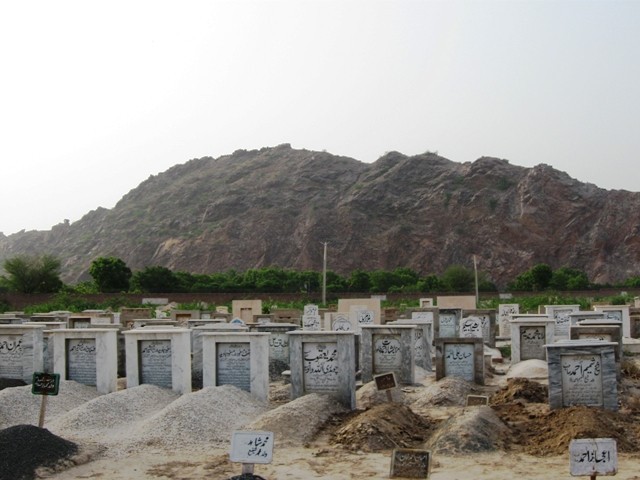
The tombstones in Rabwah's graveyards tell a macabre tale. PHOTO: SABA IMTIAZ/EXPRESS
RABWAH: The tombstones in Rabwah’s graveyards tell a macabre tale. The graves of the men killed in the attacks on Ahmadi places of worship in Lahore – retired army officers and young factory workers among them – rest with the dozens killed due to the persecution of the Ahmadiyya community.

The graveyards have been defiled in the past as locals have released animals in the graveyards or trod on the graves.

Other tombstones in a row show how entire families were systematically killed.

“If you knock at any door in Rabwah, you will find a story of persecution,” says Amir Mahmood, who works at the Jamaat Ahmadiyya’s press section.

One door leads to a prominent Ahmadi family from Mardan. Despite years of harassment, lawsuits, imprisonment and a kidnapping, the family’s men vowed to stay in Mardan. Four of them were gunned down. “After my father’s assassination I told my husband to be more careful. But he wasn’t scared,” says Rabia Mehmood, who was expecting her first child when her husband was killed.

Another door leads to Bushra Siddiqui’s family. She lives with her two widowed daughters, whose husbands were killed because of their faith.

Siddiqui’s daughter Asma Ahsan says her husband was praying at Darul Zikr in Lahore when it was besieged last May. She received a phone call from him, informing her that he was safe. Later, she learned that he had been killed. To add insult to injury, several neighbours did not offer condolences.

While the May 2010 carnage highlighted the systematic campaign of violence against Ahmadis, it did not end there. Three days later, a man entered Naimatullah’s house in Narowal district and stabbed him to death. His daughter Sidra recalls waking up to an “awful noise”. She rushed to the courtyard, where her dying father lay. The assassin was caught a few hours later, roaming around a seminary after Fajr prayers. He was reportedly ‘inspired’ to kill Naimutallah after being incited by local clerics.

“Nobody is safe in this country,” says Malik Munawwar Ahmad, the 78-year-old head of Darul Ziafat, which carries out the decades-old tradition in the community of housing and feeding travellers.

For Ahmadis, every day brings forth new incidents of harassment. In Vehari, clerics recently called for the Kalima to be erased from Ahmadi places of worship. The Jamaat’s representative in Vehari says the threat – from the Khatam-e-Nabuwwat movement and the Majlis-e-Ahrar – emanated from a land dispute over an Ahle Hadith mosque, which was unrelated to the Ahmadiyya community. He said the community would not give in to the clerics’ threats and would wait for the area administration’s decision.

“There was always opposition to us, but the 1974 and 1984 amendments created a storm,” says Ahmad. “But our silent protest is being recorded with God, and He will announce His decision.”

Published in The Express Tribune, July 12th, 2011.

Copyrighted © 2011 The Express Tribune News Network
URL: http://tribune.com.pk/story/207776/ahmadis...to-tell/

Thursday, November 4, 2010

Ahmadi rights: No grounds for a burial

Express Tribune, Pakistan
PAKISTAN
BLOGS
Ahmadi rights: No grounds for a burial
Aatekah Mir Khanby Aatekah Mir Khan
A senior sub-editor for the Lahore city pages of The Express Tribune
November 4 2010
The police were nice enough instead to act as an escort throughout the exhumation.
Politics is a dirty business, be it at any level. Add religion to it and it makes a messy mix.

On Sunday night, the body of an Ahmadi citizen was exhumed from a graveyard near Bhalwal, because the graveyard was a Muslim one.

The police harassed the family until they acquiesced to the demand.


There are only two Ahmadi families in that area, but they have lived there for decades. According to the brother of the deceased, their elders were also buried in the same graveyard. But this time around, the clerics in Sargodha decided that they did not want a graveyard of their faith ‘polluted’.

Religion is supposed to be something between you and God, even when you are alive. Thus, people who do not give the living that freedom are wrong, but to continue hounding a person based on their religion even when he is dead is detestable. But have we heard a single condemnation from any of the politicians or the religious leaders on the outrage? No. Why? Because commenting on anything that has to do with religion (if it is against what ‘they’ believe) is shunned like playing with fire. There is no way you can leave unscathed if you dare speak up.

As far as I know, the Quran doesn’t say anywhere that a Muslim is ordered – or even allowed – to disturb a dead man’s peace, even if he is not a Muslim-even if a non-Muslim is buried in a Muslim cemetery!

According to the police, they did so because they were afraid that unless they did what the clerics had asked (read: told) them to do, there would be a law and order situation. If you think it is strange that the police bend so easily to the whims of clerics, please don’t be. We live in a country where religion was infused into politics with such skill that even decades later, no one dares to spoil the fancy ‘finish’. If anything, everyone wants to add a cherry on top. The Hudood Ordinance and blasphemy laws are just two glaring examples of no-go-areas. If you need recent examples, then the unanimous condemnations of Nawaz Sharif – who ‘mistakenly’ called Ahmadis our brothers after the attack on their worship places in Lahore – and Nilofer Bakhtiar – for suggesting that there was nothing wrong with selling alcohol at TDCP motels – should help job your memory.

Just on Monday, there was a rally taken out by some religious parties at The Mall, which brought the city to a halt, Now usually, whenever there is a rally or a protest there, the police are willing to impose Section 144, but on Monday, they did not. The police were nice enough instead to act as an escort throughout. The reason? They did not want to be on the ‘wrong side’ of religious leaders. It’s fairly simple, really. Just like George W. Bush spelled it out: either you are with us or you are against us (and honey, you do not want to be against us). Why would they want to be? They can slap you with a fatwa and declare you worthy of being killed.

Keith Olbermann, an MSNBC anchor, wrote in August about the Ground Zero ‘mosque’ and appealed to Americans not to fall victim to “prejudice and religious intolerance and our greatest enemy: stupidity, exploited by rapacious politicians.” In the same column, he wrote how he interprets Pastor Martin Niemoller’s ‘Then they came’: “But Niemoller was not warning of the Holocaust. He was warning of the willingness of a seemingly rational society to condone the gradual stoking of enmity towards an ethnic or religious group, warning of the building-up of a collective pool of national fear and hate, warning of the moment in which the need to purge, outstrips even the parametres of the original scape-goating, when new victims are needed because a country has begun to run on a horrible fuel of hatred — magnified, amplified, multiplied, by politicians and zealots, within government and without…Niemoller was not warning of the holocaust. He was warning of the thousand steps before a holocaust became inevitable. If we are at just the first of those steps again — today, here — it is one step too close.”

URL: http://blogs.tribune.com.pk/story/2739/ahmadi-rights-no-grounds-for-a-burial/

Tuesday, November 2, 2010

Pakistan Ahmadi man forcibly exhumed in Lahore

South Asia
2 November 2010 Last updated at 16:18 GMT
Pakistan Ahmadi man forcibly exhumed in Lahore
By M Ilyas Khan
BBC News, Islamabad
Injured Ahmadi in Lahore attacks
Ahmadis are despised by many
Pakistanis
Police in Pakistan have forced a family of the Ahmadi sect to exhume the body of a relative because it was buried in a Muslim graveyard.

Officials in the Sargodha district of Punjab province say they took the unusual move after anti-Ahmadi Muslim groups threatened peace in the area.

Ahmadis consider themselves Muslims but a 1984 law barred them from identifying themselves as followers of the faith.

The law also put restrictions on their religious practices.

‘Law and order situation’

Shehzad Waraich, a farmer in the Bhalwal area of Sargodha district, died on 30 October and was buried in a shared graveyard designated by the government.

“The police approached the relatives of Mr Waraich on 31 October and asked them to remove the body from the Muslim graveyard as this could lead to a law and order situation,” Salimuddin, an Ahmadi community spokesman, told the BBC.

“The family complied with the request and exhumed the body. They have now buried it in a different graveyard reserved for the Ahmadis several miles away from the village.”

The police said the family was asked to exhume the body because the burial was “illegal”.

“They buried Mr Waraich in a Muslim graveyard, which is against the law,” Javed Islam, the Sargodha district police chief, told the BBC.

“Members of the Khatm-e-Nabuwat organisation and some local people approached the police and conveyed their objection to the burial. The objection was within the ambit of the law, so we acted accordingly,” he said.

Khatm-e-Nabuwat is an anti-Ahmadi religious organisation that acts as a watchdog on their activities.

Mr Islam said that he was not concerned about the moral aspect of the exhumation of Mr Waraich’s body - his job was to enforce the law.

Ahmadis in Pakistan are often mobbed and lynched by extremist elements who critics say are encouraged by favourable laws.

The Ahmadi spokesman, Salimuddin, said it was the 30th incident since 1984 in which an Ahmadi body has been forcefully exhumed by the administration to satisfy the opponents of the community.

“The administration always sides with our opponents, and has a convenient argument that they are trying to maintain peace,” he said.

No place for Ahmadi body in a Muslim graveyard

Express Tribune, Pakistan
Pakistan
Punjab
No place for Ahmadi body in a Muslim graveyard
November 2, 2010
Interred body of an Ahmedi exhumed from a Muslim graveyard after protests held against the burial.

BHALWAL: Interred body of an Ahmadi was exhumed here on Sunday from a Muslim graveyard after some local clerics led protest against the burial and the Sargodha tehsil police forced the dead man’s heirs to remove it from the graveyard.

Shehzad Waraich, who died on October 30, was a resident of Chak 24 North.

Shehzad’s brother told The Express Tribune that several members of the family including his grandparents and parents were buried in the same graveyard. He said there never had been any objection or disapproval.

He said that their families were the only two Ahmadi families in Bhalwal, a town with a population of only a few thousands. Chaks 19, 20, 21, 22, 23 and 24 have three government graveyards, shared by the residents of the area, he said.

He said that the people of his village, Chak 24 North, had not objected to his brother’s burial in the Chak 19 graveyard, so he had buried the body there. “Some of our elders are also buried there, we decided to bury him in the same graveyard,” he added. Waraich’s body was buried in the Chak 19 graveyard on the morning of October 30.

He said that on October 31, Sadar Division SHO Azhar Yaqoob and DSP Ghulam Murtaza came to their village along with other police officials and asked his family to remove the body of his brother from the Muslims graveyard of Chak 19.

“I told him that our elders were all buried in the graveyard. Neither the people of my village, nor of Chak 19 had raised any objection,” he said.

He said that the police told him that some local clerics in Sargodha had objected to the burial and in the interest of law and order, asked him to remove the body of his younger brother.

He said that the family, some relatives and the police then exhumed the body from the graveyard on Sunday.

“I don’t think that the police were forced to do this. The way I see it, the police forced us.”

Saleemul Din, an Ahmadi community spokesman condemned the police action. He said, “To this day, 30 Ahmadis’ bodies have been exhumed for similar reasons. The police do have no right to humiliate the dead from our community like this. Yet, they have been doing it since 1984.”

Sadar Division DSP Ghulam Murtaza said that some clerics had approached him and asked him to remove the body. He said that they had threatened him with protest movement against the police if the body of the Ahmadi man was not exhumed. In view of the sensitivity of the situation, he said, he did his best to resolve the matter peacefully by ordering the removal the body from the graveyard.

Published in The Express Tribune, November 2nd, 2010.

Saturday, May 8, 2010

Imperatives of interfaith tolerance

---Daily Star, Bangladesh
Friday, May 7, 2010
Point Counterpoint
Imperatives of interfaith tolerance
Syed Rezaul Karim

A few days ago, national dailies reported that an Ahmadiya woman was denied a burial place in the Nakhalpara graveyard in Dhaka because she belonged to the Ahmadiya community. The woman used to live in the Nakhalpara area and it was her Sunni Muslim neighbours who barred her burial in the locality. Her body had to be carried to a graveyard at Tejgaon, where she found an eternal resting place.

This social and religious intolerance and hostility is symptomatic of a society unaware of the true spirit of Islam. Tolerance, in essence, means to give consideration to others. In social life friction between people does occur in every society, and differences arising from religion, culture, tradition and personal tastes persist.

But the truly pious persons look upon people with love and compassion. There is a well- known Hadith narrated by Jabir Bin Abdullah. The Prophet Mohammad (peace be upon him) said: “He who is not merciful to others, will not be treated mercifully ( Bukhari).“

The elements that make peace in a society in the spirit of Islamic tradition are compassion, forgiveness and respect for all. There is a very significant and interesting story recorded by Al- Bukhari in this regard. The Prophet of Islam once saw a funeral passing by in a street in Medina. The Prophet was seated at that time. On seeing the funeral, the Prophet stood up in respect. At this one of the companions said: “O Prophet, it was the funeral of a Jew.” The Prophet replied: “Was he not a human being?“ What is meant here is that every human being is worthy of respect.

There may be differences of opinion among people regarding religion and culture but everyone has to respect the sanctity of the other. Allah has stressed the importance of following the Prophet (peace be upon him), revealing that His love of a person and His forgiveness of his /her sins depend on him/her following the Prophet.

The patent hostility towards the Ahmadiyas on the part of some Sunni Muslims stems from their (Ahmadiya’s) belief that Mirza Golam Ahmad (1835-1909) of Qadiyan was a divine reformer, a messiah and prophet within the fold of Islam. This belief is rejected as blasphemy by Sunnis and Shias alike.

They point out that the holy Koran is categorical in stating that “prophethood” has been sealed with the advent of Prophet Mohammad (peace be upon him), who is the last in the chain of prophets. However, the Ahmadiyas also believe in the oneness of God, in the Koran and Prophet Mohammad (peace be upon him).

The Koranic revelation to the Prophet with regard to religious divisions can be gleaned from the following passage of Sura Anam: “Those who have made divisions in their religion and became sects, thou art not of them in anything; their affair is unto God, then He will tell them what they have been doing. Whoso brings a good deed shall have ten the like of it; and whoso brings an evil deed shall only be recompensed the like of it; they shall not be wronged (verse 159/160).”

To deny a place of burial to a human being is an insult to humanity. The Prophet Mohammad (peace be upon him) said: “All God’s creatures are his family, and he is the most beloved of God who trieth to do most good to God’s creatures.”

The famous poet-philosopher Hazrat Sheikh Sadi composed a beautiful couplet on the humanity of man: “The children of Adam are limbs to each other, having been created from one essence.”

Sometimes, in blind religious zeal and emotion, some zealots call the Ahmadiyas Kafirs. But one should be reminded of what our Prophet said about such reckless sayings. Hazrat Abu Jaar (peace be upon him) said that he heard the Prophet saying: “No man shall call another man Fasik or Kafir, because if he or she is not really so, the allegation will fall on the person who said so.”

“Everyone is divinely furthered in accordance with his character,” said the Prophet.

From the above sayings of the Prophet and the Koranic admonitions, it should be understood that intolerance to human beings in the name of religion, caste or sect is not in the traditions of Islam. God has laid the earth open for every class or creed of people, whether they believe in Him or not.

We would like to see Bangladesh as a tolerant and humane society where different religious and ethnic groups can coexist with their distinctive faiths and cultures. Freedom to practice one’s own religion unfettered by the majority’s commanding faith is a civilised norm, and an essential ingredient for democratic dispensation. Let God’s mercy be on all living creatures.

We would like to conclude with seven pieces of advice from Maulana Jalaluddin Rumi, a Sufi saint and the greatest mystic poet of the world. He admonishes:

“In generosity and helping others, be like a river.
In compassion and grace be like the sun.
In concealing other’s faults, be like the night.
In anger and fury, be like the dead.
In modesty and humility, be like the earth.
In tolerance, be like the sea,
Either appear as you are or be as you look.”

Syed Rezaul Karim is an ex-MD of Hoechst Bangladesh.

URL: www.thedailystar.net/newDesign/news-details.php?nid=137296

Monday, April 26, 2010

Burial barred as she was Ahmadiyya

---The Daily Star, Bangladesh
Monday, April 26, 2010 | Front Page
Burial barred as she was Ahmadiyya
Staff Correspondent

The devotees of a mosque yesterday obstructed the burial of an elderly woman of Ahmadiyya community at a graveyard in the city’s Tejgaon Industrial area.

The body of Akimunnesa, 62, a resident of East Nakhalpara, was finally buried in a graveyard near Mohakhali bus terminal amid resistance from the devotees of Rahim Metal Jam-e-Mosque in the area.

Rafiq Ahmed, brother of the deceased, said they took the body to the graveyard of the mosque where their grand parents had been buried.

But the devotees and the people of the mosque committee barred them from burying the body saying Ahmadiyyas are not Muslim and the body of a non-Muslim could not be buried there, he added.

Devotees told reporters that the graveyard is used for the burial of the bodies of the Muslim community but not for non-Muslims.

Akimunnesa died as bricks from the rooftop of a six-storey building at East Nakhalpara fell on her head around 8:30pm on Saturday.

URL: www.thedailystar.net/newDesign/news-details.php?nid=135940
 
^ Top of Page