Showing posts with label ahmadiyyah. Show all posts

Friday, April 8, 2011

The banal rhetoric of imperialism, colonialism

OPINION
Fri, 04/08/2011
8:00 AM
The banal rhetoric of imperialism, colonialism
Al Makin, Yogyakarta
The current campaign waged by the US and its allies against Col. Muammar Qaddafi’s merciless dictatorship also entails a war of ideas.

Qaddafi and his followers have shielded themselves from democratic protesters with a predictable and boring rhetoric of anti-imperialism and anti-colonialism.

Libya will be occupied by the West, just as Iraq, Afghanistan and Vietnam were occupied! Colonial powers harbor nothing but jealousy of the Third World’s advancing wealth! Oil is at the root of every problem!

The rhetoric evokes the bitter experience of the Islamic world under a long period of Western colonialism. It is not surprising that the US and its allies have been branded as crusading armies bent on destroying their Muslim enemies.

Conspiracy theorists have already drawn analogies between colonialism and the recent Libya campaign. Some Indonesian politicians have promoted this rhetoric in public. Whether anyone wants to listen is a different issue.

Hidayat Nur Wahid, a senior politician of the Prosperous Justice Party (PKS), said that the goal of the current war in Libya was “to seize the nation’s oil”, adding that “European countries have suffered from an economic recession. They need new resources to revive their economy.”

It sounds like the rhetoric of Iranian president Ahmadinedjad, except in an Indonesian format. Compare Hidayat’s words with those of Ahmadinedjad on the Libyan crisis: “The Westerners have to cast aside their colonialist ambitions.”

The rhetoric of imperialism and colonialism can also be found in the case of Ahmadiyah, the minority Islamic sect that has suffered repeated harassment at the hands of Indonesian radicals.

According to the hard-liners, the European Union, the UN and US congressmen asked the Indonesian government to pay serious attention to the plight of Ahmadiyah. Many Indonesian officials, rather than heeding their warnings, fired back at perceived international pressure.

Home Minister Gamawan Fauzi, for instance, rejected demands to revoke laws that discriminate against the Islamic sect. Gamawan’s response to the US congressmen does not surprise us, as he warmly welcomed the FPI leaders’ proposal to disband the group. You can guess which faction the man sides with.

On March 23, I was invited to speak at the Religious Affairs Ministry’s dialogue and public hearing on Ahmadiyah that was held in Central Jakarta.

I made myself as clear as possible to other participants that the failure to protect any citizen of Indonesia means the beginning of the nation’s collapse. I reminded the audience about the domino effect. After Ahmadiyah, the Shiite, Christian minority, and liberals, Nahdlatul Ulama and Muhammadiyah — all groups that are not considered purely “Islamic” by Islamists — will be targeted by the radicals.

I realized that most of the participants disagreed with me. Before my turn to speak I listened to members of the Islam Defenders Front (FPI) — an organization whose fame lies in their radical stances and terrifying tactics — give their threatening opinions.

The Religious Affairs Ministry used to be a place where the idea of religious pluralism and other progressive concepts were incubated under the leadership of A. Mukti Ali, Alamsjah Ratuprawiranegara and Munawir Sadzali. Now the ministry has become a rendezvous for the FPI leaders.

I am afraid that Ahmadiyah will be disbanded by a more “authoritative” law, enacted after the government’s “consults” with different groups.

In fact, nobody is sure that the government listened the sound judgments conveyed by scholars and activists at the seminar. As usual, politicians placed political interests ahead of all other concerns.

Religious Affairs Minister Suryadharma Ali, who also chairs the United Development Party (PPP), revealed his true colors.

At a conference in Samarinda he urged fellow party members not to hesitate to make Islam as an ‘ideology’ (The Jakarta Post, March 27, 2011). He also denounced liberal thinking (The Jakarta Post, Feb. 23, 2011).

Indeed, at the ministry’s dialogue I heard a moderator provoke the audience when he said that the US and Western powers were meddling in the case of Ahmadiyah — a form of intervention that we must not bow down to.

This rhetoric reminds us the way Abu Bakar Ba’asyir often defends himself in the court. He has repeatedly said that he was arrested under orders from the US. The conspiracy theories then followed: the Indonesian government was a mere toy of the world superpower, the US.

I am afraid to draw some points of similarities among the opinions conveyed by Qaddafi, Ahmadinedjad, Hidayat Nur Wahid, the FPI leaders, Ba’asyir, two of the President’s current ministers and perhaps other state officials. I question to what extent radical thinking has penetrated the government.

Has this government and other political leaders already knelt down before the FPI’s leaders?

The writer is a lecturer at Sunan Kalijaga State Islamic University, Yogyakarta.

Copyright © 2008 The Jakarta Post - PT Bina Media Tenggara. All Rights Reserved
URL: www.thejakartapost.com/news/2011/04/08/the-banal...

Sunday, August 1, 2010

Politics Seen in Ahmadiyah Violence

Jakarta Globe, Indonesia
August 1, 2010
Farouk Arnaz & Antara

Politics Seen in Ahmadiyah Violence
.
Kuningan, West Java. The forcible closure of Ahmadiyah mosques, which led to rioting in Manis Lor village in Kuningan, West Java, was most likely fueled by the political desires of district head Aang Hamid Suganda, an official from the Commission for Missing Persons and Victims of Violence alleged on Sunday.

“We found a fact [regarding Aang’s political designs]. We need to confirm it, but we believe it to be true,” said Sinung Karto, a member of the commission also known as Kontras.

“After two years of peace, anarchy occurred last Thursday.

This was triggered by instructions issued by the district head to seal off Ahmadiyah mosques,” he said, adding that the commission had undertaken two days of intensive research and investigations at the scene of the violence.

Sinung said that Aang had promised to close the mosques during his campaign for the 2008 district head election, in which he won a second term.

Aang’s term ends in 2013, and even though he cannot run for a third term, he is believed to be preparing the way for his wife, Utje Ch, to succeed him.

Closing down the Ahmadiyah mosques, Sinung suggested, was an effort by Aang to achieve this by courting public support.

Indra Listiantara, from the Setara Institute for Peace and Democracy, said that having investigated the case, Setara had come to the preliminary conclusion that Aang had ordered the mosques closed for political reasons.

“We suspect that once his term as Kuningan district head ends, Aang will run in the West Java gubernatorial election,” Indra said.

“He wants to keep his support base intact, and gaining political support from Muslim hard-liners by openly opposing and taking action against Ahmadiyah is key to that.”

Both Indra and Sinung have called on the police to take action and investigate the mosque closures and subsequent violence.

“Even though the police were a little slow in preventing what transpired on Thursday, we have to give them credit for stopping the scuffles from degenerating into a full-blown riot,” Indra said. “They should, however, find the person responsible for the incident.”

Police officers, acting on orders from Aang, on Thursday sealed off Ahmadiyah mosques in Manis Lor after having failed to do so on Monday due to resistance from the group’s members.

But as the protesters blocked police attempts to shut down their mosques, groups of hard-line Muslims flocked to the village and scuffles broke out.

Amid pressure from Muslim groups, the government in 2008 prohibited members of Ahmadiyah from practicing their faith in public or proselytizing, but stopped short of banning the sect.

Many mainstream Muslims consider Ahmadiyah deviant because its members recognize the sect’s founder, Mirza Ghulam Ahmad, as a prophet.

Kuningan Police Chief Adj. Sr. Comr. Yoyoh Indayah confirmed that Aang issued an official letter last Thursday to seal off the mosques, “based on the demands of a certain Islamic group.”

“I do not want to speculate about what was behind the letter or those demands. I don’t know about political motivations,” Yoyoh told the Jakarta Globe.

“Nobody was arrested because I prefer to [keep the peace]. Those who sealed off the mosques, by the way, were not locals. They were from Tasikmalaya, Sumedang and Ciamis.”

Meanwhile, the Indonesian Legal Aid Foundation (YLBHI) said that if the government did not take action against the hard-liners, it was in effect endorsing further violence.

“We believe that violence against minority religious groups will continue if the government does not do anything,” Erna Ratnaningsih, from the YLBHI, said on Saturday.

Ifdal Kasim, from the National Commission on Human Rights (Komnas HAM), said he regretted a recent statement by Religious Affairs Minister Suryadharma Ali, in which he declared Ahmadiyah haram, or forbidden.

“The government must admit to the existence of Ahmadiyah in Indonesia. It is the government’s job to allow the Ahmadis to hold their prayer services,” Ifdal said, a day after Suryadharma declared Ahmadiyah was haram because it was a misguided sect that did not consider Muhammad to be the last prophet.

Suryadharma urged police to take action against Ahmadis found spreading their teachings, even as he warned residents in Kuningan not to take the law into their own hands.

Hasyim Muzadi, who formerly led Nahdlatul Ulama, the largest Muslim organization in Indonesia, also said that even if Ahmadis veered away from mainstream Islamic teachings, Indonesians must not take the law into their own hands.

“Violence will cause those ideologies to turn even more militant, because they are pressured through physical means,” Hasyim said.

Copyright 2010 The Jakarta Globe

Saturday, July 31, 2010

Indonesian President: Hit Back at West Java ‘Anarchy’

Jakarta Globe, Indonesia

July 31, 2010
Camelia Pasandaran
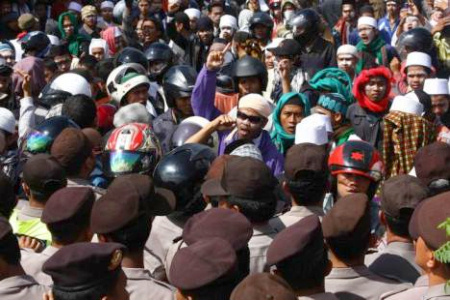
Police form a line between Ahmadiyah protestors who want their mosque reopened and mainstream Muslims who want to make sure it stays closed. (AFP Photo/Yonda)
.
Indonesian President: Hit Back at West Java ‘Anarchy’
.
Jakarta. Amid rising tensions in Kuningan, West Java, following the closure of Ahmadiyah mosques there by security officials, President Susilo Bambang Yudhoyono on Friday called for firm police action.

Djoko Suyanto, coordinating minister for political, legal and security affairs, said the president had instructed him to order the police to take resolute action against the unrest.

“In my opinion, anarchy — no matter by whom or where — should be handled firmly,” the minister quoted Yudhoyono as saying.

The Kuningan Police have already been told of their duties, Djoko said, adding that he had confidence they would be able to contain the situation.

Police officers, acting on orders from the Kuningan district head, on Thursday sealed off Ahmadiyah mosques in Manis Lor village after having failed to do so on Monday due to resistance from the group’s members.

But as the protesters blocked police attempts to shut down their mosques, groups of hard-line Muslims flocked to the village and scuffles have broken out. Police have since been busy preventing an escalation in violence.

Amid pressure from Muslim groups, the government in 2008 prohibited members of Ahmadiyah from practicing their faith in public or proselytizing, but stopped short of banning the sect that many mainstream Muslims consider deviant.

Unlike other Muslims, members of Ahmadiyah recognize the sect’s founder, Mirza Ghulam Ahmad, as a prophet.

While ordering the police to be firm, Djoko recognized they also faced difficulties in containing the situation. “If there are only five officers up against 500 people, they cannot be firm,” he said. “So they have to adjust to the conditions in the field.”

Kuningan’s district head, Aang Hamid Suganda, who had ordered the mosques sealed, called on all parties to avoid violence.

“We must make all Kuningan people feel secure,” Aang said. “Violence is not the best way to solve problems, so let us discuss it and go through legal channels.

Dedeh, a resident of Manis Lor, said it had been four days since villagers had boarded up their windows to protect them from stones being thrown by protesters.

According to Dedeh, Thursday’s clashes were relatively minor compared to the violence that occurred last year and in 2007.

The Jakarta Legal Aid Foundation (LBH) on Friday urged the government to punish people who resorted to violence or infringed on freedom of worship.

“It is not only about the right to have a religion or faith, but also about the right to feel secure, to be protected, to be free from discrimination, and the right to be protected as a minority,” said Nurkholis Hidayat, LBH’s director.

He said both the central government and regional administrations should be responsible for protecting and promoting human rights, as well as all religions and faiths, including Ahmadiyah.

The Setara Institute for Peace and Democracy also said on Friday that the state should safeguard freedom of religion.

“The president should be embarrassed if there are citizens who are unable to worship because of pressure from unruly masses.”


Additional reporting by Antara

Copyright 2010 The Jakarta Globe

Friday, July 30, 2010

Minority Islamic sect under fire in Indonesia

Yahoo News


Minority Islamic sect under fire
in Indonesia
.
Achmad Ibrahim, Associated Press Writer — Fri Jul 30, 11:03 am ET
.
MANISLOR, Indonesia – A minority Islamic sect told followers Friday to prepare for war after rock-throwing mobs attacked one of their mosques in central Indonesia, calling its members heretics.

The weeklong violence in Manislor, a village in West Java province, peaked Thursday after more than 500 hard-liners from the Islamic Defenders Front, known as FPI, clashed with 3,000 Ahmadiyah sect followers.

At least eight people were injured, including three police.

“We have to defend ourselves and our mosques,” said Deden Sujana, who heads security for the sect, saying hard-liners have “gone too far.”

“We call on Ahmadiyah followers to fight against them in the name of Allah,” Sujana said.

Indonesia, a secular state of 235 million, has more Muslims than any other in the world.

Most people practice a moderate form of the faith, but a small but vocal extremist fringe has gained influence in recent years because the government relies heavily on Muslim parties in parliament.

Ahmadiyah, which has roughly 200,000 members, is considered deviant by conservatives because it does not recognize Muhammad as the final prophet. Perpetrators of violence against the sect often go unpunished.

Tensions started building around Manislor after local authorities sealed Ahmadiyah’s An-Nur mosque, saying they had violated a 2008 government decree that stops short of banning the group but orders members to stop practicing.

That gave FPI, hard-liners known for attacking nightclubs and bars, the unspoken go-head to target the sect.

Mobs threw rocks over the wall. Police, who are bracing for more violence over the weekend, responded by firing tear gas.


It is surprising to note that reporter mis-quoted Jamaat Ahmadiyya’s view and misunderstood it a “call for war”. Ahmadiyya Muslims in Manis Lor are trying to save their Eight Mosques from destruction by unruly mobs coming from other cities.

Ahmadiyah Clashes Continue in Indonesia

Jakarta Globe, Indonesia

July 30, 2010
Nurfika Osman, Ronna Nirmala & Camelia Pasandaran

A group of people believed to be Ahmadiyah followers fight back as Indonesian mainstream Muslims try to attack their mosque in Manislor village, Kuningan district, on Thursday. (AFP Photo/Yonda)

Ahmadiyah Clashes Continue in Indonesia

As the standoff between West Java villagers and followers of the Ahmadiyah sect entered its fourth day, the Ministry of Religious Affairs said it was trying to mediate the week-long dispute, which flared into violence again on Thursday.

Religious Affairs Minister Suryadharma Ali said the tension was essentially a “political problem.” He did not elaborate further but urged the warring parties to settle their dispute peacefully.

“Differences of opinion over religion should not be solved with violence but through discussion,” he said.

The Ahmadiyah is perceived as a deviant sect by mainstream Islam. The government has stopped the group from worshiping in public but has fallen short of banning it altogether.

After a failed attempt to seal the sect’s mosques in a village in Kuningan on Monday, police and the Public Order Agency (Satpol PP) followed through with the closures on Wednesday, meeting fierce resistance.

“Government officials have an obligation to protect citizens without looking at their beliefs,” Ifdhal Kasim, the chairman of the National Commission on Human Rights (Komnas HAM) told the Jakarta Globe on Thursday. “Sealing their house of worship is against the Constitution.”

Ahmadiyah followers and security forces clashed again on Thursday as groups opposed to the sect joined local police and Mobile Brigade (Brimob) units trying to close several mosques.

Groups claiming to support a pure form of Islam against the Ahmadiyah gathered around the entrance to Manis Lor village in Kuningan in the morning, following the sealing of eight Ahmadiyah mosques in the village, a local police officer said.

“At first, the anti-Ahmadiyah groups pelted the mosque with stones. The followers of Ahmadiyah were angry because their mosque was attacked, and there was fighting,” the officer said of Thursday’s violence, which reportedly stopped just after midday prayers. Ifdhal said Ahmadiyah followers were the real victims in the violence.

“They face many forms of discrimination. Their access to education and livelihood is limited and at the same time they are facing a government that facilitates the discrimination,” he said.

Bonar Tigor Naipospos, deputy chairman of the Setara Institute for Peace and Democracy, said the state should guarantee religious freedom to all, including the Ahmadiyah.

The group is often a target of orthodox Muslims worldwide because of its claim that the sect’s founder, Mirza Ghulam Ahmad, is the last prophet, a view many consider blasphemy.

The government passed a decree in 2008 prohibiting the sect from practicing its faith in public or trying to convert others to its beliefs. [**]

According to Setara, which monitors religious tolerance, the past month has seen a sharp increase in acts of violence against the Ahmadiyah, especially in West Java.

“The use of public pressure and regional government power has been a systematic pattern in violations of religious freedom recently,” Bonar said.

The Kuningan district government has used pressure groups to back its effort to close the Ahmadiyah mosques in Manis Lor, but Bonar doubts they are local villagers. “According to our sources, these people did not come from Kuningan, but from other areas such as Ciamis and Tasikmalaya,” he said.

Bonar urged President Susilo Bambang Yudhoyono to show his commitment to pluralism by speaking out against the violence.


The statement is erroneous. Hadhrat Mirza Ghulam Ahmad of Qadian did not make any such claim of being last prophet. Please visit Alislam.org/messiah for further info.

Copyright 2010 The Jakarta Globe

Rights Commission Urges Authorities to be Strict on Sectarian Attack

TEMPO Interkatif, Indonesia
Rights Commission Urges Authorities to be Strict on Sectarian Attack
Friday, 30 July, 2010 | 13:13 WIB

TEMPO Interactive, Jakarta — The National Human Rights Commission has responded to a renewed attack on the banned Islamic sect the Ahmadiyah yesterday (29/7) in West Java which involved thousands from different islamic organisations in Kuningan Regency.

Stanley Adi Prasetyo a commissioner with the national body said today (30/7) “even law enforcement apparatus could not curb certain belief of faith let alone those who are not part of the authority.”

Thousands of people from different islamic group which are against the Ahmadiyah sect attacked a group of people after a religious gathering by the Ahmadiyah group in Manis Lor Village on Thursday (29/7). Attacks on the group have been reported since 2007.

Stanley said authorities should take strict measure against those who take the law into their own hands radically which he said will affect those outside the conflict.

ARIE FIRDAUS


The statement is erroneous. Hadhrat Mirza Ghulam Ahmad of Qadian did not make any such claim of being last prophet. Please visit Alislam.org/messiah for further info.

Copyright © 2010 TEMPOinteraktif
URL: www.tempointeractive.com/hg/nasional/2010/07/30/brk,20100730-267511,uk.html

Thursday, July 29, 2010

Indonesia mob attacks Muslim sect

AlJazeera News
UPDATED ON:
Thursday, July 29, 2010
21:18 Mecca time, 18:18 GMT
.
NEWS   Asia-Pacific

Indonesia mob attacks Muslim sect

The mob stoned the mosque of Ahmadiya sect, whose beliefs contradicts mainstream Islam [AFP]
Indonesian police have clashed with about 200 people trying to attack a mosque used by a minority Islamic sect known as Ahmadiya.

The mob hurled stones at the mosque in Manislor village in Kuningan district in West Java, prompting an hour-long confrontation with police, a local Ahmadiya official said.

“About 200 people pelted stones at our mosque and clashed with the police for about an hour. It is not clear yet who was the organiser of the mob,” Nurahim, the local general secretary of the sect, told the AFP news agency.

“The police were able to secure the mosque and handle the people. The situation, however, is still tense now.”

Nurahim said the village’s 3,000 Ahmadiyah followers were ready to help the police if needed but would not respond to the violence.

“We had a similar experience before in 2007, in which our mosque and houses were attacked. A house was burned and several were damaged at the time,” he said.

The Ahmadiyah sect, which claims 500,000 followers in Indonesia, believes that its founder Mirza Ghulam Ahmad was the final prophet and not Mohammad, contradicting a central tenet of mainstream Islam.

Ahmad claimed to be a reincarnation of Prophet Mohammad, a claim rejected by Muslim authorities and scholars.

He also claimed to to be the Christian messiah. His sect believes that Jesus did not die on the cross, but he moved to India where he died at the age of 120.

Indonesia’s top Islamic body issued a fatwa in 2008 describing the sect as “deviant”.

Ahmadiyah has had a presence in the country since the 1920s.

Aljazeera.net/english 2003 - 2010 ©

Hundreds attack mosque

The Straits Times, Singapore
Breaking News
July 29, 2010 Thursday
Updated 11.17 pm
SE Asia
Home » Breaking News » SE Asia » Story
Jul 29, 2010
Hundreds attack mosque
JAKARTA - INDONESIAN police clashed with about 200 people on Thursday as the mob tried to attack a mosque in West Java belonging to a minority Islamic sect.

The crowd hurled stones at an Ahmadiyah mosque in Manislor village in Kuningan district, leading to an hour-long conflict with police, said local general secretary of the Ahmadiyah sect, Nurahim.

‘About 200 people pelted stones at our mosque and clashed with the police for about an hour. It’s not clear yet who was the organiser of the mob,’ Mr Nurahim, who goes by one name, told AFP.

‘The police were able to secure the mosque and handle the people. The situation, however, is still tense now,’ he said.

Mr Nurahim said the village’s 3,000 Ahmadiyah followers were ready to help the police if needed and were not carrying out counter-attacks.

‘We had a similar experience before in 2007, in which our mosque and houses were attacked. A house was burned and several were damaged at the time,’ Mr Nurahim said. – AFP

Situation in Manis Lor Remains Tense as Ahmadi Hold Firm

Jakarta Globe, Indonesia
July 29, 2010
Situation in Manis Lor Remains Tense as Ahmadi Hold Firm

The stand-off between locals and followers of the Ahmadiyah sect in Manis Lor village, Kuningan, West Java, is continuing.

On Thursday, 300 Islamic activists from Kuningan, Ciamis and Indramayu districts gathered at the village to protest against the continued existence of the Ahmadiyah community.

Ahmadiyah is seen as a deviant sect by mainstream Muslims. The government has banned the group from holding its rituals in public but has stopped short of banning it altogether.

Metro TV reported that Kuningan district head Aang Suganda arrived at the village to meet with both sides of the dispute.

He urged the parties to discuss their differences peacefully and avoid resorting to violence.

Meanwhile, in front of the An-Nur Mosque, 200 Ahmadiyah followers remained on guard, along with Kuningan Police and local Public Order Agency (Satpol PP) officers.

Many villagers were forced to erect signs in front of their homes. The signs read: “The residents in this house are not Ahmadiyah and please do not damage our house.”

Two previous attempts by local authorities and police to close the mosque have failed after they were met with fierce resistance.

The Setara Institute for Peace and Democracy recorded 33 cases of attacks against Ahmadiyah members last year and well as many other cases of religious discrimination against Christians.

Copyright 2010 The Jakarta Globe

In Indonesia, Muslims, Ahmadis in standoff

CNN, USA
In Indonesia, Muslims, Ahmadis in standoff
From Kathy Quiano-Castro, CNN
July 29, 2010 -- Updated 1355 GMT (2155 HKT)
.
Jakarta, Indonesia (CNN) – Sectarian tensions rippled through an Indonesian town Thursday, where groups squared off over the closing of a minority group’s mosques.

Groups of Muslims and Ahmadis threw rocks at each other in the West Javan village of Kuningan, with police standing guard between the two groups.

Indonesian TV showed scenes from the village and quoted police and others about the tensions.

The violence flared after the local government ordered the sealing and closing down of several Ahmadi mosques.

Ahmadis, a religious group loathed by many in the Muslim world, are considered heretical and have been persecuted.

Sunni and Shiites do not consider the Ahmadis part of Islam because they do not regard Mohammed as the last prophet sent by God. [**] As such, they have been targeted by Islamic extremists.

The Indonesians haven’t banned the group but have issued a decree banning the religion from holding public gatherings and spreading their beliefs. An Islamic council there also issued a fatwa against the group.

After the mosques were ordered closed, Ahmadis resisted, hurling rocks at police deployed there. Islamic activists came to the scene and demanded the closings.

Anti-Ahmadi protesters tried to break through the police barricade to get to the mosques. Residents fearing more attacks have put up signs in front of their homes, saying they’re not members of the Ahmadiya group.

Police officer Yoyo Indayah, from the Kuningan police, says officers were trying to persuade the activists to leave the site after evening prayers.

Slamet Effendy, head of the commission on inter-religious harmony in the Indonesian Islamic Clerics Council, said in a TV interview that he hopes for a peaceful resolution to the conflict.

“Our security officers are still guarding the sealed mosques,” a police commander, S. Priyono, said on TV.


The statement is erroneous. Hadhrat Mirza Ghulam Ahmad of Qadian did not make any such claim of being last prophet. Please visit Alislam.org/messiah for further info.

© 2010 Cable News Network. Turner Broadcasting System, Inc. All Rights Reserved.
URL: http://edition.cnn.com/2010/WORLD/asiapcf/07/29/ind...#fbid=c78-j6zQYaU

Hundreds attack Ahmadiyah mosque in Indonesia

Saigon Post, Vietnam
INTERNATIONAL
Thursday ,Jul 29,2010, Posted at: 15:08(GMT+7)
Hundreds attack Ahmadiyah mosque in Indonesia
.
JAKARTA, July 29, 2010 (AFP) — Indonesian police clashed with about 200 people Thursday as the mob tried to attack a mosque in West Java belonging to a minority Islamic sect.

The crowd hurled stones at an Ahmadiyah mosque in Manislor village in Kuningan district, leading to an hour-long conflict with police, said local general secretary of the Ahmadiyah sect, Nurahim.

“About 200 people pelted stones at our mosque and clashed with the police for about an hour. It’s not clear yet who was the organiser of the mob,” Nurahim, who goes by one name, told AFP.

“The police were able to secure the mosque and handle the people. The situation, however, is still tense now,” he said.

Nurahim said the village’s 3,000 Ahmadiyah followers were ready to help the police if needed and were not carrying out counter-attacks.

“We had a similar experience before in 2007, in which our mosque and houses were attacked. A house was burned and several were damaged at the time,” Nurahim said.

The Ahmadiyah sect, which claims 500,000 followers in Indonesia, believes that its founder Mirza Ghulam Ahmad was the final prophet and not Mohammed, [**] contradicting a central tenet of mainstream Islam.

Indonesia’s top Islamic body issued a fatwa in 2008 describing the sect as “deviant”.

Ahmadiyah, which many conservative Islamic leaders in the Muslim-majority nation describe as their enemy, has had a presence in the country since the 1920s.

The statement is erroneous. Hadhrat Mirza Ghulam Ahmad of Qadian did not make any such claim of being last prophet. Please visit Alislam.org/messiah for further info.


The statement is erroneous. Hadhrat Mirza Ghulam Ahmad of Qadian did not make any such claim of being last prophet. Please visit Alislam.org/messiah for further info.

© Copyright 2005 SGGP English edition

Wednesday, July 28, 2010

Tense Standoff in W. Java as Police Close Ahmadiyah Mosques

Jakarta Globe, Indonesia
July 29, 2010
Tense Standoff in W. Java as Police Close Ahmadiyah Mosques

Jakarta. After having failed on Monday to seal off mosques belonging to the Ahmadiyah sect in a village in Kuningan, West Java, police and public order officers followed through with the closures on Wednesday but met with strong resistance from sect members.

An attempt to shut down the mosques on Monday failed after hundreds of men from the local Ahmadiyah sect blocked police from carrying out the operation.

“This morning, we returned to seal the mosques and we were assisted by other security forces such as the Mobile Brigade [Brimob], and the Public Order Agency [Satpol PP],” Comr. S Priyono, from the Kuningan Police, said on Wednesday, adding that about 250 personnel had been deployed.

According to Priyono, who heads the police’s operations division, the district chief, Aang Hamid Suganda, had ordered that the eight Ahmadiyah mosques located in Manis Lor village be shut down.

Ahmadiyah is seen as a deviant sect by mainstream Muslims. The government has banned the group from holding its rituals in public but has stopped short of banning it altogether.

Its followers believe its founder, Mirza Ghulam Ahmad, was a prophet of Islam, a claim that contradicts orthodox Muslim beliefs.

The police succeeded in sealing the mosques early on Wednesday morning, but Ahmadiyah followers soon closed ranks and some began throwing sticks and rocks at the security forces.

A scuffle ensued and tear gas was used to disperse the crowd.

“Our security officers are still guarding the sealed mosques,” Priyono said, adding that tensions remained high between the security officers and Ahmadiyah members.

The Setara Institute for Peace and Democracy recorded 33 cases of attacks against Ahmadiyah members last year.

Copyright 2010 The Jakarta Globe

Tense Standoff in West Java After Police Attempt to Close Ahmadiyah Mosque

Jakarta Globe, Indonesia
July 28, 2010
Jakarta Globe
In this file photo, protesters from Islamic Defenders Front (FPI) shout slogans during a rally to ban Ahmadiyah in front of Presidential Palace in Jakarta. (JG Photo/Jurnasyanto Sukarno)

Tense Standoff in West Java After Police Attempt to Close Ahmadiyah Mosque

Kuningan, West Java. Violent scenes erupted in Kuningan, West Java, early on Wednesday morning when police and local government security officers attempted to seal a mosque belonging to a branch of Islam considered deviant by mainstream Indonesian Muslims.

As police and Public Order Agency (Satpol PP) officers moved in on the Ahmadiyah mosque in Manislor village, enraged followers began pelting them with rocks and sticks.

Ahmadiyah is a controversial sect that believes its founder, Mirza Ghulam Ahmad, was the last prophet of Islam [**], a claim that contradicts mainstream Muslim beliefs.

Outnumbered, policemen and Satpol PP finally withdrew but the group chased them to the village boundary.

According to Metro TV, the order to seal the mosque came from Aang Hamid Suganda, head of Kuningan district.

As of 10 a.m. this morning, the sect followers were still guarding and blocking the street leading to the mosque.

It was the local government’s second attempt to seal the mosque in the past three days. On Monday, the officers were forced to abort the plan because hundreds of people blocked the street.

On Monday, the Setara Institute for Peace and Democracy released a report saying that the government’s one-way system of monitoring religious harmony was ineffective.

“It seems that people and the government do not realize that the right to worship, as stipulated in the Constitution, comes with the right to have a house of worship,” Setara’s Bonar Tigor Naipospos said.

The statement is erroneous. Hadhrat Mirza Ghulam Ahmad of Qadian did not make any such claim of being last prophet. Please visit Alislam.org/messiah for further info.

Copyright 2010 The Jakarta Globe

Monday, July 26, 2010

The Sealing of Eight Ahmadiyya Mosques in Manis Lor Village is Postponed

TEMPO Interkatif, Indonesia
Translated from Indonesian
by Lisa Latief
The Sealing of Eight Ahmadiyya Mosques in Manis Lor Village is Postponed
Monday, 26 July 2010 | 14:27 WIB
Jamaat Ahmadiyya of Kuningan, West Java, smeared their faces with toothpaste while obstructing the closing of their house of worship. TEMPO/ Widodo Djatmiko
TEMPO Interaktif, Kuningan — The sealing of the mosque belonging to Jamaat Ahmadiyya in Manis Lor Village, Jalaksana Subdistrict, Kuningan Regency, West Java, is finally postponed after holding dialogue. However, some members of Jamaat Ahmadiyya are still worried if their house of worship will be closed.

Today the government of Kuningan Regency planned to close and seal eight mosques belonging to Jamaat Ahmadiyya in Manis Lor Village. The closure is based on the warrant from Kuningan regent number 45/.2/2065/Satpol PP containing the order to close and seal eight mosques belonging to Jamaat Ahmadiyya in Manis Lor Village. This is based on the recommendation of Indonesian Ulema Council number 38/MUI-Kab/VI/2010 dated on June 24th 2010.

Based on that warrant, the Head of Civil Service Police Unit, Indra Purwantoro, along with other members came to Manis Lor Village to close up the mosque.

However, before they could reach the mosque, hundreds of Jamaat Ahmadiyya men blocked the way to the village. They also smeared their face with toothpaste in order to save themselves from effects of tear gas and held each other’s hands to block the way to the village.

They collected the blocks of beams and tires and placed behind the lines of human; while the women were reading Koran and praying in An Nur Mosque, the biggest mosque belonging to Jamaat Ahmadiyah in Manis Lor village.

One member of Jamaat Ahmadiyya managed to grab the warrant of Kuningan regent, Aang Hamid Suganda. He took it and wanted to tear it but the head of Civil Service Police Unit, Indra Purwantoro quickly chased and saved the warrant.

The Head of Ahmadiyya Center Security Commission, Deden Sujana said that they can not accept the sealing of the mosque which is the House of God before the dialogue started. “Mosque is the house of worship, why should it be sealed?“ he said.

Therefore, his side demanded for dialogue first, to know the reason of sealing of their mosque. Deden also claimed that whenever they had insistence from other groups, they always are blamed. “Why is it us to always be insisted?“ he asked.

Deden denied that it was Jamaat Ahmadiyya that opened the seal attached by Kuningan regency government in December 2007. “It was Litbang Depag, not us.” He said.

However, Indra Purwantoro denied that there was no dialogue before. “The dialogue has been held many times,” he said. But the result of the dialogue was that the order to seal the Ahmadiyya mosque was released by Kuningan regent.

Beside, Indra also said that in Ahmadiyya Articles of Association and bylaw, there is an article stating recruitment to convert to Ahmadiyya. “It has violated Indonesian Joint Ministerial Decree, because it is prohibited to recruitment from another religion,” he said.

Indra denied that the sealing happens because of the insistence from other Islamic groups. “I think it is not an insistence. It is an aspiration,” he said. Kuningan government, Indra thinks, should accommodate every aspiration. About the opening of seal by Litbang Department of Religious Affair, Indra admitted that he has not received any warrant yet from the department.

After holding tough dialogue for more than an hour, it was finally agreed that the dialogue will be conducted first and the sealing of the mosque is cancelled.

IVANSYAH

Original Indonesian Version

TEMPO Interaktif, Kuningan — Penyegelan masjid milik Jemaah Ahmadiyah di Desa Manis Lor, Kecamatan Jalaksana, Kabupaten Kuningan, Jawa Barat, akhirnya ditunda setelah dilakukan dialog. Namun sejumlah anggota jemaah Ahmadiyah masih was-was jika rumah ibadahnya akan ditutup.

Hari ini Pemerintah Kabupaten Kuningan berencana menutup dan menyegel delapan masjid milik jemaah Ahmadiyah di Desa Manis Lor. Penutupan tersebut didasarkan pada surat perintah Bupati Kuningan Nomor 45/.2/2065/Satpol PP yang berisi perintah menutup dan menyegel delapan masjid milik jemaah Ahmadiyah di Desa Manis Lor. Penutupan tersebut didasarkan pada rekomendasi Majelis Ulama Indonesia Nomor 38/MUI-Kab/VI/2010 tertanggal 24 Juni 2010.

Atas dasar surat perintah itulah Kepala Satuan Polisi Pamong Praja Kuningan, Indra Purwantoro, mendatangi Desa Manis Lor bersama dengan anggota lainnya untuk menutup masjid.

Namun sebelum sampai di masjid, ratusan kaum lelaki jemaah Ahmadiyah menutup jalan masuk ke desa. Mereka juga mencoreng muka dengan menggunakan odol, untuk menghindari jika dilempar gas air mata, serta bergandengan tangan untuk menutup jalan masuk ke desa tersebut.

Mereka pun mengumpulkan bongkahan balok dan ban yang diletakkan di belakang barisan manusia. Sedangkan para wanita terlihat mengaji dan berdoa di Masjid An Nur, masjid terbesar milik jemaah Ahmadiyah di Desa Manis Lor.

Sempat terjadi saling kejar saat seorang jemaah Ahmadiyah mengambil dan hendak merobek paksa surat perintah Bupati Kuningan, Aang Hamid Suganda. Namun Kepala Satuan Polisi Pamong Praja Indra Purwantoro segera mengejar dan mengamankan surat perintah tersebut.

Ketua Komisi Keamanan Ahmadiyah Pusat Deden Sujana mengungkapkan mereka tidak terima jika masjid yang merupakan rumah Tuhan disegel sebelum dilakukan dialog terlebih dahulu dengan mereka. “Masjid itu tempat ibadah, kenapa harus disegel,” katanya.

Karena itu, pihaknya pun menuntut dilakukan dialog terlebih dahulu untuk mengetahui alasan dilakukan penyegelan terhadap mesjid milik mereka. Deden pun mengklaim jika setiap ada desakan dari kelompok lain, merekalah yang selalu disalahkan. “Kenapa kami yang selalu didesak?“ tanyanya.

Deden pun membantah jika Jemaah Ahmadiyah Manis Lor yang membuka segel yang sudah ditempel Pemerintah Kabupaten Kuningan pada Desember 2007. “Yang membukanya Litbang Depag, bukan kami,” katanya.

Sedangkan Indra Purwantoro membantah jika belum dilakukan dialog. “Dialog itu sudah berkali-kali dilakukan,” katanya. Namun hasilnya tetap surat perintah untuk penyegelan masjid Ahmadiyah tetap dikeluarkan oleh Bupati Kuningan.

Selain itu Indra pun mengungkapkan jika dalam anggaran dasar dan rumah tangga Ahmadiyah terdapat klausul yang menyatakan perekrutan untuk masuk ke Ahmadiyah. “Ini sudah melanggar SKB 3 menteri. Karena tidak boleh ada perekrutan terhadap agama lain,” katanya.

Indra pun membantah jika penyegelan dikarenakan adanya desakan dari kelompok Islam lainnya. “Saya kira itu bukan desakan. Tapi aspirasi,” katanya. Setiap aspirasi menurut Indra harus ditampung oleh Pemkab Kuningan. Mengenai segel yang dibuka oleh Litbang Departemen Agama, Indra mengaku selama ini belum pernah menerima surat dari Litbang Departemen Agama tersebut.

Setelah dialog yang alot, hingga memakan lebih dari 1 jam, akhirnya disepakati jika dialog akan dilakukan terlebih dahulu dan penyegelan mesjid dibatalkan.

Ivansyah

Copyright © 2010 TEMPOinteraktif

Blocking the Road to Village, Jamaat Ahmadiyya of Kuningan refuses to get their Mosque sealed

TEMPO Interkatif, Indonesia
Translated from Indonesian
by Lisa Latief
Blocking the Road to Village, Jamaat Ahmadiyya of Kuningan refuses to get their Mosque sealed
Monday, 26 July 2010 | 10:00 WIB
Some of Jamaat Ahmadiyya members held Id Prayer 1429 H in Al-Kautsar Mosque, Pontianak, West Kalimantan, on Wednesday (1/10). Until now, Jamaat Ahmadiyya Indonesia in West Kalimantan has 500 members and they hold Id prayer and daily activity as usual. FOTO ANTARA
TEMPO Interaktif, Kuningan — Hundreds of members belonging to Jamaat Ahmadiyya in Manis Lor village, Jalaksana Sub district, Kuningan regency are preparing to prevent the sealing of their Mosque by Kuningan Government, on Monday (26/7) today.

Based on what is observed, hundreds members of Jamaat Ahmadiyya, most of them men, seem to be blocking the roads leading to their village. The blockage is specially managed on the main road to their mosque.

Nur Rahim, General Secretary of Ahmadiyya Manis Lor, Kuningan explained that they just defend the house of God. “We defend the House of Allah,” he said.

They, Nur Rahim continued, will defend the house of Allah to the death. Kuningan government will seal it today. “We hope there will be no conflict, but we will definitely defend our house of worship till the end,” he said.

Meanwhile, according to what is seen, hundreds of policemen are still protecting the entry road to Manis Lor village. However, until now, the officials of Kuningan government who will manage the sealing have not been seen yet.

Ivansyah

Original Indonesian Version

TEMPO Interaktif, Kuningan — Ratusan jamaah Ahmadiyah di Desa Manis Lor, Kecamatan Jalaksana, Kabupaten Kuningan bersiap-siap menghadang penyegelan yang akan mesjid yang akan dilakukan Pemerintah Kabupaten (Pemkab) Kuningan, Senin (26/7) hari ini.

Berdasarkan pantauan, ratusan jamaah Ahmadiyah yang rata-rata terdiri dari kaum lelaki terlihat memblokir jalan masuk ke desa mereka. Pemblokiran dilakukan terutama sebelum jalan masuk ke mesjid mereka.

Nur Rahim, Sekretaris Umum (Sekum) Ahmadiyah Manis Lor, Kuningan,menjelaskan mereka hanya mempertahankan rumah Allah. “Kami hanya mempertahankan rumah Allah,” katanya.

Mereka, lanjut Nur Rahim, akan mempetahankan habis-habisan rumah Allah yang rencananya akan disegel oleh Pemkab Kuningan hari ini. “Kami tidak berharap terjadi kerusuhan, tapi yang pasti kami akan mempertahankan habis-habisan rumah ibadah kami,” katanya.

Sementara itu berdasarkan pantauan ratusan polisi pun masih berjaga-jaga di jalan masuk Desa Manis Lor. Namun hingga kini aparat dari Pemkab Kuningan yang akan melakukan penyegelan belum terlihat.

Ivansyah

Copyright © 2010 TEMPOinteraktif

Tuesday, September 22, 2009

Islamic veil unfolding over Indonesia

---The Malaysian Insider, Malaysia
Tuesday September 22 2009

Islamic veil unfolding over Indonesia

JAKARTA, Sept 22 — Recent moves in Indonesia, including plans by one province to stone adulterers to death, have raised concerns about the reputation of the world’s most populous Muslin country as a beacon of moderate Islam.

The provincial assembly in the western-most province of Aceh — at the epicentre of the Indian Ocean tsunami that killed 170,000 people there nearly five years ago — last week decreed the ancient Islamic penalty of stoning to death for adultery.

The decision could still be overturned once Aceh’s new Parliament is sworn in next month.

But many, including Aceh’s governor, the central government in Jakarta, and local businessmen, are concerned about the impact a broadcast public execution by stoning could have on Indonesia’s international reputation.

“The perception and the reaction from the international community would be condemnation,” said Anton Gunawan, chief economist at Bank Danamon, who stressed that he thought an actual stoning unlikely.

“For investors who are relatively familiar with Indonesia and know it is mostly moderate, it might not have an impact. But for people who don’t know Indonesia, they will think ‘Oh, now I have to be careful of it’.”

The Aceh case is one of several showing how hardline Muslim groups are influencing policy in Indonesia.

Local governments, given wide latitude to enact laws under Indonesia’s decentralisation programme, have begun to mandate Syariah regulations, including dress codes for women.

One ethnic Chinese Indonesian businessman, a practising Christian who asked not to be quoted by name, said that he feared if the trend continued it could lead to capital flight by the wealthy Chinese, Christian minority.

“A lot of regional laws are going in that direction. It’s already alarming the way it’s going. It’s a minority who are doing this, but the problem is that the silent majority just keep silent.”

Last year, the government imposed restrictions on Ahmadiyya, a minority Muslim cult, following intense lobbying by hardline Muslim groups to have them banned.

President Susilo Bambang Yudhoyono’s party also backed an anti-pornography law, which imposes restrictions on certain forms of dance, traditional dress and the depiction of nudity in art.

The law was widely condemned by minority religious and ethnic groups, including the Balinese.

A new film law passed this month goes even further, prohibiting depictions of drug use, gambling and pornography, and requiring film-makers to have their plots approved by the Minister of Culture before production can begin.

“I think the Islamic parties will be a strong influence on the lawmaking of the next cabinet,” said Suma Mihardja, who led a campaign against the anti-pornography law.

“Tension could be directed toward xenophobia, racism, or religious conflict as we see in Malaysia today.”

Other legislation on the cards at the national level includes a bill making halal certification compulsory, instead of voluntary as is now the case.

That would result in higher costs for many food and pharmaceuticals companies, domestic and foreign, ranging from Nestle and Unilever to Kraft Foods Inc and Cadbury Plc, said Suroso Natakusuma from the Indonesian Chamber of Commerce and Industry.

“Every single item will need halal certification and an external audit process may follow,” he said.

“The auditor may need to be sent to the country where the product was made to check the process is halal. That means air tickets, hotels. This will mean a lot of extra costs.”

The religiously inspired laws seem to run against the wishes of the electorate.

In the 2009 parliamentary election, the vote for the conservative Islamic party PPP declined 2.8 percentage points to just 5 per cent of the total vote, while the vote for another Islamic group, the Prosperous Justice Party (PKS), rose only 1.5 percentage points to 9 percent of the total. Overall, the share of votes for Islamic parties has steadily declined.

“People appear to be pandering to an audience that isn’t really asking for anything,” said James Bryson of HB Capital, which invests in Indonesian stocks. “The halal bill is not winning any votes and it’s making an already complex system of certification even more expensive.”

“Many of these laws lately are becoming more conservative,” said Said Abdullah of secular opposition party PDI-P who is on the committee debating the halal bill. “The government is trying to accommodate the Muslim community but they are actually not following our real constitution.”

Yudhoyono, a former general, won a second five-year term in July on promises to continue the battle against corruption and spur economic growth.

In the run-up to elections, Yudhoyono and his secular Democrat Party shifted closer to a clutch of religious parties including the hardline Islamist PKS, as relations with his main coalition partner, Golkar, grew increasingly strained.

Aceh wants to attract more investment, just like many other parts of Indonesia. Holding public executions by stoning, which could be televised and shown around the world, could well make that more difficult. — Reuters

URL: www.themalaysianinsider.com/index.php/bus...unfolding-over-indonesia
 
^ Top of Page