Showing posts with label Shariah law. Show all posts

Wednesday, May 11, 2011

Islamic Hard-Liners Plan Massive Pancasila Rally

Jakarta Globe, Indonesia
HOME
Islamic Hard-Liners Plan Massive Pancasila Rally
Nivell Rayda | May 11, 2011

Cianjur, West Java. After failing to kick-start a revolution through massive protests echoing those in the Middle East this year, hard-line Muslim groups are now plotting an even bigger rally next month, this time claiming they have forged an unlikely alliance with nationalists.

Speaking from his home in West Java, Chep Hermawan, the leader of the Islamic Reform Movement (Garis), said that 40,000 protesters were expected to rally in front of the Presidential Palace in Jakarta on June 1.

“Basically everyone who is a staunch critic of SBY will be on board,” Chep said, referring to President Susilo Bambang Yudhoyono. “It will be like Cairo, where everyone who didn’t like Mubarak joined forces to topple a corrupt government.”

Chep named Sri Bintang Pamungkas, a Suharto-era political activist, and Andi Mapetahang Fatwa, a member of the Regional Representatives Council (DPD), as being among the nationalists who had expressed an interest in taking part in the rally.

“We plan on doing this on the anniversary of the Pancasila,” Chep said, referring to the state ideology first articulated by former President Sukarno on June 1, 1945.

Chep said Muslim groups were hoping to return the Pancasila to its original state, as outlined in the Jakarta Charter of June 22, 1945. The first principle of the Jakarta Charter, which was ultimately incorporated into the preamble of the constitution, was the “obligation for all followers to observe Shariah law.” It was later changed to “Belief in the one and only God,” by then-Vice President Mohammad Hatta.

“We want the Pancasila to return to its original state,” Chep said. “We don’t reject the Pancasila, rather we want to restore it to its intended purpose.”

The protest, Chep added, would also cover other topical issues. “Basically our plan is to stage a rally that appeals to all, not just Muslims,” he said. “We have been talking with the nationalists and they agreed to join our rally, but they will be pushing labor issues, agricultural reform and so on.”

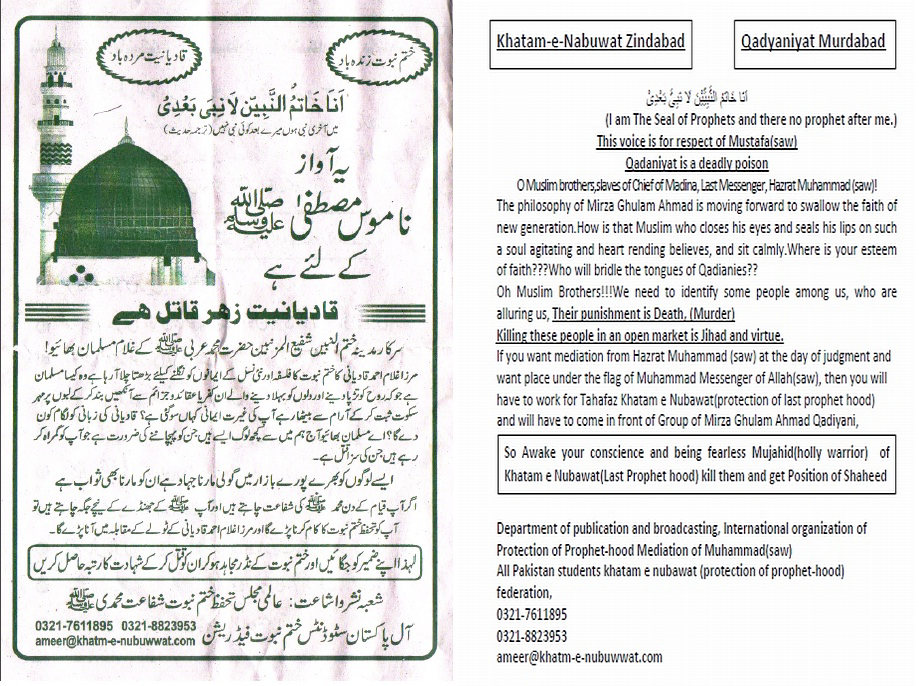
Demonstrators, he said, would also demand the dissolution of Ahmadiyah, a minority Islamic sect considered deviant by mainstream Muslims.

In February, a massive rally by hard-line groups demanded Yudhoyono issue a decree banning Ahmadiyah, threatening a revolution if he failed to do so by March 1. Nothing has happened since the deadline passed.

Chep blamed a lack of coordination and funds for the failure of the February protests.

For the June protest, Chep said that meetings had been, and would continue to be, held with leaders of opposition parties and former presidential candidates, asking them for political and financial support. “I have also prepared Rp 2 billion [$234,000] to finance the rally in the hope that opponents of the government will be convinced to invest as well,” Chep said.

Executives of the hard-line Islamic Defenders Front (FPI) and the Islamic People’s Forum (FUI) said they had not yet heard of the plan.

Copyright 2010 The Jakarta Globe
URL: www.thejakartaglobe.com/news/islamic-.../440537

Thursday, May 21, 2009

Why the Taliban’s going to win in Pakistan

---LiveMint.com, India

Posted: Thu, May 21 2009. 9:17 PM IST
Columns

Why the Taliban’s going to win in Pakistan

The Taliban cannot defeat Pakistan militarily. The Taliban will win because what they want is already being implemented by Pakistan

Reply to All | Aakar Patel

The Taliban will win in Pakistan. They are on the right side of the law. They are also on the right side of history. Last month, a video of Talibs whipping a 17-year-old girl for adultery upset Pakistanis, who thought it barbaric. It might be, but it is the law. The punishment for married adulterers in Pakistan is to “be stoned to death at a public place” (Ordinance 7 of 1979). Unmarried adulterers are to be “punished, at a public place; with whipping numbering one hundred stripes”.

Later in April, the world worried over Pakistan’s decision to enforce Shariah law in the district of Swat, being held by the Taliban. But Shariah is already in force in the whole of Pakistan; it is only being implemented selectively. What the Taliban are demanding is enforcement. Pakistanis might fear the Taliban but nobody opposes Islamic law. Speaking against the “ideology of Pakistan” means 10 years in jail (Penal Code 123a).

In Pakistan, defiling the Quran means life in prison. Speaking against the Prophet is an automatic death sentence (Penal Code 295c).

Under laws that president Zia-ul-Haq introduced, the maximum punishment for theft is amputation of hands. Muslims caught drinking face 80 lashes.

Under prime minister Zulfiqar Ali Bhutto, founder of the liberal Pakistan People’s Party, parliament apostatized the entire Ahmedi sect, a group of Punjabi Muslims.

An Ahmedi “is not a Muslim for the purposes of the constitution or law” (Second Amendment, 1974). If Ahmedis refer to themselves as “Muslim”, or their prayer house as “masjid”, or recite the azaan (call for prayer), they shall be imprisoned for three years (Pakistan Penal Code 298B, 298C).

What happens to Pakistan’s liberal politicians when these laws are passed?

They have to disappear.

Bhutto’s finance minister was the socialist, Mubashir Hasan. Every year, he leads the candle vigil at Wagah. His book, The Mirage of Power, is a detailed account of his four years as minister but makes no mention of the apostatization of the Ahmedis. He skips over the episode. Why? He is afraid to communicate his opposition because he might be lynched.

It is difficult to be secular in Pakistan. The man whose party surrendered at Swat was Asfandyar Wali, grandson of Abdul Ghaffar Khan, the Frontier Gandhi.

The Taliban cannot defeat Pakistan militarily. The Pakistan army will rout it because the Talibs have neither armour, nor artillery nor aircraft.

The Taliban will win because what they want is already being implemented by Pakistan.

On 23 December 1999, Pakistan’s supreme court banned the charging of interest on loans, deciding it was not Islamic. Effectively, this would shut down the banking system and switch off the economy. Pervez Musharraf, then president, got the court to appoint a committee to decide how to implement this ban. This has delayed the destruction of Pakistan’s economy, but not avoided it. In 1998, prime minister Nawaz Sharif moved the 15th Amendment to enforce Shariah. This would designate him Amir-ul-Momineen, commander of the faithful, like Mullah Omar. The Bill was passed by the lower house before being blocked in the senate by the small party of Bihari-UP migrants from India, the Muhajirs.

Urdu-speaking Muhajirs form the only secular party in Pakistan. Their base is Karachi, where they are up against four million Pashtun immigrants. Who are the Talibs? Ethnically, they are Pashtun, 15% of Pakistan’s population.

Many were students of a curriculum designed at Deoband, a school in Uttar Pradesh’s Saharanpur district. It was set up after the war of 1857, seen as the end of Muslim rule in India. Its purpose was to revive Islam by ridding it of the corruption of Hindu influence. It recognizes the jurist Abu Hanifa (who died in 765). The Jaish-e-Mohammad follows the Deobandi ideology.

Pakistan was founded by a man who didn’t really understand Islam. Mohammed Ali Jinnah was a South Mumbai Gujarati who spoke no Urdu or Arabic. He was a constitutionalist who did not understand the nature of the state he had founded. He was a Shia of the Sevener Ismaili Khoja sect. They are talented businessmen and good citizens, but Sunnis regard them as heretics. To widen his appeal, Jinnah converted to “regular” Twelver Shiism.

But that wasn’t good enough.

When he died in 1948, a year after Partition, his deputy, Liaquat Ali Khan, had him buried as a Sunni with a Deobandi maulvi leading his funeral prayer. Six months after Jinnah’s death, on 12 March 1949, Khan introduced the Objectives Resolution in the Pakistan assembly, which was legislating the new constitution. Pakistanis, Khan declared, would enjoy democracy, freedom and equality “as enunciated by Islam”. These words alarmed the assembly’s Hindu members, all Bengalis from East Pakistan. They said this was not what Jinnah had promised them. But Jinnah had been vague. And the Muslims in the assembly were able to point to instances where Jinnah had spoken clearly of Shariah law. The committee voted 21:10. All Muslims voting for; all Hindus against.

Khan assured the Hindus that they would not be discriminated against. He was assassinated in 1951. The discrimination would be written in later, incrementally and over time.

By law, only a Muslim may now be Pakistan’s president (Article 41-2) or prime minister (Article 91-4). Not that there are many non-Muslims left.

Pakistan is today 96% Muslim and unable to think on secular lines. Why are Pakistanis doing this to themselves?

B.R. Ambedkar speculated about this in 1946. “The Muslims have no interest in politics as such. Their predominant interest is religion” (Pakistan: The Partition of India, pages 232-233). All that the Muslim voter cared about, he wrote, was that the candidate “replace the lamps… (and) provide a new carpet for the masjid”. He added: “None of the secular categories of life have any place in the politics of (the) Muslim community and if they do find a place—and they must because they are irrepressible—they are subordinated to one and only one governing principle of the Muslim political universe, namely, religion.” Months later, Ambedkar began work on India’s secular constitution, which took force on 26 January 1950.

Till last year, Nepal was the only Hindu state on earth. The Chhetri (Kshatriya) dynasty ended with the republic of 2008.

Why was it a Hindu state? Because executive power flowed from a warrior king, as prescribed in the Hindu code, Manusmriti. But Nepal was Hindu only to that extent. Nothing else from Hindu texts could be applied because most of it is against the Universal Declaration Of Human Rights, just like Shariah is.

The religious state is utopian, and demands perfection. If we obey God fully, He will look after us. This is not the view of just the bearded Talib of Swat: the justices of the supreme court of Pakistan expect that blessings will be showered on their country after they skewer its economy.

Pakistan is in religious ecstasy. Like Iran, it will have to go through the process of full Islamization.

After this it will learn that there is no other way to run a modern state than as a secular democracy.

Aakar Patel is a director with Hill Road Media.

Write to Aakar at replytoall@livemint.com

URL: http://www.livemint.com/2...y-the-Taliban8217s-going.html

Monday, November 24, 2008

Bangladesh’s Secular Democracy Struggles with Violent Radical Islam

--- The Cutting Edge News

Inside Islam
Bangladesh’s Secular Democracy Struggles with Violent Radical Islam
Benedict Rogers November 24th 2008

Cutting Edge Burma Desk

Bangladesh is a country associated more with floods, cyclones and poverty than terrorism or radical Islamism. Indeed, it is a country founded on secular, democratic values and widely regarded as a moderate Muslim state. In recent years, however, militant Islamism has quietly been taking ground – and Bangladesh’s survival as a progressive state is on a knife-edge.

The warning signs have been there for some years, and some commentators have been sounding the alarm. In 2002, Ruth Baldwin wrote a piece in The Nation headlined: “The ‘Talibanisation’ of Bangladesh.” Hiranmay Karlekar wrote Bangladesh: The Next Afghanistan? While Maneeza Hossain’s Broken Pendulum: Bangladesh’s Swing to Radicalism and Ali Riaz’s God Willing: The Politics of Islamism in Bangladesh are all important contributions.

Perhaps the most visible and dramatic sign of the growth of extremism came three years ago. On 17 August 2005, between 11 and 11.30 am, 527 bombs were exploded in a massive attack on all but one of the country’s 64 districts. Such a carefully co-ordinated campaign of terror shocked the nation – but in many respects it was just the tip of the terror iceberg. Other terrorist incidents, including an attack on the Bangladeshi-born British High Commissioner, members of the judiciary and sporadic attacks on religious and ethnic minorities are further indicators of the presence of well-organised terrorist networks.

However, it is not simply the acts of violence that should cause concern. The Islamists’ ideological influence has spread to almost all parts of Bangladeshi society – not least the political arena.

The umbrella organisation is Jamaat-e-Islami, a radical group founded in India in 1941 by Mawlana Abul Ala Maududi. According to one analyst in Bangladesh, Jamaat’s objective is to create “a monolithic Islamic state, based on Shari’ah law, and declare jihad against Hindus, Buddhists, Christians and free-thinking Muslims.” Religious minorities – and Muslims regarded by Jamaat as heretical, such as the Ahmadiyya sect – are targeted for eviction, according to one human rights activist, “or at least to be made into a ‘non-existent’ element whose voice cannot be heard.” Jamaat’s tentacles now reach into major sectors, including banking, health care, education, business and non-profit organisations, and they aim to “destroy” the judicial system, according to one critic, including by “physically eliminating judges.” In 2001, Jamaat won 17 parliamentary seats in alliance with the governing party, the Bangladesh National Party (BNP), and became a partner in the coalition government until its overthrow by the military in 2007. Elections scheduled for next month could result in Jamaat’s return to government, if BNP wins, and even in the current caretaker administration there are believed to be Jamaat-sympathisers.

While Jamaat is the umbrella, according to journalist Shahriar Kabir and the Forum for Secular Bangladesh there are over 100 Islamist political parties and militant organisations in Bangladesh. Only four of these have been banned, and even they continue to operate under alternative names. Extremist literature, audio and video cassettes are widely distributed, and thousands of madrassas teach radical Islamism.

All this is completely at odds with the vision of Bangladesh’s founder, Sheikh Mujibur Rahman, who led the struggle for independence from Pakistan in which at least three million were killed, ten million displaced and 250,000 women raped. According to Hiranmay Karlekar, at the heart of the birth of Bangladesh was a belief that “the Bengali identity had prevailed over the Islamic identity.” The preamble of the first constitution explicitly stated a commitment to secularism and democracy, and political parties were banned from using religion as a basis for their activities.

Bangladesh began sliding slowly towards Islamism following the assassination of Rahman in 1975. In 1977, references to secularism were deleted from the constitution and the phrase “Bismillah-Ar-Rahiman-Ar Rahim” (“In the name of Allah, the Beneficient, the Merciful) was inserted. Five years later, General Ershad – one of the military dictators who ruled the country in the alternating competition between the army and the democrats – introduced the Eighth Amendment, making Islam the state religion. The constitution now states that “absolute trust and faith in the Almighty Allah shall be the basis of all actions.”

There remain some provisos, which give religious minorities protection. For example, while Islamic principles are set out as guiding values, the constitution states that they “shall not be judicially enforceable.” The Chief Justice has said clearly that Shari’ah does not constitute the basis of the country’s legislation. Religious freedom, including “the right to profess, practice or propagate any religion”, is protected, and discrimination on religious grounds prohibited.

Nevertheless, in practice Christians, Hindus and Buddhists are denied promotion in the government and the military and in the view of one Bangladeshi journalist, religious and ethnic minorities have seen “unprecedented persecution” in recent years.

In 1998, for example, three Christian sites in Dhaka were attacked – a Catholic girls’ school, an Anglican church and a Baptist church. A mob set fire to the school, destroyed property, burned books, pulled down a cross and smashed statues of the Virgin Mary and St Francis of Assisi. Death threats were issued from the nearby mosque. Since then, sporadic attacks on churches have escalated. In 2007, at least five churches were attacked. Hindus and Ahmadiyyas face similar violence.

Cases of abduction, rape, forced marriage and forced conversion of religious minority women – and particularly young girls – are increasing, in a trend worryingly reminiscent of Pakistan. On 13 February 2007, for example, Shantona Rozario, an 18 year-old Christian student, was kidnapped. She was forced at gunpoint to sign a marriage document with her kidnapper, and an affidavit for conversion to Islam, witnessed by a lawyer, a mullah and a group of young men. After a month she managed to escape, but others are not so fortunate. On April 30 of this year a 14 year-old Christian girl, Bituni de Silva, was raped at gunpoint, and on May 2 a 13 year-old daughter of a pastor was gang-raped.

Apostates in Bangladesh face similar severe consequences for leaving Islam as they do throughout the world. On 1 February this year, a 70 year-old woman convert to Christianity from Islam, Rahima Beoa, died from burns suffered when her home was set ablaze after her conversion.

In 2004, a Jamaat Member of Parliament attempted to introduce a blasphemy law in Bangladesh, modelled on Pakistan’s notorious legislation. Attempts have been made to ban Ahmadiyya literature. And even during the State of Emergency, when protests and processions are supposed to be banned, extremists led by groups such as Hizb-ut-Tahrir have held angry rallies. On 17 September 2007, for example, a cartoon was published in a satirical magazine, Alpin, featuring a conversation between a child and an imam, in which the boy was told that he should always use the prefix ‘Mohammed’ before a name. The boy then decided to call his cat “Mohammed Cat.” The cartoon sparked outrage, and effiges of the newspaper editor were burned in street protests. The cartoonist and the editor were arrested, charged with sedition, and the publication was closed down. In April this year, large protests were held after Friday prayers in major cities, opposing the government’s plans to legitimate women’s rights in the constitution. Maulana Fazlul Haq, chairman of the Islami Oikya Jote, described such a policy as “anti-Qu’ran” and “anti-Islamic.”

An estimated 2.5 million people in Bangladesh belong to indigenous ethnic tribal groups, sometime sknown as “Adibashis.” There are at least 40 different ethnic groups, mainly inhabiting the Chittagong Hill Tracts and the plains area around Mymensingh. Most of these tribal groups are non-Muslim – predominantly Buddhist, Christian and Animist. Since the late 1970s, the Bangladeshi government has actively sponsored the resettlement of Bengali Muslims into the tribal areas – resulting in the construction of mosques, land-grabbing, evictions and discrimination against non-Muslims. One indigenous rights campaigner said: “Our way of life is an open society. Men and women can work anywhere. We are more flexible on gender issues. But the settlers have come in and built mosques, and they use their loudspeakers which affects us culturally and psychologically.”

In one village near Mymensingh, for example, a Bengali Muslim married a Christian from a tribal group. All the other villagers are Christians. After a few years, he decided he needed a mosque – even though he was the only Muslim in the area. So now he is building a mosque – and the likelihood is he will bring in an imam, who will bring his family, who will bring their relatives: and the slow, subtle, insidious repopulation of a non-Muslim, non-Bengali area will unfold. When I visited the remote jungle village, the atmosphere was tense – and the imam, sitting at the mosque construction site, was unwelcoming.

The prediction of Bangladesh’s “Talibanisation” may sound extreme, and in the immediate term the likelihood of Bangladesh becoming like Afghanistan is far-fetched. Bangladesh has not gone as far down the road of radicalisation as Pakistan, for example. Nevertheless, the warnings need to be taken seriously. If it continues as it is, Bangladesh will go the way of Pakistan – and then the risk of Talibanisation becomes realistic.

Indeed, it is Pakistan and Saudi Arabia that are fuelling the Islamisation of Bangladesh. As one person put it, “Pakistan is the breeding ground and the brain, and Saudi Arabia provides the money.” Saudi Arabia is a major funder of madrassas and mosques in Bangladesh, for example – and it is no coincide that Wahhabi teaching is on the rise.

A prominent church leader predicts that full Shari’ah law will be implemented if the situation does not change. “Some day, it will happen. Maybe not immediately, but it will happen … The support of voices in the international community is very much needed. More people need to come and find out what is happening here.” As Ali Riaz says, “there is no doubt that if the present trend continues, the nation will inevitably slide further down the slope toward a regime with a clear Islamist agenda … What is necessary is a decisive change in the direction of the nation.” Such a decisive change is vital, to restore the founding principles of Bangladesh – secularism, democracy, equal rights. There is still a thriving civil society, with bold intellectuals, journalists and human rights activists willing to challenge radical Islamism – and that is a cause for hope. Bangladesh has not been lost to radical Islamism completely – but it will be if the alarm bells are not heard.

Cutting Edge Contributor Benedict Rogers is a human rights activist with Christian Solidarity Worldwide, and serves as Deputy Chairman of the UK Conservative Party's Human Rights Commission. He is the author of A Land Without Evil: Stopping the Genocide of Burma's Karen People (Monarch, 2004).

URL: www.thecuttingedgenews.com/index.php?...e=Features
 
^ Top of Page