
Indonesia: Open letter on human rights violations against the Ahmadiyya in West Java
Ref: TG ASA 21/2011.034
Index: ASA 21/032/2011
Gamawan Fauzi
Minister of Home Affairs
Ministry of Home Affairs
Jl. Medan Merdeka
Utara No.7
Jakarta 10110
Indonesia
14 October 2011
AMNESTY INTERNATIONAL INTERNATIONAL SECRETARIAT
Peter Benenson House, 1 Easton Street
London WC1X 0DW, United Kingdom
T: +44 (0)20 7413 5500 F: +44 (0)20 7956 1157
E: amnestyis@amnesty.org W: www.amnesty.org
Dear Minister,
OPEN LETTER ON HUMAN RIGHTS VIOLATIONS AGAINST THE AHMADIYYA IN WEST JAVA
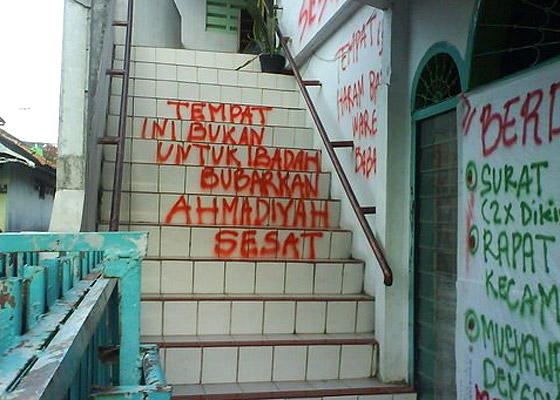
We are writing to raise our concerns about intimidation, threats and violence against several Ahmadiyya communities at the hands of certain religious groups and organizations, as well government officials in the province of West Java. These include attacks on the property of Ahmadiyya members, closure or takeover of Ahmadiyya places of worship, and members of the community being threatened in attempts to force them to denounce their beliefs.
We are particularly concerned that government authorities – including the police – are failing to protect these communities and, in some cases, actively taking part in their persecution. There is also evidence that a provincial regulation entitled “Regulation of the Governor of West Java No. 12/2011 concerning Prohibition of Activities of the Indonesian Ahmadiyya Congregation in West Java” (Regulation of the Governor of West Java No. 12/2011) issued on 3 March 2011 is being used by attackers to justify such unlawful actions.
Article 3 of the Regulation, among other things, “prohibits followers of the Ahmadiyya community from carrying out activities… related to the spreading of interpretation and activities that deviate from the fundamental teachings of Islam”. These activities include spreading Ahmadiyya teachings, installing their signboards in public places and on their places of worship and educational institutions, as well as using anything that could identify them as Ahmadiyya followers.
Below we highlight a number of cases documented by Amnesty International in West Java province. We urge the Indonesian government to ensure prompt, independent, impartial and effective investigations into these reports and take steps to ensure such attacks are not repeated. Indonesia must abide by its international legal obligation to respect and protect the freedom of thought, conscience and religion of all individuals and communities in the country.
1. ATTACKS ON AHMADIYYA PROPERTY AND INTIMIDATION OF COMMUNITY
At 11pm on 29 March 2011 in the village of Sukagalih, Sukaratu sub-district, Tasikmalaya district, approximately 100 people reportedly attacked a house belonging to the Ahmadiyya. According to eye witnesses, some of the attackers were from the As-Syafiiyah Islamic boarding school in Cikatubang located 500m from the village. There were four people in the house: a man, aged 63; his wife, aged 55; their daughter, aged 21; and a wheelchair-bound grandmother, aged 86. The attackers smashed their windows with plant pots, stones and bricks while shouting obscenities and religious slogans.
After a few minutes, the attackers entered the house through the front door, smashing furniture and electrical goods. The attackers then moved on to a small bamboo house at the back of the main property. After the family living in this house escaped, it was set on fire and razed to the ground with all of its contents.
Within days of this attack, two banners were erected immediately outside the main house and at the entrance of the road leading up to the house. The banner outside the house read:
“We support the West Java Governor Regulation No. 12/ 2011 that the Ahmadiy[ya] does not put its name on any place of worship, educational institute or anything else that belongs to Ahmadiy[ya] and ask for a presidential decree to be issued soon to dissolve Ahmadiy[ya].”
The banner at the entrance to the road leading to the attacked house read:
“Thank you to the Governor of West Java for issuing Governor Regulation [No.] 12/2011 on the prohibition of Ahmadiy[ya] activities and the spreading of Ahmadiy[ya} teachings.”
Both the banners were signed by a coalition of groups including the Islamic Defenders Front (Front Pembela Islam, FPI) and the Islamic Reform Movement (Gerakan Reformasi Islam, GARIS).
On the morning of 30 March 2011 at least six students from the boarding school were reportedly detained by the police for their involvement in the attack and taken to the Tasikmalaya District Police Station (Polres). However, they were released without charge later that evening after a demonstration by students from the boarding school in front of the police station. The local military village “guidance” officer (Bintara Pembina Desa or Babinsa) told the Ahmadiyya victims that the police had received threats of more violence against Ahmadiyya houses if the detainees were not immediately released.
2. CLOSURE OR TAKEOVER OF AHMADIYYA PLACES OF WORSHIP
In the ten days after the Governor of West Java issued the Regulation, the Babinsa officer and the Bojongpicung Sub-district Police approached elders of the Ahmadiyya community in the village of Cipeuyem, Haruwangi sub-district and asked them to allow a non-Ahmadiyya preacher to use their place of worship at prayer time. The elders denied their request.
At around 2pm on 13 March 2011, a group of around 50 people from Cipeuyem village reportedly arrived at the Ahmadiyya place of worship led by the Head of the Indonesian Ulema Council (Majelis Ulama Indonesia, MUI) in the village. They then collected all the books they could find in the place of worship and set them on fire on the pavement.
Later the same day, members of the Bojongpicung Sub-district Police (Polsek), the Bojongpicung military (Koramil), the local village administration, and the same religious leader who had earlier led the book burning, reportedly called the Ahmadiyya elders to a meeting and pressured them to close the Ahmadiyya place of worship. On 17 March 2011 in a second meeting with the same people, under the pressure of intimidation, two members of the Ahmadiyya community were forced to sign a letter saying they agreed the place of worship should be closed. Following this incident, the local Ahmadiyya community has been too frightened to continue to use this place of worship.
In the nearby hamlet of Neglasari, Sukadana village, Campaka sub-district, Cianjur district, a non-Ahmadiyya preacher has taken over an Ahmadiyya place of worship.
After a banner supporting the Governor of West Java’s Regulation was put up near the main group of Ahmadiyya houses in Neglasari, members of the Ahmadiyya community were reportedly invited to a meeting on 16 March 2011 to brief them on the Regulation. The meeting was attended by local representatives of the Attorney General’s Office, the Cianjur District Police, local representatives from the Ministry of Religion and the village administration, as well as several religious leaders. Three days later, one of those religious leaders then visited the head of the Neglasari chapter of the Ahmadiyya asking to use the Ahmadiyya place of worship for a gathering of 1,000 of his followers. Alarmed at the large number of this congregation – usually the Ahmadiyya congregation is around 20-50 people – the Ahmadiyya elders asked the local police to intervene.
In a meeting held on 21 March 2011 at the Campaka Sub-district Police Station, the head of the local police reportedly called for the planned prayer gathering to be cancelled. Nevertheless, later that day, the non-Ahmadiyya leader turned up with a congregation of 500 people and used the Ahmadiyya place of worship without permission from the Ahmadiyya elders. In attendance were around 200 public order (Dalmas) police officers from the Cianjur District Police and officers from Campaka, Sukanegara, Pagelarang and Cibeber Police Sub-districts. The Ahmadiyya members present reported that the police officers did not take any steps to prevent this, but only stood and watched.
Since then, their place of worship has frequently been used by other leaders from around Sukadana village and some of these prayer meetings are organized to “educate” the Ahmadis about Islam. The Ahmadiyya community around the place of worship has been unable to use it for several months and complaints to police have not been followed up.
3. THREATENED IN AN ATTEMPT TO FORCE THEM TO DENOUNCE THEIR BELIEFS
On 1 April 2011 a local village head reportedly approached a family in Sukadana village, Campaka sub-district and told them they must make a decision to either leave the Ahmadiyya faith or leave their homes, and offered Rp 300,000 [US$ 35] if they signed papers denouncing their faith. The family decided to leave the area not long after and is now trying to collect money to build another house closer to the core Ahmadiyya community in Sukadana village.
Since the Regulation was issued, Ahmadiyya families in Sukagalih village, Sukaratu sub-district also reported receiving visits every few weeks by village administration staff and FPI members and associated leaders. The Ahmadiyya members reported being given invitation letters asking them to attend meetings where they would be expected to leave the Ahmadiyya faith. Those who agreed to attend are made to sign a register. Officials have reportedly informed the Ahmadiyya members that “if you do not want to sign, we will not be responsible for what might happen to you”.
Amnesty International has obtained a copy of one of the invitation letters (dated 9 May 2011) from a group called the Association of Victims of the Ahmadiyya Deviant Sect (Ikatan Masyarakat Korban Aliran Sesat Ahmadiyah, IMKASA) reportedly set up by the Soldiers to Defend Islam (Laskar Pembela Islam, LPI). The heading of this invitation says in big letters: “Don’t die unless you’re a Muslim”, which Ahmadiyya members have found threatening.
4. AMNESTY INTERNATIONAL’s CONCERNS
The duty of a state to respect and ensure respect for human rights is key to ensuring the enjoyment of these rights by individuals and communities within the state. This duty is provided for, among others, in the International Covenant on Civil and Political Rights (ICCPR), to which Indonesia is a state party. It includes the obligation of states to do their utmost to prevent people’s rights being violated or abused, both by state officials and by others. If abuse has taken place, a state is obliged to investigate and prosecute those responsible in fair proceedings, and ensure reparations for victims. The police, as the arm of government charged with law enforcement, has a key role to play in ensuring that human rights are not violated or abused, as well as in the investigation of such violations and abuses when they do occur.
Under Article 2(1) of the ICCPR, human rights must be protected “without distinction of any kind, such as race, colour, sex, language, religion, political or other opinion, national or social origin, property, birth or other status”.
In an authoritative General Comment on Article 2 (non-discrimination) of the ICCPR, the Human Rights Committee, the expert group tasked under the Covenant to oversee its implementation, has stated that “[t]here may be circumstances in which a failure to ensure Covenant rights as required by Article 2 would give rise to violations by States Parties of those rights, as a result of States Parties’ permitting or failing to take appropriate measures or to exercise due diligence to prevent, punish, investigate or redress the harm caused by such acts by private persons or entities”.
Article 14 (1)(g) of Law No. 2/2002 on the Indonesian National Police also provides that “the police have a duty to investigate all criminal acts in accordance with the Criminal Procedure Code and under relevant legislation”.
Indonesian police have failed to investigate these attacks and bring those responsible to justice. Amnesty International is concerned that this failure runs contrary to Indonesia’s obligations under both the ICCPR and Indonesian laws.
Amnesty International is also concerned that the Regulation of the Governor of West Java No. 12/2011 and the closure or takeover of Ahmadiyya community places of worship denies the Ahmadiyya community their right to freedom of religion or belief.
The right to freedom of religion or belief is guaranteed in Article 18(1) of the ICCPR which provides that:
“[e]veryone shall have the right to freedom of thought, conscience and religion. This right shall include freedom… either individually or in community with others and in public or private, to manifest his religion or belief in worship, observance, practice and teaching.”
The Human Rights Committee has stated that:
“[t]he freedom to manifest religion or belief in worship, observance, practice and teaching encompasses a broad range of acts. The concept of worship extends to… various practices integral to such acts, including the… display of symbols… and the freedom to prepare and distribute religious texts or publications.”
Further, threats by local government officials against the Ahmadiyya in an attempt to force them to denounce their beliefs are in violation of Article 18(2) of the ICCPR which provides that “[n]o one shall be subject to coercion which would impair his freedom to have or to adopt a religion or belief of his choice”.
According to the Human Rights Committee, “[a]rticle 18(2) bars coercion that would impair the right to have or adopt a religion or belief, including the use of threat of physical force… to compel believers or non-believers to adhere to their religious beliefs and congregations, to recant their religion or belief or to convert”.
The right to freedom of religion is also enshrined in the Article 28E (1) of the Indonesian Constitution which provides that “[e]very person shall be free to choose and to practice the religion of his/her choice”.
According to Indonesian human rights lawyers, the Regulation of the Governor of West Java No. 12/2011 is also in violation of the Article 10 (3)(f) of Law No. 32/2004 on Regional Autonomy. In the autonomy law, the powers to make regulations on matters of religion are in the domain of the central government. Provincial or local-level regulations are therefore invalid to the extent that they are inconsistent with higher laws, such as national laws or regulations, according to the hierarchy of laws in Article 7(1) of Law No. 10/2004 on Law-making.
5. Recommendations
In order to remedy this situation, Amnesty International calls on your department to immediately take the lead in ensuring the following:
Please do not hesitate to contact us if you have any questions. We would be pleased to discuss this matter with you.
Yours sincerely,
Donna Guest
Asia-Pacific Deputy Director
Cc: General Timur Pradopo
Head of the Indonesian National Police
Patrialis Akbar
Minister of Justice and Human Rights
Suryadharma Ali
Minister of Religious Affairs
Ahmad Heryawan
Governor of West Java Province
Ifdhal Kasim
Head of the National Human Rights Commission (Komnas HAM)
Human Rights Committee, General Comment No. 31 on Article 2 of the Covenant: The Nature of the General Legal Obligation Imposed on States Parties to the Covenant, UN Doc. CCPR/C/74/CRP.4/Rev.6, 21 April 2004, para. 8.
Human Rights Committee General Comment No. 22: The right to freedom of thought, conscience and religion (Article 18): UN Doc. CCPR/C/21/Rev.1/Add.4, 30/07/1993 para. 4.
Human Rights Committee General Comment No. 22: The right to freedom of thought, conscience and religion (Article 18): UN Doc. CCPR/C/21/Rev.1/Add.4, 30/07/1993 para. 5.
Index: ASA 21/032/2011
Gamawan Fauzi
Minister of Home Affairs
Ministry of Home Affairs
Jl. Medan Merdeka
Utara No.7
Jakarta 10110
Indonesia
14 October 2011
AMNESTY INTERNATIONAL INTERNATIONAL SECRETARIAT
Peter Benenson House, 1 Easton Street
London WC1X 0DW, United Kingdom
T: +44 (0)20 7413 5500 F: +44 (0)20 7956 1157
E: amnestyis@amnesty.org W: www.amnesty.org
Dear Minister,
OPEN LETTER ON HUMAN RIGHTS VIOLATIONS AGAINST THE AHMADIYYA IN WEST JAVA
We are writing to raise our concerns about intimidation, threats and violence against several Ahmadiyya communities at the hands of certain religious groups and organizations, as well government officials in the province of West Java. These include attacks on the property of Ahmadiyya members, closure or takeover of Ahmadiyya places of worship, and members of the community being threatened in attempts to force them to denounce their beliefs.
We are particularly concerned that government authorities – including the police – are failing to protect these communities and, in some cases, actively taking part in their persecution. There is also evidence that a provincial regulation entitled “Regulation of the Governor of West Java No. 12/2011 concerning Prohibition of Activities of the Indonesian Ahmadiyya Congregation in West Java” (Regulation of the Governor of West Java No. 12/2011) issued on 3 March 2011 is being used by attackers to justify such unlawful actions.
Article 3 of the Regulation, among other things, “prohibits followers of the Ahmadiyya community from carrying out activities… related to the spreading of interpretation and activities that deviate from the fundamental teachings of Islam”. These activities include spreading Ahmadiyya teachings, installing their signboards in public places and on their places of worship and educational institutions, as well as using anything that could identify them as Ahmadiyya followers.
Below we highlight a number of cases documented by Amnesty International in West Java province. We urge the Indonesian government to ensure prompt, independent, impartial and effective investigations into these reports and take steps to ensure such attacks are not repeated. Indonesia must abide by its international legal obligation to respect and protect the freedom of thought, conscience and religion of all individuals and communities in the country.
1. ATTACKS ON AHMADIYYA PROPERTY AND INTIMIDATION OF COMMUNITY
At 11pm on 29 March 2011 in the village of Sukagalih, Sukaratu sub-district, Tasikmalaya district, approximately 100 people reportedly attacked a house belonging to the Ahmadiyya. According to eye witnesses, some of the attackers were from the As-Syafiiyah Islamic boarding school in Cikatubang located 500m from the village. There were four people in the house: a man, aged 63; his wife, aged 55; their daughter, aged 21; and a wheelchair-bound grandmother, aged 86. The attackers smashed their windows with plant pots, stones and bricks while shouting obscenities and religious slogans.
After a few minutes, the attackers entered the house through the front door, smashing furniture and electrical goods. The attackers then moved on to a small bamboo house at the back of the main property. After the family living in this house escaped, it was set on fire and razed to the ground with all of its contents.
Within days of this attack, two banners were erected immediately outside the main house and at the entrance of the road leading up to the house. The banner outside the house read:
“We support the West Java Governor Regulation No. 12/ 2011 that the Ahmadiy[ya] does not put its name on any place of worship, educational institute or anything else that belongs to Ahmadiy[ya] and ask for a presidential decree to be issued soon to dissolve Ahmadiy[ya].”
The banner at the entrance to the road leading to the attacked house read:
“Thank you to the Governor of West Java for issuing Governor Regulation [No.] 12/2011 on the prohibition of Ahmadiy[ya] activities and the spreading of Ahmadiy[ya} teachings.”
Both the banners were signed by a coalition of groups including the Islamic Defenders Front (Front Pembela Islam, FPI) and the Islamic Reform Movement (Gerakan Reformasi Islam, GARIS).
On the morning of 30 March 2011 at least six students from the boarding school were reportedly detained by the police for their involvement in the attack and taken to the Tasikmalaya District Police Station (Polres). However, they were released without charge later that evening after a demonstration by students from the boarding school in front of the police station. The local military village “guidance” officer (Bintara Pembina Desa or Babinsa) told the Ahmadiyya victims that the police had received threats of more violence against Ahmadiyya houses if the detainees were not immediately released.
2. CLOSURE OR TAKEOVER OF AHMADIYYA PLACES OF WORSHIP
In the ten days after the Governor of West Java issued the Regulation, the Babinsa officer and the Bojongpicung Sub-district Police approached elders of the Ahmadiyya community in the village of Cipeuyem, Haruwangi sub-district and asked them to allow a non-Ahmadiyya preacher to use their place of worship at prayer time. The elders denied their request.
At around 2pm on 13 March 2011, a group of around 50 people from Cipeuyem village reportedly arrived at the Ahmadiyya place of worship led by the Head of the Indonesian Ulema Council (Majelis Ulama Indonesia, MUI) in the village. They then collected all the books they could find in the place of worship and set them on fire on the pavement.
Later the same day, members of the Bojongpicung Sub-district Police (Polsek), the Bojongpicung military (Koramil), the local village administration, and the same religious leader who had earlier led the book burning, reportedly called the Ahmadiyya elders to a meeting and pressured them to close the Ahmadiyya place of worship. On 17 March 2011 in a second meeting with the same people, under the pressure of intimidation, two members of the Ahmadiyya community were forced to sign a letter saying they agreed the place of worship should be closed. Following this incident, the local Ahmadiyya community has been too frightened to continue to use this place of worship.
In the nearby hamlet of Neglasari, Sukadana village, Campaka sub-district, Cianjur district, a non-Ahmadiyya preacher has taken over an Ahmadiyya place of worship.
After a banner supporting the Governor of West Java’s Regulation was put up near the main group of Ahmadiyya houses in Neglasari, members of the Ahmadiyya community were reportedly invited to a meeting on 16 March 2011 to brief them on the Regulation. The meeting was attended by local representatives of the Attorney General’s Office, the Cianjur District Police, local representatives from the Ministry of Religion and the village administration, as well as several religious leaders. Three days later, one of those religious leaders then visited the head of the Neglasari chapter of the Ahmadiyya asking to use the Ahmadiyya place of worship for a gathering of 1,000 of his followers. Alarmed at the large number of this congregation – usually the Ahmadiyya congregation is around 20-50 people – the Ahmadiyya elders asked the local police to intervene.
In a meeting held on 21 March 2011 at the Campaka Sub-district Police Station, the head of the local police reportedly called for the planned prayer gathering to be cancelled. Nevertheless, later that day, the non-Ahmadiyya leader turned up with a congregation of 500 people and used the Ahmadiyya place of worship without permission from the Ahmadiyya elders. In attendance were around 200 public order (Dalmas) police officers from the Cianjur District Police and officers from Campaka, Sukanegara, Pagelarang and Cibeber Police Sub-districts. The Ahmadiyya members present reported that the police officers did not take any steps to prevent this, but only stood and watched.
Since then, their place of worship has frequently been used by other leaders from around Sukadana village and some of these prayer meetings are organized to “educate” the Ahmadis about Islam. The Ahmadiyya community around the place of worship has been unable to use it for several months and complaints to police have not been followed up.
3. THREATENED IN AN ATTEMPT TO FORCE THEM TO DENOUNCE THEIR BELIEFS
On 1 April 2011 a local village head reportedly approached a family in Sukadana village, Campaka sub-district and told them they must make a decision to either leave the Ahmadiyya faith or leave their homes, and offered Rp 300,000 [US$ 35] if they signed papers denouncing their faith. The family decided to leave the area not long after and is now trying to collect money to build another house closer to the core Ahmadiyya community in Sukadana village.
Since the Regulation was issued, Ahmadiyya families in Sukagalih village, Sukaratu sub-district also reported receiving visits every few weeks by village administration staff and FPI members and associated leaders. The Ahmadiyya members reported being given invitation letters asking them to attend meetings where they would be expected to leave the Ahmadiyya faith. Those who agreed to attend are made to sign a register. Officials have reportedly informed the Ahmadiyya members that “if you do not want to sign, we will not be responsible for what might happen to you”.
Amnesty International has obtained a copy of one of the invitation letters (dated 9 May 2011) from a group called the Association of Victims of the Ahmadiyya Deviant Sect (Ikatan Masyarakat Korban Aliran Sesat Ahmadiyah, IMKASA) reportedly set up by the Soldiers to Defend Islam (Laskar Pembela Islam, LPI). The heading of this invitation says in big letters: “Don’t die unless you’re a Muslim”, which Ahmadiyya members have found threatening.
4. AMNESTY INTERNATIONAL’s CONCERNS
The duty of a state to respect and ensure respect for human rights is key to ensuring the enjoyment of these rights by individuals and communities within the state. This duty is provided for, among others, in the International Covenant on Civil and Political Rights (ICCPR), to which Indonesia is a state party. It includes the obligation of states to do their utmost to prevent people’s rights being violated or abused, both by state officials and by others. If abuse has taken place, a state is obliged to investigate and prosecute those responsible in fair proceedings, and ensure reparations for victims. The police, as the arm of government charged with law enforcement, has a key role to play in ensuring that human rights are not violated or abused, as well as in the investigation of such violations and abuses when they do occur.
Under Article 2(1) of the ICCPR, human rights must be protected “without distinction of any kind, such as race, colour, sex, language, religion, political or other opinion, national or social origin, property, birth or other status”.
In an authoritative General Comment on Article 2 (non-discrimination) of the ICCPR, the Human Rights Committee, the expert group tasked under the Covenant to oversee its implementation, has stated that “[t]here may be circumstances in which a failure to ensure Covenant rights as required by Article 2 would give rise to violations by States Parties of those rights, as a result of States Parties’ permitting or failing to take appropriate measures or to exercise due diligence to prevent, punish, investigate or redress the harm caused by such acts by private persons or entities”.
Article 14 (1)(g) of Law No. 2/2002 on the Indonesian National Police also provides that “the police have a duty to investigate all criminal acts in accordance with the Criminal Procedure Code and under relevant legislation”.
Indonesian police have failed to investigate these attacks and bring those responsible to justice. Amnesty International is concerned that this failure runs contrary to Indonesia’s obligations under both the ICCPR and Indonesian laws.
Amnesty International is also concerned that the Regulation of the Governor of West Java No. 12/2011 and the closure or takeover of Ahmadiyya community places of worship denies the Ahmadiyya community their right to freedom of religion or belief.
The right to freedom of religion or belief is guaranteed in Article 18(1) of the ICCPR which provides that:
“[e]veryone shall have the right to freedom of thought, conscience and religion. This right shall include freedom… either individually or in community with others and in public or private, to manifest his religion or belief in worship, observance, practice and teaching.”
The Human Rights Committee has stated that:
“[t]he freedom to manifest religion or belief in worship, observance, practice and teaching encompasses a broad range of acts. The concept of worship extends to… various practices integral to such acts, including the… display of symbols… and the freedom to prepare and distribute religious texts or publications.”
Further, threats by local government officials against the Ahmadiyya in an attempt to force them to denounce their beliefs are in violation of Article 18(2) of the ICCPR which provides that “[n]o one shall be subject to coercion which would impair his freedom to have or to adopt a religion or belief of his choice”.
According to the Human Rights Committee, “[a]rticle 18(2) bars coercion that would impair the right to have or adopt a religion or belief, including the use of threat of physical force… to compel believers or non-believers to adhere to their religious beliefs and congregations, to recant their religion or belief or to convert”.
The right to freedom of religion is also enshrined in the Article 28E (1) of the Indonesian Constitution which provides that “[e]very person shall be free to choose and to practice the religion of his/her choice”.
According to Indonesian human rights lawyers, the Regulation of the Governor of West Java No. 12/2011 is also in violation of the Article 10 (3)(f) of Law No. 32/2004 on Regional Autonomy. In the autonomy law, the powers to make regulations on matters of religion are in the domain of the central government. Provincial or local-level regulations are therefore invalid to the extent that they are inconsistent with higher laws, such as national laws or regulations, according to the hierarchy of laws in Article 7(1) of Law No. 10/2004 on Law-making.
5. Recommendations
In order to remedy this situation, Amnesty International calls on your department to immediately take the lead in ensuring the following:
- Order the central police to undertake a thorough, independent and impartial investigation into the intimidation, threats and violence against the Ahmadiyya community in West Java;
- Ensure that the findings of the investigation are made public and are submitted, wherever relevant, to the Public Prosecutor so that all those suspected of involvement in human rights-related offences are brought to justice in proceedings which meet international standards of fairness and without the imposition of the death penalty, and that victims are provided reparations;
- Revoke the Regulation of the Governor of West Java No. 12/2011 and all other regional and national regulations that restrict the activities of the Ahmadiyya community in Indonesia or otherwise violate their right to freedom of thought, conscience and religion;
- The central government must ensure that any regulations issued at the provincial and at the district level are in compliance with human rights protections as provided in the 1945 Indonesian Constitution and Indonesia’s obligations under international law, in particular the ICCPR; and
- Denounce all public statements inciting discrimination and violence against the Ahmadiyya and take steps to ensure that all religious minorities in Indonesia, including the Ahmadiyya, are protected and allowed to practise their faith free from fear, intimidation and persecution.
Please do not hesitate to contact us if you have any questions. We would be pleased to discuss this matter with you.
Yours sincerely,
Donna Guest
Asia-Pacific Deputy Director
Cc: General Timur Pradopo
Head of the Indonesian National Police
Patrialis Akbar
Minister of Justice and Human Rights
Suryadharma Ali
Minister of Religious Affairs
Ahmad Heryawan
Governor of West Java Province
Ifdhal Kasim
Head of the National Human Rights Commission (Komnas HAM)
Human Rights Committee, General Comment No. 31 on Article 2 of the Covenant: The Nature of the General Legal Obligation Imposed on States Parties to the Covenant, UN Doc. CCPR/C/74/CRP.4/Rev.6, 21 April 2004, para. 8.
Human Rights Committee General Comment No. 22: The right to freedom of thought, conscience and religion (Article 18): UN Doc. CCPR/C/21/Rev.1/Add.4, 30/07/1993 para. 4.
Human Rights Committee General Comment No. 22: The right to freedom of thought, conscience and religion (Article 18): UN Doc. CCPR/C/21/Rev.1/Add.4, 30/07/1993 para. 5.
© Amnesty International
URL: www.amnesty.org/en/library/asset/...asa210322011en.html
URL: www.amnesty.org/en/library/asset/...asa210322011en.html











 Posts
Posts


