Religious persecution of Ahmadiyya Muslim Community continues worldwide. In Pakistan, Blasphemy Laws are being used specially against Ahmadis to harass them. Millions of religious minority are under threat to be falsely implicated in any such case on the basis of personal enmity with a punishment from 3 years RI to death. This blog was created to update Pakistani visitors of www.thepersecution.org, access to which was blocked by Pakistan Telecommunication Authority without any reason.
After the government crackdown on certain madrassas in Islamabad recently, the representatives of the Wafaq-ul-Madaris aired their indignation on TV channels. They criticised the action on the grounds that madrassas have always been weapon/terror-free – including, if you please, the Lal Masjid – and, as such, cannot be held responsible for any anti-state activities The went on to add thatif the government officials wish to visit any of the premises, they must do so with the permission of Wafaq-ul-Madaris. In answer to such defiant outbursts, the interior minister meekly assured the Wafaq that the government never meant to violate the sanctity of these great places of learning and knowledge, and is only looking for some foreign Imams residing in some madressahs illegally. One fails to understand why the government has to be apologetic in carrying out such actions against any institution in Pakistan if it has reports of illegal activity there, especially when we are in a state of war. Madressahs, even if registered, are not sacrosanct or above the law. Unfortunately, it is this obsequiousness of our rulers toward the mullah since the creation of Pakistan that has emboldened the extremists over the last six decades.
The Muslim struggle for Pakistan did not include the Deoband or the Jamiat-e-Ulema-e-Hind who opposed the idea of Pakistan tooth and nail. Nonetheless, once Pakistan became a reality the Wahabi-Deobandi groups made gradual inroads as our leaders acquiesced to their demands within a few years of independence. Since then their influence has remained unchecked by the state as it focused on short-term political goals, it is therefore not surprising that they have eventually assumed the mantle of our self-proclaimed saviours and architects of the national identity of Pakistan.
Be it the Objectives Resolution or the timing of the Anti-Ahmadiyya movement in the 50s that facilitated the first martial law; the ban on alcohol and declaration of Friday as a weekly holiday by Zulfikar Ali Bhutto, Naseerullah Babar’s Taliban idea during Benazir’s government, or Nawaz Sharif’s Shariah Bill of the 90s, staying on the right side of Maulana Fazl ur Rahman by successive governments or the on-going pampering of Wafaq-ul-Madaris by the incumbent administration, the political players of Pakistan have always put their own narrow interests before the interests of the nation.
The military dictatorships on the other hand have used the mullah to further their own specific interests. From Ayub Khan to Musharraf, all military regimes have sought the cooperation of one religious sect or the other. Zia in particular played the mullah card to promote American interests and Arab culture simultaneously, destroying national institutions in the process while Musharraf’s post-9/11 two-faced strategy ensured the continuity of extremism. Jointly, the politicians and the military dictators, with help from America and Saudi Arabia, have managed to create a monster that feeds on violence and bloodshed.
The religious clerics, whether Muslim or non Muslim, derive their political power from exploiting the insecurities of the masses by focusing on differences in religious and socio-cultural beliefs, thus leading to social divisions. In a multi-ethnic Pakistani society with a sizeable non-Muslim population, this has spelled disaster. Over the last three decades, the Deobandi/Wahabi mindset has transmuted ideological divisions into militant sectarianism that has been duly exploited by the Taliban and their domestic sympathisers that include mainstream religious-political parties.
Muslim states like Turkey, in keeping with the Ottoman tradition, have managed to keep their clerics under state control to ensure social order. In Pakistan, they have been given a free hand; what we are witnessing today in the shape of violence is the dark side of religiosity infused by religious extremists into the psyche of both the uneducated masses and the unsuspecting educated elite. This has transpired due to the manipulation of religious sentiments by vested interests and festering socio-economic and governance issues all rolled into one. But above all, this is due to the deliberate omission of critical thinking skills and philosophical knowledge from the national curricula, thus rendering a large majority of Pakistani population incapable of objective assessment. This omission is largely attributable to the direct or indirect influence of the mullah especially during and after the Zia era.
Today the same extremist elements continue to spread their hatred of one another as well as propagate against Pakistan’s national interests by promoting conspiracy theories and blind anti-Americanism from the pulpit. And while doing so, they fail to mention the negative influence of certain policies of the Saudi government toward Pakistan. The anti-American and anti-government slogans after the Islamic University bombing would have sounded more genuine had they been accompanied with anti-Taliban slogans. Pakistan will never become a self-respecting nation unless it disengages itself from not only American shackles but also the ones imported from Saudi Arabia. This requires a mature political leadership that believes in impartial analyses and practical strategies, not to mention courage and wisdom.
The Waziristan operation is in full swing and if the religious parties cannot support it for fear of life, they can at least remain quiet. By stoking the fire of anti-Americanism to garner support for the Taliban through ill-timed rallies and referendums, they are doing no service to Pakistan. The nation is being driven into a frenzy that can only spread more intolerance and spawn fear and anxiety. Furthermore, it serves as a diversion because it deflects people’s attention from the real issue of good governance and allows religious and secular leaders, whether in the government or opposition or outside the parliament, to play their petty games without having to shoulder the required responsibilities to steer the country out of the present quagmire.
Religion is a strong social phenomenon and has been employed by many in human history to serve political ends. Muslim history is no exception. The mullahs of Pakistan have employed the same dispensation since 1947 to gain political power. This has eventually led to the rise of a ferocious militant element never known in Muslim history. Not even the Hashashins of Hassan Sabah killed with such merry abandon. It is high time for the state to check the spread of unbridled hatred. It is time to stop pampering the mullah.
The writer is executive editor of Criterion, Islamabad. Email: talatfarooq11@gmail.com
Of late, amidst the murder and mayhem accompanied by an absence of government or any signs of governance, a group of citizens has been circulating an email message exhorting whoever to ‘bring back Jinnah’s Pakistan’.
Now, to bring back something that existed for a mere moment in the life of this nation is more than difficult at a time when the national mindset is what it is.
Mohammad Ali Jinnah’s Pakistan was denounced six months after his death when the Objectives Resolution was passed, negating the words he had so eloquently spoken to his constituent assembly on Aug 11 1947: ‘… You may belong to any religion or caste or creed — that has nothing to do with the business of the state.’ Thus, willy-nilly, the state was made the custodian of religion.
In the early 1950s, the British writer Hector Bolitho was commissioned by the government to write an official biography of Jinnah. It was published in 1954. Such was the moral dishonesty and hypocrisy that had taken a firm hold and rooted itself in the country’s psyche that the ruling clique of the day perverted Jinnah’s words, and printed in the book was this version of the quoted sentence: ‘You may belong to any religion or caste or creed — that has nothing to do with the fundamental principle that we are all citizens and equal citizens of one state.’
In April 1962, the days of President Gen Ayub Khan, came a lessening of the prevailing hypocrisy and the government press department published a collection of Jinnah’s speeches as governor general of Pakistan. The Aug 11, 1947 speech was printed in full in its original version. (These speeches were reprinted by the government of Benazir Bhutto and released for sale in 1989.)
In 1984, when wily Ziaul Haq ruled, came the finest biography of Jinnah so far written. Prof Stanley Wolpert’s well-researched book, Jinnah of Pakistan, was published in the US by Oxford University Press and 500 copies were sent to Pakistan to be released for sale.
Prior to its release, two copies were sent by OUP to the information ministry seeking permission to reprint locally. The minions of this pernicious ministry, which should not exist, took exception to certain passages in the book in which our founder-maker’s personal tastes and habits were mentioned.
The 498 copies of the book lying with OUP were removed from their storeroom and reprinting of course denied. To top this crass idiocy, Wolpert was approached and asked to delete the offending passages so that it could be reprinted and sold. Naturally, Wolpert’s response was that as a scholar he was unable to compromise on basic principles and any deletion/amendment was out of the question.
Thus the book effectively remained banned in Pakistan until in 1989, when, to give full credit to Benazir and her government, permission was given to OUP to reprint and the book was released for sale. Zia’s was an exercise in pure futility.
Our large neighbour also has blinkered intolerant elements in its midst. There is a long list of books that are banned in India, amongst them Stanley Wolpert’s ‘factional’ novel on the assassination of Gandhi, Nine Hours to Rama, which was banned by the government in 1962. And now, this August, two days after its release the government of the Indian state of Gujarat saw fit to issue a notification ‘forfeiting’ and ‘prohibiting’ Jaswant Singh’s Jinnah: India-Partition-Independence (Mr Singh was also expelled by his party, the BJP).
The book was banned with immediate effect and in the wider public interest because it was alleged that its contents are highly objectionable, against the national interest, misleading, distort historical fact and that it is defamatory in regard to Sardar Vallabhbhai Patel, who is largely regarded as the architect of modern India.
Mr Singh swiftly approached the Indian Supreme Court challenging the ban on the grounds of the violation of fundamental rights. The court issued a notice to the Gujrat government. In the meantime, an appeal was submitted to the Gujrat High Court which struck down the ban. With the Gujrat government prevaricating, the matter remains before the supreme court.
Now, to the bringing back in totality of Jinnah’s Pakistan — that we can never do as half of his Pakistan was shorn by the collusion of our politicians and army generals, the deadly mixture of Zulfikar Ali Bhutto and Gen Yahya Khan who threw away East Pakistan through a lust for power coupled by incompetence and insensitivity. What can be saved, if we had the leadership to do so, is the spirit of Jinnah’s Pakistan as expressed by him on that distant August day.
Had a large part of the Middle Eastern region and parts of South Asia been able to heed Jinnah’s words that religion, caste and creed ‘has nothing to do with the business of the state’ the world may well have been in better shape today. It is possible that the extremism that has galloped away in these areas would not have taken root had various states not been allowed to force upon the world their dangerously distorted version of a religion.
As for Pakistan, the Objectives Resolution forms the preamble to ZAB’s constitution and was additionally inserted as an annex by Ziaul Haq. Then we have ZAB’s second amendment to his constitution which reinforces bigotry and intolerance. No government has been strong enough to take on the mullah fraternity whose grip has strengthened with the years. To bring us back to Jinnah’s Pakistan, we must have a revolution — a revolution of the national mindset and a latter-day Ataturk to ensure that it is successful.
United States House of Representatives Tom Lantos Human Rights Commission House Committee on Foreign Affairs Washington, D.C.
October 8, 2009
Testimony of Amjad Mahmood Khan, Esq.
Mr. Chairman and Members of the Commission:
Thank you for inviting me to testify today on the legal and constitutional issues surrounding Pakistan’s anti-blasphemy laws. I am honored to provide testimony before this body. The fact that you have commissioned a special hearing on this issue demonstrates your deep commitment to international human rights and religious freedom, and for that you are to be commended.
I am a Muslim-American attorney residing in Los Angeles. In my private practice, I litigate complex business and commercial matters for the firm Latham & Watkins, LLP. In my pro bono practice, I represent refugees and disaster victims. I have studied international and human rights law at Harvard Law School and have written about Pakistan’s anti-blasphemy laws and surrounding issues for the Harvard Human Rights Law Journal and other periodicals.
The Problem of Blasphemy
Let me begin by defining the problem. Pakistan uses its Criminal Code to prohibit and punish blasphemy. Blasphemy in Pakistan broadly refers to any spoken or written representation that directly or indirectly outrages the religious sentiments of Muslims.[1] Five of Pakistan’s current penal code provisions punish blasphemy. These are collectively referred to as the “anti-blasphemy” laws. Over the course of 25 years, approximately 1,000 individuals have been arrested under the anti-blasphemy laws.[2] These individuals were Muslims (Sunnis, Shias and Ahmadis), Christians and Hindus.[3] Their crimes ranged from wearing an Islamic slogan on a t-shirt to planning to build a Mosque to distributing Islamic literature in a public square to offering prayers in a Mosque to printing a wedding invitation card with Quranic verses to sending a text message perceived as critical of Islam.[4] Their punishments ranged from fines to indefinite detention to life imprisonment to the death sentence. Although no one to date has been executed for blasphemy, at least 32 individuals have been killed by mobs after being arrested for blasphemy.[5] One Roman Catholic bishop committed suicide outside of a Pakistani courtroom to protest the death sentence of a Christian arrested for blasphemy.[6]
Pakistan’s anti-blasphemy laws continue in full force and effect today. They incite religious extremism and silence the opinions of both Muslim and non-Muslim minorities. The U.S. State Department’s 2008 report on Pakistan points out how “authorities routinely used the [anti]-blasphemy laws to harass religious minorities and vulnerable Muslims and to settle personal scores or business rivalries.”[7] Amnesty International reports that Pakistan’s anti-blasphemy laws are “a handy tool to silence debate and dissent.”[8] Human Rights Watch reports that “Pakistan’s continued use of its blasphemy laws against religious minorities is disgraceful” and must be “repealed.”[9] The U.S. Commission on International Religious Freedom, in a recent letter to President Obama, described the anti-blasphemy laws as “restricting religious freedom” and fostering “vigilante violence.”[10]
In 2006, the National Assembly of Pakistan submitted a bill to the standing committee entitled, “The Apostasy Bill,” which proposes sentencing to death male and female apostates who do not recant their conversions from Islam.[11] If passed, the Bill would supersede the anti-blasphemy laws currently in effect.
Thus, the problem of blasphemy in Pakistan remains more precarious than ever.
How Pakistan Came to this Point
Before I elaborate about the specific abuses stemming from the anti-blasphemy laws, it may be helpful to describe briefly how the laws came into existence.
Pakistan’s early founding reflected a deep commitment to fundamental human rights. Pakistan’s most famous founder, Muhammad Ali Jinnah, spoke openly about the importance of keeping religious distinctions out of politics and promoting religious freedom and tolerance.[12] The right to religious freedom was central to the struggle for an independent Pakistan in 1947. In fact, Pakistan was one of only a handful of Muslim countries to vote in favor of the United Nations Universal Declaration of Human Rights in 1948 and fought especially hard to defend Articles 18 and 19 of that Declaration, which pertain to religious freedom.[13] For example, Pakistan’s first foreign minister, Mohammad Zafrulla Khan, who later would become President of the United Nations General Assembly and President of the International Court of Justice (The Hague), defended the Declaration against intense opposition from Saudi Arabia. Pakistan’s original 1956 constitution outlined in clear terms the right of each citizen to profess, practice, and propagate his religion (Article 20), to attend school freely without religious instruction (Article 22), to enjoy places of public entertainment without religious discrimination (Article 26), to qualify for appointment in the service of Pakistan without religious discrimination (Article 27), and to preserve and promote his own language, script, or culture without religious discrimination (Article 28).
Unfortunately, however, Pakistan’s commitment to religious freedom steadily deteriorated over the course of the next several decades. The building of a secular and inclusive state in Pakistan proved difficult in the face of rising religious fundamentalism. The inclusion of religiously-charged language in Pakistan’s Constitution eroded the vital constitutional safeguards for religious freedom. For example, in 1962, the Pakistan Advisory Council for Islamic Ideology added a “repugnancy clause” to the Constitution: “No law shall be repugnant to the teachings and requirements of Islam as set out in the Qur’an and Sunnah [actions of the Holy Prophet], and all existing laws shall be brought into conformity therewith.”[14] In 1980, President Zia-ul-Haq created a special Federal Shariat Court to scrutinize all existing laws in Pakistan to make sure they were not repugnant to Islam.[15] In 1984, President Zia-ul-Haq approved new laws by Parliament to criminalize words and conduct that could be perceived as disrespecting Islam or Muslims. These laws are now referred to as the anti-blasphemy laws. Anyone can register a blasphemy case against anyone else in Pakistan. In 1986, President Zia-ul-Haq signed the Criminal Law Act, which imposed the death penalty for blasphemy under Pakistan’s Penal Code and Press Publication Ordinance Section 298-C.[16]
In short, within a span of a few decades, Pakistan devolved from being a leading international proponent of religious freedom to enacting some of the world’s most dangerous laws against religious minorities.
The Plight of the Ahmadiyya Muslim Community in Pakistan
The anti-blasphemy laws have led to wide-ranging abuse of religious minorities in Pakistan. Perhaps the most telling example of the abuse concerns members of the Ahmadiyya Muslim Community. Approximately 4 million Ahmadi Muslims live in Pakistan.[17] The fundamental difference between the Ahmadiyya Muslim Community and the Sunni Muslim majority concerns the identity of the messiah – the reformer that the Prophet Muhammad foretold would appear after him. Ahmadis believe Mirza Ghulam Ahmad to be the messiah.[18]
Ahmadis profess to be Muslims, but their belief is irrelevant under the law. Article 260 of Pakistan’s Constitution defines who is or is not a Muslim for purposes of the law.[19] The Second Amendment to Pakistan’s Constitution, passed in 1974, amended Article 260 to say that “a person who does not believe in the absolute and unqualified finality of the Prophethood of Muhammad, the last of the Prophets or claims to be a Prophet, in any sense of the word or of any description whatsoever, after Muhammad, or recognizes such a claimant as a Prophet or religious reformer, is not a Muslim for the purposes of the Constitution or law.”[20] This amendment explicitly deprived members of the Ahmadiyya Muslim Community of their Muslim identity.
In the context of Pakistan’s Second Amendment to the Constitution, the anti-blasphemy laws have essentially criminalized the very existence of Ahmadis in Pakistan. Two of the five anti-blasphemy laws explicitly target by name the activities of the Ahmadiyya Muslim Community.[21] These two laws are part of what is known as Martial Law Ordinance XX, which amended Pakistan’s Penal Code and Press Publication Ordinance Sections 298-B and 298-C. For fear of being charged with “indirectly or directly posing as a Muslim,” Ahmadis could no longer profess their faith, either verbally or in writing. Pakistani police destroyed Ahmadi translations of the Qur’an and banned Ahmadi publications, the use of any Islamic terminology on Ahmadi wedding invitations, the offering of Ahmadi funeral prayers, and the displaying of the Kalima (the principal creed of a Muslim) on Ahmadi gravestones.[22] In addition, Ordinance XX prohibited Ahmadis from declaring their faith publicly, propagating their faith, building mosques, or making the call for Muslim prayers.[23] In short, virtually any public act of worship or devotion by an Ahmadi can be treated as a criminal offense punishable by death.
Ahmadis account for almost 40% of all arrests under the anti-blasphemy laws.[24] And the situation grows dire each passing day. For example, earlier this year, four Ahmadi school children in the Layyah District were formally charged with blasphemy for allegedly writing the name of Muhammad on the walls of a Mosque’s toilet.[25] The children (the youngest 14 years old) remained behind bars without bail for six months.[26] They continue to face blasphemy charges today and can be subject to life imprisonment or death.[27] According to BBC, the charges these children face were purely fabricated.[28] Cases like this are not uncommon in Pakistan. In prior years, elderly Ahmadi women, Ahmadi mothers and even Ahmadi babies have fallen victim to the anti-blasphemy laws.[29]
The persecution of the Ahmadiyya Muslim Community in Pakistan goes beyond individual arrests. Under the guise of the anti-blasphemy laws, Pakistani authorities have demolished, set on fire, forcibly occupied, sealed or barred the construction of over 90 Ahmadi Mosques.[30] They have also denied the cemetery burial of 41 Ahmadis and have exhumed after burial the bodies of 28 Ahmadis.[31] Finally, through a series of political maneuvers, they have also denied Ahmadis the right to vote in Pakistan.[32]
The Plight of the Christian Community in Pakistan
The anti-blasphemy laws have also been used to oppress Christian minorities in Pakistan. Over one hundred Christians have been arrested under the anti-blasphemy laws since their inception.[33] Blasphemy charges against Christians generate sectarian strife. Dozens of Christians have fallen victim to mob violence after being arrested for blasphemy. Most recently, just last month, several mobs attacked hundreds of Christian homes in the Gojra and Kasur Districts of Pakistan. Six Christians – including four women and a child of 7 years of age – were burned alive.[34] At least 11 Christians in these districts were formally charged with blasphemy and currently await sentencing.[35] The anti-blasphemy laws have been used to intimidate Christians and unjustly settle land disputes.[36] Several Christians who have been arrested under blasphemy are held in indefinite detention without charge and face grave risk.[37] For example, a Christian detainee in Sialkot was recently found dead in prison – allegedly beaten and tortured – while he awaited his trial for blasphemy.[38]
How the Anti-Blasphemy Laws Gained Legitimacy in Pakistan
Not surprisingly, having suffered under the anti-blasphemy laws for years, religious minorities in Pakistan have challenged the constitutionality of the anti-blasphemy laws under Article 20 of Pakistan’s Constitution.[39] Unfortunately, however, the anti-blasphemy laws have withstood legal scrutiny.
Just a few years after the laws were passed, the Federal Shariat Court (the highest religious court in Pakistan) was asked to exercise its jurisdiction under Article 203D of the constitution to rule whether or not Ordinance XX was contrary to the injunctions of the Qur’an and Sunnah (practice of Prophet Muhammad). The court, in the case Mujibur Rahman v. Government of Pakistan, upheld the validity of Ordinance XX and ruled that parliament had acted within its authority to declare Ahmadis as non-Muslims.[40] Ordinance XX, the court maintained, merely prohibited Ahmadis from “calling themselves what they [were] not,” namely Muslims.
On July 3, 1993, the Supreme Court of Pakistan dismissed eight appeals brought by Ahmadis who were arrested under Ordinance XX and Section 295-C. The collective complaint in the case, Zaheerudin v. State, was that the 1984 Ordinance violated the constitutional rights of religious minorities.[41] The court dismissed the complaint on two main grounds. First, the court held that Ahmadi religious practice, however peaceful, angered and offended the Sunni majority in Pakistan; to maintain law and order, Pakistan would, therefore, need to control Ahmadi religious practice. Second, Ahmadis, as non-Muslims, could not use Islamic epithets in public without violating company and trademark laws. Pakistan, the court reasoned, had the right to protect the sanctity of religious terms under these laws and the right to prevent their usage by non-Muslims. The court also pointed to the sacredness of religious terms under the Shari’a. The remarkable ruling further entrenched the anti-Ahmadi ordinances by giving the government power to freely punish Ahmadi religious practice as apostasy.
In light of these twin court decisions by the highest judicial bodies in Pakistan, the anti-blasphemy laws remain a legitimate state-approved instrument for persecution of religious minorities. Religious minorities have no further legal recourse within Pakistan to overturn the anti-blasphemy laws.
How the Anti-Blasphemy Laws Violate International Human Rights Norms
Despite their perceived legitimacy in Pakistan, the anti-blasphemy laws clearly run afoul of various international human rights instruments. First, the anti-blasphemy laws circumvent Article 55(c) of the U.N. Charter[42] and Article 18 of the Universal Declaration of Human Rights (UDHR), to which Pakistan is a signatory. This is especially troubling since Pakistan was once firmly committed to abide by the Charter and Declaration. Second, the anti-blasphemy laws circumvent Articles 18, 19, 20 and 27 of the International Covenant on Civil and Political Rights (ICCPR), to which Pakistan is a signatory.[43] The ICCPR concretized the basic freedoms of religion and conscience articulated in the UDHR and made its signatories legally bound by it. In addition to prohibiting state coercion that would impair a person’s freedom to practice or adopt a religion or belief of one’s choice, the ICCPR also prohibits states from denying religious minorities the right, in community with other group members, to enjoy their own culture, profess or practice their own religion, or to use their own language. The anti-blasphemy laws blatantly violate these principles. While Pakistan is not technically bound under the ICCPR until and unless it ratifies the covenant, it is arguably bound by the provisions therein by virtue of customary law. Finally, the anti-blasphemy laws circumvent Article 6 (c) of the U.N. Declaration on the Elimination of All Forms of Religious Intolerance and Discrimination Based on Religion and Belief[44] as well as U.N. Resolution 1985/21, which specifically condemns Ordinance XX.[45]
How Pakistani Government Officials Are Recognizing the Problem with the Anti-Blasphemy Laws
There is cause for hope. Pakistani Government officials have finally taken notice of the ever-increasing abuses emanating from the anti-blasphemy laws. Pakistan’s President, Asif Zardari, recently met with the Pope and the Archbishop of Canterbury and pledged that Pakistan would not permit the misuse of the anti-blasphemy laws.[46] Pakistan’s Prime Minister, Yousuf Gilani, recently pledged to scrutinize the anti-blasphemy laws.[47] Pakistan’s National Assembly Standing Committee on Human Rights recently requested the Pakistani Parliament re-examine the anti-blasphemy laws and scrutinize their nefarious effects on religious minorities.[48] Punjab Governor, Salmaan Taseer, recently urged Parliament to repeal the anti-blasphemy laws.[49] Pakistan’s Minister for Minority Affairs, Shahbaz Bhatti, recently stated: “The stand of the Pakistani government is to review, revisit and amend Pakistan’s anti-blasphemy laws so they will not remain a tool in the hands of extremists.”[50]
Why the United States Should Push for Repeal of the Anti-Blasphemy Laws
The United States is one of the largest investors in Pakistan’s future. It is firmly committed to assist Pakistan to combat extremism, violence and lawlessness within its borders. If Pakistan does not successfully defeat those extremists who aim to uproot democracy and use nuclear weaponry to perverse ends, the United States can face a grave security threat.
But the battle against extremists in Pakistan cannot be won unless the Pakistani Government scrutinizes and reforms the laws and policies that give ammunition to these extremists. It is simply not enough to apprehend and uproot extreme groups like the Taliban in Pakistan without first addressing the root problem. The United States must push Pakistan’s Parliament to repeal the anti-blasphemy laws in order to dismantle the extremist apparatus that endangers the world.
The time is ripe for decisive action. We cannot settle for a band aid solution to a festering sore. The House of Representatives has twice passed resolutions to condemn the anti-blasphemy laws in Pakistan – once in 1986 and once in 2002.[51] While both resolutions demonstrated the United States’ deep commitment to religious freedom in Pakistan, they could not solve the problem: the anti-blasphemy laws remain in effect and continue to victimize religious minorities. In fact, Pakistan’s anti-blasphemy laws have set a dangerous precedent for similar laws in other Muslim countries, such as Bangladesh and Indonesia.[52]
I commend this Commission for supporting the recent House Resolution Number 764, which calls for the restoration of religious freedom in Pakistan. It is an important step towards rectifying the problem of the anti-blasphemy laws in Pakistan. But more can be done. I respectfully recommend the following:
First, the Commission should urge Pakistan to ratify the ICCPR. Pakistan has only signed this treaty, but it has not ratified it. Once Pakistan firmly commits itself to upholding this treaty’s provisions for religious freedom, it will have to repeal the anti-blasphemy laws. Pakistan needs to return to its roots and become a champion of religious freedom once again.
Second, the Commission should urge Pakistan to include Ahmadis in the country’s joint electoral roll along with every other citizen of Pakistan. Ahmadis deserve the right to vote without unlawful restrictions.
Finally, the Commission should urge Pakistan to undertake a comprehensive review of all pending cases against Ahmadis under the anti-blasphemy laws. Those Ahmadis who languish in prisons without charge should be afforded basic due process.
Thank you very much for your time.
Amjad Mahmood Khan, “Persecution of the Ahmadiyya Community in Pakistan: An Analysis Under International Law and International Relations,” Harvard Human Rights Journal, Vol. 16, Spring 2003, at p. 227, available at http://www.law.harvard.edu/students/orgs/hrj/iss16/khan.shtml#fnB40 (last visited on October 4, 2009).
National Commission for Justice and Peace in Pakistan (NCJP) data, quoted in “NJCP Signature’s Drive Against Blasphemy Laws,” Dawn, August 28, 2009, available at www.dawn.com/wps/wcm/connect/dawn-content-library/dawn/the-newspaper/national/ncjps-signature-drive-against-blasphemy-laws-889 (last visited on October 4, 2009).
Id.
See Dexter Filkins, “Pakistan’s Blasphemy Law Under Heightened Scrutiny,” Los Angeles Times, May 9, 1998, at A1; Editorial, “Pakistan’s Cruel Blasphemy Law,” New York Times, August 30, 2001, at A20.
NCJP data, supra, note 2.
Filkins, supra note 4.
Bureau of Democracy, Human Rights and Labor, U.S. Department of State, Annual Report on International Religious Freedom: Pakistan, http://www.state.gov/g/drl/rls/irf/2008/108505.htm (last visited on October 4, 2009)
Amnesty International, “Pakistan: Blasphemy Laws Should Be Abolished,” August 21, 2001, available at http://www.amnesty.org/en/library/asset/ASA33/023/2001/en/6bd5700e-d8f5-11dd-ad8c-f3d4445c118e/asa330232001en.html (last visited on October 4, 2009).
Human Rights Watch, “Pakistan: Pandering to Extremists Fuels Persecution of Ahmadis,” May 5, 2007, available at http://www.hrw.org/en/news/2007/05/05/pakistan-pandering-extremists-fuels-persecution-ahmadis (last visited on October 4, 2009).
United States Commission on International Religious Freedom, Letter from Felice D. Gaer to President Barack H. Obama, May 5, 2009.
Ahmadiyya Muslim Community, Apostasy Bill 2006 (proposed), available at http://www.thepersecution.org/50years/apostasybill.html (last visited on October 4, 2009).
Mohammad Ali Jinnah, Address at the Karachi Club (Aug. 11, 1947), available at http://www.pakistani.org/pakistan/legislation/constituent_address_11aug1947.html (last visited on October 4, 2009).
See Tayyab Mahmud, “Freedom of Religion and Religious Minorities in Pakistan: A Study of Judicial Practice,” Fordham International Law Journal, Vol. 19, 1995, at p. 4086, see also Mary Ann Glendon, A World Made New: Eleanor Roosevelt and the Universal Declaration of Human Rights, 2001, at p. 168.
Pak. Const., pt. IX, art. 227.
See David F. Forte, “Apostasy and Blasphemy in Pakistan,” Connecticut Journal of International Law, Vol. 10, 1994, at pp. 27, 35-37. By 1986, the Federal Shariat Court had invalidated fifty-five federal laws and 212 provincial laws as being contrary to Islam.
See Pak. Penal Code § 295C (part of the Criminal Law Amendment Act of 1986, which amended the punishments enumerated in §§ 298B and 298C to include death). “Whoever by words, either spoken or written, or by visible representation, or by any imputation, innuendo, or insinuation, directly or indirectly, defiles the sacred name of the Holy Prophet Muhammad (peace be upon him) shall be punished with death, or imprisonment for life, and shall be also liable to fine.”
See M. Nadeem Ahmad Siddiq, “Enforced Apostasy: Zaheerudin v. State and the Official Persecution of the Ahmadiyya Community in Pakistan,” Journal of Law and Inequality, Vol. 14, 1995, at pp. 275, 279.
Id. Siddiq notes that, fundamentally, Ahmadis fall within the pale of Islam. They are followers of Mirza Ghulam Ahmad of Qadian, India, who claimed to be the same Messiah foretold by Prophet Muhammad and awaited eagerly by all Muslims. The Ahmadiyya Community meant to revive the “true spirit” and message of the Islam Muhammad effectuated, relieving it from all misconstrued or superstitious teachings that tainted Islam for fourteen centuries. The orthodox Muslims claim that Mirza Ghulam Ahmad had proclaimed himself a prophet, thereby rejecting a fundamental tenet of Islam: Khatem-e-Nabuwat (a belief in the “finality of Prophet Muhammad”). Ahmadis respond that Mirza Ghulam Ahmad came to illumine Islam in its pristine beauty and to reform its tainted image, as predicted by Prophet Muhammad; for Ahmad and his followers, the Arabic Khatem-e-Nabuwat does not refer to the finality of prophethood in a literal sense, that is, to prophethood’s chronological cessation, but rather to its culmination and exemplification in Prophet Muhammad.
See Pak. Const. pt. XII, ch. 5, arts. 260(3)(a), 260(3)(b). “Muslim means a person who believes in the unity and oneness of Almighty Allah, in the absolute and unqualified Prophethood of Muhammad (peace be upon him), the last of the prophets, and does not believe, or recognize as a prophet or religious reformer, any person who claimed or claims to be a prophet, in any sense of the word or any description whatsoever, after Muhammad (peace be upon him).” Subsection (b) reads: “‘Non Muslim’ means a person who is not a Muslim and includes a person belonging to the Christians, Hindus, Sikh, Buddhist or Parsi community, a person of the Quadiani Group or Lahori Group (who call themselves ‘Ahmadis’ or by any other name) or a Bahai, and a person belonging to any of the Scheduled Castes.”
See Pak. Const. Second Amendment.
See Pak. Penal Code §§ 298B, 298C (collectively referred to as Ordinance XX). According to § 298B: (1) Any person of the Quadiani group or the Lahori group (who call themselves ‘Ahmadis’ or any other name) who by words, either spoken or written, or by visible representation a. refers to, or addresses, any person, other than a Caliph or companion of the Holy Prophet Muhammad (peace be upon him), as ‘Ameer-ul-Mumineen,’ ‘Khalifat-ul-Mumineen,’ ‘Kilafat-ul-Muslimeen’ ‘Sahaabi’ or ‘Razi Allah Anaho’; b. refers to, or addresses, any person, other than a wife of the Holy Prophet Muhammad (Peace be upon him), as ‘Ummul-Mumineen’; c. refers to, or addresses, any person, other than a member of the family (Ahle-bait) of the Holy Prophet Muhammad (peace be upon him), as Ahle-bait; or d. refers to, or names, or calls, his place of worship as Masjid; shall be punished with imprisonment of either description for a term which may extend to three years, and shall also be liable to fine. (2) Any person of the Quadiani group or Lahori group (who call themselves as ‘Ahmadis’ or by any other name) who by words, either spoken or written, or by visible representation, refers to the mode or form of call to prayers followed by his faith as ‘Azan’ or recites Azan as used by Muslims, shall be punished with imprisonment of either description for a term which may extend to three years, and shall also be liable to fine.
Siddiq, supra note 17, at pp. 288-289.
Id.
NCJP data, supra note 2.
United States Commission on International Religious Freedom, Letter from Felice D. Gaer to Anne C. Patterson, May 19, 2009 (citing Layyah incident).
Ahmadiyya Muslim Community, Press Release, “Ahmadi Children Released on Bail After Nearing Six Months Imprisonment,” July 7, 2009, available at http://thepersecution.org/press/09/pk090707.html (last visited on October 4, 2009).
Id.
Ahmadiyya Muslim Community, Press Release, “Four Ahmadi school children and an adult frivolously booked and arrested by the police on false accusation of Blasphemy by extremist elements,” February 2, 2009, quoting BBC report, available at http://www.thepersecution.org/case/case009.html (last visited on October 4, 2009).
Amnesty International, Report on Pakistan, September 1996, available at http://www.thepersecution.org/ai/amnst196.html (last visited on October 4, 2009).
See Ahmadiyya Muslim Community, Facts and Figures on Pakistan, available at http://thepersecution.org/facts/events.html (last visited on October 4, 2009).
Id.
See, e.g., Barbara Crosette, “Pakistan’s Minorities Face Voting Restrictions,” New York Times, Oct. 23, 1990, at A5; David Lamb, “Non-Muslims in Pakistan Seek a Political Voice,” Los Angeles Times, Jan. 13, 2002, at A9. The persecution of Ahmadis emanates from their political disenfranchisement. Between 1978 and 2002, Pakistan used a separate electorate system for Muslims and non-Muslims. In order to cast their votes for minority candidates, non-Muslims had to register on “non-Muslim” electoral rolls. Ahmadis, however, base their entire ideological foundation on Islam and profess to be true Muslims. Registering as “non-Muslims” demeaned their faith and compromises their ethical standards. Registering as “Muslims” resulted in severe legal consequences, including fines and imprisonment. As a result, Ahmadis were deprived of their basic freedom of conscience and could not adequately vote in Pakistan’s elections. On February 27, 2002, President Musharraf issued Chief Executive’s Order No. 7 of 2002 (Conduct of General Elections Order), which called for the elimination of the separate electoral system. Non-Muslim minorities and Ahmadis hailed the Order as a step towards democratic reform in Pakistan. After several decades, Ahmadis once again voted in large numbers. Succumbing to the pressure of religious extremists, however, President Musharraf subsequently passed a series of amendments to the original Order, which stated explicitly that the “[s]tatus of Ahmadis [was] … to remain unchanged” (June 17, 2002 Amendments; Section 7-B). This, in effect, kept intact a joint electoral roll for all eligible voters, Muslim and non-Muslims, except Ahmadis. As a result, Ahmadis presently are the only group in Pakistan who do not appear on Pakistan’s joint electoral rolls and cannot legally vote without facing severe punishment.
NCJP data, supra note 2.
Ben Quinn, “Six Christians Burned Alive in Pakistan Riots,” The Guardian, August 2, 2009, available at http://www.guardian.co.uk/world/2009/aug/02/christians-burned-alive-pakistan (last visited on October 4, 2009).
Joseph Keenan, “Mob Attacks 100 Pakistan Christian Homes on Blasphemy Charge,” Pakistan Christian Post, July 3, 2009, available at http://www.christianpost.com/article/20090703/mob-attacks-100-pakistan-christian-homes-on-blasphemy-charge/index.html (last visited October4, 2009).
Michelle A. Vu, “Jailed Christian ‘Suicide’ Sparks Protests in Pakistan,” Pakistan Christian Post, September 16, 2009, available at http://www.christianpost.com/article/20090916/jailed-christian-s-suicide-sparks-protests-in-pakistan/index.html (last visited October 4, 2009).
Id.
Id.
See Pak. Const., art. 20. “Subject to law, public order and morality:—(a) every citizen shall have the right to profess, practise and propagate his religion; and (b) every religious denomination and every sect thereof shall have the right to establish, maintain and manage its religious institutions.”
See Mujibur Rehman v Gov’t of Pakistan, 1985 S.D. Vol. II (Fed. Shariat Court) 382, 473 (Pak.).
Zaheerudin v. State, 26 S.C.M.R. 1718 (S.Ct. 1993) (Pak.). Zaheerudin v. State was a 4-1 ruling led by Justice Abdul Qadeer Chaudhry, holding that Ordinance XX was in accord with statutes and judicial opinions in England and the United States that protect religious freedom; the majority erroneously cited legal precedent from both jurisdictions as false support.
See U.N. Charter art. 1, para. 3; U.N. Charter art. 55, para. c.
See International Covenant on Civil and Political Rights, arts. 18, 27, G.A. Res. 2200A (XXI), U.N. GAOR 21st Sess., Supp. No. 16, at 52, U.N. Doc. A/6316 (1966), 999 U.N.T.S. 171 (entered into force 1976).
See Declaration on the Elimination of All Forms of Intolerance and of Discrimination Based on Religion or Belief, G.A. Res. 36/55, U.N. GAOR, 36th Sess., Supp. No. 51, at 171, U.N. Doc. A/36/684 (1981).
See The Situation in Pakistan, E.S.C. Res. 1985/21, reported in Report of the Sub-Commission on Prevention of Discrimination and Protection of Minorities on its Thirty-Eighth Session, U.N. ESCOR, 38th Sess., at 102, U.N. Doc. E/CN.4/1986/5 (1986).
Editorial, “Blasphemy Law Misuse Won’t Be Permitted,” Daily Times of Pakistan, September 19, 2009, available at http://www.dailytimes.com.pk/default.asp?page=2009\09\19\story_19-9-2009_pg7_37 (last visited on October 4, 2009).
Zarar Khan, “Pakistan May Review Blasphemy Laws Following Violence Aimed at Ahmadis,” CNS News, August 6, 2009, available at http://www.cnsnews.com/news/article/52134 (last visited on October 4, 2009).
Muhammad Bilal, “NA Committee Asks Government to Re-Examine Blasphemy Law,” Daily Times of Pakistan, September 2, 2009, available at http://www.dailytimes.com.pk/default.asp?page=2009\09\02\story_2-9-2009_pg7_1 (last visited on October 4, 2009).
Editorial, “Taseer for Repeal of Blasphemy Law,” The Nation, September 17, 2009, available at http://www.nation.com.pk/pakistan-news-newspaper-daily-english-online/Politics/17-Sep-2009/Taseer-for-repeal-of-blasphemy-law (last visited on October 4, 2009).
Editorial, “Bhatti Vows to Revise Blasphemy Law,” Daily Times of Pakistan, September 19, 2009, available at http://www.dailytimes.com.pk/default.asp?page=2009\09\19\story_19-9-2009_pg7_35 (last visited on October 4, 2009).
See, e.g., Amjad Mahmood Khan, “Different, Banned,” Wall Street Journal, February 20, 2004, at W4 (describing the persecution of Ahmadiyya Muslim Community in Bangladesh), available at http://www.opinionjournal.com/taste/?id=110004718 (last visited on October 4, 2009).
Mr. Muhammad Azam Tahir was murdered because of his faith on September 26, 2009 in the presence of his wife and daughter in Uch Sharif Distt. Bahawalpur, Punjab, Pakistan. He was returning on his motorcycle from a family wedding at 8:30 p.m. when two unknown persons brandishing a firearm forced him to stop. The assailants pointed a gun at him. Mr. Tahir pleaded with them to take whatever they wanted and leave him and his family alone, but as he said this, one of them shot him in the temple. He died on the spot. The assailants took nothing else and fled the scene. Video by MTA - Running time: 00:16:44
Uch Sharif; September 26, 2009: Mr. Muhammad Azam Farooqi was murdered because of his faith on September 26, 2009 in the presence of his wife and daughter. He was returning on his motorcycle from a family wedding at 8:30 p.m. when two unknown persons brandishing a firearm forced him to stop. In the muddle Mr. Farooqi, his wife and daughter fell from the motorcycle. The assailants pointed a gun at him. Mr. Farooqi pleaded with them to take whatever they wanted and leave him and his family alone, but as he said this, one of them shot him in the temple. He died on the spot. The assailants took nothing else and fled the scene. It was a targeted killing; he was killed only for being an Ahmadi. Mr. Farooqi was in the medical profession. He was a helpful man, and was popular in the area. He is survived by his wife, two sons and a daughter.
The Supreme Head of Ahmadiyya Community mentioned his martyrdom in his Friday sermon, and said:
“The opponents of our Jamaat may murder a few of our members; they may loot Ahmadis of their wealth; they may destroy our buildings; they may stop us constructing mosques, but they will never weaken our faith. …
The members of the Jamaat worldwide need to focus on prayers. Because the way the situation is developing it seems that Ahmadis, particularly in Pakistan, are going to face increased cruelty and hardship. Our ignorant opponents do not realise that their deeds are not harming our community, but in fact are harming the country and society at large.”
Ahmadi escapes a murderous attempt
Karachi; September 12, 2009: Twenty-nine year old Mr. Luqman Ahmad Gondal s/o Mr. Nasir Ahmad Gondal (president of the local Ahmadiyya community) closely escaped an attempt on his life. He departed from his house in the morning for his job. The bus of Abbot Laboratories picks him up daily a short distance from his home. As he made his way up to his regular pick up point, two men on a motorcycle approached him from behind and fired at him. The bullet pierced his hip. He was taken to a government hospital where the doctors simply administered the wound and bandaged it. However, afterwards he was taken to a private hospital where eleven stitches were required to seal the wound. The police registered an FIR. Mr. Luqman has no personal quarrel with anyone. He was targeted for his faith.
Arbitrary arrest of an Ahmadi
Badomalhi, district Narowal; September 29, 2009: Two Ahmadis, Mr. Javed Ahmad Malhi and Mr. Tahir Hameed have been falsely booked under Ahmadi-specific PPC 298-C at Police Station Badomalhi on September 29, 2009 with FIR 110/09 on a fabricated accusation. Mr. Mahli was arrested immediately, and the police are searching for the second accused.
The applicant Imran Faraz Butt accused him in the FIR of coming to his shop, beating him, and threatening him with grave consequences in case he did not fill in the form for initiation into the Jamaat Ahmadiyya etc. The complaint is obviously ridiculous and false.
The reality is that the applicant has business dealings with the accused. Butt borrowed some stock from the Pepsi agency of the accused. When the accused asked him for the payment, he refused to pay, and called his friends for assistance. After the incident the applicant went to nearby mosques, and started a propaganda campaign against the Ahmadiyya community. The next day he went to the police station along with a procession and had the case registered.
It is routine to use anti-Ahmadiyya laws to settle personal scores. This demands the immediate attention of the authorities. The central Ahmadiyya office at Rabwah brought it to the notice of all concerned.
Attack through state on freedom of worship
Raipur, District Sialkot: Drafters of the Ordinance XX, law specific to Ahmadis, targeted Ahmadiyya mosques in particular. They were of the opinion that an attack on Ahmadis’ places of worship would be one of the most effective ways to repress Ahmadiyyat. Accordingly, since the promulgation of the said ordinance, miscreants, with the support of authorities, have demolished 21 Ahmadi mosques, set 11 on fire, forcibly occupied 14 and barred construction of forty more. By hook or by crook the system deprives Ahmadis of their places of worship. In village Raipur, the Ahmadiyya mosque is built on a community plot designated as Shamlat Deh. The adjacent plot is used as a graveyard for non-Ahmadis. The care-taker of the graveyard applied to the Revenue Department to claim the plot of the Ahmadiyya mosque. The department conveniently granted him the claim. So, Ahmadis appealed to the court, who issued a stay order.
The care-taker thereafter had a criminal case registered against 7 Ahmadis. The defendants hurriedly approached a magistrate to seek bail before arrest, which was granted.
There is no shortage of officials who seek an easy entry into paradise by serving the cause of religion. The staff of Police Station Sabz Pir has acted accordingly. They have moved Article 145 to have the mosque sealed under the pretext that it was a ‘risk to law and order’.
Freedom of religion has strange interpretation in the land of the pure. The police consider it their right to close down the places of worship of ‘others’.
Lahore becomes a center of anti-Ahmadiyya activism
Lahore: Encouraged by the tacit but explicit policy of the provincial government and the federal government, the mullas have become very active in terms of their anti-Ahmadiyya activities. Incidents have occurred in various neighborhoods of Lahore since the new government took over after the February 2008 election. Here we report the latest developments in Model Town and Green Town areas of the provincial capital.
Office-holders of the Aalami Majlis Tahaffuz Khatme Nabuwwat Model Town recently wrote an application to the Chief Secretary of Punjab in which they conveyed that at the Ahmadi place of worship Bait un Noor in Model Town Ahmadis preach, distribute literature, post armed guards at the time of Friday prayers and use loud speaker. Ahmadis also offer Eid Prayers in the adjacent ground “thereby violating PPC 298-B and C, so action should be taken against them”. This was the mullas’ demand.
At this the administration ordered an inquiry by a Deputy District Officer. He wrote in his report that Ahmadis have a mosque in Model Town where they offer their prayers in the traditional way of Fiqh Hanafia; they do not preach, nor do they distribute literature; they post armed guards on Fridays for self-defence, they use loudspeakers in low volume, and their neighbors have no objection to that.
Despite the above report the authorities prevented Ahmadis from holding the Eid prayers in the ground where they had been congregating annually for this purpose for years. They had no option but to pray inside the building. However mullas arrived in Model Town in numbers shouting slogans and abuse at Ahmadis and declared their own intentions to offer their prayers in the ground. The police prohibited them from doing so, and registered a case against them. Some of these miscreants had come all the way from Sargodha, Bahawalpur and Rawalpindi like mullas Akram Toofani (cyclone), Afan Farooqui and Shiraz Bhatti. However, no arrests were made.
The clerics, in view of the police report favourable to Ahmadis, applied to the Sessions Judge, Lahore to order the police to register a case under Ahmadi-specific laws PPC 298-B and C against seven named Ahmadi notables. The judge was happy to oblige the mulla, and ordered the police to register a case.
The Daily Times of Lahore reported in its issue of September 29, 2009 that the Green Town (Lahore) Police was “set to launch an operation to remove verses of the Holy Quran from more than 20 shops of Ahmadiyya community on College Road, Township, on the complaint of local traders.”
The above-mentioned incidents show a clear trend of state-supported lack of tolerance, curbing of religious freedom, and tyranny against a peaceful community. The Taliban are not isolated in Fata; they have spread into the heart of the plains of the Punjab and enjoy support of plenipotentiaries.
Ahmadis in Lathianwala remain under great pressure
Lathianwala, District Faisalabad; September 24, 2009: It will be recalled that on behest of anti-Ahmadi agitators in Faisalabad the police booked as many as 32 Ahmadis in July under the blasphemy clause and the law specific to Ahmadis. Subsequently a heavy police contingent desecrated the Ahmadiyya mosque in the village and removed Islamic and religious inscriptions from all Ahmadiyya houses. These Ahmadis are on temporary bail until September 30.
The mulla, however, is bent upon mischief. A number of clerics railed against the Ahmadis of Lathianwala in their Friday Sermons. The religious leadership is busy in instituting further agitation. The Sunni Tehrik, a politico-religious sectarian party sent a group of armed mischief-mongers to Lathianwala on 24th September. They parked their vehicle in front of the entrance of an Ahmadi home. Ahmadi children came out and touched the vehicle. At this the visitors started making noise as to why the children even touched their vehicle. They shouted threats, moved over to the bazaar, collected some local colleagues who brought along fire-arms. These gangsters started firing at Ahmadis. Ahmadi youth also fired in self-defence. At this the attackers retreated. In this exchange, three young Ahmadi young men received minor injuries.
The police came to know of the developments and arrived at the scene. At this the attackers fled. The police and senior officials stayed on late into the night. The police SHO refused to register a case based upon the injuries to the Ahmadi youth. The next day, at the orders of the Superintendent of Police Jaranwala, the SHO registered a case against 24 men of each party under an anti-terrorism clause. This is a bizarre form of non-partisanship and justice.
Unlawful detention and torture of Ahmadi innocent by Rawalpindi police
Rawalpindi: Rawalpindi is often referred to as the twin city of Islamabad. The police here share the Federal Government’s lack of concern for the human rights of Ahmadis. May be, they take their cue from the capital of the Punjab, from where they receive their orders.
Malik Ghulam Mustafa, an Ahmadi, lives in the neighborhood of Muslim Town. He is facing harassment from local extremist elements. He used to drive a taxi, but had to stop doing so in the face of this opposition. He decided to start a general store business along with his two sons Irfan Ahmad and Adnan Ahmad. Last month someone abducted the maid of a non-Ahmadi family residing in the same plaza. They wrongfully accused Irfan and Adnan of involvement in the crime. The police arrested Irfan Ahmad and kept him in detention for eight days. When presented in the court, the parents of the girl told the court that they did not suspect Irfan’s hand in the case; so he was released.
More recently, on September 7, the police took Irfan Ahmad once again. On this occasion he was also beaten up. He had fever in the preceding days. His parents and relatives are worried and upset. They have written to the Supreme Head of the Community for prayers.
Malicious agitation in Azad Kashmir
Organized opposition and agitation is rife in Azad Kashmir these days, and in Bhimbar area particularly. Organizations banned officially for their terrorist activities have changed their names and are taking a leading role in the anti-Ahmadiyya drive. They distribute provocative literature, issue fatwas of death, and assault Ahmadis, damage their businesses while authorities shirk from providing security to these victims.
The extremist elements enjoy support from some political heavy weights.
Ahmadiyya headquarters have reported the situation to the authorities and requested relief.
It would be appropriate to quote from the hate literature that is being distributed, to provide an insight into this campaign of hate. Excerpt (translated from Urdu):
It is highly regrettable that the group of damned apostates who should have been put to the sword, and the party of heretics who should have been hanged, these thieves of the End of Prophethood who should have been tossed in blood and dust, who should have been cut to pieces, continue to be a part of our social fabric in Azad Kashmir Kotli, Mirpur, Bhimbar, Muzaffarabad, Pakistan and through out the world of Islam.
It further states:
Read it yourself, and pass it on to others as well. This literature is published fortnightly.
The distributors have given their contact address:
MUJAHID TAHAFFUZ KHATME NABUWWAT: 0301-6187674
These groups are obviously free to operate openly, and are quite safe from the authorities who only pay lip service to opposition to extremism and sectarianism.
The Layyah Five
Multan: It will be recalled that five Ahmadis including four school children were booked under the blasphemy law PPC 295-C in district Layyah early this year. They remained in prison for almost six months before the High Court accepted their plea for release on bail. The incident attracted worldwide attention from the human rights lobby.
These accused are now facing trial in a sessions court at Multan. The judge has ordered a medical report on the teenagers to assess if they are adults, because that is relevant to the penalty of ‘death’ under this clause.
Although the police investigation stated clearly that there was no proof or witnesses to the alleged incident, the authorities continue to pursue these innocent victims. This is ample proof of the bigotry and hypocrisy of the officials and politicians. The Punjab government should bear direct responsibility for further victimization of the innocent boys.
Burial denied
Bavewali 232/RB, District Faisalabad
August 2, 2009: An Ahmadi, Mr. M. Afzal died here on August 2, 2009. Preparations for his burial were being carried out when the Imam of the local mosque threatened on the loudspeaker that the burial of Muhammad Afzal would not be allowed in a Muslim graveyard nor would any Muslim observe his funeral prayer. This graveyard is not exclusive to any sect; 15 Ahmadis’ graves are already situated here. The police intervened and reprimanded the mulla for his announcement, and assured security to the Ahmadis. However, by the time the dead body was about to be taken to the graveyard, a hostile crowd had gathered there. The police thereafter wilted, and advised caution to Ahmadis. Ahmadi elders then decided to take the body to another village for burial.
Chak No. 426/GB, District Toba Tek Singh;
September 7, 2009: Mrs. Abdul Majeed died on September 6, 2009. A grave was prepared in the common graveyard the following day for her burial. Some miscreants arrived at the scene and opposed the burial. The authorities and the elders of the locality intervened, and allocated a separate plot for the burial of Ahmadi dead. A grave was dug up there, and the burial took place.
Khurpa, district Sialkot
September 12, 2009: Mr. Rahmat Ali, an 80 year old Ahmadi, died here, and a grave was prepared for him in the common graveyard. Some miscreants and extremists gathered there to oppose and stop his burial. The DSP Pasroor arrived at the scene. He advised Ahmadis to bury him at another location, and he undertook that the graveyard would be divided in the next few days after which the dead body could be shifted back. Ahmadis decided to take the coffin to a nearby village, but a non-Ahmadi friend offered a piece of his own land where the burial then took place.
A Khatme Nabuwwat conference at Rabwah
Director Public Affairs, Sadr Anjuman Ahmadiyya, Rabwah addressed the following letter to various authorities of the Punjab and the Federation (translation):
Sir,
Assalamo Alaikum Warahmatullahi Wabarkatoh
I draw your kind attention to an important and sensitive issue.
According to the press reports, opponents of the Ahmadiyya community have scheduled a Khatme Nabuwwat conference at Chenab Nagar (Rabwah) on September 7, 2009. It is significant to note that the said conference is being held in the holy month of Ramadan.
Ninety-five percent of the population of Chenab Nagar (Rabwah) is Ahmadi, and they are not allowed to hold their annual conferences and educational functions and events in this town. However, their opponents are entirely free to transport outsiders to Rabwah and hold conferences, take out processions, abuse Ahmadi elders on loud-speakers, make provocative moves and create law and order problems through their rallies. Now, once again, a conference is scheduled on September 7. This is likely to pose a threat to the peace of the town. As in the past, this year again it is likely that the participants will be from organizations that are officially banned (for terrorism). These people come out in the town in groups, move about in residential areas, and make provocative gestures near Ahmadiyya places of worship. There is likelihood of an unpleasant incident in the town on account of the said conference.
In the above-mentioned circumstances it would be appropriate not to permit the holding of this conference or provide it official patronage. In case the permission is granted, the participants should be restricted to use only the main roads and routes. They should be told not to misbehave with women, not to indulge in provocative slogans or indiscriminate use of sound amplifiers. Speeches that incite hatred and communal discord, thereby posing a threat to law and order should be prohibited.
In case of an untoward incident the organizers and the authorities will be responsible.
Last year, an identical request was made to you but unfortunately it proved futile.
We hope that you will now take appropriate steps to maintain law and order in the town.
This is an issue of sensitive nature, and deserves immediate attention.
Yours sincerely,
Sd/ Saleem ud din Director Public Affairs Rabwah (Chenab Nagar), District Chiniot
The conference was permitted nevertheless.
A press report on Khatme Nabuwwat conference in Rabwah
Rabwah; September 7, 2009: Opponents of Ahmadiyyat were permitted to hold a conference at Rabwah despite a request from the Ahmadiyya head office that there was no justification for such a conference at Rabwah, organized by non-resident mullas. As expected, the speakers made provocative speeches full of hate and fabrications. Below we reproduce extracts from a press report published in the daily Nawa-i-Waqt of Lahore on September 9, 2009 (translation):
The tragedy at Gojra is the work of Qadianis. Their activities should be banned, demand Ulama in the Khatme Nabuwwat Conference
We shall defend the national ideological and physical frontiers with our lives. We shall not tolerate any change in the blasphemy law.
Sharia penalty for apostasy (death) should be imposed, and a column of religion should be added in the national identity card. Maulana Muhammad Ahmad Ludhianwi, Ilyas Chinioti, Maulana Alam Tariq and others addressed the conference. Various resolutions were passed.
Chiniot (correspondent): The 22nd Annual International Khatme Nabuwwat Conference held under the auspices of the International Khatme Nabuwwat came to an end in the small hours of the morning, having lasted all night…. The ulama said that Jews and Hindus were following their agenda of the break-up of Pakistan. Their agents should be mindful that so long as the ulama are there, none can dare do that…. Muslims can tolerate a lot but not defiling the Quran and the name of their Prophet. A number of resolutions were passed at the conference whereby it was accepted that Qadianis were busy conspiring against Islam and Pakistan. A ban should be imposed on their activities…. The Government Jamia Nusrat Girls College should be renamed Jamia Syedah Aisha Siddiqa, and Nusrat Girls High School Chenab Nagar should be renamed Jamia Syedah Fatimah-tul-Zohra…. A column of religion should be added to the computerized national identity card or the colour of Muslims’ card should be different so as to ensure distinctive religious identity in accordance with the constitution and law. Qadianis are busy buying land around Chenab Nagar at hundred times the (normal) cost so as to establish a state like Israel. The authorities should take note of this conspiracy. Penalty of (death for) apostasy should be imposed as recommended by the Islamic Ideology Council. The conference severely condemned the American drone attacks. …
Conduct of the daily Jang, the leading vernacular paper
September 7, 2009: The daily Jang has adopted anti-Ahmadiyya policy to promote its sales and to curry favour with the clerics. It issues a special edition annually on September 7 to celebrate the day when through an amendment to the constitution, Ahmadis were declared non-Muslims by Zulfiquar Ali Bhutto in 1974.
Editors and column-writers of this daily never tire of preaching morality to others. However, when it comes to political mullas, the paper spares all its space to support them in curbing religious freedom of others and making shameful demands. For instance this time an essay written by Mufti Khalid Mahmud unabashedly recommends death for so-called apostasy, ban on propagation of dissenting religious opinion, imprisonment for use of epithets forbidden by the state, forcible take over of places of worship of ‘heretics’, usurpation of their property etc. This so-called ‘free press’ uses its freedom to curb universal human rights and freedom of others. This it does despite the state’s declared policy to disown and discredit communalism. The Jang defiles the dictates of social and governmental consensus that spreading communal hatred is evil.
The Mufti, however, must take credit for not repeating the lie that 10,000 were ‘martyred’ during the anti-Ahmadiyya riots in 1953.
The daily Jang is edited by Abid Abdullah, and its Chief Executive (Editor) is Mir Shakil ur Rahman.
A profile in courage
London: Mr. Altaf Hussain, the Quaid of MQM, now residing in London talked about Ahmadis in Pakistan in a television interview. It was reported in the Daily Express of September 9, 2009. Excerpts (translation):
I do not want an Islamic Republic; I want a Peoples Republic of Pakistan where everyone should be free to live in accordance with his faith. I do not want a Pakistan of pretended mullas and politicians. … In 1988 when we won seats in the National Assembly, I toured the entire country. I noticed that the country was occupied by thieves and robbers and looters of national wealth. If a petty official takes bribe he is sent to prison, but the feudal lords who take loans worth trillions, get these remitted and excused….
The MQM is the only party whose leader issued a message of condolence on the demise of the Qadiani Amir, Mirza Tahir Beg (sic). A number of daily papers wrote editorials that I had committed Kufr. Well, I am going to commit the Kufr again, let anyone who wishes to, issue a fatwa. Qadianis who live in Pakistan should have full freedom to live in accordance with their faith and belief. It is their right. Qadianis, like other minorities, should have complete freedom to propagate their dogma. I have read Ahmadiyya literature. Their Kalima (Islamic creed) is the same as ours. They also believe in the Finality of Prophethood of the Holy Prophet (PBUH). The first Nobel Prize laureate of Pakistan, Dr Abdus Salam was an Ahmadi. It would be most unjust of us not to accept that. When the MQM comes to power, I will request the authorities to let me establish a (big) compound where I shall build a Mosque, a Gurdawara (for Sikhs), a (Hindu) Temple, a church and also an Ahmadiyya Mosque. All of them will worship in their own way at their own timings in that compound. …
Religion has nothing to do with politics. Whenever you bring in religion, you will get nowhere. I say, do not hate (on the basis of) how one worships. Do not distribute tickets for heaven and hell; everyone worships (the same) God.
A TV program mentions the Ahmadiyya situation in Pakistan
September 3, 2009: A TV channel Express News holds a weekly talk-show “Point Blank with Lucman” which is hosted by Mr. Mobashir Lucman. Lucman is known for discussing sensitive issues. On September 3, 2009 he had invited three mullas, Jalil Naqvi a Shia, Amir ul Azim of Jamaat Islami and Tahir Mahmud Ashrafi, a Brelvi political cleric. Lucman took up the issue of Ahmadiyyat for about 10 minutes. It is rare that the electronic media mentions Ahmadiyyat; occasionally when it does, it provides an opportunity to the mulla to restate his aggressive and obscure position.
Lucman introduced the subject by showing a video of the incident of Lathianwala where the police undertook the sacrilege of defiling the Ahmadiyya mosque. The three participating mullas and viewers all over Pakistan saw how the state was involved in violating Ahmadis’ human rights and freedom of religion by removing the Kalima (Islamic creed) with a chisel and covering up other holy inscriptions with paint and cement from Ahmadis’ homes. The incident must have shocked most of the viewers but the penal of mullas was not impressed.
Lucman asked them: “These holy inscriptions are being broken up with hammer and chisel. This whole big tile, on which Allah and Masha Allah are written, fell down in the gutter below. Let me tell you that this place is a Masjid of Jamaat Ahmadiyya from which the Kalima is being defaced while the worshippers are (seen) offering prayers (Namaz). All the homes (that were shown) belong to Ahmadis. I do not belong to any sect, particularly Jamaat Ahmadiyya, but I do know that defiling the Kalima or Quranic verses (that is a sin), what should be done about this? Will you please tell me?”
At this Allama Naqvi, the Shia took the plea that as the constitution of Pakistan has declared Ahmadis non-Muslims they should forego their link with Islamic practices like other non-Muslims. The Allama conveniently forgot that the fatwas of the majority of the ulama on the Kufr of Shias are more numerous and more severe than against Ahmadis.
Tahir Ashrafi suggested that ‘Qadianis’ should have their own logo and Kalima as they believe in Mirza Qadiani. Ashrafi did not mention the fact that Brelvis have their own whole range of saints whom they are accused of worshipping.
But the most ludicrous of the three responses was from none other than the mulla representing Jamaat Islami, Amir ul Azim. He said, “What I say is on the basis of ‘copyright.’ As you cannot permit me to name my own (TV) channel as Express or name my own cola as Pepsi or Coca Cola, use and write their logos, and then say: let the people decide as to which one is real and which one is fake, which one is better and which is not good.” Only Azim could have the audacity to compare the licenses for a TV channel or Coca Cola with the institution of a worldwide religion. Lucman should have offered to show him the ‘license’ for the Express News and demanded from him the license that the Jamaat Islami has got from Allah to appropriate all the copyrights of Islam.
One wishes that Lucman would also invite an Ahmadi to join his program; however there is the great risk that the Blasphemy law and laws specific to Ahmadis would be invoked against any participating Ahmadi.
Islamabad; September 30, 2009: According to a press report Maulana Fazlur Rahman of JUI(F) has offered to mediate talks between the government and Taliban. As he is active in promoting the violation of Ahmadi human rights, we record and report below extracts from this press report (translation):
Maulana Fazl ur Rahman informed the media of his successful talks with the Prime Minister of Pakistan and stated that the government had promised to accept the demands of JUI(F) and has formed an 8-member committee to implement through legislation the recommendations of the Islamic Ideology Council. “As such we have delayed our decision to quit the government,” he said. He expressed the hope that these negotiations would not prove as futile as the government’s promises in the past. Maulana Fazl ur Rahman said that the legislation of CII recommendations is only a few days away. He further stated that the prime minister had issued instructions to the ministries of interior and foreign affairs to make a fresh policy in light of the Joint Resolution of the National Assembly passed in-camera regarding national security. In reply to a question, Maulana Fazl ur Rahman offered that he could act as an arbitrator in negotiations between the government and the Taliban…. He said, “We intend to confront American intervention.”
The daily Jang, September 30, 2009
It is relevant to mention that the CII has recommended, inter alia, the penalty of death for apostasy. The JUI(F) and JI members of the National Assembly proposed a draft bill on apostasy with the Assembly in May 2007. There are strong indications that this mulla is trying to push the bill for which there is no precedent in the Holy Quran.
His offer of ‘arbitration’ betrays his close links with the Taliban who continue to kill innocent civilians by the droves within Pakistan and across the border.
A quotable quote from an independent source on Ahmadiyya human rights
The monthly Herald, Karachi of August 2009 published an interview of Mr. Iqbal Haider, a leading human rights activist in Pakistan. Its excerpts are reproduced below:
It’s shocking that three percent non-Muslims can make 97 percent of Muslims feel insecure.
Iqbal Haider, Co-chairperson of the Human Rights Commission of Pakistan and senior Supreme Court lawyer
“The most discriminatory piece of legislation against non-Muslims is the Constitution of Pakistan that makes it mandatory for the president to be Muslim. …
As law minister, I conducted a survey about blasphemy cases and found out that with some minor exceptions all these cases were motivated by personal enmity, prejudices and local rivalries. …
The societal discrimination they face deprives them of equality of opportunity which is a basic requirement for a democracy. Ahmadis are the worst victims of such discrimination and deprivation, mainly because they refuse to regard themselves as non-Muslims whereas the state and the society are unwilling to let them have any rights, let alone the freedom to practice their religion.
Pakistan, in fact, has the most oppressive laws when it comes to Ahmadis and the suspicion runs so deep that even the non-Ahmadis – if and when they want to run in an election or when they apply for their identity papers – have to submit affidavits that they are not Ahmadis and that they firmly believe in the finality of the Prophethood of Mohammad (pbuh). No such laws exist anywhere else in the world. …
A law prohibits them (Ahmadis) from calling themselves Muslims or pretending, portraying and presenting themselves as Muslims. They are forbidden from reciting the Kalima, they are not allowed to read the Holy Quran and they cannot call their places of worship mosques. They cannot even use certain names for themselves that may allow them to be regarded as Muslims. This is the most extreme form of discrimination which exists nowhere else. …
But the worst example of such discrimination shows up in the way those accused of blasphemy are treated. Many of them are murdered by the policemen who are supposed to protect them as undertrial prisoners. Others face openly hostile religious fanatics during their trials. Apparently, the courts cannot check aggressive gesturing and abusive language against the accused because the fanatics intimidate the courts through show of strength. The authorities never have the courage to control, contain or arrest such aggressive, extremist and religious militants.”
The monthly Herald, August 2009
Ahmadis behind bars
Mr. Muhammad Iqbal was imprisoned for life in a fabricated case of blasphemy. He was arrested in September 2004, and is now incarcerated in the Central Jail, Faisalabad. An appeal lies with the Lahore High Court against the decision of the Sessions Court. It is registered as Criminal Appeal No. 89/2005. He is now in the sixth year of his imprisonment. His appeal is under process these days.
Three Ahmadis namely Mr. Basharat, Mr. Nasir Ahmad and Mr. Muhammad Idrees along with 7 others of Chak Sikandar were arrested in September 2003 on a false charge of murder of a cleric, alleged by opponents of the Jamaat. The police, after due investigation found no evidence against the accused. Yet these men still faced ‘complaint trial’ for a crime they did not commit. Based on the unreliable testimony of the two alleged eye-witnesses (who were proven false in the court) the court acquitted seven of the accused, but on the evidence of the same two liars the court sentenced these three innocent Ahmadis to death. They are being held in a death row at a prison in Jehlum, while their appeal lies with the Lahore High Court. They are now in the seventh year of their incarceration. Their appeal to the Lahore High Court is registered as Criminal Appeal No. 616/2005 dated 26 April 2005.
Dr. Muhammad Asghar was arrested on a fabricated charge of blasphemy in June 2008. The judge rejected his plea for bail. The police investigation found him innocent. Subsequently his plea for bail has been rejected by the High Court — and the Supreme Court. The Supreme Court has directed his expeditious trial which is now in progress.
From the press
37 non-muslims including 13 Qadianis converted to Islam in a ceremony at the mosque of Hanter Pura.
The daily Musawat; Lahore, September 3, 2009
Blasphemy law should be revised and its unfair application should be stopped. — NA Standing Committee
The daily Din; Lahore, September 02, 2009
Asma for abolishing blasphemy laws. Taseer for repeal of the blasphemy law.
The daily Nation; Lahore, September 18, 2009
We accept the Constitution of 1973; the blasphemy amendment was propped up during Zia regime, and no political party is in accord with it. The corrupt ulama called the Quaid-e-Azam a Kafar-e-Azam. I am not afraid of them. — (Governor) Taseer
The daily Waqt; Lahore, September 19, 2009
The country will face civil war, if the blasphemy law is abolished. — Jamaat-e-Islami
The daily Ausaf; Lahore, September 18, 2009
The security of minorities is an integral part of the faith. There is no question of amending the blasphemy law. — Shujaat, Pervaiz Elahi
The daily Khabrain; Lahore, September 20, 2009
Salman Taseer and Asma Jahangir are trying to please the Jews and Qadianis. — Rae Akram
The daily Nawa-i-Waqt; Lahore, September 20, 2009
Minorities are living in fear, says WCC.
The daily Dawn; Lahore, September 02, 2009
HRCP worried about attacks on minorities
The daily Dawn; Lahore, September 15, 2009
9/11 was a conspiracy of the U.S. against Muslims. — Munawar Hasan
The daily Khabrain; Lahore, September 11, 2009
The drive to annul the Blasphemy law is a Qadiani conspiracy. The country will thereby face situation like that in 1974. — International Khatme Nabuwwat Muslims will offer their lives to defend the law. The Governor Punjab should seek pardon from the people. — Ilyas Chinioti The demand of annulment of this law is shameful. — Ahmad Ludhianwi Lawyers observe strike to protest the Governor’s statement. Sunni Tehrik will hold ‘Day of Condemnation’ against Mirzaiat on September 25 and hold demonstrations on October 2.
The daily Ausaf; September 25, 2009
30 Killed in Kohat blast
The Daily Times; Lahore, September 19, 2009
20 Killed including 6 members of the Peace Committee in Bunair
The daily Waqt; Lahore, September 25, 2009
Audacious attacks on minister in capital; driver killed
The daily Dawn; Lahore, September 03, 2009
Blasphemy case against ‘Faith healer’ Earlier the police registered on Friday FIR No 434/09 under section 298 and 298-A of the PPC against faith healer Abdullah and his wife Shazia and arrested them for injuring the feelings of the Muslims by claiming that their 10 month old son was Imam Mehdi. According to the FIR Saleem and other accused uttered derogatory remarks against wearing beard by Muslims, which according to them was not a Sunnah of Holy Prophet Muhammad (peace be upon him) but a ritual of Sikhism.
The daily Dawn; Lahore, September 03, 2009
Team constituted to investigate burning of Hindu holy books
The Daily Times; Lahore, September 13, 2009
Blasphemy accused found dead in Sialkot jail
The daily Nation; Lahore, September 16, 2009
Church set on fire near Sialkot
The daily Dawn; Lahore, September 12, 2009
18 women die in Karachi (in) free food stampede.
The Daily Times; Lahore, September 15, 2009
Nawaz met Osama four times to have the Benazir government dismissed. — Brig Malik Mumtaz
The daily Khabrain; Lahore, September 29, 2009
Pakistan at extreme food security risk — Food Security Risk Index
The daily Dawn; Lahore, September 08, 2009
700 Belgian schools to ban headscarves
Brussels: About one fifth of all schools in Belgium’s Dutch-speaking Flanders region will ban pupils from wearing Muslim headscarves they said on Friday. “This decision promotes the feeling of equality and prevents group formation or segregation on the basis of external symbols of life philosophy”, said a statement from school, which number about 700. Most schools in Flanders are Catholic.
The Daily Times; Lahore, September 12, 2009
Op-eds
Christians targeted again
When Pakistani scholars assert that Pakistan is in the grip of extremism, they are pointing to two locations where it is gestated and spread around: the madrassah and the mosque. Alas, both places are free of activists carrying the moderate message of the state. Equally sadly, the Christian community has lost all faith in the state and is demanding repeal of the Blasphemy law. The government has weakly concealed only ‘procedural changes’ while admitting that the mischief lies in the law.
The Daily Times; Lahore, September 13, 2009
Death of blasphemy accused
The latest death has burdened the conscience of Pakistan with one more collective crime. The state, forewarned, has instead relied on its old reflex of looking away and letting an innocent man die.
The Daily Times; Lahore, September 17, 2009
For and against Blasphemy Law
Both the mainstream parties want the law repealed. Prime Minister Yousaf Raza Gilani in his memoir complains that Nawaz Sharif as a prime minister wanted to change the Blasphemy law but Ms Bhutto did not help in Parliament. Later Ms Bhutto returned to power in 1993 and wanted to change the law but this time Nawaz Sharif did not help. The PPP and the PML(N) are busy fighting their other less worthy battles in Parliament, but if they had the wellbeing of the country at heart they could have joined hands to repeal the Blasphemy Law and they faced up to the extremist backlash just as the country is finally confronting the terrorism of the Taliban. There is no other way to tell the killers of our Christian Community that they have to stop this horrible pastime.
The Daily Times; Lahore, September 18, 2009
When Punjab Governor Suleman Taseer suggested it, the Amir of Jamaat-e-Islami, Syed Munawar Hasan, reacted by saying that those who ask for repeal (of the blasphemy laws) also commit blasphemy.
Kunwar Idrees in the daily Dawn; Lahore, September 27, 2009
The survival of Afghanistan and Pakistan is dependent on their cooperation with each other to eliminate militancy and extremism.
From review on book ‘Recovering the Frontier State…’ authored by Rasul Bakhsh Rais; in the Dawn supplement on September 06, 2009
Footage shot by the ABC shows Indonesian military and police officers meeting with Muslim clerics to plan persecution of an Islamic sect.
Official Blasphemy by Pakistani Authorities
Pakistani authorities removed Kalima and Names of Allah from Ahmadiyya Mosque in Lathianwala near Faisalabad, Punjab. Approximately 300 Policemen and Elite Force commandos raided Ahmadiyya houses on 10th August, 2009 to commit the shameless act of Official Blasphemy having “NO FEAR” of Allah, the Almighty.
Mob attack on Ahmadiyah Muslims in Umbulan Village, Indonesia
A Mob comprising of 1,500 religious fanatics, chanting slogans to destroy Ahmadiyah, attacked a house used by Ahmadiyah members for prayers in Umbulan Village, Cikeusik Sub district, Pandeglang District, Indonesia. About 20 Ahmadiyah followers were present in house when attackers started destroying the house, put various vehicles on fire. Three Ahmadis were brutally beaten to death after they were stripped while five sustained serious injuries. An Ahmadi who managed to save his life by showing his press card recorded this tragic incident. WARNING: This video contains some scenes of extreme violence, not fit for viewing by children or persons with weak hearts. Viewer discretion is strongly advised. ________________________


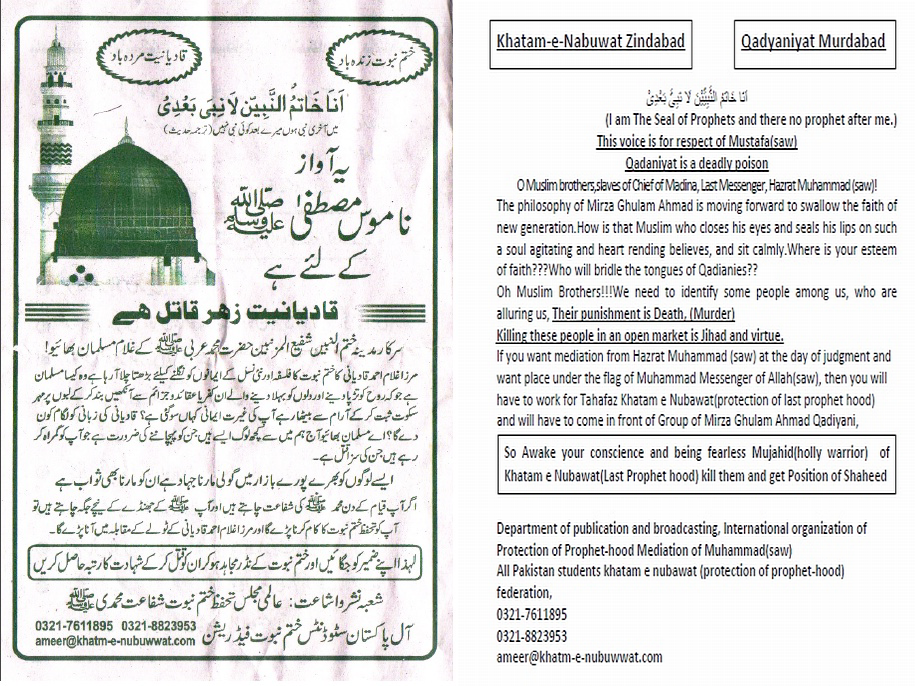




 Posts
Posts


