Thursday, January 14, 2010

Ahmadi leader’s murder suspects ‘visit’ police again

---Daily Times, Pakistan
Thursday, January 14, 2010

Ahmadi leader’s murder suspects ‘visit’ police again

*
None of the accused have moved court for bail despite being named in FIR 8 days ago
*
Complainant denies SP’s claim that he had asked police not to arrest accused
*
MPA says four men are innocent and he advised them not to get bail

By Rana Tanveer


LAHORE: All four men accused of murdering a local Ahmadi leader in Ferozewala appeared before the Sheikhupura superintendent of police (SP) (Investigation), accompanied by a Pakistan Muslim League-Nawaz (PML-N) member of the provincial assembly, to “prove their innocence” on Wednesday.

Eight days have passed since the victim’s family nominated the four men in the FIR but the police have yet to formally arrest the suspects despite getting two chances – when the men visited the police station with PML-N MPA Pir Ashraf Rasool to ‘prove their innocence’. It is important to mention here that the suspects have not moved the court for bail so far.

According to details, two assailants gunned down 70-year-old Muhammad Yousaf while he was at his general store on January 5. A first information report (FIR) was registered at the Ferozewala Police Station, wherein Muhammad Ahmed Fridi, Inamullah son of Shaukat Ali, Ashraf and Haji Arshad were named as the accused. The two assailants were not named in the FIR.

Consent: Syed Amin Bukhari, the SP, told Daily Times that the accused were not on bail and according to the law they should be arrested, but with the consent of the complainant the police had given them a chance to prove their innocence.

The SP said both parties had appeared before him, adding that he had given them a few days to resolve the matter through a local panchayat. He said the accused had guaranteed their cooperation and would not evade the police.

Influence: However, Faatehul Din, the complainant and son of the murdered Ahmadi leader, told Daily Times the accused had been given undue favour by the police and PML-N MPA Pir Ashraf Rasool. He said he had never asked the police not to arrest the accused. He said the MPA accompanied the accused to the office of the SP to influence the police.

Suspects are innocent: The MPA told Daily Times that the four men were innocent. He said he had advised the four not to get bails as they were innocent, adding that the competent authority to decide the case were the police and the courts. Ashraf said he was ready to hand over the men to police custody.

Saleemud Din, a spokesperson for the Jamaat-e-Ahmadia, told Daily Times the accused were being given undue favour.

URL: www.dailytimes.com.pk/default.asp?page=2010\01\14\story_14-1-2010_pg13_1

Protect Ahmadis [Editorial]

---Daily Times, Pakistan
Wednesday, January 13, 2010

Second Editorial: Protect Ahmadis

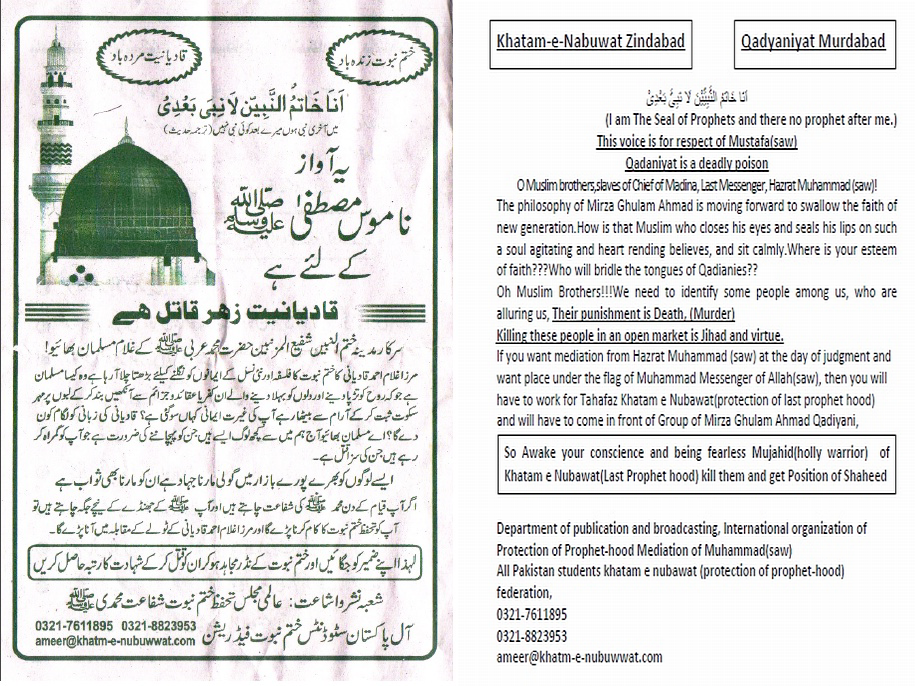
The recent incident of murder of an Ahmadi leader in Ferozewala, a city of Sheikhupura district situated near Lahore, is a sad reflection of how society chooses to treat a section of the minorities, variously known as Mirzais or Qadianis in Pakistan. What is more disconcerting though, is the apathy — rather collusion — of the state, which not only allows such incidents to take place under its very nose, it tends to protect the perpetrators. According to a series of reports published in this paper, Professor Mohammad Yousaf, leader of the Ahmadi community in Ferozewala, had sought police protection against sectarian zealots in his locality who had been threatening him. Allegedly, in response to this, two unidentified assailants shot him dead while he was at his general store. It was with some effort the family managed to lodge the FIR against the two murderers and four abettors known to the victim, who live in the same area. Instead of arresting the accused and investigating further, it is reported that the police let the four abettors go when they visited the police station with PML-N’s member of the Punjab Assembly Pir Ashraf Rasool. Meanwhile, both the police and the nominees in the FIR have been pressurising the family to withdraw the murder case. Alarmingly, even after the ghastly retribution visited upon Mohammad Yousaf, Khatam-e-Nabuwat Youth Wing’s signboard on the main roundabout of the town, which urges believers to kill and maim Islam’s enemies and to socially boycott Ahmadis, has not been removed.

While we are witnessing the gruesome consequences of promoting extremist Islam in the form of suicide attacks, this incident shows another dimension of the free rein given to hate-mongering mullahs. Most often the paranoia and hatred against Ahmadis inspired by self-styled Islamic leaders has taken a murderous turn. Not long ago, a TV presenter incited the wholesale murder of Ahmadis by declaring it an obligation for Muslims, as a result of which two targeted killings took place in Sindh. This continues unabated because of the failure of the concerned authorities to take action against the culprits. Apparently, it is due to a deep bias that runs through the entire system. There is a visible nexus of protection as demonstrated in this case. Whether they are Muslim or non-Muslim, the state is responsible to protect all citizens of Pakistan against oppression. It is these kinds of cases that really require judicial activism, as the legislature and executive have both been found siding with the perpetrators rather than the victims. *

URL: www.dailytimes.com.pk/default.asp?page=2010\01\13\story_13-1-2010_pg3_1

Wednesday, January 13, 2010

Pakistan’s abused Ahmadis: A mosque by any other name

---The Economist
Wednesday January 13th 2010
Pakistan’s abused Ahmadis
A mosque by any other name

Jan 13th 2010
From The Economist print edition

Members of the Ahmadiya sect face a new rash of persecution

AS AFZAL TAHIR was reciting the Koran last month, and otherwise minding his own business—an electrical repair shop—four Muslim fundamentalists came to threaten him. If they caught Mr Tahir masquerading as a Muslim again, they said, he would pay for it: with up to three years in prison, which is the penalty for members of the Ahmadiya sect who are convicted of that crime.

Ahmadis consider themselves Muslims, though they differ from the Sunni mainstream on an important point: they believe that Mirza Ghulam Ahmad, the 19th-century Indian who founded their tradition, was a latter-day prophet. In many Muslims’ eyes, this makes them un-Islamic and blasphemous. Pakistan’s Ahmadis, of whom there may be 4m, were declared to be non-Muslims by the government in 1974. In the 1980s, under General Zia ul Haq, a fundamentalist Sunni dictator, most aspects of Ahmadi worship were in effect criminalised—in some cases by blasphemy laws which carry the death penalty.

The Ahmadis are an educated minority, who do well in commerce and produced Pakistan’s first Nobel laureate. But they are not permitted to call their mosque a mosque, nor to issue the Muslim call to prayer, display Koranic inscriptions or otherwise present themselves as Muslims. Under an arrangement re-established by Pervez Musharraf, the country’s most recent military dictator, Ahmadis have a separate voters’ list and parliamentary seats reserved for their candidates. But most Ahmadis choose not to vote at all. And some, including the leader of Lahore’s Ahmadis, Munir Ahmad Sheikh, argue that those holding the reserved seats, having implicitly accepted their status as non-Muslims, are not really Ahmadis at all.

Seated at Lahore’s main Ahmadi mosque—where an engraving of the Kalima, the Muslim profession of faith, has been crudely planked over—Mr Sheikh diagnoses a new outbreak of anti-Ahmadi thuggery. This is a roughly decennial event, he says, and has manifested itself in recent attacks on Ahmadi mosques in Lahore and intensified intimidation of Ahmadi traders.

A general rise in Islamist militancy, in which jihadists’ competing agendas have tended to merge, may explain this. Economic hardship, which aggravates the property disputes that so often underlie sectarian and religious violence, could be another factor. As can mundane political rivalries: a fiery dispute last September between Pakistan’s central “moon-sighting committee” and the government of North-West Frontier Province, over when to end the Ramadan fast, escalated to the point that supporters of the government likened their opponents to the Ahmadis—in effect, using the sect as a paragon of religious deviance.

So long as anti-Ahmadi sentiment is sanctioned by law, there is little prospect of breaking the decennial cycle. Nor is any political party likely to dare antagonising the Islamists by trying to repeal Pakistan’s anti-Ahmadi laws. It was, after all, a government of the relatively liberal Pakistan People’s Party that first declared the group to be non-Muslim. With most mullahs, the government and the law all ranged against the Ahmadis, it would be surprising if most Pakistanis were not too.

The shop next to Mr Tahir’s is pasted with anti-Ahmadi slogans. One screams “Every Ahmadi is a blasphemer like Salman Rushdie”. Asked whether this wasn’t rather un-neighbourly, the proprietor, Muhammad Rafiq, replies, “Whatever the mullahs say must be right.”

URL: www.economist.com/world/asia/displaystory.cfm?story_id=15266768

Ahmadi leader killed in Ferozwala: Police let suspects leave with PML-N MPA

---Daily Times, Pakistan
Tuesday, January 12, 2010

Ahmadi leader killed in Ferozwala: Police let suspects leave with PML-N MPA

* IO says nominated suspects allowed to leave on guarantee of MPA Pir Ashraf Rasool
* Complainants claim efforts being made to exonerate Yousaf’s killers

By Rana Tanveer

LAHORE: Four suspects – who remained at large for six days after their nomination in a first information report in the murder of a local Ahmadi leader were brought to a police station on Monday, but police let them leave with a member of the provincial assembly instead of arresting them, sources in the Ferozewala Police Station told Daily Times.

The sources said the MPA, a member of the Pakistan Muslim League-Nawaz (PML-N), had brought the four suspects – Muhammad Ahmed Fridi, Inamullah, Ashraf and Haji Arshad – to the police station, and they remained there for more than an hour. They said the investigation officer listened to their side of the story, wherein they claimed they were innocent and had been wrongly implicated in the case. Following this, the police – instead of arresting them on the basis of their nomination in the FIR – let them go with the MPA, said the sources.

According to the FIR registered with the Ferozewala Police Station on January 5, two armed assailants attacked 70-year-old Muhammad Yousaf while he was at his general store in the presence of Yousaf’s sons, Fatehuddin and Mahmood Yousaf. The FIR said Yousaf was shot six times in the chest and arms and he died immediately. Yousaf was allegedly killed for reporting the assailants to police over their reported involvement in the spread of religious hatred against the Ahmadi sect and provoking people to kill Ahmadis. According to the FIR, Muhammad Ahmed Fridi, Inamullah, Ashraf and Haji Arshad abetted Yousaf’s murder.

The policeman in charge of the investigation, Sub-Inspector Rai Zulfiqar Ali, told Daily Times that the suspects came to the police station with PML-N MPA Pir Ashraf Rasool, and conceded they were allowed to leave, “as the complainant party did not come to the police station”.

MPA’s guarantee: He said the suspects were summoned to the police station on Monday to listen to arguments from both sides. He said although the four men had been named in the FIR, they were allowed to leave on the MPA’s guarantee. “The MPA will bring them to the police station on Tuesday (today),” he said.

Zulfiqar said police were trying locate the two assailants – who had not yet been identified. He said after three raids were conducted to arrest the four suspects named in the FIR, the MPA brought them to the police station.

Exonerate suspects: Yousaf’s son Fatehuddin told Daily Times that police and the MPA were giving the suspects “an undue favour”. He said efforts were being made to “exonerate the suspects because they are influential”.

He claimed that the MPA had been “sheltering the suspects since the day of the murder … they have been living with him”. He said while police summoned his family to the station on Monday, they did not go because “we were feeling insecure because of their influence”.

Azhar Siddique advocate, an expert in criminal law, told Daily Times that the police decision to let the suspects go was “gross misconduct and illegal”. He said the development showed that police were biased against the complainants.

Meanwhile, the Jamaat Ahmadia Lahore adopted a resolution against the murder of a member of their sect. Spokesman Munawar Shahid told Daily Times that his group strongly condemned the role of “extremists spreading religious hatred”. He said that with such incidents on the rise, the government must take serious notice of alleged atrocities against Ahmadis.

URL: www.dailytimes.com.pk/default.asp?page=2010\01\12\story_12-1-2010_pg13_1

In Southeast Asia, human rights abuse is not yet history

---The Jakarta Post, Indonesia
Headlines Mon, 01/11/2010 8:58 AM

In Southeast Asia, human rights abuse is not yet history

Ary Hermawan, The Jakarta Post, Jakarta

The dark history of extra-judicial killings and disappearances of political or human rights activists seems so distant in democratic Indonesia, a decade after the collapse of Soeharto’s authoritarianism.

That, however, is no sign that human rights is no longer an issue in this country of 230 million people.

Only recently, a mob attacked a church that was still under construction in Bekasi, West Java, adding to the long list of cases of religious violence in the world’s largest Muslim country, which includes the banning of Ahmadiyah and the imprisonment of many whose faith has been deemed heretical and blasphemous by religious authorities.

While the mystery surrounding the 2004 killing of Munir Said Thalib has not been resolved, President Susilo Bambang Yudhoyono riled rights activists last week by appointing Lt. Gen. Sjafrie Sjamsoeddin as deputy defense minister, a move critics said highlighted Indonesia’s persistent culture of impunity.

The general is alleged to have been involved in a series of human rights abuses during the political turmoil in 1998. “The President’s step could tarnish Indonesia’s good reputation concerning human rights,” said Commission of Missing Persons and Victims of Violence (Kontras) coordinator Usman Hamid.

And the situation is no less disheartening in other ASEAN countries.

Myanmar has not yet released opposition leader Aung San Suu Kyi from her house detention, and has barred her from participating in the 2010 elections under a new election law, defying calls from leaders around the world to free the country’s democracy icon.

The encouraging signs of the junta opening up to the outside world have not yet resulted in the release of hundreds of jailed political activists there either.

In the Philippines, civilians including journalists were brutally killed in an apparently election-linked massacre in November last year, an atrocity which prompted global condemnation and that was recorded in history as one of the darkest days for journalists.

In Malaysia and Vietnam, political freedom is not yet a reality, even in the blogosphere where anonymity usually provides greater freedom to digital gadflies. Vietnam has recently launched a crackdown on bloggers who are critical of Communist Party policies, sending them to jail for breaching the security law.

According to the Associated Press, the bloggers were arrested because they spoke against the government’s policies toward China.

The supremacy of Islam as the state’s religion in Malaysia has also raised concerns of diminishing religious freedom in the country. The latest example was the government’s insistence on banning a Catholic publication from using the word “Allah” for God, which it said was exclusive to Islam.

Five churches were attacked last week in relation to the “Allah” row after the Malaysian government appealed a high court decision that overturned the ban.

Rights activists have also criticized ASEAN’s handling of sepa-ratist movements in restive regions such as in the southern parts of the Philippines and Thailand, and the eastern part of Indonesia, which often deliberately ignore any human rights approaches to reconciliation.

Thailand last month reprehensibly deported thousands of the Hmong refugees back to Laos, prompting condemnation from the international community who feared the Laos’ ethnic minority who backed the US during the Vietnam War may face more persecution. Myanmar also committed heinous crimes against Muslim Rohingyas.

As if domestic rights issues were not that overwhelming, Southeast Asian countries have now become a transit point for migrants fleeing war-torn and poverty-stricken homelands — another issue that also needs to be addressed with regard to human rights norms.

URL: www.thejakartapost.com/news/2010/01/11/in...not-yet-history.html

Friday, January 8, 2010

Great grandson of Mirza Ghulam Ahmed meets Qazi

---The News International, Pakistan
Thursday, January 07, 2010, Muharram 21, 1431 A.H

Great grandson of Mirza Ghulam Ahmed meets Qazi

By Our Correspondent
LAHORE

THE great grandson of Mirza Ghulam Ahmed Qadiani, Abdur Rahman, who has embraced Islam, called on Jamaat-e-Islami former Ameer Qazi Husain Ahmed at Mansoora on Wednesday.

He was accompanied by Allama Ibtisam Elahi Zaheer, the son of Allama Ehsan Elahi Zaheer.

Abdur Rahman, elder son of Mirza Nasir Ahmed, embraced Islam in the year 1999 after going through Allama Ihsan Elahi’s book “Qadiniat, Mirzayat and Islam.” He has command of seven languages and is working as a translator at Bhasha Dam. His Qadiani name was Mirza Ahmed Bilal.

Abdur Rahman told Qazi that after embracing Islam, he had given up his inherited property. Last year, he applied for Hajj and the Saudi authorities had asked him for documentary evidence of his embracing Islam which was produced to them.

He said that a fortnight back, a group of Qadianis abducted him and subjected him to severe torture at Aiwan e Mahmud near Sir Ganga Ram Hospital and his nose was fractured. He fell unconscious after which they abandoned him near Anarkali Bazaar. Allama Ibtisam Elahi provided him with protection and arranged his medical treatment.

Qazi Husain Ahmed condemned torture and said it exposed the cruel face of Qadianiat. He told Abdur Rahman that embracing Islam by him was a breakthrough and a big news. He said that if the people in Rabwah were given basic human rights, their majority would revert to Islam. At present, he said, Rabwah people were under great pressure.

Qazi called upon the government to provide proper security to Abdur Rahman and warned that if any harm was done to him, Qadianis would be held responsible.

He said Muslims all over the world were happy over embracing of Islam by Abdur Rahman. He also thanked the religious parties for expressing solidarity with Abdur Rahman.

On December 21, 2009 Express TV, Pakistan in its program “Point Blank” hosted by Mr. Mubashir Luqman, presented one Abdur Rehman who claimed to be a grandson of Hazrat Mirza Ghulam Ahmad Qadiani (as) and son of Hazrat Mirza Nasir Ahmad (ra), the 3rd Caliph of Ahmadiyya Muslim Community. In his interview and subsequent Press Conference arranged by Hafiz Ibtisam Elahi Zaheer, Secretary General of Jamiat Ahle Hadith, Abdur Rehman alleged that he convered to Islam in 1989 and now some Ahmadis have kidnapped and tortured him. In a Press Release Mr. Salimuddin, spokesperson of Jamaat Ahmadiyya, categorically denied Abdur Rehman’s false accusations as well as his claim. It is well known that Hazrat Mirza Nasir Ahmad (ra) had only three sons namely Mirza Anas Ahmad, Mirza Fareed Ahmad and Mirza Luqman Ahmad. Appearance of this fake person in media with connivance of mullas is an indication of conspiracy to harm Jamaat Ahmadiyya and family of holy founder of Jamaat.

URL: www.thenews.com.pk/daily_detail.asp?id=217381
 
^ Top of Page