Friday, July 8, 2011

European Parliament Voices ‘Grave Concern’ Over Religious Violence in Indonesia

Jakarta Globe, Indonesia
NEWS
European Parliament Voices ‘Grave Concern’ Over Religious Violence in Indonesia
July 08, 2011

The European Parliament has chimed in on incidents of religious persecution in Indonesia with a resolution that expresses “grave concern” over the recent string of attacks against Christians and Ahmadis, according to a religious rights group.

The resolution, released on Friday, details “grave concern at the incidents of violence against religious minorities, particularly Ahmadi Muslims, Christians, Baha’is and Buddhists … at the local blasphemy, heresy and religious defamation by-laws, which are open to misuse.”

The resolution also calls for the revision or repeal of the 2008 Joint Ministerial Decree prohibiting the dissemination of Ahmadiyah Muslim teachings, according to Christian Solidarity Worldwide.

Mitro Repo, a Finnish member of the European legislative body, said: “While Indonesia’s national ideology ‘Pancasila’ has been a great example of enshrining pluralism, cultural harmony, religious freedom and social justice, there is a deep concern that the blasphemy, heresy and religious defamation by-laws are open to misuse. Such laws do not have a place in a state that truly respects human rights and engages in an open dialogue with its civil society.”

The past few years have seen continued acts of violence against Ahmadis in Indonesia, culminating in the killing of three sect members by a mob in Cikeusik, Banten, in February.

And Christians in Bogor have been locked out of their own church by that city’s administration in defiance of a Supreme Court order. Tensions in that city between members of the GKI Tasmin Church and hard-line Muslims led to the stabbing of two church elders last October.

The resolution follows similar moves by legislative bodies in the United States, United Kingdom and Sweden highlighting the violent persecution of religious minorities in Indonesia.

CSW’s special ambassador Stuart Windsor said: “We hope that this resolution, taken together with the actions in the UK and Swedish parliaments, will increase the pressure on the Indonesian government to take firm action to protect Indonesia’s religious minorities from violent attacks.

“We urge the Indonesian government to uphold the nation’s proud tradition of religious pluralism, freedom and harmony enshrined in the country’s guiding philosophy of ‘Pancasila’, to promote peaceful co-existence between different religious groups, and to combat religious extremism and violence.”

Activists Cry Foul at ‘Lenient’ Prosecutors in Ahmadiyah Trial

Jakarta Globe, Indonesia
NEWS
Activists Cry Foul at ‘Lenient’ Prosecutors in Ahmadiyah Trial
Elisabeth Oktofani & Chrestella Tan | July 08, 2011

A video grab showing the attack on members of the minority Ahmadiyah Islamic sect in Pandeglang, Banten province, on February 6. Activists on Thursday decried sentence demands of less than a year for those on trial over the attack. (Photo courtesy of Human Rights Watch)
Rights activists expressed outrage on Thursday over the light jail terms sought for suspects in the deadly attack on Ahmadiyah followers in Banten in February, saying such leniency would not deter future violence.

“There is a lack of seriousness from law-enforcement officials in handling sectarian clashes, and this could pose a danger to national unity,” said Bonar Tigor Naipospos, the deputy chairman of the Setara Institute for Peace and Democracy.

His remarks came shortly after prosecutors at the Serang District Court in Banten recommended sentences of between five and seven months for 12 defendants accused of having a role in the Feb. 6 attack in Cikeusik subdistrict. Three followers of Ahmadiyah, a minority Muslim sect, were killed in the attack and five more were seriously injured.

“The seven-month demand is really weak,” Bonar said. “This was because the prosecutors saw the case as a spontaneous incident instead of a systematic attack.

“More than that, pressure from outside groups during the trial was also a factor in the weak sentencing demand. The state failed to provide adequate protection for prosecutors and judges during the trial.”

He was referring to the defendants’ vocal supporters who have crowded the courtroom throughout the trial. Bonar said trials involving sectarian clashes needed the same high level of security provided for terrorism cases.

The prosecution was also criticized by activists for failing to charge the defendants with incitement of hatred, which carries a heavier maximum punishment.

“The prosecutors didn’t prepare the sentencing demand based on the evidence and the magnitude of the crime,” said Haris Azhar, the executive director of the Commission for Missing Persons and Victims of Violence (Kontras).

“They should have seen this as a very serious case because [the attack] occurred because of hatred spread by certain groups of people,” he said.

“It is clear to see that there is a lack of courage and ability on the part of the prosecutors to bring the hatred issue to trial, while [inciting hatred] is a very serious and important issue.”

The defendants have been charged with crimes ranging from provoking violence to assault. Still, the lesser of the charges, provocation, allows punishment of up to six years in jail.

Meanwhile, prosecutors have said the sentencing recommendation was light because the group of 25 Ahmadis involved in the incident was believed to have played a part in provoking the attack.

Prosecutors said the evidence showed members of the banned sect not only provoked the riot, but also filmed it and distributed the videos.

Sentences of seven months were sought for 10 defendants, while sentences of five and six months were sought for two others during the marathon hearings in Serang, the capital of Banten.

Copyright 2010 The Jakarta Globe
URL: www.thejakartaglobe.com/home/activists-cry.../451544

Thursday, July 7, 2011

Prosecutors Ask for 5-7 Months for Defendants in Cikeusik Ahmadi Attack

Jakarta Globe, Indonesia
NEWS
Prosecutors Ask for 5-7 Months for Defendants in Cikeusik Ahmadi Attack
Jakarta Globe | July 07, 2011

In February, 2011, a mob of about a thousand attacked a house that sheltered 25 Ahmadiyyah members; killing three and severally injuring five in Cikeusik.
Prosecutors entered relatively light sentencing demands on Thursday for 10 participants believed to have roles in the deadly mob attack on a group of Ahmadiyah sect members in Cikeusik, Banten, earlier this year.

The defendants, charged with crimes ranging from provoking violence to assault, received sentence demands in the five to seven-month range — far below the maximum of six years for the lesser charge of provocation.

Prosecutors said the sentencing requests were fairly light because they believed that the group of 25 Ahmadis had played a part in provoking the attack.

The attack, which was filmed and posted on YouTube, saw a mob of about a thousand attacking a house that sheltered 25 members of the minority Islamic sect. Three Ahmadis were killed and five were seriously injured in the violence.

Prosecutor M. Yunis said the sentencing demands were lighter due to evidence that showed that members of the banned sect were systematically provoking riots.

Two other defendants, both under 17-years-old, were still awaiting sentencing demands.

Copyright 2010 The Jakarta Globe
URL: www.thejakartaglobe.com/news/prosecutors-ask.../451435

Ahmadiyah trial continues with extra security

Jakarta Post, Indonesia
ARCHIPELAGOThu, 07/07/2011 12:47 PM
Ahmadiyah trial continues with extra security
The Jakarta Post
A court case centered around a fatal attack on members of a religious minority group, Ahmadiyah, continued Thursday at Serang District Court in Banten, with the court set to hear prosecutors read out their sentence demands.

The hearing is being guarded with extra security, with personnel from the police and the military seen ready with a water cannon and antiriot vehicles in the court parking lot, kompas.com reported Thursday prior to the hearing.

Security screening has also been tightened for people wanting to enter the court.

Ambulances were also seen near the court building.

In February, about 1,500 people attacked members of the Ahmadiyah sect in Cikeusik, Banten, killing three.

Eleven defendants are being jointly tried for an assault causing death, inciting violence, mistreating others, participating in an assault and illegally possessing sharp weapons.

However, prosecutors have declined to charge anyone with the murder or manslaughter of the three Ahmadis.

Legal activists monitoring the trial including from the Institute for Policy Research and Advocacy (Elsam) previously said the prosecutor involved in the case had show a substandard performance. (rpt)

Copyright © 2008 The Jakarta Post - PT Bina Media Tenggara. All Rights Reserved
URL: www.thejakartapost.com/news/2011/07/07/ahmadiyah-trial...

Tuesday, July 5, 2011

Pakistan’s persecuted minorities: For Ahmadi refugees in Thailand, problems double back home

Express Tribune, Pakistan
Pakistan
Pakistan’s persecuted minorities: For Ahmadi refugees in Thailand, problems double back home
By Abdul Manan
Published: July 5, 2011
A Pakistani refugee who is a member of the Ahmadiyya, an Islamic minority sect, carries his daughter as he is released from a detention centre in Bangkok June 6, 2011. PHOTO: REUTERS/ FILE
BANGKOK: Irfanul Mulk may have been able to find temporary shelter in Thailand, but those who forced him out of Pakistan are now flexing their muscles to bring him back.

Irfan, 27, left his village Taban in Punjab’s Sheikhupura district after he and his two brothers Furqanul Mulk, 21, and Umer Sultan, 31, were held under Pakistan Penal Code’s Section 298-C which prohibits Ahmadis from calling themselves Muslim or “in any manner whatsoever outrages the religious feelings of Muslims”. A police case was lodged against them but residents refused to calm down, and the three men decided to leave the country.

“When people of the village learnt about our detention and asylum applications, they approached the Sheikhupura District police chief and submitted an application seeking our repatriation to Pakistan calling us traitors who had maligned the country abroad,” Irfan told The Express Tribune.

Since then, the police have raided their home several times and their elder brother Haider Sultan, who stayed back in Pakistan, is facing constant threats.

Representatives of the Tehrik-i-Khatm-i-Nubuwat, an organisation that has repeatedly attacked the Ahmadiyya community for its religious beliefs, have even written to the US Embassy in Pakistan, warning them against giving American nationality to Irfan and his brothers.

But while Irfan and his brothers had to suffer at the hands of their neighbours, there are others who have been persecuted by their own families.

Syed Altaf Hussain Bukhari, the grandson of a renowned pir* whose shrine is located on the outskirts of Islamabad, moved to Thailand in November 2010 with his wife Sadia and their two children. They were forced to flee after his family cut off ties with them for having converted in 1996 to the Ahmadi faith and even subjected him to physical torture.

“When I announced that I was becoming an Ahmadi, my brothers and a cousin, who was the caretaker of the shrine at that point, immediately denounced their relationship with me,” he said. His brothers started telling followers that he was not their real brother as their father had adopted him. Pamphlets bearing his photograph were distributed in Sheikhupura, calling him liable to be murdered.

To protect his wife and children, Altaf, who survived the deadly attacks on Ahmadiyya worship places in Lahore in May 2010, left his ancestral village to move to Sheikhupura and eventually, in 2003, he moved to Lahore where they went into hiding.

Once his people back home learnt that he was seeking asylum in Thailand, they started threatening his father-in-law as well.

Shahid Mehmood, who fled from Multan where he had an established business, said that he had witnessed the beheading of two Ahmadi doctors in March 2009 and insisted on registering an FIR against a pir for instigating his followers to murder Ahmadis. “His followers would visit my shop daily and try to persuade me to withdraw the case,” says Mehmood. “I went to three senior police officers who threw the file in my face and told me that they were followers of [the pir] and could not dare to proceed against him.”

But after another Ahmadi man Rana Ataul Kareem was murdered in August 2009 and the case was traced back to the pir, Mehmood started to receive threats. In September 2010, Mehmood, his wife and four children, arrived in Bangkok.

Back home, Mehmood’s shops have been closed and his house has been sealed.

Many families decided to send younger members abroad while parents stayed back. Aamir Ali, 22, left his village Pasrur in Punjab’s Sialkot district along with his three sisters. But after news of them seeking asylum spread, villagers started to taunt their mother, who has had to regularly switch homes.

* The name of the pir is being withheld on the request of Bukhari.

Published in The Express Tribune, July 5th, 2011.

Copyrighted © 2011 The Express Tribune News Network
URL: http://tribune.com.pk/story/202641/pakistans-persecuted.../

Monday, July 4, 2011

Insecure minorities: Threatened at home, jailed abroad

Express Tribune, Pakistan
Pakistan
Insecure minorities: Threatened at home, jailed abroad
By Abdul Manan
July 04, 2011
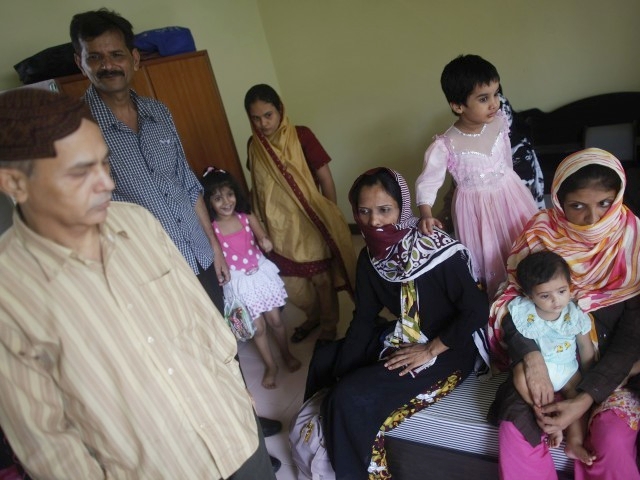
The refugees, all members of the Ahmadi community, had been in detention for more than six months. PHOTO: REUTERS/FILE
BANGKOK: Tahir Mehmood Adil, an Ahmadi from Sialkot, was kidnapped in 2009 by militants, held captive for 36 days and threatened with beheading. His cousin, Sajjad, negotiated successfully for his release. A few days later, however, Sajjad was shot dead and Adil received a text message saying he would be next.

That was when Adil fled to Thailand with his wife and three children. On arrival, he was arrested by Thai immigration authorities who tore up their asylum papers and took them to Bangkok’s notorious Immigration Detention Cell (IDC). The family was detained here for the next seven months in the most inhumane conditions.

Detained refugees

Adil is one of 96 such refugees from Pakistan whose fate hangs in balance as they are transferred from one detention centre to another, despite having their status recognised by the United Nations High Commission for Refugees (UNHCR).

By December 2010, the Thai immigration bureau detained 91 Pakistanis seeking asylum on grounds of religious persecution in their home country. Another 38 were detained in the early months of 2011.

Of the 131 Ahmadis at Bangkok’s Suan Phlu IDC, 35 were sent back in the last week of December. The remaining 96 refused to budge on grounds that it amounted to suicide. These persons were finally released with the support of the Thai committee for refugees in June.

The group now reports to the immigration bureau every month. Their situation has improved as compared to their time in the IDC but they are not allowed to leave their residence without permission from the local police.

Inhumane conditions

This group, including 34 children, now lives in two separate confinement centres and apartments in a Bangkok suburb. Each family has a single room. For them there is some light at the end of the tunnel. The refugees are awaiting resettlement to third countries, mainly the US.

The conditions at the detention centre were worse, says Adil as he looks back at his time there. The cells where they were detained were designed to hold around 40 but housed 150 detainees. Women and children were separated from the men.

The choice was clear. Stay in the IDC or go back to Pakistan. It is an unending battle. Two of the detainees who have been in IDC for 23 months were granted bail but the UNHCR refused to recognise their status. Two others who were at the last step of their resettlement process were told to repeat the entire process.

Painful process

Adil told The Express Tribune that everyone had a story to tell. He acknowledged that even though they were aware of Thailand not being a signatory to the UNHCR’s convention on refugees, their fate in Pakistan was one which would be worse and that is why they decided to come here.

Adil said that the process of seeking asylum and refugee status from UNHCR was lengthy and painful. He said interviews don’t take place for months, much beyond the mandatory three-month period. The resettlement is another lengthy process in which refugees are informed about their final destination.

Individual stories

The stories go on. Qamar and Mansoor who had been in the centre for the last two years had been granted bail but they were later refused refugee status. After their release, their resettlement process had slowed down.

One Rana Qamar had been detained along with his two children while his wife was in Pakistan. Qamar’s 11 year old daughter, Areesha, was detained for seven months all alone.

Another detainee, Adnan Rashid, said that he was in detention but his wife and two children were not. He feared for them.

Doctors who escaped targeted killings at home are also part of the group. Dr Hafeez Ahmad, who hails from Karachi said that after his colleagues, Dr Hameedullah Shah and Dr Najamul Hassan were shot dead he decided to leave. But not after shifting his clinic four times in a bid to discourage those targeting him.

Kashif Butt whose wife gave birth to their child in the IDC recalls his horrible experience. When his wife was taken to the nearby hospital, her legs were tied so she could not run away. In another case, a Pakistani woman’s feet were bound when she went in for a caesarean procedure.

Every day is a living hell for many. The Ahmadiyya Community representative in Thailand Imran Ahmad told The Express Tribune that the future of those family members who later joined their next of kin hangs in balance.

Despite all the frustration and the fear, most are fearful of returning to Pakistan. Some laugh and others cry at the mention of their home country. But all pray for their future and for those left behind.

Published in The Express Tribune, July 4th, 2011.

Copyrighted © 2011 The Express Tribune News Network
URL: tribune.com.pk/story/202056/insecure-minorities.../
 
^ Top of Page