 |
Pakistan |
Thinking proactively: Ahmadis have found their own solutions in Rabwah
By Saba Imtiaz
Published: July 11, 2011
Published: July 11, 2011
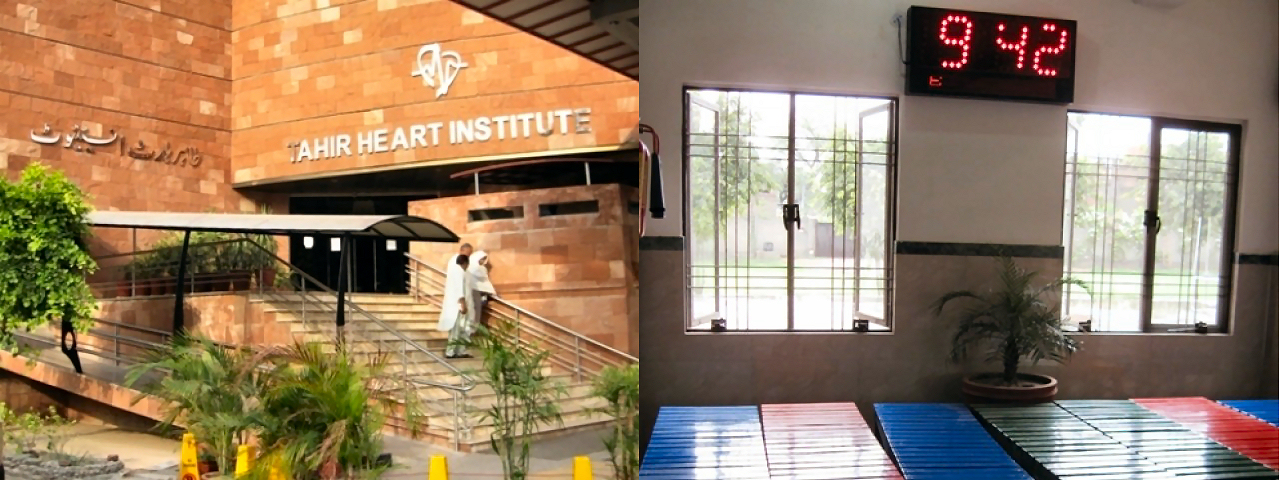 Over 80% patients at the Tahir Heart Institute are not from community. PHOTO: SABA IMTIAZ/EXPRESS |
RABWAH: When a fire broke out at a building in Chiniot, the district administration called the rescue service in Rabwah for help.
The irony that the Chiniot building was owned by a member of the Khatam-e-Nabuwwat movement is not lost to Rabwah’s rescue services. A former tae kwon do instructor with the Pakistan Army, Nadir Saidain says the fire service was started because the district administration refused to assist in rescue operations in Rabwah town.
The service, like many others in the area – such as a 200-bed guest house – is free. Other facilities, including a sports centre and swimming pool, are heavily subsidised.
Despite the ostracism of Ahmadis in mainstream society, the community’s facilities draw people of all faiths to Rabwah.
The gleaming 80-bed Tahir Heart Institute is one example. Over 80 per cent of its patients are not Ahmadis. Its head, Dr MMH Nuuri, says the hospital does not have any discriminatory policies. Admission forms do not ask for the patient’s religion, and preaching in the premises is not allowed.
Up to 300 people are treated daily, many of whom hide details of their visits. According to Dr Nuuri, “I overheard a patient talking on the phone and telling someone he was under treatment in Sargodha. The patient later said, ‘Sorry doctor, but if people know I am in Rabwah I will not be spared.’”
Treatment is free, but those who can afford it contribute towards the cost. Referrals come in from cardiologists across Pakistan, and it has attracted doctors from abroad to practice for short stints.
“Our doctors have to be committed towards their profession,” Dr Nuuri said. “Our philosophy is that the patient is always right and doctors have to abide by their wishes.”
The hospital is one of many in Pakistan built by the Ahmadiyya community. Healthcare, along with other areas that would normally be the domain of the district’s administration – such as security and sanitation – are all managed by the community, since the administration is lax in its duties.
Reminders of the government’s negligence are visible all over Rabwah. The community’s schools, which were nationalised in the 1970s, were never returned. Tahir Ahmad, who handles education projects, maintains a list of government officials he has met since 1996 to lobby for the return of the schools to the community’s control. Despite complying with the government’s requirement to deposit an amount comprising fees and schools’ staff allowances for six months to one year, the government refuses to denationalise the schools, citing “law and order” as a reason.
Ahmad recalls a conversation with then-outgoing Punjab Chief Secretary Kamran Rasool. “Young man, you are an Ahmadi,” Rasool reportedly said. “You are not going to get these schools back.”
The community has built new schools and provides scholarships and soft loans. As a result, Rabwah reportedly has a literacy rate of over 90 per cent. One such school – with a modern lab, well-stocked library and spacious classrooms – charges a monthly fee of Rs25.
The schools provide a safe environment for students who would be harassed elsewhere. Young graduates told The Express Tribune about being shunned for their faith or told to ‘join the right way’. One student who was asked to leave his hostel because of his faith has not recovered from the incident as yet, and is reluctant to complete his education.
Even though Ahmadi families were discriminated against during last year’s floods, the community has provided housing and aid to families – irrespective of their beliefs – in flood-affected areas. “We were taking relief goods to Rajanpur once,” recalls a representative. “We were stopped on the way and asked, “You are taking relief goods to Ahmadis? Don’t you know they are non-believers?”
Published in The Express Tribune, July 11th, 2011.
The irony that the Chiniot building was owned by a member of the Khatam-e-Nabuwwat movement is not lost to Rabwah’s rescue services. A former tae kwon do instructor with the Pakistan Army, Nadir Saidain says the fire service was started because the district administration refused to assist in rescue operations in Rabwah town.
The service, like many others in the area – such as a 200-bed guest house – is free. Other facilities, including a sports centre and swimming pool, are heavily subsidised.
Despite the ostracism of Ahmadis in mainstream society, the community’s facilities draw people of all faiths to Rabwah.
The gleaming 80-bed Tahir Heart Institute is one example. Over 80 per cent of its patients are not Ahmadis. Its head, Dr MMH Nuuri, says the hospital does not have any discriminatory policies. Admission forms do not ask for the patient’s religion, and preaching in the premises is not allowed.
Up to 300 people are treated daily, many of whom hide details of their visits. According to Dr Nuuri, “I overheard a patient talking on the phone and telling someone he was under treatment in Sargodha. The patient later said, ‘Sorry doctor, but if people know I am in Rabwah I will not be spared.’”
Treatment is free, but those who can afford it contribute towards the cost. Referrals come in from cardiologists across Pakistan, and it has attracted doctors from abroad to practice for short stints.
“Our doctors have to be committed towards their profession,” Dr Nuuri said. “Our philosophy is that the patient is always right and doctors have to abide by their wishes.”
The hospital is one of many in Pakistan built by the Ahmadiyya community. Healthcare, along with other areas that would normally be the domain of the district’s administration – such as security and sanitation – are all managed by the community, since the administration is lax in its duties.
Reminders of the government’s negligence are visible all over Rabwah. The community’s schools, which were nationalised in the 1970s, were never returned. Tahir Ahmad, who handles education projects, maintains a list of government officials he has met since 1996 to lobby for the return of the schools to the community’s control. Despite complying with the government’s requirement to deposit an amount comprising fees and schools’ staff allowances for six months to one year, the government refuses to denationalise the schools, citing “law and order” as a reason.
Ahmad recalls a conversation with then-outgoing Punjab Chief Secretary Kamran Rasool. “Young man, you are an Ahmadi,” Rasool reportedly said. “You are not going to get these schools back.”
The community has built new schools and provides scholarships and soft loans. As a result, Rabwah reportedly has a literacy rate of over 90 per cent. One such school – with a modern lab, well-stocked library and spacious classrooms – charges a monthly fee of Rs25.
The schools provide a safe environment for students who would be harassed elsewhere. Young graduates told The Express Tribune about being shunned for their faith or told to ‘join the right way’. One student who was asked to leave his hostel because of his faith has not recovered from the incident as yet, and is reluctant to complete his education.
Even though Ahmadi families were discriminated against during last year’s floods, the community has provided housing and aid to families – irrespective of their beliefs – in flood-affected areas. “We were taking relief goods to Rajanpur once,” recalls a representative. “We were stopped on the way and asked, “You are taking relief goods to Ahmadis? Don’t you know they are non-believers?”
Published in The Express Tribune, July 11th, 2011.
Copyrighted © 2011 The Express Tribune News Network
URL: http://tribune.com.pk/story/207111/thinking..rabwah/
URL: http://tribune.com.pk/story/207111/thinking..rabwah/






 Posts
Posts


