 |
October 07-13, 2011 Vol. XXIII, No. 34 |
Blog » By Tariq Bashir
Rabwah: an oasis of tranquility amidst raging storms

Apart of the city caught fire or, more probably, was set on fire and under cover of the fire, a mob started targeting a religious minority killing a few big names of the community. Terrified of impending death at the hands of the baying crowd, the remainder took refuge in a building where the ruler was under a legal obligation to protect their lives only to be butchered on coming out even though they had been promised a pardon if they renounced their faith. 150 people died but the perpetrators were only punished lightly with fines; their biggest protector being the fact that they all belonged to the majority religion of the land. In case you are wondering, no, the incident didn’t take place in Lahore on 28 May 2010 against Ahmadis although the murderous human instincts usually reserved for religious/ethnic minorities, almost similar modus operandi and chillingly identical sequence of events with minor changes remain the same almost a millennium later.
The above refers to the infamous Clifford’s Tower massacre of Jews, one of the fiercest and racist pre-expulsion pogroms in medieval York, England in March 1190 which took place a mere six months after the coronation of King Richard I. Try to change the names, location year and especially the eventual rap-on-the-knuckles punishment for the perpetrators from York in 1190 to almost a thousand years later in Lahore in 2010, you will find overwhelming similarities in both incidents extremely disturbing. That’s not all, identical public opinions , in both medieval England and 21st century Pakistan regarding minorities when they are invariably blamed for being at fault when persecuted is chillingly shocking. Emotional scars are seldom healed especially when the victim is a whole group of people. Human history is replete with such mob killings and the apparent “crime” for attracting such gruesome mass punishment, incidentally, has often been their membership of a certain religion or ethnic group.
Perched on the unenviable position of the most oppressed religious minority in Pakistan by far the Ahmadis of Pakistan have been bearing the brunt of the indigenous clergy’s venom hell bent upon decimating them if they refuse to renounce their faith for almost six decades. A visit to Rabwah in order to get a perspective on things was a must. After picking up my contact, Imran from Chiniot, a small town only a few kilometers apart from Rabwah on the main Faisalabad-Sargodha highway, it was time to enter the leafy hamlet.
Planned and built in the same era with its wide roads, semi curves, neat roundabouts and, amongst others, eucalyptus trees, Rabwah feels like Model Town, the upscale suburb of Lahore. The mid morning sun was fast threatening to assume its furious glow and the tiny puddles of water accumulated from the overnight rain had started to give off steam. Driving through the furrows made in the muddy, half-broken road by vehicles’ tyres near the busy market place with greengrocers hawking their merchandise and men, women and children noisily haggling, the scene could have been that of any small town Sunday market in Pakistan.
In Pakistan’s political calendar 1974 looms large as the year when the society at large happily embraced gradual erosion of its core social values of tolerance and religious freedom failing to cherish and guard the same as happens in most civilized societies. Eversince that lamentable parliamentary over-reaction under pressure from the religious right the collective slow trot on the road to perdition-and now having been worked up into a swift gallop-is dotted with a number of milestones of shame, many stained with the blood of religious minorities.
Like a Mormon town Rabwah’s religious symbols are the first to greet the visitor especially the distinct black caps worn by men and boys making one feel like being in a different place from the rest of rustic, rural Punjab. Even the burkas women wore were cut and stitched in the 70s style as was commonly worn by women of my mother’s generation of the same era when the impossible duality of figure hugging and hijab could go hand in hand. Does that signify the community’s abrupt isolation from the mainstream since 1974 like a clock rendered out of order after a bomb explosion showing the exact time of the blast? Although I did not try to find the answer, privately, my answer to that was a yes.
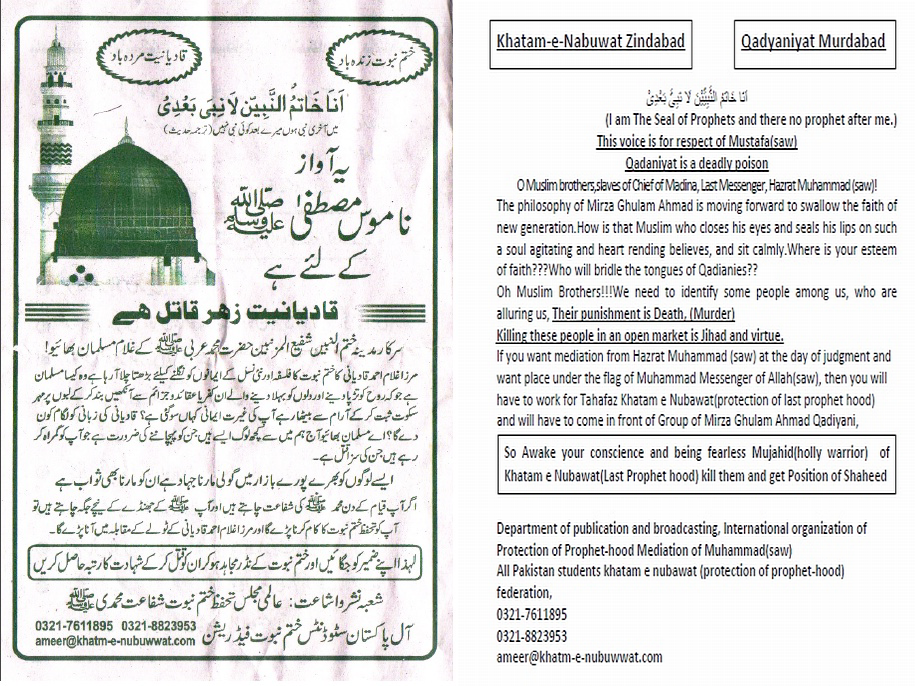
Mr Khan, the retired, grey-haired civil servant out of the three gentlemen that I was supposed to meet had a more secular and egalitarian outlook on the whole issue. The other two, Shakeel, a prayer leader from a nearby district and Asim, a volunteer in his early thirties seemed more orthodox in their approach in terms of religion to the point of proselytizing. After lunch at Darul Ziafat and during tea and cookies I was shown examples of such milestones, posters inciting people to murder apostate and perfidious fifth columnists Qadianis, discriminatory land auction advertisements expressly excluding Ahmadis from taking part, the kind of overt racism West Indian blacks and Irish immigrant workers had to endure in the 50s London barring perhaps the death threats.
While sitting in the shadow of the portraits of bearded and turbaned religious leaders of the faith, past and present, adorning the walls of the sitting area adjacent to the dining table where lunch was served earlier by efficient waiters, the conversation invariably veered towards religion and theological differences between creeds and sects. Although as per our mutually agreed arrangement only human rights angle of the abuses had to be discussed but the exchange on comparative religions was getting quite engrossing.
On February 27 1842 a brilliant comet belonging to the Kruetz Sungrazing Comet Group passed only 126,000 miles from Sun’s photoshere which appeared to the naked eye as “an elongated white cloud”. Passengers on board the ship Owen Glendower, off the Cape of Good Hope, described it as a “short dagger like object” that closely followed the Sun towards the western horizon. William Sears, an American convert to Baha’ism, mentions this comet in his riveting read, Thief in the Night as a proof of the fulfillment of Biblical and Islamic prophecies concerning the second coming of the Messiah. Intriguingly at about the same time when Baha’ism was being born in Shia Iran Qadiani faith was launched in British India. Even more intriguing was the fact that both claimed the advent of the promised Messiah; I could not help but ask my hosts the obvious question.
“Do you rely on the sighting as a sign of the second coming like the Baha’is?“ No was the definitive answer from Mr Khan, the effete septuagenarian who looked surprisingly fit for his years. “But the choice is between Baha’ism and Ahmadiyya [when it comes to the second coming of Jesus]“, he chuckled with an intelligent shine in his eyes living upto his palpably relaxed demeanour causing a rather long pause of silence in the conversation. Quite frankly, the picture one gets these days of smaller religious groups is that of being increasingly anxious to ensure their physical well being rather than care about their creed being superior, Ahmadis being no exception. When will this atmosphere of intolerance and inhuman hatred ease up and who will pull the plug? The cliched but true answer to the latter part of my question was trotted out by those present in unanimity; the military establishment who propped up the half baked, semi literate mullah to create a perpetual constituency for itself will have to pull the plug and walk out of this dangerous and pernicious state policy.
As our vehicle slowly trudged out of that well kempt oasis of tranquility after saying our farewells amidst mutual feelings of doom and gloom, my mind went back to what Khan had remarked earlier about the westernized liberal elites equally if not more to blame for extremism to take root since they are the ones who have, over the years, kept the dream of rule of law and constitutionalism alive. One could easily add another much bigger section of the population which, dare I say, is the silent majority; those straddling the liberal-conservative divide that usually choose not to voice their concerns when it comes to the constitutional right to life, never mind the freedom to practice religion.
Food for thought? Indeed.
Names of people mentioned in the piece have been changed.
The author can be reached at bashirtariq33@yahoo.co.uk and on twitter @Tariq_Bashir
The above refers to the infamous Clifford’s Tower massacre of Jews, one of the fiercest and racist pre-expulsion pogroms in medieval York, England in March 1190 which took place a mere six months after the coronation of King Richard I. Try to change the names, location year and especially the eventual rap-on-the-knuckles punishment for the perpetrators from York in 1190 to almost a thousand years later in Lahore in 2010, you will find overwhelming similarities in both incidents extremely disturbing. That’s not all, identical public opinions , in both medieval England and 21st century Pakistan regarding minorities when they are invariably blamed for being at fault when persecuted is chillingly shocking. Emotional scars are seldom healed especially when the victim is a whole group of people. Human history is replete with such mob killings and the apparent “crime” for attracting such gruesome mass punishment, incidentally, has often been their membership of a certain religion or ethnic group.
Perched on the unenviable position of the most oppressed religious minority in Pakistan by far the Ahmadis of Pakistan have been bearing the brunt of the indigenous clergy’s venom hell bent upon decimating them if they refuse to renounce their faith for almost six decades. A visit to Rabwah in order to get a perspective on things was a must. After picking up my contact, Imran from Chiniot, a small town only a few kilometers apart from Rabwah on the main Faisalabad-Sargodha highway, it was time to enter the leafy hamlet.
Planned and built in the same era with its wide roads, semi curves, neat roundabouts and, amongst others, eucalyptus trees, Rabwah feels like Model Town, the upscale suburb of Lahore. The mid morning sun was fast threatening to assume its furious glow and the tiny puddles of water accumulated from the overnight rain had started to give off steam. Driving through the furrows made in the muddy, half-broken road by vehicles’ tyres near the busy market place with greengrocers hawking their merchandise and men, women and children noisily haggling, the scene could have been that of any small town Sunday market in Pakistan.
In Pakistan’s political calendar 1974 looms large as the year when the society at large happily embraced gradual erosion of its core social values of tolerance and religious freedom failing to cherish and guard the same as happens in most civilized societies. Eversince that lamentable parliamentary over-reaction under pressure from the religious right the collective slow trot on the road to perdition-and now having been worked up into a swift gallop-is dotted with a number of milestones of shame, many stained with the blood of religious minorities.
Like a Mormon town Rabwah’s religious symbols are the first to greet the visitor especially the distinct black caps worn by men and boys making one feel like being in a different place from the rest of rustic, rural Punjab. Even the burkas women wore were cut and stitched in the 70s style as was commonly worn by women of my mother’s generation of the same era when the impossible duality of figure hugging and hijab could go hand in hand. Does that signify the community’s abrupt isolation from the mainstream since 1974 like a clock rendered out of order after a bomb explosion showing the exact time of the blast? Although I did not try to find the answer, privately, my answer to that was a yes.
Mr Khan, the retired, grey-haired civil servant out of the three gentlemen that I was supposed to meet had a more secular and egalitarian outlook on the whole issue. The other two, Shakeel, a prayer leader from a nearby district and Asim, a volunteer in his early thirties seemed more orthodox in their approach in terms of religion to the point of proselytizing. After lunch at Darul Ziafat and during tea and cookies I was shown examples of such milestones, posters inciting people to murder apostate and perfidious fifth columnists Qadianis, discriminatory land auction advertisements expressly excluding Ahmadis from taking part, the kind of overt racism West Indian blacks and Irish immigrant workers had to endure in the 50s London barring perhaps the death threats.
While sitting in the shadow of the portraits of bearded and turbaned religious leaders of the faith, past and present, adorning the walls of the sitting area adjacent to the dining table where lunch was served earlier by efficient waiters, the conversation invariably veered towards religion and theological differences between creeds and sects. Although as per our mutually agreed arrangement only human rights angle of the abuses had to be discussed but the exchange on comparative religions was getting quite engrossing.
On February 27 1842 a brilliant comet belonging to the Kruetz Sungrazing Comet Group passed only 126,000 miles from Sun’s photoshere which appeared to the naked eye as “an elongated white cloud”. Passengers on board the ship Owen Glendower, off the Cape of Good Hope, described it as a “short dagger like object” that closely followed the Sun towards the western horizon. William Sears, an American convert to Baha’ism, mentions this comet in his riveting read, Thief in the Night as a proof of the fulfillment of Biblical and Islamic prophecies concerning the second coming of the Messiah. Intriguingly at about the same time when Baha’ism was being born in Shia Iran Qadiani faith was launched in British India. Even more intriguing was the fact that both claimed the advent of the promised Messiah; I could not help but ask my hosts the obvious question.
“Do you rely on the sighting as a sign of the second coming like the Baha’is?“ No was the definitive answer from Mr Khan, the effete septuagenarian who looked surprisingly fit for his years. “But the choice is between Baha’ism and Ahmadiyya [when it comes to the second coming of Jesus]“, he chuckled with an intelligent shine in his eyes living upto his palpably relaxed demeanour causing a rather long pause of silence in the conversation. Quite frankly, the picture one gets these days of smaller religious groups is that of being increasingly anxious to ensure their physical well being rather than care about their creed being superior, Ahmadis being no exception. When will this atmosphere of intolerance and inhuman hatred ease up and who will pull the plug? The cliched but true answer to the latter part of my question was trotted out by those present in unanimity; the military establishment who propped up the half baked, semi literate mullah to create a perpetual constituency for itself will have to pull the plug and walk out of this dangerous and pernicious state policy.
As our vehicle slowly trudged out of that well kempt oasis of tranquility after saying our farewells amidst mutual feelings of doom and gloom, my mind went back to what Khan had remarked earlier about the westernized liberal elites equally if not more to blame for extremism to take root since they are the ones who have, over the years, kept the dream of rule of law and constitutionalism alive. One could easily add another much bigger section of the population which, dare I say, is the silent majority; those straddling the liberal-conservative divide that usually choose not to voice their concerns when it comes to the constitutional right to life, never mind the freedom to practice religion.
Food for thought? Indeed.
Names of people mentioned in the piece have been changed.
The author can be reached at bashirtariq33@yahoo.co.uk and on twitter @Tariq_Bashir
Copyright © 2011 by The Friday Times, Inc. or related companies. All rights reserved.
URL: www.thefridaytimes.com/beta2/tft/blog.php?blogstory=17
URL: www.thefridaytimes.com/beta2/tft/blog.php?blogstory=17







 Posts
Posts


