Showing posts with label USSD. Show all posts

Thursday, May 6, 2010

Pakistan: Report on Human Rights Practices, 2009

Excerpts from U.S. Department of State
Country Reports on Human Rights Practices - 2009
Released by the Bureau of Democracy, Human Rights, and Labor,
March 11, 2010
Pakistan
……
Although the civilian government took some positive steps, the overall human rights situation remained poor. Major problems included extrajudicial killings, torture, and disappearances. Collective punishment was a problem, particularly in the Federally Administered Tribal Areas (FATA), which fall under the legal framework of the Frontier Crimes Regulation (FCR). Lengthy trial delays and failures to discipline and prosecute those responsible for abuses contributed to a culture of impunity. Poor prison conditions, arbitrary arrest, and lengthy pretrial detention remained problems, as did a lack of judicial independence. Corruption was widespread within the government and police forces, and the government made few attempts to combat the problem. Rape, domestic violence, sexual harassment, and abuse against women remained serious problems. Honor crimes and discriminatory legislation affected women and religious minorities respectively. Religious freedom violations and inter-sectarian religious conflict continued. Widespread trafficking in persons, child labor, and exploitation of indentured and bonded children were ongoing problems. Child abuse, commercial sexual exploitation of children, discrimination against persons with disabilities, and lack of respect for worker rights remained concerns.
……

RESPECT FOR HUMAN RIGHTS

Section 1
Respect for the Integrity of the Person, Including Freedom From:


a. Arbitrary or Unlawful Deprivation of Life

……
Attacks on houses of worship, religious gatherings, and religious leaders linked to sectarian, religious extremist, and terrorist groups outside FATA resulted in hundreds of deaths reported during the year. The HRCP reported that through August sectarian violence killed 215 persons and injured 573. Examples of these cases include the following:
……

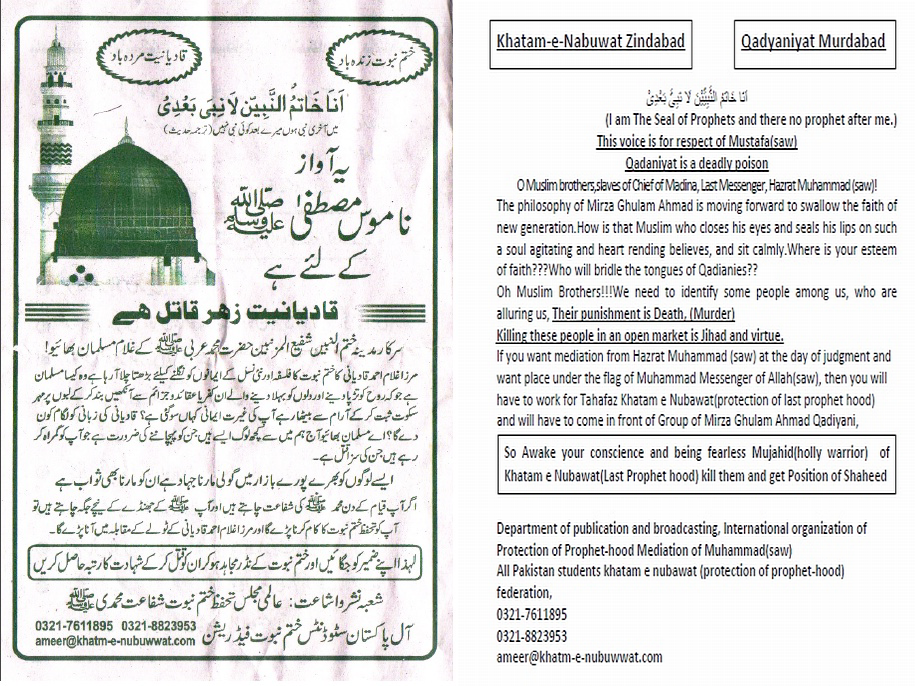
By year’s end the government had not taken steps to address the September 2008 killings of Dr. Abdul Mannan Siddiqui and Seth Muhammad Yousuf, two Ahmadi leaders in Sindh. In September 2008 the local anchor of a religious affairs program on Geo Television, Amir Liaquat Hussain, declared that Islamic teachings necessitated the killing of members of the Ahmadi sect and prompted two religious scholars who were guests on the program to affirm his position.

c. Torture and Other Cruel, Inhuman, or Degrading Treatment or Punishment

The law prohibits torture and other cruel, inhuman, or degrading treatment, but there were reports that security forces, including intelligence services, tortured and abused individuals in custody. Under provisions of the Anti-Terrorism Act, coerced confessions are admissible in anti-terrorism courts. During the year the NGO SHARP reported 2,300 cases of torture by police, most of which occurred in Punjab. Observers noted that underreporting of torture was prevalent in the NWFP and Balochistan. Torture occasionally resulted in death or serious injury.
……

Prison and Detention Center Conditions

Prison conditions were extremely poor and failed to meet international standards. Overcrowding was widespread, except for cells of wealthy or influential prisoners. According to SHARP, more than 95,000 prisoners occupied 72 jails originally built to hold approximately 36,000 persons.

Inadequate food and medical care in prisons led to chronic health problems and malnutrition for those unable to supplement their diet with help from family or friends.……

Foreign prisoners often remained in prison long after completion of their sentences because they were unable to pay for deportation to their home countries.

Police reportedly tortured and mistreated those in custody and at times engaged in extrajudicial killings. Christian and Ahmadi communities claimed their members were more likely to be abused. Non-Muslim prisoners generally were afforded poorer facilities than Muslim inmates and often suffered violence at the hands of fellow inmates.
……

d. Arbitrary Arrest or Detention

Role of the Police and Security Apparatus

………
Police often failed to protect members of religious minorities from societal attacks, including Christians, Ahmadis, and Shias.

Arrest Procedures and Treatment While in Detention

………
The law stipulates that detainees must be brought to trial within 30 days of their arrest. Under both the Hudood Ordinances and standard criminal codes, there are bailable and nonbailable offenses. Bail pending trial is required for bailable offenses and permitted at a court’s discretion for nonbailable offenses with sentences of less than 10 years. In practice judges denied bail at the request of police or the community, or upon payment of bribes. In many cases trials did not start until approximately six months after the filing of charges, and in some cases individuals remained in pretrial detention for periods longer than the maximum sentence for the crime with which they were charged. SHARP estimated that approximately 55 percent of the prison population was awaiting trial. ……

In May 2008 the government announced it had imposed a moratorium on the death penalty, although the moratorium was not enforced in practice. In March 2008 the HRCP had noted there was “strong evidence” that the death penalty was applied without regard to due process, and SHARP reported that there were an estimated 7,000 inmates on death row. ……

e. Denial of Fair Public Trial

Lower courts remained corrupt, inefficient, and subject to pressure from prominent wealthy, religious, and political figures. The politicized nature of judicial promotions increased the government’s control over the court system. Unfilled judgeships and inefficient court procedures resulted in severe backlogs at both trial and appellate levels.

There were extensive case backlogs in both the lower and superior courts. According to a 2009 report published by the Law and Justice Commission of Pakistan on National Judicial Policy there were 138,945 cases pending at the superior judiciary and 1,565,926 pending with the lower courts or subordinate judiciary.
……

Trial Procedures

Courts routinely failed to protect the rights of religious minorities. Judges were pressured to take strong action against any perceived offense to Sunni orthodoxy. The judiciary rarely heard discrimination cases dealing with religious minorities.

Laws prohibiting blasphemy continued to be used against Christians, Ahmadis, and members of other religious groups, including Muslims. Lower courts often did not require adequate evidence in blasphemy cases, which led to some accused and convicted persons spending years in jail before higher courts eventually overturned their convictions or ordered them freed.

Original trial courts usually denied bail in blasphemy cases, claiming that because defendants faced the death penalty, they were likely to flee. Many defendants appealed the denial of bail, but bail often was not granted in advance of the trial. Lower courts frequently delayed decisions, experienced intimidation, and refused bail for fear of reprisal from extremist elements.
……

f. Arbitrary Interference with Privacy, Family, Home, or Correspondence

………
In accordance with the Anti-Terrorism Act of 1997, the government banned the activities of and membership in several religious extremist and terrorist groups. Some of the banned groups changed their names and remained active, including Jaish e Muhammad (new name: Tehrikul Furqan & Al Rehmat Trust); Tehrik e Ja’afria Pakistan (new name: Tehrik e Islami Pakistan); and Sipah e Sihaba Pakistan (new name: Millat e Islamia Pakistan). Many of the renamed groups were subsequently banned. Lashkar e Taiba regrouped under the new name Jamaat ud-Dawa. The government seized the public assets of Jamaat ud-Dawa and ordered its accounts frozen in response to the group’s designation as an alias of a Foreign Terrorist Organization under UN Security Council resolution 1267. In 2008 the government labeled Tehrik-e-Taliban Pakistan (TTP) a terrorist organization and ordered the State Bank to freeze all the organization’s accounts.
………

Section 2
Respect for Civil Liberties, Including:


b. Freedom of Peaceful Assembly and Association

The law provides for freedom of assembly and freedom of association, subject to restrictions imposed by law.

Freedom of Assembly

Although the constitution provides for this right, in practice the government placed selective restrictions on the right to assemble. By law district authorities can prevent gatherings of more than four people without police authorization. Separately, Ahmadis have been prohibited from holding conferences or gatherings since 1984.

c. Freedom of Religion

The constitution states that adequate provisions shall be made for minorities to profess and practice their religions freely, but the government limited freedom of religion in practice. Islam is the state religion, and the constitution requires that laws be consistent with Islam. The Federal Shariat court ensures that laws are consistent with Shari’a. All citizens are subject to the blasphemy laws. Freedom of speech is constitutionally subject to “any reasonable restrictions imposed by law in the interest of the glory of Islam.”

According to the HRCP, there was an increase in cases of violence against minorities during the year. Reprisals and threats of reprisals against suspected converts from Islam occurred. Members of religious minorities were subject to violence and harassment, and at times police refused to prevent such actions or charge persons who committed them, leading to an atmosphere of impunity. The constitution stipulates the president and the prime minister must be Muslim. The prime minister, federal ministers, and ministers of state, as well as elected members of the Senate and National Assembly (including non-Muslims), must take an oath to “strive to preserve the Islamic ideology,” the basis for the creation of the country.
………

The law declares the Ahmadi community, which considers itself a Muslim sect, to be a non-Muslim minority. The law prohibits Ahmadis, who numbered more than two million, from engaging in any Muslim practices, including use of Muslim greetings, referring to their places of worship as mosques, reciting Islamic prayers, using specific Islamic terms, and participating in the Hajj or Ramadan fast. Ahmadis were prohibited from proselytizing, holding gatherings, or distributing literature. Government forms, including passport applications and voter registration documents, require anyone wishing to be listed as a Muslim to denounce the founder of the Ahmadi faith. According to Ahmadiyya Foreign Mission, during the year 11 Ahmadis were killed due to their faith; there were nine targeted attacks against Ahmadis that resulted in several serious injuries; 37 Ahmadis were charged under blasphemy laws; and 57 Ahmadis were charged under Ahmadi-specific laws. At year’s end no Ahmadi was in prison on charges of desecration of the Koran.

The penal code calls for the death sentence or life imprisonment for anyone who blasphemes the Prophet Muhammad. The law provides for life imprisonment for desecrating the Koran and up to 10 years in prison for insulting another’s religious beliefs with the intent to offend religious feelings. The latter penalty was used only against those who allegedly insulted the Prophet Muhammad. ……

On January 28, authorities arrested five Ahmadis, including four teenage students and one adult, for carving the name of the Prophet Muhammad onto the walls of a bathroom stall at a mosque in Punjab province. According to the AHRC, no evidence suggested the five individuals were responsible, and authorities did not conduct any investigation before the arrest. The four students who allegedly defaced the stalls at the behest of the adult had no connection to the mosque and did not live nearby, and a police official said police were not aware of any substantial evidence that linked the students with the crime. According to the AHRC, the district police officer told family members of the accused that police were under pressure from religious fundamentalists to act against the students. The students were released in July.

There were no developments regarding the June 2008 case in which police charged all the residents of Rabwah in Punjab under anti-Ahmadi laws and arrested Muhammad Yunus for lighting fireworks and lamps and greeting each other, which the government considered to be preaching their faith, a crime by law.

Police closed the Ahmadi centers in August 2008 following a citizen complaint that Ahmadis were attempting to proselytize. The centers were permitted to reopen on the condition that they remove the Kalima (the recitation of the Shahada, the Islamic recitation of faith) from their centers.
………

There were no developments in the 2007 case in which an Intelligence Bureau district officer ordered the arrest of five Ahmadis, including two minors, after a teacher discovered the minors carrying an Ahmadi children’s magazine. After the case received wide media coverage, the charges were dropped but then re-filed in February 2007 against two adults.

By the end of the year, there were no developments in the trial of the 2007 case of a retired assistant sub-inspector who shot and killed a recent Ahmadi convert in a restaurant in Seerah, near Mandi Bahauddin in Punjab. At year’s end he was incarcerated and the case was pending.
………

Complaints under the blasphemy laws were used to harass rivals in business or personal disputes. Most complaints under these laws were filed against the majority Sunni Muslim community by other Sunnis. Appellate courts dismissed most blasphemy cases; the accused, however, often remained in jail for years awaiting the court’s decision. Trial courts were reluctant to release on bail or acquit blasphemy defendants for fear of violence from extremist religious groups. In 2005 a law went into effect revising the complaint process and requiring senior police officials to review such cases in an effort to eliminate spurious charges. According to human rights and religious freedom groups, this process was not effective because senior police officers did not have the resources to review the cases. There were no legal restrictions on Christian or Hindu places of worship. District nazims had to authorize construction after they assessed the need for a new church or temple. Religious minority groups experienced bureaucratic delays and requests for bribes—routine obstacles all religious groups faced—when they attempted to build houses of worship or to obtain land.
………

Societal Abuses and Discrimination

Sectarian violence between Sunni and Shia extremists continued during the year. Shias, Christians, and Ahmadis were the targets of religious violence across the country.
………

The government did not address the 2008 attacks against one church, one Hindu temple, and five Ahmadi mosques in Punjab.

Since the promulgation of the Anti-Ahmadiyya Ordinance in 1984, 295 Ahmadis have faced charges, and at the end of the year two Ahmadis were in prison under the blasphemy laws.
………

Ahmadi leaders charged that militant Sunni mullahs and their followers sometimes staged marches through the streets of Rabwah, a predominantly Ahmadi town and spiritual center in central Punjab. Ahmadis claimed that police generally were present during the marches.

Ahmadi, Christian, Hindu, and Shia Muslim communities reported significant discrimination in employment and access to education, including government institutions. These communities also faced societal violence. The National Education Policy mandated Islamic studies in schools; non-Muslim students could opt out of the course in favor of a more general ethics course. Several minority religious groups claimed the policy infringed on the religious freedom of non-Muslim students and made textbooks more biased toward Islam by removing information regarding the practices of other religions.
………

For a more detailed discussion, see the 2009 International Religious Freedom Report.

Section 3  

Respect for Political Rights: The Right of Citizens to Change Their Government

Elections and Political Participation

………
The government required voters to indicate their religion when registering to vote. The Ahmadi community boycotted the elections, according to the EU Election Observation Mission, because they were required to register on a separate voter roll.
………

There were 10 religious minority members in reserved seats in the National Assembly, and one served in the cabinet as the Federal Minister for Minorities. Such seats were apportioned to parties based on the percentage of seats each won in the assembly. Under the law minorities held 23 reserved seats in the provincial assemblies: eight in Punjab; nine in Sindh; three in the NWFP; and three in Balochistan.

Section 6

Discrimination Based on Race, Sex, Disability, Language, or Social Status

The constitution provides for equality for all citizens and broadly prohibits discrimination based on race, religion, caste, residence, or place of birth; in practice, there was significant discrimination based on each of these factors.


Thursday, April 16, 2009

Pakistan: USSD Country Reports on Human Rights Practices - 2008

Excerpts from
U.S. Department of State
Country Reports on Human Rights Practices - 2008
Released by the Bureau of Democracy, Human Rights, and Labor, February 25, 2009

Pakistan

……
Despite some improvements after the state of emergency at the end of the previous year, the human rights situation remained poor. Major problems included extrajudicial killings, torture, and disappearances. There were also instances in which local police acted independently of government authority. Collective punishment was a problem particularly in the Federally Administered Tribal Areas (FATA), which falls under the legal framework of the Frontier Crimes Regulation (FCR). Lengthy trial delays and failures to discipline and prosecute those responsible for abuses consistently contributed to a culture of impunity. Poor prison conditions, arbitrary arrest, and lengthy pretrial detention remained problems, as did a lack of judicial independence. Corruption was widespread within the government and police forces, and the government made few attempts to combat the problem. Although implementation of the 2006 Women’s Protection Act somewhat improved women’s rights, rape, domestic violence, and abuse against women remained serious problems. Honor crimes and discriminatory legislation affected women and religious minorities respectively. Religious freedom violations and inter-sectarian religious conflict continued. Widespread trafficking in persons, child labor, and exploitation of indentured and bonded children were ongoing problems. Child abuse, commercial sexual exploitation of children, discrimination against persons with disabilities, and worker rights remained concerns.
……

RESPECT FOR HUMAN RIGHTS

Section 1 Respect for the Integrity of the Person, Including Freedom From:

a. Arbitrary or Unlawful Deprivation of Life

Attacks on houses of worship, religious gatherings, and religious leaders linked to sectarian, religious extremist, and terrorist groups outside FATA resulted in hundreds of deaths during the year. Examples of these cases include the following:

……
On September 7, the local anchor of a religious affairs program on Geo Television, Amir Liaquat Hussain, declared that Islamic teachings necessitated the killing of members of the Ahmadi sect and prompted two religious scholars who were guests on the program to affirm the injunction. Amir, a former minister of religious affairs in the Musharraf government, repeated the statement the next day. Within days, two local Ahmadi leaders were killed in Sindh. Two gunmen killed Dr Abdul Mannan Siddiqui, an Ahmadi doctor and local leader known for his charity work, in a Mirpurkhas hospital on September 8. The gunmen also shot an Ahmadi guard and two patients. A day later, gunmen killed another local Ahmadi leader, Seth Muhammad Yousuf, in the bazaar in Nawab Shah. The Pakistan Medical Association called for official investigations into the case, but as of year’s end, the government continued to stall investigation into the deaths. Local media and human rights organizations condemned the Geo program for inciting sectarian violence.

c. Torture and Other Cruel, Inhuman, or Degrading Treatment or Punishment

The law prohibits torture and other cruel, inhuman, or degrading treatment; there were reports, however, that security forces, including intelligence services, tortured and abused individuals in custody. Under provisions of the Anti-Terrorism Act, coerced confessions are admissible in antiterrorism courts. The NGO SHARP reported 1,013 cases of torture by police between January and June, including approximately 500 cases by the Punjab police and nearly 350 cases by the Sindh police.……

Prison and Detention Center Conditions

Prison conditions were extremely poor and failed to meet international standards. Overcrowding was widespread, except for cells of wealthy or influential prisoners. According to SHARP, nearly 90,000 prisoners occupied 87 jails originally built to hold a maximum of 36,075 persons.

Inadequate food and medical care in prisons led to chronic health problems and malnutrition for those unable to supplement their diet with help from family or friends. Foreign prisoners often remained in prison long after completion of their sentences because they were unable to pay for deportation to their home countries.

Police reportedly tortured and mistreated those in custody and at times engaged in extrajudicial killings. Christian and Ahmadi communities claimed their members were more likely to be abused. Non-Muslim prisoners generally were afforded poorer facilities than Muslim inmates and often suffered violence at the hands of fellow inmates.
………

d. Arbitrary Arrest or Detention

Role of the Police and Security Apparatus

Police often failed to protect members of religious minorities from societal attacks, including Christians, Ahmadis, and Shias.

Arrest and Detention

………
The law stipulates detainees must be brought to trial within 30 days of their arrest. Under both the Hudood and standard criminal codes, there are bailable and nonbailable offenses. Bail pending trial is required for bailable offenses and permitted at a court's discretion for nonbailable offenses with sentences of less than 10 years. In practice judges denied bail at the request of police, the community, or on payment of bribes. In many cases trials did not start until six months after the filing of charges, and in some cases individuals remained in pretrial detention for periods longer than the maximum sentence for the crime for which they were charged. Human rights NGOs estimated that approximately 50 percent of the prison population was awaiting trial.

e. Denial of Fair Public Trial

Lower courts remained corrupt, inefficient, and subject to pressure from prominent wealthy, religious, and political figures. The politicized nature of judicial promotions increased the government's control over the court system. Unfilled judgeships and inefficient court procedures resulted in severe backlogs at both trial and appellate levels.

Trial Procedures

………
Courts routinely failed to protect the rights of religious minorities. Judges were pressured to take strong action against any perceived offense to Sunni orthodoxy. The judiciary rarely heard discrimination cases dealing with religious minorities.

Laws prohibiting blasphemy continued to be used against Christians, Ahmadis, and members of other religious groups, including Muslims. Lower courts often did not require adequate evidence in blasphemy cases, which led to some accused and convicted persons spending years in jail before higher courts eventually overturned their convictions or ordered them freed.

Original trial courts usually denied bail in blasphemy cases, claiming that since defendants faced the death penalty, they were likely to flee. Many defendants appealed the denial of bail, but bail was often not granted in advance of the trial. Lower courts frequently delayed decisions, were intimidated, and refused bail for fear of reprisal from extremist elements.
………

f. Arbitrary Interference with Privacy, Family, Home, or Correspondence

………
In accordance with the Anti-Terrorism Act of 1997, the government banned the activities of and membership in several religious extremist and terrorist groups. Some of the banned groups changed their names and remained active, including: Jaish e Muhammad (new name: Tehrikul Furqan & Al Rehmat Trust); Tehrik e Ja’afria Pakistan (new name: Tehrik e Islami Pakistan); and Sipah e Sihaba Pakistan (new name: Millat e Islamia Pakistan). Lashkar e Taiba regrouped under the new name Jamaat ud-Dawa but was again banned in December in response to its designation as a Foreign Terrorist Organization under UN Security Council resolution 1267. On August 25, the government labeled Tehrik-e-Taliban Pakistan (TTP) a terrorist organization and ordered the State Bank to freeze all the organization’s accounts. The TTP is a militant umbrella organization formed in December 2007 by Baitullah Mehsud.
………

Section 2 Respect for Civil Liberties, Including:

a. Freedom of Speech and Press

………
On September 7, the local anchor of a religious affairs program on Geo TV, Amir Liaquat Hussain, declared that Islamic teachings necessitated the killing of members of the Ahmadi sect. Within days, two local Ahmadi leaders were killed in Sindh (See section 1.a.).
………

b. Freedom of Peaceful Assembly and Association

The law provides for freedom of assembly and freedom of association, subject to restrictions imposed by law.

Freedom of Assembly


Although the constitution provides for this right, in practice the government placed selective restrictions on the right to assemble. By law, district authorities can prevent gatherings of more than four people without police authorization. Separately, Ahmadis have been prohibited from holding conferences or gatherings since 1984.

c. Freedom of Religion

The constitution states that adequate provisions shall be made for minorities to profess and practice their religions freely, [Word freely which appeared in the original Objective Resolution, passed by the Constituent Assembly of Pakistan in March, 1949, was omitted when it was made a substantive part of the Constitution of Pakistan by P.O. (Presidential Order) No.14 of 1985, Art.2 and Sch.item 2 (with effect from March 2, 1985).] but the government limited freedom of religion in practice. Islam is the state religion, and the constitution requires that laws be consistent with Islam. According to the constitution, Shari’a can be applied to a situation deemed to be in contradiction to the Koran, and therefore citizens who are normally governed by secular law can be subject to Shari’a. Shari’a also was applied in some tribal areas. In the PATA of NWFP, religious advisors assisted judges. All citizens were subject to certain provisions of Shari’a and the blasphemy laws. Freedom of speech is constitutionally subject to “any reasonable restrictions imposed by law in the interest of the glory of Islam.”

Reprisals and threats of reprisals against suspected converts from Islam occurred. Members of religious minorities were subject to violence and harassment, and at times police refused to prevent such actions or charge persons who committed them, leading to an atmosphere of impunity. The constitution stipulates the president and the prime minister must be Muslim. The prime minister, federal ministers, and ministers of state, as well as elected members of the Senate and National Assembly (including non-Muslims), must take an oath to “strive to preserve the Islamic ideology,” the basis for the creation of the country.

The law declares the Ahmadi community, which considers itself a Muslim sect, to be a non-Muslim minority. The law prohibits Ahmadis, who numbered more than two million, from engaging in any Muslim practices, including use of Muslim greetings, referring to their places of worship as mosques, reciting Islamic prayers, using specific Islamic terms, and participating in the Hajj or Ramadan fast. Ahmadis were prohibited from proselytizing, holding gatherings, or distributing literature. Government forms, including passport applications and voter registration documents, require anyone wishing to be listed as a Muslim to denounce the founder of the Ahmadi faith. The Ahmadi community claimed that during the year, 31 Ahmadis faced criminal charges under religious laws or because of their faith. As of November, there had been four targeted killings of Ahmadis during the year, according to the AHRC.

The penal code calls for the death sentence or life imprisonment for anyone who blasphemes the Prophet Muhammad. The law provides for life imprisonment for desecrating the Koran and as long as 10 years in prison for insulting another’s religious beliefs with the intent to offend religious feelings. The latter was used only against those who allegedly insulted the Prophet Muhammad. Groups such as the Khateme Nabuwwat Movement, which considered anyone who questioned the finality of Prophet Muhammad to be a heretic, were reported to insult Ahmadi beliefs, but authorities did not prosecute these cases.

On June 8, police charged all the residents of Rabwah in Punjab under anti-Ahmadi laws and arrested Muhammad Yunus. The basis for the police charges against the thousands of Rabwah residents, according to the FIR, included lighting fireworks and lamps and greeting each other, which the government considered to be preaching their faith, a crime by law. The case was pending at year’s end.

In August communities near Multan warned Ahmadis in the area to close their places of worship. When they refused, the communities lodged a complaint with local police, alleging the Ahmadis were attempting to proselytize. Police ordered the “temporary closure” of Ahmadi centers in the area. They remained closed at year’s end.

………
During the year, there were no developments in the January 2007 case in which an Intelligence Bureau district officer ordered the arrest of five Ahmadis, including two minors ages eight and 11, after a teacher discovered the minors carrying an Ahmadi children’s magazine, Tashhizul Azhan. The case received wide press coverage, following which the charges were dropped. The case was re-filed in February 2007 against two adults.

There were no developments in the trial of the March 2007 case of a retired assistant sub-inspector who shot and killed a recent Ahmadi convert in a restaurant in Seerah, near Mandi Bahauddin in Punjab. The retired officer, Riaz Gondal, later surrendered to police and admitted to the killing, claiming the act was justified under Islamic apostasy laws. At year’s end, he was incarcerated and the case was pending.

………
Complaints under the blasphemy laws were used in business or personal disputes to harass religious minorities or other Muslims, but most complaints were filed against the majority Sunni Muslim community. Many blasphemy complaints were lodged by Sunnis against fellow Sunnis. The appellate courts dismissed most blasphemy cases; the accused, however, often remained in jail for years awaiting the court’s decision. Trial courts were reluctant to release on bail or acquit blasphemy defendants for fear of violence from extremist religious groups. In 2005 the president signed a bill into law revising the complaint process and requiring senior police officials to review such cases in an effort to eliminate spurious charges. According to human rights and religious freedom groups, however, this process was not effective because senior police officers did not have the resources to review the cases. In 2007 courts convicted two individuals and acquitted two others under the blasphemy laws; 71 cases were ongoing at the end of the year.

Societal Abuses and Discrimination

Sectarian violence between Sunni and Shia extremists continued during the year. Shias, Christians, and Ahmadis were also the targets of religious violence across the country.

According to the National Commission for Justice and Peace (NCJP), one church, one Hindu temple, and five Ahmadi mosques were attacked and damaged in different parts of the country during the year; four of the seven attacks took place in the province of Punjab.

In the same period, the NCJP reported 53 Ahmadis and 93 Christians faced trials or were in prison on charges of desecrating the Koran.

Human rights lawyer and chairman of the NGO Legal Aid for Destitute and Settlement Parvez Aslam Chaudhry was forced to travel with police security during the year, following an attack on him in January 2006 for his work defending blasphemy cases. Although Punjabi authorities filed a case against an unknown assailant in 2007, no arrests were made during the year.

………
Ahmadi leaders charged that militant Sunni mullahs and their followers sometimes staged marches through the streets of Rabwah, a predominantly Ahmadi town and spiritual center in central Punjab. The Ahmadis claimed that police generally were present during these marches.

Ahmadi, Christian, Hindu, and Shia Muslim communities reported significant discrimination in employment and access to education, including at government institutions.

Shia, Christian, Hindu, and Ahmadi communities faced discrimination and societal violence. The government removed religiously sensitive material from new textbooks on religious differences and on how to worship. Other religions can opt out of these readings and read the more generic “Book of Ethics.”

Section 3 Respect for Political Rights: The Right of Citizens to Change Their Government

Elections and Political Participation

The government required voters to indicate their religion when registering to vote. The Ahmadi community boycotted the elections, according to the European Union Election Observation Mission, because they were required to register on a separate voter roll.

………
There were 10 religious minority members in reserved seats in the National Assembly and one served in the cabinet as the Federal Minister for Minorities. Such seats were apportioned to parties based on the percentage of seats each wins in the assembly. Under the law, minorities held 23 reserved seats in the provincial assemblies: eight in Punjab; nine in Sindh; three in NWFP; and three in Balochistan.

Section 5 Discrimination Based on Race, Sex, Disability, Language, or Social Status

The constitution provides for equality for all citizens and broadly prohibits discrimination based on race, religion, caste, residence, or place of birth; in practice, however, there was significant discrimination based on each of these factors.

URL: www.state.gov/g/drl/rls/hrrpt/2008/sca/119139.htm

Wednesday, April 15, 2009

Bangladesh: USSD Country Reports on Human Rights Practices - 2008

Excerpts from
U.S. Department of State
Country Reports on Human Rights Practices - 2008
Released by the Bureau of Democracy, Human Rights, and Labor, February 25, 2009

Bangladesh

………
Although levels of violence declined significantly and the caretaker government oversaw successful elections, the government’s human rights record remained a matter of serious concern, in part due to the state of emergency that remained in place for most of the year and the failure to fully investigate extrajudicial killings. The state of emergency, which was relaxed temporarily in advance of local elections in August and finally lifted on December 17, curtailed many fundamental rights, including freedom of expression, freedom of association, and the right to bail. The government promulgated the Emergency Powers Rules (EPR) 2007 and Emergency Powers Ordinance 2007 to enforce the state of emergency. The anticorruption drive that the government initiated, while greeted with popular support, gave rise to concerns about fairness and equity under the law. For most of the year the government banned political activities, although this policy was enforced unevenly. There was a decrease in the number of extrajudicial killings by security forces, but they committed serious abuses, including extrajudicial killings, custodial deaths, arbitrary arrest and detention, and harassment of journalists. Some members of security forces acted with impunity and committed acts of physical and psychological torture. Violence against women and children remained a serious problem, as did trafficking in persons.

RESPECT FOR HUMAN RIGHTS

Section 2 Respect for Civil Liberties, Including:

c. Freedom of Religion

The constitution establishes Islam as the state religion and also stipulates the right, subject to law, public order, and morality, to practice the religion of one's choice. The government generally respected this right in practice. Although the government was secular, religion shaped the platforms of certain political parties. Discrimination against members of religious minorities existed at both the governmental and societal levels, and religious minorities were disadvantaged in practice in such areas as access to government jobs, political office, and justice.
………

Government protection of Ahmadiyyas continued to improve, although social discrimination continued. The High Court continued to stay the government ban on publishing Ahmadiyya literature, effectively allowing Ahmadiyyas to publish.
………

Societal Abuses and Discrimination

Discrimination against Ahmadiyyas, Hindus, and Christians occurred during the year. However, there were no demonstrations by anti-Ahmadiyya groups during the year.

On March 15 and March 21, the Special Branch of police in Brahmanbaria prevented groups of Ahamadiyyas from holding a religious convention. Due to intervention by officials at senior levels of the home ministry, both conventions were held.
………

URL: www.state.gov/g/drl/rls/hrrpt/2008/sca/119132.htm

Indonesia: USSD Country Reports on Human Rights Practices - 2008

Excerpts from
U.S. Department of State
Country Reports on Human Rights Practices - 2008
Released by the Bureau of Democracy, Human Rights, and Labor, February 25, 2009

Indonesia

The government generally respected the human rights of its citizens and upheld civil liberties. Nonetheless, there were problems during the year in the following areas: killings by security forces; vigilantism; harsh prison conditions; impunity for prison authorities and some other officials; corruption in the judicial system; limitations on free speech; societal abuse and discrimination against religious groups and interference with freedom of religion, sometimes with the complicity of local officials; instances of violence and sexual abuse against women and children; trafficking in persons; child labor; and failure to enforce labor standards and worker rights.

RESPECT FOR HUMAN RIGHTS

Section 2 Respect for Civil Liberties, Including:

b. Freedom of Peaceful Assembly and Association

Freedom of Association

On April 19, approximately 350 members of the Islamic sect Ahmadiyya from 200 chapters across the country were forced to cancel their national conference in Bali when the Bali police would not issue them a permit (see section 2.c.).

c. Freedom of Religion

The constitution provides for “all persons the right to worship according to his or her own religion or belief” and states that “the nation is based upon belief in one supreme God.” The government generally respected the former provision. Six faiths Islam, Protestantism, Catholicism, Hinduism, Buddhism, and Confucianism—received official recognition in the form of representation at the Ministry of Religious Affairs.

On January 15, the government-appointed Coordinating Board for Monitoring Mystical Beliefs in Society recommended the government dissolve the Ahmaddiyah sect.

On June 9, the government issued a decree prohibiting the Ahmaddiyah from proselytizing and conducting religious activities, as well as prohibiting vigilantism against the sect. The decree warned Ahmaddiyah members against making their own interpretations of Islam and against spreading their beliefs. Vice President Jusuf Kalla said that the decree did not prohibit the Ahmadiyya from worshipping or continuing to practice within its own community.

On September 1, the South Sumatra governor banned Ahmadiyyah and any activities of the Indonesian Jamaah Ahmadiyyah organization in the province.

Persons whose religion was not one of the six officially recognized faiths had difficulty obtaining an identity card, which was necessary to register marriages, births, and divorces. Men and women of different religions experienced difficulties in marrying and in registering marriages. The government refused to register a marriage unless a religious marriage ceremony had taken place. However, very few religious officials were willing to take part in weddings involving couples of different faiths. For this reason, some brides and grooms converted to their partner’s religion. Others resorted to traveling overseas to wed.
………

Societal Abuses and Discrimination

Throughout the year numerous Ahmadiyya communities were attacked by vigilante groups, and over 20 mosques were forcibly shut down. A number of these incidents occurred after the release of the July decree that banned attacks on the religious group.

URL: www.state.gov/g/drl/rls/hrrpt/2008/eap/119040.htm

Thursday, October 9, 2008

Int’l Religious Freedom Report - 2008: Pakistan

Released by the Bureau of Democracy, Human Rights, and Labor
September 19, 2008
Pakistan

The country is an Islamic republic. Islam is the state religion, and the Constitution requires that laws be consistent with Islam. The Constitution states that “subject to law, public order and morality, every citizen shall have the right to profess, practice, and propagate his religion“; however, in practice the Government imposes limits on freedom of religion. Freedom of speech is constitutionally “subject to any reasonable restrictions imposed by law in the interest of the glory of Islam.”

The Government took some steps to improve its treatment of religious minorities during the period covered by this report, but serious problems remained. Law enforcement personnel abused religious minorities in custody. Security forces and other government agencies did not adequately prevent or address societal abuse against minorities. Discriminatory legislation and the Government’s failure to take action against societal forces hostile to those who practice a different religious belief fostered religious intolerance, acts of violence, and intimidation against religious minorities. Specific laws that discriminate against religious minorities include anti-Ahmadi and blasphemy laws that provide the death penalty for defiling Islam or its prophets. The Ahmadiyya community continued to face governmental and societal discrimination and legal bars to the practice of its religious beliefs. Members of other Islamic sects also claimed governmental discrimination.

Relations between religious communities were tense. Societal discrimination against religious minorities was widespread, and societal violence against such groups occurred. Societal actors, including terrorist and extremist groups and individuals, targeted religious congregations.

The U.S. Government discusses religious freedom with the Government as part of its overall policy to promote human rights. During the period covered by this report, U.S. embassy officials closely monitored the treatment of religious minorities, worked to eliminate the teaching of religious intolerance, and encouraged the amendment of the blasphemy laws.

Section I. Religious Demography

The country has an area of 310,527 square miles and a population of 170 million. Official figures on religious demography, based on the most recent census taken in 1998, showed that approximately 97 percent of the population was Muslim. Groups comprising 2 percent of the population or less include Hindus, Christians, and others, including Ahmadis. The majority of Muslims in the country are Sunni, with a Shi’a minority ranging between 10 to 20 percent. Parsis (Zoroastrians), Sikhs, and Buddhists each had approximately 20,000 adherents, while the Baha’i claimed 30,000. Some tribes in Baluchistan and North West Frontier Province (NWFP) practiced traditional animist religious beliefs.

Less than 0.5 percent of the population was silent on religious affiliation or claimed not to adhere to a particular religious group. Social pressure was such that few persons would claim no religious affiliation.

Section II. Status of Religious Freedom

Legal/Policy Framework

The Constitution establishes Islam as the state religion. It also declares that adequate provisions shall be made for minorities to profess and practice their religious beliefs freely; however, in reality the Government imposes limits on freedom of religion, particularly on Ahmadis.

A 1974 constitutional amendment declares Ahmadis to be non-Muslim. Section 298(c), commonly referred to as the anti-Ahmadi laws, prohibits Ahmadis from calling themselves Muslims, referring to their religious beliefs as Islam, preaching or propagating their religious belief, inviting others to accept Ahmadi teachings, or insulting the religious feelings of Muslims. The punishment for violation of the section is imprisonment for up to 3 years and a fine. Other religious communities were generally free to observe their religious obligations; however, religious minorities are legally restricted from public display of certain religious images and, due to discriminatory legislation and social pressure, are often afraid to profess their religious beliefs freely.

Freedom of speech is subject to “reasonable” restrictions in the interests of the “glory of Islam.” The consequences for contravening the country’s blasphemy laws are death for defiling Islam or its prophets; life imprisonment for defiling, damaging, or desecrating the Qur’an; and 10 years’ imprisonment for insulting another’s religious feelings. These laws are often used to settle personal scores as well as to intimidate vulnerable Muslims, sectarian opponents, and religious minorities. Under the Anti-Terrorist Act, any action, including speech, intended to incite religious hatred is punishable by up to 7 years of imprisonment. Under the act, bail is not to be granted if the judge has reasonable grounds to believe that the accused is guilty; however, the law is applied selectively.

Any speech or conduct that injures another’s religious feelings, including those of minority religious groups, is prohibited and punishable by imprisonment. However, in cases where the religious feelings of a minority religious group were insulted, the blasphemy laws were rarely enforced and cases rarely brought to the legal system. A 2005 law requires that a senior police official investigate any blasphemy charge before a complaint is filed. According to nongovernmental organizations (NGOs), this law was not uniformly enforced.
……

The Government designates religious affiliation on passports and requests religious information in national identity card applications. Citizens must have a national identity card to vote. Those wishing to be listed as a Muslim must swear to believe that Prophet Muhammad is the final prophet and denounce the Ahmadiyya Movement’s founder as a false prophet and his followers as non-Muslims, a provision designed to discriminate against Ahmadis. Before the 2002 general elections, President Musharraf abolished the requirement to take this oath, but he later reversed his decision, resulting in an election boycott by the Ahmadiyya community. Initial voter registration no longer requires such an oath, but the Election Commission claimed that any Muslim registrant whose religious beliefs were challenged by the public would have to take the oath. As a result, Ahmadis continued to boycott the elections. No new policies based on religion were made for the February 2008 elections.

The Constitution provides for the “freedom to manage religious institutions.” In principle, the Government does not restrict organized religious groups from establishing places of worship and training members of the clergy. In practice, however, religious minorities suffered from restrictions on this right. The Government, at the district level, consistently refused to grant permission to construct non-Muslim places of worship, especially to the Ahmadiyya and Baha’i communities, citing the need to maintain public order. There is no official restriction on the construction of Ahmadiyya places of worship; however, Ahmadis are forbidden from calling them mosques. District governments often refuse to grant Ahmadis permission to hold events publicly, therefore they hold their meetings in members’ homes. The Government can shut down these gatherings if neighbors report hearing the recitation of Qur’anic verses.
……

The Constitution specifically prohibits discriminatory admission to any governmental educational institution solely based on religious affiliation. Government officials stated that the only factors affecting admission to governmental educational institutions were students’ grades and home provinces; however, students must declare their religious affiliation on application forms. This declaration is also true for private educational institutions, including universities. Muslim students must declare in writing that they believe that Prophet Muhammad is the final prophet, a measure that singles out Ahmadis. Non-Muslims must have their religious affiliation verified by the head of their local religious community.
……

A March 2007 report indicated that unregulated, extremist madrassahs in Karachi continued to thrive in the sprawling city with a large population of young, unemployed men. International Crisis Group reported that after 5 years of trying to reform madrassahs, the Government’s program had not fully succeeded, and that extremist groups were operating mosques and madrassahs in the open in Karachi and elsewhere, due to lack of consistent regulation. Despite the fact that reforms were stalled, the majority of the country’s madrassahs have been registered, foreign students are now required to obtain a no-objection certificate before attending madrassah classes, and all madrassahs are required to report their finances. Additionally, the new government announced that there would be a uniform curriculum in the madrassahs, with a more secular tone to be introduced.

All wafaqs mandated the elimination of teaching that promoted religious or sectarian intolerance and terrorist or extremist recruitment at madrassahs. Inspectors mandated that affiliated madrassahs supplement religious studies with secular subjects, including English, math, and science. Wafaqs also restricted foreign private funding of madrassahs. Examination concerns remained under active discussion with the Government. Some unregistered and Deobandi-controlled madrassahs in the FATA, Karachi, and northern Baluchistan continued to teach extremism. Similarly, the Dawa schools run by Jamat-ud-Dawa continued such teaching and recruitment for Lashkar-e-Tayyiba, a designated foreign terrorist organization.

The Mutahida Majlis-e-Amal (MMA)-led provincial government, a coalition of six conservative parties that ruled in the NWFP until November 2007, continued to pass directives and legislation in accordance with conservative Islamic views. If implemented, many of these initiatives would impose Shari’a on all citizens, regardless of religious affiliation. Existing laws include antiobscenity measures under which advertising has been torn down, stores fined for selling certain western recordings, a complete ban on alcohol, and a requirement for civil servants to pray five times daily.

The Government does not restrict religious publishing in general; however, the sale of Ahmadi religious literature is banned. The law prohibits publishing any criticism of Islam or its prophets or insults to another’s religious beliefs.
……

Missionaries (except Ahmadis) operate in the country and can proselytize, as long as there is no preaching against Islam and the missionaries acknowledge they are not Muslim. ……

Restrictions on Religious Freedom

The Government generally enforced existing legal restrictions on religious freedom.

Since 1983 Ahmadis have been prohibited from holding public conferences or gatherings, and been denied permission to hold their annual conference. Ahmadis were banned from preaching and were prohibited from traveling to Saudi Arabia for the Hajj or other religious pilgrimages. Ahmadiyya publications were banned from public sale, but they published religious literature in large quantities for a limited circulation.

While the Constitution guarantees the right to establish places of worship and train clergy, in practice Ahmadis suffered from restrictions on this right. According to press reports, authorities continued to conduct surveillance on Ahmadis and their institutions. Several Ahmadiyya mosques reportedly were closed; others reportedly were desecrated or had their construction stopped.

Public pressure routinely prevented courts from protecting minority rights. These same pressures forced justices to take strong action against any perceived offense to Sunni orthodoxy. Discrimination against religious minorities was rarely placed before the judiciary. According to several NGOs, cases against Christians and Ahmadis continued to grow during the reporting period; however, the judiciary, even at the lower levels, acted in a more judicious manner in dealing with these cases as compared with previous reporting periods. NGOs reported that cases against both the local Christian and Hindu communities continued but to a lesser degree, and that social discrimination remains at high levels. There was generally a long period between filing the case and the first court appearance. Lower courts were frequently intimidated, delayed decisions, and refused bail for fear of reprisal from extremist elements. Bail in blasphemy cases was usually denied by original trial courts, arguing that since defendants faced the death penalty, they were likely to flee. Many defendants appealed the denial of bail, but bail was often not granted in advance of the trial.
……

The Government sometimes funded and facilitated Hajj travel but had no similar program for pilgrimages by religious minorities. Due to the passport requirement to list religious affiliation and denounce the Ahmadi prophet, Ahmadis were restricted from going on the Hajj, because they were unable to declare themselves as Muslim. In addition, given the Government’s lack of recognition of Israel, religious believers, regardless of religious affiliation, were unable to travel to Israel on pilgrimage. This especially affected Baha’is, since the Baha’i World Centre, the spiritual and administrative heart of the Baha’i community, is located in northern Israel.

Shi’a and other religious minorities contended that the Government persistently discriminated against members of their communities in hiring for the civil service and in admissions to government institutions of higher learning.

Promotions for all minority groups appeared limited within the civil service. These problems were particularly acute for Ahmadis, who contended that a “glass ceiling” prevented them from being promoted to senior positions and that certain government departments refused to hire or retain qualified Ahmadis.……

Members of minority religious groups volunteered for military service in small numbers, and there were no official obstacles to their advancement; however, in practice non-Muslims rarely rose above the rank of colonel and were not assigned to politically sensitive positions. A chaplaincy corps provided services for Muslim soldiers, but no similar services were available for religious minorities. In September 2007 the Government of Punjab commissioned a Sikh traffic warden in Lahore, and he was the first non-Muslim recruit in the Punjab police department.
……

Officials used bureaucratic demands and bribes to delay religious groups trying to build houses of worship or obtain land. While Ahmadis were prevented from building houses of worship, Sunni Muslim groups built mosques and shrines without government permission, at times in violation of zoning ordinances and upon government-owned lands. According to the press reports in December 2007, locals of Rasool Nagar protested against the district government for demolishing a newly constructed two-room Sunni mosque. The mosque attendees claimed that they were granted permission from the district; however, district administrators deny granting permission.

Abuses of Religious Freedom

Police reportedly tortured and mistreated those in custody, and at times, engaged in extrajudicial killings. It was usually impossible to ascertain whether adherence to particular religious beliefs was a factor in cases in which religious minorities were victims; however, both Christian and Ahmadiyya communities claimed their members were more likely to be abused. Non-Muslim prisoners generally were accorded poorer facilities than Muslim inmates, including a lack of access to spiritual resources. Conversion to other minority religious groups generally took place in secret to avoid a societal backlash.

Ahmadiyya leaders claimed the Government used regular sections of the Penal Code against their members for religious reasons. Authorities often accused converts to the Ahmadiyya community of blasphemy, violations of the anti-Ahmadi laws, or other crimes. The Government used anti-Ahmadi laws to target and harass Ahmadis. The vague wording of the provision that forbids Ahmadis from directly or indirectly identifying themselves as Muslims enabled officials to bring charges against Ahmadis for using the standard Muslim greeting and for naming their children Muhammad. According to the Islamabad-based Jamaat-e-Ahmadiya, the Ahmadiyya community claimed that during the period covered by this report, 45 Ahmadis faced criminal charges under religious laws or because of their religious beliefs: 7 under the blasphemy laws, 23 under Ahmadi-specific laws, and 15 under other laws but motivated by their adherence to Ahmadiyya religious beliefs.

At the end of the reporting period, four Ahmadis were arrested on blasphemy charges; one was in prison, and three others were out on bail. The Ahmadiyya community claimed these were falsely brought due to their religious beliefs. Fifteen more criminal cases, ranging from killings to destruction of property, were filed against prominent members of the Ahmadiyya community during the reporting period. The cases remained unprosecuted, and the accused were allowed to post bail.

In June 2008 an antiterrorism court at Gujranwala, Punjab, acquitted five persons arrested for the murder of eight Ahmadis of Mandi Bahauddin District. The killings took place in October 2005 when a group attacked Ahmadi worshippers during the morning congregational prayers at their mosque, injuring 20 persons and killing 8.

On March 6, 2008, police arrested 80-year-old Ahmadi Altaf Husain in Kabeerwala for desecrating the Qur’an. According to police, a student saw Husain rip pages out of the Qur’an and throw them on the ground. Members of the Ahmadiyya community stated that Husain was just reading the power meter outside his home when the student warned him that he was stepping on a page of the Qur’an. Police arrived and arrested Husain.

In January 2008 authorities arrested an Ahmadi in Wazirabad, Punjab, on charges of distributing Ahmadi-related pamphlets. He was granted bail in March 2008 and forced to leave the area after receiving numerous death threats.

In January 2008 police charged an Ahmadiyya businessman, Manzur Ahmed, with destroying pages that included religious inscriptions. At the end of the reporting period, he remained behind bars on destruction of holy material.

In September 2007 police accused Mumtaz Ali, an Ahmadi, of subscribing, receiving, and subsequently distributing the newsletter of the local Ahmadiyya community. He was taken in police custody for 10 days and released because of his old age. In October Ali died, but the police refused to drop the charges and threatened the doctor’s family with imprisonment if the household continued to receive the newsletter.

In November 2007 three Ahmadis were arrested in Sargodha, Punjab, on charges of proselytizing when they invited other locals to their places of worship. They were given bail in mid-February 2008.

In December 2007 Larkana police arrested 21 Ahmadis on charges of gathering and worshipping like Muslims after neighbors claimed to police that they heard Islamic verses coming from the home of one of the members. At the end of the reporting period, three of the 21 remained in prison.

In 2007 authorities released Mian Mohammed Yar, the president of the local Ahmadiyya community in the Okara District of the Punjab, who was arrested in August 2006 under the anti-Ahmadi laws on the charge of preaching.

Authorities routinely used the blasphemy laws to harass religious minorities and vulnerable Muslims and to settle personal scores or business rivalries. Authorities detained and convicted individuals on spurious charges. Judges and magistrates, seeking to avoid a confrontation with or violence from extremists, often continued trials indefinitely.

During the reporting period, authorities arrested at least 25 Ahmadis, 11 Christians, and 17 Muslims on blasphemy charges. Many remained in prison at the end of the reporting period. The National Commission for Justice and Peace (NCJP) stated “Generally we do not request bail because of security. Blasphemy suspects are often safest in prison under police protection.”

On June 18, 2008, Mohammad Shafeeq was sentenced to death for blasphemy after he allegedly defiled the Qur’an and used derogatory language to refer to the Prophet Mohammad. Shafeeq was arrested in 2006, on the complaint of local religious leaders, in a village near Sialkot where the trial was held.

In June 2008 four Ahmadis were arrested and charged for blasphemy in Kotri. The arrests were made after a dispute occurred over construction of an Ahmadiyya prayer center and protests from mullas of Tahafuz Khatame Nabuwwat.
………

In October 2006 police arrested Ahmadi Mohammed Tariq and charged him under blasphemy laws for allegedly tearing off anti-Ahmadiyya stickers inside a bus. Police released him on bail in December 2006, and at the end of the reporting period, he was awaiting trial.

In September 2006 police released on bail two Ahmadiyya journalists working for an Ahmadiyya publication, Al Fazl, whom they had charged under blasphemy laws. Three others from Al Fazl, an editor, a publisher, and a printer, remained in confinement awaiting court proceedings on the same charges. According to Jamaat-e-Ahmadiya, all were released but were given strict warnings by the police to stop publishing. Reports also indicated that strong pressure was placed on the provincial and district governments by many religious leaders to shut down the publication activities of all Punjabi Ahmadis following this case.
………

In the spring of 2007, members of the Ahmadiyya community purchased 6 acres of land outside Lahore to expand a preexisting cemetery. Local clerics denounced the purchase and held demonstrations against the Ahmadiyya community. Police sided with the clerics, and local authorities claimed the construction of a wall on the land would be used to form a “center of apostasy.” When the Ahmadis refused to remove the wall, five buses of policemen arrived and destroyed it in the middle of the night. Officials admitted the action was taken under pressure of local clerics.

In October 2006 police stopped construction of a new Ahmadiyya school in Sialkot district. Mullahs reportedly then destroyed the partially constructed building. At the end of the reporting period, the school had yet to be constructed.
………

Section III. Societal Attitudes

Relations between the country’s religious communities remained tense. Violence against religious minorities and between Muslim sects continued. Most believed that a small minority was responsible for attacks; however, discriminatory laws and the teaching of religious intolerance created a permissive environment for attacks. Police often refused to prevent violence and harassment or refused to charge persons who commit such offenses.

Mobs occasionally attacked individuals accused of blasphemy, their family, or their religious community prior to their arrest. When blasphemy and other religious cases were brought to court, extremists often packed the courtroom and made public threats against an acquittal. Religious extremists continued to threaten to kill those acquitted of blasphemy charges. High-profile accused persons often went into hiding or emigrated after acquittal.

In October 2007 the National Engineering and Science Commission cancelled a fellowship awarded to Amna Zaheka upon learning that she was an Ahmadi. The public organization stated that she was not found suitable for employment based on the grounds that her religious beliefs could lead to her being a security risk.

Ahmadi individuals and institutions long have been victims of religious violence, much of it organized by religious extremists.

On June 5, 2008, the Principal of Punjab Medical College expelled 15 Ahmadi women students and 8 men students accused of preaching Ahmadiyyat in the university. On June 5, 2008, students went on strike, surrounded the principal’s office, and demanded expulsion of all Ahmadi students. The principal held a session of the Disciplinary Committee and issued orders to expel 23 Ahmadi students. Four of the women students were in their final year of studies. At the end of the reporting period, the case was pending.

In April 2008 a large group of Islamic scholars held an international conference dealing with the question of the Ahmadi Muslims in Chichawatni. The participants demanded that all Ahmadis serving in the armed forces be discharged and that their property be confiscated by the Government.

In July 2007 Minhajul Quran Council, a Braelvi religio-educational organization, advertised in the press that it would hold a week long course on “Radd-e-Qadianiyat” (Rejection of the Ahmadi Faith) at Madrassah Daarul Ulema, Nuria Rizvi, in the Gulberg area of Faisalabad. The seminary also hired small vans that toured Faisalabad and other nearby towns and cities announcing this course. The course was held and its proceedings were published in local newspapers. The seminary used loudspeakers during the course, read material, delivered speeches against the Ahmadiyya group, and called for attendees to be aware of the “fallaciousness of the religious group.”
………

Some Sunni Muslim groups published literature calling for violence against Ahmadis, Shi’a Muslims, other Sunni sects, and Hindus. Some newspapers frequently published articles that contained derogatory references to religious minorities, especially Ahmadis, Hindus, and Jews.
………

Section IV. U.S. Government Policy

U.S. embassy officers maintained a dialogue with government, religious, and minority community representatives to encourage religious freedom and discuss the blasphemy laws, the Hudood Ordinance, curriculum reform in the public education and madrassah education systems, treatment of the Ahmadiyya and Christian communities, and sectarian violence. Embassy officials, including the Ambassador, met with leaders from communities of all religious groups and NGOs working on religious freedom problems. Embassy officials also raised and discussed treatment of the Ahmadis with parliamentarians.

As part of its overall public education reform program, valued at $100 million (6 billion rupees), the U.S. Government provided substantial financial support to the Government’s curriculum reform initiative, which included eliminating the teaching of religious intolerance.

 
^ Top of Page