Showing posts with label Quran. Show all posts

Wednesday, August 19, 2009

Minorities’ right to liberty

---daily Dawn, Pakistan
Provinces
Minorities’ right to liberty
Anwar syed
Sunday, 16 Aug, 2009 | 10:27 AM PST |

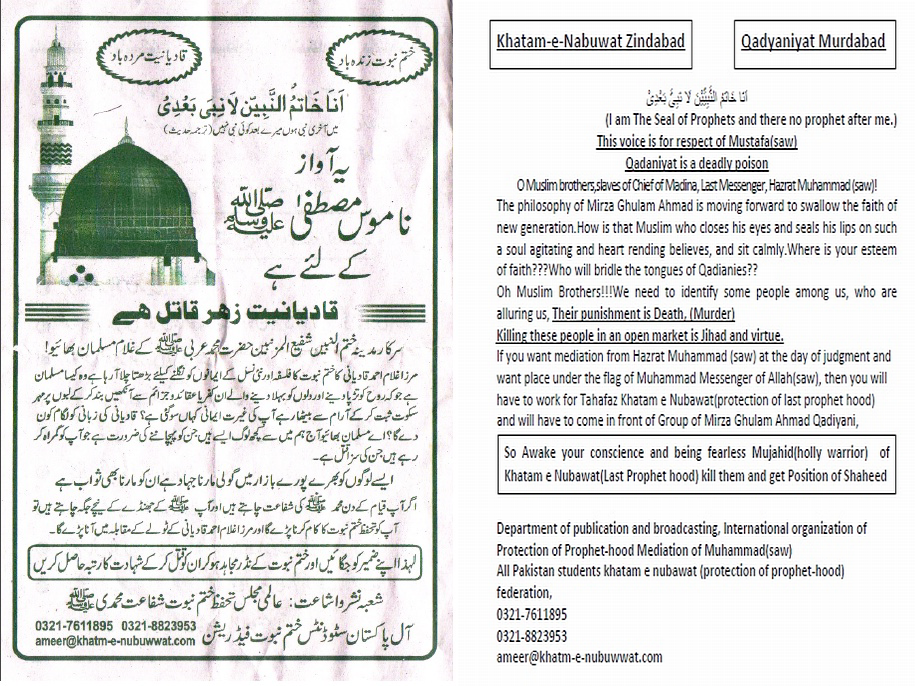
A group of Muslims, professedly incensed and enraged over the alleged desecration of the Quran, killed seven Christians in Gojra in Punjab. The allegation may not have been valid.

It is possible that the victims and their killers had been involved in a local quarrel. It is also possible that the victims were targeted simply because they were non-Muslim. The following presentation is based on this latter premise.

The killings have been widely condemned. Prime Minister Yousuf Raza Gilani and Punjab Chief Minister Shahbaz Sharif went to Gojra to condole with the victims’ families, and each announced an award of Rs100m as compensation to them. Mr Gilani also announced his government’s resolve to apprehend and prosecute the killers. This was a laudable response on his part, and we hope it does not turn out to be one of those promises that are lightly made and then forgotten.

This was not the first incident of its kind in the country’s recent experience. Hindu, Christian and Ahmadi communities and neighbourhoods in Sindh and Punjab have been attacked, persons killed, homes and businesses plundered and places of worship destroyed. These deeds were barbaric and so were their doers.

It takes a measure of intellectual sophistication and civility to value diversity and respect those who think differently from others. These attitudes of mind are cultivated in a democratic culture, which settles issues through discussion, debate and a process of give-and-take (compromise). This mode of arriving at decisions does not admit of absolutes. It requires admission of a degree of tentativeness in one’s own position, willingness to concede that the opponent has to be heard, for his argument may have some merit.

Granting exceptions, it may be said that absolute firmness of belief in the validity of a set of propositions, and tolerance of those who do not subscribe to them, do not go together. Indeed, they are mutually exclusive.

Intense believers in their professed faith have fought others in numerous times and places. Protestants and Catholics, and within the Protestant Church Anglicans and Presbyterians, persecuted, even killed, one another for more than 100 years in Ireland and Scotland respectively.

The same kind of conflicts took place in France, Germany, Switzerland and Massachusetts. In India orthodox caste Hindus have traditionally humiliated certain lower caste groups as untouchables. They have also been persecuting their Muslim citizens.

Islam enjoins tolerance of the non-believer. ‘Moderate’ Muslims are indeed tolerant of views other than their own. But there are, and have been, others who hold that those who disagree with them are not real Muslims, and that they deserve to be placed beyond the pale of Islam, if not eliminated. At the present time, the Taliban are the foremost of such groups.

Where in the configuration described above do we place the frenzied Muslims in Gojra who killed some of its Christian residents? It is most likely that they were intellectually unsophisticated, at best semi-literate, basically uncouth and uncivil.

Next, they were intense believers in the sanctity of their faith. The allegation that the Christians had desecrated the Quran may have been invalid but, if so, that fact was probably not known to most of them. They did, however, allow themselves to get into a rage without looking into the allegation. That may have happened because the accused were poor Christians.

Muslims constitute nearly 97 per cent of this country’s population. The remaining three per cent consist of Christians, Hindus and a sprinkling of Sikhs and Zoroastrians. Certain individuals from among them became renowned for their attainments. Justice A.R. Cornelius, chief justice of Pakistan, was one of the most learned, profound and eloquent jurists that ever worked in Pakistan. Justice Bhagwandas, a former judge of the Supreme Court, is another such luminary. Some of the more wealthy Zoroastrians have given large sums of money for the establishment and maintenance of educational institutions, hospitals and other charities.

The minority people are loyal citizens of Pakistan as much as the Muslims may be. They pose no threat to its security and well-being. Nor do they pose a threat to the well-being of their neighbours. They are not numerous or strong enough even to influence public policy (as for instance the Jews are in America). Why would then any group of Muslims want to persecute, harass, terrorise or kill them?

In most such cases they are accused of having committed blasphemy, such as insulting the Prophet (PBUH) or desecrating the Quran. The accusation is often unfounded. It is possible also that the alleged act, if it did happen, was accidental and unintended. The blasphemy law should be repealed because it is a bad law, but false accusations against minority persons will continue to be made, for the motivation behind them has nothing to do with the law’s susceptibility to abuse.

One reason why minority groups are harassed may be that they are weak, and weakness invites aggression. They can easily be driven from their homes and whatever little land they may have, which their tormentors can then appropriate. If some of them have defied any of the tough guys in the area, they will be punished for their self-assertion. The greater likelihood is that their oppressors are acting simply from perversity, viciousness and meanness of spirit of which they happen to have more than their share.

What is then to be done? I believe that governments and political leaders at all levels, particularly the Islamic parties, must do all they can to persuade the imams and khateebs in our mosques to tell their audiences that it is their Islamic duty to protect the non-Muslim minorities in this country.

The writer is professor emeritus at the University of Massachusetts. anwarsyed @ cox.net

©2009 DAWN Media Group. All rights reserved

Thursday, August 6, 2009

Christians in Pakistan Attacked for Religious Beliefs

---Salem News, USA

Aug-06-2009 12:52
Christians in Pakistan Attacked for Religious Beliefs

Ahmadiyya Muslim Community denounces violence against Pakistan’s Christian minority.

(GOJRA, Pakistan) - The Ahmadiyya Muslim Community (AMC) strongly condemns the violence towards Pakistan’s Christian minority last week in the town of Gojra.

In response to a report that a Quran had been defiled, a mob of up to 20,000 individuals in Gojra rioted and, on Saturday, attacked local Christian residents for no other reason than their religious beliefs.

More than 100 Christian houses were burned and looted in a rampage that lasted 8 hours and resulted in 20 injuries and seven deaths. Pakistani authorities later stated that the report that spurred this violence was spurious.

Such episodes of religious intolerance and violence have become increasingly common since the passing of Pakistan’s anti-blasphemy laws in 1984.

Many legal experts say the laws have been badly misused since their introduction by the military dictator General Muhammad Zia ul-Haq.

Under the laws, a religious charge filed by anyone can be subsequently used to stir hatred and justify sectarian violence. “The blasphemy law is being used to terrorize minorities in Pakistan,” said Shahbaz Bhatti, Pakistan’s minister of minority affairs, in an interview in Gojra on Sunday.

The AMC has also experienced violence towards members of its community in Pakistan due to the anti-blasphemy laws. Because of their belief in Mirza Ghulam Ahmad as the Promised Messiah, over 100 members of the AMC have been killed by extremists in Pakistan. The AMC strongly opposes all violence in the name of religion and advocates universal freedom of religion.

“The Quran clearly states that there is no compulsion in religion” stated Dr. Nasim Rehmatullah, vice president of AMC USA. “Freedom of religious beliefs should be a right given to all citizens of democracy and such [blasphemy] laws demonstrate the lack of tolerance for all religious minorities within Pakistan and should be strongly denounced worldwide.”

The Ahmadiyya Muslim Community (AMC) is a dynamic, reformist and fast growing international movement within Islam. Founded in 1889, AMC spans over 190 countries with membership exceeding tens of millions. AMC USA, established in 1921, is the first American-Muslim organization.

Source: AMC, the only Islamic organization to believe that the long-awaited messiah has come in the person of Mirza Ghulam Ahmadas (1835-1908) of Qadian. Ahmad (as) claimed to be the metaphorical second coming of Jesusas of Nazareth and the divine guide, whose advent was foretold by the Prophet of Islam, Muhammadsa. AMC believes that God sent Ahmadas, like Jesusas, to end religious wars, condemn bloodshed and reinstitute morality, justice and peace. Ahmadas’s advent has brought about an unprecedented era of Islamic revival and moderation. He divested Islam of fanatical beliefs and practices by vigorously championing Islam’s true and essential teachings.

URL: www.salem-news.com/articles/august062009/christians_gojra_8-6-09.php

Thursday, February 26, 2009

Islamic council’s fatwas divide Indonesia

---The Earth Times

Islamic council’s fatwas divide Indonesia - Feature
Posted : Thu, 26 Feb 2009 06:47:55 GMT
Author : DPA

Jakarta – A series of religious edicts issued by Indonesia’s council of Muslim scholars has triggered controversy, exposing sharp divisions between conservatives and liberals in the world’s most populous Muslim nation. In January, the Indonesian Ulema Council (MUI) issued a fatwa, or religious edict, banning Muslims from practising yoga that includes Hindu rituals, such as chanting.

It also ruled smoking in public and abstaining from electoral voting are sinful.

The rulings, which are not legally binding, sparked criticism from some Indonesians who worried about their implications on human rights and democratic freedom with some critics going further by suggesting that the government disband the council.

The council has been criticized for fatwas issued in 2005 declaring that liberalism and secularism are against Islamic tenets and that the Ahmadiyya Muslim sect is heretical because it does not recognize Muhammad as the last of the prophets.

The fatwa on Ahmadiyya has been blamed for a series of attacks on the property and followers of the sect by fundamentalist Muslims.

The council has defended its edicts, saying its job is to provide guidance to Muslims on issues of public concern.

“It’s obvious there are Muslims who don’t understand religious laws, and they need fatwas on issues that are not clearly stated in the Koran,” said Amidhan, a council deputy chairman who, like many Indonesians, goes by one name.

But some liberal observers said they believe the fatwas are a threat to the country’s reputation as a tolerant nation that respects diversity.

Muhammad Syafi’i Anwar, executive director of the International Centre for Islam and Pluralism, said the edicts showed that the council was aligning with groups that seek to impose sharia, or Islamic law, in Indonesia.

“This is part of creeping ‘shariaization,’ but I’m optimistic they won’t go very far,” Anwar said. “I believe the media is critical.”

The council and other groups representing followers of Buddhism, Christianity and Hinduism were set up by the government of former dictator Suharto as part of his efforts to maintain religious harmony and his grip on power.

The council is not a government institution and is funded by public donations, but under Suharto’s rule, which ended in 1998 amid widespread unrest, the council’s fatwas tended to toe the government line.

“The MUI is trying to assert its power because it was only a rubber-stamp institution during the Suharto era,” Anwar said “They have more influence, thanks to the backing of groups that promote conservative agendas.”

The overwhelming majority of Indonesia’s 190 million Muslims are moderate, but a vocal Islamist minority has been clamouring for the imposition of sharia.

Fachry Ali, a political analyst at the University of Indonesia, said he did not believe the council had ambitions beyond what it sees as religious duties.

“Yoga, for example, is problematic in the context of pure Islam, which is against all forms of idolatry,” he said. “MUI is just one of those groups seeking to purify Islam.”

“The MUI believes that the views of the liberals are not based on religious texts,” Fachry added. “It’s hard to reconcile when both sides stick to their points of departure.”

The council said Muslims could still practise yoga, which is increasingly popular among middle-class Indonesians, if they don’t use chants associated with Hinduism and treat it purely as a form of physical exercise.

The council said it fears the ancient Indian exercise could erode the faith of Muslims

Dian Putri, who works for a media company, said she did not intend to follow the council fatwas although she does not practice yoga with chanting.

“They are too extreme,” she said. “It’s like they are playing God. Maybe those fatwas are useful for religious Muslims, but for more liberal ones, sometimes their statements are disturbing.”

But Henri Basel, a teacher, said he supported the council.

“People criticize the fatwas without reading them in their entirety,” he said. “Of course, people can choose not to follow the fatwas if they also have sound religious reasonings, but there’s no point in making a fuss about it.”

“Those so-called liberals have access to the media like newspapers, TV and the Internet, but the majority of Indonesians don’t necessarily agree with them,” he said.

Copyright, respective author or news agency
URL: www.earthtimes.org/articles/show/257482,...-divide-indonesia--feature.html

Saturday, October 25, 2008

Pakistan: From religious politics to religious extremism

--- The Daily Star, Bangladesh

Saturday, October 25, 2008 01:51 PM GMT+06:00

Strategic Issues

Pakistan: From religious politics to religious extremism
Air Cdre Ishfaq Ilahi Choudhury, ndc, psc (Retd)

FOR years, internal situation in Pakistan has been getting from bad to worse. With the bombing of Marriott Hotel in Islamabad on 13 Sept 2008, there is now serious concern about the long-term viability of the state of Pakistan itself. Is it going to be another Afghanistan, Iraq, Sudan or Somalia is the question. The worry is many times more because Pakistan happens to be a nuclear-armed state. Any nuclear weapon or fissile material falling in the hands of the terrorists will have disastrous consequence. The North-Western part of the country bordering Afghanistan, known as Federally Administered Tribal Areas (FATA), has been virtually under the control of Islamic Militants, known as Pakistani Taliban. The Taliban are fighting a two-pronged war - in Afghanistan against the Afghan-NATO forces and in Pakistan against the Pakistani military; yet most of the victims of their random attacks are innocent civilians. They have imposed harsh and arbitrary ‘Sharia’ law on the populace that include random killing and brutal torture. The bombings and assassinations in both the capitals of Afghanistan and Pakistan by the Taliban mean that they have now extended their areas of operations right up to the capitals. The situation is further complicated by the cross-border operations performed by the Afghan-NATO forces into Pakistan, chasing and attacking the Taliban. Although this had been going on for quite sometime, probably with a nod of approval from the Pakistan government, but with the new elected government in place in Islamabad such news are putting them under increasing pressure. Although commentators are quick to blame President Musharraf for the mess, I would argue that Musharraf continued with a legacy that started with the birth of Pakistan as a nation-state.

Pakistan was the first country in the world created on the basis of religion Israel being the second and only other one. Its founder Mr. M. A. Jinnah argued that Muslims of India constitute a separate nation based on “distinctive culture and civilization, language and literature, art and architecture, names and nomenclature, sense of values and proportion, legal laws and moral code, customs and calendar, history and traditions, —-” (1944). Jinnah’s vision of Pakistan, however, was a Muslim majority democratic state and not a theocratic one. On the future constitution of Pakistan, he said on 11 August 1947, “You will find that in course of time Hindus would cease to be Hindus and Muslims would cease to be Muslims, not in the religious sense, because that is the personal faith of each individual, but in the political sense as citizens of the State.” Again in February 1948, he reiterated, “In any case Pakistan is not going to be a theocratic State – to be ruled by priests with a divine mission. We have many non-Muslims - Hindus, Christians, and Parsis - but they are all Pakistanis. They will enjoy the same rights and privileges as any other citizens and will play their rightful part in the affairs of Pakistan.” Things changed with Jinnah’s death a few months later. The Basic Principle of the Constitution (Objective Resolution 1949) adopted in 1952 stated that the Quran and Sunnah were to be the sources of all laws in Pakistan, that it would be an Islamic Republic and only a Muslim could be the Head of state. Gradual inroad of religion into Pakistani politics had begun. The politicians in Pakistan increasingly used Islam for achieving their political ends. All the three constitutions of Pakistan (1956, 1962, and 1973) promised to create an Islamic Republic, although the political players had no consensus as to what such a republic would be.

It is interesting to note that the Pakistani politicians, while not known for religiosity, were keen to use Islamic cards to political ends and as such always courted the Mullahs. One figure who stood out against the Mullahs was President Ayub Khan (1958-1969). Ayub Khan, despite violent opposition by the Ulemas promulgated the Muslim Family Law in 1961, which, still today, is the only marriage safety mechanism for Muslim women in Pakistan and Bangladesh. Yet, Ayub and his handpicked Muslim League opposed secular democratic movements by raising the bogey of “Islam in Danger.” Ayub’s successor, Gen. Yahya used the Muslim League and Jamaat-e-Islami to carry out large-scale atrocities on the Bengalis during the Liberation War in 1971. In 1974, Mr. Z. A. Bhutto (1972-1976), again not a particularly observant Muslim, declared the Ahmediya community as non-Muslims, threw them out of public life and created restrictions on their religious practices, only to placate the Mullahs.

Islamic parties in British India had little contribution towards the creation of Pakistan. Leaders of the Pakistan Muslim League that led the Pakistan movement were urban elites nurtured in English traditions. The foremost Islamic religious party then was Jamiat Ulema-e-Hind that supported Indian National Congress and opposed the partition. Maulana Maududi, who founded Jamaat-e-Islami, had opposed partition, but upon his migration to Pakistan started campaigning for a state based on Islamic Sharia. He was sentenced to death in 1953 (commuted later under Saudi pressure) for his alleged involvement in anti-Ahmadiya riots in Punjab. Religious parties with extreme views such as Jamaat-e-Islami could never win the hearts and minds of the larger populace because traditionally the Muslims of Pakistan, like the rest of Muslims in South Asia, had been followers of Sufi tradition of Islam. Veneration of saints and sufis formed a core belief across Pakistan. This was an anathema to the Jamaat ideology that was based more on the Deobandi tradition. Thus, despite over 95% Muslim population, the religious parties that preached exclusive and often violent brand of Islam did not have a large support base nor had an overt say in power. However, it all changed, when Gen. ZIa-ul-Haq (1976-1988) seized power.

Like most of the rulers of Pakistan since 1947, Gen Zia was a migrant, a refugee from India and as such had no political base. He picked up the Mullahs as his power base creating a Mullah-Military nexus in Pakistan since then. Two years into the power, Zia introduced Sharia Courts to oversee Civil Courts that functioned on Anglo-Saxon Laws. These courts sanctioned brutal punishments such as stoning, amputation of limbs and lashing. Although many of these sentences were turned down by Higher Courts or suspended due to outcry from the Human Rights activists, whenever those were carried out the victims were almost always the poor and downtrodden. In 1977, Zia-ul-Haq made consumption of alcohol by Muslims a punishable offence. Ironically, the consumption of alcohol and addictive drugs in Pakistan has gone up many times since then. Zia’s Islamic law against blasphemy and adultery made a mockery of justice when those were directed against poor minorities or tortured and tormented women. He made a wholesale revision of school textbooks to make those more Islamic. Thus, children were taught that the Hindus, Sikhs, Jews and Christians are the mortal enemies and there can be no friendship with the infidels. The Hindus and Sikhs were portrayed as conspiratorial and blood thirsty, while Muslim invaders, such as Sultan Mahmud Ghazni, were heroes, even when they came only to loot and plunder. The children were encouraged to go for holy Jihad in order to defend Islam and Pakistan. These textbooks were not meant for the Madrassas, but for the government sponsored mainstream schools. Thus, a whole generation of youth grew up in an atmosphere of hate and prejudice. All these were being done at a time when there were serious issues of social injustices and inequalities to be addressed at home. Zia’s use of Islam was aimed at perpetuating his dictatorship over a populace cowered down by divine justice. His edicts on zakat and ushr alienated the Shia’s and sown the seeds of sectarianism in Pakistan. It can be said in retrospect that Zia contributed much to the rise of fundamentalism, obscurantism and retrogression that is threatening Pakistan today. No wonder, Zia-ul-Haq is a despised figure in today’s Pakistan.

The Soviet intervention in Afghanistan in 1979 came as a blessing for President Zia and the power elites of Pakistan. As the Afghan resistance against the Soviet occupation forces grew, the US found it an opportunity to draw the Soviets into a quagmire Soviet Union’s Vietnam. It fell on the CIA to fund, arm and train the Afghan dissidents, then known as Mujahideen. The CIA’s partner in Pakistan was the Inter-Services Intelligence Agency (ISI). The CIA passed billions of dollars of cash, weapons and explosives through the ISI. Much of these arms and cash were siphoned off by various religious extremists in Pakistan and had been a source of violence and instability since then. Pakistan has since been awash with arms and drugs known as “Kalashnikov culture”. Research estimates that in a population of 160 million there are 40 million firearms and 4 million drug users. For any nation, this could be a prescription for death.

Call for Jihad against the communist infidels in Afghanistan attracted Muslim youths from all over the world to the training camps set up in Pakistan’s north-west. Thousands of CIA-funded Madrassas or religious schools provided fresh recruits for the Jihad in Afghanistan. These Madrassas graduated young men steeped in the doctrine of armed jihad against the enemies of Islam. Interestingly, prior to the 1970s, Pakistan had only few Madrassas, attached to the mosques or shrines for producing Imams and Muezzins. Pakistan did not have Aliya or Quomi Madrassa system as we have in Bangladesh and in parts of India. By 1980s, however, Madrassas proliferated in Pakistan thanks to the flow of funds from the ME countries, particularly Saudi Arabia. Increasingly, the madrassas went under the control of Jamaat-e-Islami or Jamiat-ul-Ulama-e-Islam (JUI), the two leading religious parties of Pakistan. The madrassas were used as a springboard for Wahabi/Salafi school of Islam as practiced in Saudi Arabia. The Sufi and Barelvi schools, two main Sunni traditions in Pakistan, were on retreat. Meanwhile, the minority Shias of Pakistan were alarmed by the growth of Sunni madrassas and the rise of various Sunni Jihadi organizations, such as

Lashkar-e-Janghvi, Lashkar-e-toiba, Sipah-e-Sahaba, which went on a killing spree of the Shias. Soon the Shias started opening their Madrassas and had their militant outfits such as Tehrik-e-Jafri, Sipah-e-Muhammad etc. Since mid-80s, violent Shia-Sunni clashes had been on the rise. By one account, more than 400 people died of sectarian violence in 2007 alone. This year’s toll would be even higher.

THE fall of Kabul to the CIA-ISI sponsored Mujahideen forces in 1992 after eleven years of civil war was considered a great victory of the religious forces and of the government of Pakistan. However, the vicious power struggle between Mujahedin factions led to a civil war that devastated Afghanistan the second time. As the Mujahedins were busy fighting a new force composed of young Madrassa students, known as the Taliban (Students), came sweeping from Pakistan’s border all the way to Kabul in 1996. The Taliban were recruited from Afghan refugee camps, indoctrinated in Pakistani madrassas, and trained and equipped by the ISI. Darul Uloom Haqqania, a madrassa in Akora Khattak, about 40 miles west of Peshawar, run by Maulana Samiul Haq, a JUI leader, claimed to have provided most of the Taliban recruits and the leadership. Meanwhile, the Madrassas across Pakistan had no shortage of students especially from poor rural background for whom free lodging, food, as well as some education was far better than being jobless and hungry at home. Many of these students have routinely been recruited by the Jihadi organisations to go to Kashmir or inside India to spread the Jihad. Some of them are now turning against their own government as suicide bombers or assassins. It has been reported that the poor parents with a number of sons are pressured to give one or two sons in the way of the Allah i.e. become a Jihadi. The parent’s refusal could bring shame and harassment, and if they agree, financial inducement follows. Interestingly, the Mullahs or their children never decide to become a Mujahid or a suicide bomber; always the poor are sacrificed on the altar of God.

Although the Taliban government controlled 90% of Afghanistan, it was recognised by only three sponsor countries, namely: Pakistan, UAE and Saudi Arabia. Pakistan was looking forward to a titular government in Afghanistan that would not raise the Pakhtunistan issue. A pliable government in Kabul would mean Pakistan could then concentrate on Kashmir and the rest of India. Elected prime ministers such as Benazir Bhutto (1988-90, 1993-96) or Nawaz Sharif (1990-93, 1997-99) could not alter the Islamists power structure in Pakistan. In fact, Benazir was the Prime Minister when the Taliban were installed in Kabul. Like many, she believed that the Taliban would stabilise the situation in Kabul and would open up Pakistan’s trade and commerce route to Central Asian Republics. The Taliban rule in Kabul was brutal, archaic and arbitrary and brought nothing but shame on the Islamic community. Meanwhile, inside Pakistan, especially in the North western tribal belt, the Taliban influence grew and by the end of 1990s they came to represent the legal authority. Successive Pakistani government chose to conform and compromise with the Taliban. Although after 9/11, President Musharraf became an active partner with the US in its War on Terror, he maintained a cosy relationship with the religious parties at home. He needed the support of the Mullahs because most of the mainstream politicians had deserted him. Muttahida Majlis-e-Amal (MMA), a cocktail of religious parties, had established a theocratic fiefdom in the NWFP. While Pakistan government was aiding the American forces in their war in Afghanistan, JUI Chief Maulana Fazlur Rahman sent thousands of armed volunteers to fight alongside the Taliban. The Maulana led the convoy in full view of the world media, but when faced with the northern army in the Jalalabad, quickly returned to Pakistan leaving his ragtag army to massacre.

The Al-Qaeda and Taliban, after being pushed out of Afghanistan in 2001, infiltrated into FATA as well as major cities of Pakistan. Large Pashtun migrant population in cities such as Karachi have turned these into their safe haven. They are using Pakistan as their rear areas to regroup, recuperate and rearm. Arrest of Khalid Sheikh Muhammad, a top Al-Qaeda leader, from Rawalpindi in March 2003 showed how terror network are using Pakistani heartland to launch their operations. Other top-level Al-Qaeda leaders arrested included Abu Zubaida and Abu Faraj Al-Libbi, both connected with worldwide terror operations. After early successes against the Taliban and Al-Qaeda forces in 2001-03, there was a let up both from the Afghan-NATO side as well from Pakistan. The Taliban and Al-Qaeda used the intervening period to regroup and rearm. The formation of Muttahida Majlis-e-Amal (MMA) government in NWFP in 2002 only helped the rehabilitation of Al-Qaeda and Taliban in Pakistani soil. MMA actually implemented the Taliban’s agenda banned co-education, put women inside Burqa, banned music, movies and videos, and dispensed harsh Islamic justice to the poor. MMA, of course, were not capable of addressing the issues of illiteracy, backwardness, unemployment and poverty. The poor suffered while the rich just left with their capital. It is no wonder that in the election in 2008, the religious parties suffered their worst defeat. In the NWFP, the leftist Awami Nationalist Party (ANP) bagged the largest numbers of 31 seats while the religious MMA got only 9 seats. Nationally, the religious parties did even worse; they got only 3 seats out of 258 contested. People gave their verdict with the ballot, but then these religious parties never believed in democratic process anyway.

The Government’s use of force since 2007 to dislodge the extremists from the border areas ran into trouble because the Army, equipped and trained to fight a conventional battle in the plains of Punjab or the desert of Sindh, was not battle ready to fight an insurgency in the rugged hills of Hindukush. The paramilitary forces that were initially assigned were pathetically under-armed to withstand a determined enemy. Many among them, especially the Pashtuns, were sympathetic with the Taliban and often, large numbers of them surrendered without a fight. There were allegations at home and abroad of elements within the military, especially ISI, having retained connection and sympathising with the Taliban-Al-Qaeda. Large numbers of Pakistani forces were taken prisoners and were exchanged for Taliban prisoners or huge cash. Videos of beheading of the Pakistani soldiers by the Taliban sent a chill of terror among the troops fighting there. Meanwhile, the Taliban, with assistance of extremist political parties and various militant organisations inside Pakistan have created a battlefield that has no frontiers. Frankenstein’s monster has come back to haunt its creator.

Ironically, within the Pakistani ruling establishment, including the military, there is not enough realization of the grave and imminent danger. They are still preparing for the hypothetical war against India. Latest modernization plan of the armed forces is directed towards the conventional warfare rather than the unconventional one that is raging at present. Pakistan air force has signed a deal for 100 air superiority fighters for bringing parity with Indian Air Force whereas its own bases are now vulnerable to attack by the militants. The Navy is buying Submarine to, probably, search and destroy underwater Taliban! However, since the American’s have clearly spelt out that they were going to hunt down the Taliban-Al-Qaeda wherever they might be, the Pakistan military have finally moved in earnest to fight the Taliban in the FATA and NWFP. Recent reshuffle within the ISI also indicate a change of direction. Meanwhile, homegrown extremist organizations are off the radar screen for the time being, but they are all bidding for their time.

The last election ushered in new hopes for Pakistan. People voted out the religious parties and gave their verdict for a progressive, democratic Pakistan. Now it is up to the politicians to guide the nation out of the chaos into which the Mullah-Military nexus has led them. There is much to be done immediately. The Taliban-Al-Qaeda axis has to be defeated militarily, politically and ideologically. The need for a joint NATO-Afghan-Pakistan command and operational structure is immediate. As long as the terrorists operate freely across the ill defined and porous Pak-Afghan border, Pakistan cannot strongly argue against the NATO-Afghan forces crossing its border in hot pursuit or launching attack on leadership targets at short notice. It would be in the interest of Pakistan to cooperate with the partners. On the political front the religious parties must be isolated and not be allowed to ride on others’ shoulders and re-enter the main stage. The government needs to make people understand that religious extremism leads to violence and terror and that it jeopardizes development and progress. Especially in the tribal belt, there is much to be done on the socio-economic front. The ANP in power provides a window of opportunity that everyone must utilize. There is a need to bring all the Madrasasas under government control and carry out a review of the academic programme. Sayid Qutub and Maududi should be replaced by Al-Farabi, Ibn-Khaldun, Rumi and Iqbal. Inclusive Islam that encourages peaceful co-existence must be encouraged as opposed to exclusive Islam that espouses violence. There is a need to review the textbooks in the mainstream schools too to rid them of extremist contents. The government must ensure better educational opportunity for the poor, so that the poor youth do not fall victim to the manipulation of the religious fanatics. On the ideological front, the government needs to combat the creeping influence of radical Islamic ideology from the ME. There must be effective anti-money laundering mechanism to monitor the flow of money into and within the country to deny finance to religious extremists or their front institutions. The list of priorities can be long, yet they are urgent. The Civil Society in Pakistan is clamouring for a change from religious orthodoxy to religious enlightenment. People have already spoken by rejecting religious extremism on the Election Day. Now it is up to the government to steer the nation towards a peaceful future. A failure now will spell disaster for all of us in South Asia.

The author is a freelancer.

URL: www.thedailystar.net/story.php?nid=59142
www.thedailystar.net/story.php?nid=60164
 
^ Top of Page